Sunday, October 30, 2011

The relentless writer under the tyranny of physical paralysis (Books - The Memory Chalet by Tony Judt)

This is the second book I have read in as many weeks in which the writing was a sheer act of will, the other being Joan Didion's A Year of Magical Thinking. The esteemed historian Tony Judt wrote the essays that became The Memory Chateau by dictating them, having become quadrapeligic due to ALS, a degenerative disease of the motor neurons that eventually killed him in 2010. What impressed me nearly as much as his perseverance while looking death squarely in the face was the fact that the form he chose was a new kind of writing for him - memoir. Given that the form of one's writing becomes a signature of our work and could be said to be integrated with our very sense of self, I thought a change in form a courageous leap so late in the game. Although one could say, that the starkly new circumstances of his disease and the mental state accompanying it necessitated such a shift. In any event, it was a highly successful one.

The book is at once warmly personal and learned. Judt lay imprisoned with the indignities of his medical diagnosis for two years. A state that could leave one obsessed with one's limits. Yet he used his memories of childhood, adolescence, and professional life to naturally integrate reflections on such broader subjects as train travel, French intellectuals, and class. This did not produce an experience of desultory musing in the reading, far from it. Rather, I felt as though a quality of mind was being revealed to me. For Judt thinking of personal history meant considering the movements of cultures - their rulers, thinkers, the quality of life they produced for their people materially and in their freedom of thought, and the value of that legacy. As he says:
In earlier days I might have envisaged myself a literary Gepetto, building little Pinocchios of assertion and evidence, given life by the plausibility of their logical construction and telling the truth by virtue of the necessary honesty of their separate parts. But my latest writings have a far more inductive quality to them. Their value rests on an essentially impressionistic effect: the success with which I have related and interwoven the private and the public, the reasoned and the intuited, the recalled and the felt...

It might be thought the height of poor taste to ascribe good fortune to a healthy man with a young family struck down at the age of sixty by an incurable degenerative disorder from which he must shortly die. But there is more than one sort of luck. To fall prey to a motor neuron disease is surely to have offended the Gods at some point, and there is nothing more to be said. But if you must suffer thus, better to have a well-stocked head: full of recyclable and multipurpose pieces of serviceable recollection, readily available to an analytically disposed mind. All that was missing was a storage cupboard. That I should have been fortunate enough to find this too among the trawlings of a lifetime seems to me close to good fortune...
Open this cupboard and diverse, multi-layered riches come tumbling out. I loved, for example, that in the midst of personal memories of Britain's post-war austerity we have access to Judt's historical analysis on the relationship of class and rulers as it changes in war and peacetime.
Austerity was not just an economic condition: it aspired to a public ethic. Clement Attlee, the Labour prime minister from 1945 to 1951, had emerged - like Harry Truman - from the shadow of a charismatic war leader and embodied the reduced expectations of the age.

Churchill mockingly described him as a modest man "who had much to be modest about." But it was Attlee who presided over the greatest age of reform in modern British history - comparable to the achievements of Lyndon Johnson two decades later but under far less auspicious circumstances.
And, one paragraph later, this is followed by this series of wonderful metaphors, as imaginative as they are instructive.
All politics is the art of the possible. But art too has its ethic. If politicians were painters, with FDR as Titian and Churchill as Rubens, then Attlee would be the Vermeer of the profession: precise, restrained - and long undervalued. Bill Clinton might aspire to the heights of Salvador Dali (and believe himself complimented by the comparison), Tony Blair to the standing - and cupidity - of Damien Hirst.
Isn't that fabulous? Learned, and apt, if slightly naughty.

With Judt's memory of London's Green Line buses of his youth we receive his clear-minded analysis of the relationship between city geography, class relations between drivers and riders, and how these produced a ride of different qualities from one on London's double-decker red buses. Judt writes lovingly of his life-long passion for train travel.
Thus to travel in Switzerland is to understand the ways in which efficiency and tradition can seamlessly blend to social advantage. Paris's Gare de l'Est or Milano Centrale, no less than Zurich's Hauptbahnhof and Budapest's Deleti Palyaudvar, stand as monuments to nineteenth-century town planning and functional architecture: compare the long-term prospects of New York's inglorious Pennsylvania Station - or virtually any modern airport. At their best - from St. Pancras to Berlin's remarkable new central station - railway stations are the very incarnation of modern life, which is why they last so long and still perform so very well the tasks for which they were first designed. As I think back on it - toutes proportions gardees - Waterloo did for me what country churches and Baroque cathedrals did for so many poets and artists: it inspired me. And why not? Were not the great glass-and-metal Victorian stations the cathedrals of the age?

...Perhaps the most dispiriting consequence of my present disease - more depressing even than its practical, daily manifestations - is the awareness that I shall never again ride the rails. This knowledge weighs on me like a leaden blanket, pressing me ever deeper into that gloom-laden sense of an ending that marks the truly terminal disease: the understanding that some things will never be.
He is not explicit in making the double entendre, and yet the not-so-subtle double meaning Judt gives the word terminal is what I find most touching about this essay. How Judt uses words poetic word play to allow us to make a connection between his present moment of being (which we experience as the act of writing in a moment of loss) and the importance he attaches to a personal memory creates multiple layers of meaning.

The Memory Chalet allowed me to connect present social-political circumstances to personal history, despite the fact that that history was not my own. The quality of the writing stripped the reading experience of distance. Judt's reflections on the revolutionary movements in the late 1960s in France and Eastern Europe, for example, gave me opportunity to consider my thinking about the present Occupy Wall Street movement. Particularly strong was the essay on Czeslaw Milosz, Lithuanian thinker and writer and the winner of the 1980 Nobel Prize in literature, and his book The Captive Mind. Judt writes, for example, on the concept of the economy:
..."the market"... is just an abstraction: at once ultra-rational (its argument trumps all) and the acme of unreason ( it is not open to question). It has its true believers - mediocre by contrast with the founding fathers, but influential withal; its fellow travelers - who may privately doubt the claims of the dogma but see no alternative to preaching it; and its victims, many of whom in the US especially have dutifully swallowed their pill and proudly proclaim the virtues of a doctrine whose benefits they will never see.

Above all, the thrall in which an ideology holds a people is best measured by their collective inability to imagine alternatives.
fighting words from someone unable to move, eat or breathe without assistance.
We know perfectly well that untrammeled faith in unregulated markets kills: the rigid application of what was until recently "Washington consensus" in vulnerable developing countries - with its emphasis on tight fiscal policy, privatization, low tariffs, and deregulation - has destroyed millions of livelihoods...
Yes.

I particularly enjoyed Judt's admiration of Milosz's writing about the Persian phenomenon of ketman. This is a type of elective identity permitting one to live with the contradiction of saying one thing and believing something else, a mechanism Milosz sees played out in the intersection of psychology and sociopolitics under totalitarian regimes, like those he lived in under the USSR. Milosz quotes Arthur de Gobineau's Religions and Philosophies of Central Asia extensively:
Officially, contradictions do not exist in the minds of the citizens in the people's democracies. Nobody dares to reveal them publicly. And yet the question of how to deal with them is posed in real life. More than others, the members of the intellectual elite are aware of this problem. They solve it by becoming actors...

"There are occasions when silence no longer suffices, when it may pass as an avowal. then one must not hesitate. Not only must one deny one's true opinion, but one is commanded to resort to all ruses in order to deceive one's adversary. One makes all the protestations of faith that can please him, one performs all the rites one recognizes to be the most vain, one falsifies one's own books, one exhausts all possible means of deceit. Thus one acquires the multiple satisfactions and merits of having place oneself and one's relative under cover, of not having exposed a venerable faith to the horrible contact of the infidel, and finally of having, in cheating the latter and confirming him in his error, imposed on him the shame and spiritual misery that he deserves.
"Ketman fills the man who practices it with pride. Thanks to it, a believer raises himself to a permanent state of superiority over the man he deceives, be he a minister of state or a powerful king; to him who uses Ketman, the other is a miserable blind man whom one shuts off from the true path whose existence he does not suspect; while you, tattered and dying of hunger, trembling externally at the feet of duped force, your eyes are filled with light, you walk in brightness before your enemies. It is an unintelligent being that you make sport of; it is a dangerous beast that you disarm. What a wealth of pleasures!"
This way, Judt reflects, one can adapt freely to the requirements of the rulers who dominates one
while believing that they have preserved somewhere within themselves the autonomy of a free thinker...
While reading this as the literate reflection of a thinker about history, politics, and class I could not help also seeing it as a metaphor for a free thinker subjected to the tyranny of physical paralysis. I tore through the 200-plus pages of these succinct, erudite and moving essays. I cannot advocate strongly enough for The Memory Chalet as a rich reading experience, perhaps the best I have had this year.

For those in hearing an informed appreciation of Tony Judt. Here is the obituary by Timothy Garton Ash from The New York Review of Books

Thursday, October 27, 2011

Lyrical coming of age story in post-war England (Books - The Flight of the Maidens by Jane Gardam)

Jane Gardam's post-World War II coming of age story, The Flight of the Maidens, features three very different young women who share the honor of prestigious university scholarships as they graduate from a small Yorkshire high school. The time is 1946. Hetty tries to extricate herself from what we would nowadays call a co-dependent relationship with her mother, alternating between childish reliance and virulent rebellion. Una dates a "bad boy" as she is raised by a single mother who keeps a beauty salon. Liselotte is a German Jewish refugee, taken in by Quakers when she arrives via the Kindertransport.

Gardam's book has two strengths. Her observation of character is razor- sharp, edged with an irony that stops shy of adolescent meanness only because, although it comes from the pen of a third-person narrator, that meanness is suited to the point-of-view of her character.
The vast vicar flung himself about in his chair, helped himself to more fruit salad and poured condensed milk (thirty-five coupons) round and round his pudding bowl from the flowery tin. 'Your mother has given up a very great deal for you, Hetty.'
or
Mrs Vane was proud of her drier, which was one of the latest power-filled domes. Her mother, who had been a hairdresser too, though trained, had had to sit her clients in front of a coal fire with a towel over the shoulders and a cup of tea while they held their heads to the flames. Mrs Vane's mother's clients had looked like the victims of shipwreck. Mrs Vane's were like apprehensive pupae.
That and they are dead funny. And she captures essential moments, like this one, with a photographic 'snap.'
It was an amazement, an impossibility, this freedom. Nobody in the world knew where she was. Nowhere in the throng, anywhere in North Kensington, was there a living soul who had seen her before, or would ever see her again. She had sixteen-and- elevenpence in the world, and no bed to sleep on. She walked on and on.
That amounts to as lyrical a summation of the book as one can get. Its second strength is strong bones. The book begins with the three young women together in their town as they leave school. It follows each of their narrative threads, alternating them more and more closely until they come back together with a cinematic surge as the plot-lines converge, a structure that was both touching and satisfying. Where the book could let one down was in the plotting. I'm not sure I buy the rosiness of the story's resolution, which I won't detail so as not to spoil it. Gardam's story does include losses for the young women, but she obviously sees the flight of these maidens as a sort of deliverance, one I remained a little skeptical of as the book drew to a close. The Flight of the Maidens is an entertaining read with richly detailed characters and a good sense of time, yet the total effect fell a bit short of the mark.

Sunday, October 16, 2011

Writing one's way to the story (Books - Slouching Towards Bethlehem & The Year of Magical Thinking by Joan Didion)

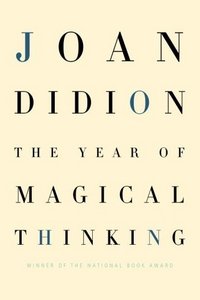

I went on a quest a week or two ago to try to discover what it is about Joan Didion's The Year of Magical Thinking that makes it such a stunning book. That lead me to re-read a couple of Didion's essays from Slouching Towards Bethlehem prior to re-reading the memoir. Take this essay On Morality.
As it happens I am in Death Valley, in a room at the Enterprise Motel and Trailer Park, and it is July, and it is hot. In fact it is 119o. I cannot seem to make the air conditioner work, but there is a small refrigerator, and I can wrap ice cubes in a towel and hold them against the small of my back. With the help of the ice cubes I have been trying to think, because The American Scholar asked me to, in some abstract way about "morality," a word I distrust more every day, but my mind veers inflexibly toward the particular.
Yes indeed, her mind does veer toward the particular, relentlessly so. Asked by a respected publication to write on the concept of morality and what does she put on paper? Her global location, the temperature of the room, how she reacts to it, and who she is (someone asked by The American Scholar to...). A conventional journalist would give you the lede: who, what, where, when, and why. Didion roots the reader in her own concrete circumstances because her point of view is that of the artist. She covers the basics like a good actor, to root herself: who am I, where am I, what am I doing, what do I want? She does this for several pages while intermittently describing stories she has heard in the desert, one about a roadside accident, another about divers trying to retrieve bodies from an underground pool, all of which allows her to do her job, that is to reflect on the concept of morality, but as it impacts real people in real places, and the way that she knows its impact is by discovering through the act of writing how it impacts her.
The widow of one of the drowned boys is over there; she is eighteen, and pregnant, and is said not to leave the hole. The divers go down and come up, and she just stands there and stares into the water. They have been diving for ten days but have found no bottom to the caves, no bodes and no trace of them, only the black 90o water going down and down and down, and a single translucent fish, not classified. The story tonight is that one of the divers has been hauled up incoherent, out of his head, shouting - until they got him out of there so that the widow could not hear - about water that got hotter instead of cooler as he went down, about light flickering through the water, about magma, about underground nuclear testing.
Are you there with her? I am. This is someone who knows how to sequence words so that you can see, hear, touch, taste and smell. No wonder she worked in film. This film has the unsettled soundtrack and the bizarre lighting of a Twilight Zone episode. All that, so when she finally delivers the goods, you are with her in her "here and now," and can she can talk to you as a cohabitant in place and time.
You see I want to be quite obstinate about insisting that we have no way of knowing - beyond that fundamental loyalty to the social code - what is "right" and what is "wrong," what is "good" and what "evil." I dwell so upon this because the most disturbing aspect of "morality" seems to me to be the frequency with which the word now appears; in the press, on television, in the most perfunctory kinds of conversation. Questions of straightforward power (or survival) politics, questions of quite indifferent public policy, questions of almost anything: they are all assigned these factitious moral burdens. There is something facile going one, some self-indulgence at work. Of course we would all like to "believe" in something, like to assuage our private guilts in public causes, like to lose our tiresome selves; like, perhaps, to transform the white flag of defeat at home into the brave white banner of battle away from home. And of course it is all right to do that; that is how, immemorially, things have gotten done. But I think it is all right only so long as we do not delude ourselves about what we are doing, and why.
Now she has come in for the kill. Doesn't mince words, does she? But she knows words as painters know color. ' Factitious' anyone? And it doesn't sound from this passage like much has changed since 1965, does it.

In the essay Goodbye to All That Didion begins by rooting herself, and by extension, her reader, in the here and now of memory.
It is easy to see the beginnings of things, and harder to see the ends. I can remember now, with a clarity that makes the nerves in the back of my neck constrict, when New York began for me, but I cannot lay my finger upon the moment it ended, can never cut through the ambiguities and second starts and broken resolves to the exact place on the page where the heroine is no longer as optimistic as she once was.
Her creative process becomes clearer and clearer as I read, and what a pleasure to watch her work - as that is the experience I am having. I don't feel as though I am reading a finished product, rather like I am watching a story being made, making the acquaintance of both the writer and the story as I go. Like any story teller, actor, painter, Didion enters her studio, sits at her desk and sometimes she must ask: how do I begin. This is the ending place for many actors, painters and writers because, having no answer, they stop. Not Didion. She sits down knowing her assignment is 'the place where it ends' but all she can think of is the beginning, so she writes that. She tries to see ending in her mind's eye and she sees only the beginning and it makes her physically tense, and so she writes that. Didion knows her craft. Her craft is to write, to place words on paper out of her experience. To practice that craft you do just that. You do it with the experience you have right now, not the experience you wish you had.

Of course one could complain - but she is able to do that because of confidence, possibly even arrogance - she has many successes behind her. Perhaps. Sometimes past successes breed confidence, other times they breed anxiety. For all we know, she did it with tremendous insecurity, but words are put on the page nonetheless, until she arrives at some clarity about how she will do what she has to do. But she has not waited for that moment to arrive to begin the the business of writing, that she has been doing all along.
Part of what I want to tell you is what it is like to be young in New York, how six months can become eight years with the deceptive ease of a film dissolve, for that is how those years appear to me now, in a long sequence of sentimental dissolves and old-fashioned trick shots - the Seagram Building fountains dissolve into snowflakes, I enter a revolving door at twenty and come out a good deal older, and on a different street. But most particularly I want to explain to you, and in the process perhaps to myself, why I no longer live in New York.
Now she doesn't merely use the techniques of film - she calls the reader's attention to that fact. I admire her voice so much because the art and the artist are one. The story I am going to tell you begins with the fact that I am I (as Gertrude Stein might say) and that I have to tell you a story. It is a little incoherent as I start, so I'll simply begin there, with the incoherence. I would do an exercise with my actors back when I was teaching acting that was developed by Lee Strassberg at The Actor's Studio. I used it continually with them, and whenever I worked myself as an actor. It is called "Speaking Out." All it asks is that the actor speak out of their experience of the present moment on a physical, mental, or emotional level. That is harder than it sounds, because one's present experience while creating work that matters to us isn't necessarily so pleasant to contemplate. It is full of anxieties around the pressure of appearing competent before an audience of your peers. It is full of the imperfections of which we are all composed: fears, needs, jealousies. Let's face it, when working under pressure at something that matters deeply to us, and when doing so in public as the actor's job requires, none of us are exemplars of anything. And let's be clear - speaking out of the experience of the present moment is quite different that speaking about it. One can speak about the experience from knowledge of it, and this usually comes with distance. To speak out of the experience means you are in it, right now, and whatever unattractive mess you are is what you expose with your words and actions. And if and when you find that the stream of words and actions flow from the 'you' of that moment, the skilled teacher will guide you back to the scene or monologue on which you are working, so that your experience flows into the reality of that moment. That is not because the story is about 'you,' which is so often the criticism leveled at the Method approach to acting, this is because this is an exercise in vulnerability. It is a relentless pursuit of the flow of human experience that is woven into one's practice of one's craft over time, the goal being to fulfill the character's relationship to their circumstances with human behaviors that have an inevitability and an authenticity that is like those we encounter in the world. It is often imperfect, as we are. It is often less than completely in- the-moment, but it is a place to begin.

This is just what Didion does. What makes The Year of Magical Thinking so remarkable, yes I am finally getting there, is the fact that she does this while being stripped to the bone by loss. Rather than making vulnerability the reason to do something else, she inhabits the moment of nine months after her loss, and relentlessly puts down one word and then another. The act seems, if anything, more determined than ever to write from the here and now. Just look at these words.
It is now, as I begin to write this, the afternoon of October 4, 2004.
It is now. How bare can you get? It is not descriptive of loss or vulnerability per se, but it's an act of facing the present out of that vulnerability as well as Didion can at the moment (it is speaking out), and it is practiced in the medium of her art - words - instead of the behavior of the actor.
Nine months and five days ago, at approximately nine o'clock on the evening of December 30, 2003, my husband, John Gregory Dunne, appeared to (or did) experience, as the table where he and I had just sat down to dinner in the living room of our apartment in New York, a sudden massive coronary event that caused his death...
Just the facts of his death over and over. That is where her minds dwells and so that's how she begins the writing process and, if we wish, we're along for the ride. Didion's act of writing leads to beginning the story telling task which, in typical Didion fashion, is the visible subject of the story until it can become the invisible means.
This is my attempt to make sense of the period that followed, weeks and then months that cut loose any fixed idea I had ever had about death, about illness, about probability and luck, about good fortune and bad, about marriage and children and memory, about grief, about the ways in which people do and do not deal with the fact that life ends, about the shallowness of sanity, about life itself. I have been a writer my entire life. As a writer, even as a child, long before what I wrote began to be published, I developed a sense that meaning itself was resident in the rhythms of words and sentences and paragraphs, a technique for withholding whatever it was I thought or believed behind an increasingly impenetrable polish. The way I write is who I am, or have become, yet this is a case in which I wish I had instead of words and their rhythms a cutting room, equipped with an Avid, a digital editing system on which I could touch a key and collapse the sequence of time, show you simultaneously all the frames of memory that come to me now, let you pick the takes, the marginally different expressions, the variant readings of the same lines.
The inadequacy of the medium to the richness of experience - if that isn't a well trodden theme for the experienced artist! How quickly has Didion evolved from mourner to writer, returning to the concerns of a seasoned artist - impatience with her medium - once setting pen to paper. As with her earlier work, the writing begins from wherever she is. Who she is, where she is, the thoughts, activities, or sensations that occupy her. Then she writes her way toward her task, whether assigned or discovered, until she tells the story of telling the story. In doing so she faces, from time to time, creative limits. Often, she then refers to film - another medium she has worked in, one with different advantages and limits. She seems to have created a career-long creative dialogue, but rather than creating a dissolve or an edit with words (techniques she can as has used) she puts the conflict between forms directly on the page. This experience of conflict with her medium, she says, this is the story. This is useful because in a moment in which she could be removed from her chief action - telling a story - she makes a technical aspect of that act visible so that the story may continue.

I thought I was going to write about The Year of Magical Thinking. I had lots of pages tagged that were examples of writing I admired but in starting with Slouching Towards Bethlehem this became a story about creative process and, especially, beginnings. This is a favorite theme of mine as an artist and a teacher of process, so I guess that isn't terribly surprising. When I think of it, the aspect of The Year of Magical Thinking that most impresses me is that Didion could begin writing at all, so perhaps that was my story, or at least it is. It is the story because that is what I wrote.

Friday, October 14, 2011

The usefulness of lying, genetically speaking (The Folly of Fools by Robert Trivers)

Acerbic critique of Robert Trivers's new book on evolutionary biology Deceit and Self Deception, by Jenny Diski in The Guardian this week (hat tip: Book Slut).
...Now, decades on, he has arrived at a big, new universal theory, also essentially based on the arithmetic of gene selection. Deceit is useful where telling the (unpleasant) truth would hamper your progress. Progress towards what? Trivers would say your fitness, which is defined as raising the chances of replicating your genes into the next generation.

Your genes, apparently, would agree with him; but they would, wouldn't they? That is if they were capable of agreeing. I want to hang on to the fact that the building blocks of ourselves do not want or intend anything. Chemicals aren't conscious, although by amazing chance they can combine to make a conscious organism.

Once self-conscious humans begin to do science, and with the benefit of language, start to describe the nature of the chemicals that make them what they are, but having to use regular language if they want a large audience (maths is a much better language, but fewer people can read it), they cannot help but slide into the notion of intention. Dawkins's selfish gene gained an absurd life of its own because most people don't speak arithmetic.

It's an excellent point, in fact, genes aren't really even actual things per se, they are more an idea advanced to characterize chemical function, but many of those who advance our understanding of evolution find the notion of genes necessary, or let's say helpful, as they find Trivers's work influential. Indeed, it's interesting to consider the usefulness of deceitful behavior since, if we look at our psychological development, once we learn how to speak we generally learn how to lie and thereafter we must be taught when and when not to do so. For instance, you should tell mommy the truth about spilling the powder all over the bathroom, but you should not tell the lady who works in the bakery that she has a fat tushy. The review has made me most interested to read the book despite the fact that all the science with which I'm familiar links genes to the production of proteins not behaviors. Genes are no doubt necessary to produce behaviors as cold is necessary to produce snow, but just because it's cold doesn't mean that it's snowing. Behavior evolves in the context of individual bodies and collective environments and is the product of many genes upon many proteins and subsequent neurotransmitters upon neurons via mechanisms that are many steps away from the initial genes, but still, somebody has to ask the questions at the level of behavior if we are ever to understand the answers. This book is made all the more interesting after learning a little more about the author from Andrew Brown's profile, also in The Guardian. Trivers seems a fascinating iconoclast. The book appears to be called The Folly of Fools in its American version, at least I believe they're the same (someone please correct me if I'm wrong about that.)

Thursday, October 13, 2011

Crime and Punishment meets Princess Di in Paris (Books - An Accident in August by Laurence Cossé)

I am a huge fan of Laurence Cossé's A Novel Bookstore, so I was delighted to stumble across her 2003 novel An Accident in August at one of my favorite New York haunts. The premise is simple. Lou, who works a simple job and lives a largely uneventful life in Paris, happens to drive into the Alma tunnel on her way home one night as a Mercedes speeds by her, swerves, and crashes headlong into a post killing its passengers. The passengers were Princess Di, Dodi, their bodyguard and driver. When Lou discovers the identity of the passengers she becomes consumed by paranoia. Too frightened to come forward, she begins trying to cover her tracks.

When I began reading An Accident in August, I found it gimmicky. It reeked of its own clever opportunism, and its language (though this could have been the translation) was hyperdramatic, sensationalist.
And the question kept coming at her, nagging, the question with no answer: why did I run away? Why didn't I stop? What came over me, turning me into some terrified rabbit, not even a thought about stopping to help or act as a witness, thinking only of saving my own skin?

Saving my own skin, no one else's; like some rabbit about to be skinned, yes, bushy-tailing it out of there.

Then it came to her, like a bolt of lightning. It was death she had run away from...
But Cossé is skilled at creating a claustrophobic sort of trappedness. The book this one most reminded me of was Crime and Punishment in that most of the "action" occurs in the head of someone who has committed a crime as they run from themselves. However, it isn't merely being blamed for what happened that Lou dreads, it is the media attention this will attract and the fact that she will forever been known at "the driver who..." I find it interesting that both An Accident in August and A Novel Bookstore share this theme of being exposed by the media. Cossé, who worked as a journalist, seems to cast journalists as the bad guys. This sense that Lou's life will never again be her own drives her to some irrational choices, but the thing that really got me to stay with this book wasn't wondering whether she would get caught, since we know the driver was never found, the real point of interest was the way being in this position made Lou change her life. Raskolnikov is tormented, but he only succeeds in running towards himself. Lou tries to run away. This kind of attempted transformation of character (since I won't tell you whether she succeeds or not) is something most people dream of doing at some point in their lives. If only I had.... If only I was..... If only I looked.... One function of a good piece of art is that it can help us imagine such a metamorphosis. Cossé's novel does that in spades and that, I found, was the fun of it.

Monday, October 10, 2011

A noisy signal buried among amusing anecdotes and formulae (Books - Noise by Bart Kosko)

Noise, Bart Kosko, tells us, is unwanted sound. In everyday life we might use the word to describe the car alarm we hear blaring off the street while we are trying to sleep, or the background music in a restaurant that obscures the words of the person with whom I'm conversing. The sciences have a specific use for the term noise.
Noise is a red rose that grows in a cornfield. It is a signal that does not belong there.

Noise is a signal we don't like.

Noise has two parts. The first has to do with the head and the second with the heart.

The first part is the scientific or objective part: Noise is a signal. But then what is a signal? A mathematical answer is that a signal is what we describe with a variable such as x. The broad answer lets light or dollars or red blood cells count as signals because they can vary in time or space.

A physical answer deals with energy.

A signal is a source of energy such as an electrical pulse or a chemical pattern or the acoustical roar of an audience. It is structured energy... Yet we see a signal as still more than energy.

A signal is anything that conveys information.

All fields of science search for signals. Physicists look for particle signals in bubble chambers. Geologists look for earthquake signals in crust data. Botanists look for hormone signals in a pruned peach branch. Political scientists look for voter signals in polls and election an results. Psychologists look for mating signals in barroom behavior and underarm sweat. Neuroscientists look for electrochemical signals in the bast synaptic webs of our brains.

The same holds for engineering but with a key difference: Engineers shape signals as well as search for them...

The second part of noise is the subjective part: It deals with values. It deals with how we draw the fuzzy line between good signals and bad signals. Noise signals are bad signals. They are the unwanted signals that mask or corrupt our preferred signals... But for whom are they bad?.. One person's signal is another person's noise...
This excerpt from the first chapter of Kosko's book gives you a good idea of both the subject he covers in his book and his writing style. Somewhere within the relaxed verbiage that make up the 160 pages of Noise is a good 50 page discussion of the concept of noise, examples of how it is manifest in the sciences - particularly in information theory - how different types of noise are characterized (as measurements of frequency magnitude ), how noise can be overcome, and how it can be useful in enhancing the intelligibility of a signal (a concept known as stochastic resonance). The trouble is, Kosko's writing is a little, well, noisy.

Kosko's excitement for his subject comes through loud and clear, but the flood this unleashes tends to diffuse his writing. When one good example will do six are offered. When he intends to organize a reader's thinking, as he did in dividing noise into two parts: 'head' and 'heart,' that will define an argument in the ensuing pages, he cannot resist a tangent. Above, following a paragraph of examples of noise in different sub-areas of science, is another paragraph about how engineers are different from other scientists. Once he returns to the second half of his organizing structure, I had forgotten that I was supposed to organize my thinking into two halves.

Kosko is not merely effusive on the sentence by sentence level. The book makes five or six excellent points, but these would realistically make up a lengthy article. To fill out the longer book format, each chapter is padded with nine epigraphs. These make the same points made in the chapter, only more succinctly. In addition, Kosko repeats material unnecessarily in the body of the text. For instance, he covers stochastic resonance very adequately with good examples and a clear image in an early chapter. There is no need to cover it again toward the end of the book.

Lastly, I'm not sure if the writer or his editor were clear about what audience they were writing for. One the one hand, Kosko maintains a chatty style, offering very approachable examples for tough to understand concepts - this is a talent that makes me understand why he might have written a book on such a subject for the lay-reader. He is also great at the perfect three-sentence description of a key scientific concept to orient his reader. There is an excellent one on photosynthesis, where he characterizes humans as sugar parasites. I think it might be more accurate to say plant parasites, since as a living organism that is the source of our sugar and oxygen, plants are our host, but that's a quibble. He's also good at dropping entertaining anecdotes related to the idea of interest - like film actress Heddy Lamar's 1942 patent for a frequency-hopping spread spectrum (no...really). However, in the discussing power laws of statistics gets blinded by his own facility with mathematics in a way that would leave the average reader in the dust.
The scheme says that the noise is white if the noise spectrum does not depend explicitly on the frequency f. That corresponds to the case of 1/f raise to the power zero because the zeroth power gives the constant value of unity: 1/f0 = 1. Pink noise falls off or decreases with the inverse of the frequency. So pink noise has a spectrum that falls off with the first power of the frequency or 1/f.
Or he writes one of those mind-boggling waterfalls of terminology that physicists like to think explain the universe but always make me feel like I fell down a hole and hit my head:
The earth would form a black hole if we somehow compressed it down to the size of about a marble. That would cross the critical limit where the dense object's gravity would in effect turn in on itself and suck all its matter down to a point or "singularity." A marble-size black region or event horizon would surround the infinitesimal singularity in the space-time continuum. The sun is not massive enough to become a black hole when it burns up the hydrogen in its core in about five billion years. It will instead expand into a red giant and then cool off and die quietly as a white dwarf. The sun would become a black hole if we could compress it to a dense ball with a radius of about one kilometer.
Red giant. White dwarf. Right. Crystal clear.

Noise is an exercise in contradictions. I find its subject matter fascinating to think about, but the discussion goes on a bit longer than the raw material permits. The writing alternates between technical and colloquial, embedding the information in what I would say is too little context for the engineer and too much noise for the lay reader.

Saturday, October 8, 2011

The impermeability of love - an Upper West Side romance (Books - Eight White Nights by Andre Aciman)

A twenty-something man meets a bold and unusual woman named Clara at a christmas party and a spell was cast. For the next week they spend hours of each day with each other, drink at all hours of the day and night, attend Eric Rohmer films, and invent a playful language all their own. In some ways one could say there is nothing new about this spell. It is called love and it has happened to billions of people before these two. What is distinctive about Andre Aciman's Eight White Nights is the way in which reading it echoes the isolation of such a romance.
Halfway through dinner, I knew I'd replay the whole evening in reverse - the bus, the snow, the walk up the tiny incline, the cathedral looming straight before me, the stranger in the elevator, the crowded large living room where candlelit faces beamed with laughter and premonition, the piano music, the singer with the throaty voice, the scent of pinewood everywhere as I wandered from room to room, thinking that perhaps I should have arrived much earlier tonight, or a bit later, or that I shouldn't have come at all, the classic sepia etchings on the wall by the bathroom where a swinging door opened to a long corridor to private areas not intended for guests but took another turn toward the hallway and then, by miracle, led back into the same living room, where more people had gathered, and where, turning to me by the window where I thought I'd found a quiet spot behind the large Christmas tree, someone suddenly put out a hand and said, "I am Clara."

[...]

In someone else, I am Clara would have sprung like a tentative conversation opener - meek, seemingly assertive, overly casual, distant, aired as an afterthought, the verbal equivalent of a handshake that has learned to convey firmness and vigor by overexerting an otherwise limp and lifeless grip. ...

Here, I am Clara was neither bold nor intrusive, but spoken with the practiced, wry smile of someone who had said it too many times to care how it broke the silence with strangers...

I am Clara
. It barged in unannounced, like a spectator squeezing into a packed auditorium second before curtain time, disturbing everyone, and yet so clearly amused by the stir she causes, that, no sooner she'd found the seat that will be hers for the rest of the season than she'll remove her coat, slip it around her shoulders, turn to her new neighbor, and, meaning to apologize for the disruption without making too much of it, whisper a conspiring "I am Clara." It meant, I'm the Clara you'll be seeing all year long here, so let's just make the best of it...

It was a cross between a ribbing "How couldn't you know?" and "What's with the face?" "Here," she seemed to say, like a magician about to teach a child a simple trick, "Take this name and hold it tight in your palm, and when you're home alone, open your hand and think, Today I met Clara."
Aciman's tone is elegiac. He writing is urbane, contemporary, and can be colloquial, but it can also be precious. It's not that phrases like "no sooner she'd found the seat" doesn't have lovely music, but they call attention to the writing and removed me from the spell that is this novel's focus. Set in Manhattan's Upper West Side, now a privileged enclave of Banana Republics, Starbucks, Whole Foods, the restaurants of Power Chefs, multiplexes, and Equinoxes - it's basically a high-end mall dotted with expensive highrise coops and vestiges of its old self in simpler, family-owned restaurants, the neighborhood branch of the public library, and more stolid, old-world apartment buildings - it comes by its urbanity honestly. The characters spend a good deal of time at Rohmer's films. Aciman liberally references literature and music, particularly opera, often without preamble. Boris Godunov, Feodor Chaliapin, Don Giovanni, and the final duet of L'Incoronazione di Poppea, all make appearances. For example:
"Without wasting another second, Clara smirked back and, out of the blue, shook her hand and made a totally obscene gesture. "Printz Oskar to you, dickhead!" The man seemed totally trounced by the gesture and raced ahead of us.

"That'll teach him."

Her gesture left me more startled than the driver. It seemed to come from an underworld I would never have associated with her or with Henry Vaughan or with the person who'd spent months poring over Folias and then in the wee hours sang Monteverdi's Pur ti miro" for us. I was shaken and speechless. Who was she? And did people like this really exist?
Any reader can appreciate that this paragraph conveys something about Clara's duality - the rarefied areas of knowledge to which she has access coupled with an impulsivity that is coarse and close to the surface. I directed opera productions for over a decade, so the first line of the duet pur ti miro immediately starts the music playing in my mind's ear. The result is an enveloping experience mixing the sexual anticipation that is the engine of the novel, with pictures of New York roadways in winter, and a gorgeous baroque soundtrack. This perfectly conjures the exclusivity of the world that these two characters create, however, it is a world that Aciman seems willing to risk excluding readers from. Now, maybe I'm being snooty in imagining I can follow this story better than other readers. If Aciman has created the same sense that this novel speaks especially to me for all his readers, he has succeeded in ways I cannot assess. However, it bothered me that Aciman's first-person narrator is every bit as ready with classical literary allusions and lines from opera as she, but that we never know how he came by his knowledge. Aciman spends many, many pages establishing the origin of his narrator's reticence to take a risk - a key character trait that establishes him in opposition to Clara. However, he doesn't question for a minute the fact that he can burst into Leperello's Act I aria from Mozart's Don Giovanni. I know nothing of the origin of this side of his character. I don't know what he does for a living, if, indeed, he needs to hold a job at all, since he is able to take an entire week off from work, yet inhabits a building with a doorman and eats out constantly. The strength of this choice is the way in which it evokes the impermeable fantasy of the early days of intense romance. The flip-side, however, is it makes me wonder who the hell he is. The implication I came away with is that maybe he was Aciman himself, only younger, but not possessing this knowledge distracted from abandoning myself to the narrative at times. That was especially true in that the main action of the novel was about his learning to be himself. But I only learned about one side of this character, the side that needed to be "fixed," the rest of him remained a cipher.

The quality I most enjoyed in Aciman's writing is its spaciousness. You need to give this novel time, not in that it takes long to read, it actually accumulates quite a bit of momentum, but that requires an investment in the relationship. The opening chapter doesn't merely establish the details of meeting Clara. It is an extended riff on the phrase I am Clara that went on for tens of pages. If you enjoy steeping yourself in words that slowly conjure a feeling, you will eat this book up. If you like cutting to the chase, this is not the novel for you. I identified with the world of these two characters, so wondering what would happen to them created suspense for me. I found my investment in it warmly rewarding.

Thursday, October 6, 2011

Inflorescence - Swedish Poet Tomas Transtromer wins the Nobel Prize for Literature

In-flo-res-cence - from the Latin inflorescere - to begin to blossom. 1. the producing of blossoms; flowering; 2. the arrangement of flowers on a stem or axis; 3. a flower cluster on a common axis; 4. flowers collectively; 5. a solitary flower, regarded as a reduced cluster.

Today's Nobel Prize winner in literature, Swedish Poet Tomas Transtromer, has long been a favorite of mine.

Dream Seminar
Four thousand million on earth.
They all sleep, they all dream.
Faces throng, and bodies, in each dream -
the dreamt-of people are more numerous
than us. But take no space...
You doze off at the theatre perhaps,
in mid-play your eyelids sink.
A fleeting double-exposure: the stage
before you out-manoeuvred by a dream.
Then no more stage, it's you.
The theatre in the honest depths!
The mystery of the overworked director!
Perpetual memorising of new plays...
A bedroom. Night.
The darkened sky is flowing through the room.
The book that someone fell asleep from lies still open
sprawling wounded at the edge of the bed.
The sleeper's eyes are moving,
they're following the text without letters
in another book -
illuminated, old-fashioned, swift.
A dizzying commedia inscribed
within the eyelids' monastery walls.
A unique copy. Here, this very moment.
In the morning, wiped out.
The mystery of the great waste!
Annihilation. As when suspicious men
in uniforms stop the tourist -
open his camera, unwind the film
and let the daylight kill the pictures:
thus dreams are blackened by the light of day.
Annihilated or just invisible?
There is a kind of out-of-sight dreaming
that never stops. Light for other eyes.
A zone where creeping thoughts learn to walk.
Faces and forms regrouped.
We're moving on a street, among people
in blazing sun.
But just as many - maybe more -
we don't see
are also there in dark buildings
high on both sides.
Sometimes one of them comes to the window
and glances down on us.


Fire Jottings
Throughout the dismal months my life sparkled alive only when I made love with you.
As the firefly ignites and fades out, ignites and fades out, - in glimpses we can trace its flight
in the dark among the olive trees.

Throughout the dismal months the soul lay shrunken, lifeless,
but the body went straight to you.
The night sky bellowed.
Stealthily we milked the cosmos and survived.


Romanesque Arches
Inside the huge romanesque church the tourists jostled in the half darkness.
Vault gaped behind vault, no complete view.
A few candle-flames flickered.
An angel with no face embraced me
and whispered through my whole body:
'Don't be ashamed of being human, be proud!
Inside you vault opens behind vault endlessly.
You will never be complete, that's how it's mean to be.'
Blind with tears.
I was pushed out on the sun-seething piazza
together with Mr and Mrs Jones, Mr Tanaka and Signora Sabatini
and inside them all vault opened behind vault endlessly.


A Page of the Night-Book
I stepped ashore one May night
in the cool moonshine
where grass and flowers were grey
but the scent green.

I glided up the slope
in the colour-blind night
while white stones
signalled to the moon.

A period of time
a few minutes long
fifty-eight years wide.

And behind me
beyond the lead-shimmering waters
was the other shore
and those who ruled.

People with a future
instead of a face.


More of Tomas Transtromer's poems are linked via my side bar under the heading Inflorescence and then his name.

Saturday, October 1, 2011

Individual lives caught in the tide of history (Books - The Greater Journey by David McCullough)

I've been seized by a bout of non-fiction reading. I was going to claim this was a rarity for me, but that's really not true. I had been reading plenty of non-fiction the past few years, but most of it was assigned for class. Now that I'm done with classes, I can read the non-fiction I choose and I made a good choice in David McCullough's latest, The Greater Journey - Americans in Paris.

This is an unusual history in that it doesn't so much focus on names, dates, and events of a single place or movement as on a swath of time, 1830 - 1900, in which France underwent great political change, and the influence of that time upon individual American artists, political figures, inventors, and doctors - the men and women of ideas. In that time, France's Second Republic underwent a coup d'etat by Louis Napoleon, the nephew of Napoleon Bonaparte, resulting in the creation of the Second Empire. The city of Paris was given a grand overhaul under the charge of Georges-Eugene Haussmann, one whose basic plan survives today. Paris underwent a siege by Germany, and the bloody reign of the Paris Commune, liberated by the establishment of a Third Republic, which lasted until the French government collaborated with the Nazis in the formation of the Vichy government. However, none of these events are, themselves, the point of McCullough's narrative. McCullough portrays Parisian culture in that tumultuous time as remarkably stable in its influence. It was a city known for great painters, sculptors and writers, and for the quality of education available in the arts, medicine, law, and the sciences. Paris was the center of a highly developed culture which included not only arts and sciences, but a renowned cuisine. Really Paris was a place devoted to the art of living. In many ways it still is. The thrust of McCullough's book focuses on the ways in which exposure to such a way of life through a visit to Paris was an important component of a good American education. The Greater Journey is the story of the way Parisian life influenced Americans like painters Samuel Morse, John Singer Sargent and Mary Cassatt, sculptor Augustus Saint-Gaudens, writers James Fenimore Cooper, Henry James, and Harriet Beecher Stowe, and medical students Oliver Wendell Holmes and Elizabeth Blackwell. As well as the mutual influence of the French and American governments and of their statesmen. Charles Sumner, the great American lawyer and early spokesman for the abolition of slavery, was profoundly influenced by his time in Paris studying at the Sorbonne and the free black men and women he encountered both as fellow students and in the rest of daily life, an experience which proved revelatory for him. The diary of American ambassador Elihu Washburne was, until now, an unknown primary source of the Siege of Paris. It is one McCullough relies on heavily in chapters integrating Washburne's life story with the history of that decisive political standoff.

This synthesis is the success of The Greater Journey throughout. It is less a traditional history of government figures, acts, and battles, than it is a series of short, intertwined biographies set in the context of history. Though some of its key figures might be considered secondary characters in the feature film treatment American education, film and television gives to history - painter George P. A. Healy, pianist Louis Moreau Gottschalk and feminist Margaret Fuller are not exactly household names - each one of their stories became interesting as McCullough showed them swept up in the tidal wave of nineteenth-century Parisian art and ideas. I didn't even know that I would want to know their stories, but I found myself easily reading 60 - 70 pages in a sitting and eager to return. Sweeps of influence are at least as important to the consideration of the lessons we can derive from the history of a person or time as the toe-nail-clippings-and-all variety. McCullough makes coherent narrative out of a collection of disparate lives as they were influenced by a place that was itself influenced by great changes in its physical landscape and architecture, and its form of government. The Greater Journey is a reminder that, amidst the cataclysmic rhetoric we Americans hear on an a daily basis about our security, our economy, and the danger of the evil other party from our power-obsessed political representatives, great cultures survive strong upheaval. Large parts of Paris were burned to the ground in the 1871 siege and more than 50,000 lives were tragically lost, yet the government reorganized and Paris rebuilt, and the 1889 World's Fair was attended by millions who came to visit one of the most beautiful and influential cities in the world.

My earlier post about this book is here.