Sunday, March 15, 2009

And speaking of psychopaths... (Books - The Talented Mr. Ripley & Films - Psycho)

It is fascinating to watch Patricia Highsmith not merely illustrate the sociopathy of the talented Tom Ripley, but to sow the seeds of what she believes is its underpinnings. Ripley's parents are killed early in his childhood and he is raised by an Aunt who is happy to spend the insurance money but is hardly interested in having a son. He spends his childhood isolated from other children, and berated and mocked by his aunt. Interestingly, the process of diagnosing antisocial personality disorder means distinguishing those who display traits such as disregard for others and social norms, lack of remorse, and so on as a protective measure against their circumstances from those who, shall we say, came that way. Tom's disregard for others seems to be balanced by an equally tremendous regard for himself - it would be easy to look at Tom Ripley as a sort of black-hole-person - a negative space where a personality ought to be - who keeps slurping up the names and personalities of others, but Highsmith is careful to give you glimpses of the dregs of person that survives in the corpse of his personality.
A cap was the most versatile of headgear, he thought, and he wondered why he had never thought of wearing one before? He could look like a country gentleman, a thug, an Englishman, A Frenchman, or a plain American eccentric, depending on how he wore it. Tom amused himself with it in his room in front of the mirror. He had always thought he had the world's dullest face, a thouroughly forgettable face with a look of docility that he could not understand, and a look also of vague fright that he had never been able to erase. A real conformist's face, thought. The cap changed all that.
Wow, one cap and it's all gone. So much for psychotherapists, medication and all that nonsense. I think perhaps we should tell the insurance industry about caps - it would save us all so much time and trouble. With one size fits all, anyone could rid themselves of years of damaging pschological history with a one-time purchase. Tom is a fascinating combination of ingeniously creative and terribly shallow. Creative enough to hatch complex and manical plans to support himself, shallow enough to only see these alternatives as a means of doing so.

At one point, Dickie, the young man he is supposed to return to the bosom of his wealthy family, asks Tom what he can do. Tom answers:
'Oh, I can do a number of things - valeting, baby-sitting, accounting - I've got an unfortunate talent for figures. No matter how drunk I get, I can always tell when a waiter's cheating me on a bill. I can forge a signature, fly a helicopter, handle dice, impresonate practically anybody, cook - and do a one-man show in a nightclub in case the regular entertainer's sick. Shall I go on?' Tom was leaning forward, counting them off on his fingers. He could have gone on.

A veritable Figaro. A man empty enough to be filled is what Tom looks like at first glance, but really he is so full of a sense of worthlessness it makes him desperate to matter deeply to someone. He's not no one. But he's not someone to anyone else, just to himself. At root he seems to feel so deeply wronged that nothing can redress the balance. Speaking of psychopaths, we had gotten Hitchcock's Psycho out of the library and watched it (again) last night. Another wounded boy deserted by his parents who method of righting his wrongs goes just a little haywire. Anthony Perkins is frighteningly good as the motelier Norman Bates, not for showing us his madness but rather his sanity. The creeping sense of menace comes from this sense of ordinary, happy-go-luck charm that unravels so subtly. Norman is slowly trapped into recognizing the elaborate lengths he has gone to not to be alone, but as the pressure starts you merely see him push his hands a little deeper into the pockets of his courderoys. Just a flash of disturbance crosses his face before it is smoothed over by the warm appealing sense of understanding Norman shows the world. Even in discovering the body after the first murder, Perkins and Hitchcock allow us barely a moment to indulge Norman's emotions before he packs it all away and cleans up his world. Makes it right again. When Norman tries to dispose of the car in the swamp, watch Perkins face register the car, first as it refuses to sink and then as it finally does. If we had to watch another actor play that scene, it would have been a Wagnerian opera of facial expressions. It is also interesting to observe his vocal production style in the film, so different from the rapid-fire, sing-song stylized delivery of most 1950s film-actors. Perkins speaks in the film like a regular young person of his day. Another way they establish his ordinaryness.

It is interesting to observe these two products of the late 1950s, that laced-up era in which much of American society was focused on fighting the insidious threat it saw in communism. It is as though this literary sociopathy might have been a way of expressing this sense of being frightened and alone in the world while the role we assumed was one of tremendous power and squeaky-clean goodness.

Friday, March 13, 2009

Unreality (Books - The Talented Mr. Ripley by Patricia Highsmith)

So far The Talented Mr. Ripley is living up to the creep-factor it is known for. I am trying to figure out what the magic ingredient is. It is not merely that Tom Ripley has no remorse for whatever scheme he is carrying out - tax fraud, pretending he knows a young man so that his wealthy father will pay for him to travel to Europe and bring him home to run the family business - but that his lying is so easy, so automatic, as though he would not think of doing anything else, even if he has a flash of momentary fear. Tom Ripley's talent is for making himself empty so that he can fill up with bits of other people - he's a cannibal.

It is little wonder that Patricia Highsmith's novel became a movie, such clear pictures does her writing create, not just of the look of a moment but of the essence of it.
Automatically, as he strolled to an empty space at the bar, he looked around to see if there was anyone he knew. There was the big man with red hair, whose name he always forgot, sitting at a table with a blonde girl. The red-haired man waved a hand, and Tom's hand went up limply in response. He slid one leg over a stool and faced the door challengingly, yet with a flagrant casualness.
This paragraph reveals Tom Ripley's perspective to me, which reads like a three-year-old's - there is the 'big man with red hair,' then the big man 'waved his hand,' an isolated subject and verb with no humanity in them - it's a man without a name and a some thing he does. People do not exist for Tom Ripley and therefore what he says to them or does to them is immaterial - he lives only for himself.

In this opening scene in the bar Raoul's where the red-haired man drinks with his blonde girl, Ripley meets Mr. Greenleaf, who engages Tom to bring his son home from Europe. Tom goes for dinners at the Greenleaf home.
He felt himself beginning to sweat, and he tried to relax. What was he so worried about? He'd felt so well tonight! When he had said that about Aunt Dottie -

Tom Straightened, glancing at the door, but the door had not opened. That had been the only time tonight when he had felt uncomfortable, unreal, the way he might have felt it he had been lying, yet it had been practically the only thing he had said that was true: My parents died when I was very small. I was raised by my aunt in Boston.

Mr. Greenleaf came into the room. His figure seemed to pulsate and grow larger and larger. Tom blinked his eyes, feeling a sudden terror of him, an impulse to attack him before he was attacked.

'Suppose we sample some brandy?' Mr. Greenleaf said, opening a panel beside the fireplace.

It's like a movie, Tom thought. In a minute, Mr. Greenleaf or somebody else's voice would say, 'Okay, cut!' and he would relax again and find himself back in Raoul's with the gin and tonic in front of him. No, back in the Green Cage.

'Had enough?' Mr. Greenleaf asked. 'Don't drink this, if you don't want it.'

It is because he barely exists as a real person that Ripley has no moral sense. He lives mostly in overlapping frames of unreality which Highsmith is very good at creating. Frames within frames that create a rubbery world with uncertain time frames and male and female figurines with no names inhabit them, and through this unsteady world Tom Ripley walks, occassionally worried he will be caught, but unperturbed about the consequences of his actions for anyone else. Highstreet has fashioned a magnificently creepy universe and a story line that just makes one want to turn the page 'automatically' and read on.

Thursday, March 12, 2009

I'll expect a finder's fee if you pitch this idea...

btt button

Tami inspired this week’s question:

What book do you think should be made into a movie? And do you have any suggestions for the producers?

Or, What book do you think should NEVER be made into a movie?

Having been a director, I used to play this game all the time. Two of my favorite candidates for novels to turn into a play or film were Charles Baxter's Shadow Play, and John Gardner's October Light. Interesting to look at my pencil scribbles of cast lists on the inside cover now. Interesting too that they are both about idiosyncratic families and how 'the way things should be' crash into 'the way things are.' Beautiful books, both of them, for their themes as well as their writing.

Tuesday, March 10, 2009

To sleep - perchance to dream...

A study carried out in three cultures - India, S. Korea and the U.S. - examined college students' dreams and their ideas about what they mean, reports John Tierney in today's Science Times. Dreamer's biases greatly impacted their interpretations of their dream's meaning:
...they attached more significance to a negative dream if it was about someone they disliked, and they gave correspondingly more weight to a positive dream if it was about a friend...People who believed in god were more likely than agnostics to be swayed by divine apparitions.
There are those who treat dreams as literal portents, others who think they reveal unconscious experience, still others who think them the byproduct of the brain figuring out what goes in the discard bin of the day's mental activities, and those who think that it is the brain making sense of, as Tierney writes, 'random impulses,' and the study calls 'the byproduct of unrelated brain activity.' Those beliefs impact the dreamer's interpretation of their dreams. In thinking about the categories, one thing that they all have in common is that the dreams seem to have a structure, a sense of...well, sense. Most dreams as far as I know are narrative, although some can be somewhat abstracted or episodic (I'd love to read some research on the structure of people's dreams). Narrative is one of the brain's ways of giving organization to a bunch of occurrences via context. So whether someone chose a mystical or a literal theory, all experienced the dream as organized. The categories are interesting to me: dreams as portents or revealers of our unconscious mind are describing people's belief about how their dreams might be used after they have had them. Those categories are not mutually exclusive either of each other, or of the other two categories, one an explanation of what they might be psychologically (the brain dumping information into its garbage bin) the other what they might be neurally (random impulses). I don't know how this impacted the statistical analysis of their subjects and whether subjects were forced to choose only one of the four categories. I find it interesting too that people speak of the "random firing" explanation for phenomena like dreams or visions prior to death as a means of demystifying the experience. They speak as though firing neurons obviate any possible meaning these experiences could have. If we are to have an experience, whether the source of that experience is inside or outside the body, neurons must fire. In fact, in the studies that permitted us to trace how sensory systems work - mapping a path from, say, the skin surface, to a particular spot in the somatosensory cortex, scientists could confirm the function of a neuron by electrically stimulating it and found that it produced the sensation of a touch on that spot on the skin when none actually occurred. Very real experiences are created by the firing of neurons whether the cause of that firing was from an external or an internal source. For those who would call these impulses 'random' I would ask - by what criteria? Do they fit a certain mathematical distribution? Or is the word chosen to indicate that no pattern could be measured? If so it does not indicate that one does not exist.

In fact, one sees a great deal of organization in the firing of neurons in the brain during sleep that is thought to contribute to the consolidation of memories. One can observe the brain patterns of activation elicited in the hippocampus (a brain area associated with memory) during training on some motor task replayed during REM sleep (Maquette et al, 2000) and can observe a correlation between the extent of improvement on that task and the amount of replaying of that pattern (Peigneux et al, 2003). One can also see similar patterns of activation, but on a different time scale, during slow-wave sleep (Ribero et al, 2004). Finally, one can also see evidence of the structural changes that must occur for memory to become long-lasting occurring during REM sleep. I make these points simply to say that a good deal of purposeful activity not under conscious control is going on during sleep and that some activities in the brain are far from random. Something in the brain's activity produces experiences that for most people appear to have a certain amount of organization, if not the logic typical of our waking hours. This study is not examining the meaning of dreams per se, but rather our beliefs about the meaning of our dreams. When we dream we seem to have a certain experience, however if we remember the dream upon waking we are already re-constructing it and if we relate this dream to a friend, therapist or researcher we are re-constructing it yet again. Each time adding more structure and more layers of associations. The brain is drawn to patterns and the mind to building structure. The patterns of firing neurons is how the brain encodes all the diverse types of information we encounter in our experience and any feeling, memory, or plan for action that results from it. I wonder how "unrelated" the neuronal firing is to the dreams we experience and the meanings we make of them.

Monday, March 9, 2009

Jane Austen and Tim Burton's Love Child (Books - Anansi Boys by Neil Gaiman)

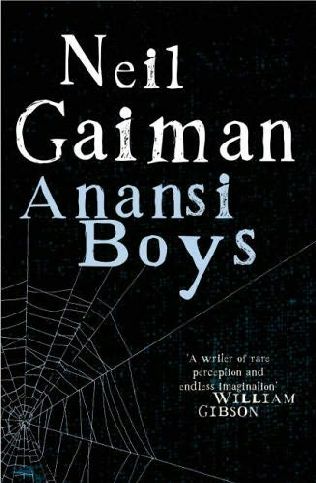
Fat Charlie discovers that two of his family members are gods only when his father dies one day while singing karaoke. He also learns that he has a brother who can be summoned by talking to a spider (those gods). Eager to see the brother he never knew he had, Charlie finds a spider and asks. Said brother knocks on the door and proceeds to make Charlie a fraud suspect at work and to sleep with Charlie's fiancee, something Charlie has yet to do. It should come as no surprise that Charlie decides maybe he doesn't need to see his brother so badly after all. He visits several old women friends of his father's in Florida, who also happen to be witches.
It was sort of like Macbeth, thought Fat Charlie, an hour later; in fact, if the witches in Macbeth had been four little old ladies and if, instead of stirring cauldrons and intoning dread incantations, they had just welcomed Macbeth in a fed him turkey and rice and peas spread out on white china plates on a red-and-white patterned plastic tablecloth - not to mention sweet potato pudding and spicy cabbage - and encouraged him to take second helpings, and thirds, and then, when Macbeth had declaimed that nay, he was stuffed nigh unto bursting and on his oath could truly eat no more, the witches had pressed upon him their own special island rice pudding and a large slice of Mrs. Bustamonte's famous pineapple upside-down cake, it would have been exactly like Macbeth.
You know what Neil Gaiman's Anansi Boys reminds me of? One of the old screwball comedies. This is just like Bringing Up Baby or Philadelphia Story. Sure the premise is absurd, but the more entertaining it becomes - either by be amusing or horrifying - the more you leave the question of whether this actually could happen alone and just enjoy the ride.

Gaiman employs an authoritative omniscient narrator who, at times, pulls back for a long shot and seems to chuckle into his hand. At the end of a scene in which Daisy investigates Charlie's computer for evidence of his embezzling the Grahame Coats Agency, Gaiman employs a crain shot, pulling his camera up and far away until it spies Coats asleep in his home:
While fast asleep in his bedroom, in a large but certainly not ostentatious house in Purley, Grahame Coats slept. If there was any justice in the world, he would have moaned and sweated in his sleep, tortured by nightmares, the furies of his conscience lashing him with scorpions. Thus it pains me to admit that Grahame Coats slept like a well-fed milk-scented baby, and he dreamed of nothing at all.

Somewhere in Grahame Coat's house, a grandfather clock chimed politely, twelve times. In London, it was midnight. In Florida it was seven in the evening.

Either way, it was the witching hour.

Marvelous. It is as if Jane Austen had met Tim Burton and had a love child. They would create a scathing social satiric horror fantasy just like this one.

Sunday, March 8, 2009

Happy additions...

It was 60 degrees yesterday! I know it's just a tease, but we opened all the windows and did a massive cleaning of our apartment and then made a really good dinner and watched a really bad movie. When I went to bed - early to try to cushion turning the clocks forward - I perused a few books sent to me by a friendly publicist for review. Two of them caught my interest:

Although it has a clumsy title, Songs My Mother Never Taught Me by Selcuk Altun and translated into English by Ruth Christie, has an almost old fashioned narrative style. The two short chapters that open the book are narrated by a wealthy, listless young man whose overbearing mother has recently died and a hired assassin who is about to retire - two men newly liberated. Undoubtedly they will meet in this short novel set in Turkey and described as a thriller and a metaphysical puzzle.
In the Ottoman mansion where I've lived as its heir, guest, prisoner, and now master, I enjoy the excitement of not knowing how many days or years I'll remain. For Ifkat's sake - the tireless servant of a tired old building who'd swallow a stale prostate pill so it wouldn't be wasted - I haven't taken refuge in my apartment at the top of a skyscraper in central but quiet Sisli. As the shutters' futilie struggle with the south wind ends, the morning ezan begins. I wait patiently in the drawing room, surrounded by bronze statuettes. When the prayer ends the wind will assail again. My left hand enjoys shaking cigar ash onto the silk carpet, and I realize I've forgotten what kind of drink is in my right. At the funeral service attended by the elite of the city I had murmured lines from Kucuk Iskender's Rock Manifesto, and now I can hum that cruel tirade until I pass out in the dim morning hours. Today I am twenty-seven years old. And the only gift I desire is the ecstasy of being liberated from my mother and my fiancee.
This one has me curious, I think I'll give it a try.


Japan Through the Looking Glass isn't necessarily a title I would have taken off the shelf, even though I was reflecting just the other day that I would like to travel to Japan, but Alan Macfarlane's combination of apologetic Westerner and Cambridge don charmed me into reading a couple of chapters. Here an excerpt from his travel diary on lunching with the Judge's of Japan's High Court:
When we asked why it often took many years for quite simple cases to be decided, they said that it was because as judges they found it so difficult to come to a decision. Life was complicated, things were not black and white. Binary decisions of 'guilty' or 'not-guilty' were not easy in a Japanese context.
The strongest impression Macfarlane wishes to communicate in the opening of this book is how unlike Western culture Japan is and how difficult to summarize the differences.
Experienced Victorian travellers did not merely say that Japan was different from other places they had visited... A particularly elegant account was given by W. E. Griffis who spent several years in Japan:

A double pleasure rewards the pioneer who is the first to penetrate into the midst of a new people. Beside the rare exhiliration felt in treading soil virgin to alien feet, it acts like mental oxygen to look upon and breathe in a unique civilisation like that of Japan. To feel that for ages millions of one's own race have lived and loved, enjoyed and suffered and died, living the fullness of life, yet without the religion, laws, customs, food, dress, and culture which seem to us to be the vitals of our social existence, is like walking through a living Pompeii.
That is precisely why I love to travel (whether through reading or actually) to remind myself that millions of people are unlike me and to attempt for a time to crawl inside some part of their experience. Macfarlane seems to have wanted to do the same thing in his four journeys to Japan and this appears to be a fascinating and readable account of his attempt. Two books added to the TBR pile, that must mean that exams are coming up.

Saturday, March 7, 2009

Books inscriptions and questions of loyalty (Books - Sons of Liberty by Adele Griffin)

I received a surprise gift from a classmate this week. A book - good choice! I particularly liked the fact that it was inscribed by the giver. This would be one of those booking-through-Thursday-type-questions: what do you think of book inscriptions? Some people are just horrified by writing of any kind in books but I love when I receive a book from someone, having it inscribed. It usually tells me something about why they chose the book for me and I can associate the book forever with the giver and the date. I love it too when I buy a used copy of something, if it has an inscription in it. I get a little bonus story of the previous reader's life along with whatever story the book has to tell. I don't know that many people who keep up this old tradition and I find it a meaningful one.

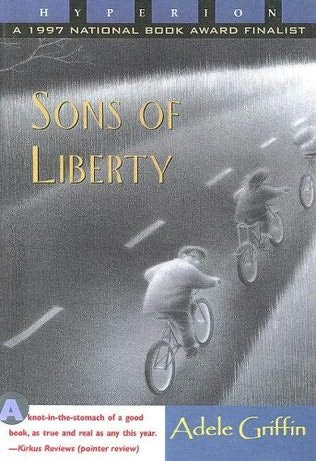
This is a novel for young readers called Sons of Liberty by Adele Griffin. It concerns a middle school-aged boy named Rock who is smart and has a thing for history, but seems to get in a lot of trouble. His father is a discipline freak who does things like wake his children up at 2 am to fix the roof. His mother has become a frightened agoraphobic. There is also an older brother, a toddler sister, and a friend with even more abusive parents. Griffin creates a convincing child's state-of-mind in Rock, even though this reader sometimes did not believe the dialogue and could smell the effort of presenting thematic content for a young reader. Not that integrating themes into story isn't a challenge, I just don't want to be aware of it. This book told a good story in which a young reader might find someone like himself but it was tempted sometimes to veer away from this task to make some painfully clear instructional point.
"He just says stuff when he's angry. He's not gonna take away Wynona." Rock yawned. "You've heard him say all those same things before. Don't worry about it and go to sleep."

"I told Dad I have accidents because sometimes my dreams and nightmares hurt too much."
I wanted the kids to simply behave in the story rather than make the author's points. I felt it would have shown more respect to the reader and would have stopped the flow of the story less. However, I found the theme of the power struggle between authority figures and children well rendered. I especially enjoyed how Griffin dealt with two questions - responsibility toward others and when disagreement with or disobedience to authority is disloyal (and by extension, when it is not). This last notion Griffin integrated with Rock's writing a paper on the American Revolution in a way I particularly enjoyed.
The only thing Rock liked envisioning was his role in the cover-up, after Liza was safely gone. In his mind's eye he pictured a lineup of adults - Mrs. Zukoff, Mr. Faella, Timmy and Arlene, even his own parents - all pumping him with questions. Then he saw himself, secret as a stone, but inside he would be laughing, thinking of how easily he'd sneaked Liza across the battlefields of grown-up rules and regulations and straight to freedom.

An enjoyable read. I could easily imagine my 11-year-old self glued to this book until it was done.

Thursday, March 5, 2009

Our tender, sharp-eared cultural chronicler - Horton Foote


A toast to one of my favorite American playwrights - Horton Foote - our tender and sharp-eared cultural historian, our Chekhov - who died yesterday at 92 year old. I wrote about him here. I have acted in one of his plays, directed two others, and worked on one of his films. Rent his marvelous A Trip to Bountiful or read A Habitation of Dragons if you want to join me in celebrating his beautiful dramatic and literary accomplishments.

Here's how The New York Times remembers him, and the Los Angeles Times, and here's a profile from 2007.

The best books I've never read...

btt button

We’ve all seen the lists, we’ve all thought, “I should really read that someday,” but for all of us, there are still books on “The List” that we haven’t actually gotten around to reading. Even though we know they’re fabulous. Even though we know that we’ll like them. Or that we’ll learn from them. Or just that they’re supposed to be worthy. We just … haven’t gotten around to them yet.

What’s the best book that YOU haven’t read yet?


Oh my, the list is long. I'd put Ulysses (which I have pledged to Sheila I will read before I'm done with my Ph.D.), Proust, Daniel Deronda, The Pickwick Papers, something by Cynthia Ozick, and Buddenbrooks on the top of the "best" books I've never read list. Updike had been on that list until I read The Witches of Eastwick earlier this year. And if I weren't cleaning up after a bathroom renovation I would probably write more about the whole subject. In the meantime, please click over to my other post today, remembering the late, great Horton Foote - America's Checkhov.

Monday, March 2, 2009

Historical fiction (Film - The Last King of Scotland)

We borrowed the film The Last King of Scotland from the library three times before we finally had enough time to watch it last night. I think I was a little skittish about the subject matter. It concerns the unbalanced dictator Idi Amin, his rise to power in Uganda in the 1970s, and his relationship with a young Scottish doctor (a fictional character), who goes to Africa after graduating school to escape the promise of a stifling middle class career. The doctor, a victim of his own innocence, ends up first being drawn to the charismatic Amin and then, through a crazy fluke, becoming Amin's personal physician. Forrest Whitaker eschews making Amin a one-note maniac - tempering his performance with a mixture of Amin's allure and an edge of desperate, childish insecurity. As always, I found James McAvoy able to do exactly what the role asks, beginning with an adolescent impulsivity, moving to enthusiastic innocence, and finally to a fear you could smell off the screen. He does not, like most young stars, telegraph the qualities in his character with foot-high explanations and pretend that he has done his job. Rather, he opens himself to each experience his character has and goes where he goes. McAvoy has just enough bravado to do that in front of you, but not so much that he changes the behavior of the character either for fear you won't get it, or because he needs to show you how great he is, or because he wants you to love him. McAvoy is probably the most emotionally accessible young male screen actor out there these days. He's great in this film and he's pretty stunning in Atonement too. Simon McBurney also does a great weasle-ish turn as a British diplomat. This film is very good at story telling with a minimal amount of text, dispatching with its exposition in a few short scenes and montages shots with music. It has an appropriately jumpy rhythm and its last half hour is horribly violent but also incredibly suspenseful. I am glad I finally got the courage to watch it.

Sunday, March 1, 2009

Your father was a god....no, really (Books - Anansi Boys by Neil Gaiman)

After working for 11 hours on a homework assignment yesterday, I fell into bed and didn't really feel like tackling Middlemarch, so I reached into the TBR pile and pulled out Neil Gaiman's Anansi Boys. I wasn't wild about American Gods but I did like The Graveyard Book and Coraline and, in fact, the new 3-D film of Coraline is terrific, so I'm not sure what to expect from this one. So far, a hapless fellow named Charlie learns that his father has dropped dead while singing karaoke in a bar and flies to his funeral. After it, he learns from an old neighbor that his father was a god...no really. This tale is told in a whimsical voice - half Dickensian saga, half comic pop fiction - it is fast-moving, funny, and the language has a kind of permenance.
It begins, as most things begin, with a song.

In the beginning, after all, were the words, and they came with a tune. That was how the world was made, how the void was divided, how the lands and the stars and the dreams and the little gods and the animals, how all of them came into the world.

They were sung.

The great beasts were sung into existence, after the Singer had done with the planets and the hills and the trees and the oceans and the lesser beasts. The cliffs that bound existence were sung, and the hunting grounds, and the dark.

Songs remain. They last. The right song can turn an emporer into a laughingstock, can bring down dynasties. A song can last long after the events and the people in it are dust and dreams and gone. That's the power of songs.

There are other things you can do with songs. They do not only make worlds or recreate existence. Fat Charlie Nancy's father, for example, was simply using them to have what he hoped and expected would be a marvelous night out.

This may be just the ticket. Now back to homework.

Thursday, February 26, 2009

What price polymathism? (Books - The Invention of Air by Steven Johnson)

Steven Johnson's The Invention of Air begins, as most of Johnson's books do, as a book about ideas - the discovery of electricity, of oxygen and carbon dioxide, the development of unitarianism. Johnson asks why certain information is not only discovered at a certain moment in time, but why it is accepted and how it spreads through the culture out of which it sprung, or, contrarily, why it may be uncovered by a solitary genius but never find acceptance. Johnson's subject, Joseph Priestley, is a seventeenth century polymath - scientist, theologian, radical political philosopher. Johnson's prologue for this short book is set on the ship Samson, on which Priestley and his wife sailed to America in 1794, seeking asylum, having been persecuted in England for radical political and religious ideas. Priestley tells us of dangerous waterspouts the ship encounters on the Atlantic while Priestley, unruffled, stands on the deck dipping a thermometer into the ocean to confirm the temperature changes that Benjamin Franklin observed on an earlier voyage and which led to his charting of the Gulf Stream. Johnson writes four chapters on the evolution of Priestley's investigative and creative output. They are lively, tight narratives chock full of ideas but rendered in language comprhensible for the non-scientist. Somehow Johnson's last chapter does not live up to the previous four. This chapter also begins on the Samson, but by that time I had forgotten the opening scene. That may be my fault for allowing too much time to elapse between reading the beginning and the end of the book, but Johnson does not remind us of this powerful image with which he begins - Priestley focused solely on his work while all around him powerful forces of nature rage. Sadly, the last chapter finds Priestley's life unravelling around him - no fault of Johson's -but somehow this chapter, too long for an epilogue but too short on ideas relevant to Johnson's theme, takes on a desultory character. Johnson relates a series of events - finding a place to live, tragedies befalling the Priestley family - which would all seem natural to the final pages of a more conventional biography, but in this narrative, more focused on a man's impact on science and philosophy than on his life as a whole, it seems dry and out-of-place. One success in this final section is Johnson's connecting Priestley to the Jefferson-Adams correspondence:
The fact that Priestley should play such a transformative role in the Jefferson-Adams letters, coupled with the fact that he is mentioned in that archive far more frequently than Washington, Franklin, or Madison, gives us some sense of the magnitude of Priestley's presence in the minds of Jefferson and Adams. Priestley was a king of Zelig of early American history, appearing at key turning points like some kind of errant founding father: Franklin's kite; the Privy Council; Alien and Sedition; the Jefferson-Adams correspondence.
I think the errant founding father notion is a bit of a stretch, but Johnson's thesis about why Priestley's polymathism was more natural to his time than to, say, our own is right on the money.
...Priestley's maverick beliefs and cross-disciplinary thinking would damage his reputation in the coming decades. He became a kind of sacrificial lamb for the parallel developments of specialization and professionalism that dominated nineteenth-century science. Serious science became the province of experts and specialists, not dabblers and amateurs. Pioneering research - according to the new consensus - required that the scientist isolate himself from the external worlds of politics or faith, and not seek connections to them.
Johnson is at his best in describing the movement of thought, that was what made his The Ghost Map such a terrific book. He has a harder time blending his closing argument with the structure he set up for himself in The Invention of Air but, all in all, this is a compact and energetic book that links American history, basic science, and modern ideas of information theory in a convincing and readable way. I continue to admire Steven Johnson's talents as a synthesizer of ideas in the context of culture. My other thoughts about this book are here, here, and here.

Wednesday, February 25, 2009

It's all philosophy... (Books - The Invention of Air by Steven Johnson)

The third chapter of Steven Johnson's biography of scientist/political philosopher/theologian Joseph Priestley - The Invention of Air - focuses on Priestley's radical political and theological activities. Johnson makes the observation that nowadays you rarely find scientists and theologians in the same person in fact, the two disciplines are seen as naturally polarized, but in those days it was all philosophy. A scientist, a theologian, a philosopher - they were all striving to understand the nature of the same world and give that understanding breath through narrative. Today the volume of information that exists on natural phenomena is far greater and the methods of each discipline have evolved to be much more highly specialized. One relies on the evidence of inner experience and the practice of perscribed ritiual and limits the scope of ones inquiry for the payoff of a sense of truth. The other places no limits on the scope of inquiry, puts natural phenomena to tests specifically to disprove what we think we may know, (and presets the criteria for drawing conclusions) to assemble a body of knowledge. However, science develops its texts in the language of probability and promises more questions for ever and ever, amen. I have lately seen several public meetings and books advertised about reconciling science and religion. I say, why? They are not the same and there is great use in contrary approaches to the mysteries of nature. There are indeed individuals who pursue science with all its rigours on a daily basis and yet hold religious beliefs or perform religious practices that would seem to be at odds with those beliefs. Welcome to the human condition - Walt Whitman said it best - I am large, I contain multitudes.

John Tierney's article in yesterday's Science Times explored the other of Priestley's two interests, the intertwining of science and politics. He writes about a book by Dr. Roger Pielke Jr., The Honest Broker, which argues that scientists risk their credibility when they advocate for specific public policies and might be more useful serving other roles in relation to the debates on matters scientific. It seems that Joseph Priestley is clearly a man of a different era, a different world. Steven Johnson's book really brings to life why a man with Priestley's specific combination of interests could exist when he did and how what he learned was born out of the cauldron of his culture.

Monday, February 23, 2009

Alive in the conflict (Books - Middlemarch by George Eliot)

I am nearly half way through George Eliot's massive social study of country life in Victorian England - Middlemarch - and I thought it a good time to step back and take a longer view, so caught up have I been in characterizations and authorial voice. Larger plot structure is now becoming visible and I see two young women - Dorothea and Rosamund, each desirable in her way. Dorothea is more serious, she cultivates plans for the design of housing on her Uncle's estate and she studies Latin and Greek. She decides to marry Casaubon, an elder clerical scholar, hoping to serve him. Rosamund is more spoiled and is drawn to Lydgate, the handsome young doctor newly come to Middlemarch. She is planning to marry him for love - love of him, love of love, love of the institution of marriage, but most of all out of love for herself.

Likewise we have Casaubon, a severe, impersonal man thought to be researching in order to write a book, although it is beginning to appear that he knows only how to research and hasn't the courage to create a book from his notes any more than he has the courage to consummate his marriage to Dorothea. Lydgate is a gentlemanly, young physician who has studied in Paris and has lived for his scientific work and now has, much to his own surprise, fallen in love with the beauty of Middlemarch. Eliot appears to have set up a tension between those who live from their passion and those who contain it with obligation - an apt contest for the Victorian era.

As Lydgate and Rosamund plan their wedding, order their plate and crystal and hire seamstresses for the trousseau, I am struck by the sheer impracticality of their plan making and can read the disaster that looms. Eliot has made me feel a sense of foreboding without explicitly writing a word about what might happen in their future. This couple behaves only out of I want. Whereas Casaubon and Dorothea act out of I must - preferring to think that they have no hearts at all. At the arrival of Will Ladislaw, Casaubon's young cousin who is very attracted to Dorothea, Casaubon has what we would today call a heart attack. He has never bothered to consider desire or marriage but now finds himself jealous. Dorothea's future is also coming into view. She, who tried to live solely from a sense of duty, finds herself wanting to see her young cousin-in-law. It is Eliot's strength as a writer that, although she makes it clear who her characters are, they are not caricatures but multi-faceted human beings capable of conflict within themselves.

Friday, February 20, 2009

Books devoutly to be wished

Recent additions to the TBR pile

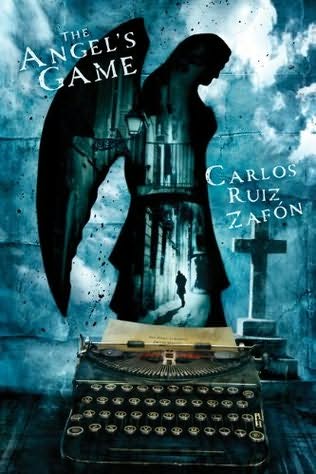
Carlos Ruiz Zafon has a new book - The Angel's Game - yay! If you loved The Shadow of the Wind like I did, with its romantic mystery steeped in the world of books, I hear that you will love this one too. I am always a little wary of sequels, or in this case prequels, but I am ever hopeful.


I don't honestly remember what made me suddenly interested in reading Patricia Highsmith's Ripley novels. To date I have only read her insidious short fiction. I have heard these books are alluringly creepy and people who like them seem to want to read them all. I think I will give them a try.


Cornflower Books spoke warmly of An Equal Stillness, a fictional biography of a woman who must balance her lives as painter and member of a family (in a way men rarely seem to have to do, or at least their doing so has not provoked too many novels). I am particularly interested in Francesca Kay's skilled evocation of paintings in words (already an accomplishment) but, as this is a fictional biography, these paintings did not even exist for her to describe.

Thursday, February 19, 2009

Dewey Decimal it ain't...

btt button

This week’s question is suggested by Kat:

I recently got new bookshelves for my room, and I’m just loving them. Spent the afternoon putting up my books and sharing it on my blog . One of my friends asked a question and I thought it would be a great BTT question. So from Tina & myself, we’d like to know “How do you arrange your books on your shelves? Is it by author, by genre, or you just put it where it falls on?


There is a rough logic to my shelving system but Dewey Decimal it ain't. In the bedroom is mostly fiction, the shelf nearest my bed has most of my favorite books. The books I have never been without no matter where I had moved or how much was in storage. J. D. Sallinger is there, Tim Winton, Richard Powers, Nicholas Moseley, Don DeLillo, Dostoevsky, Zilpha Keatley Snyder, Dickens, Sarah Salway's Tell Me Everything is there, The Sterile Cuckoo is there, On Beauty is there. They are in no order whatever, except that I know where they are and if there is more than one of an author's books, they are shelved together. Just a few feet away is a matching shelf (these shelves once belonged to my grandparents). This one has some genres - many short story collections are here, but not Chekhov or Alice Munro, Russian History is also here, history and cultural history of the period from around 1900 - 1920, this includes novels set around this time The Regeneration Trilogy of Pat Barker, and The Great Gatsby both live here. E. M. Forster is also here. Across the room is a tall, walnut bookshelf that I found on the street. It houses more fiction I am partial to including Ethan Canin, Chekhov, A. B. Yehoshua, A. S. Byatt, Wallace Stegner, Ian McEwan, Gregory Maguire, Rose Tremain, Chaim Potok, Russell Banks, spill-over Moseley, spill-over Tim Winton, Saul Bellow, John McGahern, Charles Baxter, and a lot of scifi and fantasy resides here - His Dark Materials Trilogy, Philip K. Dick, Ursula LeGuin, Tales of the Otori, Connie Willis, C. S. Lewis, Isaac Asimov, all of the Harry Potter books. In the dining room are two shelves, also both from my grandparents. One houses books by and about Virginia Woolf and the Bloomsbury set. It also has Alice Munro, Iris Murdoch, May Sarton, Dawn Powell, Willa Cather, Wuthering Heights and Jane Eyre are here too. Opposite them reside the works of G. B. Shaw, Hesse, some Thomas Mann, lots of Shakespeare, more short story collections, most of my miniature books, Eugene O'Neill, and some spill-over poetry. It seems like a shelf of women and a shelf of men face off in my dining room! In a built-in hutch on another wall are all poetry, books about poets, and our good dishes. In the living room there is a low shelf that I also found on the street. It has a lot of music - mostly opera scores - an also books about musicians, composers, and conductors, books related to opera texts, and books on yoga and meditation. Next to that, an enormous built-in wall unit housing all our recordings, more fiction, books written in languages other than English, psychology, biography, plays, books about theatre artists, books about acting, and the teapot collection. In the kitchen, which also contains my office, is a free-standing shelf of neuroscience books, all my class notes, and a second built-in shelf of neuroscience books, along with more poetry, all my reference books, more books on acting, and all my cookbooks interspersed with many tins of tea. And lastly, the shelf no one ever sees. It sits in our coat closet and houses the books that we will give away or sell. Tour complete. Thank you for coming.

Wednesday, February 18, 2009

My friend the omniscient narrator (Books - Middlemarch by George Eliot)

The assurance of George Eliot's authorial voice, which begins every chapter of Middlemarch like a film voice over, could be thought to create an enormous distance. Nearly each chapter begins, to continue with the filmic similes, with a long shot.

An eminent philosopher among my friends, who can dignify even your ugly furniture by lifting it into the serene light of science, has shown me this pregnant little fact. Your pier-glass or extensive surface of polished steel made to be rubbed by a housemaid, will be minutely and multitudinously scratched in all directions; but place now against it a lighted candle as a centre of illumination, and lo! the scratches will seem to arrange themselves in a fine series of concentric circles round that little sun.

But their accretion begins, contrary to my initial certainty that the omniscient narrator is always a cold narrator, to accumulate intimacy. Now, well into Book Three, I am smiling as each chapter begins, saying to myself 'Oh, it's my friend again!" Book Three features a particularly gripping sub-plot concerning Fred Vincy, the too-indulged son of a well-to-do but not extravagantly rich Middlemarch family. To continue on the theme of chapter openings, one could read them alone to follow the plot:
Fred Vincy, we have seen, had a debt on his mind, and though no such immaterial burthen could dpress that buoyant-hearted young gentleman for many hours together, there were circumstances connected with this debt which made the thought of it unusually importunate...

I am sorry to say that only the third day after the propitious events at Houndsley Fred Vincy had fallen into worse spirits than he had known in his life before...

Fred Vincy wanted to arrive at Stone Court when Mary could not expect him, and when his uncle was not down stairs: in that case she might be sitting alone in the wainscoated parlour...

But Fred did not go to Stone Court the next day, for reasons that were quite peremptory...

But plot is not the point. Certainly the remainder of each chapter fills in the rough outline of action provided by the first sentence, but the treats I look forward to from Eliot are the description of her characters and their inner thoughts which my dearest friend, the omniscient narrator, knows so well.

Fred knew, to bully one about expenses: there was always a little storm over his extravagance if he had to disclose a debt, and Fred disliked bad weather within doors. He was too filial to be disrespectful to his father, and he bore the thunder with the certainty that it was transient; but in the meantime it was disagreeable to see his mother cry, and also to be obliged to look sulky instead of having fun; for Fred was so good tempered that if he looked glum under scolding, it was chiefly for propriety's sake...

Point of view is everything in the vast narrative that is Middlemarch, the telling of this story is not simply happening after happening but who it happened to and why it happened to them and, most of all, what we think of that. Although I had been struggling to get through more than a chapter or two a night with all of my reading for class, last night I sailed through about fifty pages. I am beginning to catch the rhythm of this epic of small town social psychology.

Tuesday, February 17, 2009

The neuroscience of the 7 deadly sins...

If The Neuroscience of the Seven Deadly Sins is not a title we see on the bookstore shelves in the next year I'll eat my hat. Today's Science Times has a piece by Natalie Angier looking at what the brain might be doing when you are doing envy or schadenfreude. Both feelings, the researchers point out, are felt only in light of a third person. A Japanese lab used fMRI to measure blood oxygen level dependent (BOLD) activation of the brain while participants read social narratives, imagining themselves as the protagonist, in relation to a "target character." When the target's possessions were superior, subjects reported feeling envy and the BOLD level of their anterior cingulate cortex (ACC) increased proportionately to that envy. In a second study in which misfortunes were visited upon the target, subjects reported pleasure in their pain (schadenfreude) and the ventral striatum (VS)was similarly activated by that experience. Most interestingly, the amount of ACC activation in the first study correlated with the amount of VS activation in the second, implying that the more envious of the character you were in the first study, the more you enjoyed his downfall in the second.

This article reports the ACC to be associated with physical pain sensation, although I am more familiar with it at the neural correlate of conflict monitoring and error detection in relation to sensations of reward or loss. The article discusses shame as the flip-side of envy, i.e., it is a socially unacceptable feeling, hence its status as a 'sin.' That made me wonder, are the researchers really measuring envy, or if they are measuring shame? The subjects are being compelled to not simply have their feelings but to report them to others. If envy activates brain regions that contribute to error and pain processing, maybe we are seeing the response to shame, I would like to see a study in which the effect of shame is controlled for. I am also interested in how envy differs from greed. Aren't they both covetous desire of reward, except that envy includes the object from whom the reward is to be gained? These researchers do make a point of saying they are specifically studying emotion in the context of a third party but, nonetheless, a comparison of the two would be interesting. Finally, I would like to commend Natalie Angier not just for weaving a interesting and readable story tying neuroscience to new shoes and the economy, but also owns up to the exploratory nature of this research and the criticisms many in the field have of the way fMRI scans are used as instant and complete pictures of brain activation.

Sunday, February 15, 2009

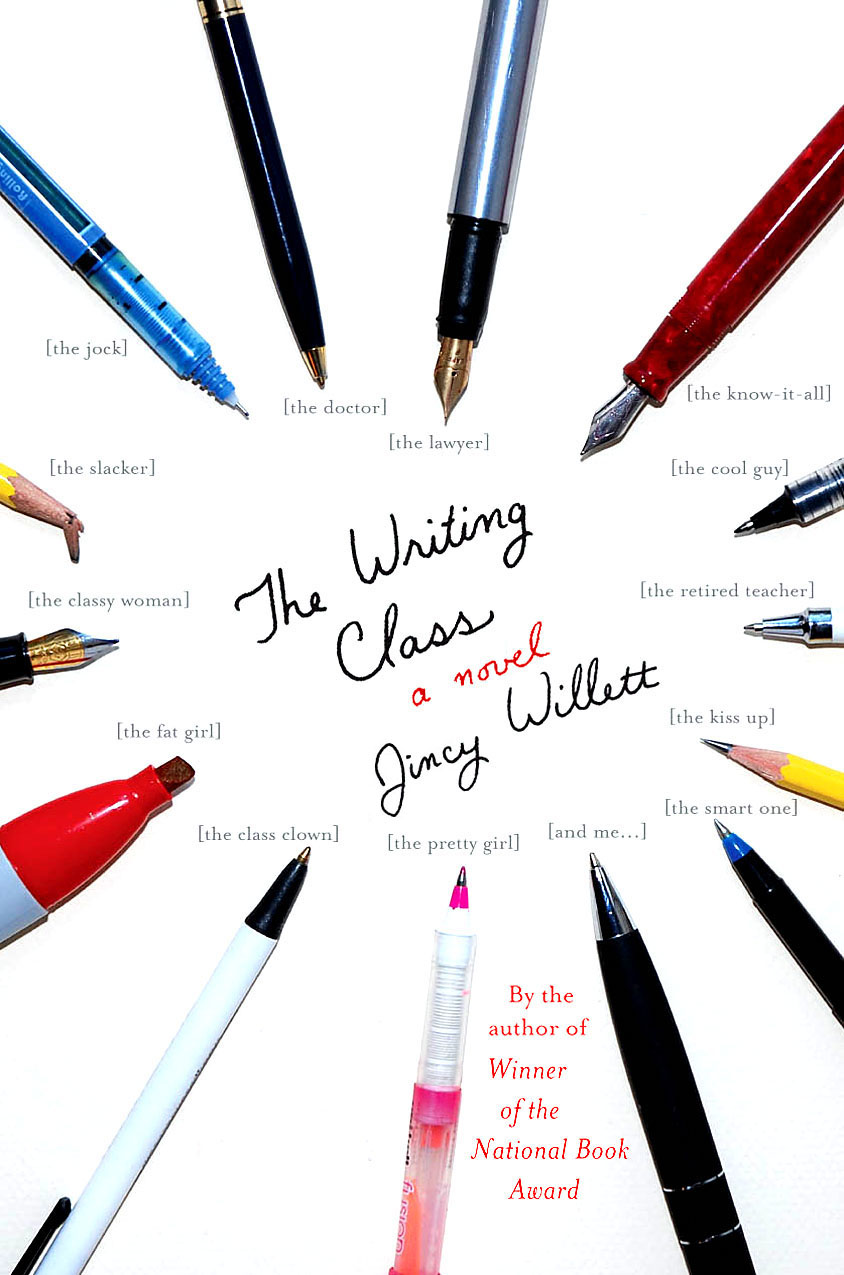
Writing-teacher-turned-detective (The Writing Class by Jincy Willett)

The Writing Class by Jincy Willett ended very satisfyingly. See my first post for the setup. Not only does Willett have the writing-teacher-turned-detective attempt to solve the crime by analyzing the writing of her students, one of whom is a homicidal maniac, she also teaches her students how to be astute and critical readers thereby eliciting their help. Even the personal circumstances of Amy, our teacher-detective, which earlier in the book I hadn't much cared about, end up being usefully woven into the plot. It is funny, fast-moving, has a terrifically suspenseful climactic scene. Lots of fun.

A palace rises in the dark wood... (Le Grand Meaulnes by Alain-Fournier & Joseph Cornell)

One of my favorite of Joseph Cornell's boxes today in honor of the Cornflower Book Group's discussion of Le Grande Meaulnes by Alain-Fournier.

Saturday, February 14, 2009

Triple threat (Books - The Writing Class by Jincy Willett

The Writing Class by Jincy Willett is the type of novel I seem to be able to get through these days. That's not to say that it isn't good, in fact it's great fun, just lighter than my typical bill of fare. It's a triple threat, part writer's book, part comedy, part mystery. Amy Gallup is our heroine. Her one well-reviewed novel, written in her youth, somehow did not lead to great success and everlasting happiness. She is now teaching writing in the extension program of a local college, widowed, and living with a basset hound named Alphonse, who barely acknowledges her presence.
Amy Gallup was a loner who was afraid to be alone. She had never lost her child's fear of basements, and bedroom closets, and the thick darkness under her bed. Over the years she had tried roommates, live-in friends, and husbands, and the lack of privacy in all but her first marriage had driven her crazy, so crazy that these night terrors were preferable. Drinking helped, though getting drunk did not.
I find the more serious character development side of this novel its weakest link. Not that it is poorly written, but I find myself getting through it to get to the good parts, which are Willett's ventriloquism act, in which she writes like each of the students in the writing class - young feminist, retired school teacher, arrogant physician, divorced swinger. They're all there.
Far off in the night woods, Paul Gratiano could hear the ripping howl of carivorous dogs, feral coyotes, the hooting of predatory owls, the helpless scream of a fat white rabbit. He shivered in his hiding spot, even though the night was hot and moist.

Why had he agreed to meet her here, of all places, and now, of all times?

Why was he here, within this lonely clump of maples, in Central Park at midnight?
What I enjoy even more than Willett's writing like each of her characters is her making comments on the writing in the character of each of the students. If any of you have ever been in a writing class, you will know exactly what I mean. The critic who has to compliment everything, the one who cannot critique writing apart from whether they liked the behavior of the characters, the one who is sure that every work written in the first person is autobiographical... The strong suits of this novel are the comedy - there are a few good, out-loud guffaws - and the mystery. Someone, evidently a member of the writing class, is cruelly tormenting Amy and each of the students. These start out simply as mean pranks, but finally, when one of the class members is murdered, things gets seriouser. It's not just who did it, but why that is keeping me tearing through this entertaining read. And it was a present - thanks Sheila!

Thursday, February 12, 2009

Blog love

btt button

Suggested by Barbara H. A comment on someone else’s BTT question this week inspired this question:

Do you read any author’s blogs? If so, are you looking for information on their next project? On the author personally? Something else?

Yes. I read Terry Teachout's blog About Last Night, he's the theatre critic for The Wall Street Journal, but has also written several books and an opera libretto. I read him and his two colleagues who share that space because they have intelligent things to say about what's going on in the theatre. I read the wonderful Alex Ross, author and music critic for The New Yorker at his blog The Rest is Noise because of the interesting performances that he attends around the world and the recordings he discovers, and because he is obsessed with the late, great Lorraine Hunt Lieberson too. I started reading blogs by reading two 1) Andrew Sullivan's, former editor of The New Republic and author of several books including Virtually Normal and Love Undetectable, for his provocative thinking about politics and society. I don't always agree with him but I am always interested to hear what he thinks and how he will argue for it. 2) My dear friend Sheila, who is a brilliant and funny writer and has had a story published, and her first book will be when someone gets smart enough to snap it up. I read The Frontal Cortex, Jonah Lehrer's neuroscience blog and his book Proust Was a Neuroscientist wasn't too bad either. Hopefully I will get to the new one soon. I read Neil Gaiman's Journal, not for any voyeuristic reason, just because it's a good read. He had a great post of the First Amendment, for instance. And I discovered it through Sarah Salway's blog, which I started reading because I am crazy about her book Tell Me Everything and learned on her blog that she is a creative process nut like I am, continually thinking about and practicing ways to ignite the spark and prime the pump.

I suppose, with all these authors, I am interested to know when they have written a new book,if it is books they write, but mostly if I read their blogs, it is because I enjoy what they write there.

Tuesday, February 10, 2009

Go outside and play...

Your mother was right, turn off the boob-tube. A short piece in today's Science Times tells us of a study by Dr. Brian Primack and colleagues, linking the number of hours of daily television viewing in adolescence to increased chances of developing depression in adulthood. The study assessed over 4,000 adolescents without depression and tested them again seven years later. For each hour of daily viewing, their chances increased and the effect was stronger for males than for females. Similar effects were not observed for video cassettes, radio, or computer games. Those for whom the effects were greatest watched more than nine hours of television per day. For them, the incidence of depression nearly tripled over those watching less than three hours per day.

Somebody tell me, how can you go to school and have nine free hours? The study controlled for effects of age, race, socioeconomic status and level of education, but what was watched, parental supervision, number of hours of sleep, exercise, nutrition, alcohol and drug consumption, or specific risk factors for depression were not assessed as far as I can tell from the abstract. I would like to know if the viewer was sitting still and watching or whether they were preparing food and getting dressed and had the box on in the background. Also, the depressive symptoms with only assessed with a 9-item checklist. At least with video cassettes you would have to get up eight times to insert and remove the cassettes. Wouldn't being completely passive for nine hours per day make anyone depressed? It strikes me as a lesson in powerlessness. I can't even read nine hours per day and I love to read.

Monday, February 9, 2009

In which fantasy bumps up against reality and Dorothea says 'ouch.' (Books - Middlemarch by George Eliot)

The fact is unalterable, that a fellow-mortal with whose nature you are acquainted solely through the brief entrances and exits of a few imaginative weeks called courtship, may, when seen in the continuity of married companionship, be disclosed as something better or worse than what you have preconceived, but will certainly not appear altogether the same. And it would be astonishing to find how soon the change is felt if we had no kindred changes to compare with it. To share lodgings with a brilliant dinner-companion, or to see your favourite politician in the Ministry, may bring about changes quite as rapid: in these cases too we begin by knowing little and believing much, and we sometimes end by inverting the quantities.

Still, such comparisons might mislead, for no man was more incapable of flashy make-believe than Mr. Casaubon: he was as genuine a character as any ruminant animal, and he had not actively assisted in creating any illusions about himself. How was it that in the weeks since her marriage, Dorothea had not distinctly observed but felt with a stifling depression, that the large vistas and wide fresh air which she had dreamed of finding in her husband's mind were replaced by ante-rooms and winding passages which seemed to lead nowhither? I suppose it was that in courtship everything is regarded as provisional and preliminary, and the smallest smaple of virtue or accomplishment is taken to guarantee delightful stores which the broad leisure of marriage will reveal. But the door-sill of marriage once crossed, expectation is concentrated on the present. Having once embarked on your marital voyage, it is impossible not to be aware that you make no way and that the sea is not within sight - that, in face, you are exploring an enclosed basin.

Ah, the expansiveness of George Eliot's narrative. Middlemarch is a study in the constant bumping together of internal states and external realities. The expression "the honeymoon is over" seems to have been written with Dorothea in mind. Even with a multi-week stay in Rome, on the far shore of betrothal she becomes disillusioned. I love Eliot's two metaphors - the vista replaced by a closed room, and a voyage at sea replaced by one in a basin. They are hilarious even while Dorothea's circumstances are not. Anyone who has been an outsider in a community and takes Dorothea as a kindred spirit, and who admired that she married a much older man purely for his mind (or actually her fantasy of his mind) still, in reading the pages of their courtship, must have been saying 'don't do it' and in reading these pages is now saying 'I told you so,' and yet simultaneously (or maybe an instant later) experiencing her lonliness and sadness. But what have we to go on prior to engaging in a relationship but fantasy? Prior to co-habitation (since I am forbidden to marry anyone I could love) I could only imagine what it would be like to be together always. But marriage is a state of mind, all the more powerful because it is bestowed by the institution of the state or religion. Here's that notion of top-down phenomenon again (see this post for an explanation). In our modern habit of living together prior to marriage it is still not the same. It is not the same because of the name, even if it is no different circumstantially. Dorothea, however, lived in a much earlier era. She could only rely on her fantasy which is now rudely bumping up against the reality of a prim, distant, husband who she imagined a great scholar. Now she is realizing that those rows of notebooks, that she would patiently transcribe for him would, in fact, never become a book. His body is the same. He mind the same. The books the same. Rome the same. Only Dorothea's knowledge is different. It is because Eliot spend so much time in the mind's of her central characters, developing our intimate acquaintance with their point-of-view and the context in which it points, that we are treated to the simultaneous vistas that this book affords us. It's as though we have two lenses and might, at any time, peer through either. One gives us that distant wisdom, lets us anticipate Dorothea's misapprenhension and smile knowingly at her naivetee, the other makes us disillusioned ourselves. I thought I should get this post out of the way prior to Valentine's Day.

Sunday, February 8, 2009

The Dark Knight and Middlemarch (Books - Middlemarch & Film - The Dark Knight)

One of my favorite creative exercises is bringing together the unlikely. The Dark Knight - the recent oh-so-bleak Batman flick - and Middlemarch - George Eliot's masterpiece of 18th century English village life - nothing to do with each other, you say? Try me. After a long day of school work, and cleaning up, and after about 10 days of having no bathroom due to renovations, the walls are finally done (though much else needs completing) but The Ragazzo and I decided to celebrate anyway with pizza and a movie. The Dark Knight had come in from the library. I have heard so much negative criticism of it - it's too long, it's too dark, Heath Ledger isn't Jack Nicholson... I decided to see for myself.

Not only would I say it is a well done movie, I think it really is the Batman for our time. Batman must fight a crazed terrorist who is willing to die, who seems to be motivated to do evil for the sake of it. A city despite its greatest forces seems brought to its knees by forces that seem to embody chaos. Sound familiar? My one qualified criticism, which I'll get out of the way up front, is that this Gotham was so obviously Chicago (I've lived in Chicago, so it was obvious to me). That distracted me a bit, but this film couldn't make the Tim Burton fantasy landscape kind of choice because it was going for a much more veridical sense of fantasy. It certainly did have some great sets for the interiors. In any event, now to address the criticisms I have heard from others. Too long - I didn't think so. A typical shoot-em-up Blockbuster would have developed the characters less, might have had fewer scenes between the wonderful Michael Caine and our Batman, Christian Bale, for example, and it would have probably ended with the "great tragedy." I'll call it that for anyone who hasn't seen the film yet. But that would not have been this Batman film, because this film isn't just about good versus evil, it is about consequences. The film would have had a hard time doing that in 2 hours and 10 minutes. Too dark? It couldn't have been much darker, I'll give you that, but what on earth do we make myths about if not our greatest forces of darkness. What was difficult about this film is that the darkness just didn't stop. It extended beyond the bad, bad guys casting its penumbra over what we thought we could count on as good. When it's not just the Joker wreaking havoc but the police, the D. A., Batman himself - what are we to do then? Then we have to consider whether we have any darkness within ourselves. Consequences. Then you have made a Batman film I am really interested in watching. The cast - Christian Bale always feels a little loopy to me. He seems to take himself very seriously, but that veneer seems to hide a kind of manic belief that I think really works, particularly in this Batman film. Michael Caine seems to have a lot of fun as the faithful Alfred. Maggie Gyllenhaal is thoughtful and a serious, like she's in an Ibsen play or something. I really liked that take on Rachel Dawes. She is a grown-up woman living in a dark world, having to make grown-up choices or she feels she will have waited too long. It was a Rachel, again, for our time. Everything does not have to be Sex in the City. But the stand-outs of the film are Gary Oldman, who must have the camera on him for 85% of the film, and he never stops being active inside. He is a man charged with keeping order in a crumbling world and plays quiet desperation in a way I really bought. Then there is Heath Ledger. No, he is not, Jack Nicholson. Thank god. Not that Jack isn't great, but the guy's still alive. They could have cast him if they wanted him. What is utterly menacing about this joker, is that he is so subdued. Even in his truly in-your-face-moments, he does go all the way, but he doesn't show off. It's dramatic but its not operatic. I thought this made him incredibly unpredictable and, therefore, scary. He had a different story about his scar for each person who would listen, but you could believe each one. This villain truly has no limits. Ledger wasn't trying to show you how far he himself was from this crazy man, the way Brad Pitt plays it in 12 Monkeys, he seemed to just quietly be trying to slip inside of him. It's not just a shame a young man like Ledger could not have lived a longer life, but his death seems our loss too. We can only wonder what this talented young artist might have created.

But the real thing that makes the film a Batman for our time isn't simply the terrorist parallels, but the notion of consequences. This is played out on multiple levels. There is Batman himself, who must agonize over concealing his identity, since it is the one thing the Joker wants (we will not give in to terrorists). Ironic since he conceals his own. There is a "good" character who turns "bad," when pushed to his limit, but I won't give away which character that is. There is one scene in which two groups of people - one mostly prisoners and their keepers and the other ordinary citizens of Gotham - must decide if they will blow the other group up to save themselves. That gets at the very meat of this film - what are we willing to do to save ourselves? for goodness sake, the prisoners on the boat are even dressed in the orange outfits we saw in every picture of Guantanamo. That's what makes this our Batman. This film asks - when terror strikes - who do we become? That is the true chaos faced in this film, our sense that we always know what is right goes out the window. If we are to search our souls there is probably a part of anyone of us that could be pushed to the limit and the joker wants to know where that limit is in each of us. That is why he is a force of such tremendous potential evil. Real chaos is when no one, not just the bad guys, but no one is regulated by a sense of right and wrong.

And that is where I find a parallel with George Eliot's Middlemarch. Eliot is interested in nothing so much as how choices are played out as consequences, except that her canvas is the 18th century village. I lay down in bed last night at close to midnight, after having watched a three-hour batman film, and written a homework assignment for several hours, and cleaned up the apartment, and not a book on my current list did it for me. I am enjoying Steven Johnson's The Invention of Air, but I have just started a 50-page chapter and I did not feel like non-fiction. I am not really enjoying either The Seance or The Locked Room that much, and then I saw Middlemarch. Which Matt and I were supposed to have been reading together and somehow we both slipped off the path last fall. Well, I'm back...Matt? In the chapter I read last night, I had to really come in for a landing in terms of pacing after The Dark Knight. Oh the pleasure of those swathes of words, that flow across the page like country paths.
That, entering into Lydgate's position as a newcomer who had his own professional objects to secure, Mr. Farebrother should have taken pains rather to warn off than to obtain his interest, showed an unusual delicacy and generosity which Lydgate's nature was keenly alive to.
And, so, here is the question facing Lydgate that is the subject of this chapter. Should Lydgate, the new physician in town who is interested in forwarding his scientific research (for the betterment of mankind, of course) elect to the chaplaincy the man whom Mr. Bulstrode, the banker, supports? This is the banker who has just become interest in supporting Lydgate's work. Or should he vote for a kinder man and a better preacher, to whom some Middlemarchers object for his playing billiards? If he should be seen to support a man some think immoral, will those people patronize his practice? But if he is seen to be Mr. Bulstrode's yes-man, will they respect him?
It went along with other points of conduct in Mr. Farebrother which were exceptionally fine, and made his character resemble those southern landscapes which seem divided between natural grandeur and social slovenliness. Very few men could have been as filial and chivalrous as he was to the mother, aunt, sister, whose dependence on him had in many ways shaped his life rather uneasily for himself; few men who feel the pressure of small needs are so nobly resolute not to dress up their inevitably self-interested desires in a pretext of better motives. In these matters he was conscious that his life would bear the closest scrutiny; and perhaps the consciousness encouraged a little defiance towards the critical strictness of persons whose celestial intimacies seemed not to improve their domestic manners, and whose lofty aims were not needed to account for their actions....

On the other hand, there was Tyke, a man entirely given to his clerical office, who was simply curate at a chapel of ease in St. Peter's parish, and had time for extra duty. Nobody had anything to say against Mr. Tyke, except that they could not bear him, and suspected him of cant...

But whichever way Lydgate began to incline, there was something to make him wince; and being a proud man, he was a little exasperated at being obliged to wince.
Questions of consequence are the stuff of great fiction and great theater - Macbeth, A Winter's Tale, Crime and Punishment, Frankenstein, To Kill a Mockingbird, Anna Karenina even screwball comedies, think of Philadelphia Story or Bringing up Baby - what are these all about if not consequence? Not comfortable, to be sure - but involving and worth spending time in. These works of art are the exercise we give our conscience in a realm where we don't have live with the consequences so that, when we do, we have had some practice . That is one of the great values of art, in my opinion.

Thursday, February 5, 2009

Artists' lives and works...

btt button

Suggested by Simon Thomas:

Have you ever been put off an author’s books after reading a biography of them? Or the reverse - a biography has made you love an author more?


I can think of writers and other artists whose work I don't enjoy. I can think of biographies that I found unreadable, usually they are what I call the toe-nail-clippings-and-all biographies. You know "and then Hemmingway ate his breakfast on February 3rd, it was Thursday, in a small cafe, spending 1 franc. His daughter found the receipt in his shoe. He then got his shoes polished before visiting Gertrude and Alice." But I cannot think of a situation where reading about someone's life has made me not enjoy their work. I've learned some pretty nasty things about Wagner, but I still like hearing and seeing his operas. Picasso was cruel to some of his women, but his work I can admire again and again. I have had the case, with Virginia Woolf, where, in researching a play I directed about her life, I read everything about her and I continue to (although I've yet to read the latest book about her relationship with her servants). All the diaries, the letters, most of the essays, Leonard Woolf's memoirs, the two-volume biography by Quentin Bell - her nephew - Hermione Lee's biography, all sorts of more general Bloomsburiana, like the Victoria Glendenning biography of Vita Sackville West. The intimate details of their worst qualities has yet to put me off her fiction or any of the work of that fascinating circle of artists.

Wednesday, February 4, 2009

One...

This meme is from Matt and saves me from writing something involving too much thought this morning, a good thing.

One book you’re currently reading: The Invention of Air by Steven Johnson.

One book that changed your life:The Vakhtangov School of Stage Art by Nikolai Gorchakov
A book about the great student of Stanislavski who ended up founding a satellite studio of the Moscow Art Theatre, directing several brilliant projects, and dying at around age 40. It taught me there was another director who thought about theater the way I did.

One book you’d want on a deserted island: I usually say the complete works of Shakespeare because they're bottomless, but at this point I might take Middlemarch because it seems like the only place I might have enough time to finish it.

One book you’ve read more than once: The Goldbug Variations by Richard Powers - fantastic.

One book you’ve never been able to finish: The Man Without Qualities by Robert Musil, and in this case I graciously accept defeat.

One book that made you laugh: Paper Towns by John Green - terrific YA lit.

One book that made you cry: Sula by Toni Morrison in an ice cream store in Pittsburgh.

One book you keep rereading: For Kings and Planets by Ethan Canin.

One book you’ve been meaning to read: It's not one, there's a list on my sidebar but Middlemarch (yes, Matt, I know, I know. I getting there!) Buddenbrooks, Daniel Deronda, and Natasha's Dance particularly plague me.

One book you believe everyone should read: I don't make a lot of pronouncements about what other people should do. But I have recommended My Name is Asher Lev by Chiam Potok to numerous readers.

Grab the nearest book. Open it to page 56. Find the fifth sentence…
Differentiation of the forebrain vesicle is a bit more complex, although in essence a deep groove (when viewed from the outside) forms rostrodorsally to produce an endbrain vesicle, followed by an interbrain vesicle.
You asked. It's from Brain Architecture by Larry W. Swanson. and now for all of you who went 'huh?' to the above, this volume is the next closest...
Aside from the torments of longing i endured, away from her, swinging between bouts of wild elation and terror lest she should change her mind, the one cloud on our horizon was the question of where we were to live.
From The Seance by John Harwood.

Considered yourself tagged if it suits you.

Tuesday, February 3, 2009

A good cry? Not so fast

Today's Science Times reports on research challenging the notion that crying is always cathartic. Jonathan Rottenberg, psychologist, and his colleagues, observed that the well researched notion that most of us remember more of the good and less of the bad over time holds true for crying. The anger or shame experienced with the crying maybe forgotten, leaving only a memory of relief. Therapist Judith Kay Nelson contends that a pattern concerning the relationship to crying is laid down in childhood.
"Crying, for a child, is a way to beckon the caregiver, to maintain proximity and use the caregiver to regulate mood or negative arousal...Those who grow up unsure of when or whether that soothing is available can, as adults, get stuck in what she calls protest crying - the child's helpless squall for someone to fix the problem, undo the loss."
Both the details of the cry and the individual crier influence the effect. Poor Oedipus. It was all for nought. Forget the Greeks, next time you're feeling down, go for the Marx Brothers.