Saturday, July 3, 2010

Thriller and love story on the surface, serious moral critique beneath (Books - Any Human Face by Charles Lambert)

It was probably a good year-and-a-half ago that Dovegreyreader conducted a wonderful interview with author Charles Lambert where I learned of his collection of stories The Scent of Cinnamon and his novel Little Monsters. I bought the second and for some reason it then festered on my TBR pile unread. Then a few weeks ago I heard described a new novel that Lambert had written set in Italy. I immediately ordered Any Human Face, it arrived this week and I glanced at the first page Thursday evening, becoming instantly hooked. I finished gulping it down this morning.

This is an unusual book in that it has everything - love, suspense, moral conflict, social criticism, psychological acuity, and crack writing - but none of it is expected. It is pitch-perfect on the a fast-paced, ostentatious, brutal beauty of Rome. Who the central character is purposely eludes the reader for some time, although in time the point of view unambiguously settles, but I will let you discover where by reading the book yourself. It moves back and forth between the 1980s and 2008, between Alex, Michel, and Andrew - all young gay men living in Rome. Bruno and Martin - two older journalists - and a wonderful character known as The Birdman, instantly recognizable to anyone who was familiar with the gay scene in the 1980s as the older man who takes in strays and mentors them while harboring an unrequited love - part queen of the bordello, part professor, part nurse, part mama. And three women - Alina, a generous and practical spirit, married to Martin. Daniela - an art critic with terrible taste and worse moral judgment, and The Girl - one of many victims of kidnapping and exploitative sex by higher-ups in Roman and or Vatican politics whose inner monologue Lambert imagines.

Lambert's writing is rich with observations both interior and exterior that imbue character and place with clarity and instantaneous complexity:
It took almost twenty minutes before they could sit down, at one of the tables up against the wall. Bruno told the waiter to bring some bread and a litre of local white. And four suppli. And four filetti di baccala. Alex had his elbows on the table, waiting for Bruno to tell him to shift them, feeling in the mood for a fight, nothing too serious, a touch of friction to remind them both that Alex had a mind and body, and not just body, of his own. He was still smarting from being called Alessandro, his real, despised name, although it might have been worse: Bruno might have said Sandro, as Alex's mother always did. His earlobe was warm, almost sore, from the pressure of Bruno's fingers, the edge of his broken, nictoine-yellowed nail.

Alex was wearing a T-shirt he'd bought that day, white, with Greek letters round the neck, but Bruno, the only person he knew who could read what they said, didn't seem to have noticed...
I love writing like this, a few sentences crammed with sensation that amount to a volume on the experiences to be found in this part of Rome - the sounds, sights, and smells. Alex's inner life is revealed - his youth, insecurity, and how he is different from the typical young man of his neighborhood of origin. The nature of his relationship with Bruno is not explained, but is there to be understood through the details. We learn of the difference classes each come from, and of Bruno's preoccupied state. This is masterful writing - characters and place, inner and outer realities, exposition and plot seamlessly interwoven and wrought through detail not prosaic explanation.

This novel is entertaining to read - a time capsule of 1980s Rome and of a type of gay culture I vaguely knew from New York in that period. Though the book is by no means limited to describing gay culture or relationships - there are loving and unloving people of all sorts in it. It is also a thriller packed with intrigue, sweating with suspense, whose narrative speeds along like a Maserati on the Via del Corso. The plot concerns a collection of photographs which include some sensitive police material and become a mortal threat to anyone who has been in contact with them. Andrew, who owns a bookshop and suffers from artistic pretensions, decides to mount a show together with Daniela (the art critic of doubtful taste) with some of these photographs. There are two outrages represented in these photos - one is the crime exposed by them (and is of such cost to those who would rather not have them on view) the other is Daniela's outlook that when reinterpreted in an artistic context they are rendered anonymous and harmless:
'These images are pure text, Andrew, used, abused, discarded text, crying out to be reinterpreted... She's pixels on paper, darling.'
This novel, though entertaining to read, is an unambiguous critique of the moral hypocrisy that infects the powerful. And the nature of that crime which combines an abuse of power with the dehumanization of innocent people pursuing their mundane pleasures, doing some sort of work, making the little mistakes and the helpful gestures that finally add up to their lives. It is Lambert's accomplishment with this novel that he drives home this point with the juxtaposition of richly imagined scenes rather than with explanation or grandstanding, and that these scenes do double duty as thriller and love story. I also appreciate it for the tender depiction of gay characters both young and old pursuing love and helping each other through the stages of their lives.

This is a superb novel, enjoyable on so many levels. I hope you will seek it out and read it. Now I'm going to try unearth Little Monsters without burying my bedroom and see what Lambert's first novel was like.

Monday, June 28, 2010

Fish with legs and other predictable oddities of nature (Books - Your Inner Fish by Neil Shubin)

Paleontologist Neil Shubin, a discoverer of Tiktaalik - a fish with legs which is one of the many thousands of clear demonstrations in nature of the evolution of species - has written an entertaining and swift-moving book about the nature of his work collecting fossils and why it matters. If you can get past the gimmicky title, and I didn't find it too hard, Shubin writes in a modest, approachable style, provides down-to-earth examples (pun intended), and conveys to the reader the excitement he feels about his work.

The work traces three lines of evidence that Shubin offers as a way to better understand our own origins - fossils, genes, and embryos. Shubin builds our understanding in the book's first pages of how knowledge about anatomy and geology are necessary in the use of fossils to understand the evolution of species.
The order of fossils in the world's rocks is powerful evidence of our connections to the rest of life. If, digging in 600-million-year-old rocks, we found the earliest jellyfish lying next to the skeleton of a woodchuck, then we would have to rewrite our text. The woodchuck would have appeared earlier in the fossil record than the first mammal, reptile, or even fish - before even the first worm. Moreover, our ancient woodchuck would tell us that much of what we think we know about the history of the earth and life on it is wrong. Despite more than 150 years of people looking for fossils - on every continent of earth and in virtually every rock layer that is accessible - this observation has never been made.
Once a certain body of information has been amassed about the age of rocks and the structure of the skeletons of ancient creatures, a scientist can begin to make predictions about the layers of rock in which they are likely to find a particular kind of fossil - even if that fossil has yet to be discovered. This is, in fact, exactly what Shubin and his team did:
It took us six years to find it, but this fossil confirmed a prediction of paleontology: not only was the new fish an intermediate between two different kinds of animal, but we had found it also in the right time period in earth's history and in the right ancient environment...

Darwin's theory allows us to make very precise predictions.
Shubin's ushers us into the world of genes building the reader's understanding with simple, clear language. He does the same for developmental embryology, telling the story of how multi-celled creatures like the sponge or us humans evolved from single celled ones with the advent of intra-cellular communication and substances like collagens and proteoglycans - the glue that hold cells together. My favorite story in the book was about single-celled creatures known as choanoflagellates, their similarity to a particular type of cell in the sponge, many of which assemble to form the prototype of a mouth, and the genetic evidence to suggest that structures of multiple cells in bodies evolved from the collaboration of single-celled creatures in just this way. What are the advantages of the body plans that evolved since algae and single celled flagellates? What are the liabilities, since we all know that single celled creatures are still in abundance and there is ample evidence for our imperfections in thrombosis, and choking (one could not call the fact that we use the same tube to both inhale and swallow food particularly intelligent design.

Shubin is an amusing teacher, giving us a primer in how to extract DNA with just a kitchen blender, some dish soap, and rubbing alcohol. Talking about the origin of hiccups and hernias as misbegotten legacies of evolution, and offering a wonderful lesson in heredity with a family tree of clowns that arises from run-of-the-mill humans with the single mutation of a red rubber nose, followed in the next generation by floppy feet, and then orange curly hair. Once he has laid the groundwork, Shubin then launches into his point about what information we can derive from the family tree of a species:
The real power of this family tree lies in the predictions it allows us to make... We can now... confidently reconstruct the relationships among long-dead animals and the bodies and genes of recent ones[.] We look for the signature of descent with modification, we add characteristics, we evaluate the quality of the evidence, and we assess the degree to which our groups are represented in the fossil record.
Shubin is an effective teacher because he doesn't forget that to communicate his subject is more than impressing us with his knowledge, it is allowing us to see his wonder at the world, the vulnerability he feels when he perceives we have learned something new about who we are, this permits the reader to share his passion for his subject without becoming experts ourselves and he accomplishes this most effectively in Your Inner Fish.

Thursday, June 24, 2010

More news than the news...

btt button

Do you read book reviews? Do you let them change your mind about reading/not reading a particular book?

Do I read reviews? Are you kidding? I write them, I had better read them. I read book reviews, theatre reviews, film reviews, music reviews, visual arts reviews and I read both the finer art of professional criticism and the opinions of my fellow enthusiastic amateurs. I read them for three reasons: 1) to become a better critic and reader myself; 2) to offer some structure and alternative point of view for my own opinion (if I have already read or seen the piece) or to advise me as to whether to read it or see it or listen to it, but with performing arts I do this less often. As I have been a professional in the field I often already know what I want to see and might save a review to read after I've seen it. Although, when I am visiting another city and want to see something I most certainly read the papers and the Time Out equivalent for suggestions. With books, I am interested in the recommendations of my fellow bloggers. That's part of the fun of being in this community, and over the years I have learned whose opinion is most often like my own. 3) Most importantly, I read reviews as a news source - a zeitgeist meter. The book review is the first section I go for in the Sunday paper. If I'm spending time in England, I'll read The London Review of Books. Once I'm done with graduate school, I will renew my subscription to The New York Review of Books. The books that are written in a time, and the opinion of contemporary writers and thinkers about them are a record of what our society is thinking about. I consider it more news than the news. I certainly trust it over any American television news source which, these days, is little more than packaged entertainment. Just one more "reality" television show. So, indeed yes, I read reviews and am glad to be influenced by them.

Tuesday, June 22, 2010

Serious cardplaying and how we make up our damn minds! (Books - How We Decide by Jonah Lehrer & The Cardturner by Louis Sachar)


The two books I just finished share a theme. Both address the mechanisms and consequences of decision making and both use card playing as an example, but one is fiction and the other non-fiction.

Jonah Lehrer's How We Decide begins with the premise that the age-old preference for rationality over emotionality does not always lead to better decision-making. He introduces the roots of this notion with a 101 of Western thought - Plato, Ovid, Descartes, Thomas Jefferson, Immanuel Kant, and finally Sigmund Freud covered in about three pages, all leading up to:
The simple idea connecting Plato's philosophy to cognitive psychology is the privileging of reason over emotion. It's easy to understand why this vision has endured for so long. It raises Homo sapiens above every other animal: the human mind is a rational computer, a peerless processor of information. Yet it also helps explain away our flaws: because each of us is still part animal, the faculty of reason is forced to compete with primitive emotions... This theory of human nature comes with a corollary: if our feelings keep us from making rational decisions, then surely we'd be better off without any feelings at all. Plato, for example, couldn't help but imagine a utopia in which reason determined everything. Such a mythical society - a republic of pure reason - has been dreamed of by philosophers ever since.

But this classical theory is founded upon a crucial mistake. For too long, people have disparaged the emotional brain, blaming our feelings for all of our mistakes. The truth is far more interesting... If it weren't for our emotions, reason wouldn't exist at all.
Actually, we're all animal. Lehrer's book goes on to illustrate the value of the "emotional brain" over its alter-ego the "rational brain" with effective anecdotes, which first build a case for its superiority and then concede that effective decision making depends, in fact, upon the type and context of the decision and that really both are useful. Lehrer's writing strength is an apparent ease and fluidity that gives his work accessibility. Each chapter begins with an illustrative story that is unthreateningly situated in a non-scientific genre: aviation, football, poker, directing television, battlefield maneuvers, politics. This device almost becomes gimmicky but it is effective. Lehrer skirts defining what rational thought or emotion are - he assumes that if we all use the terms that we know what we mean. Often, the data he cites situates a brain process in a particular region of the brain and supports this with fMRI data. "Twinges of feeling" originate in the amygdala, the orbitofrontal cortex coordinates this visceral data into the stream of more rational measurements and out pops a decision - or something like that. He offers a brief summary of the evolutionary development of the human brain which, unlike our phylogenetic predecessors, does not merely rely on "instinct" but allows us to organize cognition, give symbolic expression to abstract thoughts and emotions, accumulate knowledge to invent novel solutions, and to think about our feelings and our thoughts giving us distinct advantages as well as liabilities:
This is why a cheap calculator can do arithmetic better than a professional mathematician, why a mainframe computer can beat a grand master at chess, and why we so often confuse causation with correlation. When it comes to the new parts of the brain, evolution just hasn't had time to work out the kinks.
It's also what gives us by-products like rumination and neuroticism but, hey, there's a cost for everything.  Evolution is a process without a planned end product, so its results don't exist without "kinks." However, one could say that our ability to prioritize data is superior to that of the computer. We calculate more slowly but we have the capacity to tell the important from the unimportant. We work on different scales and solve different problems, is all. Sometimes Lehrer's story telling can make things a bit mushy. For instance, in an example from baseball he offers the reader a batter unconsciously interpreting anticipatory clues from minute details he perceives in how the pitcher grips the ball, the angle of the wrist - these are then somehow "seamlessly converted" into a feeling about the pitch. He does not say how or by what structures. Do these feelings precede the prediction or are they the prediction? And by feelings does he mean the emotion that he has written about, or an unconscious calculation (which strikes me, rather, as rational thought).

Lehrer offers a good chapter on the role of the neurotransmitter dopamine in making predictions by pitting what has been learned about nature to what is being observed. He focuses to largely good effect on the anterior cingulate cortex and its role in error detection - a vital ingredient in our brain's ability to predict - offering clearly explained examples from a variety of scientific literature including not only anatomy but physiology, chemistry, and artificial intelligence, keeping the examples focused and the writing chatty. He connects these concretely to the role of practice in learning and both the behavioral and the neural necessity of experiencing the "unpleasant symptoms of being wrong" so that our brains can revise their model. This would seem to belie the fashionable over-reliance on constantly shoring up self-esteem at any cost in the name of learning.

Lehrer also offers a chapter on the disadvantages of "relying upon our dopamine neurons" (a physiological oversimplification) and how this makes us vulnerable to seeing patterns in nature even when they don't exist, producing our belief in fallacies like winning streaks.  He presents equally engaging examples from the worlds of basketball, gameshows, and economics and some of the classic work of Amos Tversky and Daniel Kahneman. But Lehrer offers a frustrating example of loss aversion on the stock market which I believe he gets exactly wrong. His description of the neuroeconomics is fine, he just confuses probabilities calculated about the stock market in general with the likelihood of particular results for individual investors. It all very well to talk about the irrationality of investing in bonds because they give lower yields than stocks, but those probabilities are calculated over time for the entire market. Individual investors however purchase their investments on given days and must sell them on given days to achieve the benefits of their yield. Bonds may yield half of what stocks do in theory but in practice if you are retiring or must sell some of your shares to purchase a house or pay a large bill, you are stuck with the yield on that day. The reason to diversify ones portfolio is because the invidual's interaction with the market is actual not theoretical. If the stock market automatically yielded 8% for every investor regardless of timing and the bond market automatically yielded 4%, the brokers and advisers would be out of business!

Once covering the advantages and disadvantages of emotion, Lehrer goes on to do the same for rational thought, owning that one great use of rational thought is as a regulator of emotion:
How do we regulate our emotions? The answer is surprisingly simple: by thinking about them.
The prefrontal cortex allows each of us to contemplate his or her own mind, a talent psychologists call metacognition...The prefrontal cortex can deliberately choose to ignore the emotional brain.
This chapter offers some knuckle whitening writing from Lehrer as he describes the events in the cockpit during the famous Flight 232 as an example of the successful regulation of emotion by rational thought. However, there are times we evidently think too much.  Another chapter is devoted to that subject (after a detour into the application of all of these processes on making moral decisions). Finally, Lehrer reconciles the dual realms in a couple of chapters which employ examples from the world of professional poker and offers us some practical advice of how we may apply the knowledge we have gained. How We Decide is an eminently readable, almost breezy book that benefits from Lehrer's wide interests and effectively communicated enthusiasm for all things brainy, even if it sometimes suffers from some oversimplification or some conflation of neurophysiology with behavior. It dips into the hard science as necessary but should not unduly stress out the lay reader. While less dazzling than Lehrer's debut book Proust was a Neuroscientist, it tells a good story, hitting many of the key points of the psychology of making decisions, communicating all the while how this is a story about us.


Ironically, although The Cardturner is a work of fiction, it is less effective storytelling. The book is the latest effort of Louis Sachar who wrote the wildly popular Holes. While it leaves no doubt for Sachar's love of bridge, it doesn't leave me with any burning desire to go out and learn the game. About one-third of this novel is devoted to descriptions or bridge terms, bridge strategies, and bridge games, a fact which Sachar's narrator - the teenage Alton - apologizes for continually. He conveniently offers a little symbol where these passages begin and end so that one can skip over them and simply read the boxed summary at the end. This could potentially make for a very short read. Tolstoy might have thought of this technique and saved us all a whole lot of time. If Sachar knew he was writing a book on a subject no reader would be interested in, why did he bother? If he conversely believed that the story, his cleverly written narrative voice, or his believable enough teenage characters would interest us enough to be tricked into reading about bridge and discover that - hey this isn't so bad - why doesn't he allow one of those things to do the job? But he does neither. The narrative becomes a thinly veiled expression of his insecurity that we will find bridge either boring or inscrutable - and consequently I did. The story of teenage romantic confusion and coming into ones own is enjoyable enough. Alton's parents are in bad financial straits and they want him to befriend his very wealthy uncle so they are assured of an inheritance. Alton becomes the cardturner for his uncle, an avid bridge player, who has lost his sight. It has a convincingly writtten teenage first-person narrator, some dumb jokes about the Nixon era (one character's psychiatrist is named Dr. Ellsworth - get it?), a couple of well drawn characters - particularly in the rich uncle Lester Trapp, one or two suspenseful sequences, lightening-fast writing, and a lot of bridge. It will no doubt entertain some young adult readers and perhaps even make them curious about the game and, if so, Sachar will have achieved his goal. I was mildly entertained for a couple of hours but I was never wowed.

Monday, June 21, 2010

Our recent past celebrated by the music of the Beatles, a trip down Penny Lane (Film - Across the Universe)


Although I was alive in the 1960s, I was a little too young to have seen the Beatles live. That didn't keep me from being an avid fan of their music, with it's sophisticated lyrics, irrepressible melodies, and variety of musical textures. The first "grown up" record I ever bought my sister was their Revolver. Enough reminiscing. The reason for this stroll down memory lane is director Julie Taymor's 2007 homage to the Beatles and the context in which they made their music - Across the Universe. This was an era of immense culture clashes between the old ways of thinking and new, repression and freedom, experimentation and tradition, cynicism and idealism. A time when unjaded political activism mattered deeply in this country - which makes it an era very unlike our own. Through it ran a current of music, visual art, theatre, and writing, which was expressive of the spirit out of which is was born. Some of these passionate experiments look or sound silly today, but not the music of the Beatles. Taymor and her team took about a dozen of their songs and stapled them loosely to an iconographic story of the times - a string of cliches really, if I'm honest - but that doesn't matter in the end because they provide a dramatic scaffolding upon which these songs are reborn with a striking freshness. This is due, in part, to the qualities she draws from her talented, youthful cast - Evan Rachel Wood, Jim Sturgess, Joe Anderson, Dana Fuchs, Martin Luther,and T. V. Carpio. The story is but an excuse for an exercise in nostalgia, but the vision could only be Taymor's. The recreations of a 1960s Greenwich Village apartment feels just right, and the larger-than-life-sized puppets, the painted bus, and loopy Cameos from Bono and Eddie Izzard made me feel like I had woken up in Yellow Submarine. The cast do some beautiful singing-acting - they do the songs superficial musical justice too - but it is the way the life of their character finds a natural expression in songs that is the striking and effective accomplishment of this film, particularly as these songs are so well known it is hard to separate them from their original performances. Despite the hackneyed book, it is a touching paean to a valuable part of our recent past, one out of which our own era was born, and an unrestrainable celebration of an impressive body of creative work by a few artists of that time whose impact resonates afresh in Across the Universe.

Hat tip: Sheila (thanks, friend)

Saturday, June 19, 2010

Novelties VIII

Eating:
Our CSA has begun, so we get our weekly share of organic fruits, vegetables, and eggs. This has resulted in:

Swiss chard + scallions + oregano (fresh) + prosciutto + pasta + parmigiano (and a little pasta water) = yum

Little red potatoes + white onions + green onions + fresh thyme and oregano + bok choy + white beans + chorizo = yum (dress with a little white wine vinegar and you're set or add broth to make it a soup)

Drinking:
When the mercury goes over 80 it's time for rose. This one is like drinking strawberry juice while sucking on river stones. It's really dry and a good combination with salty and spicy foods.


Watching:
I really have a thing for Raul Esparza. Generously talented and vulnerable actor and singer (mostly on the stage). I've also recently been introduced to the (cancelled) series Pushing Daisies, which is imaginative but I do see why it could not sustain itself for more than a couple of seasons. In any event, here is a scene with Raul and the equally wonderful Kristin Chenowith. They don't allow me to embed it, so I provided the link.


Listening: It's Raul Esparza day so....the quality of these recordings aren't great but their content give you a good idea of the range of his vocal talents and the amount of himself that he brings to his work:


Surfing: 1, 2, 3


Learning:
Jonah Lehrer teaches us about something that is even worse for our brain than the internet. Lesson in a nutshell: Life is full of cognitive tradeoffs.

Friday, June 18, 2010

Man as hyperbole (Books: How we Decide by Jonah Lehrer & The Road to Xanadu by Simon Callow)


I find myself with so much reading and writing for work (and such a desire to be out and moving when I'm not working) that I'm getting through fewer books this summer than I am used to. The two I'm devoting the most attention to right now are Jonah Lehrer's latest - How We Decide - which, as its title indicates, discusses the mechanisms of decision making at the neural and psychological levels. It's very readable and he employs lots of accessible examples, staying on the light side of the science. I'll do a post on the whole thing when I have finished it but I became a fan of Jonah's with his first book Proust Was a Neuroscientist and I remain one as I read this.

The second is a two-volume biography of Orson Welles by actor/writer/director Simon Callow which I received from friend Sheila about a year ago (and I'm just getting to it now?!). You may remember Callow as the Reverend Bebe in the fantastic Merchant/Ivory adaptation of E. M. Forster's A Room With a View (and if you don't, watch the film again because it is well worth it). I have just begun the first volume of the Welles bio - The Road to Xanadu - and Callow is about as erudite and enthusiastic a biographer as one could hope for. I especially like his opening insights.
If you try to probe, I'll lie to you. Seventy-five percent of what I say in interviews is false. I'm like a hen protecting her eggs. I cannot talk. I must protect my work. Introspection is bad for me. I'm a medium, not an orator. Like certain oriental and christian mystics, I think the 'self' is a kind of enemy. My work is what enables me to come out of myself. I like what I do, not what I am...Do you know the best service anyone could render to art? Destroy all biographies. Only art can explain the life of a man - and not the contrary. (Orson Welles to Jean Clay, 1962)
Aint' that the truth. If only more artists felt this way. Now the performing arts seems to have become synonymous with personal confession and careers are sustained via industries of image-building. Although Welles was no exception to this in practice, only in theory.
Hitherto, the only credible representations of him have been those offered by John Houseman in Run-through and Michaeal Mac Liammoir in All About Hecuba and Put Money in they Purse. Both men engaged deeply with Welles and were beguiled and frustrated by him in equal measure. Their distinctly different views of him, though highly personal, are based on close observation and intense engagement, and written with precision and insight; both men were denounced by Welles, their witness called into question. I was lucky enough to know them personally and what they told me about Welles has been the starting point for my book, which is thus simultaneously a synthesis and a deconstruction.

Not bad credentials for one great artist becoming the biographer of another.

And Callow's explanation for why newspapers were such an important source for his book:
He publically constructed himself from the earliest age - my first press clipping is headed ACTOR, POET, CARTOONIST - AND ONLY TEN - in a medium that he courted and denounced in equal measure; and the press returned the compliment. Together they concluded a sort of Faustian pact wherein Welles was meteorically advanced by sensation -hungry newspapers, to whom he pandered shamelessly, until at the height of his fame he fell foul of them; saddled with a preposterous reputation and a personality drawn by him and coloured by them, he found himself unemployable, his work overshadowed by his everexapanding Self. Even his body became legendary, out of control; whatever his soul consisted of protected from the world by wadding. Locked in a personal relationship as complex and curious as that of Lear and his fool, Welles and the newspapers needed and abominated each other in a co-dependency that only his death dissolved. It is no coincidence that his most famous work is the apotheosis of the newspaper film.
Holy moly - Faust and Lear in one paragraph. This promises to be a thorough if hyperbolic journey and I think I'm going to love every crowded page of it.

Thursday, June 17, 2010

Books of the times...

btt button

Do you prefer reading current books? Or older ones? Or outright old ones?

I read them all. There is nothing about the time in which the book was written that is any guarantee of quality, although one would like to think that time provides a kind of filter so that more and more of the greatest works are what remain from times past. When push comes to shove I tend to read more recent books and books from our recent past. Recent books are a good measure of our own zeitgeist, particularly fiction, as wearing the mask of that form encourages a narrative that is not just descriptive of events but is rather of them, out of them. It is like sticking a tap into the heart of our times and seeing what flows beneath the surface. One quality that can be felt in writing of different eras is relationship to time. The quality of narrative flow is different in a book from 1860, a book from 1960, and a book from 2010 because the circumstances that surrounded the writing and the reading were so different. Writing for a pre-antibiotics reader, a pre-World War I reader, a pre television reader, or a pre-internet reader occasioned different relationships to lifespan, to the content of the human mind, to the rhythm and flow of information. I think it is those forces that make me expect a particular kind of music from writing of one period or another (although that expectation is not always met). It is this expectation that unconsciously draws me perhaps to wishing to read a book from one era or another.

Sunday, June 13, 2010

Battle of the brains...

I haven't actually read Nicholas Carr's new book yet - The Shallows: What the Internet is Doing to Our Brains, but as far as I have heard in two interviews with the author, the book is an expansion on his 2008 article Is Google Making Us Stupid? - Magazine - The Atlantic? It explores the impact of recent information technology on our intellects. The reviews I have read stress that the book is non-polemic and balanced argument but that hasn't stopped others from getting their knickers twisted in a knot. Steven Pinker offered a short, worthwhile counter-argument in this week's New York Times. Yes, the brain has and will continue to evolve in relation to the media in which it is steeped. We certainly cannot stop that process. Is Carr just in mourning for the change he fears because his business is narrative? Is he Chicken Little or does he have a valid point? Brains are admittedly diverse in their ability to concentrate broadly versus deeply. That would be true with or without the internet. Most people are in the middle of the curve. At each extreme end of that continuum is a cognitive style that is the hallmark of a diagnosable condition - Attention Deficit Disorder is characterized by (among other things) an inability to sustain attention on one point for an extended period of time. On the other end are Autistic Spectrum Disorders which are characterized by (among other things) a cognitive style that gets involved more deeply in details than the gist of things, and those on the spectrum generally have a harder time shifting from one point of concentration to another. Each of those cognitive styles has its assets and liabilities. Your technology-addled brain is here reading my blog, but this is a bookish blog and therefore you probably also manage to concentrate on a fair bit of full-length narrative, so have you read Carr's book? Will you? Personal feelings are not study data but what do you think?

Saturday, June 12, 2010

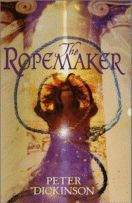
Power corrupts... except when its my power (Books - The Ropemaker by Peter Dickinson)

Peter Dickinson's The Ropemaker was the recommendation of a colleague who enjoys YA fantasy and since I too am an occasional fan, I decided to try it on for size. Written in 2001, it is now out of print so I decided to keep my eye out for likely bookstores on my recent Midwestern tour figuring that, in New York City bookshop stocks of a printing would be gone through quickly as demand is high but in a more out of the way place, it would take longer for a shop to sell out. My logic was rewarded. In the one independent bookstore in Charleston, West Virginia, there sitting on the shelf of the Young Adult section was a lone copy of The Ropemaker.

I wish I could say that I felt my patient search had been rewarded, but my reaction to this book was lukewarm. It offered me neither the commercial appeal, good characters, adequate writing and excitement of the Harry Potter books nor the higher brow adventure of His Dark Materials. The Ropemaker concerns Tilja, a girl in a family of magical women, with no powers of her own who must go on an expedition on whose outcome the very future of humanity depends. Needless to say, she find that her own powers, though different from those she sees in others, are far from useless, meets a young boy her age, and grows up along the way. The book is peppered with a lot of quasi-spiritual platitudes about what people were meant to do or descriptions of what I guess I would call intuition:
Her thoughts, if you could call them thoughts, were a muddle of astonishment and grief...

She couldn't possibly see the faint tracks they had so far been following, but her feet seemed to know the way.
Evidently learning ones magical powers involves a lot of experiences in which thought is insufficient and indeed in which individual body parts sometimes know a great deal more than our intellect. This was a recurrent refrain.

I read this book as an allusion to the idea that power corrupts and absolute power corrupts absolutely. An elderly ruler with lots of power (magic) attempts to keep order by regulating the use of magic with officials called Watchers, who themselves must have a lots of power to regulate the power of others. Consequently, the populace lives subjugated by fear and a hierarchy of petty bureaucrats with lesser power do what they can to feel on top of those below them by making threats and exacting bribes.

Tiljia's most important lesson is to learn of the alluring influence of power:
With a shock she realized that she was experiencing something she had never imagined, a sense of absolute power. All these people, even a great lord of the Empire, even the Emperor himself, were under her control. They could move, or not, as she chose. The thought was oddly frightening. If you had the power you wanted to use it. This must be what magicians were like, all the time.
This is the strongest part of the novel, though I found its execution pedantic and obvious. Perhaps I would have been a more forgiving reader at 12 - 15 years old, but generally I find that when a writer writes up to young readers instead of down, they rise to the occasion. The pacing of The Ropemaker was lugubrious, characters were sketched in generalities rather than specifics, and the narrative was bloated. I wish I could say I enjoyed the book more but this one was not a winner for me. Regardless, I thank my friend for the recommendation. I always like trying out books smart people like, even when I don't. Dickinson has won a number of awards, so others obvious don't share my opinion. Anyone else out there who has read something of his they enjoyed?

Thursday, June 10, 2010

Can I have your autograph?

btt button

Do signed copies excite you? Tempt you? Delight you? Or does it not matter to you?


Signed copies don't affect the content of a book, so in that way I can take or leave them, but they do make the book as physical object more exciting. If I like a book and author, and I like to own books (and I do) then having a signed copy enhances the pleasure of that ownership. I have even stood in line to get a copy of a book signed (Ethan Canin and Sasa Sanisic are the two authors I recall doing that for). I also think that a signed copy makes a good gift. I already like giving books as gifts and it makesa book a little more distinctive. It personalizes it.

Wednesday, June 9, 2010

Fiction upcoming...

On our recent travels, friends living near Indianapolis took us to a nearby town called Noblesville (pop. 28,500). Unfortunately it's claim to fame was a high KKK membership at one point, and a number of lynchings held in front of their courthouse, a lovely looking building now historic for this sad reason. Despite this, its two antique shops had a number of interesting books. One I had never heard of:

Anatole France's Penguin Island. My edition of it is an English translation published by Blue Ribbon Books in 1909. It's on lovely yellowed hand-cut pages with a lot of cotton content. Each chapter begins with an ornate dropped capital letter, decorated with a design that looks like a wood cut. The story is about a monk who comes upon a society of penguins who have, as the book jacket says
become endowed with the immortal souls of men and forthwith begin the establishment of a new code of manners and customs. Under the guise of penguins, Anatole Frances satirizes the institutions of men...
It seems writers in the early 20th century had to disguise stories that were highly critical of their readers by setting them on another planet or making them about another times period or another species. Good thing we don't have to do that now.

The other book is one I had vaguely heard of, World So Wide, by the prolific Sinclair Lewis, the author of 22 novels and 3 plays in his lifetime. This novel was his last and is set in Florence. It looks like a September romance and is billed as "slashing satire." My hard back copy is in lovely condition. Not exactly antique, it is from 1951.

Two tangible treasures from our travels give me some more fiction to look forward to this summer.

Sunday, June 6, 2010

Always there at the collision of cultures... (Books - Travels with Herodotus by Ryszard Kauscinski)

When Poland still sat behind the iron curtain, Polish journalist Ryszard Kapuscinski traveled to far flung countries both Eastern and Western - Iran, Egypt, India, China. Early on he reported for the Soviet-run press services but he is now remembered as having been the writer of observant, beautifully written, book-length pieces of journalism about places most of his countrymen would never see - generally distant and sometimes dangerous places undergoing some political unrest or outright revolution. Many of his travels were made with Herodotus's 2500-year-old The Histories in tow. Kapuscinski's Travels with Herodotus looks back on his travels using The Histories as a lens through which to reflect on what forces influence the formation of a country from a clan or a culture from a country, and what happens when those cultures collide.

Thrust into India in the early 1950s with only Polish and Russian, he took both solace in and instruction from Herodotus:
Cast into deep water, I didn't want to drown. I realized that only language could save me. I started to think about how Herodotus, wandering the world, had dealt with foreign languages. Hammer writes that Herodotus knew only Greek, but because Greeks at the time were scattered over the entire planet, had their colonies, ports, and factories everywhere, the author of The Histories could avail himself of help offered by the countrymen he encountered, who serves as his translators and guides... I approached India not through images, sounds, and smells, but through words; furthermore, words not of the indigenous Hindi, but of a foreign, imposed tongue [English], which by then had so fully taken root here that it was for me an indispensable key to this country, almost identical with it. I understood that every distinct geographic universe has its own mystery and that one can decipher it only by learning the local language. without it, this universe will remain impenetrable and unknowable, even if one were to spend entire years in it.
Spoken like a writer.

There are three qualities Kapuscinski brings to his work that make him the ideal revealer of places. From reading his Imperium I thought that one was fearlessness, but this memoir reveals that that was not true. It was more like a nearly guileless innocence that seemed to bring him smack into the center of dangerous situations.
Once, as I was leaving the hotel, one of these people stopped me and asked that I follow him - he would show me an old mosque (I surmised that the man was one of them, as he always stood in the same spot, surveying what was probably his beat). I am by nature quite credulous, to the point even of regarding suspicion not as a manifestation of reason but as a character flaw; now the fact that an undercover agent proposed a visit to a mosque instead of ordering me to report to a police station brought me such relief - joy, even - that I agreed without a moment's hesitation.
The second was the recognition that he has much to learn about other people. The third was a quality that he brought to finding out about them - that is a curiosity coupled with imagination. The result is that what he sees on his travels or what he reads in Herodotus generates questions about the place he is in or the people he is with, questions about the specifics of their circumstances or their internal life. For example in reading of Herodotus:
What sort of child is Herodotus? Does he smile at everyone and willingly extend his hand, or does he sulk and hide in the folds of his mother's garments... Is he obedient and polite, or does he torture everyone with qeustions...and in school? With whom does he share a bench? Did they seat him, as punishment, next to some unruly boy? Or, the gods forbid, a girl? Did he learn quickly to write on the clay tablet? Is he often late? Does he squirm at lessons? Does he slip others answers? Is he a tattletale?
As he reads Herodotus on the sixth century Babylonian uprising against the Persians:
Once their rebellion was out in the open, this is what they did. The Babylonian men gathered together all the women of the city - with the exception of their mothers and of a single woman chosen by each man from his own household - and strangled them. The single woman was kept on as a cook, while all the others were strangled to conserve supplies...

Our Greek says nothing more about this mass execution. Whose decision was it? That of the Popular Assembly? Of the Municipal Government? Of the Committee for the Defense of Bablylon? Was there some discussion of the matter? Did anyone protest? Who decided on the method of execution - that these women would be strangled? Were there other suggestions? That they be pierced by spears, for example? Or cut down with swords? Or burned on pyres? Or thrown into the Euphrates, which coursed through the city?

There are more questions still. Could the women, who had been waiting in their homes for the men to return from the meeting during which sentence was pronounced upon them, discern something in their men's faces? Indecision? Shame? Pain? Madness?
Travels with Herodotus is chock full of these waterfalls of marvelous questions. That is what encounters with history generate in Kapuscinski, and that is why he is such a marvelous writer - an artists, really - about the things which generate countries and cultures. They remind me of the kind of the questions actors and directors ask in order to translate the generalities provided by scripts into the specifics of behavior. They are the means Kapuscinski uses to make abstract ideas observed about places most of us have never been into human terms, recognizable to the reader as close to their own. Kapuscinski introduces many such ideas - the notion that the construct of culture is at base an aristocratic one, or this one, probably my favorite:
If reason ruled the world, would history even exist?
Travels with Herodotus is not a light read, but Kapuscinski's jaunty voice and his adventures provide rich insights on the world we live in and that is why I love reading him.

Friday, June 4, 2010

Virginia Woolf has nothing to be afraid of (Theatre - God of Carnage by Yamina Reza)

I went to the theatre for the first time in, oh.... more than 8 months, last night. This from someone who used to work in the field and see three shows a week! How wonderful to live within 25 minutes of Broadway and have smart bill of fare with great casts the likes of Jeff Daniels and the inimitable Janet McTeer. The play was Yasmina Reza's God of Carnage. She wrote Art, a provocative philosophical play about the nature of the title subject that was the talk of the theatre scene in the mid 1990s. Last night's play had everything I tend to like in an evening at the theatre: serious moral questions, demands that the actors invest deeply in their circumstances, good roles served by able actors, it did not rely on a lot of spectacle - so why didn't I like it? It was because the play had little imagination, it relied on cliched rather than idiosyncratic ideas of people, and because, although its stakes were high, neither the writing nor the acting was quite up to delivering them authentically.

God of Carnage concerns two well-to-do New York couples (at least in this translation by Christopher Hampton. I would actually like to know if the French version is set in Paris and Hampton's West End version in London, with their particulars) whose young sons get into an altercation. One breaks two teeth of the other, although this act was likely provoked, it was a verbal act that precipitated the physical one. The parents get together in a gesture of working things out amicably and the evening devolves into a violent free-for-all in which the enlightened foursome become drunk and abusive themselves and, ostensibly, show their true colors, which are more savage than their children's. The play attempted to address "real" circumstances in current up-scale New York life, but was really more what you might think New York were like if your only experience of it was from Sex in the City. Honestly, this was some television idea of Soho or Upper East Side whining at its worst. Cell phones. Lawyers defending evil pharmaceutical companies, money buying couples beautiful furnishings and overpriced tulips from the Korean deli on the corner, but not buying them love. Its hyper-reality rendered it mundane. Who cares? I guess the average theatre goer probably cares because they are generally over 60 and from a high income bracket or are Broadway tourists (no offence meant) . But this play certainly did not reflect my life or the life of my friends with children, not even taking into account the fact that it carefully subtitles itself a "farce." Is that supposed to mean that we don't take its moral quandries seriously?

The s biggest joke of the evening is that one of the monied foursome barfs uncontrollably for a time. This, of course, requires a theatrical solution, since it is unreasonable to ask an actor to throw up every night. Barfing on stage or screen is a pet peeve of mine because a) it is a cliche and b) it is one of those things that the audience KNOWS is not true. Dying falls into this category too and plenty of characters in dramas do that, I know - but that is trying to address the ultimate mystery - the end of life. There is something about the basic truth of throwing up that means everyone knows you're faking it. And unless everything else the character is doing is absolutely believable, it throws the authenticity of the entire performance into question for me. If Lucy Liu had been up to the rest of the emotional requirements of her role, maybe I might have been more forgiving, but she was hard pressed to yank herself up to the dramatic demands of her barfing agony, subsequent drunk scene, and the gorgeous monologue that Yasmina Reza wrote and that is sure to become a staple of the audition scene for 40 something actresses for the next couple of years. Dylan Baker was adequate as her husband. Janet McTeer was emotionally available though sometimes strained. It was only Jeff Daniels who showed great insight and admirable vulnerability to the circumstances, an intelligent choice as he was ultimately meant to be the least feeling of the bunch. But the writing seemed to demand impossible reactions given the circumstances and the acting, understandably, was not able to justify it. Although I was happy that a play was exploring the circumstances it did and was able to laugh at some of the jokes, I didn't buy God of Carnage . Reza cannot have been innocent of the references she made to Edward Albee's great play Who's Afraid of Virginia Woolf - a foursome with marital problems who get drunk of an evening and reveal far too much about themselves while slaughtering contemporary values, but the homage she pays does not does not reach the level of its object of admiration either in terms of histrionics or lyricism.

Thursday, June 3, 2010

My drug of choice...

btt button

Which do you prefer? Short stories? Or full-length novels?

I enjoy a good short story, have been moved by them, interested by them, and admired them. They are a great way to study the art and craft of writing as the whole work can be taken in at a sitting and multiple readings can easily be compared side by side. Some of the best writing I have read has been in shorter works by Ethan Canin, Lorrie Moore, Anton Chekhov, Thomas Mann, Dostoevsky, Andre Dubus, and Alice Munro. I also feel I come at my critical appreciation of a short story differently than a novel because they are the fictional form I have tried my own hand at, but nothing sustains me like a good novel. Though I admire short fiction, it does not generally possess the scope of a novel because there is less room for development. Even with the most economical writing, the reader isn't spending as much time with the the characters, events, and ideas of a story. The greatest works I have read, the stuff that has convinced me that I knew the characters intimately, that has shattered me, that has comforted me, that seems to have changed my life, have been novels. Novels are my drug of choice.

Wednesday, June 2, 2010

Disaffection doesn't pay... (Books - A Week in December by Sebastian Faulks)

Hmmm, so much for checking in... Returned today from points both Mid Atlantic and Midwest. A little road trip starting in Wisconsin, through Illinois and Indiana, Kentucky, West Virginia, ending up in Pennsylvania at a great little log cabin/b&b. Much seeing of friends and family, (and one fellow book blogger!), and a little bit of post-semester relaxation on our own as well.

It should be no surprise that I managed to read (and find) a few books as well! Despite the fact that things did not turn out precisely the way I thought they would in my first post on Sebastian Faulks's A Week in December, my opinion did not change much as I read the remainder of the novel. The segments concentrating on each of the broad cast of characters were lengthy enough to flesh out their circumstances with some care, but I found the novel carelessly repetitive of details - even if it was just at the level of two completely different characters eating the same dinner (pasta and orange juice). The most interesting development was the theme of alienation that is the crux of this novel. Faulks compares one character's schizophrenic delusions:
"His belief in his world was more secure than my belief in ours. I mean, I feel pretty sure that you are sitting here and that your name is Jenni and my name is Gabriel and that this is London, that's a window and so on. But I do have room for doubt... That's the difference. Adam has no doubt. His cosmos is fully understood. He receives instruction from voices whose reality is stronger than mine is to you..."
With another's involvement in the allure of Muslim fundamentalism, with another's involvement in the world of virtual relationships in an on-line game, with yet another's investment in credit default swaps:
"Then the bank was laying off its own risk anyway. And They still had plenty of buyers for this shit, some of whom were happy to take it in derivative form. So for the bank the dodgy part is now cash-neutral and risk free."

"This is fantasy," said Wetherby.

Veals's lips twitched. as though they wanted to smile. "That not all. Now this is the tricky bit, Siomon. Concentrate. Get through this and you can go and ring Susanna Russell from HSBC and take her out to lunch. After this bit, it's all laughts. OK. The thing is that every time Johnny wrote me or others like me an insurance on a triple-B bunch of shit, he effectively created a new security. Then he put all these securities - the credit default swaps - into a new synthetic bond, which he could then trade on! More commission, more profit, and the market goes on. It's fantastic...The only asset backing this synthetic bond was my side bet with the bank. Trouble was, there seemed to be no liquidity in these synthitic CDOs. They stuck to the banks' fingers."

"Christ, John," said Wetherby. "It sound like this fantasy football game my son plays. Does your son do that?"
So what do you think. Is Wetherby a well integrated character whose life we care a great deal for at the novel's end, or is he a throw-away character whose soul purpose is to allow this narration to serve as a thinly veiled expository economics lesson? If you chose the second option, you would agree with my reading of this novel.

That's what A Week in December added up to for me. Lots of thin devices trying to do their well-intentioned duty on a checklist of current affairs topics: reality TV, on-line gaming, credit default swaps, and disaffected youth being drawn to Muslim fundamentalist cells and becoming willing to sacrifice their lives in acts that terrorize the innocent. It's hard to write an entertaining novel about disaffection, and Faulks succeeds in doing that, but only barely. I trudged through it dutifully, I'm not even sure why. Perhaps because Faulks has a talent for creating characters who come to life through the details through which he wrought them. And that's no mean feat - two points for that - but in the end I found A Week in December's ambitions in integrating each and every concern of our daily lives overwhelmed the craft of involving those characters in compelling circumstances that felt real. The novel never really unlocked that door after which reading becomes an effortless flow.

I also read Ryszard Kapuscinski's Travels with Herodotus - a beautiful travel book to accompany my own travels. More on that in the next day or two.

Friday, May 21, 2010

Off to parts Mid-west...

Off for a brief tour of the American heartland, including the places pictured below. I won't post as often as usual in that time, but will try to check in. Expect me back around the beginning of June.

Restless, Altmanesque montage of disconnected lives (Books - A Week in December by Sebastian Faluks)

This is my first encounter with best-selling British writer Sebastian Faulks. So far his latest, A Week in December, reads like a restless montage of contemporary ephemera - a literary equivalent of, say, the film Crash - reflecting the breadth of contemporary London life and its preoccupations - credit default swaps, multiculturalism, gaming with on-line avatars, and terrorism. He quick-cuts between segments (of substantial length) from the lives of a young woman who is a train-driver on the London underground, a hedge-fund manager, a young man in an islamist terrorist cell, a teenager who does nothing but smoke pot, eat pizza, and watch so-called reality television, and a few others, following their lives over a single week as their existences slowly converge in what feels likely to be disaster. This Robert Altmanesque technique does not shortchange the reader on detail within the individual segments. In fact, Faulks has accumulated scads of them which, as I read, I can't help thinking of how mind-numbingly specific to our own time they will become in about five minutes. Yet, the meta-story is told the through the confluence of these stories, which make for their own evocative rhythm that feels as though the segments are being viewed on simultaneous screens - hence the allusion to Crash - and whose appreciation is not particularly harmed by missing any particular detail of an individual segment.

Living post market crash and post the recent Times Square bomb attempt, I feel as though I've paid for a ride on a roller coaster, knowing the tracks will end abruptly and that it will fling me into the abyss, and yet I read on with a strange curiosity for how he will fling me there. The most pervasive theme I'm struck by in these individual narratives is one of the interpersonal distance inherent in our crowded lives, how much substantive human contact has reduced as we claim to be better connected and better informed - watching television that claims to be about "real" lives.

Jenni, the train driver, lives most of her life beneath the streets of London in the driver's cabin of the Circle Line. When released after her shift she is eager to get home to her gaming, where she assumes a false name and meets other substitute identities:
She had not gone far before she encountered a man. He had cargo pants to the knee, bare torso and multiple piercings. His skin was light brown, though most of it was covered in tattoos; he carried a Uranium credit card (the highest rating) and a submachine gun in his right hand.

Jenni sighed. This was not the kind of man she would have chosen, but she had learned that it was pretty much standard dress for men in Parallax. Most of the maquettes were scary and you just had to remind yourself that they might in reality be women or children - you absolutely could not rely in appearances; you had to disbelieve your eyes.
Finn, the teenage TV addict watches a television interview with a schizophrenic:

For the last fifteen years, Alan had been without a permanent home. He said he hadn't liked the hospital, it was loud and dirty, but at least he'd felt safe there.

"So," said Terry O'Malley, "as far as your accommodation's concerned, it seems you're in two minds about it."

The audience laughed. "Schizophrenia...in two minds..." O'Malley underlined his joke for the slower ones.

"That's not what schizophrenia means," said Alan. "That's a misunderstanding. It's nothing to do with a 'split personality' or -"

"Sorry," said Barry Levine. "Which one of you said that?"
The characters in these parallel stories watch television to get the stories of real people, but they don't actually listen to them. They connect to tattooed gangsters and don't really know who they are. This is a world about being disconnected from each other and from our senses - the equipment that we have to collect information about the world and make predictions about behavior given what we can know about what exists outside of us. The only people alert to the details of their surrounds in this novel are those who want to place bombs in public places or who wish to make personal fortunes at the cost of billions in others' pension investments. This is our world, in case you didn't recognize it.

Wednesday, May 19, 2010

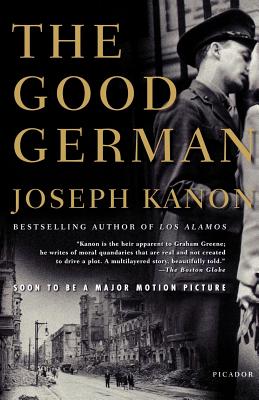
Moral ambiguities in post-war Berlin (Books - The Good German by Joseph Kanon)


Joseph Kanon has been compared to Graham Greene, and having just read The Good German I can see why. He explores moral questions in a context where the political meets the personal but does so in a format that is recognizable as entertaining - the thriller. Kanon's plot doesn't baby the reader. It is intricate and he does not over-explain the action in a step-wise fashion - a quality I appreciate. Instead, events unfold fluidly through behavior and dialogue, their ambiguities intact. The setting of The Good German is just post-World War II Berlin. The concentration camps have been emptied. Berlin is rubble and the British, the Americans, and the Russians have carved it up into zones and are struggling over how justice can be wrought on the Germans. That's the political part of the story. Into this setting falls the body of an American soldier. No one knows who murdered him or why but a great deal of money is found on his corpse and American reporter Jake Geismar is not content to leave the story alone. That's the mystery/thriller aspect of the story. The book asks one question, the Germans were clearly responsible for the war but who do you hold accountable? The military sent to Berlin to clean up the mess seem to find that, beyond the Nazi party leadership and the camp guards, everyone else seemed to have been following orders or trying to stay alive. No ordinary individual German seems to think they had any culpability. Is a greifer (a spy who turned Jews and other criminalized groups in to the Nazi's) guilty? Even if they are Jewish themselves? How about a scientist who collected statistics for the experiments conducted on unwilling human subjects in the camps? That is the moral part of the story. In addition, Geismar left behind in Berlin a married woman with whom he had an affair and wants to know if she is still alive. That's the love part of the story and in Kanon's hands these four threads of this book blend unselfconsciously. His prose is entertaining but not too brisk at the outset. He takes his time developing the stories and their actors. His dialogue is clipped, sparse, and believable, the moral and political ambiguities are neatly plotted and make good drama, the history is accurate and detailed, and he is good at suspense too. In the last 100 pages there is a terrific escape and chase scene - a real white-knuckler. This is a book that just screams movie - and evidently it was made into one, although I haven't seen it. Have any of you?

Tuesday, May 18, 2010

Things are looking up!


Good news! John Tierney has an article in today's Science Times on Matt Ridley's new book The Rational Optimist. Its thesis is that homo sapiens are unique not because of bigger brains, nor because of our ability to cooperate, but rather because we created ways to exchange goods and information.
"The extraordinary promise of this event was that Adam potentially now had access to objects he did not know how to make or find; and so did Oz," Dr. Ridley writes. People traded good, services, and most important, knowledge, creating a collective intelligence..."
This lead to circulating the knowledge of domesticating crops, the development of alphabets, and number systems and, Ridley argues, the creation of measured time, because the worth of a good or service was measured in how long a person would have to work to pay for it. One might also argue that it circulated small pox and MacDonald's but that isn't mentioned.
"The modern world is a history of ideas meeting, mixing, mating and mutating and the reason that economic growth has accelerated so in the past two centuries is down to the fact that ideas have been mixing more than ever before."
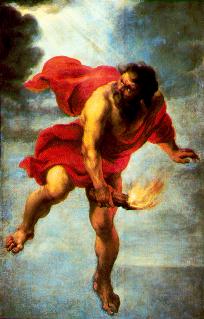
His prediction is the spread of prosperity and happiness and the decrease of disease and violence. I will have to read the book to find out how he goes from point A to point B, and Tierney's piece certainly makes me want to, but I am not sure how mixing inevitably leads only to the progress of good things and the decrease of bad. One might argue that innovation is more likely to diffuse information, that is, that it will spread randomly until it becomes equally distributed. Is knowing more always better? The myth of Prometheus, pictured above, argued otherwise. What happens when bad things spread? The spread of what knowledge we have is inevitable, but is the eternal increase of knowledge inevitably positive? What happens the day that that knowledge includes the certainty of the destruction of our planet or the extinction of our species? But Ridley is a wonderful thinker and writer and amidst crashing markets, bombings, and the growth of the Tea Party, some unbridled optimism is welcome.

Thursday, May 13, 2010

Dolphins are shallow

You may have heard that dolphins are the most intelligent species in the animal kingdom (aside from us brilliant creatures). They may be cute when balancing balls on their noses, but that theory has been seriously debunked. I am so disillusioned!

Via The Loom, thanks Carl.

Wednesday, May 12, 2010

Reading with recycled neurons (Books - Reading in the Brain by Stanislas Dehaene)


Reading in the Brain by Stanislas Dehaene is a readable account of how the reading brain works, as well as how it doesn't.  Given the fact that printed text is a relatively recent human invention and, given the time scale of evolution, the brain could not have evolved specialized structures for reading per se but rather has adapted structures that evolved for more general visual purposes and applied them to this specialized task which combines seeing and recognizing objects and the reception of the abstract thoughts of another person. The form of letters have little to do with the meaning they ultimately communicate. As a result it has become the work of seven to ten of our earlier years to learn rote the relationship between our culture's symbols representing the units of sound (phonemes).  These are combined into (words) from which we generate continuous phrases and sentences which accomplish the transfer of information and point of view. This is done at a minimum with some coherence, if not also some beauty, and the composer of those same units of meaning doesn't even have to be around to explain himself. It might seem roundabout that printed text has to take a two step journey from sound to meaning rather than going straight to meaning, but this is what allows language to communicate abstract thought:
I suspect that any radical reform whose aim would be to ensure a clear, one-to-one transcription of English speech would be bound to fail, because the role of spelling is not just to provide a faithful transcription of speech sounds. Voltaire was mistaken when he stated, elegantly but erroneously, that "writing is the painting of the voice: the more it bears a resemblance, the better." A written text is not a high-fidelity recording. Its goal is not to reproduce speech as we pronounce it, but rather to code it at a level abstract enough to allow the reader to quickly retrieve its meaning.
The brain accomplishes this remarkable feat, Dehaene tells us (without even being there), via two pathways that operate simultaneously when reading is fluent. One path transfers the letter-string to it sound content (and the motor requirements of our making that sound with our vocal apparatus) prior to its meaning, and the other that goes for the identity of the word first and then the sound. A great number of pages in the book is spent on discussing the fruits of Dehaene and his colleague Laurent Cohen's labors identifying the left hemisphere's visual word-form area, a region of the brain whose purpose seems to be to be the visual analysis of the symbols that make up letters and words irrespective of their superficial differences. That is to say we can read word, WORD, or even WoRd equally easily and can tell the difference between ANGER and RANGE. You can see the visual word-form area in the picture representing the relative activity of regions of Dehaene's reading brain below, its the area right above his ear. There are other areas that accomplish the conversion of printed text into units of sound, still others that agree on the meaning of the assembly given not only its form but its context.
The typical right-handed person's brain has developed most of its key language processing areas in the left hemisphere (left handers are less reliable in this regard). This is true whether the personn reads from left to right or right to left and whether they read an alphabet whose symbols map to units of sound (as in these roman letters you are reading right now) or comprise pictures of whole words (as in logographic alphabets like Chinese). Dehaene, in fact, explores the evolution of different writing systems from pictoral markers in depth as he builds his case for how the human brain evolved the skill of reading, a section of the book I very much enjoyed.

Much of this case centers on the brain's ability to adapt cortex to multiple functions, something he calls neuronal recycling.
We would not be able to read if our visual system did not spontaneously implement operations close to those indispensable for word recognition, and if it were not endowed with a small dose of plasticity that allows it to learn new shapes. During schooling, a part of this system rewires itself into a reasonably good device for invariant letter and word recognition.

According to this view, our cortex is not a blank slate or a wax tablet that faithfully records any cultural invention, however arbitrary. Neither is it an inflexible organ that has somehow, over the course of evolution, dedicated a "module" to reading. A better metaphor would be to liken our visual cortex to a Lego construction set, with which a child can build the standard model shown on the box, but also tinker with a variety of other inventions.

My hypothesis disagrees with the "no constraints" approach so common in the social sciences, according to which the human brain is capable of absorbing any form of culture. The truth is that nature and culture entertain much more intricate relations. Our genome, which is the product of millions of years of evolutionary history, specifies a constrained, if partially modifiable cerebral architecture that imposes severe limits on what we can learn. New cultural inventions can only be acquired insofar as they fit the constraints of our brain architecture.
In the book's final chapter, Dehaene discusses cortical plasticity - a neuroscientific idea that is relatively recent and much in vogue.  It is the ability of brain's neuron's to adapt their function from one purpose to another - for example, when a blind person's visual cortex cells become able to decode sensation of the fingertips to braille letters.  Dehaene makes a case for the necessity of cortical plasticity in inventing cultural forms like number systems and the arts. It's one of those fun bits of reaching for the stars that a researcher has to save for when they write a book rather than a journal article. His voice comes off a little stuffy at times, but his theory is intricate - composed of many interleaving units - so his writing must be systematic in driving home each concept and then attaching is to its predecessor. His model for how the brain accomplishes reading, I must emphasize, is one of several, but he does acknowledge alternate viewpoints along the way. The lay reader may not find this book as accessible as Maryanne Wolf's Proust and the Squid, but it goes into more depth and synthesizes a lot of information into a coherent narrative arc. His diction is clear and the reading experience fluid and even entertaining. Dehaene's work is at the cutting edge of our understanding about the relationship between language and the brain so I found it a pleasure to get the story from one of its sources.

If you in or around NYC on Thursday March 13 at 6pm, join me for a film about dyslexia called THE BIG PICTURE: RETHINKING DYSLEXIA.  Click here for information.

Thursday, May 6, 2010

Triple-threat

btt  button

So … you’re halfway through a book and you’re hating it. It’s boring. It’s trite. It’s badly written. But … you’ve invested all this time to reading the first half. What do you do? Read the second half? Just to finish out the story? Find out what happens? Or, cut your losses and dump the second half.

If the book is trite, boring, and badly written I doubt I would have gotten half way (unless it's only 100 pages long - I'm willing to give most bad reading experiences 50 pages). There is no question for me on this point - dump it. What am I reading for? Fun, enlightenment, information - whatever the case - it's all for me. I have no obligation to anyone connected with my reading. Even if I have received the book for free to review I won't finish it (in fact, especially then, as I am trying to give an honest reaction to what I have read and it is usually something I would never have read in the first place). Who am I kidding? The author is not hanging around waiting for my opinion, ARCs are publicity, kids. I don't read for my many adoring fans, much as I love them both. Two exceptions - reading for school, I almost always complete assigned reading unless I am simply tortured by it, and reading something written by a friend, although my friends don't usually write things that are trite, boring, and badly written. They don't tend to sin in threes. Where I might sit on the fence is if a book has a dull subject but is brilliantly written (I almost never find this to be the case), or has a killer story but is written in illiterate fragments or a string of endless cliches. Even in these cases, I don't agonize over not finishing a book. Closing doors is healthy. There are enough choices to make in this information-saturated world and ruling one out lightens the burden. Lastly, although I sometimes talk about investing time, an economic metaphor in this case isn't entirely appropriate. If I have invested $1000 in a stock and it disappoints me by going down, to not sit it out means I have lost my money. Having spent a few hours in reading the first half of a book - if it was a good investment, then my time was not a wasted regardless of whether I continue or I stop. If it was obviously not a good investment from the get-go I shouldn't have read so far (and generally I don't). I may invest time to read, but it is only by continuing to invest it when I am getting nothing in return that I experience a loss. That is the reason I don't agonize about pulling out, there is only a cost for continuing. If a book is good enough to make me wonder whether, if I read on, it would improve then there is something compelling in it and I should consider the pleasure of that anticipation its own reward. Any way I look at it, reading is sheer indulgence and I'm going to trust my taste and follow my pleasure since I can't do that as relentlessly in most other areas of life.

Sunday, May 2, 2010

Brutal power in a quiet package (Books - The Debut by Anita Brookner)


Anita Brookner's The Debut was her's in the fiction world (she had written art history prior to writing fiction); it was as well my first encounter with her writing, and I was pleasantly surprised. I had been led to expect the repressed work of a bookish spinster, but my experience of this novel about a young woman who has escaped into books to avoid the tyranny of her indulgent actress mother and clueless father, was of a literate mind which energetically subjugates words to its bidding to produce a wry, bittersweet story with acutely etched characters. Her's is a piquant voice, with a clearly defined moral stance, one whose observations are without mercy but also full of humor.

Dr. Weiss, at forty, knew that her life had been ruined by literature.

In her thoughtful and academic way, she put it down to her faulty moral education, which dictated through the conflicting but in this one instance united agencies of her mother and father, that she ponder the careers of Anna Karenina and Emma Bovary, but that she emulate those of David Copperfield and Little Dorrit.

[...]

And yet she had known great terror, great emotion. She had been loved, principally b a leading philologist at the Sorbonne, but that was not her story. Her adventure, the one that was to change her life into literature, was not the stuff of gossip. It was, in fact, the stuff of literature itself. And the curious thing was the Dr. Weiss had never met anyone, man or woman, friend or colleague, who could stand literature when not on the page.

Her writer's eye seems hungry to land to alight on the unsuspecting scene and have at it, producing some delicious set pieces, like this one of George and Helen's (the parents) arrival in Brighton for their first holiday in years:
... The taxi had unloaded George and Helen into a maelstrom of returning holiday makers, a world they did not know existed: Elderly men with veins standing out on their foreheads trying to cope with five suitcases, elderly women with swollen feet and glistening white cardigans bought especially for the holiday, enduing the fright of a lifetime in order to enjoy the pleasure they had promised themselves all through the winter, too many children, shrill with tiredness, their long hair sticking to their damp faces, their mouths smeared and stained with sweets and ice lollies, none of them aspiring even to the relative comfort of a taxi, but queuing patiently for buses, shifting their burdens from hand to hand, trying to quiet the children, longing for that cup of tea at home, safe at last for another year.
Doesn't that paragraph makes you feel sticky with the grime of a long journey? Brookner's writing can appreciated for its precision, its delicious topography, its consistency of outlook, and its ability to call up visceral experience. There is another similarly potent paragraph on caring for an elderly invalid that is a gem.

The writer Brookner most calls to mind for me is Cynthia Ozick, also a consummate crafter of memorable characters, her experience deeply steeped in the close reading of literature, and a writer of darkly funny novels. Apparently this novel is somewhat autobiographic and since Brookner decided to make the switch from art history to fiction, she has turned out something like 25 of these 200-page works at the rate of one per year, according to this Paris Review interview with her. The Debut had a brutal power in a quiet casing - like someone wielding a sledgehammer encased in soft batting. I am admiring both of Brookner's skill of observation and the delicious prose with which she delivers them up. Do any of my readers have a Brookner favorite they recommend I read next?

Saturday, May 1, 2010

Anita Brookner on writing...

In anticipation of writing about Anita Brookner's precisely observed, and sardonic The Debut in the coming days, here is a Paris Review interview with her from 1987. Very exacting in her moral outlook and somewhat rigid in her thinking, she started writing novels in her 50s and has produced one per year. This is the first of her's I have read. Great writing - a potent voice that envelops one in the world of her characters. It is fascinating, as always, to read of her process and her influences.