Saturday, November 10, 2012
The limits of genius (Books - Measuring the World by Daniel Kehlmann)
Sunday, November 4, 2012
The riches and burdens of family legacy (Books - The Scientists by Marco Roth)

Another New York story was the subject of The Scientists by Marco Roth (Farrar, Straus and Giroux, 2012) which I was convinced was a novel, but turns out to have been a memoir. It tells of a thirty-something New Yorker whose father, a medical researcher, contracted the HIV virus in the 1980s.
Monday, October 29, 2012
Growing up minus the childhood (Books - Down the Rabbit Hole by Juan Pablo Villalobos)

Some people say I'm precocious. They say it mainly because they think I know difficult words for a little boy. Some of the difficult words I know are: sordid, disastrous, immaculate, pathetic, and devastating. There aren't really that many people who say I'm precocious. The problem is I don't know that many people. I know maybe thirteen or fourteen people, and four of them say I'm precocious. They say I look older. Or the other way around: that I'm too little to know words like that. Or back-to-front and the other way around, sometimes people think I'm a dwarf. But I don't think I'm precocious. What happens is I have a trick, like magicians who pull rabbits out of hats, except I pull words out of the dictionary. Every night before I go to sleep I read the dictionary. My memory, which is really good, practically devastating, does the rest...
Sunday, October 28, 2012
Being rich ain't all its cracked up to be (Books - The Patrick Melrose Novels by Edward St. Aubyn)

 Alcohol addiction,heroin addiction, incest, your father's public humiliation of your mother - seems a small price to pay for unconscionable wealth and a villa in Provence, no? Patrick Melrose grows up with a seemingly unreasonable share of horror on the one hand and neglect on the other, which lead to a sense of aimlessness, some very persistent chemical dependencies, and an extraordinary amount of self-disgust. Thank goodness Melrose becomes reflective enough so that this account of his first 45-or-so years is more than a parade of ghoulish abuse. Indeed, Edward St. Aubyn's Patrick Melrose novels: Never Mind, Bad News, Some Hope, Mother's Milk, (The Patrick Melrose Novels, Picador, 2012) and At Last (Farrar, Straus and Grioux, 2011) are mercilessly observant of a world of advantage and indulgence, while at the same time being brutally funny. Their narrative arc traces the legacy of cruelty and narcissism that first mangles and imprisons the mind of its protagonist and eventually liberates it over nearly 900 pages that read like wild-fire consuming the lavish homes of Southern California millionaires, only here, most of the residents seem unwilling to leave their burning homes. The events were sometimes so dreadful that I had to remember to close my mouth, which hung agape. So precise was the scrutiny St. Aubyn gave his characters, it was like looking at a collection of extraordinarily insects, still alive, pinned inside a luxurious display case. But the cruelty is ultimately redeemed by a vision that is humane, even forgiving, but never pacifying. Having read the first four novels collected in a single volume, as I reached the last word of Mother's Milk, I said aloud 'Oh my god,' and went out the next day to buy At Last, which had recently been published separately.
Monday, October 15, 2012
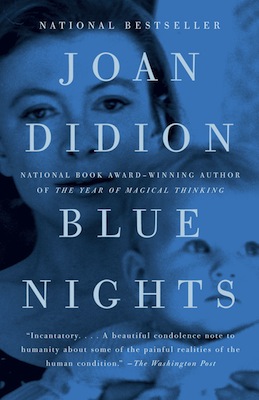
The public voice of our frailty (Books - Blue Nights by Joan Didion)
Saturday, October 13, 2012
Piteable men building their positions of strength on the backs of formidable women (Books - Three Strong Women by Marie NDiaye)

The expectation — whether menacing or well meaning — that NDiaye should “represent” multiracial France, or be considered a voice of the French African diaspora, has often dogged her. In fact, as NDiaye is at pains to make clear, she scarcely knew her Senegalese father, who came to France as a student in the 1960s and returned to Africa when she was a baby. Raised by her French mother — a secondary school science teacher — in a housing project in suburban Paris, with vacations in the countryside where her maternal grandparents were farmers, NDiaye describes herself as a purely French product, with no claim to biculturalism but her surname and the color of her skin. Nonetheless, the absent father — charismatic, casually cruel, voraciously selfish — haunts NDiaye’s fiction and drama, as does the shadow of a dreamlike Africa in which demons and evil portents abound, where the unscrupulous can make overnight fortunes and, with another turn of the wheel, find themselves rotting in a jail cell.
Thursday, October 11, 2012
Re-imagining Shakespeare's fairy kings and foolish mortals (Books - The Great Night by Chris Adrian)

Sunday, October 7, 2012
The story of the 20th century as the search for a 'self' (Books - Any Human Heart by William Boyd)

Saturday, October 6, 2012
Lost it all but rich in "selves" (Books - What is the What by Dave Eggers)

Thursday, October 4, 2012
Negotiating science in politics (Books - The Art and Politics of Science by Harold Varmus)

Returned from places distant, diverting, and delicious
We're back. The Ragazzo took way better pictures than I did. But here are a few of mine from a walk on the Sussex downs, a view of Ljubljana - the capital city of Slovenia - from the castle which overlooks it, and Lake Bled, a beautiful area of Slovenia where we took a hike - you can see the Alps in the background. Misha Matthew correctly identified all of the locations on my Vacate quiz and will be receiving a book on distant lands! Congratulations, Misha.
I didn't actually take any pictures in Venice or London and my pictures from Vienna are pretty boring but the trip wasn't. We managed to get opera tickets in Vienna and see a performance of Elektra and even before we left, we booked tickets for Scenes From an Execution a Howard Barker play from the 1970s about the freedom of the artist. The primary character is loosely based on Renaissance painter Artemisia Gentileschi and the play is being given a new production at the National Theatre in London starring Fiona Shaw and with a favorite English actress of mine - Phoebe Nichols. The British public seems less than happy with the production if the Guardian article I linked above is any indication, but I thought it intelligent and elegantly produced. We ate well in Venice and stayed in some beautiful and unique places. The train ride from Vienna to Ljubljana offers spectacular scenery and an honest to goodness dining car with linen tablecloths and decent, if not elegant, food.
In addition I read 5 novels, so I really have some catching up to do here. In the coming days I will post on David Egger's What is the What, William Boyd's Any Human Heart, Chris Adrian's The Great Night, Marie Ndiaye's Three Strong Women, and Never Mind by Edward St. Aubyn. In fact, I'm in the middle of his Patrick Melrose novels right now and they are brilliantly written, riveting, and hilarious even as the action is mind-bogglingly ghastly. More to follow.


I didn't actually take any pictures in Venice or London and my pictures from Vienna are pretty boring but the trip wasn't. We managed to get opera tickets in Vienna and see a performance of Elektra and even before we left, we booked tickets for Scenes From an Execution a Howard Barker play from the 1970s about the freedom of the artist. The primary character is loosely based on Renaissance painter Artemisia Gentileschi and the play is being given a new production at the National Theatre in London starring Fiona Shaw and with a favorite English actress of mine - Phoebe Nichols. The British public seems less than happy with the production if the Guardian article I linked above is any indication, but I thought it intelligent and elegantly produced. We ate well in Venice and stayed in some beautiful and unique places. The train ride from Vienna to Ljubljana offers spectacular scenery and an honest to goodness dining car with linen tablecloths and decent, if not elegant, food.
In addition I read 5 novels, so I really have some catching up to do here. In the coming days I will post on David Egger's What is the What, William Boyd's Any Human Heart, Chris Adrian's The Great Night, Marie Ndiaye's Three Strong Women, and Never Mind by Edward St. Aubyn. In fact, I'm in the middle of his Patrick Melrose novels right now and they are brilliantly written, riveting, and hilarious even as the action is mind-bogglingly ghastly. More to follow.


Saturday, September 15, 2012
Vacate!
Friends and new acquaintances, we're off to points east for a little bit - a late vacation. Below are the pix of our destinations. The closest guesses (as in most geographically specific) will be entered in a drawing. One winner will be selected when we return (you can live anywhere) . The winner can choose 1 book related to travel or places other than the place you live - fiction or non-fiction, travel, history, world politics, or recipes of distant places - exact details of the offer to follow on our return. Friends, relatives, and others who know our travel plans are not eligible. Answers by email please, not by comment: bookeywookey@gmail.com. Please put 'VACATE drawing' in the subject line. I will, of course, require the name and mailing address of the lucky winner.


Thursday, September 6, 2012
Encore, encore (Books - A Positively Final Appearance by Alec Guinness)

Monday, September 3, 2012
Aesthetics transforms vision and the mind, which transforms aesthetics... (Books - The Age of Insight By Eric Kandel)

The eminent Nobel-Prize winning neuroscientist satisfyingly brings together modernist art, the Viennese Secession to be precise, the study of the unconscious mind emerging during the same period, and what the development of neurobiology and cognitive psychology can contribute to our understanding of human-ness. His self proclaimed aim is to bring together science and art, his mechanism is to address what we know about how the brain accomplishes visual perception, creativity, and feeling. The result is a fluidly written account, fueled by a lifetime in neuroscience and a passion for painting, particularly portraiture.
A talent for wonder (Books - My Name Escapes Me by Alec Guinness)

Friday, August 31, 2012
Knowledge + taste = meaningful judgment
The excellent Daniel Mendelsohn, sings his creed at Page-Turner on the job of a critic. (The title for this post is his formula, not mine.)
I remember, too, something that Vendler wrote, years later, in a piece about a volume of Merrill’s work that was published after the poet’s death, at the relatively early age of sixty-eight—about how, now that Merrill was gone, he wouldn’t be around to show her how to grow old. I read this with astonishment. So this was what poetry was for: to show you how to live. As for Kael, the sheer extremity of her enthusiasms, the ornery stylistic over-seasoning, the grandiose swooping pronouncements, made it clear that there was something enormous at stake when you went to the local movie theatre.A thoughtful, instructive, and balanced essay.
Sunday, August 26, 2012
A Winter's Tale for the End of Summer (Books - Winter's Tale by Mark Helprin)
In the waning days of summer, I have been energetically immersed in reading, but not so inclined to write. I can probably blame it on all the writing I'm doing at the lab. That's as good an excuse as any. You should be able to read some sort of mention of The Rational Optimist, Consciousness, and Winter's Tale one of these weeks, if that's what you're pining for. And I should be done with Eric Kandel's The Age of Insight soon. The last one is a book after my own heart on the subject of neuroscience and Viennese art, no really. I intend to finish it soon, even if only to have read it prior to visiting Vienna in a few weeks. Now that I have started my fingers going, maybe I'll share less of a coherent review than some disjointed thoughts about my re-read of Mark Helprin's Winter's Tale now, prior to my book club showing up here to eat fruit and cheese and discuss it.
 What a passionately lyrical saga Mark Helprin has fashioned in Winter's Tale (Harcourt Brace & Co., 1983) . It is a moralistic tale, a love story, a fantasy, and an absolute love song to a fictionalized late 19th century New York City. I was aware as I read of how highly literate the narrative voice is, even while being thoroughly submerged in the lightening-fast 700 pages which are romantic, imaginative, and often thrilling.

Saturday, August 4, 2012
An antidote to summer - the useless poems of Gennady Aygi
Some snowy poems as an antidote to the dog days of summer. Jamie Olson writes informatively on the dissident form and ordinary content in his review of a new translation of Russian poems Into the Snow: Selected Poems of Gennady Aygi. Sounds enticing.
The difference between Aygi’s ars poetica and Mandelstam’s lies in the way the two poets represent poetry itself. Both of them believe that other aspects of experience lack something essential, but while Mandelstam implies that the aesthetic power of poetry can fill that gap, Aygi dismisses even his own art as powerless. If a dissident is one who rejects the dominant ideology, then for Aygi that rejection applies in some sense to poetry as well.On Berfrois.
Thursday, August 2, 2012
Tracing the moral decay of politics (Books - Echo House by Ward Just)

Thursday, July 26, 2012
The passage of time and the creative art of biography (Books - The Stranger's Child by Alan Hollinghurst)

Tuesday, July 24, 2012
One great talent appreciates another
The great rhapsodist of the American theatre, Tennessee Williams, on the fragile yet directed talents of actress Sandy Dennis.
Hat tip: Sheila.
Check out the whole web site - it has one wonderful clip after another on the personalities and processes of great actors.There is a belief among some--primarily critics--that an actress willfully commits to the commission of a particular set of mannerisms and attitudes...
Hat tip: Sheila.
Sunday, July 22, 2012
What to do when the cake doesn't turn out the way you expect
A truly lovely tribute to Nora Ephron by Nathan Englander at Page-Turner with excellent thoughts on creative process.
And that to me is a good way to sum up what being a working artist is all about. It’s about being a person who makes real things in a real world.
Saturday, July 21, 2012
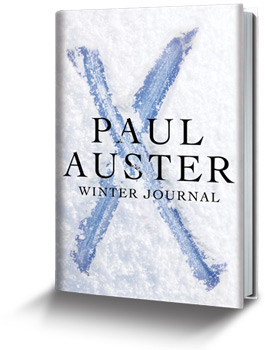
Writing in and of the body (Books - Winter Journal by Paul Auster)
Wednesday, July 18, 2012
Two maverick souls struggle for closeness (Books - Three Weeks in December by Audrey Schulman)

Sunday, July 15, 2012
Allowing the reader the unfamiliar feeling of having time (Books - A Time of Gifts by Patrick Leigh Fermor)

One of the early chapters of this book touches at some retrospective length on the way things began to change; how I moved from the fairly predictable company of fellow army-candidates into older circles which were simultaneously more worldly, more bohemian and more raffish: the remainder, more or less, of the Bright Young People, but ten years and twenty thousand double whiskies after their heyday, and looking extremely well on the regime. This new and captivating world seemed brilliant and rather wicked; I enjoyed being the youngest present, especially during the dissipated nocturnal ramblings in which every evening finished: ("Where's that rather noisy boy got to? We may as well take him too"). I had reached a stage when one changes very fast: a single year contains a hundred avatars; and while these were flashing kaleidoscopically by, the idea of my unsuitability for peacetime soldiering had began to impinge. More serious still, the acceptance of two poems and the publication of one of them - admittedly, only on foxhunting - had fired me with the idea of authorship.But Patrick Leigh Fermor's self-study period as a writer fails to solidify as he had hoped.
Saturday, July 14, 2012
Compelling biography of a monster (Books - The Emperor of all Maladies by Siddhartha Mukherjee)

Wednesday, July 4, 2012
Positive Deviant Alert
Two positive deviants attracted my attention lately:
Natalie Angier profiled physicist Dr. Mildred Spiewak Dresselhaus, a New Yorker who defied the odds for women in science thanks to the encouragement of the Nobel laureate and medical physicist Dr. Rosalyn Yalow. She studied with Enrico Fermi at University of Chicago and then began her own research on carbon at MIT half a century ago.
Our favorite design magazine The World of Interiors, an English publication, featured an essay in the latest issue by the blogger and author of the book Spitalfields Life. Check this excellent blog out. It offers affectionate and energic appreciations of the history and contemporary culture of the hip and energetic Spitalfields neighborhood of London. The author's mission:
Natalie Angier profiled physicist Dr. Mildred Spiewak Dresselhaus, a New Yorker who defied the odds for women in science thanks to the encouragement of the Nobel laureate and medical physicist Dr. Rosalyn Yalow. She studied with Enrico Fermi at University of Chicago and then began her own research on carbon at MIT half a century ago.
Dr. Dresselhaus has also been a prominent advocate for women in physics and engineering, disciplines that are still short on high-ranking female faces and that were outright hostile to women when she began her career in the late 1950s. Even before entering science, she was well accustomed to hostility and hard times, having grown up impoverished in a rough part of the Bronx.
Our favorite design magazine The World of Interiors, an English publication, featured an essay in the latest issue by the blogger and author of the book Spitalfields Life. Check this excellent blog out. It offers affectionate and energic appreciations of the history and contemporary culture of the hip and energetic Spitalfields neighborhood of London. The author's mission:
Over the coming days, weeks, months and years, I am going to write every single day and tell you about life here in Spitalfields at the heart of London. How can I ever describe the exuberant richness and multiplicity of culture in this place to you? This is both my task and my delight.
Let me disclose to you the hare-brained ambition I am pursuing, which is to write at least ten thousand stories about Spitalfields life. At the rate of one a day, this will take approximately twenty-seven years and four months. Who knows what kind of life we shall be living in 2037 when I write my ten thousandth post?
Sunday, July 1, 2012
An imagined Henry James - portrait of a master by a master (Books - The Master by Colm Toibin)

Saturday, June 30, 2012
Eating to be free...

I don’t know what “foodie” means, but it seems to me to mean something unbalanced. There is a difference, and should be, between being in the know about “in” restaurants, chefs, food trends and liking and feeling able to eat well. One thing that really matters is feeling as though one, and often only oneself, is able to completely freely satisfy one’s own appetite. That is a good reason to know how to cook.
Thursday, June 28, 2012
Frisky collage maker
One of my favorite poets, Dan Chiasson, posts a beautiful appreciation of The Collective Writings of Joe Brainard, recently published by the Library of America, at Page-Turner.
Brainard is one of those figures—in his art, his writing, and, one gathers, his person—whose primary genius was to give long-sought relief from overbearing works of art, pieces of writing, and people. For their friendliness, their air of openness, their distaste for guile and pretense, Brainard’s productions have a soothing quality; the other “New York School” writers and artists seem almost reverent and self-serious next to him.Now who could possibly make Frank O'Hara seem reverent?! I am going to have to find a copy of I Remember today.
He is better known as an artist: a maker of frisky collages, a painter of exquisite male nudes, an assembler of miniatures. But he wrote beautifully, especially in his iconic connect-the-dots memoir, “I Remember.”
Thursday, June 21, 2012

Check out the story on All Things Considered.
Saturday, June 16, 2012
Sanity: a key to the good life? (Books - Going Sane by Adam Phillips) The Tyranny of Positive Thinking II

Sunday, June 10, 2012
Meeting the stranger in oneself (Books - Be Near Me by Andrew O'Hagan)
 The subject matter of a book is often what determines whether or not I read it. Who and what it is about leads us to anticipate our interest in its events or identification with its protagonist. The more we read, the more experienced we imagine we become at such predictions, but then every so often we get a surprise. I picked Andrew O'Hagan's Be Near Me off the recommended books table at a favorite bookstore a week back only to find out it is about an Oxford educated Catholic priest engaged to lead a parish in an economically depressed village in Scotland. That was not at all what I was interested in for my next read and yet this novel about encountering strangers - particularly the stranger in oneself - turned out to be the most involving, probing, and beautifully written novel I have read this year.
Saturday, June 9, 2012
Collect data, test, revise theory, repeat....
Carlo Rovelli, theoretical physicist and author (The First Scientist) is excellent on how science works at Edge.
Collect data, test, organize results in a theory, collect more data, test, revise theory, repeat.
Science is not about certainty. Science is about finding the most reliable way of thinking, at the present level of knowledge. Science is extremely reliable; it's not certain. In fact, not only it's not certain, but it's the lack of certainty that grounds it. Scientific ideas are credible not because they are sure, but because they are the ones that have survived all the possible past critiques, and they are the most credible because they were put on the table for everybody's criticism.
Collect data, test, organize results in a theory, collect more data, test, revise theory, repeat.
Tuesday, June 5, 2012
Unlive a little.
Psychoanalyst and writer Adam Phillips (On Kissing, Tickling and Being Bored, Going Sane) a sensible and erudite thinker about the human mind its products has a new book out: Missing Out: In Praise of the Unlived Life and so is profiled in the Guardian.
Hat tip: Bookslut
"I'm not on the side of frustration exactly, so much as the idea that one has to be able to bear frustration in order for satisfaction to be realistic. I'm interested in how the culture of consumer capitalism depends on the idea that we can't bear frustration, so that every time we feel a bit restless or bored or irritable, we eat, say, or we shop."He's great at where culture meets feelings. And there is a picture of his bookshelves.
Hat tip: Bookslut
Sunday, June 3, 2012
The adventure of filling the gap (Books - Remarkble Creatures by Sean B. Carroll)

Remarkable Creatures is a clearly written and passionate account of how field science gets done. Its subject may not seem as relevant to the average reader as popular works about healthcare or how our brains learn, but one could say it is of even greater significance
Tuesday, May 15, 2012
Building a forgotten identity one word at a time (Books - New Finnish Grammar by Diego Marani)

Saturday, May 12, 2012
The costs and incentives of doing science (Books - How Economics Shapes Science by Paula Stephan)

Sunday, May 6, 2012
Jazz and betrayal in occupied Berlin and Paris (Books - Half-Blood Blues by Esi Edugyan)

Edugyan moves the action between 1939 and 1992 as her cranky narrator tries to hold back the past from encroaching on the present. The voice she has him sing in, for it does evoke music,

Wednesday, May 2, 2012
A battle for connection (Books - Solace by Belinda McKeon)

An aspiration toward wholeness in a fracturing world? (Books - Howards End by E. M. Forster)

Thursday, April 26, 2012
A cruel hand laid upon American citizens (Books - The New Jim Crow by Michelle Alexander)
 According to Michelle Alexander's The New Jim Crow: Mass Incarceration in the Age of Colorblindness, the "War on Drugs," was not waged in an effort to dispense justice to dangerous criminals, but rather to control black men by putting them behind bars and relegating them to permanent second class status upon their release. Her book is damning accusation that the execution of the drug laws has effectively continued the marginalization of black men that began with slavery, proceeded to the Jim Crow laws. The difference today is that, since many presume we have reached the colorblind nirvana dreamed of by Dr. King, this is carried out through procedures masquerading as law and race is never mentioned. Alexander's book reads less like a typical account of current affairs than a passionate case argument, a form that will come as no surprise considering her career as a civil rights lawyer and legal scholar.
Sunday, April 15, 2012
Get out of the lab: scientists communicating with the world (Books - Am I Making Myself Clear, Don't be Such a Scientist, Escape from the Ivory Tower)
As I approach the home stretch of a PhD in neuroscience, I find that that the audience I most enjoy writing for about this cutting edge field is the general non-scientist reader. I read three books recently about scientists communicating with non-scientists. Am I Making Myself Clear by Cornelia Dean, Don't Be Such a Scientist by Randy Olson, and Escape from the Ivory Tower by Nancy Baron have in common a belief that most scientists do this poorly and, ironically, that they should do it more often. Too long winded, too technical, and too many qualifications are the main criticisms, and each volume offers advice on how to be more effective.
Friday, April 13, 2012
Michael Gazzaniga, Father of Neuroscience, Speaks on Brain Science and Free Will
 I covered neuroscientist Michael Gazzaniga's talk on the brain and free will at Cooper Union for Capital New York, hence the resounding silence here. Check out my piece at the link below.
“Probably 99.999 percent of what goes on in the brain is automatic and unconscious. I have no idea what my next sentence will be, and sometimes I sound like it,” Gazzaniga began in his unassuming way. “We think the other stuff, the ‘me,’ the ‘self,’—we think that’s really important. We think there is somebody in charge—somebody pulling the levers.”In promoting the book Who’s In Charge, Gazzaniga has learned that this is a subject on which everyone has an opinion.
Can we have free will, if the brain's actions are automatic? A scholar makes the case | Capital New York
Wednesday, April 4, 2012
Orwell's inherently human contradictions embraced (Books - Why Orwell Matters by Christopher Hitchens)
 I decided to read the late Christopher Hitchens's Why Orwell Matters less because I have a driving interest in political essayist and novelist George Orwell than because I had never read a book by Hitchens and many a sharp reading friend had praised his work. I was vaguely aware of Orwell being lauded and derided alternately by the left and the right. I knew he had become a hero of the neo-cons and I didn't know why. There's no reason to read at all if you're only going to stay in your ideological comfort zone, so I picked up Why Orwell Matters this weekend to see what they were all about.
 This slim volume is not a biography. It is a corrective polemic of others opinions of Orwell - either critics of him, or those who idolized Orwell by appropriating
Sunday, April 1, 2012
A drama of social injustice in the Mumbai slums (Books - Behind the Beautiful Forevers by Katherine Boo)
 Award-winning journalist Katherine Boo has spent two decades, according to her bio, writing about how societies distribute opportunity and, consequently, who is defined as poor. The last three years of that time she spent reporting on India, and in particular, an illegal squatters' slum near the Mumbai airport and luxury hotels known as Annawadi. Although Boo writes non-fiction, her prose in Behind the Beautiful Forevers transforms poverty from a socio-political abstraction into something one can taste and smell and whose consequences upon real people we experience deeply.
Friday, March 30, 2012
What use is history? (Books - In Europe by Geert Mak)
 There is no use fixating on past mistakes, some advise. Stay in the present, say the gurus. But these approaches are anathema to the human nervous system. Even basic nervous systems use sensory equipment - eyes, ears, antennae, pressure sensors - connected to a few dozen nerves to adequately serves an organism which wishes to avoid danger, find food, or reproduce. But one advantage of having a brain is that we can accumulate information about common patterns of stimuli existing in our environment, using it to anticipate what we encounter in the future. Our brain's visual system makes
Thursday, March 22, 2012
Dastardly art about the forces that spur vioence (Film: Inglourious Basterds (2009) by Quentin Tarantino)
 Quentin Tarantino's use of violence in films like Pulp Fiction is supposed to be commentary on violence in film and television, but I have found them merely exploitative. This is not because media does not glorify violence, but because Tarantino's use of self-referential gestures and cute trademarks while using slaughter patently as entertainment is too cavalier. We already live surrounded by bloodshed - take the last 48 hours: with the murder of seven victims by a militant in Southwestern France and the outrageous shooting of an unarmed 17-year-old in Florida by a man claiming he was feeling threatened - I find the irony too disrespectful of lost lives. What the hell is so funny? So my own positive assessment of his film Inglourious Basterds (2009) surprised me.
Sunday, March 18, 2012
Who says reading is in decline?
 I was struck in reading today's New York Times that the number of pieces on reading and books must have reached some sort of critical mass. Or perhaps it was only the Times's effort to assert its own relevance?
The online edition has begun a series called Draft. It concerns the art of writing and its maiden voyage was a riffy, elegiac essay by Jhumpa Lahiri on the pleasure she finds in sentences (the written not the served kind). This was flanked in the Sunday Review by two more essays. One by Dwight Garner where the message was on the medium - what sort of reading calls for e-readers, iPads, or the printed page, he asks? He cited the recent New York Review of Books essay by novelist Tim Parks (speaking of books in the news) which championed electronic reading media as
Tuesday, March 13, 2012
Heir apparent to Dasheill Hammett (Books Nineteen Seventy-Four - Book I of the Red Riding Quartet by David Peace
 The first volume of David Peace's Red Riding Quartet, Nineteen Seventy-Four, is a violent thunderclap of a novel. It details the search of a rookie crime journalist, Eddie Dunford, for the murderer of a school girl in Yorkshire during the week preceding christmas. It becomes apparent to Eddie that the murder may be one of a string of crimes and Eddie begins connecting the dots between them and powerful people in business and law enforcement. Despite the fact that he has only just buried his own father, or perhaps because of it, Eddie begins a stubborn search for the truth in a world of savagery and exploitation that is way beyond his ken.
Sunday, March 4, 2012
Navigating time across the abyss of loss (Books - Purgatory by Tomas Eloy Martinez)
 I have often wondered what it is about living in South America that leads writers to adopt the form of magical realism. Having read Purgatory by Tomas Eloy Martinez, recently translated into English by Frank Wynne and published by Bloomsbury USA, I think that I understand.
Since the 1930s, Argentina experienced more than 30 political coup d'etats. In 1975, a military junta seized power from Juan Peron. From 1976 until 1983, in government-instigated acts of terrorism, an estimated 15,000 persons were
Saturday, March 3, 2012
Richard Powers - where fact and fiction collide (Essay - What Does Fiction Know?)
One of my very favorite writers, Richard Powers, who writes at the intersection of fiction and science, has written an inspiring essay about the city of Berlin, the unreliability of storytellers, and the place where fiction and fact collide. It is inspiring for the way it mixes personal experience, data, and artifice. It appeared in last summer's Design Observer and I link it here.
Thursday, March 1, 2012
Healing a wounded nation one narrative at a time (Books - Glow by Jessica Maria Tuccelli)
 There are those who say that America is unnecessarily obsessed with race, but most who make that claim would like to change that conversation. America was founded by dominating one race in order to seize their land and by dominating a second in order to support commerce. Both native Americans and those whom Americans enslaved were subjugated out of a sense of entitlement. Whites assumed for centuries that their skin color was favored by their gods and, because they were willing to dominate through violence, that what they captured was theirs to keep. America is built on a legacy of hubris and its consequences can still be felt. For a century following slavery, society was legally bifurcated so that education, transportation, partaking of daily commerce, and marriage were separate for white people and people of color. It seems disingenuous to claim, after those laws were changed under protest a few decades ago, that people of color in America should now feel the same as whites since they supposedly have the same opportunities. Even if they had the same opportunities, history doesn't simply evaporate.
Subscribe to:
Posts (Atom)