Friday, January 23, 2009

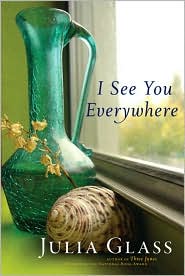
Two parts of one whole (Books - I See You Everywhere by Julia Glass)

I have finished I See You Everywhere, which I wrote about here. I don't want to say much more about it so as not to ruin your own reading of it, except to say that I found it a warm and nourishing read. The chapters of alternating point of view serve the story well, adding some surprises that wouldn't have been accomplished by a conventional narrative. I found myself invested in the two sisters - two parts of the same whole, really, and consequently as I read the book, I could find different parts of myself in each of them. I wonder if creating these two characters was the same for the writer, that is to say, were they each in some way her? The last section creates an epilogue, letting a greater amount of time elapse before revisiting one of the two narrators. Staying with my theme of philosophy for today (see my other post), this section muses more broadly on life's pleasures and hurts, and particularly on the use of creating art in the context of loss. This epilogue had the feeling of pulling back the camera, after numerous scenes filmed in close-up. It had a more distant feeling, but appropriately so. It did not leave me cold as epilogues often do. It succeeded in concluding the but not by rushing through fifty years to tie every last plot point up with a bow.

Glass's writing is fluid and elegant, but also contemporary. I'll leave you with a paragraph:
When Ray came into my life, he was just that: a shaft of sunlight invading a murky room. I had been married for too long to a genteel but oblivious man whose still waters hid many things but not, after all, an undertow of passion. At first, the decorum and calm in my marriage had been such a relief that I thought, So this is it. But then I met Ray, and I knew, thought it made me sadder than I had every been, This is it. He called me Miss Fever, Miss Open Flame, Miss Hundred and Ten in the Shade - and, once, Miss Bases Loaded Tying Run on Third No outs. One day our illicit gymnastics left his handprints in the new gray carpet of my office; that night, I locked the door so the cleaning lady couldn't remove them. Next morning, when I walked in and saw again the image of his hands, ghostly as petroglyphs, I began to shake. I locked the door for another hour. I was certain that my life as lived (so cautiously) was over.

The original developmental psychologists (Books: Theories of Development by William Crain)

I always think of philosophers creating theories about fully formed adults, their ideas and the societies they create. That is how I remember learning about John Locke and Jean Jacques Rousseau in college; but William Crain's book Theories of Development reminds us that they were really the original developmental psychologists. Locke thought the human being started out as a tabula rasa, becoming socialized by acquiring knowledge and skills through observation of associations, repetition, imitation and having behaviors reinforced with rewards or discouraged with punishment.


Rousseau felt that although children began life without any knowledge, Nature endowed each child with a particular way of thinking and feeling.

Nature is like a hidden tutor who prompts the child to develop different capacities at different stages of growth.

Rousseau sets out four developmental stages, what a child was capable of acquiring during each one and how. They're reminiscent of Piaget's or Erikson's stages (they are traditionally the ones I think of as developmental psychologists). Both Locke and Rousseau offered their theories of educating children to become "successful" adults. Locke seeing this success defined by the adult's ability to control individual desires - to seek the approval of society so that one might serve it. Whereas Rousseau saw people as driven by primitive urges, fighting being crushed by society. He felt that a successful education permitted the adult to develop independent ideas and morals so as to stand up to society rather than conform to it. We're still playing out this debate today. If any of you are fans of Lost, you will recognize it as one of the themes of the show, hence a character named John Locke.

Thursday, January 22, 2009

The yin and the yang of it...

btt button

Since “Inspiration” is the theme this week … what is your reading inspired by?

You. That's a little glib, I know, but the dialogue that is the world wide web gives me lots of ideas for reading and it keeps me energized because my reading happens in the context of someone other than me. Writing about my reading pushes me to read better, more closely, and to form opinions as I read, not just let it wash over me. But the flip-side is equally true, my other inspiration is simply my whim. Reading is a totally self-centered realm (in the best sense). I get to be curious about what ever I want and to satisfy that curiosity by following my nose. I read what I want, when I want, and I depend on no one to do it. Except the writer and the library or bookshop. And that's the yin and the yang of it.

Wednesday, January 21, 2009

Not what you think... (Books - I See You Everywhere by Julia Glass)

I See You Everywhere by Julia Glass comes by its title in a hilarious scene set in a hospital. There are two sisters. Clem, the younger and more reckless one, gets into a serious accident and winds up in the hospital. Louisa the older one, more concerned with living responsibly, more desirous of life's conventional joys gets the news of Clem's accident from their mother. It is Clem's voice narrating Louisa's story:
Louisa's smart, smarter than me in the report-card sense, but whenever she's nervous, she babbles. Today, day two of my renewed consciousness, she's worse than ever, as if she's burning off extra fuel. I guess she's just glad I'm alive, and if I weren't so drugged up, I hope I'd be touched. "So I get home," she's saying. "Hugh's already asleep, I've had too much wine, and what do I find on the machine but one of Mom's classic soliloquies. Something like 'Clem's been in a serious accident, honey, I'm not at home because I'm here with her and your father's back and forth because there's a hurricane off Bermuda - Ethan or Efram, I think; your father says it's a bad sign that here we are not even August and already up to E. C and D passed us by, but B was a very close call. Great for the roses, though. You can't speak to her, I'm afraid, but call this number, I'm giving you this number, just a second, hang on, it's here in my purse. Is it as hot down there as it is up here? Yes, here it is, right, so call and say you love her. Will you do that, please? She can't talk, but have them leave her a message, I'll call you later,'"

Louisa stops pacing. So of course I have no idea where 'here' is or who 'they' are, but I call the number, I'm frantic, and this woman answers, 'I see you?' as if I'm expected to answer, 'Aha, but I see you, too!' Like a game of some kind. All I can say is 'You see me? How?' and she laughs. 'That's a new one,' she says. 'This is intensive care,' and I freak out. I can't believe she's laughing."

"That's cute," I say. "Like, ICU in my dream. ICU on the Johnny Carson show. ICU everwhere."

"More like, ICU every time all hell breaks loose. For both of us."
And that sums up this lovely book perfectly both in its form and its content. It is a series of chapters, each separated by three years, that track the lives of the two sisters. Glass writes each chapter alternately in Clem's voice and then Louisa's. Many of the chapters, like this one, have a stand-alone, short story quality to them. I believe that is the form that they first existed in. In each one it is apparent not just how completely different the two sisters are as people, but how much they depend on each other to define themselves. Glass has made the sister's voices and points of view distinct, but my one quibble with the book as a novel is that I sometimes find the tone of the chapters too various to hang together. But then I find myself justifying that in the changes in Clem and Louisa's circumstances, their age, their relationships, the settings, and the fact that time elapses between each chapter that we don't witness first hand and regardless, they are a pleasure to read.

The scene I excerpted is also emblematic of this book because what you get at first hearing is not really not what is being said. You might think you're reading another little monologue in the voice of the risk averse sister, and you are. But what you are really reading is a small part of complex novel that is an even smaller part of each of these sisters' lives, we only see the parts when they are thrust together "every time all hell breaks loose," as Clem says, It is told through accumulation, through repetition and variation until you finally realize you are reading something you didn't expect, 'I.C.U.' and not 'I see you.' Although both are equally true. I'm not quite finished with it, but three quarters of the way through Glass has created a warm and touching book whose characters feel deeply real and that lets its pleasures emerge quietly out of character study.

Sunday, January 18, 2009

It's in the air... (Books - The Invention of Air by Steven Johnson)

After six hours writing a paper yesterday about a brain structure called the superior temporal sulcus, you might not think I'd be much in the mood for reading about science, but actually I felt primed to read Steven Johnson's latest, so skilled is he at making a narrative flow of scientific ideas and the era in which they gain acceptance. His new book The Invention of Air exemplifies this. Here he tells the story of Joseph Priestly, who started his life of scholarship by writing a book of English grammar, next studying electricity, learning many of the basics from another polymath, Benjamin Franklin. Priestly wrote a 700-page book on the electricity which became the seminal text on the subject for the next century. Priestly was involved in the discovery of ten 'airs,' we would call them gases, including oxygen, nitrous oxide, and carbon dioxide, for which he discovered the ingenious use of carbonating water, influencing the taste of future generations in ways he could hardly have imagined. But Johnson's life is hardly a conventional biography. What Priestly's life becomes a platform for in Johnson's book is a discussion of the emanation and dissemination of ideas. Johnson marvels not simply at the fact that Priestly, after discussing electricity in a London coffee house with Benjamin Franklin, conducts experiments in his kitchen and writes a lengthy and influential book on the subject, but rather at the character of the book. Scientific writing until that time was in the form of a philosophical argument and proof and if Newton's Principia is the prime example, it was written in Latin. Priestly, although fluent in seven languages, wrote his book in English in the form of a narrative:
But his History was as much a breakthrough for its form as for its content. He had invented a whole new way of imagining science; instead of a unified, Newtonian pronouncement, Priestley recast natural philosophy as a story of progress, a rising staircase of enlightenment, with each new innovation building on the last. In his prologue to the History, he contrasts his method favorably with the existing genres of civil history and natural history: the epic stories of kings and wars and famines, or the meticulous inventories of nature - insects, rocks formations, flowers - that had become commonplace over the preceding century. There were great lessons and pleausres to be found in those other forms of writing, Priestley argued, but they lacked the definitive movement toward clarity and understanding that could be found in his own philosophical history...
The story of scientific narrative is one of two themes Johnson mines in his opening chapter. The second is the notion of innovative streaks, both on the individual and societal level. Why do a few people seem to have a disproportionate share of the big ideas, Johnson asks, and why does the popularization of those ideas seem to occur in bursts. This is a discussion Johnson covers ably in fifteen pages of easy and even amusing narrative. He puts the theories of Thomas Kuhn's 1962 book The Structure of Scientific Revolutions, which imagnes a small center of change, starting in the lab with the scientist and radiating outward, alongside the notion of the ecosystem:
Ecosystem theory has changed our view of the planet in countless ways, but as an intellectual model it has one defining characteristic: it is a "long zoom" science, on that jumps from scale to scale, and from discipline to discipline, to explain its object of study: from the microbiology of bacteria, to the cross-species flux of nutrient cycling, to the global patterns of weather systems, all the way out to the physics that explains how solar energy collides with the Earth's atmosphere.
This interconnected network model is a favorite of Johnson's - how ideas move for the cellular networks of the human brain to cultural systems like the economy, to massive forces like energy. This notion, contrary to Kuhn's, sees large pattern of changes occurring when large simultaneous cultural forces align or, you could say, when the notion is 'in the air.' Johnson, with a nod to Tom Standage's book A History of the World in Six Glasses, half-jokingly credits the emergence of the coffee house culture with the birth The Age of Enlightenment. Starbucks, take note.

I had looked at both Johnson's book and another - Julia Glass's novel I See You Everywhere on the same evening in a bookstore a couple of weeks back. Both are new and in nicely designed hardcover editions, with attractive jackets. Both are of a size agreeable to hold in ones hand, but it was the end of the semester and I was hardly likely to start them immediately, so I ordered them on line. Having first admired them, and then waited for them, and then placed them on the to-be-read-sooner-rather-than-later pile I had enjoyed anticipating them, particularly Glass's novel whose opening pages had a warm, comforting feeling to them. I found myself almost loath to begin I See You Everywhere so much had I enjoyed my anticipation of it. But start I did and now having written about Steven Johnson writing about Priestley writing about science, I have a little writing about science I should do myself. So I will force you to anticipate my thoughts on Julia Glass's new novel until later.

Saturday, January 17, 2009

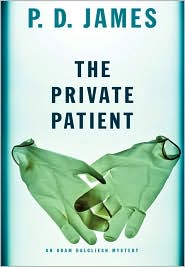
A mystery inside a mystery (Books - The Private Patient by P. D. James)

On subway trips to and from the library to work on a paper, and warm in bed on a frigid New York night (and part of the morning), I finished P. D. James's latest The Private Patient. I cannot say much more about it than I did in my other post, that is the way with mysteries, but as the early signs indicated the past did figure importantly. After detective Adam Dalgliesh gathers everyone in the house part, the plot took over from James's careful development of character and the rhythm of the writing accelerated. While there were surprises in how things turned out, it wasn't one of those flashy endings. The mystery was a multi-layered affair. The solution to this crime unfolded quietly and then there were, shall we say, mysteries packed inside the mysteries. What I like James best for is her deeply thought out characters and how she writes about what goes on inside of them...

He sometimes wondered what it would be like to find that secret door said to be open to the lightest touch, and to feel this burden of guilt and indecision fall from his shoulders. But he knew that one dimension of human experience was closed to him as was music to the tone deaf.

...and how they appear to others.

Mogworthy, an incongruous Cerberus, had changed into a shiny blue suit and striped tie, which gave him the look of an ancient undertaker, and stood beside her, back to the fire, the only one on his feet. He turned to glare at Dalgliesh as they entered; the glare seemed to Benton more minatory than aggressive.

I love the fact that she gets not one but two mythological references into two sentences. The Private Patient satisfied me in the ways that the traditional British mystery always does, particularly one crafted by P. D. James.

There are two books waiting for me at the library but it is six degrees, or something like that, outside and I may not want to make the walk. I also have a section of my paper to write today, so I don't know what I will end up reading next.

Friday, January 16, 2009

Chaos bursts through careful control (Books - The Private Patient by P. D. James)

I'm about one-third of the way into P.D. James's latest and she writes with the confidence of someone who has earned her place as the reigning master of the intellectual English mystery. Her descriptions do not walk so much as process down tree-lined avenues. There is a deliberateness, a thoroughness to her writing that, in The Private Patient, is accompanied by retrospection. Legacy, memory, age, whether of house, city, or a character, is the preoccupying theme of this book.
The lease was long and renewable; she would have liked to buy the house, but knew that it would never be for sale. But the fact that she couldn't hope to call it entirely her own didn't distress her. Most of it dated back to the seventeenth century. Many generations had lived in it, been born and died there, leaving behind nothing but their names on browning and archaic leases, and she was content to be in their company.

[...]

The City which lay below was a charnel house built on multi-layered bones centuries older than those which lay beneath the cities of Hamburg or Dresden. Was this knowledge part of the mystery it held for her, a mystery felt most strongly on a bell-chimed Sunday on her solitary exploration of its hidden alleys and squares? Time had fascinated her from childhood, its apparent power to move at different speeds, the dissolution it wrought on minds and bodies, her sense that each moment, all moments past and those to come, were fused into an illusory present which with every breath became the unalterable, indestructible past.
And then, the set-up:
It was now eight-thirty and she was in her bathroom. Turning off the shower, she moved, towel-wrapped, to the mirror over the washbasin. She put out her hand and smoothed it over the steam-smeared glass and watched her face appear, pale and anonymous as a smudged painting. It was months since she had deliberately touched the scar. How, slowly and delicately, she ran a fingertip down its length, feeling the silver shininess at its heart, the hard bumpy outline of its edge. Placing her left hand over her cheek, she tried to imagine the stranger who, in a few weeks' time, would look into the same mirror and see a doppelganger of herself, but one incomplete, unmarked, perhaps with only a thin white line to show where this puckered crevice had run. Gazing at the image, which seemed no more than a faint palimpsest of her former self, she began slowly and deliberately to demolish her carefully constructed defences and let the turbulent past, first like a swelling stream and then a river in spate, break through unresisted and take possession of her mind.
All of James's books invest in a thorough set-up with lots of insight into character, which I love, but I find this one particularly unhurried. No pressure here except to get the job done - to introduce each character in turn and each plot-line with equal care and the tone proper to their circumstances. Some are to be essential to solving the mystery, others are, no doubt, destined to become red herrings, but to stint on any of them would be to give away which is which. James spends 100 pages making us acquainted with the investigative journalist Rhoda Gradwyn, the renowned plastic-surgeon George Chandler-Powell, hired to remove Rhoda's own legacy - a scar she has had since childhood. James spends a chapter on each member of the staff of Chandler-Powell's private clinic, housed in his historic manor in Dorset.

I don't think it is merely coincidental that P.D. James as an older writer is writing about time, about age, but I also don't think it is a merely a preoccupation with self. The past is, I'm sure, going to be essential to solving the mystery. In the same way, I don't thing that the fact that the writing here is methodical is a quirk of James's style through which we have to suffer to get to the good stuff. It is a deliberate voice chosen to express the way that Chandler-Powell and Rhoda Gradwyn are methodical. Both are characters who have come out of chaos in their pasts and have reacted to it by putting a good amount of control into their lives. The routine of their work, their weekly schedule, the food they eat and when they eat it, each of these aspects of their lives is highly controlled and has an old-fashioned rhythm to it. So it is a surprise when, following the surgery, Rhoda suddenly sees a ghostly figure around her bed making ritual gestures just prior to murdering her (this is not a spoiler, we know she will die from the first sentence of the book). I really like this touch for two reasons - this otherworldly figure clad in white could be a nurse, surgeon, or someone who has taken surgical scrubs, mask, and gloves from the premises and who is seen through Rhoda's post-anesthetic haze - it could also be something otherworldly bursting through the protective veneer of these controlled lives just at the moment of the crime. As though it reaches through, perhaps from the past? I don't know yet. But the book's tone changes with the crime - as lives change as the result of a murder - and with the introduction of detective Adam Dalgleish and his team comes a more modern-day percussive, chaotic rhythm. Murder cuts into Gradwyn's world and keeps her new face an eternal mystery.

Wednesday, January 14, 2009

I have always depended on the kindness of strangers... (Books - Twilight & Moonbeam Alley by Stefan Zweig)

The pair of short stories Twilight & Moonbeam Alley, both by Stefan Zweig, collected in a single petite edition by Pushkin Press, both concern people whose very existence depends on others. We all depend on other people to one extent or another, even if we try hard not to. The two subjects of Zweig's twin character studies could not be more different from each other. The focus of Twilight is Madame de Prie, a member of the court of French king Louis XV. She offends the king with a bold political move and is banished to her country estate at Courbepine, she assumes, for a short while. It turns out to last must longer than she expected and while she considered herself a self-sufficient and powerful woman she discovers otherwise in her exile.
But as soon as he left she felt as if the weight of the silence were descending on her twice as heavily as before, as if she alone had to hold up the high ceiling, she alone must keep back the advancing darkness. She had never known how much a single human being can mean to another, because she had never been lonely before. She had never thought more of other people than of air, and one does not feel the air, but now that solitude was choking her, only now did she realise how much she needed them, recognising how much they meant to her even when they deceived and told lies, how she herself drew everything from their presence, their easy manners, their confidence and cheerfulness. She had been immersed for decades in the tide of society, never knowing that it nourished and bore her up, but now, stranded like a fish on the beach of solitude, she flinched in despair and convulsive pain...
**MAJOR SPOILER ALERT**
Madame de Prie first tries to do what she is used to - manipulate friends in high places, take a young lover in order to feel more powerful than someone else, and finally beg those in power to reinstate her. None of these succeed in changing her circumstances, so she changes her attitude, accomplishing this by planning her own death. ** SPOILER FINISHED**

What is unusual about this story is its tone, which feels for all the world like a fairy tale, dark though it may be. There is a magical, dark-and-stormy-night mood to this piece which is a parable about valuing others more than ones position or wealth. The story is also nearly prophetic in light of Zweig's own experience of and response to forced exile from his native Austria by the Nazis.

The accompanying piece, Moonbeam Alley, concerns an encounter had by a German traveler on his way home by ship, with a woman and a man, both of whom he encounters in a seedy bar in an alley near the docks.
I liked such alleyways in foreign towns, places that are a disreputable market-place for all the passions, a secret accumulation of temptations for the sailors who, after many lonely days on strange and dangerous seas, come here for just one night to fulfill all their many sensuous dreams within an hour. These little side-streets have to lurk somewhere in the poorer part of any big city, lying low, because they say so boldly and importunately things that are hidden beneath a hundred disguises in the brightly lit buildings with their shining window panes and distinguished denizens. Enticing music wafts from small rooms here, garish cinematograph posters promise unimaginable splendours, small square lanterns hang under gateways, winding in very clear invitation, ussuing an intimate greeting, and naked flesh glimpsed through a door left ajar shimmers under gilded fripperies. ..But all this is hidden in modestly muted yet tell-tale fashion behind shutters lowered for the look of the thing, it all goes on behind closed doors, and that apparent seclusion is intriguing, is twice as seductive because it is both hidden and accessible. Such streets are the same in Hamburg and Colombo and Havana, similar in all seaports, just as the wide and luxurious avenues resemble each other, for the upper side and underside of life share the same form. These shady streets are the last fantastic remnants of a sensually unregulated world where instinct still has free rein, brutal and unbridled; they are a dark wood of passions, a thicket full of the animal kingdom, exciting visitors with what they reveal and enticing them with what they hide. One can weave them into dreams.
This story, although it sets the atmosphere beautifully, almost lost me, because it appeared to do nothing else for some time. But once our narrator meets the central character, things get interesting. The story is built around a central psychological surprise that I won't disclose as it is the whole story. The set-piece of this story is a brilliant ten-page monologue about obsession of one person for another that has me sold on this story as perfect for adaptation to a one-man drama. As a director, I used to read constantly with an eye to what story might adapt well to drama, but I haven't been drawn to that characteristic in a story in some time. The translation by Anthea Bell, as with her work on Sasa Stanisic's How the Soldier Repaired the Gramophone, feels fluid, natural and stylistically right for the period. I'm going to get cracking on this idea so you had better no steal it. In the meantime, I'm grateful to John Self for recommending these wonderful stories and to Dovegrey for seconding that emotion. I third it, and get them in this elegant little edition, it's a pleasure to read.

May I have the envelope please...

I was going to post on Stefan Zweig's Twilight but then Matt gave me this nifty recognition a couple of days ago and it's taken me this long to figure it out. Thank you, Matt. I'm honored to be honored. It's the Premio Dardos or Darts Award which, well I'll let them say it.

This award acknowledges the values that every blogger shows in his or her effort to transmit cultural, ethical, literary, and personal values every day. The rules to follow are:

1) Accept the award, post it on your blog together with the name of the person who has granted the award and his or her blog link.

2) Pass the award to 15 (actually 10) other blogs that are worthy of this acknowledgment. Remember to contact the bloggers to let them know they have been chosen for this award.

So there you have it. I most gratefully follow rule #1 by accepting this award and posting it, but as for rule #2 I say - rules, schmools, I'm doing this my own way - and passing it on to just a few blogs, even if someone has honored them already. Please hold your applause until the end of the presentation.

Although Cornflower Books is a fairly new place, Cornflower is an old hand at bringing us her observation on books, cakes, and other various and sundry. A visit to her place is like being invited to someone's comfy kitchen for tea and a chat. I found out about A. S. Byatt's upcoming book at her house and so, Cornflower, I honor you.

Notes of an Anesthesioboist is exactly what it says. Our fearless, reed-sucking goddess of sleep shares her thoughts on her work, her reading, cooking, family life. A thoughtful, nourishing place to visit and for that I honor her.

C.B. and his faithful friend Dakota get a lot of books in. That is, C. B. reads 'em and Dakota eats 'em. The trick is to see which one gets to them first. C.B. is an energetic reader, an involved member of his community, and I find his author interviews a particularly good reason to visit and to give him this honor. The name of the blog is Ready When You Are, C. B.

I always enjoy seeing what author Sarah Salway will offer next in the way of writing prompts, following her visits to writer's workshops and artists colonies, and especially her exploits with shopping trolleys, and so I honor Sarah's Writing Journal.

The Mookse and the Gripes is the place to go when you want to dive head-first into an in-depth reading of meaty literature like the poetry of Walcott or Robert Penn Warren's All the King's Men. I have gotten more than a couple of good recommendations here so, Mookse, please accept this honor with my thanks.

Last, but certainly not least, I choose to honor my dear friend and fellow-blogger Sheila for her passionate writing on her reading, her film going, her favorite actors, and her friends and family (she is a prolific memoirist at the moment) at The Sheila Variations. For being a consistently fun, provocative, and raucus read, Sheila, I honor you.

And now, please give a hearty roar of approval to these bloggers by checking out their sites if you haven't already.

Tuesday, January 13, 2009

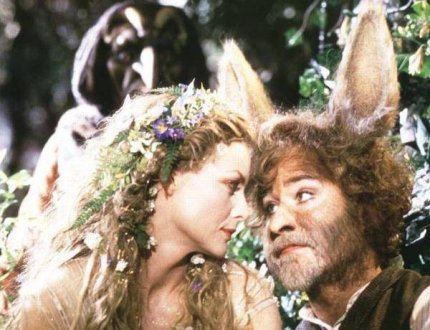
What fools these mortals be...

Captain of our fairy band,
Helena is here at hand,
And the youth, mistook by me,
Pleading for a lover's fee.
Shall we their fond pageant see?
Lord, what fools these mortals be!
- William Shakespeare - A Midsummer Night's Dream
Whatever your brilliant idea is, Shakespeare thought of it first. John Tierney writes in today's Science Times about the neuroscientist Larry Young and his theory of love. Prairie voles tend, unlike most mammals to mate monogomously.
When a female prairie vole’s brain is artificially infused with oxytocin, a hormone that produces some of the same neural rewards as nicotine and cocaine, she’ll quickly become attached to the nearest male. A related hormone, vasopressin, creates urges for bonding and nesting when it is injected in male voles (or naturally activated by sex).
Oxytocin, produced during childbirth and nursing, is the same chemical that stimulates bonding between mother and child. So motherly love is, neurochemically, the prototype of adult love. I am sure Dr. Freud, wherever he is, has just lit up a celebratory cigar and the attachment theorists are throwing a champagne party!

Researchers are now playing around with manipulating oxytocin levels in humans and discussing its use in everything from encouraging more typical social relations in people with autism to marriage counseling. But researchers are noticing, as Shakespeare did, that problems might arise if the wrong partner is targeted. They are also playing around with the idea of a vaccine that inhibits mating and nesting impulses. So the first drug could make you fall in love with an ass and the second might keep you from acting like one yourself. And Shakespeare thought of that one too.

Monday, January 12, 2009

Good witches and bad (Books - The Witches of Eastwick by John Updike)

I wrote a couple of posts back that the witchcraft in John Updike's The Witches of Eastwick was like the harnessing of the forces of nature gone mad. Having now finished it, I hadn't really known how right I was. By the forces of nature I don't mean the moon and the tides but rather the forces inside of us - lust, jealousy, greed. The witches' powers are enriched by their being single, which to Updike means in a state of implicit need. Alexandra, Sukie and Jane all crave the company of Darryl Van Horne, the new single man in town. Deep down the three women are just as nice, and just as duplicitous, racist, and narrow-minded as the rest of the people in Eastwick, the small town that is the setting of this novel. They crave the same things - companionship, sex, fulfilling work, a sense of agency. These three women are nearly just like everyone else, except that they practice rituals that subserve these inner forces for use in malevolent acts against others. Updike has sets up a story in which the witches are our heroines, although he is far from simplistic about good and evil. One way he does this is by creating a marvelous foil for our witches in the character of Felicia Gabriel. Felicia has given her life to improving every aspect of her town that she can. She does this the old fashioned way, by writing letters to the editor, chairing committees, and the like. She puts every ounce of energy she has toward observing and correcting the wrongs she sees around her. The trouble is, she sees them absolutely everywhere, and while one could say she is a force only for good, she has in truth become an enraged, bitter witch herself. She sees no good in anything she hasn't fixed, and has become a prude and a pedant. She eventually also becomes one of the witches victims and her demise is as horrible as it is hilarious. This book sends-up suburbia, leaving no character unchastised - neither the rich nor their servants, the drug addict in the parking lot nor the minister, and neither the good witches nor the bad.

The other pleasure this novel offers is the writing and whether Updike is exercising his "good witch" or his bad, he attains simultaneously erudition, comedy, and majesty. Take these two descriptions of the witches, one early in the novel reveling in Sukie's beauty and the other later, basking in the demise of Jane, they exemplify using talents, this case Updike's writing talents, in the service of the light and the dark:
Sukie was the most recently divorced and the youngest of the three. She was a slender redhead, her hair down her back in a sheaf tirmmed straight across and her long arms laden with these freckles the cedar color of pencil shavings. She wore copper bracelets and a pentagram on a cheap thin chain around her throat. What Alexandra, with her heavily Hellenic, twice-cleft fatrues, loved about Sukie's looks was the cheerful simian thrust: Sukie's big teeth pushed her profile below the brief nose out in a curve, a protrusion especially of her upper lip, which was longer and more complex in shape than her lower, with a plumpness on either wide of the center that made even her silences seem puckish, as if she were tasting amusement all the time.

and

"Isn't this cozy!" Jane Smart cried, coming in late, wearing almost nothing: plastic sandals and a gingham mini with the shoulder straps tied at the back of the neck so as not to mar her tan. She turned a smooth mocha color, but the aged skin under her eyes remained crepey and white and her left leg showed a livid ripple of varicose vein, a little train of half-submerged bumgs, like those murky photographs with which people try to demonstrate the existence of the Loch Ness monster. Still, Jane was vital, a thick-skinned sun hag in her element.

A lusty, energized, potent, and, at times, uncomfortable novel, but the writing is always an alluring pleasure. My other posts on it are here, here and here.

Next up: Stefan Zweig's Twilight and Moonbeam Alley put out in a beautiful compact edition by Pushkin Press on paper so yummy I could eat it.

Saturday, January 10, 2009

The sentence as a one act play (Books - The Witches of Eastwick by John Updike)

I'm going to post on just one sentence today. You can do that with John Updike. Such rich and resonant writing. He writes sentences that are like one act plays.


They all heard her car, a pale gray Corvair convertible with front-wheel drive and her ex-husband's vanity plate ROUGE still on the back, start up and spin out and crackle away down the drive.
Four characters comprise the dramatis personae - three people hearing the car and one driving it (I guess there are five characters if you count the ex-husband). There is not just a car - but a specific model - filling out our understanding of our driver's class, her taste, her self-image. They all hear her car. They do this together, as if it stops whatever action they were engaged in. And not only can they hear it, we can hear it too because Updike chooses such specific verbs. He doesn't tell us that the car merely drove away, or drove quickly, or that it tore down the driveway (somewhat cliched). The gray Corvair convertible starts up, spins out and crackles down the drive. I don't want to spout such nonsense as "great writing is all in the verbs," but precise verbs go a long word towards placing the reader somewhere specific. Three sounds occur because of our driver's circumstances, of which we know something if we have read the preceeding sentences, but even without doing so one can form a specific impression - mine is one of haste, and possibly daredevil carelessness but there could be some anger in there too. The reader too hears three sounds. Driving away can sound like hundreds of things but the crackling of a sports car's wheels on a driveway is much more precise, it permits the reader to hear something close to what the writer imagines, rather than to simply guess at the sounds or interpolate their own generic car driving away noise. With the additional knowledge of the car, its driver, and her audience of listeners one sentence becomes a mini-drama complete with actions, relationships, scenery, props, and sound effects.

Friday, January 9, 2009

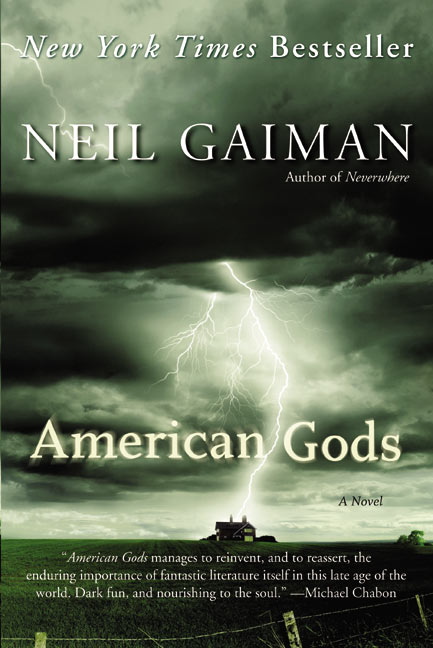
The celebration of people for who they are (Books - American Gods by Neil Gaiman)

The final 100 pages of Neil Gaiman's American Gods didn't mine any new territory but, having stuck with it, the novel delivered in the end. Shadow, the lead character in American Gods is a memorable creation and Gaiman has a rich imagination, especially given the fact that, he gave himself nearly all of Eastern and Western civilizations deities as characters. My earlier reservations about the novel stand (you can read those posts here and here) and I still don't really know why the several interludes were necessary, but American Gods was an intricately plotted and entertaining saga. Gaiman makes a point of peopling his American epic with people of many races, a choice that felt natural and appropriate. And this is the second story of Gaiman's I have read that includes gay characters, where sexuality is an aspect of their characterization but it has little to do with sex. If Gaiman seems to have a broader theme running through all of his work (that I know so far) it is the growth of people toward who they are and the celebration of that once they get there.

Nature gone awry (Books - The Witches of Eastwick by John Updike)

I am continuing to enjoy John Updike's sumptuous sentences and comic riff on suburbia in The Witches of Eastwick. In this section the three witches, Alexandra, Sukie, and Jane, assemble for their weekly get-together as Alexandra muses privately on her fear of cancer.
The platter was coarse tan earthenware gouged and glazed with the semblance of a crab. Cancer. Alexandrea feared it, and saw its emblem everywhere in nature - in clusters of blueberries in the neglected places by rocks and bogs, in the grapes ripening on the saggin rotten arbor outside her kitchen windows, in the ants bringing up conical granular hills in the cracks in her asphalt driveway, in all blind and irresistible multiplications.

"Your usual?"

[...]

"I guess it's still tonic time," Alexandra decided, for the coolness that had come in with the thunderstorm some days ago had stayed. "How's your vidka supply?" Someone once told her that not only was vodka less fattening but it irritated the lining of your stomach less than gin. Irritation, psychic as well as physical, was the source of cancer. Those get it who leave themselves open to the idea of it; all it takes is one single cell gone crazy. Nature is always waiting, watching for you to lose faith so she can insert her fatal stitch.

I enjoyed this section on a number of levels. Updike captures that sort of obsessional neurotic fear one can get caught in from time to time, where one see the object of one's fear everywhere. It is itself a sort of cancer, the growth of a seed of knowledge gone amok. Then there is Updike's making literature of science. Although it is a little less absolute that Alexandra's understanding would have it, cancer is thought to occur when the programming that governs the balance of cell replication and cell death goes awry. Finally though, what I like most about this passage, is that the witches in relation to the sedate Rhode Island town they inhabit are themselves forces of nature gone crazy. That is what witchcraft is about, the harnessing of nature's powers to achieve some end (it doesn't have to be nefarious). I am experiencing Updike's novel as a comic take on the way suburbia has tamed the forces of nature in us all.

Wednesday, January 7, 2009

Did you hear the one about Medea? (Books - American Gods by Neil Gaiman)

I have about 100 pages left in Neil Gaiman's American Gods, but this will probably be my final post on it. Gaiman has created a world in which modern notions of commerce, technology, and media are personified as modern-day gods who wage war on the gods of old - the pre-judeo-christian deities. Shadow, a mild, bookish, ex-con, ends up as bodyguard/chauffeur/errand boy for a latter-day version of Odin, one of the Norse pantheon.

Odin, here named Wednesday, stiffs a waitress in order to have some money to carry out his pre- war preparations.
"This isn't necessary," said Shadow. "I said I get the idea. You could do this to anyone, couldn't you? Tell me bad things about them."

"Of course," agreed Wednesday. "They all do the same things. They may think their sins are original, but for the most part they are petty and repetitive."

"An that makes it okay for you to steal ten bucks from her?"

Wednesday paid the taxi and the two men walked into the airport, wandered up to their gate. Boarding had not yet begun. Wednesday said, "What the hell else can I do? They don't sacrifice rams or bulls to me. They don't send me the souls of killers and slaves, gallows-hung and raven-picked. They made me. They forgot me. Now I take a little back from them. Isn't that fair?"
In what I am assuming was the climax scene, although I could be surprised, the warring parties meet at a motel that is in the exact center of America for a purpose I won't divulge. One of the modern-day gods trying to win Shadow over to their side is Media.
"Media. I think I have heard of her. Isn't she the one who killed her children?"

"Different woman," said Mr. Nancy. "Same deal."
Neil Gaiman is a funny guy. He finds lots of opportunities for clever humor admidst his premise of a war for governance over the American soul. He manages to turn his many spiritual/cultural notions into page-turning fiction. His creative fantasy is prolific and well-meaning, but the whole things never rises above mildly entertaining for me. And I am still waiting for the thirty-page tangent about a serving girl from Cornwall and the various graphic sex scenes that popped up through the narrative to weave themselves into the vast cloth that is American Gods. I am sure they are going to figure soon, in what feels like the book's denouement, but 500 pages seems a long time to wait for it. So far, my favorite book of Gaiman's is still Coraline.

Tuesday, January 6, 2009

Air had to be invented? (New Acquisitions Department)

Two new acquisitions! The other day, with a few minutes to spare before meeting a friend for dinner, I ducked into a handy Barnes & Noble just to see what was out. I tend not to make impulse purchases, especially at chain bookstores, although I will do so at independents and I will shop at the mega stores on-line because of the price advantage. I saw that Steven Johnson's new book is finally out. I've been looking forward to it since learning he had a new one in the works on his blog a few months ago. I really enjoyed his Mind Wide Open and The Ghost Map which I wrote about here extensively. The Invention of Air is about inventor/theologian Joseph Priestly whose discovery of oxygen was part of a larger discovery of the notion of the ecosystem in general. Mirroring this scientific narrative is an historical one looking at the emergence of unitarianism at the time of America's formation. These twin narratives bring together one of Johnson's favorite themes, how new ideas emerge through networks. Sounds enticing.

The other is Julia Glass's recent novel I See You Everywhere. I enjoyed her Three Junes when that first came out but, for some reason, was not interested by her second book enough to read it. This one was sitting out on the new fiction table and I picked it up to read a few sentences. I was taken instantly by the narrative voice, and that is always a good sign. The narrator is a self-described loner (but not a sociopath, she warns us) and spends the evening of her 25th birthday glazing porcelain and listening to Ella Fitzgerald. She is one of two sisters, and it is their relationship that forms the centerpiece of this novel.

Meanwhile, vacation is clearly over as I spent all day yesterday working on various home and school projects (we're having the bathroom redone and The Ragazzo was stripping the old paint and wallpaper off the walls this weekend. What a mess). All that by way of saying, the reading is likely to slow down a bit. I have managed to get through a good deal more of Neil Gaiman's American Gods, which, in 450 pages, has managed to come together a bit (see my first post). I'll post on that anon but right now, it's off to the dentist.

Sunday, January 4, 2009

A writer who takes the trouble (Books - The Witches of Eastwick by John Updike)

Only 3 days into the year and I have already started a book not on my list! Actually, I had reserved John Updike's The Witches of Eastwick at the library in October after having read Sam Tanenhaus's excellent review of the recently released sequel in the New York Times Book Review and forgotten all about it. I figured if I were going to read The Widows of Eastwick, I should read the predecessor first. I also hadn't had much luck getting through a novel of Updike's. I had tried both The Centaur and Couples and found them dated, though I have yet to give any of the Rabbit novels a try. Fifty pages into The Witches of Eastwick all that has changed. I am enthusiastically admiring Updike's observations of 1980s suburbia - as rich as they are hilarious. But most of all it is his descriptions I marvel at - whether of people or of places - they unfold specific detail, by specific detail, in seemingly effortless sentences that move steadily, nobly, like a royal procession or a great river.
Coal pulled her on, past a heap of barnacled square-cut rocks that had been part of a jetty built when this beach was the toy of rich men and not an overused public playground. The rocks were a black-freckled pale granite and one of the largest held a bolted bracket rusted by the years to the fragility of a Giacometti.
That description expects something of the reader. Updike's spare use of commas makes one slow down to feel the rhythm of the sentence. They build detail upon detail in multiple realms at once. In the first sentence, we see the rocks as barnacles but the in the context of both the town's geography and its sociology. In the second we learn of the rock's specific identity and then, in addition, this rock's unique detail of a bolted bracket whose shape we can clearly see in our mind's eye, if we are well-versed in modern sculpture.

This train of paragraphs in which Alexandra, one of the three witches, takes her dog Coal for a walk on the beach, also does service as a lengthy description of Alexandra herself.
Alexandra wore her hair in a single thick braid down her back; sometimes she pinned the braid up like a kind of spine to the back of her head. Her hair had never been a true clarion Viking blond but of a muddy pallor now further dirtied by gray. Most of the gray hair had sprouted in front; the nape was still as finespun as those of the girls that lay here basking. The smooth young legs she walked past were caramel in color, with white fuzz, and aligned as if in solidarity...

Coal plunged on, snorting, imagining some scent, some dissolving animal vein within the kelpy scent of the oceanside. The beach population thinned. A young couple lay intertwined in a space they had hollowed in the pocked sand; the boy murmured into the base of the girl's throat as if into a microphone. An overmuscled male trio, their long hair flinging as they grunted and lunged, were playing Frisbee, and only when Alexandra purposefully let the powerful black Labrador pull her through this game's wide triangle did they halt their insolent tossing and yelping. She thought she heard the word "hag" or "bag" at her back after she had passed through, but it might have been an acoustic trick, a mistaken syllable of sea-slap. She was drawing near to where a wall of eroded concrete topped by a helix of rusted barbed wire marked the end of public beach; still there were knots of youth and seekers of youth and she did not feel free to set loose poor Coal, though he repeatedly gagged at the restraint of his collar. His desire to run burned the rope in her hand. The sea seemed unnaturally still - tranced, marked by milky streaks far out, where a single small launch buzzed on the sounding board of its level surface. On Alexandra's other side, nearer to hand, beach pea and wooly hudsonia crept down from the dunes; the beach narrowed here and became intimate, as you could see from the nests of cans and bottles and burnt driftwood and the bits of shattered Styrofoam cooler and the condoms like small dried jellyfish corpses.
What a couple of paragraphs. I am going to march through my reading of them. We begin by learning just a little about what Alexandra looks like (we have learned more before this point) but Updike cannot do that without making a comparison, as I see it, it is Alexandra's own comparison of herself to the sea of youth in which she is awash. We can feel in that description her yearn to be sexual but her awareness of her own middle-aged status, her lack of physicality as she resents the boys' "insolent" game of Frisbee and then feel the slap of the insult on her back. "Hag," a nasty slap if she is already feeling her age, although the word does double-duty as a synonym for witch. Updike cannot resist adding Alexandra's notion that she could have mistook the sound of the surf for a word with an "a" vowel in it. A highly unlikely mistake, adding both humor from the third-person narrator, and awareness of a slightly desperate optimism from the interior perspective of Alexandra that this narration affords the reader. I love the mixture of the sexual and the inanimate that repeats itself again and again - the boy murmuring into the girls throat like a microphone, the rusted barbed wire and youth, the condoms and the stryrofoam. Finally, I love to death the fact that the plants growing on the beach are given their names - beach pea and wooly hudsonia. It is the mark of a writer who takes the trouble to see and to write precisely so that what we read can feel effortless. That or it indicates he can name them on sight as handily as he can a Giacometti. If the reader cares to do a little research, then he can see along with the writer, the patterned, eucalyptus-green leaves of the beach pea, and immerse himself further in the world of the story rather than skim across the surface of the narrative with the general knowledge that there is some sort of plant there. I also like the fact that this detail can flow from the twin perspectives of the narration, both from the third-person omniscient narrator who knows everything we need to be told, and Alexandra's interior perspective. It struck me as I read that sentence that, as a witch, she might know the names of the local flora.

I have a whole additional rant on how I read what the witches stand for in this suburban Rhode Island beach town, but I'm going to save that for another post.

Friday, January 2, 2009

Well-imagined gods and shadows (Books - American Gods - by Neil Gaiman)

One quarter of the way through Neil Gaiman's American Gods and I can't say, like the queen, that I'm not amused, but I am finding the whole thing a bit unsatisfying. Shadow survives three years in prison imagining the joy awaiting him when he returns to his wife and the job he will work at with his best friend. But he is released two days early, being told that both his wife and best friend were killed in a car crash. He is then pursued by a mysterious man in a white suit who wants to employ him. It seems no matter what lengths Shadow goes to to avoid him, the man keeps popping up and Shadow finally feels he must say yes.

Apparently his employer and his cronies are gods of a non-judeo-christian variety (Odin, Frau Holle) but Shadow is too dull or too logical to realize it for over 150 pages. I am enjoying Gaiman's sense of humor, his collection of antiquated gods whose importance never took hold in America, are self-important and hungry for some realm in which they can wield their power - they remind me of a few boards of directors I've been around (I've been around some great ones too). Despite their various powers, Gaiman humanizes the gods with amusing flaws. When he and Wednesay (his empoyer) stay overnight with several cronies in Chicago, one of his hostesses can, it seems, harness the power of the moon but she can't cook worth a damn. The best scene so far has been a meeting of these old gods, accessed by riding the largest carousel in the world, housed beneath Frank Lloyd Wright's House on the Rock. Gaiman uses this to begin to reveal to Shadow who he is among. They travel "in the minds" of one of the gods, and Shadow is then capable of seeing each of the deities in their many guises simultaneously.
He was looking at Mr. Nancy, an old black man with a pencil mustache, in his check sports jacket and his lemon-yellow gloves, riding a carousel lion as it rose and lowered, high in the air; and, at the same time, in the same place, he saw a jeweled spider as high as a horse, its eyes an emerald nebula, strutting, staring down at him; and simultaneously he was looking at an extraordinarily tall man with teak-colored skin and three sets of arms, wearing a flowing ostrich-feather headdress, his face painted with red stripes, riding an irritated golden lion, two of his six hands holding on tightly to the beast's mane; and he was also seeing a young black boy, dressed in rags, his left foot all swollen and crawling with blackflies; and last of all, and behind all these things, Shadow was looking at a tiny brown spider, hiding under a withered ocher leaf.
I love the freeness of Gaiman's fantasy and its specificity. I love that the gods would exist in multiple forms at the same time in a way that the human mind could not see. This is all revealed to Shadow following an elaborate description of the carousel, the result being that I heard the calliope and barrell organ music that grinds from an old carousel as this scene took place - it created a marvelous old-carnival atmosphere that was just perfect. However, 160 pages in although I know that Shadow works for Wednesday, and although I know that Wednesday and his godly band are being threatened by another as yet nameless group, I really don't know anything else. Several chapters have been interspersed with this story that have included wildly graphic sex that showed up in the story for no reason I could fathom and the story of Essie Tregowan, the daughter of a Cornish cook who ends up in America. I trust these are all going to fit together in a way that will make me gasp with recognition but right now I am finding the whole effect is disjointed and I'm getting a little impatient for a story that hangs together.

Thursday, January 1, 2009

Sending up Chicago's Gold Coast (Books - The Actual by Saul Bellow)

Backtracking to some brief thoughts on my last read of 2008, Saul Bellow's novella The Actual. I found it a fluid, mischievous set of intertwining character studies at the center of which is Harry Trellman, a Chicago businessman - an eternal outsider with a talent for assessing character.
It's easy enough to see what people think they're doing. Nor is what they really are up to hard for common sense to make out. The usual repertories of strategems, deceits, personality rackets, ringing the changes on criminal cunning, are hardly worth examining.
Bellow maintains this chatty, appropriately cumbersome, smart-boy-up-from-the-streets voice for Harry throughout the book's 100 pages. The plots concerns Harry's 40-year high school crush on Amy Wustrin who, in the book's present time frame has divorced Harry's best friend. She is an interior decorated for the ultra wealthy. The story has some marvelous send-ups of the whimsical upper crust of Chicago society. In the most memorable scene in the story, a social climber who has spent several years in jail for trying to have her wealthy husband knocked off, pours tea onto Amy Wustrin's lap in order to manoeuvre her into the bathroom and pursuade her to inflate her estimate of her apartment's furniture. It is simultaneously hilarious, tense, and embarrassing. I found the book swift-moving, entertaining, skillfully set up, and well written, but I can't say I had the impression I was reading a gushworthy masterpiece. I am not going to ruin the story the way the book cover does, but I wasn't surprised where it led and found that rather than making the piece profound, it rendered it into a one-joke wonder. Still, it's worth a read, and I may search out some complete reviews by critics who thought it particularly good to see if I can learn something. So far, I am a bigger fan of Bellow's longer works.

Best laid plans

btt button

So … any Reading Resolutions? Say, specific books you plan to read? A plan to read more ____? Anything at all?

Name me at least ONE thing you’re looking forward to reading this year!


I don't have any structured resolutions. My pleasure reading is a forum where I allow myself to follow my impulse. I didn't do all that well with reading challenges last year. I signed up for The Russian Reading Challenge - that was an absolute disaster, and it's not because I don't like Russian literature or books about Russia, I do. The Chunkster Challenge wasn't so bad but only because I kept adding to the list every book I finished that was more than 450 pages. I did fairly well on The Man Booker Challenge, only one title remains - I did not manage to read Darkmans. The only challenge I completed was C. B.'s Short Story challenge, which was spur of the moment and only lasted one month. I even managed to win a prize! I could make a resolution that I am not going to do any book challenges this year, but I'm sure I'll get tempted and break that one too.

That being said, I have a scrumptious stack teetering by my bed and a wonderful fantasy that I am going to read them all in 2009. Ha, ha, the joke's on me. I've already begun Middlemarch and I intend to finish it before the spring. I also began Neil Gaiman's American Gods this morning at about 2:30 when I finally got into bed. I've been told by several trusted sources that this is the Gaiman novel to try. I liked Coraline, and I had mixed but generally positive reactions to The Graveyard Book, but I could not for the life of me get into Neverwhere. One of the review blurbs on my copy said that I was sure to like American Gods "if you have enjoyed John Crowley's Little Big." I didn't enjoy Little Big at all, but I'm going to give this one a shot and if I make it, I am told I should read Anansi Boys after that. Some other books on the stack I'm excited about:
The Scientific Life - Steven Shapin
Jude the Obscure - Thomas Hardy
Twilight - Stefan Zweig
Beware of Pity - Stefan Zweig
The Chateau - William Maxwell
The Imposter - Damon Galgut
Self-Organization in Biological Systems - Camazine, et al.
Freedom & Neurobiology - Richard Searle
Travels with Herodotus - Ryszard Kapuscinski
Collected Stories - Tennessee Williams

...and yourself?

Wednesday, December 31, 2008

The year's reckoning...

I have completed Saul Bellow's novella The Actual which brings this year in at 70 books.

21 written by women and 49 by men
60 written in English and 10 in other languages
A scant 4 were non-fiction and the rest fiction

My thoughts on The Actual will follow tomorrow, right now I've got to get the food ready for our guests! Happy New Year. I hope you ring (or have rung) it in with gusto.

Lies, both historical and domestic (Books - The Archivist's Story by Travis Holland)

Pavel, a literature teacher in Stalinist Russia, loses his job after assisting a student to denounce a fellow member of the faculty, and gets himself hired as the archivist at Lubyanka, where those accused of crimes against the state were often imprisoned. Many of those thought of as a threat to Stalin and his killing machine were writers. Pavel finds himself asked to interogate one of his favorites, Isaac Babel.
Pavel says, "I've been asked - ordered - to clear up a discrepancy in your file. It's just a formality."

"What sort of discrepancy?"

"A manuscript my supervisor happened upon while reviewing your file. A story. Quite a remarkable story. There's no record of it in the evidence manifest, which means it can't be officially attributed to anyone, yourself included. Which means, officially speaking" - Pavel shrugs uncomfortably - "it doesn't exist. As I said, it's just a formality. If you could perhaps take a look, tell me if you recognize it. Can you read without your glasses?

Obviously Pavel is not a man born to carrying out interrogations. During the course of the meeting, Babel and Pavel find out they have something in common besides their love for a good story.
"I promised her we would see each other again," Babel says. "Will they let her visit me, do you think?"

"I don't know."

"I wouldn't want my last words to her to be a lie."

"Of course not." Come with me, Pasha. Please. To which Pavel had replied: I will see you soon. His last words to Elena. The memory is enough to drive Pavel from his chair - he cannot face Babel. At the bureau he sets down his tea glass, then thinks, I wish I had gotten on that train.

As if picking up on this, Babel asks, "How did your wife die?"

"She was on her way to Yalta. The train derailed."

"An accident."

"The police suspect it may have been sabotage. Something laid across the tracks." Pavel must gather himself before continuing. "From what I was told, she was thrown from the carriage when it broke apart." A pumpkin, Pavel thinks: The image has stayed with him all these long terrible months, the line of wrecked carriages split innocently open like pumpkins on the snow. It is easier to envision this than to confront the images Pavel has repeatedly driven from his mind. Elena spilled out in the filed; Elena in the back of a truck, wrapped in a sheet; Elena at the mouth of the crematorium, the tray beneath her trembling on it castersa s the morgue attendant pushed her into the fire.

"I can't imagine people intentionally doing that, " he says. "Can you?"

Babel stares bleakly down into his glass. "You've read my stores," he says finally, looking up at Pavel. "Your colleagues, when they came to arrest me at my dacha, they dragged my wife along. Did you know that? They made her knock on the door. In case I resisted. Can you imagine how she must have felt, to have to do that?" An edge of bitterness has crept into Babel's voice." You are not the only one who has lost his wife."

Pavel turns away. A sob rises in his throat and is out before he can stifle it. For a moment he is overcome with a desire to sweep the samovar onto the floor, to knock his empty tea glass and the tin flying - the temptation is so strong Pavel must clutch his hands together, forcing them down.

"They shouldn't have taken your glasses," he says quietly.

The result of this meeting is that Pavel finds the story in the archives and sneaks it out of Lubyanka. Woven into Travis Holland's The Archivist's Story this story are many additional plot threads - Pavel's mother is suffering from health problems, the question of his wife's remains, an elderly neighbor and her pet pug, a former teaching colleague - all more or less domestic issues - through which we experience how individual lives in Stalinist Russia were impacted by the politics. The central action of the novel comes down to the question of what kind of man Pavel is. Is the the kind who will return Babel's story to the archives and save his skin, or the kind of man who will keep it for himself and perhaps others to read for its beauty?

Pavel becomes paranoid, resembling another great Russian literary criminal, Raskolnikov. He greatly fears being found out and is repeatedly interrogated himself by a superior officer in scenes that Travis Holland has written with great intensity and well imagined details. That is what largely characterizes this brief exciting novel - good attention to detail, some scenes suffused with great tension, and others dealing with simple human loss, experienced by most human beings. This is all set on the eve of the second world war, and the question of whether Germany would break the pact it formed with Russia and invade Poland. Holland has used these historical events in such a way that the promises and lies on a domestic level are mirrored by the promises and lies on a national level and, somehow, when Germany finally does attack Poland (something I know to have happened as an historic fact), it seemed surprising as it must have at the time to many Russians. Travis Holland's prose is straightforward, and his sense of history skillfully integrated with an involving plot. An excellent novel for my penultimate read of the year.

If I can manage to finish Saul Bellow's The Actual by midnight, that will bring me to 70 books for the year. It's a short book, but we have a lot of party prep to do, so I had better get cracking.

Tuesday, December 30, 2008

A year's worth of openings...

This also from Matt. A nostalgic look back at the past year's posts via the first lines of my first post of each month. I sometimes add a few more lines for context:

January:
Eleven humans and one dog rang in 2008 at our house (sans the ball on tv).

February:
About 100 pages in to The Master Bedroom by Tessa Hadley I realized that I am now reading two books about adulterous relationships (Heat and Dust being the other). Hmmm. I'm sure Dr. Freud would have something to say about that.

March:
Imani's first annual Outmoded Authors Challenge wrapped up yesterday. I challenged myself to read six books by four authors. Unfortunately, I never got to two of them. (This seems to be the story of 2008's challenge reading for me!)

April:
In Divisadero the writing is not like writing, it's more like being led down a path blindfolded and you are willing to be led.

May:
The process of adding years to our lives and coming to points where our years of experience outweigh our years of possibility. Hopefully we feel like some of that experience has made us wiser and yet not so wise that we can never be surprised. The disappointment or contentment we feel with life seems caught up in the balancing act of those two components. We take our measure of them in the little things of life like being able to garden, doing our shopping independently, feeling needed. That seems to be the subject of the first section of Jhumpa Lahiri's new collection of stories - Unaccustomed Earth.

June:
Displacement. The other-worldliness of picking up your family by the roots and transplanting them somewhere else because over-proud religious or national factions have decided that they no longer wish to live with the inconveniences of others. Sasa Stanisic reveals the hypocrisy of the adults who teach children that they should share, the religions that teach children they should love thy neighbor, and who then make life impossible for each other because it is too much damn work for them to understand others not exactly like them. It seems to me that his fantastical novel How the Soldier Repairs the Gramophone is not fantastical because the writer thinks it will be interesting but rather because it is the form that best expresses the fantasmogorical nature of being a refugee, of trying to adopt a new country, a new language, of missing the food traditional to your homeland, of wondering whether those you left behind are still alive.

July:
I found myself irritated by an article in today's Science Times by Benedict Carey about a neuroscientific imaging technique called diffusion spectrum imaging (DSI) that we are sure to be hearing more about. It was the first Science Times article I have seen to mention this relatively new, hot lab toy so I wish it had been more thorough.

August:
One morning in Chicago I had tiptoed to the kitchen with the intention of making some coffee. While customarily spilling grounds all over the counter, I spotted a can in the corner whose red label read SADNESS. Was there so much of it they could can it and sell it? A bolt of pain went through my intestines before I realized that it was not SADNESS but SARDINES. It was too late for recovery, for sadness was now the dark matter in the universe of still objects around me: the salt and pepper shakers; the honey jar; the bag of sun-dried tomatoes; the blunt knife; a desiccated loaf of bread; the two coffee cups, waiting. My country's main exports are stolen cars and sadness.
I just love this excerpt. The way Brik, the writer in Aleksandar Hemon's The Lazarus Project, is surprised into a realization about himself through this little domestic detail. Strong emotion bubbles through this book of alternating plots - the Jewish immigrant, Lazarus Averbuch, who is accidentally shot to death in a moment of panic in the Chicago Police Chief's house in 1908 and is then branded a dangerous anarchist to get the Chief and his family off the hook - and the contemporary writer in Chicago, a Bosnian immigrant, who goes in search of Averbach's story - returning all the way to Lazarus's and his own roots in Eastern Europe.

September:
Appropriately enough, my entire day off yesterday was spent very laboriously - setting up my sleek new laptop. Just a little over 4 pounds and very slim, it required nearly five hours on the phone both with technical support of both the computer and my wireless router -we're a multi-laptop household with one internet hook up and a dislike of wires going every which way - and I'm still not finished figuring out Vista, and the new restrictions Microsoft has put on managing your email. I still have a few hours to go adding all of the technical programs I need for the lab. What price beauty?

October:
I was sad to learn from Mark Sarvas that poet, critic (and tender curmudgeon laureate) Hayden Carruth died this week. Here is the Times obituary and here is my Inflorescence post, which includes a bio, a portrait of him done for the University of Chicago Magazine, and several of his poems including an excerpt from Dearest M, an elegy Carruth wrote for his daughter, and the marvelous Scrambled Eggs and Whiskey, as a remembrance.

November:
Tobias Wolff's Old School is a literature lover's dream. I am about three-quarters of the way through this wonderful novel after only a single sitting. It is set at a fancy boys' prep school in 1960, right after the election of JFK. It is narrated retrospectively from the point of view of a former scholarship student and aspiring writer.

December:
I am enjoying the multiple layers of A. S. Byatt's ventriloquism act in Possession. As author not only of a contemporary romance between two scholars, but also of a 19th century epistolary one between the two poets studied by those writers, Byatt then gives herself the additional burden (or fun) of having one of those poets write about a third poet - Samuel Taylor Coleridge. That would be a writer writing about a writer, writing about a writer.
Mr. Shakespeare - a meme

Got this from Matt.

What was your first introduction to William Shakespeare? Was it love or hate?
I watched the Zefirelli film of Romeo and Juliet and the Prokofiev ballet pretty early in my childhood and really enjoyed them. I believe the first full play that I had to read for school was either Macbeth or Julius Casesar. I think the first play I saw live was Twelfth Night. I remember having a fairly hard time with the language but feeling like understanding them was like being a member of a secret society. It was neither love nor hate. I could see how much the plays meant to the adult's in my life and I wanted to be a member of the club. I also remember Francie, the heroine of A Tree Grows in Brooklyn, being read a page of the bible or of Shakespeare each night, and as I admired her I remember thinking that that was a good idea to do myself.

Which Shakespeare plays have you been required to read?
I think in the course of my schooling I have had to read them all, and many of the sonnets besides. There was a certain point where I switched from needing to have them assigned for a literary or acting class to actually wanting to read them. I now frequently re-read the plays, especially Hamlet and Winter's Tale.

Do you think Shakespeare is important? Do you feel you are a “better” person for having read the bard?
The scope of human experience that he writes of in his plays and the broadness of his appeal - the reach his work has few parallels. I don't think reading any text, great or small, secular or religious, makes you a better person. Your deeds do that. But the range of humanity one is exposed to in Shakespeare and the beauty of many of his works can certainly help broaden one's mind and help give one more insight into oneself and others. When my father died, it was Hamlet that I turned to

Do you have a favorite Shakespeare play?
Hamlet, A Winter's Tale, and Measure for Measure. Lear is pretty wonderful too.

How do you feel about contemporary takes on Shakespeare? Adaptations of Shakespeare’s works with a more modern feel? (For example, the new line of Manga Shakespeare graphic novels, or novels like Something Rotten, Something Wicked, Enter Three Witches, Ophelia, etc.) Do you have a favorite you’d recommend?
I love adaptations, they don't replace the plays, but over time for anyone who is going to read them, I think they will only increase the notion that the plays have something to do with our lives. I saw a great adaption by my favorite clown troop - 500 Clowns - of Macbeth that knocked the socks off the play. It was molto fun. There are lots of good operatic versions of the plays - Verdi's Otello is pretty terrific.

What’s your favorite movie version of a Shakespeare play?
Kenneth Branaugh's Much Ado with the most lovely Emma Thompson.

Monday, December 29, 2008

Chronicles of our formation (Books & film - Man in the Holocene by Max Frisch & Seven Up)

Had a lovely holiday with the Ragazzo's parents and then made our way back across Pennsylvania over two days, stopping to visit with friends. In that time I finished Max Frisch's Man in the Holocene. For those of you wondering what exactly the Holocene is, as I did, it is the name for the geological era spanning from the Ice Age through the times in which humans created their civilizations. So we are still in it. Frisch's book is an unusual and humane piece of modernist fiction. It chronicles a few days in the life of Geiser, an elderly man living on his own in the mountains in Switzerland. As landslides threaten the safety of his home, so too is his autonomy threatened by the encroaching challenges of age. He is a researcher by nature, and he collects knowledge to build a fortress of security, as though by the assembly of facts he will protect himself from danger. The text in the book alternates between sparse third person narrative and bits of text collected by Geiser - encyclopedia entries, excerpts from books on geology, and notes he has taken. It is fascinating how these scraps of text, each apparently modest in themselves, assemble to form an intimate narrative of man under siege. I don't want to say more specifically what unfolds, as, if the novels holds any pleasure for the reader, it is in the unpretentious surprise delivered by its simple events.

Also to enjoy under the category of simple pleasures, if you have not yet taken in Michael Apted's sociological documentaries of children in Britain starting with Seven Up, when they were seven years old in 1964 and checking in with them every seven years through (so far) 49 Up, filmed in 2005, then I highly recommend them. The series begins by treating the children like real human beings, asking them questions about class, love, education, and politics. They are charming, funny, touching, remarkable documents of real people that are an object lesson in the influence of both nature and nurture on how human beings create themselves. Most painfully apparent to me in watching the first two films was the deep roots of class differences. Gorgeous pieces of work.

I have begun, and am hoping to finish The Archivist's Story by Travis Holland before the year is out. The novel is about a literature teacher turned prison archivist in Stalinist Russia who must investigate an unauthorized piece of writing by a writer he very much admires - Isaac Babel. It has begun with a lot of promise.