Showing posts with label Theater Reviews. Show all posts
Showing posts with label Theater Reviews. Show all posts
Saturday, November 22, 2014
Two Political Dramas in One New York Weekend (Theatre - The Death of Klinghoffer & Sticks and Bones)
Some question the relevance of live theatrical performance in the age of Tivo and live streaming, but you wouldn't if you had seen two productions we attended, one off-Broadway and the other at the Metropolitan Opera. The New Group's production of David Rabe's 1971 Sticks and Bones is a still-fresh indictment of American hypocrisy, while the 1991 The Death of Klinghoffer by John Adams and Alice Goodman, although an over-literal production fails to ignite the material, is still resonant, especially in its having been mounted against the fear (unfounded) that its content would be incendiary fodder for anti-Semites.
First the opera. It is based on the 1985 hijacking of a cruise ship by Palestinians. The American, British and Jewish passengers are taken hostage, and a wheelchair-bound Jewish man is murdered. The ship's captain, rather than reporting the killing and trading lives for demands, reports to the authorities that nothing has occurred, forestalling escalation and letting the hijackers go free. It's a tactical decision, not a referendum on the value of a man's life. One could say that the captain chose not to value Klinghoffer's life more than that of any other passenger. As played by Paulo Szot, it was not a choice the captain took lightly. Of course, that doesn't make it any more tolerable for Klinghoffer's loved ones.

Sunday, August 15, 2010
Broadway in love and war (Theatre - South Pacific & A Little Night Music)


Two musicals in two weeks, and on Broadway no less, that has to be a record for me and the Ragazzo. We saw the Lincoln Center Theater revival of Rodgers and Hammerstein's South Pacific last week and last night, Sondheim's A Little Night Music with two heavily announced cast replacements - Bernadette Peters replacing Cathrine Zeta-Jones and Elaine Stritch replacing Angela Lansbury.
South Pacific is as classic as they come and this production demonstrates that Rodgers and Hammerstein (and the director Barlett Sher) really knew what they were doing. Set in the Asian theatre of war during World War II, it manages to spin out 11 great songs with memorable melodies, tell a classic Broadway love story, have some great laughs, break your heart, seriously treat the subject of racism in American (this was written in 1949, mind you), create a good amount of suspense, and although it lasts three hours I was scarcely aware of the time. It was great to hear secure singing voices that could handle legit as well as belt voice production rather than over-miked pop yelling. Paulo Szot who played Emile de Becque, the French plantation owner on the Island with whom American Ensign Nellie Forbush falls in love, is an opera singer (as Ezio Pinza who created the role was). He showed a range of vocal colors and an ease of stage presence not common to opera singers. Laura Osnes as Nellie was charming and open, if a little green as a performer.
The production was long on character development rather than establishing stereotypes through behavioral shorthand as so many Broadway productions do. This is important since one of its subjects of the show is racism. Even the smaller, non-singing roles of the commanding officers were given detailed, lived-in-the-moment performances. There was a large male chorus of soldiers and Bartlett Sher made the smart and, no doubt, accurate choice to usually have the black and white soldiers working separately on stage. The choreography for the male chorus was particularly strong. Christopher Gattelli found a masculine guy-like repertoire of movements that let them move like their characters - American soldiers in the 1940s - and not like Broadway dancers. I thought Danny Burstein a stand-out as Luther Billis - hilariously funny, but played as a person not a clown. Sher's production with its fluid, cinematic set design, its detailed characters, strong singing, and topical story would travel well. Since so many of Broadway's recent successful musical productions have been British imports, I left this one hoping that the exchange might go the other way - any chance for a London transfer?
A Little Night Music is as rich a concoction as Stephen Sondheim ever composed. The story is adapted from Ingmar Bergman's Smiles of a Summer Night, a farcical meditation on the experience of love as we age. His musical inspiration was Brahm's Liebeslieder Waltzes. The sophisticated lyrics are strictly Sondheim's own, intellectualizing the world to hold his heart at arms length from the rest of him. Trevor Nunn's production has been roundly criticized but I'm not sure why. The set was simple and flexible, panels like antique mirrors framed the stage, through which could be seen either wall surfaces when the setting was indoors or trees when the setting was outdoors. My one complaint of this production would be that it was over-miked. Alexander Hanson, as Fredrik Egerman was the perfect mixture of assured performer and clueless middle-aged man, chasing after his youth by marrying a girl of 18 who is so terrified she refuses to have sex. His singing and acting were seamlessly blended, although if he had sung behind the beat a bit less I wouldn't have minded. Leigh Ann Larkin brought a no-nonsense freshness to her playing of the maid Petra and sang her great song I Will Marry the Miller's Son with intelligence and aplomb.
Bernadette Peters plays Desiree Armfeldt, an actress with whom Fredrik had once been involved and to whom he returns in dismay when his new marriage is on the rocks. Peters is a veteran performer of Broadway and of Sondheim in particular (she created Dot in Sunday in the Park with George). She has made her reputation playing tart, perky characters with her trademark voice, a combination of a little-girl cry, a sweetly produced top, and a brassy Broadway belt. But she is over 60 now (although she doesn't look it) and when I heard she had taken this role, usually played by a non-singing actress, I envisioned that she might be trying to re-make herself. Right from her entrance, hidden in a company dance number of waltzing couples at the show's opening, I could feel her presence because when she switched partners, her contrasting relationships to each were clearly expressed (although only subtly demonstrated outwardly). The highlight of the evening was her deeply inhabited Send in the Clowns - living the wounded irony of her character with a devastatingly raw emotion.
The production's other star - Elaine Stritch - is surely no typecast for Madame Armfeldt, the worldly dowager who has dandled, it seems, most of the European continent's male royalty of her day to attain her position of power. Now in her late 80s, Stritch is known for her her wry, sarcasm-soaked, roar of a voice, and an utterly transparent vulnerability that bleeds touching desperation, but she is all-American. Not a touch of any other continent across the Atlantic in her voice or manner. I found this a strange, idiosyncratic, but gutsy choice. Unstereotyped, sure, but that is what exciting performing art is all about. As a director and actor I loved casting or playing against type to reveal things about character more common choices never would. What Stritch brought to the evening was an amazing ability to be sharply attuned to her present moment, always responsive along with the ability to imbued the past of her character with blood and bone. Armfeldt's reminiscences of men that she shares with her grand daughter are not just the charming lines read by an elderly actress. It's so easy to say the words "Oh, I remember when...." in a shaky voice and to be applauded for one's past roles. But when Stritch as Armfeldt remembers a man, her person glows from the inside with the pleasure of that memory. She gave every word she spoke sense, and depth, when she could remember her lines. I suspect Stritch may have occasionally read from the text, and that was okay with me. In fact, I wish she had read more so that she had been more secure. Stritch's weakness as an actress has always been a desire to give such import to her text that she plays every word rather than moment to moment. One could fault her for that in A Little Night Music, but I can't say that it diminished my pleasure of seeing her in this role, or my enjoyment of Sondheim's sophisticated confection of a musical.
Sunday, August 1, 2010
More than just speaking the speech (Theatre - The Winter's Tale by William Shakespeare)
 A bunch of us did a quintessential summer in New York thing Saturday. We waited on line in Central Park for free tickets for Shakespeare in the Park. There are two shows to see. One of them is the line. The cast: New Yorkers - interested in what's going on in their city, always the expert on it, not too nosy, generally respectful of the rules (you have to be in a city of 8 million people). There were Risk players, people playing guitar quietly to themselves, nappers, those studying up for the play, those who brought their New York Times (half of it is printed Saturday), their laptops, library book readers, bookstore book readers, kindle readers, those who brought their picnic (us - whole wheat french bread with nutella, and fruit), and those who called the local deli which actually delivers to the line. They sat on benches, lay on blankets, reclined in beach chairs, and snoozed on inflatable mattresses. There were the line monitors employed by the theatre, the tourists capturing the line on their video cameras, the saxophonist playing Mozart and Cole Porter, and the conspiracy theorist parading up and down the line playing for our sympathy. Then, of course, there was also The Winters Tale by William Shakespeare.
 I would call The Winter's Tale Shakespeare's redemptive comedy. It offers one of the most complex plot of any of his plays, probably his strongest female character (Paulina), and it could perhaps be thought a more "modern" play in that the dramatic situation and character trump the beauty of poetry. While I could take a bath in the language of Shakespeare's Richard II or Antony and Cleopatra, one cannot get away with just 'speaking the speech' in this play. In it Leontes, a king, is visited by his childhood friend Polixenes. He becomes rabidly suspicious that his queen Hermione is having an affair with Polixenes and eventually condemns her to death and banishes her newborn child. The child is taken away by a trusted servant and grows up the daughter of a peasant in Polixenes's country named Perdita. She eventually falls in love with Florizel, the son of Polixenes. Meanwhile, Leontes becomes a penitent and Paulina, unbeknownst to any soul, has kept Hermione alive. 16 years pass and this time it is Polixenes who becomes angry when he discovers his son wishes to marry a peasant. So the former advisor to Leontes brings the couple back to Leontes's country where the peasant is revealed as Leontes daughter, Paulina brings Hermione back to life, and the two kings are reunited in friendship, the two children marry. The end.
I find this tale of unrestrained impulse turning to regret one of Shakespeare's deepest and most touching. The plays success relies on the arc of Leontes's feelings being deeply and believably invested by the human being that plays him and in this director Michael Greif was unlucky with the casting of Ruben Santiago-Hudson who strutted about with his heart empty of anything that Shakespeare asks for, apparently unaware that he was asked to do more than speak the words loudly and clearly with some variation in inflection. The fact the playing space was well designed, making good use of the Delacorte theatre's outdoor setting, that Marianne Jean-Baptiste gave a strong performance as Paulina, that Perdita was played with intelligence and vulnerability by Heather Lind, and that Tom Kitt composed a lovely score, played live didn't matter in the end because Leonte's grief is the spine of this play. The one turn that saved the evening for me were the antics of Hamish Linklater as the clown Autolycus. He brought the text to life with colloquial ease, was responsive in the moment to what is going on around him, and filled himself with the circumstances of his character, ridiculous as those are. Usually the stagebusiness of Autolycus who is not only a rustic clown but also a conman, pickpocketing everyone around him, takes up so much energy that I don't know who the man actually is. Not in this case. Linklater seems born to the stage. His performance exuded joy. I'm looking forward to seeing him play Bassanio to Al Pacino's Shylock when the other play of this summer's season, The Merchant of Venice, transfers to Broadway later this season.
Sunday, July 18, 2010
Artistic attempts to render the void and then fill it (Theatre - Teorema & Film - Up in the Air)
The two works of art I saw this weekend could not have been more different, but they both concerned people with lives of outer perfection but inner emptiness for whom a key event shatters their complacency.
 One of the theatre directors I admire most, Dutch director Ivo van Hove, has a love of raw emotion exploding into unsuspecting lives and an interest in adapting either classic theatre works in provocative multi-layered ways or turning great film into theatre. I have seen many of his works - Ibsen's Hedda Gabbler, Eugene O'Neill's More Stately Mansions, Tennessee Williams's A Streecar Named Desire, Alice in Bed by Susan Sontag, and one of the best pieces of theatre I have ever seen, his adaptation of John Cassavettes cruel film Faces. Last night, members of his company Toneelgroep Amsterdam and a live string quartet, Blindman, performed his adaptation of Pier Paolo Pasolini's Teorema as part of this year's Lincoln Center Festival, one of the opportunities to see really interesting cutting edge international performing arts in New York every summer. Pasolini was an Italian avant-garde filmmaker, poet, and political activist who both led a life and composed work of passion and complexity. In Teorema a mysterious visitor enters the lives of a wealthy suburban family and shakes their empty routine to the core - for some of them this means awakening them to their basic drives for connection and sex, and for others it means stripping them clean of their trappings of wealth so that only their naked need remains. A large, grey, carpeted modern-home-like set was plopped into a large warehouse on Governor's Island in New York. So, as with many van Hove productions, the space played an important role in the theatrical experience. One had to take a Ferry and then walk 20 minutes on an Island with a compound that used to belong to the Coast Guard and now houses various artistic venues - it looks a little bit like something out of the Others compound in Lost.
In the Pasolini film, Terrence Stamp played the visitor, and his power was very much a religious one and the urges he released divine. In van Hove's adaptation, the visitor is a young vigorous man with the darker complexion and tight curls of someone who could be of Arab descent, his exact place of origin isn't all that important, what is important is that he is the "other" to the white, upper class family he visits. It is this otherness that seems to encourage these protected suburbanites to see this force in their visitor. In this production the force is more animal than divine, represented in this production by a scene the visitor enacts with a ferocious looking German Shepherd.
The visitor undoes each character in turn, but while the actors describe the acts he performs on them, in actuality it is they themselves that manipulate the visitor. He seems to become an excuse for them to release themselves, though they don't have to blame themselves for it, they can blame the unruly "other," unlike them with his darker skin, his freedom from possessions, his ease with his body. This is frequently a role "others" are given in societies. The magic and wealth that have been fictitiously given all Jews to possess, the violence and sexuality credited the black male, the bacchanalian carnality credited gay people, it seems to me that they project upon their other the force in themselves they desire most and are therefore most afraid of releasing (how Freudian of me). In any event, I found this choice a very effective one.
The text is a poetic, third-person narrative spoken by each character about himself over a microphone, creating a distance between them and their story. Yet while they narrate themselves they participate emotionally in what the character experiences in the story, so there is an alienating meld of voice-over and character, of closeness and distance that seems very much the point of the production. The people walk about holding themselves at arms length never entering their story, yet they are filled with fierce passions lying just beneath the surface. Once he has unburdened each of them of course he leaves. The cast then rip up the walls and the floor of the mod set, creating a passion-torn landscape. Then each ritualistically perform an extended monologue of where their unleashed passion took them after he had left, how they searched for him and never found him. Each character is liberated but finally undone, except for the servant, who I will discuss in a moment. Some of the images were quite effective. As the father walks naked through the rubble of his house, which is also the train station in his city, and tries to unleash a scream that can be heard above the roar of complacency, the stage picture evoked the violence of a Francis Bacon painting. Visceral, bloody like a piece of meat, a single agonized person in a space where modular walls are often visible against a larger and less clear background. I also very much enjoyed the use of a live string quartet, a rich sonority contrasting the otherwise cold palette of sound, lighting, and set, whose repertoire moves from becomes ever more atonal as the evening's dissolution progresses.
Unfortunately, I found the production somewhat undone by its own ideas. It was tied too slavishly to its pictures and theatrical rituals and shortchanged the story telling too much for my taste. The formality of having the visitor first encounter each of the family in turn and then having each of them ritualistically take turns in describing their unraveling (in the same order) became too predictable. The monologues' length did not sustain their interest given the repetitive structure and the familiarity of the physical trappings in this production which, although they partook of the language of experimental theatre, were well used cliches of the form. I have found many of van Hove's productions startlingly original, but this was not one of them. Van Hove also chose to depart from Pasolini's more religiously infused ideas, but with the character of the servant he never succeeded in replacing them with anything else. In the film, she goes home to her village and performs miracles, in this adaptation, she climbs stairs behind the set to theatrically approximate floating on a cloud, but then returns to the rubble of the set and sits smiling beatifically. I loved the performance of Frieda Pittoors, who played her, but bringing her back into the world seemed a poor choice. The cast was adventurous and I loved how generously and undemonstratively they brought themselves to the large passions of the play while speaking third-person narrative. This is a play about transformation and the actors did just that, they transformed inside and out. It gave a piece about emptiness a great deal of fullness which was very much the opposite experience that I had of Jason Reitman's film Up in the Air.
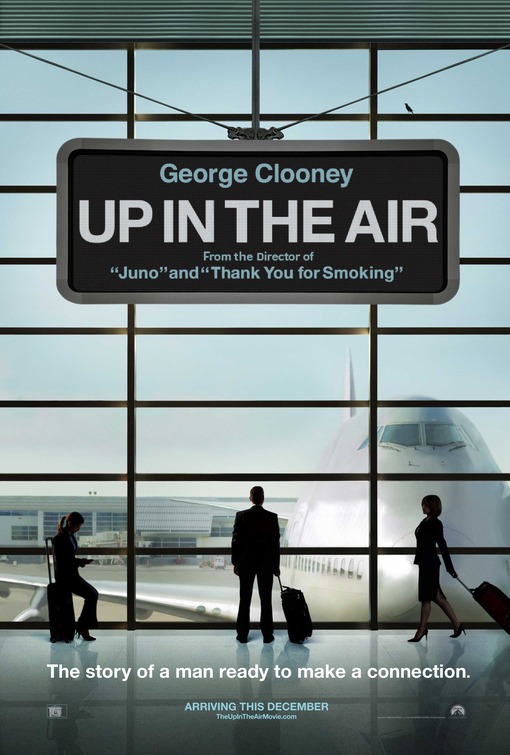 Everyone has been discussing this film as a break-through performance for George Clooney who plays Ryan Bingham, a man who fires people for a living while delivering them a cock-and-bull spiel about this being the first day of the rest of their lives opportunity. His only ambition in life is to become a 10 million mile frequent flyer. What are they talking about? I found this film a vapid exercise that never made a choice to reveal a character through complex dialogue or idiosyncratic behavior if it could do so through edited montage or cliched mannerism. And if Clooney ducked his head and shyly grinned one more time I was going to go for a long walk.
Although I don't choose to live in Omaha or Des Moines, I spent ten years in the middle of my large and various country and I thought Reitman was incapable of depicting what he put forward as average American life without mocking it. His characters perform empty rituals whether they fire people for a living or hold average jobs and aspire to fill condos and cars. Then they get married and everyone is filled with emotion for a day. No wonder all these loonies talk about the "sanctity of marriage," it seems to be one of the only times they're alive, if we are to believe this film. The combination of being the brother of the bride, discovering that his freewheeling-on-the-road-occasional fuck-buddy who he thought had the same values as he actually has a family, and the threat of becoming professionally redundant himself by a call center is supposed to humanize Clooney's character, but if he changes I didn't see it. And if he doesn't - what's this film about anyway?
Friday, June 4, 2010
Virginia Woolf has nothing to be afraid of (Theatre - God of Carnage by Yamina Reza)
 I went to the theatre for the first time in, oh.... more than 8 months, last night. This from someone who used to work in the field and see three shows a week! How wonderful to live within 25 minutes of Broadway and have smart bill of fare with great casts the likes of Jeff Daniels and the inimitable Janet McTeer. The play was Yasmina Reza's God of Carnage. She wrote Art, a provocative philosophical play about the nature of the title subject that was the talk of the theatre scene in the mid 1990s. Last night's play had everything I tend to like in an evening at the theatre: serious moral questions, demands that the actors invest deeply in their circumstances, good roles served by able actors, it did not rely on a lot of spectacle - so why didn't I like it? It was because the play had little imagination, it relied on cliched rather than idiosyncratic ideas of people, and because, although its stakes were high, neither the writing nor the acting was quite up to delivering them authentically.
God of Carnage concerns two well-to-do New York couples (at least in this translation by Christopher Hampton. I would actually like to know if the French version is set in Paris and Hampton's West End version in London, with their particulars) whose young sons get into an altercation. One breaks two teeth of the other, although this act was likely provoked, it was a verbal act that precipitated the physical one. The parents get together in a gesture of working things out amicably and the evening devolves into a violent free-for-all in which the enlightened foursome become drunk and abusive themselves and, ostensibly, show their true colors, which are more savage than their children's. The play attempted to address "real" circumstances in current up-scale New York life, but was really more what you might think New York were like if your only experience of it was from Sex in the City. Honestly, this was some television idea of Soho or Upper East Side whining at its worst. Cell phones. Lawyers defending evil pharmaceutical companies, money buying couples beautiful furnishings and overpriced tulips from the Korean deli on the corner, but not buying them love. Its hyper-reality rendered it mundane. Who cares? I guess the average theatre goer probably cares because they are generally over 60 and from a high income bracket or are Broadway tourists (no offence meant) . But this play certainly did not reflect my life or the life of my friends with children, not even taking into account the fact that it carefully subtitles itself a "farce." Is that supposed to mean that we don't take its moral quandries seriously?
The s biggest joke of the evening is that one of the monied foursome barfs uncontrollably for a time. This, of course, requires a theatrical solution, since it is unreasonable to ask an actor to throw up every night. Barfing on stage or screen is a pet peeve of mine because a) it is a cliche and b) it is one of those things that the audience KNOWS is not true. Dying falls into this category too and plenty of characters in dramas do that, I know - but that is trying to address the ultimate mystery - the end of life. There is something about the basic truth of throwing up that means everyone knows you're faking it. And unless everything else the character is doing is absolutely believable, it throws the authenticity of the entire performance into question for me. If Lucy Liu had been up to the rest of the emotional requirements of her role, maybe I might have been more forgiving, but she was hard pressed to yank herself up to the dramatic demands of her barfing agony, subsequent drunk scene, and the gorgeous monologue that Yasmina Reza wrote and that is sure to become a staple of the audition scene for 40 something actresses for the next couple of years. Dylan Baker was adequate as her husband. Janet McTeer was emotionally available though sometimes strained. It was only Jeff Daniels who showed great insight and admirable vulnerability to the circumstances, an intelligent choice as he was ultimately meant to be the least feeling of the bunch. But the writing seemed to demand impossible reactions given the circumstances and the acting, understandably, was not able to justify it. Although I was happy that a play was exploring the circumstances it did and was able to laugh at some of the jokes, I didn't buy God of Carnage . Reza cannot have been innocent of the references she made to Edward Albee's great play Who's Afraid of Virginia Woolf - a foursome with marital problems who get drunk of an evening and reveal far too much about themselves while slaughtering contemporary values, but the homage she pays does not does not reach the level of its object of admiration either in terms of histrionics or lyricism.
Monday, July 27, 2009
Goldoni the modernist (Theater - Trilogia della villegiatura by Goldoni)
 I'm so glad each time that the Lincoln Center Festival rolls around because NYC gets a taste of some of the world's best theatre companies. Piccolo Teatro di Milano and Teatri Uniti di Napoli together brought Toni Servillo's adaptation of Carlo Goldoni's Trilogia della villeggiatura this year and the Ragazzo and I took his parents yesterday afternoon. That Goldoni was a contemporary of Mozart and his best librettist da Ponte is evident from the style of this play. Goldoni's work makes reference to Italy's commedia del'Arte tradition, with the traditional characters peeking their heads through, but it is a more sophisticated and socially critical comedy of manners. This production added another layer of modernity, darkening the classical comedic mold considerably. The play spoofs two families trying to impress each other during a weekend in the country while they are dead broke because they have lived on credit (if that is not a contemporary comedy of manners I don't know what is!). As with any classic comedy, it ends with a wedding, but not a happy one, as the bride of one broke family brings a mortgaged farm as a dowry to her equally broke fiance (whom she does not love) so that their union can produce income for her father. It is a reminder in all the political talk about how supposedly holy marriage is supposed to be, that the state got into the marriage business because it is a contract conferring ownership of land, property and, oh yes, a wife. That's what everyone who says they are defending traditional marriage is upholding. In any event, Trilogia's modern veneer steered this production clear of becoming a museum piece as so much classical theatre ends up. The production's thoughtfulness put the character's experiences front and center and gave the play contemporary resonance but without explicitly updating it. It was exemplary in its minimalist production values, a smart choice for a tour. Two simple flats, a couple of ground cloths, a few pieces of wooden furniture, some greenery, and a scrim were the sum total of their stage machinery. That accomplished two houses in town in the first play, the house and garden in the country in the second, and yet another house in the country in the third play. A few pieces of music accompanied the simple and very effective set changes. Most of the production's emphasis was put on the lighting design, which was subtle and effective. The acting varied from a subtly realistic Guglielmo played by Tommaso Ragno, to a hilariously flamboyant Ferdinando played by the production's director (who obviously type cast himself as the self-centered scrounger, given the absurd length and braggadocio of his program bio), and everything in between. Neither the three-hour length nor the fact that we listened to the play in Italian, reading a translation in projected supertitles detracted from my enjoyment of it as theatre. This production reminded me how traditional theatrical forms play out the same characters and similar situations again and again in endless permutations and that artists can find in these forms the stories of their own times and really good artists can convey to us that these are our stories.
Monday, July 20, 2009
Encounters.... (Theatre - Les Ephemeres by Theatre du Soleil and Ariane Mnouchkine)
 The Theatre du Soleil in Paris directed by Ariane Mnouchkine is, in my view, one of the most important theatre companies producing today. They work collectively, developing their stories for theatre through improvisation, and live collectively, eating their meals together at the massive Cartoucherie a complex of old factory buildings on the outskirts of Paris.
 Les Ephemeres is their latest piece - a 6 1/2 hour collection of vignettes, some seemingly unrelated in the language of any conventional plot, taken from the company's own stories and memories - that chronicles life's most essential encounters, those where one person is good to another. What binds them loosely together (in retrospect) is a story related to Mnouchkine's own life, in which a young Jewish girl is taken in by an Armenian woman during the Nazi occupation of France. Many of these encounters happen in context of great grief or callamity - a war, a car accident, an illness, a divorce - perhaps the times when we notice other people's goodness the most? Along with each scenes is Jean-Jacques Lemetre's musical score (as always in Mnouchkine's pieces). This music - part recorded and part live - has the feel of a Baroque pasacaglia played on musical instruments from all over the world. It is intensely, even repetitively elegiac. The scenes take place on circular platforms, moved about by the company. As many as four or five can be on the stage at once - each a little world, a planet in revolving continuously during the scenes played on it - sometimes slowly, sometimes quickly. This creates a dreamy rhythm for the piece, an ability to see the vignette from all sides, and suggests each episode is somehow its own complete world but constantly interacting with other worlds. I sometimes found the unrelatedness of the pieces a little frustrating but, when experienced in light of the final episode, they converged. Seeing both parts of the play in one day is a long ordeal, but one that one goes through together with the company. I would not want to see them separately. I found the pleasure of this piece was the essential humanity of the encounters, the elementality of the performances filled with, as the title suggests, the ephemera of daily existence that finally accumulates into that thing we call a life just as the bits and pieces of character and scene accumulate over the hours into a play whose meaning and value become more and more evident and continue to deepen in retrospect.
Friday, June 26, 2009
When low-tech is the highest choice you can make (Theatre - Coraline)
 After the very enjoyable 3-D animated movie adaptation of Neil Gaiman's Coraline released less than a year ago, how can the lowly theatre possible answer the heights of imagination made possible by computer technology? Stephin Merritt and David Greenspan's off-Broadway musical adaptation in a production by Leigh Silverman at MCC Theater finds just the right answer - a deliciously low-tech musical adaptation that makes all the right choices. In it a young girl with overly busy parents moves to a new house with 21 windows and 14 doors (13 that open and close and one that doesn't) is as unexpected a take on the story as you are likely to see. It creates its physical universe as well as its musical score from toy and full-sized pianos, a veteran Broadway and regional actor well into middle age plays the title role and the actors playing her parents are easily 25 years her junior, her "other mother" is played by a man, there are no cat-suits or masks, the magic 14th door through which Coraline passes into an alternate universe containing another house and another set of parents is about 2-feet square and is carried on-stage by an actor, and the sophisticated lyrics find a rhyme for the word 'zaftig.' The production is nearly pitch-perfect. There are no special effects, no dancing teacups, the actors do not wear microphones. They tell this story with words and talent. When Coraline walks from inside to outside, she tells us it is so and it is. It worked for Shakespeare. The actor playing the cat sits atop an upright piano, contributing to the musical score by stepping on the keys.
 There are so many delightful touches to this swift-moving, imaginative production. The cast is basically great and David Greenspan's Other Mother (he also wrote the book) delivers a spendidly evil performance with a tour-de-force sung monologue as she falls down the well. A few of the actors cannot seem to resist mugging, they seem a little too used to the stereotypical cutsie Broadway idiom. Francis Jue, thought he is energetically talented, cannot seem to resist guilding the lily a lot with most of the roles he plays. Jane Houdyshell is marvelous, although she does that thing that adults playing children sometimes do (particularly for the first 30 minutes of the show) that screams not just "I am a child" but "I am a loose limbed idiot-child." Cut it out Jane. It's insulting to children and it's not cute. The whole beauty of this terrific production is that it is theatre. No excuse has to be made for the casting and production choices. They are perfect. People play multiple roles without regard to race, age, or even species and acting is all you need. You don't have to play the fact that Coraline is seven, or whatever age she is. Trust that you're good enough. Children can be adult-like too, you know. Aside from these occasional attacks of the cutsies, this is a wonderful show, well worth seeing if you are near NYC before it closes on July 5. My hope is they will extend. Meanwhile, tickets can be found here.
Saturday, June 20, 2009
Hiking, opera, tea, theatre, book shopping, friends, and home again...


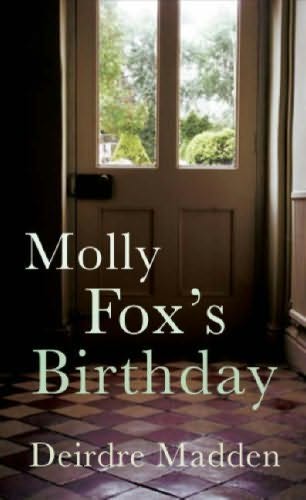
This is the B&B we stayed at in the Cotswolds and its garden. Some rain gave us lots of time for reading, but we also took several hikes on the wonderful network of pubic footpaths that cut through fields and woods across the U.K. Unlike the U.S., where keeping other people off one's land seems a priority, in England, although the farm belongs to the farmer, its beauty is shared with walkers. One can walk for hours uninterrupted and mostly skirt main roads, enjoying a quiet walk in a natural setting. It appears that hikers are respectful, we did not see a single piece of trash along the way. After one of our hikes we had a great afternoon tea in Chipping Camden. I love meeting artists and visiting their studios and try to do this wherever we visit. Our hosts introduced us to a local artist whose work we we found interesting and we had some coffee with her and checked out her work. Our long hike from Chipping Norton took us to an ancient stone circle known as the Rollright Stones. Chipping Norton also boasts a very nice independent bookshop and Cafe - Jaffe and Neale. As you can soon read in a future post, I was pretty wowed by Molly Fox's Birthday and was able to find a copy of her earlier novel One by One in the Darkness there.


We also attended the Glyndebourne Opera Festival in Sussex, seeing our friends there, 2 completed productions, and 1 in rehearsal. Giulio Cesare, a revival, has justifiably been a great sensation. I had seen it on DVD but it's much more fun live. Our friend, Danielle de Niese, sings, dances and acts Cleopatra (pictured below left) in a performance of gob-smacking energy and beauty. Falstaff is a wonderfully conceived production by Richard Jones set in World War II England. Christopher Purves blends great singing and detailed acting into one unified whole is the title role and Marie-Nicole Lemieux is fantastic as Mistress Quickly. The Fairy Queen, which we saw in rehearsal, looks like it is going to be great fun as well. It features The Orchestra of the Age of Enlightenment under the always strong direction of William Christie and I thought the choreography by Kim Brandstrup particularly strong.


We stayed in the big house at Glyndebourne (pictured above left) which was a lot of fun. Sussex was also the stomping grounds of some of my favorite Bloomsburyites. We visited Vanessa Bell and Duncan Grant's house - Charleston (above right) - and it is well worth a visit. Having worked on a play about Virginia Woolf and her circle for years, finally standing in those rooms next to the wall paintings, their studios, and garden was amazing. Unfortunately, we did not get to see Virginia and Leonard Woolf's Monk's House. Maybe next time.
We also visited Oxford, just strolling around for a few hours. The Blackwell Bookstore there is amazing. Having enjoyed William Fiennes The Music Room so much, I found his The Snow Geese there and picked up a copy. Finally, we spent several days in London. We found the Wellcome Collection's exhibits about mental health and art very interesting and they have a great bookstore as well! We also saw Sir John Soane's Museum, which we missed on our last several visits. His collection includes the Hogarth A Rake's Progress and many antiquities. It's quite a house to spend a few hours in (and it's free). We also attended two productions, both at the National Theatre, J. B. Priestley's Time and the Conways - certainly a play before its time in terms of cinematic use of time. The productions is, sadly, an unimaginative bore - lazily substituting screaming and cliches for acting, actors working from the neck up only. The production would have required some sort of physical language to reveal the special qualities of this play. Sadly, they never didn't come up with one in the first two acts and I wasn't waiting around for the third. The second play we saw was a very hot ticket - Hellen Mirren is playing the title role in Phedre in a strong and accessible translation by Ted Hughes. The production also features Margaret Tyzack and Dominic Cooper. There were some nice moments here and there. I thought John Shrapnel as Theramene turned in the strongest work of the evening. Dominic Cooper's peformance was pretty intelligent and centered and Stanley Townsend had a couple of moments where he was filled with the pain of Theseus's circumstances, but sadly those did not a Phedre make. I found most of the actors substituted vocal technique for real connection with these extreme circumstances. Mirren told us she was moved, horrified, devastated, but rarely succeeded in actually showing us that that was so. When she did her connection seemed banal, theatrical, rarely human. We attended the production with my cousin and his fiancee and heading off to the restaurant, he said to me that he couldn't understand why anyone would want to mount Greek tragedy (via French neo-classicism) as it had no meaning today. This seems to me the one reason for mounting any play - that it has some meaning in the context of our own lives. This production has a clear financial motivation for its mounting and one that would fascinate fans but it did not ably communicate to me any esthetic one. We didn't luck out with our theatre-going in London this time but our visits with friends and family and walking around the beautiful city were pleausures enough.
Sunday, November 9, 2008
Disturbing the universe (Opera - Dr. Atomic by John Adams & Peter Sellars)
 American composer John Adams and librettist Peter Sellars have created an unlikely hybrid in Doctor Atomic - an abstract documentary opera on the creation of the atomic bomb. A documentary because it is based on actual occurrences and people. Abstract because while it focuses on the days approaching the testing of the bomb at Los Alamos, it is less a linear story than a collage. It uses projection and sculpture, going back and forth from the daily activities at Los Alamos to the interior monologues of J. Robert Oppenheimer, a leading physicist on the project, and his wife Kitty, and includes two poems - one a sonnet of John Donne's and the other Muriel Rukeyser's Easter Eve 1945. These varied components hang together on a score strongly consistent in temperament and sonority. Opening each of the two acts act is a recorded soundscape evoking the period and atmosphere of those days - bits of radio, sounds of machinery, jeeps driving around the dessert, the thunder storms that plagued the testing schedule. But this gives way to Adams orchestral music, which is brash, solid, evocative and intense. Modern textures mix with beautiful lyrical lines. You know what century you are in and you can feel the disturbance in the universe that is the theme of this work.
The Manhattan Project led to the development of a bomb that worked via the fission of the uranium atom, splitting it into small parts to cause the release of tremendous amounts of energy. Some also call it the birth of “Big Science.” The destructive force of the bomb was meant to be unparalleled, but once unleashed it would literally mean that humans could destroy everything. J. Robert Oppenheim, may have been a leader of the project, but he was also a voice of conscience. Quoting the Bhavagad Gita he wrote “Now, I am become Death, the destroyer of worlds.” Once accomplished, this disturbance in the physical structure of the universe would leave the world a less stable place. While our increased knowledge would facilitate victory in war, it precipitated a world with political and humane problems never before contemplated. Dr. Atomic is a meditation on disturbance at these multiple levels and is beautiful in its sensitive expression of conscience and appropriately unsettling.
The production, directed intelligently by Penny Woolcock, is strong on story-telling. She is master for using people and things on stage to make our progress from event to event clear. There is none of the Met's typical sloppiness and nineteenth century stage clichés of people getting up on boxes to sing solo lines. Stage action was human and necessary. However Ms. Woolcock was less adept in her ability to develop the vertical line of the piece - the point in soliloquoy or aria when time’s literal progress stops and the inner workings of a person’s mind or soul unfolds before us. Here is where theatre engages in a little “quantum physics” of its own, defeating the typical laws and time and space, travelling in a way that memory and imagination allows. In these equally important moments of Dr. Atomic Ms. Woolcock seemed to have left the performers to their own devices. They became unrooted, and frozen in general attitude. It was a shame because the score and libretto in Kitty's Oppenheimer's scene in Act II were crazily inventive and an opportunity for complex internal conflict expressed with challenging music. An Act I scene meant to develop the Oppenheimers relationship, and the only time we see them together, was strangely disconnected and made unimaginative use of a silly choreographed dance rather than having these troubled human creatures connect to their love, or their pain in its absence, their feelings of inadequacy, or their feelings about anything at all. A more thoughtful development of the character of Pasqualita - the Oppenheimers’ housekeeper - might have helped sustain our interest in her long aria that opened Act II. The production seemed to want to use her as a spiritual symbol of the indiginous culture of New Mexico and perhaps stand for the parts of Los Alamos history that were more respectful of nature, but between desultory staging and textual references to vishnu and the trinity, I couldn't figure out what was intended.
Otherwise the production was strongly satisfying. Its physical elements were creative, functional, and a pleasure to look at. The Met chorus was used as an effective narrator and their performance was uncharacteristically precise and energetic. The role of J. Robert Oppenheimer is written with wide ranging emotional and musical tessitura. Gerald Finley's performance was human and involving, and his singing sumptuous. This was particularly apparent in the aria that closed Act I, a setting of John Donne’s Holy Sonnet XIV, chosen because it inspired Oppenheimer to name the bomb test site Trinity. It was the highlight of Dr. Atomic’s lyrical side. The writing of this opera was effective in not burying the story either in the development of technology, or in sentimentality for our lost innocence. The structure of the piece, building to the Trinity test, drummed up tension in the final ten minutes that really made my heart pound. As a whole the opera was thoughtful about human responsibility in the face of our ever increasing knowledge and movingly resonant, even topically so, but not preachy.
Batter my heart, three person'd God; for, you
As yet but knocke, breathe, shine, and seeke to mend;
That I may rise, and stand, o'erthrow mee,' and bend
Your force, to breake, blowe, burn and make me new.
I, like an usurpt towne, to'another due,
Labour to'admit you, but Oh, to no end,
Reason your viceroy in mee, mee should defend,
But is captiv'd, and proves weake or untrue.
Yet, dearely'I love you,' and would be loved faine,
but am betroth'd unto your enemie:
Divorce mee,'untie, or breake that knot againe;
Take mee to you, imprison mee, for I
Except you'enthrall mee, never shall be free,
Nor ever chast, except you ravish mee.
Wednesday, July 9, 2008
I am not a number. I am a free man! (Theater - The Adding Machine)

"I am not a number," Patrick McGoohan used to rage on the 1960s show about a former British agent called The Prisoner, "I am a free man." Elmer Rice's 1923 play The Adding Machine features characters who are all numbered rather than named. They are indeed the antithesis of free men and women, and this play examined the dehumanizing effects of replacing workers with machines. In experiencing it through a beautiful new musical adaptation by Jason Loewith and Joshua Schmidt, I was struck more by the fact that these people dehumanized themselves by living unchallenging lives. Mr. Zero tries so intently to protect himself from risks to body and heart that he seemed to live no life at all. After 25 years adding numbers, sharing his desk with Daisy - a woman who read each number aloud, he is made redundant by the adding machine, kills his boss in a fit of rage, and is sentenced to death. At the beginning of the show we see that everything about Mr. Zero's life has become automated including his marriage, which consists of Mrs. Zero's comparing her life to to others and sniping at Mr. Zero's inadequacies. She is played and sung with gusto by Cyrilla Baer. The composer and librettist have created an interesting score - the opening, for example, is a fugue-like piece, composed largely of numbers both spoken and sung. The music is satisfying for being quirky, complex, and gratefully lacking in pop cliche. Although the singers in this small space were miked, I felt like I was always hearing their voices unamplified. It was a pleasure to hear singers with real voices - not over-amplified screaming. The set it simple and compact and the production focuses its attention where I wish more productions would - on the human beings, their relationships to their circumstances, each other, and themselves. This is not an easy story and it could easily turn into an evening of unadulterated gloom about ruined lives - especially with our current economy and the mainstream media's love of "real" stories - but the evening turns on element of human striving-for-better as embodied in the character of Daisy and the beautiful performance of Amy Warren. This musical is unusual for being a story about middle aged people, past their prettiness but, Daisy shows us, not necessarily their prime. I loved seeing a stage full of performers who have done some living, who know how to use their voices, their souls, and their intellects to create powerful performances full of real behavior driven by human feeling. Mr. Zero is uneducated, white, poor, rough, even bigoted - think Archie Bunker but 1920s and singing - but Joel Hatch gets us to see the heart in him. I love the roughness of his characterization - his voice had a strong Brooklyn accent and there was tons of gravel and growl in it, but he could also sing beautifully. These combine to great effect in his courtroom confession - a musical monologue. It's rare to see an emotional show stopper for a middle aged man on the musical stage. I can't think of one since Sweeney Todd's Epiphany. I loved it! My favorite part of the show was when Daisy and Mr. Zero finally get together (in the afterlife). She sits next to Mr. Zero for twenty-five years on the job in hope, living on a single fantasy of the one company picnic which Mrs. Zero couldn't attend and she believes Mr. Zero showed her some affection. Now she is well past shall we say 'marriageable age,' and she knows it. She had resigned herself to being unfulfilled, but when she meets Mr. Zero in the afterlife she decides she will not allow her second chance to go by the way she did her first. Daisy's Confession is a beautiful outpouring of repressed longing through song and Amy Warren really goes to that private place in front of us. Her singing and acting form a perfect inseparable whole as she cries, rages, and blushes before us. I'd see the whole show again just to see her. Unfortunately it is scheduled to close on July 20. If you are near New York before then, go see this lovely show. It's a commercial off-Broadway production at the Minetta Lane Theater. Here's a link. This is one of those shows I wish would tour, although the road finds it hard to sell unknown work. Perhaps this show is compact enough and can play small enough venues to make a commercially viable tour, but it's more likely that regional theater companies, especially ones with intimate spaces (under 500 seats) will pick this kind of show up and do a locally based production. I hope universities don't pick it up, because it is not a show that will benefit from youthful performances, but however it might get produced near you, if you have a chance to see it, it's a beautiful show.
Monday, July 7, 2008
Drink Your Wine (Theater - The Bacchae)

Do not cross Dionysus - he's the Greek god of revelry, of wildness, of wine - that's the advice of Euripides' 2400-year-old play The Bacchae. The Greeks created mythical beings who represented various aspects of nature (and I include us in nature). In this play Dionysus is crossed by Pentheus, prince of Thebes. Pentheus is upset by the revels of the Maenads, the wild dancing women who accompany the god everywhere, and so he attempts to imprison Dionysus. But Dionysus, being a god, cannot be held. In the end, not only do Pentheus's mother, aunts, and grandfather dance in the mountains with the cult of Dionysus while wine and milk spring from the ground, but Dionysus exacts his revenge by driving the revelers to tear Pentheus to bits. His own mother impales his head on a pike as a trophy, imagining it to be a mountain lion.
A program article by Simon Goldhill describes The Bacchae as
...show[ing] how the forces of sexuality, violence, and irrationality can undermine society's most chrished commitments and offers a dark, lurid, and seductive image of the fragility of civilization.
but I don't think that is the whole picture. In fact, I don't think the play only portrays these forces as negative. Sexuality, violence, irrationality are parts of us to be understood, respected and to be given some play - even celebrated, lest we become unable to deal with them and when they burst forth take us over entirely. That, I think, is what is meant by the notion that we should respect Dionysus. If we don't respect those parts of us which need to revel, to dance, to go a little crazy once in a while, if we fear them, if we control them too much, if we deny in fact that they are a part of us - they will explode despite us and rage out of control, which will end in tragedy as this play does.
I have seen two productions of this play in the past year, one at the Experimental Theater Wing at NYU directed by my friend Kevin Kuhlke, and this production by the National Theatre of Scotland featuring a new translation by David Greig and directed by John Tiffany and featuring Alan Cumming as Dionysus, part of this summer's Lincoln Center Festival. The NYU production was very raw, with a marvelously contemporary translation and really great modern music. This production's text is contemporary and colloquial and yet also poetry - I liked the version a lot. Alan Cumming ate the poetry, reveling in his burr to make its speaking full of juice. His physical appearance - he is a god, so he may choose his form - was full-out androgynous human, as you can see in the above photograph. Male, but also female - feminine and sexual but also tough and muscular, his body wide open. Cal MacAninch played Pentheus as all wire and outrage. The highlight of the cast to my mind was Paola Dionisotti as Pentheus's mother Agave. She hurled herself into the revelry with complete abandoned passion and then broke into tiny vulnerable pieces when she realized she had killed her own son. Lovely performance. There was a lot that was good in this production but I took issue with the choice this production made regarding the Bacchae themselves. The NYU production used raw, intense, throaty music in the bodies of the young women who are their students. Here the chorus were all adult women. They were a talented and spirited bunch - coming in all shapes and sizes and they moved really well - but the music and dance created for the production was a gospel-y soul. This could have worked if its performance had had more guts, more, well, soul, but it felt more like I was watching a Vegas Motown medley. Nothing about the work lacked talent it just felt very controlled, very elegant - the opposite of what I wanted the music to evoke in a production of The Bacchae. There was one dance to show us the maenads in their revelry that really had some guts, but sadly only one. I think this production made a choice, both in the casting of Alan Cumming - who is great but who is directed to play a very entertaining Dionysus - and in the use of a very commercial, familiar, and appealing musical idiom - to make friends with the audience. The choice of playing us up, first with god as comedian, and then with Bacchae-as-Dreamgirls was to put us in the role of one who will find the god appealing, enticing, entertaining. We should feel ourselves want to be one of them. It's an interesting choice - but I think the script plays more with a tension of wanting our complicity, our involvement, but also our distance - that's the advantage of having a chorus narrate and delivering the most terrible events by messenger. I never felt the fear and excitement of what was to happen to Pentheus before it happened as I did in seeing a rehearsal at NYU without any set. My heart pounded in anticipation of what I knew was going to happen, even while Pentheus did not. Here I was skillfully entertained, but I only felt the impact of what happened afterward, through the fine performance of Agave. I finally put aside this objection so that I could enjoy the rest of the production, for it did have a lot to offer. I enjoyed the fact that the women of the chorus also played smaller roles of soldiers and the messenger who reports on the murder of Pentheus - the messenger is always a difficult role as it must make drama of events we don't ever see. Hazel Holder handled it beautifully and the physical work of the other Bacchae really added to my experience of the narration.
Saturday, May 31, 2008
Perspective (Theater - Sunday in the Park with George)

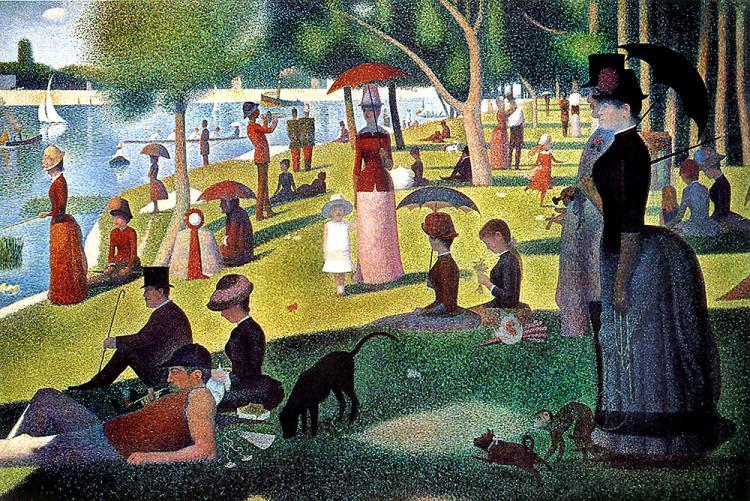
Who else but Stephen Sondheim would write an entire act of a musical in which nothing happens except an artist attempts to see and paint a picture. But that artist is pointellist Georges Seurat and that picture is Sunday Afternoon on the Island of La Grande Jatte and the musical is Sunday in the Park with George and so much happens in it. The work is in some ways a grand undertaking - it is about the artist's vision and the artist's role, it is about creative process, the prices and rewards of obsession, it about the perseverance necessary to go against the grain, it is about the acts that give life value. It is a grand undertaking presented but presented in an intimate rather than opulent production - if it's big Broadway you're after you will not find it here. The actors playing Georges (Daniel Evans) and Dot, his model (Jenna Russell) give honest and nuanced performances. Their singing voices are not flashily beautiful. The unit set is spare and functions as a blank canvas, imagine that, on which the show's settings can be painted (or projected in this case). The orchestra has only a handful of musicians in it. I appreciated how the characters other than Georges and Dot operated in a usual sort of Broadway idiom - the scale of their performances is a bit larger, they operate more as types - so that every time the actions returns to Georges or Dot, the lens seems to zoom in and we are in a room with them. The production uses theatrical form to talk about artistic form and I found that apt. In the first act, as I mentioned, we witness Georges Seurat painting his famous Sunday in the Park..., in the second, it is 100 years later in the gallery in which the painting hangs. A contemporary artist, also named George, makes an homage to his artistic predecessor involving his grandmother (Dot's daughter, perhaps the child of Seurat) and tries to figure out what his work is all about. He tries to find the courage to create what he wants instead of what he thinks others want of him. At some level we all play out this struggle of our individual wants against current of what others expect and demand of us. In that way this show is very universal. The music makes use of an appropriately narrow palette, I've always thought it referenced French classical music. I love the way this Sondheim work sets text to music, it is relentlessly speech-like. It has a very - talked-on-the-note sound to it. The one now well-known song, Putting it Together, immortalized by Barbara Streisand's Broadway Album is, to my ear, the one trite bit of music in the piece. This production did not convince me otherwise. But I love Dot's two songs - Sunday in the Park with George, in which she complains of the inconveniences and indignities of posing for the famous artist, and Everybody Loves Louis - as she tries to justify to herself leaving a famous artist for a well-loved baker. George's Finishing the Hat is a beautiful anthem to his obsessiveness, his determination to see, to recreate what he sees in a way that the viewer of the painting (even 100 years later) becomes complicit in creating with him. Seurat made use of the optical science of his day, that observed that two colors just overlapping can have the appearance of a third and different color when seen from a distance, and this gave birth to pointillism. If you look at the "black" hat, the "white" sail or the "green" leaves in Seurat's paintings, you see that they are each really composed of multiple colors. One can stand up close to the paintings and observe the composition of the colors as the forms fragment - like looking through a rain spattered window - or one can stand further away and that distance allows us to see whole forms with illusions of single colors that our eyes create. The paintings use not the perspective of the classical painters trying to render architecturally faithful reproductions of scenes on their canvases, but make one aware of how perspective is a tool that can help us see different elements of the world depending on where we stand. Sondheim's musical also uses perspective with two acts spaced 100 years apart, one in which a ridiculed maverick messed up any opportunity for a career by not painting what was expected of him and ended up alone by not living as he was expected, another in which that famous painter - his value now understood - attracts the donations of millionaires, the serious criticism of cogniscienti, and the appreciation of ordinary art lovers too, as a new generation of artist struggles with this battle of personal vision and the pressures of public opinion. The finale of both acts I and II are company numbers in which the spare melodic palette of the other songs, and the exchanged lines usually of solo voices blossom into a rousing chorus dense with harmonies and the previously white stage is saturated in the colors or the painting as each George creates his Sunday - they let you feel the ultimate satisfaction of creating a work and they are very movingly composed and staged.
It's a pity that MOMA's exhibit of Seurat's drawings is not still up. But if you will be in New York City before the end of June, get some tickets for Sunday in the Park with Georges and then spend a day at the Museum of Modern Art or the Metropolitan and take a look at some of Seurat's drawings and paintings and see if you see them as you looked at works of art before.
Saturday, May 10, 2008
Signifying Something (Theatre - The Sound and the Fury)
 In April Seventh 1928 - the first part of the psychedelic-poetic masterpiece that is The Sound and the Fury - Faulkner (you know you're important in literature when they drop your first name) evokes that day in the life of the Compson family and their servants as experienced through Benjy, their mentally retarded son. It is Benjy's thirty-third birthday and he is cared for by a teenage servant, Luster. He experiences the world around him as a series of sensory impressions which evoke memories, particularly of his sister, Caddy, but the world of past and present are indistinguishable for him. He sits in a chair, for example, catching his shirt on a nail and that reminds him of another moment in which he got caught on the same nail and instantly he is there in the sensory experiences of that previous moment. In a large way the book chronicles the dissolution of this family - the mother's hypochondria, the father's alcoholism, the sister's promiscuity, the brother's suicide (and some might say by extension the dissolution of a certain way of life for America's Southern gentry). Elevator Repair Service, the 17-year-old experimental theater ensemble that adapted this first part of of novel, has evoked this continual journeying to the past as a kind of longing. It's not uncommon for someone whose present circumstances are less than pleasant to become nostalgic. It is as if Benjy is in a perpetual loop of nostalgia, which makes his character function symbolically as the spirit of a more innocent South now gone. Theatrically he functions as our tripwire into a place where time will not stand still. His psychedelic-synesthetic experience of all times as one renders people as smells, objects as texture, and the tumult of his less than perfect home circumstances as a raucous repetitive dance for which this wildly inventive company find a physical life on stage that is appropriate to the novel and theatrically enveloping, even hypnotic. Multiple actors plays the same roles irrespective of their ages, sexes, or skin color. The set is a meticulously detailed dining and living room section of the house in which they create all the other spaces theatrically - a tree is created by piling up furniture, an armchair becomes a horse and buggy. They read directly from the novel on stage, taking turns as narrators, but also playing their own narrators as they play the characters. I believe they actually adapt every word of this section of the novel, including 'Caddy said.' Evidently they did the same with their marathon adaptation of The Great Gatsby - performing in that case the entire novel - I am absolutely dying to see this production called Gatz. For some reason I cannot understand, the rights were not given for a New York production. With every word, of April Seventh 1928 they are constrained to a 2 hour and 45 minute evening which ends up feeling just a little long. There are just two things I wished they would have done with this fantastic adaptation - their theatrical story telling is so inventive but they use up all their tricks in the first act, leaving the physical life of Act II without any surprises. I wished they had saved us one surprise. There is a moment in Act II in which Benjy is, I believe, taken off to a hospital. A white-figure appears and whisks him out through the door and following him Dilsey, the family's cook, sadly shakes her head and returns to the kitchen. It was extremely subtle and beautiful moment - but I wasn't quite sure what I was seeing, so quickly did it go by. It occurred perhaps 20 minutes before the end - what was going on there? Was that Benjy's medical castration? It passed in a flash but seemed important thematically. It seemed to herald a change, an ending which could have been evoked visually to effect an ending to the play. The one element of the adaptation that didn't quite work for me was the fact that the novel revolves around the men's relationship to Caddy while the play, adapting only one section, revolves around Benjy. I think it's smart to center the play around Benjy's but the words of the chapter's ending center around Caddy. Visually when Benjy's was whisked out the door, I felt the evening had ended and then the rest of the act felt long. That said, I hate it when people respond to something I've made on stage by telling me what I should have done differently. Do your own version, I want to say. The best response would probably be Faulkner's own description about the creative process that produced The Sound and the Fury (from the supplemental information on the New York Theater Workshop's website) :
... I wrote that same story four times. None of them were right, but I had anguished so much that I could not throw any of it away and start over, so I printed [the novel] in the four sections. That was not a deliberate tour de force at all, the book just grew that way. That I was still trying to tell one story which moved me very much and each time I failed,but I had put so much anguish into it that I couldn't throw it away,like the mother that had four bad children, that she would have been better off if they all had been eliminated, but she couldn't relinquish any of them. And that's the reason I have the most tenderness for that book, because it failed four times.
I guess that means that ERS should get at least four chances. There probably isn't going to be an adaptation of this famously complicated novel that is likely to get much better than this one. In its totality I found this was an affecting and involving evening of theater, full of invention, with a mesmerizing, multi-layered sound scape that I have to single out as one of the most effective contributions to the evening. It was designed by Matt Tierney. The production hosted by New York Theatre Workshop, one of my favorite off-Broadway companies, has been extended until June 1. If you're in the area I highly recommend it and the link to the theater can lead you to tickets. ERS also tours both around the US and Europe so you may be able to catch them some time at a theater closer to home.
...Life’s but a walking shadow, a poor player
That struts and frets his hour upon the stage
And then is heard no more. It is a tale
Told by an idiot, full of sound and fury
Signifying nothing.
Saturday, December 22, 2007
Rock 'n' Roll - A Spiritless Revolution

When I am not a fan of whatever Tom Stoppard's latest play is, I am usually still an admirer. Rock 'n' Roll follows the friendship of two men, one a British professor in love with the possibilities of Communism and the other a Czech student who lives with it. It follows the progress of their lives and their ideals through the Rock 'n' Roll of the 1960s, 70s, 80s, and 90s. It is, like many of Stoppard's more recent plays, an attempt to make theater of ideas and it is his least successful attempt to date. I saw the ambitious, passionate The Coast of Utopia - a nine hour trilogy that examined the revolution of Russian society in the 1860s - 1910s. It too was problematic but delivered a dramatic arc. It's historical sweep was extraordinary and yet one could really be touched by the people involved. That was partly the function of a magnificent, spare production and some beautiful performances, particularly Billy Cruddup's and Ethan Hawke's. Arcadia, though full of intellectual characters, remains one of the most beautiful plays I've ever seen.
Rock 'n' Roll not only less successfully mines the hearts of its characters for some shred of pathos, it suffers from a superficial production and largely empty performances. With the exception of Brian Cox who is always a pleasure to watch on stage or film, the acting is characterized more by hard work and short-hand tricks than what one might call a soul. It's sad, because there are some good people in it - Sinead Cusack first plays Esme, a Greek professor (married to Brian Cox's character, Max) ill with cancer and later plays that professor's daughter. While I have seen Cusack do some lovely work, this character's inner life, and there is plenty to mine here, fails to bubble to the surface. This actress is unfortunately left to feeble tricks to try to convince us that she feels anything at all. The writing isn't kind to her - it is very affected when she should really be allowed an outburst and asks her to turn on a dime. Rufus Sewell, who I have also enjoyed many times (although this is the first time I have seen him on stage) overplays the enthusiasm of the younger version of Jan, his character, to such a degree that he seems almost pathological. He also seems to be tearing his throat to shreds with all the hollering he's doing, so hoarse does his voice sound. As his character mellows with age, Sewell is able to calm down and show us more about who lives inside this mass of nervous shuffling and shambling. He does seem to have an inner life the whole time, it's only the fact that he believes he needs to do so much to make sure we see it that ruined my being able to be moved by it for the play's first half.
This over-the-top demonstrating by nearly the entire cast of everything that happens is exhausting to watch, but it is not satisfying and for that I fault Trevor Nunn's clunky production. The episodic structure of the plays, moving by years, does not seem to me to demand constant dropping of the curtain and long excerpts of rock 'n' roll with projections mentioning the artists' names, the studio. The music needs to be a part of the production, sure, it is such a part of Jan's life and such an expression to him of what it means to be "free." I would guess that these long pauses allow for all of the wig changes and set shifts, another aspect of the production that the play and its performers would have been less burdened without. I really didn't need Esme to show me her surgical scars done as obvious makeup effects over a body stocking. The point is how she feels about them and that she shows them to her husband. Our seeing them didn't make the production more involving or more real, rather it made it less so. And that seemed to be the problem with the entire production. Jan as an older man didn't need gray hair, Sewell already nice a few subtle things with body and voice to suggest the age of his character and that would have been sufficient. In fact, seeing these humans and their space transform would have expressed far more in theatrical language about the nature of revolution than all the film-flammery of this production. Nunn failed to trust the talents of its actors to create a personal revolution and the intelligence of its audience to experience one. The production was burdened by soulless materialism when it could have been transformed by the spirits of those who worked in it.
Saturday, December 15, 2007
500 Clowns - Daring to Show Up in Performance
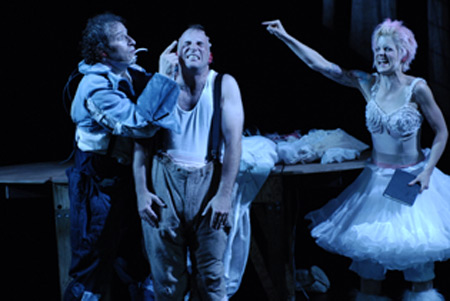
500 Clowns is a company that combines circus, heart-in-your-mouth acrobatics, improvisation, and the free adaptation of a well-known text (usually) to make a kind of theater you have probably never experienced before, unless you've experienced 500 Clowns. Full disclosure: they were founded by good friends of mine. Now, that said, they are fabulous. They continually play with the imaginary border between performance and reality that most productions take very much for granted. You know the normal routine: they turn the lights out, you sit in the dark, that means everything is different now, holy cow she's really sad, that dress means it's 1890, etc... 500 Clowns play this game differently. You've arrived in a space, they've arrived in a space, we both know it's a performance. They usually have one or two physical elements and a very limited number of props - in their current show Frankenstein, it's a table-ish sort of contraption which ingeniously becomes, well, anything they need, and they have a candlestick, I think that's it. In 500 Clown Macbeth it was a precarious scaffolding, some crumpled pieces of cellophane, and the crown. Whoever wore the crown was the king, the action of the piece was ambition (surprise, surprise) and that was expressed by trying to climb this scaffolding. The whole company (all 3 of them) also played the witches. But don't think they're all fun and games. The best thing about 500 Clowns is, ok two things, 1) is that they distill what the story is about to a nugget that can be physically expressed and then they play mercilessly with that theme through improvisation, acrobatics, and their own honest emotions. They played in Frankenstein with how we create enemies - through all their antics, this was the core of their piece and it really resonated. We think we're forced to be fearful, and initially fear is a reflexive response, but we can participate in it too, just as we do every other emotional response we have to circumstances. 2) In flirting with the edge between theater and "life" there is nothing that is not real to them in the performance. There are no distractions, there is only what they're doing or what we're doing there in that space on that day. They build their performance around playing with that moment and around physical risk taking, and it's all real - no nets - the result is really involving because they're really doing it - no pretense here - even though they're telling a story and playing characters. They are clowns, so they are frequently very funny, their shows have the delight of kids playing in mud, but they find a way to build their action to involve their emotions as well (you know, like "real" actors) and when they do, there are no nets here either. I'm not going to ruin how they do this in Frankenstein, but I found the result really effective. Frankenstein and a second show with music called 500 Clown Christmas are playing at PS122 in New York through New Year's. If you are in the New York area here is where you go for tickets. But they tour as well - check out their website at the link at the top of this post to see if they're coming anywhere near you, and if they are, run for your life! That is, go and see them.
Friday, July 20, 2007
Chekhov lives

Daniel Veronese's Proyecto Chehov comes to New York's Lincoln Center Theater Festival from Buenos Aires. He unites a group of committed and idiosyncratic actors in a bare-bones, immediate, down and dirty adaptation of Three Sisters called Un Hombre que se Ahoga (A Man Who Drowns) that is everything I go to the theater for. No light cues, only some scratches on the violin for music, one prop - a newspaper, a few chairs, the cast wear their street clothes, but they change nothing about the essence of Chekhov's play (they even stick pretty closely to the text). The biggest difference about this production is that sexual roles are reversed. The three sisters and Masha are men, Solioni, Chebutykin, Tusenbach, Vershinen, Kulygin, and Andrei are women. This is not a "concept" they play it straight. They result is that I could discover this play all over again. All of the cliches went out the window - grieving old servants with kerchiefs on their heads, Natasha as a harpie, a hang dog Kulygin. Instead we saw Amfisa as an old man truly afraid he'll be thrown out onto the street because he's too old to work. Natasha is an utterly crazy and rude kid who doesn't fit in at all. Kulygin is a proud competent teacher who simply loves Masha and cannot help himself. Olga is jaded, broken and has completely imploded upon herself. There isn't even anger left. The sisters went from their old, busy, privileged life with their parents, to a house full of soldiers and dreams of a romantic future. When everyone finally leaves and the Baroness is killed in a duel - Irina only knows that life will go on and that she will work. It is not a romanticized notion of "work" it is simply what she will do tomorrow. Everything about this cast's work was precise and real. Andrei wasn't pathetic because he played a henpecked husband or a tired bureaucrat - he was truly pathetic because he was proud to be on the town council. This production was most remarkable because it didn't make a distinction between life and theater - the cast sat in chairs around the playing area reacting to each other, jumping up from those chairs into the center of the playing area when they entered the scene. When they reacted to each other's actions or performances there was no division between their smile at a choice their fellow actor made or their smile at the character on the stage. There were no characters and actors, only people naked and true before us. I could go and see this again tomorrow. In fact, I might. It reminded me of why I did theater for the last 22 years. The mystery to me is why there were empty seats in the house. Perhaps Chekhov cuts too close to the bone.
Thursday, July 12, 2007
We're all Animals - Fables for Any Age (Theater - Fables de la Fontaine by the Comedie Francaise directed by Robert Wilson)

I saw the Comedie Francaise production of Fables de la Fontaine directed by Robert Wilson at the Lincoln Center Festival last night. I am not a fan of Wilson's, actually I'm not a fan of the Comedie Francaise either. I certainly didn't have the New York Times Ben Brantley's feeling that I was in the presence of brilliance, but the evening did offer some of the wisdom of La Fontaine's acerbic tales and some of Robert Wilson's stark trademark minimalist beauty.
I remember seeing the Comedie Francaise doing Racine in Paris, probably back in 1984. There is something about that exaggerated style of oration that simply bores me to death. I can admire the craft the way I would, say, really exquisite needlepoint, but I cannot get involved in anything beneath the surface of the characters. They force me to make a choice - perfection is the language they tell the story in - so when that facade is scratched, I can no longer admire their skill and I am also removed from the story. People can tell me this is the style and give me the reasons it evolved until they are blue in the face. I go to the theater to see life's mess. I even have this limitation when watching ballet - Baryshnikov is dazzling and highly skilled, so he almost never falls, but if he does, you fall out of the story with him.
I guess that was part of the problem last evening, these actors were practising a craft they are masters at - this declamatory style of acting - but they mixed it with precise, physical movements, creating clown-like characterizations, and story telling. They mostly fell short in these latter categories because they are amateurs at it. Theater de la Complicite has made an art of telling a story with a bold physicalization and deep feeling. These actors had a limited physical repertoire and no movement coach. Robert Le Page's troupe creates highly imaginative layered episodes with stunning stage mechanics - these, with a few exceptions never left the language of cliche. Peter Brook's company work for long months to find human substance behind simple story telling . Instead, these skilled actors hopped, danced, screeched and croaked like a bunch of silly amateurs. But there were moments when these skilled artistes strutting like chickens and prancing as foxes found something amusing and fitting to the sharp, quippy tone of these moralistic tales.
There were times that their trademark declamatory style was a way for the actor to fashion their voice like the animal's, in this case it really worked well. In playing a rooster, Gerard Diroudon got beyond simply making the noise anyone reading an animal story to a child might make. He found a marriage of animal sound and heightened theatrical speech that was funny and instantly recognizable. His physicalization of the rooster was also very detailed. Francoise Gillard's lap dog begging for affection was equally hilarious. Moidele Bickel's costumes were an excellent combination of identifying elements of the animal with human clothing elements that suggest the animal. In other words, he didn't simply hide an actor inside a suit. There was an anthropomorphization that added to the wryness of tone Wilson went for. For example, the rooster wore high heeled shoes that compelled him to put each foot down very precisely, like a bird. The lap dog wore a curly fur stole - like a spoiled socialite - and tight leggings which were stuffed above the knee. But there I go - I am reduced to discussing costumes in order to discuss what was good about this theatrical experience.
Wilson's choice to frame the evening with La Fontaine presenting or possibly creating his tales before us in the court as he ages, was one that added some meaning through context. Michael Galasso composed contemporary baroque-style music that placed us in period instantaneously. These tales do not think much of human, or should I say animal nature. Often La Fontaine seemed to sneer at his patrons as he bowed to them, which seemed only to be proof of his bleak view of the animal kingdom as a bunch of lying, greedy, flattering snobs. Yet this was really the substance of the evening. It was a courtly and highly decorous pantomime that could not disguise the true nature of the beasts (of which we are clearly one). The tales' messages are timeless and worth hearing, and the simplicity of the primary colored background, a simple lion's mask worn by a man sporting evening dress and dreadlocks, and his silly little storybook roar presented the tale starkly enough to hear it. So finally the language of the evening succeeded in its mission of telling these stories in an unsentimental language. If you want to look at deeper levels or leave the theater moved by the stories' content you would be disappointed but I finally experienced each tale like a cold, briny oyster with the sharp tang of mignonnette. Their morals should sting a little. Take this one which I've adapted just slightly: Reason offends the mighty. What they get in their head is that animals and men all exist for their sakes. To object is the worst of mistakes, sheer folly. "I quite agree, but then what's to be done?" Keep still, or else speak and run.
Subscribe to:
Posts (Atom)