Showing posts with label french film. Show all posts

Saturday, April 5, 2014

A delayed account of bookeywookey's New York cultural wanderings (Books - The View from the Tower, Robert Oppenheimer, Night in Shanghai) (Film - Les Petits Mouchoirs) (Art - Gaugin, Sonnabend, and Jasper Johns)


I have gotten hopelessly behind with a regular accounting of my reading this year, never mind the theatre, films, operas, and exhibits that make up my New York life.  Take this week.  I finished the new Charles Lambert thriller The View from the Tower which I heartily enjoyed (I'll link the post when I write it).  I dipped again into Ray Monk's Robert Oppenheimer: A Life Inside the Center, a biography of the influential physicist which I have had going since late last year.  While Monk makes the case for an interesting life full of internal conflict, his rendering is too comprehensive.  You lose the forest for the trees, the forest in this case, being the narrative throughline.  I'm disappointed by biographies that seem to be nothing more than repositories for the totality of an author's research plopped on the page in chronological order, rather than the crafting of a narrative which has an opinion about that life.  To be fair, Monk has a strong point of view about Oppenheimer's judaism which, he asserts was repressed and the source of tremendous interior conflict,however, that opinion fails to cull his narrative.

I started and gave up on Night in Shanghai (thank you Henry Holt for this copy) which was promising for its setting in 1930s Shanghai and the way the author Nicole Mones created atmosphere, but I couldn't for the life of me keep track of the characters.  The unfamiliar language impeded my remembering who was who and my lack of historical knowledge added to my difficulty remembering which side of the nationalist versus communist struggle they were on, so I couldn't follow what motivated the plot and, unfortunately, I lost the thread.  The sense of place was successfully pervasive and the writing entertaining, so don't let my faulty memory discourage you.

I went to the Antiquarian Book Fair yesterday, which, given the average price of the items displayed there was more of an antique book museum for me.  I came across a novel by Tennessee Williams I had never heard of called Moise and the World of Reason and would have bought the beautiful first edition if I had had $295 to spare.

I then wandered down to MOMA where I saw a very interesting exhibit of Gauguin's prints, how they interacted with his painting, a show whose theme was the gallerist Ileana Sonnabend and the works she brought to public attention at her Paris and New York galleries.  I have to say I found this more interesting for its history than likeable for the work in it.  I also saw a small exhibit of Jasper John's latest works: Regrets, based on a photograph of Lucien Freud.  Small, tightly curated shows are always my preference.  I didn't merely enjoy the work for itself, I appreciated how the prints and paintings on grew from the original photograph, which is also on display. This is a show that's about creative process more than anything, and how the act of an artist doing something as a result of their experience of some source, becomes the seed of new work. Wonderful show.

Finally, I made my chilly, rainy way home, poured a glass of red wine, got under a blanket and watched Guillaume Canet's 2010 Les Petits Mouchoirs; the English title is Little Whie Lies. This is a French Big Chill, complete with a tight ensemble cast of solid actors, great music choices, and a somewhat sentimental story of a group of middle aged friends minus one.  The love and pathos of old friendships is beautifully captured by the cast in that undemonstrative way that French films are so good at, where people seem like people because they are free to feel but not getting off on showing you that they can.  Be prepared to use at least one mouchoir if you're at all moved during films.

Tuesday, February 12, 2013

Film - L'Illusioniste (2010)


L'Illusioniste, a melancholy and beautifully detailed animated film from the makers of The Triplets of Belleville

Saturday, February 9, 2013

Being private in public - Film: Amour (2012)

It really is as good as everyone says it is.  Amour directed by Michael Haneke with Jean-Louis Trintignant, Emmanuelle Riva, and Isabelle Hupert depicts an elderly couple as the circle that encompasses their active lives shrinks to a point when one of them becomes ill.  The camera takes it's time, watching them as they eat their dinner, read, listen to music, wash the dishes.  The action is what takes place inside them.  These are actors who know that their job isn't posting billboards with their thoughts and feelings written all over them. Their job is to fill themselves.  Then they can do something or they can do nothing, any behavior will reveal them.  If only that were simple.  Among the many remarkable qualities of this film is the sense that these characters seem so private.  It is not just that they become isolated in their lives, they do, but when the camera is close up on the face of Jean-Louis Trintignant as he walks down the hallway of his apartment, I had the feeling he really was completely alone.  No camera.  He was in some private space in his head, subsumed by the events of his life, and the camera was an invisible witness.

Saturday, January 26, 2013

Film - Almost Peaceful (2002)

Because of my dissertation writing schedule, I'm feeling a little restricted in the additional writing I can do.  One book post per week seems to be the limit right now, but that shouldn't keep me, I'm now thinking to myself, from posting a picture or a few words on the other cultural or scientific encounters of my NY existence.  So I'll start with the film I saw last night.  No review, just an image or two from Almost Peaceful, a French film released in 2002 about a group of Jews who work for a tailor in Paris after World War II and how they try to get back on their feet.  The film really focused on the meaning of people being with people.  You know how you can sometime know you are going to like a film because of the way people are arranged in the frame?  Well, I feel I can, at any rate.


Saturday, September 11, 2010

Is art precious for its beauty, its value, or its usefulness? (Film - Summer Hours by Olivier Assayas)

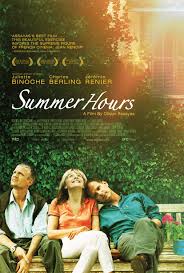
The 2008 film Summer Hours is all about legacy. It captures the lives of three siblings around the death of their mother, Helene, who was the keeper not only of their childhoods and the objects associated with it, but also of the memory of her uncle, a well-known painter. Frederic, the eldest son and only sibling still living in France, wants to preserve the house, its objects, and its artworks for continued use and pass it along to the next generation. Adrienne lives in the U.S. and Jeremie in China, they wish to sell everything as they are unlikely to use the house, having more use for its profits. The film explores the challenges inherent in passing things along to future generations. When 75-year-old Helene wants to speak to Frederic about what will fall to his care after her passing, he finds it too difficult to discuss her death. When Frederic, in turn, speaks to his teenage children about the art in the house, they try to admire it, but are really more interested in their music and their friends. Writer and director Olivier Assayas has an admirably light touch. He has the confidence to write good scenes, get people to come together and really do what his scripts say they do, and to let his camera simply observe them. I make that sound easy but it's not. That is the work of the filmmaker. Friend Sheila and I were talking about just this the other night. The medium of film is not celluloid - although that might be the chemical substance its sounds and images are recorded on. Its not even the camera, although without knowing to use lenses and cameras one could not make a film. It is people. The children play a game during the film's opening and they are obviously children playing with an interest in winning a game - not posing for the camera. It takes talent to show people being people. Actors can be very interested in themselves. They admire their own faces and their hard won talents. Assayas has cast beautifully Juliette Binoche, Charles Berling, and Jeremie Renier know what it means to inhabit a character whose life is full of details you never actually get to show, but which must precede their behavior in the story if it is to make sense. In Summer Hours- the characters act, not meaning demonstrate, meaning they do things. They meet, they mourn, they eat meals together, they make decisions - and the camera observes. They don't force themselves on the viewer. They do their jobs and if you are interested you may do your's.

Assays's mise en scene is smart. His camera celebrates the warmth, the lush and somewhat worn beauty of the house in the final summer that it is filled with its contents and people. After the death of Helene, he and his cameras walk through as the art and furniture are appraised for their value, now the house possesses the same contents, but the light is cooler, grayer. Epicures eye the Corot and the Hoffmann armoire over their expensive glasses. The stoves must be lit for warmth. The long-time caretaker of the house peers in the windows of her old home. In the film's closing scenes, we see the house's contents lodged in the Musee D'Orsay as a tour guide lectures her group on the history of desk we have come to associate with Helene's home. It is summer again. The nearly abandoned house is filled with Helen's grandchildren who party in its now raw, unfurnished rooms and its unkempt garden, blasting french rap and getting stoned. The place is obsolete - or is it? Assayas is smart enough not to decide for us. Time marches on but French law allows one to donate art to museums in exchange for a break on inheritance tax. The art may no longer reside in the home of the family whose ancestors acquired it, however one could say that many more members of future generations get to enjoy it. Is the vase by a great sculptor most valuable as a highly protected and revered possession of a museum or as the container of flowers in a home where it might at any moment be knocked to the floor by children playing? These are the questions one is left turning softly over in one's mind as the film ends. I learned on the DVD extras that to celebrate its 20th anniversary, the Musee D'Orsay, rather than making a straight, PBS-style documentary about their collection, commissioned films by real filmmakers to celebrate their birthday. Summer Hours, Assayas's contribution, is a thoughtful, tender, and quiet gem.

Tuesday, August 10, 2010

Documentary and artifice to reveal and obscure (Film - The Beaches of Agnes & The September Issue)

By coincidence the Ragazzo and I ended up watching two documentaries last weekend:


They could not have been more different. Agnes Varda, the French film director, has made open, frank films with idiosyncratic subjects for her entire career - Les Glaneurs (The Gleaners), for example, follows people who live on the detritus of others, food from waste bins behind restaurants, the potatoes that are left over after the harvest for having the wrong shape to sell, those who furnish their homes from discarded tables left on the street. Varda was part of the Rive Gauche film movement including many artists who often collaborated with one another, like director Alain Resnais and writer Marguerite Duras. Varda was married to director Jacques Demy (The Umbrellas of Cherbourg).

Varda's film acknowledged its artifice from its opening scene, involving the placement of mirrors of all sizes on the beach with shots angled to catch their subject, framing her at odd angles - so that her image, an artificial concoction, appeared floating or sitting in the natural vast setting of the sand and the ocean. In another, Varda's office was taken out of its usual setting and reassembled in the middle of a street, carrying out its business there in a detailed but stylized manner. The film was peppered with these off-kilter touches that exemplified how Varda's films, a self-conscious artisitic form, worked amidst and against the bustle of real life that existed around it. They capture something that feels real from that juxtaposition of intentional art and happy accident. Varda traced her trajectory chronologically with the story of her parents, her schooling, her filmaking, her children and husband, and her political activism - revealing much along the way about herself, the images, people, and ideas important more to her internal life than to its external events, but not necessarily explaining them. For example, we learn the intimate detail that Demy died from complication due to AIDS in 1990. We learn not from Varda's words, but from her behavior, of her profound love for him but we are not explained the details of why he contracted the virus or what each week of his suffering was like. So the film is intimate without being explicative or invasive. The strength of The Beaches of Agnes is revealing the depth, the reality, and the beauty of an inner life through the strengths of a superficial medium, but not through narrative explanation.

This is polar opposite of The September Issue, made by R. J. Cutler., a film about Anna Wintour, the editor of Vogue, and her staff through production of the 2007 September issue - what is always the biggest issue of the year, that one that introduces the look of the year to come in fashion. Though this film pretended to get the gritty backstage view of operations of Wintour - their icy queen and her yes-saying minions - it was, as far as I was concerned, a superficial bore. It was highly set-up, not surprising for a film about fashion, but the artifice was about not revealing its subject, rather than offering us detail about its subjects or what moves them to act as they do. It wished to tell a story about Wintour as a cold, decisive pragmatist who will never show the workers around her admiration to their face, even though she values their talent. Rarely are we permitted a glimpse through her dark sunglasses. The story is void of human detail, I know that she holds a Starbucks coffee, but I don't ever see how it got there, which would be an interesting detail for a celebrity who seems not to like to interact with others. I know that she comes into the office, but not at what time. I know she is muscular and perversely thin but don't know if she does that through exercise, sports, or dieting. There was one nice touch, a brief moment in Wintour's home with her daughter who tells the interviewer that she has no interest in fashion and intends to go to law school. Mama Wintour gives a mild, embarrassed smile, "we'll see," she says.

The film reveals Andre Leon Talley, Wintour's former editor-at-large as a clownish, self-obsessed egotist who does nothing but pose for the camera. The operation appears to be largely dependent on Sarah Coddington, former model and now creative director, a down-to-earth, imaginative worker who gets her personal opinion out of the way and gets the job done. In the end, the film was an utter failure to me because it called itself a documentary and yet it lied. For example, it gave the impression of Wintour as an ice queen with no sense of humor however, in either a scene that ran beneath the closing credits, or it may have been a cut scene included on the DVD, following a meeting with a nervous designer Wintour quips "give that man a drink!" A sense of humor! If you are going to develop a character, always show the flip side, or any discerning audience member will know you're lying. The biggest failure of the film was its biggest lie. Unfortunately, a key staff member commits suicide during the period during which the film was made. This was undoubtedly a terrible event tragic on both a corporate and on a personal level for people we never meet, so I do not believe that this should have been dwelt on or that people who knew the deceased should have had their lives pried into in any way, however, it was an event that had undoubted real and human consequences in this artifice-obsessed factory. Its occurrence had to touch the lives of the film's subjects and was part of the story behind their behavior which revealed their stresses and pleasures through their movement, their words, their emotions. And yet, we were made to think that all these behaviors revealed nothing but the story the filmmaker wished to tell about the production of the September issue of Vogue. What a big fat lie. Varda gave a perfect example in her film about how one can be intimate without getting specifically personal. Here was one of those tragic accidents of life that would have offered an artist a real opportunity to document who these people and this organization really were. This was purportedly the reason this film was made. It might have revealed them as more human than we suspected or perhaps as more ugly, but at any rate, the filmmaker ignored the real story thrust upon him by life and tried to stick to one he had in his head, or the one Vogue's lawyers told him he could tell. As a result we watched not a documentary but rather a big wet kiss on Vogue's butt. What a bore.

Sunday, September 13, 2009

Breaking free of the emptiness (Books - Night Train to Lisbon & Film - L'Emploi du Temps & Pierrot Le Fou)

The desire to break free of society's template and find one's more true self is, through no specific intention of my own, the theme of both the novel I am reading and the the two films I watched this weekend.

Laurent Cantet's L'Emploi du temps (Timeout is the American title) concerns Vincent, a reasonably well off French family man. Mom and 3 kids are installed in a well equipped and modern home, the in-laws live near by - and Vincent goes off to work, which keeps him on the road all week, calling in from meetings to apologize for yet another missed dinner. The trouble is, Vincent has been unemployed for months and the elaborate lie he embroiders about a potential job with the UN in Switzerland investing money to help under-financed countries develop infrastructure begins to take on a life of its own. He collects hundreds of thousands of francs simply by spouting unspecific rhetoric he has poached by stealing some of the U.N.'s public relations pieces from their lobby. I won't give the whole story away, but two things struck me about this dreamy, leisurely-paced film, one was the psychological insight about deception and especially self-deception, which I found detailed and subtly played Aurelien Recoing and the rest of the cast. The second was the emphasis on how devoid of meaning much of daily commerce is. The domestic scenes, the visits to school sports events and fairs are shot with warmth but distance, but all the scenes in the work world are icily cold, buildings are glass fortresses, people move their mouths in meetings and in phone conversation. Sentences come out, they contain the right catch-words but are devoid of any substance whatever. The biggest question the film left me with (and meant to leave me with, I believe) was whether Vincent really wanted to be in the game or not. It seemed as though his self-worth was really caught up in everyone thinking he was employed at this level. When the people around him thought he was they praised him and gave him money, his wife and parents felt more secure. But Vincent called his wife three or four times a day, not merely out of an insecure need to shore up the elaborate lie he had built, he also seemed to call because he needed connection with her and wanted her love. He seemed to crave connection with people around him and yet the people around him seemed to wish to connect most through his accomplishments. A quietly provocative film and surprisingly similar in some thematic ways to...

Jean Luc Goddard's 1965 Pierrot Le Fou which also explored opting out of society's conventions, but in a more manic and aggressive style. Pierrot who, he keeps telling the camera, is really named Ferdinand, is married to a wealthy Italian woman, lives in Paris, and reads art criticism as she plays tennis and tries to get her husband gainfully employed through Daddy. Early in the film, the couple attends a cocktail party in which the guests seem to spout nothing but platitudes and advertisement slogans. This was remarkably similar to L'Emploi du Temps emphasis on conventional society's reliance on empty rhetoric so that people in the course of daily interaction whether social or economic don't have to think. While Vincent had a quietly desperate need that vacillated between wanting to escape and wanting to take part so that he would be admired, Pierrot le Fou is angrily dismissive, (this is the 1960s, you know) condemnatory of valuing brand-name shampoo as war rages in Vietnam. Pierrot decides unequivocally to "drop out," as they said then, and run to the South of France with the babysitter who, incidentally, is being chased by Algerian gun men. He is played with iconic, cigarette-dangling insouciance by Paul Belmondo. She is played with irrepressible carelessness by Anna Karina. This is a courageously experimental film making with direct-audience address, characters bursting into song, voice-overs of quotes from art criticism, shots with colored filters over the lens. It's part screw-ball comedy, part musical, yet as violent as Quentin Tarratino's films, and is simultaneously serious social criticism. Although both character's want to drop out of conventional life, she is a nihilist, he is an intellectual wastrel. This is film making with both a lively spirit and an intellectual seriousness and that brings me to the book I have been reading over the past week...

Night Train to Lisbon by Pascal Mercier, a Swiss author now living in Germany, has received such a contradictory reception from its critics, I find it fascinating. The paperback edition is larded with hyperbolic praise for its seriousness, its philosophy. "It is a handbook for the soul..." the cover screams. "I read it in three nights and was then convinced to change my life," another said. Other critics not plastered across the book's back and front covers or first few pages found it "Fantastical, long-winded and dull..." or "turgid...bombastic." "Think of W.G. Sebald recast for the mass market: stripped of nuance, cooked at high temperature and pounded home, clause after clause." The controversy alone made me want to read it. In a sentence the novel concerns a Swiss teacher of dead languages who comes to life. A chance meeting with a woman on a bridge leads him to a philosophical book by a Portuguese doctor, which leads him to upend a life musty with routine and pursue the story of this man's life; but what this really is is a journey to himself. The passages from the philosophy book are a bit long-winded and very repetitive in theme. There is nothing particularly nuanced about this story (many of the critics blame the translator), but I am finding his book-laden adventure appealing to the bookish romantic in me and I am always a sucker for stories of self-discovery and escape from routine. In fact, it has been quite a weekend for them. I'll let you know when I'm done with it, on which side of the argument I landed.

Friday, May 25, 2007

Transformation Courtesy of Katherine Mansfield

One of the reasons I love French film (aside from the fact that the characters always have to find parking spaces and they're constantly eating) is how I see the world after viewing them. Certain film makers use the camera not to make the world more perfect that it really is, but to see how perfect this world is, and that stays with me when I leave the theater - if it was a really good film, all day long. Great documentaries can do this too, like the great double feature Film Forum showed about the artists Kiki Smith and Agnes Martin back in January, or the absolutely amazing John Cage and Merce Cunningham one of my favorites. You sit in their workspaces or their homes with them and the film renders them as objects of utter fascination. I love watching John Cage, one of music's most controversial composers, rinse the grain that he is about to prepare in the kitchen of his loft. But I'm digressing, the point is that the world seems different after watching them. French films often make me see a brick wall or hear the sound of a shoe clocking on the pavement as something new and Katherine Mansfield's Prelude seems to have the same power. I'm nearly done reading it and At the Bay and The Doll's House, in a neat little edition of three Mansfield stories that all feature the same family.

They quote Virginia Woolf on the back cover, who said that she was jealous of Mansfield's writing, and it is easy to see why. The stories remind me of nothing so much as The Waves. It's as though we're watching the world through the eyes of a dragon fly, skimming over the surface of this glassy world and every so often we land weightlessly and pick up a phrase or stark detail that , like a shard of glass, cuts beneath the surface and makes the world bleed, and then it flits on. There is a chilling moment in At The Bay where the mother lies dreamily with her baby boy on a summer day, one minute you're smelling the heat and laziness and the next you hear her thinking that she really doesn't like her baby boy at all, and then the sound of the ocean pulls you out of that thought and on to something else.

I broke open a brand new bag of sencha this morning (I'm something of a tea freak), and I saw the amazing potent green of the leaves and tasted the grassy, nutty tea through the lens of the Prelude. I love that - the world transformed by a story. Mansfield's voice is lyrical but stark, and the volume is slim but not "lite."