Showing posts with label science and art. Show all posts
Showing posts with label science and art. Show all posts
Monday, April 4, 2016
Alexander Humboldt's broadreaching influence on modern science (Books - The Invention of Nature by Andrea Wulf)

Sunday, November 1, 2015
Revolution in thought and practice (Books - The Lunar Men by Jenny Uglow)

Credulitas. Credulity. Life is short, opportunities of knowing rare; our senses are fallacious, our reasonings uncertain; man therefore struggles with perpetual error from cradle to the coffin. He is necessitated to correct experiment by analogy, and analogy by experiment...If you live life with an ounce of curiosity in you, you likely recognize the longing Darwin so pithily expressed . If you, like Darwin, James Watt and Matthew Boulton inventors of the steam engine, Josiah Wedgwood potter and chemist, Joseph Priestley religious radical and the discoverer of oxygen, or any of the other principal characters in Uglow's The Lunar Men (Farrar, Straus and Giroux, 2002), live to pursue your curiosities, then this is your creed.
Sunday, October 25, 2015
Two memoirists of passion (Books - Love is Where it Falls by Simon Callow & On the Move by Oliver Sacks)
In the last several months I read the memoirs of two fascinating, beloved, gay, British-born public figures. One was published recently, the other 15 years ago. One works in one of my areas of expertise - the arts - and the other in the other - the science of the brain. The authors were actor Simon Callow and Dr. Oliver Sacks. Their books are Love is Where it Falls (Penguin Books, 2000) and On the Move: A Life (Knopf, 2015). Their books are forthright and generous, the authors deeply giving of themselves, and they are crack writers. Knowing them now, as I do, it is fitting that these copies are signed.

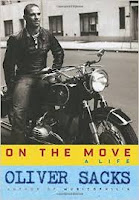
Oliver Sacks has written so humanely and observantly of his patients' lives (for instance here and here), and so openly of his peculiar fascinations, that this memoir, and this is the third of his books that might be classified as such, was a welcome departure. Here, finally, Sacks scrutinized as deeply and wrote as openly about his own life - particularly his inner life. This was welcome not only in knowing more about so great a man and storyteller, but also because one read it in the context of his impending death (about which he wrote so beautifully here and here) and because one could feel in the narrative drive this desire to share it all before it was too late.
Early in Sacks's writing career, the great poet W. H. Auden said to Sacks

She had, she said, been walking down Piccadilly, musing on the fact that it was Moliere's birthday and that not a single actor in England would know, much less care. Musing on this sad reality, it had suddenly struck her that, yes, there was an actor in England who would know and care: me. And so she had gone into Fortnum's and ordered the wine and had it sent to me, to celebrate, with my actor friends, the great playwright's birthday.So begins an unlikely romance between a fierce, 70-year old theatrical literary agent, Peggy Ramsay, and 30-year-old actor Simon Callow. I find myself wanting less to write about the merits of this book than to quote from it. These two live passionately and are attracted to each other so relentlessly, because their taste in art is not so much an aesthetic about life's decor as a deeply held principle about the way to live it.
We must feel, that is everything. We must feel as a brute beast, filled with nerves, feels, and knows that it has felt, and knows that each feeling shakes it like an earthquake.or
I do so passionately believe that the only meaning of life is life, that to live is the deepest obligation we have, and that to help other people live is the greatest achievement. It's in that light that I see acting, and that alone.

Oliver Sacks has written so humanely and observantly of his patients' lives (for instance here and here), and so openly of his peculiar fascinations, that this memoir, and this is the third of his books that might be classified as such, was a welcome departure. Here, finally, Sacks scrutinized as deeply and wrote as openly about his own life - particularly his inner life. This was welcome not only in knowing more about so great a man and storyteller, but also because one read it in the context of his impending death (about which he wrote so beautifully here and here) and because one could feel in the narrative drive this desire to share it all before it was too late.
Early in Sacks's writing career, the great poet W. H. Auden said to Sacks
You're going to have to go beyond the clinical... Be metaphorical, be mystical, be whatever you need.This is really where Sacks's writing succeeds so magnificently in combining what is true with what feels true in a story. I cherish his writing and hope to celebrate his life in a live program in the coming year.
Thursday, March 12, 2015
Improvisation in the Sciences - improvisations on a panel discussion for Brain Awareness Week 2015)
 | ||||
When I heard that the opening event of Brain Awareness Week this year was on the theme of improvisation and involved arts and science, I knew that I wanted to be the one to report on it. I decided to do this blog as an improvisation; that is what follows.
Improvisation 1
I am riding the subway on my way to Improvisation in the Sciences at Columbia. It’s the first event of Brain Awareness Week and involves musicians and scientists. Given the theme, and since I am both an artist and neuroscientist, I decided to improvise this blog, a little experiment. I’m feeling a bit nervous, like I’m performing myself. Before I left my apartment, I sat down to play a sonata on the piano, I thought it would get me in the mood but I was interrupted by a phone call letting me know that the subways were delayed. I ran out of the house. Having stopped the sonata in the middle, the strains are repeating unresolved in my mind’s ear. I am anticipating music on the program, but it probably won’t be this kind of music.
Friday, July 4, 2014
Grabbing the arts-science zeitgeist by the short and curlies (Books - Orfeo by Richard Powers)

Subscribe to:
Posts (Atom)