Showing posts with label artistic process. Show all posts

Saturday, August 6, 2016

What is left when what we loved is gone? (Books - What I Loved by Siri Hustvedt)

In the New York art world of the 1970s, art historian, Leo Hertzberg, experiences a powerful painting.  He buys it, beginning a friendship with the artist Bill Wechsler that is the center of What I Loved (Sceptre, 2016) Siri Hustvedt's deep, serious, and multifarious novel, first published in 2003 and recently released in a beautiful new softcover edition from Sceptre.

What I Loved is about many things: art, love between friends, between lovers, spouses, parents and children, and it is also very much about loss - as the title presages.  It is Hustvedt's accomplishment that though this novel occurs over a span of thirty years, interrelating the psychology of hysteria and eating disorders, page-long descriptions of visual art, details of quotidian domestic existence and passionate infidelity, and moments of profound grief, and though it is told from the first-person perspective of a somewhat fusty art academic, you don't look at the brushwork.  The ins, outs, and intersections of theme, of characters and of what they make - because everyone is painting, drawing, writing essays, a dissertation, cooking a meal, staging a rave (these characters are nothing if not generative) - this welter of detail gives rise to a single complexity - a work of rich substance and of emotional heft.

Sunday, May 1, 2016

People are more than objects in space (Books - A Doubter's Almanac by Ethan Canin)

Ethan Canin was already one of my favorite authors for having written For Kings and Planets, and I have frequently recommended his The Palace Thief and Emperor of the Air.  With A Doubter's Almanac (Random House, 2016) Canin has written a "great" book, in the sense of giving expression to profound experiences, and also, I believe, in creating something whose meaning extends beyond its exemplars - the concerns of these specific characters, the obsessions of the period in which it was written - and has the potential to be enduring. Time will tell on that second point.

In some ways, Canin is writing about the same things he has always written - fathers and sons, success and failure, gut-smarts and brains - all within the scopes of the grandest of considerations: time and space.  Time as it is experienced on a human scale, through one generation of a family experiencing another.  Three generations of the Andret family are the focus of this novel.  Space as it is described by a branch of mathematics called topology, which studies the interrelation of things, though not on the level they are visible in nature, on a hypothetical level of multiple dimensions. This is the focus of the work of Canin's protagonist, Milo Andret, who may be a genius in using math to describe such relationships but is profoundly disabled in forming a typical human bonds and severely limited even in insight into himself.  In one scene, Canin describes Milo as having to touch his own face to understand that he was smiling.

Sunday, October 25, 2015

Two memoirists of passion (Books - Love is Where it Falls by Simon Callow & On the Move by Oliver Sacks)

In the last several months I read the memoirs of two fascinating, beloved, gay, British-born public figures.  One was published recently, the other 15 years ago.  One works in one of my areas of expertise - the arts - and the other in the other - the science of the brain.  The authors were actor Simon Callow and Dr. Oliver Sacks.  Their books are Love is Where it Falls (Penguin Books, 2000) and On the Move: A Life (Knopf, 2015).  Their books are forthright and generous, the authors deeply giving of themselves, and they are crack writers.  Knowing them now, as I do, it is fitting that these copies are signed.

She had, she said, been walking down Piccadilly, musing on the fact that it was Moliere's birthday and that not a single actor in England would know, much less care.  Musing on this sad reality, it had suddenly struck her that, yes, there was an actor in England who would know and care: me.  And so she had gone into Fortnum's and ordered the wine and had it sent to me, to celebrate, with my actor friends, the great playwright's birthday.  
So begins an unlikely romance between a fierce, 70-year old theatrical literary agent, Peggy Ramsay, and 30-year-old actor Simon Callow.  I find myself wanting less to write about the merits of this book than to quote from it.  These two live passionately and are attracted to each other so relentlessly, because their taste in art is not so much an aesthetic about life's decor as a deeply held principle about the way to live it.
We must feel, that is everything. We must feel as a brute beast, filled with nerves, feels, and knows that it has felt, and knows that each feeling shakes it like an earthquake. 
or
I do so passionately believe that the only meaning of life is life, that to live is the deepest obligation we have, and that to help other people live is the greatest achievement. It's in that light that I see acting, and that alone.


Oliver Sacks has written so humanely and observantly of his patients' lives (for instance here and here), and so openly of his peculiar fascinations, that this memoir, and this is the third of his books that might be classified as such, was a welcome departure.  Here, finally, Sacks scrutinized as deeply and wrote as openly about his own life - particularly his inner life. This was welcome not only in knowing more about so great a man and storyteller, but also because one read it in the context of his impending death (about which he wrote so beautifully here and here) and because one could feel in the narrative drive this desire to share it all before it was too late.

Early in Sacks's writing career, the great poet W. H. Auden said to Sacks
You're going to have to go beyond the clinical... Be metaphorical, be mystical, be whatever you need.
This is really where Sacks's writing succeeds so magnificently in combining what is true with what feels true in a story. I cherish his writing and hope to celebrate his life in a live program in the coming year.


Saturday, May 16, 2015

Two formative men of the American Theatre (Books - A Life by Elia Kazan & Tennessee Williams: Mad Pilgrimage of the Flesh by John Lahr)

The life stories of two American Theatre makers monopolized my reading back in January: Elia Kazan: A Life, film and theatre director Kazan's hefty, probing memoir (Alfred A. Knopf, 1988) and Tennessee Williams: Mad Pilgrimage of the Flesh (W.W. Norton & Co. 2014), John Lahr's deftly paced, thoroughly researched, deeply perceptive biography of the great playwright. Two men could not have had a greater influence on the structure and build of action, the feeling of innocence and epiphany, the rhapsodic music of text, the themes of individuality and of sex that were the coming-of-age of the American theatre and film in the 1930s - 1970s, than Williams and Kazan.  Two men could not have been more superficially different - Kazan was the son of Greek immigrants, born in Turkey, a scrappy fighter, and relentless womanizer, Williams a grandson of an American preacher, delicate, gay, a virgin until twenty-six years of age - but fundamentally they were remarkably similar. Aside from their obvious love of theatre, both seemed dissatisfied with the restrictions of their world, were driven to create theatre to give veiled expression to a deep sense of personal failure, both felt outsiders and compulsively pursued relief in work or, failing that, one from drink and the other from sex. John Lahr's quotes a letter from Williams to Kazan:

Tuesday, December 23, 2014

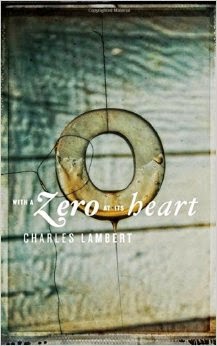
Brief flashes of memory creating the beauty of what has passed anew (Books - With a Zero at its Heart by Charles Lambert)

I have written enthusiastically of Charles Lambert's novels Little Monsters, Any Human Faceand  The View from the TowerHis new creation With a Zero at Its Heart (The Friday Project, 2014) is excitingly fresh.  Although it reflects qualities I have observed in his other work - the driving energy, the concentration on sensory experience in everyday life, and the cleanliness of prose - it refines them into something uniquely and lovingly felt.  Lambert divides his narrator's life experiences into iconic categories like money, travel, language, danger, correspondence, work, waiting, death, books - 24 in all - dipping into 10 episodes per category.  The episodes span early childhood to late-middle-age.  Each is a 120-word prose snapshot, bracingly terse but warm with remembering.  They evoke the prose poems of Frank O'Hara in their colloquialism, but with less smart-assed whimsy, and this seems not entirely without intention, as O'Hara is referred to in the section on waiting.

Saturday, April 5, 2014

A delayed account of bookeywookey's New York cultural wanderings (Books - The View from the Tower, Robert Oppenheimer, Night in Shanghai) (Film - Les Petits Mouchoirs) (Art - Gaugin, Sonnabend, and Jasper Johns)


I have gotten hopelessly behind with a regular accounting of my reading this year, never mind the theatre, films, operas, and exhibits that make up my New York life.  Take this week.  I finished the new Charles Lambert thriller The View from the Tower which I heartily enjoyed (I'll link the post when I write it).  I dipped again into Ray Monk's Robert Oppenheimer: A Life Inside the Center, a biography of the influential physicist which I have had going since late last year.  While Monk makes the case for an interesting life full of internal conflict, his rendering is too comprehensive.  You lose the forest for the trees, the forest in this case, being the narrative throughline.  I'm disappointed by biographies that seem to be nothing more than repositories for the totality of an author's research plopped on the page in chronological order, rather than the crafting of a narrative which has an opinion about that life.  To be fair, Monk has a strong point of view about Oppenheimer's judaism which, he asserts was repressed and the source of tremendous interior conflict,however, that opinion fails to cull his narrative.

I started and gave up on Night in Shanghai (thank you Henry Holt for this copy) which was promising for its setting in 1930s Shanghai and the way the author Nicole Mones created atmosphere, but I couldn't for the life of me keep track of the characters.  The unfamiliar language impeded my remembering who was who and my lack of historical knowledge added to my difficulty remembering which side of the nationalist versus communist struggle they were on, so I couldn't follow what motivated the plot and, unfortunately, I lost the thread.  The sense of place was successfully pervasive and the writing entertaining, so don't let my faulty memory discourage you.

I went to the Antiquarian Book Fair yesterday, which, given the average price of the items displayed there was more of an antique book museum for me.  I came across a novel by Tennessee Williams I had never heard of called Moise and the World of Reason and would have bought the beautiful first edition if I had had $295 to spare.

I then wandered down to MOMA where I saw a very interesting exhibit of Gauguin's prints, how they interacted with his painting, a show whose theme was the gallerist Ileana Sonnabend and the works she brought to public attention at her Paris and New York galleries.  I have to say I found this more interesting for its history than likeable for the work in it.  I also saw a small exhibit of Jasper John's latest works: Regrets, based on a photograph of Lucien Freud.  Small, tightly curated shows are always my preference.  I didn't merely enjoy the work for itself, I appreciated how the prints and paintings on grew from the original photograph, which is also on display. This is a show that's about creative process more than anything, and how the act of an artist doing something as a result of their experience of some source, becomes the seed of new work. Wonderful show.

Finally, I made my chilly, rainy way home, poured a glass of red wine, got under a blanket and watched Guillaume Canet's 2010 Les Petits Mouchoirs; the English title is Little Whie Lies. This is a French Big Chill, complete with a tight ensemble cast of solid actors, great music choices, and a somewhat sentimental story of a group of middle aged friends minus one.  The love and pathos of old friendships is beautifully captured by the cast in that undemonstrative way that French films are so good at, where people seem like people because they are free to feel but not getting off on showing you that they can.  Be prepared to use at least one mouchoir if you're at all moved during films.

Sunday, December 8, 2013

Twin memoirs of a writer's inner and outer selves (Books - Report from the Interior by Paul Auster)

I was quite taken with novelist Paul Auster's memoir of his corporeal self, Winter Journal, as I wrote last year.  It was an intimate account of what it has been like to inhabit and create from the body that is Paul Auster for his 64 years of existence.  His publishers were nice enough to pass along a copy of the sequel, Report from the Interior (Henry Holt and Company, 2013).  This one purports to do for the intellectual, spiritual, moral Auster what the last volume did for the physical.  I am a fan of Auster's artistry and have read nearly all of his fiction.  I felt this volume the less initimate of the two, but I admire this act of opening up himself in that it reveals much about how the development of the man intersects with the creation of his work.

Sunday, April 21, 2013

When autobiography fails to be personal (Theatre - Mayday Mayday - Theatre at St. Anne's Warehouse)

I know Tristan Sturrock's work as a talented member of Kneehigh Theatre, which did, among other works, a brilliantly inventive theatrical adaptation of Brief Encounter.  Mayday Mayday: A True Story by the Man Who Fell is Sturrock's one-man account of his recovery from an accident which broke his cervical spine.  It is presented by his own Theatre Damfino.  It sports a number of creative moments with its spare means, and I have no doubt that its creation was useful therapeutically, but that didn't make it involving theatre. Audiences often seem unwilling to say when autobiographic works about recovery haven't made for captivating works of art, perhaps they fear their reaction will be felt too personally.  In fact, Sturrock opens the performance by saying that this was, for a long time, a story he didn't want to tell.  I can't blame him but unfortunately, I could tell that from the performance. The work uses narrative storytelling to remain distant to the experience of it. While it showcases Sturrock's remarkable physical precision and appealing presence, it doesn't live.  It is emotionally unrevealing of his experience then or his present experience with us.  I'm pleased for his remarkable good luck but wasn't won over by Mayday Mayday as theatre.

Sunday, February 17, 2013

What we go to art for (Books - Artful by Ali Smith)

I fell over a review of Ali Smith's Artful (The Penguin Press, 2012) by happenstance this past week, thought it sounded interesting, and then walked into my favorite bookshop the next day looking for something else, and I thought - there's that book I read about.  I can never resist browsing the books stacked on the big tables at Three Lives Booksellers.  I read a page and thought - oh, I really do have to read this: its art criticism but it's also a dialogue between a woman and her dead lover, and it was originally delivered as a series of lectures, which really means she has written a dramatic dialogue.  So anyway, I bought Artful as well as the novel I had come in for and even though I was really looking forward to reading the novel, something made me start Artful on the way home in the subway that evening and I was stunned, hooked instantly.  I did not want to stop reading it.

Monday, October 15, 2012

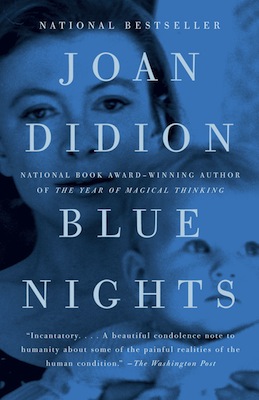
The public voice of our frailty (Books - Blue Nights by Joan Didion)

If you read Joan Didion's A Year of Magical Thinking, in which Didion, through writing, relentlessly observes herself in the act of grieving her husband during the year following his sudden death from a heart attack, I imagine you have read, or are thinking about reading, Blue Nights.  Blue Nights, although it is an act of mourning her daughter Quintana, who died scarcely a year after her father, is not just more of the same.  A Year of Magical Thinking was written through the raging storm.  The book is brutal.  Didion is dogged in examining her replacement of ordered thought with irrational and yet sensible struggles to undo the death of her husband - John Gregory Dunne - via special deals she makes with the universe.  In it, she calls less on their life prior to his death, instead replaying the evening of his death over and over.  In Blue Nights, Didion has allowed more time to pass since her daughter's death before writing. Here there is less the feeling of a disaster film shot from the cockpit of a crashing plane, and more the feeling of an invocation.  They are both books of mourning, but in Blue Nights Didion calls on memory to wonder at the life and death of her daughter, to actively feel the pain of two losses - one of Quintana, the other of herself - and to assuage them.  She uses repetition of form not exactly to reign in the emotion, but to structure it, so that the book is a conscious act of creation rather than simply an outpouring of raw grief.  I thought its form evocative of a sestina which, Mary Kinzie's A Poet's Guide to Poetry tells us, is a formal verse structure with 39 lines containing 6 stanzas of six lines whose end words repeat verbatim in the following stanzas in a highly prescribed fashion.  The seventh stanza uses all six end-words, also in a specific way. The repetition creates recurrent sounds, allowing a particular theme to echo as a refrain (as grief does with repeated memories).  The highly stereotyped order, when used well and pitted against complex emotions, creates esthetic tension and that is precisely how it functioned in Blue Nights.

Sunday, July 22, 2012

What to do when the cake doesn't turn out the way you expect

A truly lovely tribute to Nora Ephron by Nathan Englander at Page-Turner with excellent thoughts on creative process.
And that to me is a good way to sum up what being a working artist is all about. It’s about being a person who makes real things in a real world. 

Saturday, March 3, 2012

Richard Powers - where fact and fiction collide (Essay - What Does Fiction Know?)

One of my very favorite writers, Richard Powers, who writes at the intersection of fiction and science, has written an inspiring essay about the city of Berlin, the unreliability of storytellers, and the place where fiction and fact collide. It is inspiring for the way it mixes personal experience, data, and artifice. It appeared in last summer's Design Observer and I link it here.

Thursday, March 31, 2011

The narratives that make us (Books - Rodin's Debutante by Ward Just)

I am a fan of Ward Just's writing - reflective, masculine fiction that often spans the lives of its central figures, exploring how the larger motivating forces that comprise their characters intersect with the contexts of politics, art, and the private realm to make up their lives. Exiles in the Garden, Just's last book concerned a photo journalist who turns his professional eye to art photography - does one find more meaning in life living inside the fray or out of it, this book asked. The Translator is about adapting to change both in the historical and the personal contexts. I found Forgetfulness a particularly masterful novel about living post-loss - do we best remember by seeking violent justice or through love?

Just's latest, Rodin's Debutante, has a four-part structure and a subtlety similar to that of The Translator, but like Exiles in the Garden it looks at the life of a creative artist in the context of the personal as well as the political spheres. Lee Goodell's family leave their small Illinois town in the wake of its first violent crime, a rape, and move to the Chicago suburbs. Lee attends Ogden Hall, a private all-boys school, coming of age by leading their failing football team to victory. These events are charted in an old-world, third-person narrative voice. There are two strongly formative life events that propel Lee into his adulthood, one is a meeting with Ogden's Hall's reclusive founder who attempts to share some life lessons with Lee. Chiefly he imparts that one's successes are more valuable than one's mistakes. The second is a Rodin bust, putatively of Tommy's Ogden's wife, Marie, in the school's study hall, which influences his decision to become a sculptor.
The day before Christmas robin's-egg-blue boxes arrived by special messenger at the homes of the twenty-two members of the Ogden Hall football team. They were from Tiffany's, New York. Each box contained a three-ounce silver cup with the boy's name and jersey number and the year engraved on the inside rim. The mothers noticed the stamp on the bottom that indicated sterling silver and said in astonishment, Well! My goodness! There was no notes with the box or any indication of who sent it, befuddling the mothers who insisted that their sons write a thank-you note at once; but there was no one to send it to. Lee Goodell knew, but he believed that Tommy Ogden was owed his anonymity, if that was what he wanted. He certainly did not want the old man to be inconvenienced, forced to read twenty-two notes of appreciation, all composed by hand in schoolboy script. The benefactor thus remained unknown. Lee was delighted by the gesture and wherever he went thereafter he took the silver cup with him in his shaving kit, wrapped in its yellow chamois sleeve. When ever he had something to celebrate he filled the cup with whiskey or cognac and gave the old man a salute before he drank it off; the vessel was identical to Tommy Ogden's. At such time he remembered the final game, Hopkins's two touchdowns and his one, the missed point-after, the cheering all afternoon, long-haired Willa jumping, Mr. Svenson's tears, and Tommy Ogden's open Cadillac idling beyond the far goalpost. A beautiful day, a beautiful season, and a secret to wrap things up. Yet it was also true that the day was never anything more than itself. If there was a metaphor present Lee never discovered what it was.
We then experience the birth of Lee into his adulthood, this related in the first-person. A violent crime also occurs around this time, but to whom and in what way I won't reveal to you. I wasn't always convinced of Ward's rendering of Lee's dialogue as a young man, so self-possessed did it sound. I also found it striking that, while the text could conjure up physical pictures of what female characters looked like, I could never envision the males. Although Lee is a memorable central character, I have no idea what he physically looks like. But Just writes beautifully solid prose that is compact while covering swathes of time. He tells stories about the ideas that form us - our taste, our morals, our politics - and reveals them through plot and structure.

The events that form us are clearly this book's refrain. Or more precisely, it's not the events themselves, but the narratives we develop of them. There is a handsome and pleasing neatness to the structure of Just's novel. Two beautiful events, and two violent events, each of which find eternal life as narratives. These narratives are, on the one hand, the psychological scaffolding of Lee's character and, on the other, creative works - like those Lee (and Just) make. It is not so much the veracity of the events that are vital to their power, rather that they capture what is of essence. Actually, the truth of the narratives' surface details are not the matter at all. Lee goes on to value learning from his mistakes much more than his victories, and the bust is not of Marie. The violent acts are, in fact, failed completely by narrative. They conceal more than they reveal and yet, their force is irrefutable, strengthening in the case of Lee and crippling in the case of the young women who is raped.

There is another notable theme in Rodin's Debutante, namely how mens' successes in our society are so often built on a foundation of cruelty toward women. Rodin's bust was, initially to have been of Ogden's wife Marie. But in an impotent gesture of revenge, Ogden denies his wife the money, building a private school instead. A young woman of lower class is raped, the precise events of the crime are not covered in the newspaper - as the illusion of stability and safety its middle-class residents survive on is more important to the men in power than the well-being of the crime's victim. Just writes of a world governed by men who careen between what they see as irresolvable choices: intellectuality and violence, brawn and kindness, pragmatic wheeling-dealing and reclusiveness, and remembering victories or losses. Lee learns the value of confronting both sides of his nature and tries to make something both honest and lasting out of that knowledge. His medium, as it is free of words, sometimes lies less, but as marble has less explanatory power it reveals less too and Lee seems content with that.

Saturday, August 28, 2010

The presence of the artist in the art - developing talent versus promoting it (Exhibits - Matisse: Radical Invention & Film - A Single Man)


I just stared and stared at this painting at the stunning show currently on at MoMa - Matisse: Radical Invention, 1913-1917. Exploring its pleasures intertwined with the experience of the film I watched two night ago - A Single Man - to reveal to me something essential about my aesthetic taste. I like it when the act of creation shows (by design) in the work of art. Perhaps that is just because I made art myself for such a long time and because creative process is an obsession of mine. Perhaps the relationship goes the other way round - maybe I became obsessed with process because I have always been drawn to this kind of work. Whatever the case, this was very much evident in Matisse's work of this period. As he developed these paintings he adjusted the placement of figures as well as their form, he obscured details that he had earlier spent much effort in representing, and what's radical is that he leaves evidence of these changes rather than covering them up. It is a practice which creates a conversation between the subject of the art and the mode of its making, something I find interesting as well as inspiring. It is also a way for the artist to develop their talents, as awareness of technique progresses in parallel with the making of art, not separately from it. The simultaneous dialogue of the two is the artists' daily reality. That doesn't necessarily mean that it will always produce satisfying art, nor does it necessarily mean that this dialogue will be of interest to every member of the audience, but it is of great interest to me.

Matisse: Radical Invention is thoughtfully curated - it has a narrow thematic focus and therefore it is not too big (a pet peeve of mine with museum shows), it brings together different works of Matisse, not just the greatest hits, it creates a thoughtful narrative in tracing its theme of interest - a period of creative transformation in Matisse's art - seen against the backdrop of cubism in the art world and World War I in the world-at-large.

This experience was very much in contrast to that of watching A Single Man, photographer Tom Ford's feature film debut as both writer and director, adapted from the novel by Christopher Isherwood. I had heard a few interviews with Ford and his lead actor Colin Firth on the radio and was hoping for something better. The story concerns the last day in the life of a gay college professor in the 1960s who decides to commit suicide because of the sudden and devastating death of his partner of 16 years, and the unusual perspective that gives him on the things commonly around him in his daily life.

Ford, a visual artist, seems to have been captured by the notion of a unique perspective on the ordinary and perhaps felt his vision would express the lead character's heightened experience of the day. This was the film's defining feature, but the lack of access to other techniques was also its downfall. Every person in the film was beautiful - ridiculously so. Nicholas Hoult as the young student who becomes obsessed with his professor, was an expensive haircut draped in a pink mohair sweater that was glowed like cotton candy against his California tan. In fact, desserts are a good metaphor for the little visions of sweetness that Ford made of everyone George encountered, but there was no meal to accompany them. One could call this the heightened reality called for by the story, but I experienced it creating only an icy remove that destroyed any emotional impact this film could have had, despite Firth's intelligence, deep investment, and subtle portrayal. While this aspect of George's experience is important, it seems to me one should also be moved and this film's attempt at visual perfection held everything at arm's length.

One choice I particularly appreciated in this film was the lack of attention called to the sexuality of the lead character. Although his relationship was with another man and created interesting conflicts in the relationship between him and Charley (the female friend played by Julianne Moore), Colin Firth simply played George's circumstances and character qualities but did nothing to telegraph his gayness. He was middle aged, fastidious if a bit controlling, and was masculine. No limp wrist, no lisp. Thank you, Colin. Together the two of them captured that wonderful kind of friendship possible between a straight woman and a gay man that is full of intimacy but not sex and can be sustaining but can sometimes tip over into frustration for the woman if it is her primary intimate relationship, she is attracted to the man, and it cannot be consummated.

The actors were on their own (that or Ford could express his insight into the lead character but no other). The result was a beautiful performance from Firth but Julianne Moore's performance suffered for it. I find Moore a glimmering but delicate talent. Capable of flights of transparent vulnerability, she also reads to me across her body of work as wildly insecure. When she collaborates with a good director it is a joy to watch her. Here, while she communicated some of Charley's desperation to the screen it was too decorous. Her character is at the point where she can no longer control herself yet Moore's performance reeked of the kind of control exercised by an actor who is afraid to be unattractive. This coupled with Ford's own repressive control, motivated by his strictly visual talents, did not allow Charley the rawness a director like John Cassavetes and actress like Gena Rowlands might have brought to this part and this story. That, in my estimation, is what this film lacked. I wanted to feel the artistry, as with Matisse's painting, but not the artiness. I wanted to see the actor and film maker work together to make this story. I wanted to witness the beauty of the little accidents of human behavior, see her eye makeup smudge, see her nose run a little, not look at a Calvin Klein perfume advertisement. The limits of Ford's filmmaking were also evident in his use of music. With two composers, a music advisor, and a music consultant listed in the credits I felt as though too many cooks may have spoilt the sound track. The result was a hodgepodge of unspecific but superficially arty choices. I thought the choice of the aria "Ebben? Ne andro lontana" from the opera La Wally a particularly misguided choice, so associated is it with another high style film (and one I happen to love) - Diva. Similarly self-conscious choices visual choices also clouded the integrity of this film. The slow-motion sequences of waving children seen from a moving vehicle seemed to be straight out of Blue Velvet.

The 'making of' extra provided on the DVD was particularly embarrassing - self-aggrandizing and affected, with Ford's narrative scripted to death, interviews with each of the actors edited down to nothing but glib praises of Ford's filmmaking talents. Me thought the ladies did protest too much. It read like an advertisement - over controlled and pretentious - exactly the same problems as with the film itself. There is a difference between leaving elements of the creative process present in the work so it becomes a discussion between the artistic content and the art-making, and using the work of art to showcase one's talents at the expense of the content. Ford doesn't yet have the talent to recognize the difference.

Thursday, July 2, 2009

Lurid details...

btt button

Suggested by Callista83: Do you read celebrity memoirs? Which ones have you read or do you want to read? Which nonexistent celebrity memoirs would you like to see?

I love biography, autobiography, diaries, letters... insight on lives through narrative and particularly on artists' lives and their processes is a great curiosity of mine. Alec Guinness's memoir, My Name Escapes Me, is wonderful. I haven't read his others A Positively Final Appearance or Blessings in Disguise yet. John Guilgud's A Life in Letters is also great. I've also read Laurence Olivier's Confessions of An Actor. Like the title, they are a little more sensational. I suppose one day I should compare them to Joan Plowright's And That's Not All just to see how the stories match up. I bought Christopher Plummer's In Spite of Myself and Julie Andrew's Home for my mother and at some point I am hoping to read them myself. I understand from Sheila that Charles Grodin's It Would be So Nice if you Weren't Here and Ellen Burstyn's Lessons in Becomming Myself are great. American composer Ned Rorem made an alternate career as a writer, producing multiple volumes of memoirs and diaries that are lots of fun to read. The Paris and New York diaries from the 1950s are probably my favorites and while moving in elite circles they disclose their share of lurid secrets.

I did a lot of research on the artists of Bloomsbury at one point in my life (celebrities of their day), an easy task since they were so interested in writing about themselves and each other. Virginia Woolf has multiple volumes of letters and diaries as does her husband Leonard.

I learned tons about the development of the American theatre from reading the memoirs of John Houseman. The diary of Clifford Odets is a passionnate document of the best kind, and I loved Lee Strasberg's Dream of Passion, Harold Clurman's The Fervent Years, Arthur Miller's Timebends, and Alan Schneider's Entrances.

Kathrine Graham's Personal History is an out-of-this world life story and Oliver Sack's memoir Uncle Tungsten is fun too (assuming they count as celebrities. I certainly celebrate them).

If Meryl Streep and Geena Rowlands decide to reveal all (or even some) one day, I'll be on line to get my copies.

Saturday, March 28, 2009

Capturing the Accident (Culture - Pierre Bonnard, The Late Interiors, Film - In a Lonely Place, Books - Treasure Island)


The Raggazo and I celebrated our anniversary yesterday with a trip to the Metropolitan Museum to see Pierre Bonnard: The Late Interiors and have drinks on the mezzanine afterward. Although the atmosphere of their Friday Cafe is nice, for the price their artisanal cheese plate could have featured something other than colby. I'm not five. It's New York City, can't you find any good cheese? The show, on the other hand, was wonderful. It allows you to wander through the development of his interiors over about a thirty year period, its satisfying to see how his depiction of color, form, and light enriched over that time. What I liked best about the paintings was his ability to capture the accidental feel of the placement of objects on a table, the posture of his wife as she feeds the dog, or the sudden awareness of someone of themselves in a mirror. The feeling of a candid photo of a day at home - except in paint. It's interesting to see over and over again, how his interest was with the form of a table against the view out of a window, or the angle of light on the half-opened door of a room. People were usually off to the side, never posing, and with the exception of his self-portraits, they are usually painted in the color of the background. I value that ability to court the accident in art more than perhaps any other quality. I love it in acting, in directing, in painting and in words. That's why I like the poems of Frank O'Hara, the acting of Geraldine Page or Billy Cruddup, the singing of Jeff Buckley, and it's what I really loved about this show, which is on at the Met through April 19.

Also in the world of the arts, the library finally came up with a copy of the 1950 Humphrey Bogart film In a Lonely Place, a recommendation of Sheila's, 'natch. It's an unusual film for the time - the writing has an elegant feel to it, yet it is about uncontrollable passion. Bogart is a volatile and cynical screen writer who finally meets a woman he cares for when he is suspected of murder of a young coat check girl who was seen leaving a restaurant with him. Bogie gets to show both a more refined side of himself and a more vulnerable one, and he gives a really terrific performance. It has a couple of very suspenseful scenes and it does not suffer from a typical Hollywood ending. Highly recommended!

And, inspired by Verbivore, I pulled some Robert Louis Stevenson off the shelf after I finished Damon Galgut's The Imposter. I began re-reading Treasure Island for the first time since I was a child. I'm experiencing a fun, cozy, kid-reading-in-bed nostalgia that's a welcome contrast to studying for exams and writing papers.

Saturday, October 18, 2008

A Room of Her Own


Virginia Woolf's writing room at Monk's House in Sussex from The Guardian's series, Writer's Rooms. George Bernard Shaw, Jane Austen, and Anne Enright are there too. I love these.

Wednesday, June 11, 2008

Radical identity (Books - The Darling)


Russell Banks is drawn to themes of social and racial inequality, ways in which people control other people, political idealists, and strong, unique female characters - at least those seems to be points in common between The Reserve which I read earlier this year (and have this to say about it), and The Darling which I am reading now. Stylistically they are very different books. The Reserve feels like a romantic 1930s film shot in black and white- Veronica, the crazy heroine, has skin that glows in a flawless silvery white on the big screen - whereas The Darling, although it could be said to feel cinematic too, is shot in hard-edged color with hand-held cameras, and split screens. From the 1970s to the 1990s, we see Hannah, a member of the radical Weather Underground, evolve - wrinkles and all. Banks adopts the first-person to relate Hannah's story. Although we quickly know her as a caring, thoughtful and competent person, we know from the very first sentence that Hannah lives on her intuition.

After many years of believing that I never dream of anything, I dreamed of Africa. It happened on a late-August night here at the farm in Keene Valley, about as far from Africa as I have been able to situate myself. I couldn't recall the dream's story, although I knew that it was in Africa, the country of Liberia, and my home in Monrovia, and that somehow the chimps had played a role, for there were round, brown, masklike faces still afloat in my mind when I awoke, safe in my bed in this old house in the middle of the Adirondack Mountains, and found myself overflowing with the knowledge that I would soon return there.

I am trying to decide whether to characterize Hannah as impulsive. She is not flighty or unable to think things through, one would not think her crazily rash, as Veronica is, but despite planning, Hannah's life has been formed by decisions she has made on impulse, on how things feel. She would be a good actress! During the opening of the book, Banks sets up an atmosphere tense with the possibility of change and Hannah as a character who is sensitive to the augurs of that change.

For a few moments, as I always do, I stood by the window and watched the digs. They are Border collies, father and daughter, Baylor and Winnie, and when they have done their business, the first thing they do every morning is patrol the property, reclaiming their territory and making sure that during the night nothing untoward has happened. Usually I watch them work and think of them as working for me. But this morning they looked weirdly different to me, as if during the night one of us, they or I, had changed allegiances. They looked like ghost dogs, moving swiftly across the side yard in the gray pre-dawn light, disappearing into shadows cast by the house and oak trees, darting low to the ground into the garage, then reappearing and moving on. Today they worked for no one but themselves; that's how I saw them. Their gait was halfway between a trot and a run - fast, effortless, smooth, and silent, their ears cocked forward, plumed tails straight back - and they seemed more like small wolves than carefully trained and utterly domesticated herding animals.

For a moment they scared me. I saw the primeval wildness in them, their radical independence and selfishness, the ferocity of their strictly canine needs...

That last sentence presages the behavior of many of the human beings we meet later in this novel - and not just those waring factions engaged in the bloody revolution in Liberia - but American radicals like Hannah, who is herself capable of fierce selfishness and independence. Another element I'm finding compelling about the character that Banks is constructing in Hannah is the notion of political radical as a personal identity rather than a position one takes or a way to fulfill one's community involvement hours.
There is a crucial transition from radical activist to revolutionary, and when you've made that crossing, you no longer question why you have no profession, no husband, no children, why you have no contact with your parents, and why you have no true friends - only comrades and people who think they're your true friend but don't know your real name. Until Zack showed up, even though I was paying the price of being a revolutionary, I hadn't really made that crossing yet, and consequently my life had come to feel shriveled and gray, boring and pointless. I had the effects, but no cause.

Needless to say, she makes the leap, and this book follows her struggle back and forth between her need to be involved in righting injustices and her desire for a stable life with tangible, hands-on daily tasks, and real human connections. She makes three such crossings that I am aware of 100 pages into the novel. One from Brandeis University radical to Liberian resident, wife, mother, and radical defender of chimpanzees, the second back to the U.S. where we first encounter her as an aging revolutionary who has taken up a stable existence as an organic chicken farmer, and finally her return to Liberia to search for her sons.

Although the circumstances are by no means identical, Hannah's inner dialectic between herself as a revolutionary and herself as a person reminds me of my own internal conversation between my artist self and my engagement with life's other exigencies - my love of the creative process, indeed my acceptance of the fact that that is an inseparable part of my identity, and my frustration or even disgust with the extraordinary amount of self-absorption that process can entail, and the resulting urge to do something more connected to humanity, more tangible. And then the rare flashes of insight when those merge - my process has always been about the daily struggle to make them one and the same. I wonder if Bank's life as a writer, his continual return to themes of social injustice, and his penchant for creating characters like Hannah who do things like farm chickens, or Hubert St. Germain in The Reserve who chops wood and generally takes care of the Reserve's properties for its wealthy inhabitants, is indicative of a similar inner conversation?