Non-fiction


Fiction


Ah, so many books, so many plans. I wish you all a 2014 full of curiosity and wonder, fueled by good reading.

the book is full of one marvelous essay after another - about her poor father's drinking, about her mother and aunt fishing, about a terrible event Beard experienced while working at the University of Iowa. Why should I care about this stranger's life, you may ask? But her sentences lend the boredom, deep pleasures, longings, and misgivings of ordinary life true grace. She fashions sentences so deft you want to live in them.


The trouble is that Nora needs others to tell her who she is. She is not willing to reject their formulas, and that makes her angry as hell. She's believed all this time that she's been mildly disappointed, but it takes meeting the Shahid family, particularly Sirena - a visual artist - someone seemingly free of these demands, to find out she's actually furious.


Artful is a masterpiece of integrity, and I mean that in all senses of the word. Artful does not seem that it could be added to or subtracted from. It is consistent in its methods - its form (the subject, in fact, of its second chapter). It is difficult while inside the whole to question these methods. Smith's narrator tells us she is mourning a lover. Even as I am aware that Smith has created a narrative with craft and ingenuity, I believe that this must be true about Smith herself. Finally, as Merriam Webster would have it, Artful is incorruptible. What I mean is that it brings its diverse pieces together so successfully that, well I was going to say that I am not aware of them, but that is not true. When I stop to consider the components of this book - form and content, reading and writing, painting and film, artist and art, lover and loved, mourner and mourned - my appreciation of the whole doesn't pause. To consider the parts is to consider the whole.


This this has been going around like a bad summer cold - everyone has had it: BooksPlease, Books and Bicycles, My Porch... It’s from the Sunday Times - The 50 Greatest British Writers Since 1945. Since I consider myself a strong appreciator of British lit, let's see how many I have read. Red numbers indicate that I have, black that I haven't.
1. Philip Larkin - This is not starting off well. No, he is a hole in my poetry reading
2. George Orwell - Animal Farm and 1984
3. William Golding - Lord of the Flies
4. Ted Hughes - Oh yes. His translation of The Orestia is my favorite by far
5. Doris Lessing - The Golden Notebook, The Grass is Singing, the Canopus in Argus series
6. J. R. R. Tolkien – I have not been able to get through a single book of his and I have tried
7. V. S. Naipaul - no.
8. Muriel Spark - The Prime of Miss Jean Brodie.
9. Kingsley Amis - not a thing
10. Angela Carter - no.
11. C. S. Lewis - the Narnia books, The Space Trilogy, Till We Have Faces
12. Iris Murdoch - Nearly everything. She is smashing
13. Salman Rushdie - He is another one I have tried and not succeeded with
14. Ian Fleming - No, but I have seen the movies
15. Jan Morris - No.
16. Roald Dahl - Yes.
17. Anthony Burgess - No.
18. Mervyn Peake - I haven't read Gormenghast, but I saw the miniseries
19. Martin Amis - I have tried and find him obnoxious.
20. Anthony Powell - I consider A Dance to the Music of Time one of those projects I have to get to
21. Alan Sillitoe - No.
22. John Le Carré - several
23. Penelope Fitzgerald - The Bookshop, The Blue Flower, The Beginning of Spring, The Gate of Angels
24. Philippa Pearce - never heard of her
25. Barbara Pym - no
26. Beryl Bainbridge - No, but I'd like to
27. J. G. Ballard - No
28. Alan Garner - The Owl Service.
29. Alasdair Gray - No
30. John Fowles - The Magus
31. Derek Walcott - I saw his adaptation of The Odyssey on stage and have read Omeros
32.Kazuo Ishiguro - Never Let Me Go, Remains of the Day, When We Were Orphans
33. Anita Brookner - Yes, The Debut, A Closed Eye
34. A. S. Byatt - The Children’s Book, The Game, Posession, Babel Tower
35. Ian McEwan - Saturday, Atonement, The Child in Time, Black Dogs, Enduring Love, Amsterdam
36. Geoffrey Hill - No
37. Hanif Kureishi - The Buddha of Suburbia, Gabriel's Gift, and I have seen his films of My Beautiful Landrette and Sammy and Rosie Get Laid
38. Iain Banks - The Business is sitting on the shelf
39. George Mackay Brown - never have
40. A. J. P. Taylor - No.
41. Isaiah Berlin - One essay, I don't remember the title
42. J. K. Rowling - Read em all
43. Philip Pullman - Excellent
44. Julian Barnes - No
45. Colin Thubron - Among The Russians
46. Bruce Chatwin - The Songlines
47. Alice Oswald - No
48. Benjamin Zephaniah - Never have, he's quite prolific, isn't he
49. Rosemary Sutcliff - No
50. Michael Moorcock - wow, what an output, but no
That's 23 out of 50. Not bad, but I clearly have some work to do. And I just wouldn't be playing the list game without bitching at the end about who I think is missing. Evelyn Waugh, Aldous Huxley, John Betejman, D.M. Thomas, Daphne DuMaurier, P.D. James, Elizabeth Bowen, Harold Pinter, Howard Barker, Olivia Manning, Hilary Mantel, Sarah Salway, Margaret Drabble, Charles Lambert, Allan Hollinghurst, Caryl Churchill, J. B. Priestley, and Zadie Smith could easily have replaced J.K. Rowling on my list, but having just 50 spaces makes the job difficult and it is evident that The Sunday Times wanted to be inclusive of a variety of writing and perspectives. How did you do?
 This may not be the enticing morsel to everyone that it is to me, but this collection of chapters on congenital and developmental brain disorders covers the current knowledge of, clinical research on, diagnosis and treatment of the disorders that most commonly effect children. Pediatric Neuropsychology should be a useful addition to my professional library.
 It was the New York Times Review of Books that led me to Ian Frazier's new book Travels in Siberia. Interesting how we can visit Siberia now, just as people visit the concentration camps in Poland and Germany. Interesting too to have this history of repression published now in a supposedly democratic Russia, (but really it is an oligarchy just as it has always been, whether under the Tsar, Stalin, or Medvedev). This may seem like a tangent, but stay with me: my finding this in the NYTBR reminds me of the movie that The Ragazzo and I watched last night - Sidney Pollack's 1975 thriller Three Days of the Condor with Robert Redford and Faye Dunaway. Before I describe it, let me use one sentence to say what an artist Pollack is - what effective performances he encourages from his actors, how improvisatory he makes situations feel, even with less than the most subtle actors, how accidental his settings feel with the way he directs the background. This is subtle stuff but it is is essential in helping the viewer to believe in the situations shown in a film. To return to the point, in Condor, Redford plays a CIA employee whose job it is to read everything current, no matter the genre, and feed it into a computer. The computer looks for patterns of information and changes in those patterns over time to see if what the world is writing and reading about reveals anything that the rest of "intelligence" doesn't. Aside from being a well-made thriller with a somewhat prophetic plot, I bring it up here because it speaks to a point I have always made about why I read the book reviews of any paper first (aside from the fact that I like it), because it's more news than the news. It reflects what people are thinking about, even if they don't know they're thinking about it. As for Frazier's book, it is part travel book, part history, and part portrait of some of the great Russian's involuntarily exiled to Siberia. I'm fascinated by Russian history and this bleak geographic prison with its rich history.
 Journalist Alan Riding introduces us to the collection of writers, artists, and performers who remained in Paris during the Nazi occupation in And the Show Went On. Riding asks - were they "saving" French culture by working or were they simply collaborationists?
 The value of Doubt is a favorite subject of mine in my self-righteously, faith-obsessed, country. Jennifer Michael Hecht's books is a history of great doubters from the Greeks and Thomas Jefferson to H. L. Mencken and Werner Heisenberg, with whom the Uncertainty Principle is associated.
 Dutch novelist and cognitive psychologist Paul Verhaeghen has written what most critics agree is an ambitious and intellectual challenging book about a woman attracted to neo-Nazis in contemporary Berlin called Omega Minor which I heard about through Charles Lambert, a novelist I very much admire. Described by one critic as a mishmash of heart-rending horror and hilarious sex, of Hinduism and theoretical physics, of Greek mythology and Hebrew lore, this novel seems to have the reach of another one of my favorites Hopeful Monsters by Nicholas Mosley, so I'm going to give it a try. I have a feeling it will be awfully great or greatly awful.
 Cynthia Ozick's other work has offered such an interesting combination of qualities: erudite, observant, hilarious, and literary. Her 1983 novel The Cannibal Galaxy is about a French Jewish immigrant to the American Midwest and his encounter with a scholarly prodigy and her mother.
 Wendy Moffat's wonderful biography of E. M. Forster which I wrote about last week reminded me of a hole in my knowledge of poetry - Greek poet C. P. Cavafy. I decided to patch this hole with Daniel Mendelsohn's recent translation of his collected works, something to savor over time.
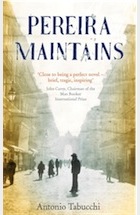 Finally, John Self spoke highly of Italian novelist Antonio Tabucchi's 1994 book Pereira Maintains. A brief work about an insular widowed journalist's political awakening.




 Bernard MacLaverty's Cal - 150 pages that are as densely packed with passion and tension as any I've read in Dostoyevsky or Hardy. The 19-year-old title character lives in Northern Ireland. A Roman Catholic, he is hounded and physically attacked by the Protestant Orangemen. His friends have joined the IRA in response to the violence with which they are threatened. Cal finds the violence too much for him. The struggles of nations would not be important if they didn't effect the lives of individual people. This book is about the converging of conflicts political and personal - the political and religious struggles of an oppressed people, a first great passionate love, and the dilemmas of a sensitive and thoughtful teenager as he makes the moral choices that are going to shape his whole life. I felt deeply the greatness of these struggles as I read. Read my full rave here.
 This book has everything - love, suspense, moral conflict, social criticism, psychological acuity, and crack writing. It is pitch-perfect on the a fast-paced, ostentatious, brutal beauty of Rome. Lambert's writing is rich with observations both interior and exterior that imbue character and place with clarity and instantaneous complexity. This novel, though entertaining to read, is an unambiguous critique of the moral hypocrisy that infects the powerful and the nature of crime which combines an abuse of power with the dehumanization of innocent people. Read my full rave here.
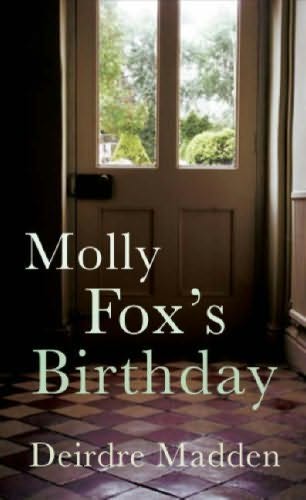 Molly Fox is a celebrated actress - a woman who delves deep into what makes up a 'self.' It is her profession to create characters from that knowledge through the medium of her self. Yet, when it comes to letting others truly know her, she does not. 'Can we ever know another?', this novel asks. The Irish novelist Deirdre Madden fashions a deep and beautiful book on this potentially abstract musing that is redolent with the pain of the distance we have from all others - even those we love most - and simultaneously rich with the rewards of the communion we can make through long acquaintance. She is particularly good at using the processes of the actor and writer to reflect on the ways we can inhabit the inherent contradiction of knowing another, but the mechanisms are so integrated with the events of this narrative that it is difficult to reveal them without ruining your reading of this book. This book is a powerful work of art with an undisturbable sense of wholeness. Read my full rave here.
 The struggle to keep the champagne bubbling when it's gone flat is the action filling Evelyn Waugh's 1930 satire Vile Bodies. Stephen Fry's brilliant film adaptation, Bright Young Things released in 2003 captures the feel of a breathless, manic party. Jim Broadbent, Stockard Channing, Peter O'Toole, Simon Callow, Stephen Campbell Moore, Emily Mortimer, James Mcavoy, Imelda Stuanton, and Fenella Woolgar are some of the beautifully cast actors who maintain an understated hysteria, if you can imagine understated hysteria. The love that director and cast have for these characters is what impresses me the most. It would be so easy to show us how vile these people are - how silly, how louche, how fey - but instead they love them to death. Raveworthy. Read my full rave here.
 Tell Me Everything by Sarah Salway . I opened this book last night and didn't stop reading it until I had finished it. The nearest voice I can think to compare Sarah Salway's to is Lorrie Moore's, and coming from me that is a big compliment. In it Molly experiences a few breaches of trust as a young woman that leave her seriously wounded. She closes down and protects herself by eating. When we meet her she has become one of life's castaways, seriously overweight without a job, a home, or any sense of herself. She meets five people - Mr. Roberts who gives her a job, Mrs. Roberts, Tim - a man of mystery, Liz - a librarian who recommends French authors, and Miranda, a hairdresser. With these relationships she begins to reclaim herself. The story is full of perfectly wrought descriptions, complex observations of human pain and fantasy, and cogent storytelling. Read my full rave here.


