Showing posts with label science and imagination. Show all posts

Sunday, November 1, 2015

Revolution in thought and practice (Books - The Lunar Men by Jenny Uglow)

Erasmus Darwin, 18th Century physician, writer, grandfather of the more famous Charles, and one of the eponymous lunar men of Jenny Uglow's book, wrote in the later years of his life:
Credulitas. Credulity.  Life is short, opportunities of knowing rare; our senses are fallacious, our reasonings uncertain; man therefore struggles with perpetual error from cradle to the coffin.  He is necessitated to correct experiment by analogy, and analogy by experiment...
If you live life with an ounce of curiosity in you, you likely recognize the longing Darwin so pithily expressed . If you, like Darwin, James Watt and Matthew Boulton inventors of the steam engine, Josiah Wedgwood potter and chemist, Joseph Priestley religious radical and the discoverer of oxygen, or any of the other principal characters in Uglow's The Lunar Men (Farrar, Straus and Giroux, 2002), live to pursue your curiosities, then this is your creed.

Friday, March 20, 2015

3-D tour through brain space for Brain Awareness Week


I talked to curious students about the Brain at BiobBase yesterday and took a really amazing tour through a 3-D brain in a planetarium...no, really.  Check out my Brain Awareness Week blog by clicking here and scrolling down.

Thursday, March 12, 2015

Improvisation in the Sciences - improvisations on a panel discussion for Brain Awareness Week 2015)


This originally appeared here but I now post it below.

When I heard that the opening event of Brain Awareness Week this year was on the theme of improvisation and involved arts and science, I knew that I wanted to be the one to report on it.  I decided to do this blog as an improvisation; that is what follows.

Improvisation 1

I am riding the subway on my way to Improvisation in the Sciences at Columbia. It’s the first event of Brain Awareness Week and involves musicians and scientists. Given the theme, and since I am both an artist and neuroscientist, I decided to improvise this blog, a little experiment. I’m feeling a bit nervous, like I’m performing myself. Before I left my apartment, I sat down to play a sonata on the piano, I thought it would get me in the mood but I was interrupted by a phone call letting me know that the subways were delayed. I ran out of the house. Having stopped the sonata in the middle, the strains are repeating unresolved in my mind’s ear. I am anticipating music on the program, but it probably won’t be this kind of music.

Friday, July 4, 2014

Grabbing the arts-science zeitgeist by the short and curlies (Books - Orfeo by Richard Powers)

In Richard Powers's most recent novel, Orfeo (Norton, 2014), a contemporary composer, Peter Els, performs experiments with the DNA of bacteria in a his lab at home - his hobby - using what he learns about the coding as the basis for his musical compositions.  The police come across his lab by accident and suspect him of bio-terrorism and Homeland Security turns an experimental composer whose career has been largely irrelevant to his field, into a world renowned fugitive from the law.

Thursday, November 14, 2013

At the corner of science and culture...


At the corner of science and culture sits a mollusk, a Nautilus, to be exact.  While we're both waiting for me to post something bookish, check out this innovative and sharp looking new magazine and blog.  Each issue has a theme, a new chapter is released each week.  This week, find out why fish are all blissed out.
Jeffrey Hawkins Writer likes to say that the average drop of water entering the Mississippi River headwaters north of Minnesota will be used 11 times before it reaches the Gulf of Mexico. That drop might irrigate crops, flow through wastewater treatment plants, pour out of residential taps, move through digestive systems, arc into toilet bowls, swirl down into sewers, and then do it over again. Whatever its fate along its 2,300-mile journey South, this water will mix with all kind of chemicals, human metabolites, and unnatural compounds.

Sunday, May 12, 2013

On self-limiting enzymes, playfullness in science, and mothers... (Books - The Statue Within by Francois Jacob)

Over the last ten days, I attended the annual conference of the International Society for Autism Research, in San Sebastian Spain, where I presented some of my research and heard about the work of many, many others.  It was impressive to see the huge amount and diversity of efforts focused on autism spectrum disorders.  On my travels there and to nearby Barcelona, I also managed to get a little reading done.

I had started The Statue Within, the memoir of French biologist Francois Jacob a while ago, but never really got going.  The conference put me in the mood to pick it up off the pile again and just as I began, I learned that Dr. Jacob had died at 92 years of age.  Dr. Jacob's contribution to our understanding of how living organisms work was to be the first to observe and describe how the level of an enzyme produced in a bacterium can be responsive to its environment, eventually earning him, Jacques Monod and and Andre Lwoff the Nobel Prize in Physiology or Medicine in 1965.  He saw that e. coli, for example, could digest the sugar lactose for energy instead of glucose, but it produced the necessary digestive enzyme (lactase) only when lactose was present.  How was this possible?  It was learned around the same time that the production of any protein (such as an enzyme) was the product of certain sequences in our DNA (we call those sequences genes).  These sequences became a template for RNA which, in turn, became a template for the production of a protein. The e. coli's genes were always equipped to produce lactase but, typically, a repressor (also a protein) was bound to the portion of our DNA responsible for producing lactase.  In the presence of lactose, the repressor binds lactose instead of those genes.  This accomplishes two things: 1) the lifting of the repression which means that the genes facilitate the production of lactase which digests the lactose and 2) it creates a self-limiting loop such that, when the lactose is gone, the repressor then binds the DNA once again and the production of lactase is turned-off.  This was important to biology not just in understanding how e. coli are responsive to their environment, but because this model extends to any gene in any organism. Dr. Jacob and Jacques Monod realized for us that genes interact with their environment.  Genes being present in an organism are not sufficient to accomplishing their action, they must be turned on" by some signal or, to use the term biologists use, they must be "expressed."  Although, as is always true with biology, it is now understood that this is a general principle and this simple mechanism is, in fact, be varied upon and complicated infinitely.

Thursday, April 18, 2013

Keeper of the cabinet of human curiosities (Books - Hallucinations by Oliver Sacks)

Now nearly 80, neurologist, writer, and keeper of the cabinet of human curiosities - Oliver Sacks - has written his 12th book.  This one is on activations of the perceptual systems that are produced by internal rather than external stimulation or Hallucinations (Knopf, 2012).  They run the gamut.  You can smell them, hear them, see them, and feel them.  They can have their origin in disease processes, chemicals, injury to the nervous system, or sensory deprivation.  They can take the form of geometric patterns, religious conviction, snatches of music, or little people (Lilliputian hallucinations).  I too have seen a patient with this last form of hallucination.  Her's were holding their heads in their hands (detached from their necks), but it didn't seem to cramp their style any.  I think that the term is probably my favorite in neurology.

I have always admired Sacks's writing about his patients because I feel that I am reading about people rather than cases.  I am a great admirer of Sacks's early books like An Anthropologist on Mars and The Man Who Mistook His Wife for a Hat, both are less continuous narratives than Hallucinations or Sacks's recent Musicophilia and The Mind's Eye.  Rather than thematic in nature, these earlier books are simply collections of essays on human beings whose strange neurologic cases make them fascinating, but who otherwise have little or no relation to each other.  I found some of the material included in Hallucinations had to stretch to be subsumed under the book's theme.  While I found most of the material interesting, an episodically constructed book might have been a more natural and satisfying form.

On more than one occasion in this book (and his last, The Mind's Eye) Sacks becomes his own subject. In this case, he writes frankly of his experimentation with hallucinogenic drugs, a piece that appeared in The New Yorker last year, and of a serious hiking accident during which Sacks says that a voice commanded him to keep going. 

I am always impressed by the historical sources Sacks cites.  They immediately make me want to visit the library.  Jackson's original papers on epilepsy and aphasias, are cited in Hallucinations.  Perhaps this is not as enticing to the average lay-reader, but for a neuroscientist, these are the golden oldies. Jacksonian seizures were named for John Hughlings Jackson.

Hallucinations makes colorfully clear that the mechanisms in the brain that eventuate patients' perceptions in the absence of external stimulation can be diverse.  The light patterns that are experienced in the aura prior to migraine might be thought of as electrical disturbances like a wave passing across the visual parts of the brain.  Whereas the hallucinations reported around near death experiences such as a floating above one's own body may occur due to stimulation of the right angular gyrus, one of several brain regions implicated in a circuit that according to Sacks mediates body image and vestibular sensations.  The vision of a dark tunnel with light at the end may be the result of decreased circulation to the retina, which narrows the visual fields.

The most remarkable of the cases Sacks writes of in Hallucinations was that of an 86-year-old English man who already had glaucoma and macular generation, but when a stroke compromises his right occipital lobe he loses vision completely in his left visual field.  What is most interesting is that he is not aware of his loss
...his brain appears to fill in the missing parts.  Interestingly, though, his visual hallucination/filling in always seem to be context-sensitive or consistent.  In other words, if he is walking in a rural setting, he can be aware of bushes and trees or distant building in his left visual field, which when he turns to engage his right side, he discovers are not really there.  The hallucination do, however, seem to be filled in seamlessly with his ordinary vision.  If he is at his kitchen bench, he "sees" the entire bench, even to the extent of perceiving a certain bowl or plate within the left side of his vision - but which on turning disappear, because they were never really there.  Yet he definitely sees a whole bench, with no clear separation between parts composed of hallucination and true perception.
The human brain is a remarkable country and it is always enjoyable to travel there with Oliver Sacks as your guide.

Wednesday, March 6, 2013

Scientist as harridan, Hollywood icon, and bad dresser


Dr. Patricia Fara, historian of science at Cambridge, bemoans in Nature today the role biographers have played in reinforcing stereotypes of women in the sciences and mathematics in Women in Science: Weird Sisters?.
It seems that being an ordinary woman with a stellar scientific career is simply not enough: to be marketable, she must also be odd. Dust jackets entice purchasers by rebranding an overlooked character as a unique female individual — in other words, as a weird woman.
Converting female scientists into publishing opportunities may sell books, but it does the cause of equality in science no favours.  

Her critique offers a list of recent biographies which, despite any shortcomings, profile some important scientists such as Rosalind Franklin, Dr. Jocelyn Bell, and, Hedy Lamarr, no really.

Tuesday, March 5, 2013

The allure of the counterintuitive - is it good or bad for science?

There is a good critique on how the popular press hypes social science research in The American Scholar: The Allure of the Counterintuitive by Jessica Love.  Well worth a look.  I very much agree with her point that the press gives very little space to studies which are
incremental, for work that shores up and teases apart, for work that complicates, for work on the boundary conditions...
But Love seems to feel that the appeal of the counterintuitive is damaging to science because people will be so entrained to hype that they will not support studying brain processes that appear to be obvious.  However,  I would argue that interest in counterintuitive conclusions is an opportunity to argue for why we study the brain, its behaviors, and its less visible processes (like the electrical and chemical signalling whose outcome are our cognitive functions) in the first place.  Even though our minds are are own, we do not have conscious access to all its processes.  This is an opportunity to explain just that, and in the case of neuroscience conclusions are even less obvious.   Although our minds 'think' our neurons do not.  We do not know before studying brain processes which hypotheses will confirm our common sense notions and which will not. So, while I get a little tired of "hey wow" science and do not like inaccurate popular press interpretations of studies, the allure of the counterintuitive offers an opportunity to better explain critical thinking and experimental processes if it is used well.

Hat tip: The Dish

Saturday, November 10, 2012

The limits of genius (Books - Measuring the World by Daniel Kehlmann)

Daniel Kehlmann is a popular German-born writer living in Austria.  With Measuring the World (Quercus, 2007) he has taken the biographies of mathematician Carl Friedrich Gauss and scientist Alexander von Humbolt as the jumping off point for a novel which vividly and amusingly imagines their inner lives.  Contemporaneous to the late 18th to early 19th centuries, Gauss and Humboldt were endowed with brilliant minds which saw novel ways to answer questions (and defeat strongly held but untested assumptions) about the world in which we live.  Both took on the entire world as their subject - the height of its peaks, the composition and temperature of its core, the shape of planetary orbits, the path of the ocean's currents, the very shape of space - but their methods of measurement couldn't have been more different.  While Humboldt shocked his own spine in testing the nervous system's ability to conduct electricity and travelled to the far reaches of the world at considerable risk to himself - he couldn't pass an Andean peak without climbing it or a mine shaft without dropping himself in - Gauss preferred to make his measurements without leaving his armchair.

Monday, September 3, 2012

Aesthetics transforms vision and the mind, which transforms aesthetics... (Books - The Age of Insight By Eric Kandel)

There has been a bevy of books examining wider aspects of culture as they intersect with brain science written by scientists in the past year:  Consciousness: Confessions of a Romantic Reductionist by Christof Koch, The Age of Insight by Eric R. Kandel, Who's In Charge?: Free Will and the Science of the Brain by Michael S. Gazzaniga, and Thinking, Fast and Slow by Daniel Kahneman.  They are written by senior neuroscientists and written for the general public I wrote about the Gazzaniga here, I will write on Koch in the coming weeks, and I have yet to finish the Kahneman, but I just completed Eric Kandel's The Age of Insight (Random House, 2012). 

The eminent Nobel-Prize winning neuroscientist satisfyingly brings together modernist art, the Viennese Secession to be precise, the study of the unconscious mind emerging during the same period, and what the development of neurobiology and cognitive psychology can contribute to our understanding of human-ness.  His self proclaimed aim is to bring together science and art, his mechanism is to address what we know about how the brain accomplishes visual perception, creativity, and feeling.  The result is a fluidly written account, fueled by a lifetime in neuroscience and a passion for painting, particularly portraiture.    

Saturday, March 3, 2012

Richard Powers - where fact and fiction collide (Essay - What Does Fiction Know?)

One of my very favorite writers, Richard Powers, who writes at the intersection of fiction and science, has written an inspiring essay about the city of Berlin, the unreliability of storytellers, and the place where fiction and fact collide. It is inspiring for the way it mixes personal experience, data, and artifice. It appeared in last summer's Design Observer and I link it here.

Friday, March 4, 2011

Probing the experience of seeing (Books - The Mind's Eye by Oliver Sacks)

I have always enjoyed Oliver Sacks's vivid, humane portraits. He is a doctor/author who has always managed to write about people instead of cases and in none of his books is that better exemplified than in The Mind's Eye, in which Sacks's experience of his own eye tumor is the subject of one of the pieces.

Each chapter in this latest collection focuses on a person whose visual system is somehow compromised or enhanced. I say visual system rather than eye because most of what we experience as 'seeing' is accomplished by the central nervous system. The retina, which is the curved screen upon which our lens focuses the light entering our eye, and that forms the back wall of our eye, is actually part of the CNS. It's like a little piece of brain that hangs by a stalk (the optic nerve). The characters of The Mind's Eye include a pianist who loses the ability to read music, a mystery writer who looses the ability to read words (but not to write them), and several people who are selectively blind for faces but not necessarily for other classes of objects. There is a chapter devoted to stereoscopy, or how the brain combines the images from our two two-dimensional retinas to create an illusion of three-dimensional space. In this case, a woman with life-long strabismus, who could not see in three dimensions because she viewed the world through one eye at a time, gains the ability to see in 3-D. I found this section particularly charming, not so much for the case study but because of the fact that Dr. Sacks, having developed an interest in stereoscopes in his childhood, built himself several:
So when, at the age of ten, I developed a passion for photography, I wanted, of course, to make my own pairs of stereo photos. This was easy to do, by moving the camera horizontally about two-and-a-half inches between exposures, mimicking the distance between the two eyes. (I did not yet have a double-lens stereo camera, which would take simultaneous stereo pairs).

After reading how Wheatstone explored stereoscopic effects by exaggerating or reversing the disparity between the two images, I began experimenting with this, too. I started taking pictures with greater and greater separations between them, and then I made a hyperstereoscope, using a cardboard tube about a yard long with four little mirrors. With this, I could turn myself, in effect, into a creature with eyes a yard apart. I could look through the hyperstereoscope at a very distant object, like the dome of St. Paul's Cathedral, which normally appeared as a flat semicircle on the horizon, and see it in its full rotundity, projecting towards me.
We were able to have fun before television and the internet! Sacks's memoir, Uncle Tungsten, is full of such examples of himself or members of his family pursuing their curiosity about the world's flora, fauna, and physical phenomena, through active research. I delight in the fact that Sacks was a member of the New York Stereoscopic Society prior to his own eye troubles (not to mention the American Fern Society and the New York Mineralogical Club, both mentioned in his bio). The fact that Sacks pursues his curiosities so avidly, whether about people or phenomena, is reflected in the way he listens to and relates the stories of his patients.

Through his case histories, Sacks also writes on how the brain evolved the skill of reading if it wasn't "designed to" do so, how our eyes take in surfaces and the boundaries between them but the brain constructs"objects" from them, the von Helmholz and Young theories of color vision, and how the brain is able to fill in holes in the visual field - both those naturally occurring in our blind spot (the place where the optic nerve exits from the retina) - and those created by injury or illness. Sacks's description of his own loss of vision is particularly evocative. He communicates through it not only how the brain constructs what we perceive from the cues the eyes collect, but also how the limits of the eye produce a different experience for the brain. When Sacks loses the peripheral visual field of one of his eyes to a tumor, he not only cannot see that portion of space, he seems to lose his awareness that it exists at all.
Kate and I finished our walk and headed back to my office. I walked ahead and got inot the elevator - but Kate had vanished. I presumed she was talking to the doorman or checking the mail, and waited for her to catch up. Then a voice to my right - her voice - said, " What are we waiting for?" I was dumbfounded - not just that I had failed to see her to my right, but that I had even failed to imagine her being there, because "there" did not exist for me.
The last chapter, which lends its title to the book, was most interesting to me. Mental imagery is a particular interest of mine. Sacks writes of neural plasticity (the reassignment of new functions to neural real estate). For example the reallocation of parts of the visual cortex to either hearing or touch for those who are blind. Or the science-fiction like work of neuroscientist Paul Bach-y-Rita , who takes advantage of such flexibility by connecting the output of a video camera, point-by-point to a grid on one of the most sensitive part of the human body - the tongue. Such a device enables blind people to walk across a room avoiding obstacles, to catch a ball rolled toward them, and make other such perceptual judgments not previously afforded them. Are these people "seeing," Sacks asks? Whether exploring case studies, the evolution of neuroscience, or more recent avances, Sacks's writing is probing, accessible, and humane in The Mind's Eye.

Sunday, February 27, 2011

Can a computer be smart or can it only be programmed to act that way? (Books - Final Jeopardy by Stephen Baker)

Final Jeopardy: Man vs. Maching and the Quest to know Everything concerns itself with the stunt planned by IBM to program a computer to play Jeopardy against human contestants. But Stephen Baker’s swift moving book doesn’t merely reveal backstage gossip like why the computer was named Watson or who designed his 'face,' the real reason to read this book is the story Baker tells about the nature of intelligence and whether machines can possess and use it.

 Baker, as IBM did, used the contest as a scaffold. For IBM this narrowed the scope of their research and imposed a schedule. For Baker it lent his narrative thrust toward a conspicuous end. It's almost a shame that we know the outcome, the contest having already been aired, but Baker writes well enough to squeeze suspense out of the story by connecting us to the stakes experienced by scientist David Ferrucci, and his team of programmers, designers, former Jeopardy contestants, and, of course, the public relations armies for IBM and Jeopardy.

I enjoyed Baker's lay-descriptions of the evolution of computing machines and how they differ from human brains: what kind of knowledge goes into them, what sorts of computations can be expected of them, what kinds of mistakes they make, how computers can learn and how we, in turn, can learn about the nature of intelligence through the exercise of programming them to do so.

For certain types of questions, Ferrucci said, a search engine could come up with answers. These were simple sentences with concrete results, what he and his team called factoids. For example: "What is the tallest mountain in Africa?" A search engine would pick out the three key words from that sentence and in a fraction of a second suggest Kenya's 19,340-foot-high Kilimanjaro. This worked, Ferrucci said, for about 30 percent of Jeopardy questions. But performance at that low level would condemn Watson to defeat at the hands of human amateurs.

Baker is adept at explaining how fact-based knowledge can be stored in and retrieved from the neural networks of the human brain. Key to his story about so-called artificial intelligence, he makes clear the difference between designing a machine that actually performs the steps of human-like cognitive processes in a silicon medium rather than an organic one versus one that looks as though it is problem-solving like a person, but is actually coming up with the answer via different processes.

Equally interesting was the discussion Baker's book provokes about what knowledge is for. This highlights the poverty of Ferrucci's tightly-focused imagination.
"You can probably fit all the books that are on sale on about two terabytes that you can buy at OfficeMax for a couple of hundred dollars. You get every book. Every. Single. Book. Now what do you do? You can't read them all! What I want the computer to do," he went on, "is to read them for me and tell me what they're about, and answer my questions about them. I want this for all information. I want machines to read, understand, summarize, describe the themes, and do the analysis so that I can take advantage of all the knowledge that's out there. We human's need help. I know I do!" 
Actually, you can't get all the information period, and the best computer can't either, so calm down, David. Knowledge is not just possessing facts, nor is it analyzing them. Analysis takes place at multiple levels. Merely determining which units within a narrative are the facts is itself analysis. And just what are facts: what are the facts of Oliver Twist, for example? Is Fagin a fact? Is the theft of a pocket handkerchief a fact? Is “some more?” Facts and the juicy stuff that can be derived from them are determined by an intersection with the point-of-view of the individual using them.

To be fair, Ferrucci understands these limitations and his project embraces the challenge of finding a solution. Ultimately, the machines that we can imagine now will likely be better at generating lists for hypothesis development than they will be at making inferential leaps. The gains made in problem solving by sudden departures from the knowledge tree or standard method are legendary - that's the 'creative' part of creative problem solving and is the very stuff of the creative leap that so often precedes a solution.

Other scientists, such as Joshua Tenebaum at MIT think that one day computers will generate concepts and make inductive leaps, but that is hard to imagine reading Baker’s account of parsing the words of a single Jeopardy question well enough to determine the category of knowledge to search (let alone to answer it). A great deal more than computing speed is necessary before computers can accurately comprehend human emotion, make inferences, and take control from their inventors like Hal in 2001: A Space Odyssey. Tenenbaum said it best:

"If you want to compare [artificial intelligence] to the space program, we're at Galileo," Tenenbaum said. "We're not yet at Newton." 
Baker's book is thoughtful, informative, and really amusing, without being pseudo-science. I'm passing my copy along to my Uncle who was a contestant on Jeopardy in the 1970s. I think he should get a kick out of it.

Saturday, July 10, 2010

Books on becoming... (Books - Microcosm by Carl Zimmer, The Statue Within by Francois Jacob, & Little Monsters by Charles Lambert)

Crazy week. I've been writing a paper in the lab (which means a lot of work-related reading), and it has been hot enough here in New York City to fry an egg on my face. I have read for fun here and there, on my commute and before I go to sleep, but not enough to finish anything. Here's what's at the top of the pile at bookeywookey:

Carl Zimmer writes eloquently in Microcosm of the biology, particularly the evolution, genetics, and the experimental manipulations applied to the single-cell microbe E. coli and what we can learn about our own species by studying it.
The threats faced by a starving E. coli are much like the ones our own cells face as we get old. Aging human cells suffer the same sorts of damage to their genes and ribosomes. People who suffer Alzheimer's disease develop tangles of misshapen protein in their brain - proteins that are deformed in much the same way some proteins in starving E. coli are deformed. Life not only grows and reproduces. It also decays.
Zimmer's writes writes a different kind of popular science book than many of those that gain popularity today. He fashions an elegant narrative line while not holding the reader's hand. If his story includes the role of the ribosome in protein synthesis or the notion of a genetic switch and you don't know what that means, he expects you to look it up. He also doesn't adhere to the scientific paper model of writing - say what you're going to do, do it, and then say what you have done - I appreciate this because it affords his narrative less excess verbiage and a greater sense of flow.

I've particularly enjoyed learning about the ways in which E. coli fashioned of identical DNA in the identical environment develop individual differences. Zimmer also makes the important point that it is E. coli that has allowed us to study the process of evolution directly. To see it before our eyes and collect evidence for it. We don't live tens of thousands of years and were not around for the entire process described by Darwin and his scientific descendants, and so we have relied on the evidence left behind in fossils. However, in an average month E. coli will produce more than 500 generations. We can see them reproduce, replicate their DNA, produce random mutations, and generate more of those mutations over time that favors their more effective survival in that environment, and this can happen on the scale of years rather than millennia.

Biologist Francois Jacob was one of the team who uncovered the mechanism by which genes regulate the production of proteins by studying E. coli. He trained as a doctor, fighting in the free French forces against the Germans in Africa in World War II. The serious injuries he sustained prevented him from work as a surgeon and so he ended up a microbiologist, eventually winning a Nobel Prize for his work. The Statue Within is his elegant philosophical memoir.
My obsession: a life that shrivels up, slowly rots, goes soft as a pulp. This worry about decline grabs me by the throat as I awake. In the brief interval between dream and waking, it flaunts before my eyes the frenzied dance of everything I would have liked to do, and did not do, and never will. As I turn over and over in my bed, the fear of the too-late, of the irreversible, propels me to the mirror to shave and get ready for the day. And that is the moment of truth. The moment for the old questions. What am I today? Am I capable of renewal? What are the chances I might still produce something I do not expect of myself? For my life unfolds mainly in the yet-to-come, and is based on waiting. Mine is a life of preparation. I enjoy the present only insofar as it is a promise of the future... Starting to work in Andre Lwoff's laboratory at the Pasteur Institute, I found myself in an unfamiliar universe of limitless imagination and endless criticism. The game was that of continually inventing a possible world, or a piece of a possible world, and then of comparing it with the real world. Doing experiments was to give free rein to every idea that crossed my mind...What mattered more than the answers were the questions and how they were formulated; for in the best of cases, the answer led to new questions. It was a system for concocting expectation; a machine for making the future. For me, this world of questions and the provisional, this chase after an answer that was always put off to the next day, all that was euphoric. I lived in the future. I always waited for the result of tomorrow. I had turned my anxiety into my profession.
Isn't that gorgeous? Old fashioned perhaps, the prose is purpler than what we would expect in a scientist's memoir today (or any memoir), but what passion and drive he conveys.

Another elegant and thoughtful wordsmith is atop the bedside pile. I wrote last week of Charles Lambert's most recent book Any Human Face, a thrillerish love story with serious moral underpinnings. That led me to finally read his first novel, Little Monsters, which I have owned for a year or more. I have quickly gotten half way into this fictional memoir of a somewhat cruel and isolating childhood. It was obvious to me upon picking up this book that I had never even read the opening paragraph:
When I was thirteen, my father killed my mother. Three days after that, I was taken away from the hospital by two people I had never seen before and would never see again, a man and a woman who used my name each time they spoke to me - Are you warm enough, Carol? Have you got your case, Carol? Carol, come along with us now - as if they knew me, although they didn't tell me their names. I must have shown willing somehow. I expect I nodded and did what I was told. I was put into a car that smelt new and then, when I was sitting alone in the back, they told me I was going to stay with Aunt Margot, who ran a pub called the Mermaid. I supposed I'd known that I wouldn't be taken home, but I was still surprised, and shocked, as I would have been no matter what the destination. They spoke about my aunt as though I was supposed to know all about her. They laughed when the man said I'd be able to get tipsy for nothing. That was the joy, he said, of living in a pub.
Well, he certainly knows how to get one's attention. I would have kept going had I read that paragraph before. The novel evokes for me themes of memory, loss, rescue, and what propels one to become the kind of adult they become. I am excited to read on.

Tuesday, May 18, 2010

Things are looking up!


Good news! John Tierney has an article in today's Science Times on Matt Ridley's new book The Rational Optimist. Its thesis is that homo sapiens are unique not because of bigger brains, nor because of our ability to cooperate, but rather because we created ways to exchange goods and information.
"The extraordinary promise of this event was that Adam potentially now had access to objects he did not know how to make or find; and so did Oz," Dr. Ridley writes. People traded good, services, and most important, knowledge, creating a collective intelligence..."
This lead to circulating the knowledge of domesticating crops, the development of alphabets, and number systems and, Ridley argues, the creation of measured time, because the worth of a good or service was measured in how long a person would have to work to pay for it. One might also argue that it circulated small pox and MacDonald's but that isn't mentioned.
"The modern world is a history of ideas meeting, mixing, mating and mutating and the reason that economic growth has accelerated so in the past two centuries is down to the fact that ideas have been mixing more than ever before."
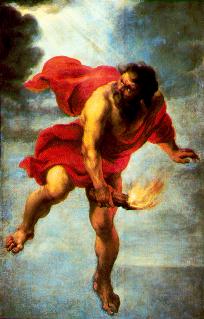
His prediction is the spread of prosperity and happiness and the decrease of disease and violence. I will have to read the book to find out how he goes from point A to point B, and Tierney's piece certainly makes me want to, but I am not sure how mixing inevitably leads only to the progress of good things and the decrease of bad. One might argue that innovation is more likely to diffuse information, that is, that it will spread randomly until it becomes equally distributed. Is knowing more always better? The myth of Prometheus, pictured above, argued otherwise. What happens when bad things spread? The spread of what knowledge we have is inevitable, but is the eternal increase of knowledge inevitably positive? What happens the day that that knowledge includes the certainty of the destruction of our planet or the extinction of our species? But Ridley is a wonderful thinker and writer and amidst crashing markets, bombings, and the growth of the Tea Party, some unbridled optimism is welcome.

Wednesday, May 12, 2010

Reading with recycled neurons (Books - Reading in the Brain by Stanislas Dehaene)


Reading in the Brain by Stanislas Dehaene is a readable account of how the reading brain works, as well as how it doesn't.  Given the fact that printed text is a relatively recent human invention and, given the time scale of evolution, the brain could not have evolved specialized structures for reading per se but rather has adapted structures that evolved for more general visual purposes and applied them to this specialized task which combines seeing and recognizing objects and the reception of the abstract thoughts of another person. The form of letters have little to do with the meaning they ultimately communicate. As a result it has become the work of seven to ten of our earlier years to learn rote the relationship between our culture's symbols representing the units of sound (phonemes).  These are combined into (words) from which we generate continuous phrases and sentences which accomplish the transfer of information and point of view. This is done at a minimum with some coherence, if not also some beauty, and the composer of those same units of meaning doesn't even have to be around to explain himself. It might seem roundabout that printed text has to take a two step journey from sound to meaning rather than going straight to meaning, but this is what allows language to communicate abstract thought:
I suspect that any radical reform whose aim would be to ensure a clear, one-to-one transcription of English speech would be bound to fail, because the role of spelling is not just to provide a faithful transcription of speech sounds. Voltaire was mistaken when he stated, elegantly but erroneously, that "writing is the painting of the voice: the more it bears a resemblance, the better." A written text is not a high-fidelity recording. Its goal is not to reproduce speech as we pronounce it, but rather to code it at a level abstract enough to allow the reader to quickly retrieve its meaning.
The brain accomplishes this remarkable feat, Dehaene tells us (without even being there), via two pathways that operate simultaneously when reading is fluent. One path transfers the letter-string to it sound content (and the motor requirements of our making that sound with our vocal apparatus) prior to its meaning, and the other that goes for the identity of the word first and then the sound. A great number of pages in the book is spent on discussing the fruits of Dehaene and his colleague Laurent Cohen's labors identifying the left hemisphere's visual word-form area, a region of the brain whose purpose seems to be to be the visual analysis of the symbols that make up letters and words irrespective of their superficial differences. That is to say we can read word, WORD, or even WoRd equally easily and can tell the difference between ANGER and RANGE. You can see the visual word-form area in the picture representing the relative activity of regions of Dehaene's reading brain below, its the area right above his ear. There are other areas that accomplish the conversion of printed text into units of sound, still others that agree on the meaning of the assembly given not only its form but its context.
The typical right-handed person's brain has developed most of its key language processing areas in the left hemisphere (left handers are less reliable in this regard). This is true whether the personn reads from left to right or right to left and whether they read an alphabet whose symbols map to units of sound (as in these roman letters you are reading right now) or comprise pictures of whole words (as in logographic alphabets like Chinese). Dehaene, in fact, explores the evolution of different writing systems from pictoral markers in depth as he builds his case for how the human brain evolved the skill of reading, a section of the book I very much enjoyed.

Much of this case centers on the brain's ability to adapt cortex to multiple functions, something he calls neuronal recycling.
We would not be able to read if our visual system did not spontaneously implement operations close to those indispensable for word recognition, and if it were not endowed with a small dose of plasticity that allows it to learn new shapes. During schooling, a part of this system rewires itself into a reasonably good device for invariant letter and word recognition.

According to this view, our cortex is not a blank slate or a wax tablet that faithfully records any cultural invention, however arbitrary. Neither is it an inflexible organ that has somehow, over the course of evolution, dedicated a "module" to reading. A better metaphor would be to liken our visual cortex to a Lego construction set, with which a child can build the standard model shown on the box, but also tinker with a variety of other inventions.

My hypothesis disagrees with the "no constraints" approach so common in the social sciences, according to which the human brain is capable of absorbing any form of culture. The truth is that nature and culture entertain much more intricate relations. Our genome, which is the product of millions of years of evolutionary history, specifies a constrained, if partially modifiable cerebral architecture that imposes severe limits on what we can learn. New cultural inventions can only be acquired insofar as they fit the constraints of our brain architecture.
In the book's final chapter, Dehaene discusses cortical plasticity - a neuroscientific idea that is relatively recent and much in vogue.  It is the ability of brain's neuron's to adapt their function from one purpose to another - for example, when a blind person's visual cortex cells become able to decode sensation of the fingertips to braille letters.  Dehaene makes a case for the necessity of cortical plasticity in inventing cultural forms like number systems and the arts. It's one of those fun bits of reaching for the stars that a researcher has to save for when they write a book rather than a journal article. His voice comes off a little stuffy at times, but his theory is intricate - composed of many interleaving units - so his writing must be systematic in driving home each concept and then attaching is to its predecessor. His model for how the brain accomplishes reading, I must emphasize, is one of several, but he does acknowledge alternate viewpoints along the way. The lay reader may not find this book as accessible as Maryanne Wolf's Proust and the Squid, but it goes into more depth and synthesizes a lot of information into a coherent narrative arc. His diction is clear and the reading experience fluid and even entertaining. Dehaene's work is at the cutting edge of our understanding about the relationship between language and the brain so I found it a pleasure to get the story from one of its sources.

If you in or around NYC on Thursday March 13 at 6pm, join me for a film about dyslexia called THE BIG PICTURE: RETHINKING DYSLEXIA.  Click here for information.

Tuesday, April 13, 2010

Information storage and replication - adaptive and maladaptive (Books - The Oxford Book of Modern Science Writing & Something is Out There)


I wrote in my last post on Richard Dawkin's fine collection of science writing of hypothesis testing - a part of the scientific method which helps us to build our body of knowledge about the world through disciplined comparison. This is how it works. Scientists pit a hypothesis that says that what they think is not true (the null hypothesis) against an alternate hypothesis (their own). For example, if the scientist is testing the effect of a drug to cure the common cold, he might take two groups of people with nasty colds, give one the drug and the other a sugar pill. His claim might be that those who took his drug will sneeze fewer times a day than those who took the sugar pill. His 'null hypothesis' would state that there will be no difference between the two groups - that both will sneeze the same number of times after taking the pill. This is the result he does not want. If his experiment is successful, he cannot prove his hypothesis per se, because no one can test every instance of something, but what the scientist can do is reject the null hypothesis to some degree of certainty. It is up to not just this probability,but also to the experimental design to say that the reason the sneezing decreased was the drug and not something else.  Our experimental design would have to account for other explanations, such as the fact that the cold ended naturally on its own - something science calls controlling the experiment.

Why would scientists work so hard to try to address an explanation other that the one we want? There are two reasons: one protects against our influencing the outcome in subtle ways in our experiment because we want success so badly (scientists fall prey to the same psychological pitfalls as any other human). The second is is one of logic and safety. Say you wanted to reach some books on a very high shelf and you had no ladder, but there was some wood, a hammer, and a few nails. You build a 4-step step-stool but you have no aluminum braces and only a single nail for each join. Would you a) proudly throw your finished stool down in front of the right spot on the shelf and jump on up to the top step, standing on your toes to reach that book as soon as it was finished or would you b) put some weight on it with your hands first, testing the stool before climbing on it? If you are like a scientist, you will opt for the second choice, preferring to break the stool you made with your hands than to impulsively leap to the top step and risk breaking your neck .  It is more logical to attempt to break the stool safely than it is to assume that it is functional because you would like that book on the top shelf so badly. It is not that we want the stool to break, it is that we want to know with a great deal of certainty that it will not. So we try to break it by putting at least as much pressure on it as it would likely withstand under typical us.

That long explanation of hypothesis testing was a preamble to a point I wanted to make inspired by another couple of excerpts Dawkins chose in The Oxford Book of Modern Science Writing, these by biologist Francis Crick and zoologist Matt Ridley. That is: scientists are good at doing other things too. One strength of a great creative-scientific mind is the way it can use its body of accumulated knowledge together with its unique perspective to see patterns in the world that others have not seen. This begins with a sentence from Watson and Crick's 1953 paper on DNA:
'It has not escaped our notice that the specific pairing we have postulated immediately suggests a possible copying mechanism for the genetic material.'

The quality of mind that enabled Watson and Crick to race ahead of their laboratory-based rival Rosalind Franklin is well demonstrated by that sentence, and it is shown again in the extract I have chosen from Crick's book Life Itself: Its Origin and Nature (1981). Watson and Crick were not only concerned with finding out how things actually are - although that was of course their ultimate goal. They also kept in mind the way DNA ought to be if it was to do its job as the genetic molecule, and this gave them a short cut, which was ignored by the painstaking Rosalind Franklin...it is in general true that deep cogitation on the way nature ought to be constitutes a good prelude to the eventual investigation of the way it actually is. Only a prelude, however: the ultimate test of an idea is not its elegance but how will it explains reality.
So creative scientists are also good at something that might be called informed musing. In fact most creative people of all kind are. I might add to Dawkins cautionary concluding sentence that a responsible reporter of science will always let you know which they are doing - testing a hypothesis or musing.

I have not read Matt Ridley's 1999 book Genome, but Dawkins describes its creative structure - 23 chapters, one for each of our chromosomes, each chapter extrapolating upon a theme inspired by what is known about the functions of that chromosome. If the excerpt is any indication, this makes for some rich cross-fertilization among genres. In the case of this chapter it is biology, physics, and information processing. The short chapter careens from Erasmus Darwin's 1794 prediction that living filaments may be shared precursor to all organic lifeforms - an amazing notion for its day! To the idea that lifeforms, unlike closed systems which proceed from states of order (requiring more energy) to states of chaos (requiring less),
...build packets of order and complexity called bodies but at the cost of expending large amounts of energy. In Erwin Schrodinger's phrase, living creature 'drink orderliness' from the environment.
Isn't that fantastic? He goes on to connect the building of a body with the need for information. That information must be storable (the DNA of our genome) and must be both readable and replicable. Less than two pages later, Ridley speaks of the year 1943 as the time when diverse ingredients began to coalesce in a way that would eventually transform how we know our world. Here is what I mean by a unique mind being able, through its own peculiar fund of knowledge and its uniquely creative disposition, to see what no one else can. Ridley writes of what Watson and Crick were up to, the tortures Josef Mengele was enacting at Auschwitz, the work of Oswald Avery that prefigured the connection of DNA to heredity, and the brilliant Alan Turing, who was creating a computation machine that also could store information, modify it, read it to enact functions, and replicate it. What Ridley sees and writes of with panache is the excitement in disparate disciplines that prefigured the connecting of biological code to heredity. It's a visionary discourse that exemplifies what I wrote of in the last post inspired by Dawkins's collection, that strong feeling precedes scientific inquiry.

I have also continued my travels with another unique mind - that of Richard Bausch - in his latest story collection, Something is Out There. "Son and Heir" is a devastating portrait of dissolution of the aimless son of a college president. Lyndhurst, the son, is a pitiable character whose combination of pride and inherent mistrust leads him to make a series poor judgments. This mistrust is predicated on his having witnessed his respected father's infidelity toward his mother alongside the public continuance of their marriage - a hypocritical facade - to which Lyndhurst has developed over time his own facade of not caring. Here too we see information stored and replicated, this time in a maladaptive pattern, no doubt initially developed to protect Lyndhurst from hurt but, in the long run he is never able to modify his mistrustful picture of the world so that he might experience it as a place where effect can predictably follow cause. Bausch's portrait of Lyndhurst's anxiety and hurt are set in the context of the great power failure during the intense heatwave the Eastern half of the U.S. experienced several summers ago. He cooks them to the boil.

Sunday, December 6, 2009

Complex narratives in science as in art (Books - Generosity - an enhancement by Richard Powers)

I wrote in my first post about Richard Powers's new novel Generosity that I was afraid this was going to be one of his novels that I couldn't get through. I am glad to say it did not turn out that way. For about the first 100 pages, Powers's narrator, Russell Stone, struggles with paralyzing self-consciousness to have enough gumption to live his life and to love another person in the novel's present time frame, and to write this novel in the future. This reader had to wonder if it wasn't really Powers's struggle we were witnessing. Too many writerly exercises: - riff-like paragraphs that are nothing more than lists to effect a jump-start:
Blogs, mashups, reality programming, court TV, chat shows, chat rooms, chat cafes, capital campaigns, catalog copy, even war-zone journalism all turn confessional. Feelings are the new facts. Memoir is the new history. Tell-alls are the new news.
I felt at times like I was watching someone trying to unplug and when he was finally released he was unwilling to shut off the flow.

Or the narrator writing about his self-consciousness, his disbelief in narrative, so that those words, no matter how doubt-filled, in the act of dropping onto the page, create the very narrative he fears eludes him.
Plot is preposterous: event following event in a chain of clean causes, rising action building to inevitable climax and resolving into meaning. Who could be suckered by that? The classic tension graph is a vicious lie, the negation of a mature grasp of reality. Story is antilife...
I feared that the novel would bet mired in this Escherian act of self-reflection, and at times it got a little cutsie, but in fact, that act became useful and to answer your question, dear narrator, it is I who could be suckered by that. It ultimately became, as this book's title suggests, a generous act to have this struggle before us. The act of creating an artistic narrative became a stand-in for the narrative that we "write" as our identity, and moreover the narrative that nature assembles of our amino acids, abbreviated A, C, T, and G, that are arrayed to write the long narrative of our genome - yet another way that units are strung together to make up individuals and their characteristics. These intertwining themes of narrative are assembled in a simple plot that makes up a complex book. Simple in that Russell's writing class tells us there are only 12 possible plots. This one concernins Russell (a writer), Candace (a psychotherapist), and Thassa (an Algerian refugee and film student). Thassa, despite a life of suffering, violence, and displacement, strikes anyone who meets her as the most irrepresibly joyous and self possessed person alive. An entrepreneurial geneticist, Thomas Kurton, learns of Thassa and studies her. He claims that her genome contains the genetic code that most disposes people toward happiness. This turns her into public property. I won't tell you whether she triumphs or becomes the victim of this attention, since that is the plot and was, for the first half of the book, what kept me reading. The book is rendered complex because it contains yet another layer of narrative in the character of Tonia Schiff, a television science journalist who is making a program about Kurton. It interweaves the questions of what it means to make a narrative that is "true" or "false" - fact or fiction. Can the story that is oneself be changed? Psychotherapy would say that it can. The book probes in some technical detail the inter-influential forces of nature and nurture on the development of personality - is happiness a thing or a concept? Is it contained in a chemical sequence? Is there a secret that can guarantee anyone happiness? Is it ethical to profit from such knowledge, whether it is Kurton who could profit from his discovery of Thassa's genome or Thassa who receives lucrative offers from companies that wish to harvest her eggs?

I am glad to say that about one third of the way through the book, the writing got over its attack of the cutsies and tells a story compelling for its complexity and its convincing characters and, once in a while, there is even some terrific writing:
He actually sits to eat, like it's some holiday. It is: spontaneous Healing Day. He closes his eyes and hold a winter strawberry to the tip of his tongue. The fruit is spongy and sublime. The Arabica - as thick as his confusion - gingers as it hits the back of his throat. He can't imagine what Thassa's standing state of grace feels like; an hour of being her would blow him away. But this morning's gratuitous pleasure gives him an inkling...
When Powers gets out of himself about the writing (or out of Russell's self if the self-consciousness that occupies the 1st part of the novel is indeed all a creation) he knows how to let a moment bloom in all its detail - to give birth to an entirely new world that exists only in his head and yet becomes totally alive for us and to makes us not only believe that this content exists for the moment but to enjoy the form with which he gave it life for its originality.

There are many times when the scientific and artistic themes of this book overlap perfectly.
This whole thing is bogus. Nothing as complicated as feeling can possibly reduce to genetics.
In attempting to create a work of art whose original impetus was the complexity of some experience, what artist has not encountered the same gulf - the same certainty of failure? That is the success of the melding of themes Powers has wrought in Generosity. Early on in the book, I felt Powers writing was too simplistic. He telegraphed his ideas to the reader to make sure we would get them. Later, he goes off on jazz-like paragraphs about signal-to-noise ratio, protein synthesis, alleles, Lamarckism, feedback loops, and color-enhanced fMRI without pausing for breath. I think there is still much to enjoy without getting every word of these paragraphs. They become like musical refrains about our technology-obsessed age that are not critical to following the plot. Although I think it is Powers's synthesis of these topics in all their technical rigour, together with an acute ear for the zeitgeist, a hilarious spoof of Oprah in a television host named Oona (and a scathing critique of her obedient sheep-like audience), and a love story for geeks with real verisimmilitude, that made this book truly satisfying for me.

He tries in this entertaining book to communicate some notions worth entering general knowledge such as the idea that:
Genes don't code for traits. They synthesize proteins. And single proteins can do incredibly different things, depending on where and when they're produced... We have no gamplign gene, no intelligence gene, no gene for language or walking upright or even a single gene for curly hair, for that matter. We certainly possess no set of genes whose function is to make us happy.
But, you know, even if we possessed knowledge of such genes, this novel says, we would not loose the pain of anticipation, the thrill of possessing a secret, or obviate the power of falling in love. The mystery of experience can be embraced through the lens of science but it cannot be explained away.

Tuesday, October 6, 2009

The uses of poppycock.

In today's Science Times Benedict Carey reports on a series of studies about total nonsense.
The brain evolved to predict, and it does so by identifying patterns. When those patterns break down - as when a hiker stumbles across an easy chair sitting deep in the woods, as if dropped from the sky - the brain gropes for something, anything that makes sense...The urge to find a coherent pattern makes it more likely that the brain will find one.
Experimentally this was investigated by Drs. Travis Proulx at University of California and Steven J. Heine at University of British Columbia by exposing subjects to either an absurd short story or to a more conventional one. Following this exposure, the students studied strings of letters with no apparent relationship to one another. Those students exposed to the absurd story remembered the letter strings far more accurately than the group that read the other story. The experimenters attribute that accuracy to their ability to create new patterns. Here's a link to the study.

Artists have used this technique for years. Courting a sense of disorientation can often be better fuel for creative explosion than a technique or rehearsal process that proceeds logically through steps of increasing knowledge and order. I'd love to do a variation on the reported study. It might be meaningful to find two varying situations for the same story rather than test two different stories, that is, create or identify one group for whom the story or some other stimulus is absurd and another for whom it is not and test their memory accuracy. A religious stimulus could be interesting - there are people for whom certain patterns of information or iconography possess serious meaning but which non-believers find to be absurd nonsense. How would these groups perform on the memory test if exposed to the exact same stimuli? This makes me want to run out and read Jabberwocky rather than an article on sub-cortical brain systems involved in visual perception in order to prepare for this morning's test.