Showing posts with label art. Show all posts

Saturday, March 18, 2017

The Great Championer of Art (Books - Kenneth Clark: Life, Art, and Civilisation by James Stourton)

Kenneth Clark, I think it is safe to say, was the most influential championer of art of his time.  Art consultant to King George VI, Director of Britain's National Gallery at just 29 years-of-age, Clark maintained this role through World War II, and although the paintings were removed to protect them from German bombs, he made the museum a rallying place to bolster the spirits of the people via art and music programming.  Art as an antidote to war  - the antithesis to American president's decision this past week to eliminate the National Endowment of the Arts in favor of military spending. Clark was also creator of Independent Television - an alternative to the BBC, and is probably best remembered as creator and host of the landmark television series Civilisation, made in 1969.  He was friend and patron of many artists and writers the likes of Duncan Grant, John Betjeman, and Henry Moore.  It is easy to see why James Stourton was drawn to write Kenneth Clark: Life, Art and Civilisation (Alfred A. Knopf, 2016) with such a compelling subject.

Stourton was thorough with the timeline of events, comprehensive in chronicling Clark's many relationships with artists, royalty and paramours, and complex in revealing his subjects contradictions - a mind described as cold and hard as a diamond, yet a nature passionate enough to break down in tears as he narrated an episode of Civilisation on the steps of the church door at Wittenberg. This biography would have been helped by a clearer sense of time and place. Although Clark accomplished some of his most memorable acts in war-torn London, they seem no different from those that occurred in the 1950s or 1960s.  The decades slip by unnoticed, first the war, then the Ministry of Information and suddenly Clark is working in television.  I found myself looking back a few pages looking for the indication that as Clark's vitae was covered that happened in the context of a world whose politics, science, art and design changed.  We know that Clark made a call, wrote a letter, or sipped a drink, but the phone, the pen, the glass is invisible. If insulation from change was the point, this was unclear. The resulting biography was a series of deeds occurring in a vacuum, making a rich life feel strangely unanchored. 

What comes through in Strourton's book regardless is what Clark stood for. Clark quoted Ruskin: "Great nations write their autobiography in three manuscripts: the book of their deeds, the book of their words and the book of their art.  Not one of these books can be understood unless we read the two others, but of the three the only trustworthy one is the last."  Judging by this standard, the United States in 2017 will be remembered as thoughtless, illiterate, and impoverished.    

Saturday, April 5, 2014

A delayed account of bookeywookey's New York cultural wanderings (Books - The View from the Tower, Robert Oppenheimer, Night in Shanghai) (Film - Les Petits Mouchoirs) (Art - Gaugin, Sonnabend, and Jasper Johns)


I have gotten hopelessly behind with a regular accounting of my reading this year, never mind the theatre, films, operas, and exhibits that make up my New York life.  Take this week.  I finished the new Charles Lambert thriller The View from the Tower which I heartily enjoyed (I'll link the post when I write it).  I dipped again into Ray Monk's Robert Oppenheimer: A Life Inside the Center, a biography of the influential physicist which I have had going since late last year.  While Monk makes the case for an interesting life full of internal conflict, his rendering is too comprehensive.  You lose the forest for the trees, the forest in this case, being the narrative throughline.  I'm disappointed by biographies that seem to be nothing more than repositories for the totality of an author's research plopped on the page in chronological order, rather than the crafting of a narrative which has an opinion about that life.  To be fair, Monk has a strong point of view about Oppenheimer's judaism which, he asserts was repressed and the source of tremendous interior conflict,however, that opinion fails to cull his narrative.

I started and gave up on Night in Shanghai (thank you Henry Holt for this copy) which was promising for its setting in 1930s Shanghai and the way the author Nicole Mones created atmosphere, but I couldn't for the life of me keep track of the characters.  The unfamiliar language impeded my remembering who was who and my lack of historical knowledge added to my difficulty remembering which side of the nationalist versus communist struggle they were on, so I couldn't follow what motivated the plot and, unfortunately, I lost the thread.  The sense of place was successfully pervasive and the writing entertaining, so don't let my faulty memory discourage you.

I went to the Antiquarian Book Fair yesterday, which, given the average price of the items displayed there was more of an antique book museum for me.  I came across a novel by Tennessee Williams I had never heard of called Moise and the World of Reason and would have bought the beautiful first edition if I had had $295 to spare.

I then wandered down to MOMA where I saw a very interesting exhibit of Gauguin's prints, how they interacted with his painting, a show whose theme was the gallerist Ileana Sonnabend and the works she brought to public attention at her Paris and New York galleries.  I have to say I found this more interesting for its history than likeable for the work in it.  I also saw a small exhibit of Jasper John's latest works: Regrets, based on a photograph of Lucien Freud.  Small, tightly curated shows are always my preference.  I didn't merely enjoy the work for itself, I appreciated how the prints and paintings on grew from the original photograph, which is also on display. This is a show that's about creative process more than anything, and how the act of an artist doing something as a result of their experience of some source, becomes the seed of new work. Wonderful show.

Finally, I made my chilly, rainy way home, poured a glass of red wine, got under a blanket and watched Guillaume Canet's 2010 Les Petits Mouchoirs; the English title is Little Whie Lies. This is a French Big Chill, complete with a tight ensemble cast of solid actors, great music choices, and a somewhat sentimental story of a group of middle aged friends minus one.  The love and pathos of old friendships is beautifully captured by the cast in that undemonstrative way that French films are so good at, where people seem like people because they are free to feel but not getting off on showing you that they can.  Be prepared to use at least one mouchoir if you're at all moved during films.

Sunday, December 1, 2013

A thing of beauty is not a joy forever unless we make it so (Books - The Goldfinch by Donna Tartt)

Shorter days and colder temperatures made me crave a long, enveloping story with equal parts warmth, adventure, suspense, and romance.  I found it in Donna Tartt's new novel The Goldfinch.  Her earlier The Secret History and The Little Friend were creepily entertaining, in the gothic romantic vein, while this book is of an entirely different mettle.  To my mind, this is Tartt's first serious novel, still entertaining, yes, but less satisfied with just shocking her reader with how warped the human spirit can become.  Still compelling, but one feels this story anchored by big themes.  One theme is identity and the part that events, other people, and oneself play in its formation.  The second is art, the role of a thing of beauty, and what gives it value. The third is fate, embodied in an act which propels the plot and gives this story its contemporary feel - that is a random act of terrorism which occurs in New York.

Monday, September 3, 2012

Aesthetics transforms vision and the mind, which transforms aesthetics... (Books - The Age of Insight By Eric Kandel)

There has been a bevy of books examining wider aspects of culture as they intersect with brain science written by scientists in the past year:  Consciousness: Confessions of a Romantic Reductionist by Christof Koch, The Age of Insight by Eric R. Kandel, Who's In Charge?: Free Will and the Science of the Brain by Michael S. Gazzaniga, and Thinking, Fast and Slow by Daniel Kahneman.  They are written by senior neuroscientists and written for the general public I wrote about the Gazzaniga here, I will write on Koch in the coming weeks, and I have yet to finish the Kahneman, but I just completed Eric Kandel's The Age of Insight (Random House, 2012). 

The eminent Nobel-Prize winning neuroscientist satisfyingly brings together modernist art, the Viennese Secession to be precise, the study of the unconscious mind emerging during the same period, and what the development of neurobiology and cognitive psychology can contribute to our understanding of human-ness.  His self proclaimed aim is to bring together science and art, his mechanism is to address what we know about how the brain accomplishes visual perception, creativity, and feeling.  The result is a fluidly written account, fueled by a lifetime in neuroscience and a passion for painting, particularly portraiture.    

Saturday, September 11, 2010

Is art precious for its beauty, its value, or its usefulness? (Film - Summer Hours by Olivier Assayas)

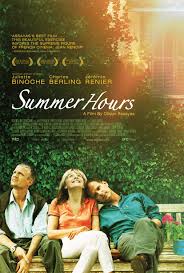
The 2008 film Summer Hours is all about legacy. It captures the lives of three siblings around the death of their mother, Helene, who was the keeper not only of their childhoods and the objects associated with it, but also of the memory of her uncle, a well-known painter. Frederic, the eldest son and only sibling still living in France, wants to preserve the house, its objects, and its artworks for continued use and pass it along to the next generation. Adrienne lives in the U.S. and Jeremie in China, they wish to sell everything as they are unlikely to use the house, having more use for its profits. The film explores the challenges inherent in passing things along to future generations. When 75-year-old Helene wants to speak to Frederic about what will fall to his care after her passing, he finds it too difficult to discuss her death. When Frederic, in turn, speaks to his teenage children about the art in the house, they try to admire it, but are really more interested in their music and their friends. Writer and director Olivier Assayas has an admirably light touch. He has the confidence to write good scenes, get people to come together and really do what his scripts say they do, and to let his camera simply observe them. I make that sound easy but it's not. That is the work of the filmmaker. Friend Sheila and I were talking about just this the other night. The medium of film is not celluloid - although that might be the chemical substance its sounds and images are recorded on. Its not even the camera, although without knowing to use lenses and cameras one could not make a film. It is people. The children play a game during the film's opening and they are obviously children playing with an interest in winning a game - not posing for the camera. It takes talent to show people being people. Actors can be very interested in themselves. They admire their own faces and their hard won talents. Assayas has cast beautifully Juliette Binoche, Charles Berling, and Jeremie Renier know what it means to inhabit a character whose life is full of details you never actually get to show, but which must precede their behavior in the story if it is to make sense. In Summer Hours- the characters act, not meaning demonstrate, meaning they do things. They meet, they mourn, they eat meals together, they make decisions - and the camera observes. They don't force themselves on the viewer. They do their jobs and if you are interested you may do your's.

Assays's mise en scene is smart. His camera celebrates the warmth, the lush and somewhat worn beauty of the house in the final summer that it is filled with its contents and people. After the death of Helene, he and his cameras walk through as the art and furniture are appraised for their value, now the house possesses the same contents, but the light is cooler, grayer. Epicures eye the Corot and the Hoffmann armoire over their expensive glasses. The stoves must be lit for warmth. The long-time caretaker of the house peers in the windows of her old home. In the film's closing scenes, we see the house's contents lodged in the Musee D'Orsay as a tour guide lectures her group on the history of desk we have come to associate with Helene's home. It is summer again. The nearly abandoned house is filled with Helen's grandchildren who party in its now raw, unfurnished rooms and its unkempt garden, blasting french rap and getting stoned. The place is obsolete - or is it? Assayas is smart enough not to decide for us. Time marches on but French law allows one to donate art to museums in exchange for a break on inheritance tax. The art may no longer reside in the home of the family whose ancestors acquired it, however one could say that many more members of future generations get to enjoy it. Is the vase by a great sculptor most valuable as a highly protected and revered possession of a museum or as the container of flowers in a home where it might at any moment be knocked to the floor by children playing? These are the questions one is left turning softly over in one's mind as the film ends. I learned on the DVD extras that to celebrate its 20th anniversary, the Musee D'Orsay, rather than making a straight, PBS-style documentary about their collection, commissioned films by real filmmakers to celebrate their birthday. Summer Hours, Assayas's contribution, is a thoughtful, tender, and quiet gem.

Saturday, August 28, 2010

The presence of the artist in the art - developing talent versus promoting it (Exhibits - Matisse: Radical Invention & Film - A Single Man)


I just stared and stared at this painting at the stunning show currently on at MoMa - Matisse: Radical Invention, 1913-1917. Exploring its pleasures intertwined with the experience of the film I watched two night ago - A Single Man - to reveal to me something essential about my aesthetic taste. I like it when the act of creation shows (by design) in the work of art. Perhaps that is just because I made art myself for such a long time and because creative process is an obsession of mine. Perhaps the relationship goes the other way round - maybe I became obsessed with process because I have always been drawn to this kind of work. Whatever the case, this was very much evident in Matisse's work of this period. As he developed these paintings he adjusted the placement of figures as well as their form, he obscured details that he had earlier spent much effort in representing, and what's radical is that he leaves evidence of these changes rather than covering them up. It is a practice which creates a conversation between the subject of the art and the mode of its making, something I find interesting as well as inspiring. It is also a way for the artist to develop their talents, as awareness of technique progresses in parallel with the making of art, not separately from it. The simultaneous dialogue of the two is the artists' daily reality. That doesn't necessarily mean that it will always produce satisfying art, nor does it necessarily mean that this dialogue will be of interest to every member of the audience, but it is of great interest to me.

Matisse: Radical Invention is thoughtfully curated - it has a narrow thematic focus and therefore it is not too big (a pet peeve of mine with museum shows), it brings together different works of Matisse, not just the greatest hits, it creates a thoughtful narrative in tracing its theme of interest - a period of creative transformation in Matisse's art - seen against the backdrop of cubism in the art world and World War I in the world-at-large.

This experience was very much in contrast to that of watching A Single Man, photographer Tom Ford's feature film debut as both writer and director, adapted from the novel by Christopher Isherwood. I had heard a few interviews with Ford and his lead actor Colin Firth on the radio and was hoping for something better. The story concerns the last day in the life of a gay college professor in the 1960s who decides to commit suicide because of the sudden and devastating death of his partner of 16 years, and the unusual perspective that gives him on the things commonly around him in his daily life.

Ford, a visual artist, seems to have been captured by the notion of a unique perspective on the ordinary and perhaps felt his vision would express the lead character's heightened experience of the day. This was the film's defining feature, but the lack of access to other techniques was also its downfall. Every person in the film was beautiful - ridiculously so. Nicholas Hoult as the young student who becomes obsessed with his professor, was an expensive haircut draped in a pink mohair sweater that was glowed like cotton candy against his California tan. In fact, desserts are a good metaphor for the little visions of sweetness that Ford made of everyone George encountered, but there was no meal to accompany them. One could call this the heightened reality called for by the story, but I experienced it creating only an icy remove that destroyed any emotional impact this film could have had, despite Firth's intelligence, deep investment, and subtle portrayal. While this aspect of George's experience is important, it seems to me one should also be moved and this film's attempt at visual perfection held everything at arm's length.

One choice I particularly appreciated in this film was the lack of attention called to the sexuality of the lead character. Although his relationship was with another man and created interesting conflicts in the relationship between him and Charley (the female friend played by Julianne Moore), Colin Firth simply played George's circumstances and character qualities but did nothing to telegraph his gayness. He was middle aged, fastidious if a bit controlling, and was masculine. No limp wrist, no lisp. Thank you, Colin. Together the two of them captured that wonderful kind of friendship possible between a straight woman and a gay man that is full of intimacy but not sex and can be sustaining but can sometimes tip over into frustration for the woman if it is her primary intimate relationship, she is attracted to the man, and it cannot be consummated.

The actors were on their own (that or Ford could express his insight into the lead character but no other). The result was a beautiful performance from Firth but Julianne Moore's performance suffered for it. I find Moore a glimmering but delicate talent. Capable of flights of transparent vulnerability, she also reads to me across her body of work as wildly insecure. When she collaborates with a good director it is a joy to watch her. Here, while she communicated some of Charley's desperation to the screen it was too decorous. Her character is at the point where she can no longer control herself yet Moore's performance reeked of the kind of control exercised by an actor who is afraid to be unattractive. This coupled with Ford's own repressive control, motivated by his strictly visual talents, did not allow Charley the rawness a director like John Cassavetes and actress like Gena Rowlands might have brought to this part and this story. That, in my estimation, is what this film lacked. I wanted to feel the artistry, as with Matisse's painting, but not the artiness. I wanted to see the actor and film maker work together to make this story. I wanted to witness the beauty of the little accidents of human behavior, see her eye makeup smudge, see her nose run a little, not look at a Calvin Klein perfume advertisement. The limits of Ford's filmmaking were also evident in his use of music. With two composers, a music advisor, and a music consultant listed in the credits I felt as though too many cooks may have spoilt the sound track. The result was a hodgepodge of unspecific but superficially arty choices. I thought the choice of the aria "Ebben? Ne andro lontana" from the opera La Wally a particularly misguided choice, so associated is it with another high style film (and one I happen to love) - Diva. Similarly self-conscious choices visual choices also clouded the integrity of this film. The slow-motion sequences of waving children seen from a moving vehicle seemed to be straight out of Blue Velvet.

The 'making of' extra provided on the DVD was particularly embarrassing - self-aggrandizing and affected, with Ford's narrative scripted to death, interviews with each of the actors edited down to nothing but glib praises of Ford's filmmaking talents. Me thought the ladies did protest too much. It read like an advertisement - over controlled and pretentious - exactly the same problems as with the film itself. There is a difference between leaving elements of the creative process present in the work so it becomes a discussion between the artistic content and the art-making, and using the work of art to showcase one's talents at the expense of the content. Ford doesn't yet have the talent to recognize the difference.

Sunday, April 4, 2010

Glorious New York update, gallery hopping, book hopping, book shopping, collapsing in a heap...

What a glorious New York day I had yesterday! Had brunch with a friend in from L.A. Then met The Ragazzo and we walked the Highline (left), an innovative urban landscape made from a disused elevated structure used for unloading freight train cars in the 1930s, with native plantings, viewing areas of New York streets, places to sit and enjoy a picnic or a read. On your next trip to NYC, be sure to walk it.

Departing the Highline in the West 20s, we went gallery hopping - there are a couple of hundred galleries in the Chelsea neighborhood. Highlights were a Patrick Pietropoli show at Axelle Galerie, he paints wonderful Canaletto influenced contemporary cityscapes, as well as a group show at Gallery Henoch. I particularly enjoyed the work of Richard Combes (left) and Steve Smulka (below).


It was but a short walk to Three Lives Bookstore - my favorite. And then we dropped exhaustedly into two seats at Cafe Loup, for a cozy dinner and home to read and rest my weary feet.

I'm working on a pile of books right now and spent time last night with three of them. Antony Beevor is known for bringing World War II history to vivid life through his writing. The Fall of Berlin 1945 is a fascinating subject, but I find I just cannot get my head around history when it involves endlessly moving battalions around. I don't know if I'm going to make it through this one, although I don't think its any fault of Mr. Beevor's. I suppose some people probably feel the same way reading about the brain.

Thomas Mann's The Magic Mountain continues to amuse. Hans Castorp is thoroughly ensconced in the Davos sanitorium, having been upgraded from visitor to patient. In the days before antibiotics, tuberculosis treatment consisted of rest, food, and fresh air (and usually eventually dying of the disease). Think lying about in blankets, a few x-rays, frustrated romance, and much philosophizing.

I received an ARC of Howard Norman's new novel What is Left the Daughter, due out this summer. I am making slow progress through what amounts to a literary legacy written as a long letter from father to daughter that is intended to lay bare long kept secrets. The form of address is personal yet the writing of the events is distant. I'm finding the disconnect is leaving me feeling uninvested, but I will read on.

I'm looking forward to a few new treasures. Sarah's Key by Tatiana de Rosnay is a novel set in Nazi occupied Paris and, judging from the rapt reading of the woman across from me on the subway the other day, is an enveloping read. The Master and His Emissary: The Divided Brain and the Making of the Western World by Iain McGilchrist sees Western culture as having evolved the way it has due to the assymetrically divided human brain. When in doubt, just chalk everything up to the "split brain." This looks to either be a fascinating and original take on history or the kind of book that will make me want to scream. Obviously I am hoping it will be the latter. I'm also looking forward to Richard Bausch's new collection of stories: Something is Out There. I read bits of them one day in a bookstore and was hooked instantaneously.

And how was your weekend?

Sunday, June 28, 2009

Art and artists of a summer's day... (Art - James Ensor at MOMA & Books - Beautiful Shadow, The Children's Book, and The Snow Geese)

A variety of activities at Bookeywookey central this weekend which all began with seeing the James Ensor show at MOMA. Who? I didn't know his name either. Ensor was a mid-nineteenth to mid-twentieth century Belgian painter. His worked spanned styles from the impressionism of his early contemporaries to the expressionism of his later ones, and spanned subject matter from domestic portraits with a stunning sense of light to Belgian carnival masks, to satire of both religious and contemporary artistic iconography. Great show and it's just opening in case you're around NYC this summer.

Got a chance to dip back into Andrew Wilson's very thorough, though longish biography of Patricia Highsmith - Beautiful Shadow. In it I learned of her novel The Tremor of Forgery, thought by many to be her best and most serious work. I am going to have to see if it's available at the library. I was struck by this quote from the character of Derwatt, the artist who is the subject of Highsmith's second Ripley novel, Ripley Under Ground.
There is no depression for the artist except that caused by a return to the Self.
That certainly sounds as thought it were true for Highsmith. The other posts on this biography are here: 1, 2, 3.

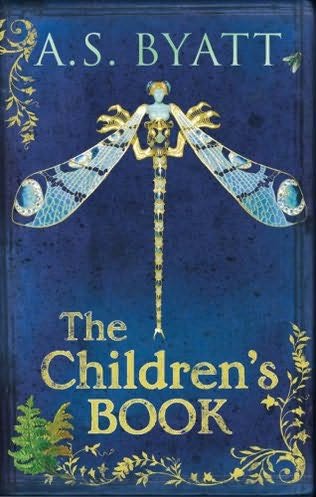
I have also made a dent in A. S. Byatt's latest novel The Children's Book, though it's only about 150 pages. It is plain to the eye what her subject matter consists of, but I'm not sure what it all adds up to yet. There is a well-to-do family and their friends, who relate to the world in a more conventional fashion, and there are also a bunch of artistic folks, most of whom seem to be Fabians, who are involved in issues of social justice and free love. The piece is set prior to World War I and seems to pit forces of convention against forces of chaos in all sorts of complicated ways. The cast of characters is broad and the saga is long. So far let's say I feel admiring of Byatt's beautiful prose but rarely propelled by the action. There are several artists among the characters - a pupetteer, a potter, and a writers of children's stories. Byatt is certainly more at home writing about writing than she is writing about artistry of a more viceral nature - like throwing pottery. The writing on the puppet show, however, is lovely:
An illusion is a complicated thing, and an audience is a complicated creature. Both need to be brought from flyaway parts to a smooth, composite whole. The world inside the box, a world made of silk, satin, china mouldings, wires, hinges, painted backcloths, moving lights and musical notes, must come alive with its own lawas of movement, its own rules of story. And the watchers, wide-eyed and greedy, distracted and supercilious, preoccupied, uncomfortable, tense, must beomce one, as a shoal of fishes with huge eyes and flickering fins becomes one, wheeling this way and that in response to messages of hunger, fear or delight. August's flute was heard, and some were ready to listen and some were not. The curtains opened on a child's bedroom. He sat against his pillows. His nurse, in comfortable grey, bustled about him, and her shadow loomed over him on the white wall...

Her writing really can cast a spell. I'm suspicious that the art-making will become a more far-reaching metaphor but I'm not sure how yet.

Finally, having enjoyed William Fiennes memoir The Music Room so much, I tracked down his first book The Snow Geese while in England. Also a memoir of sorts, or perhaps it would be more accurate to say that it is non-fiction, but Fiennes story is not merely of his subject, the geese, but of his discovery of them, his following their migratory pattern, and the effect of that journey on him. While at school, Fiennes falls ill with some illness that demands a lengthy recovery. During that time, he learns of the snow geese and read's Paul Gallico's story The Snow Goose and is moved to pursue them in their natural habitat from Southern Texas to Baffin Island in Hudson Bay. He travels to Texas and awaits his first glimpse:
The first sign was a faint tinkling in the distance, from no particular direction, the sound of a marina, of halliards glicking on metal masts. Drifs of specks appeared above the horizon ring. Each speck became a goose. Flocks were converging on the pond from every compass point, a diaspora in reverse, snow geese flying in loose Vs and Ws and long skeins that wavered like seaweek strands, each bird intent on the roost at the centre of the horizon's circumference. Lines of geese broke up and then recombined in freehand ideograms, kites, chevrons, harpoons. I didn't move. I just kept watching the geese, the halliard yammer growing louder and louder, until suddenly flocks were flying overhead, low over the shoulder, the now geese yapping like small dogs, crews of terriers or dachshunds - urgent sharp yaps in the thrum and riffle of beating winges and the pitter-patter of goose droppings pelting down around me. They approached the roost on shallow glides, arching their wings and holding them steady, or flew until they were right above the pond and then tumbled straight down on the perpendicular. Sometimes whole flocks circled over the roost, thousands of geese swirling round and round, as if the pond were the mouth of a drain and these geese the whirlpool turning above it. Nothing had prepared me for the sound, this dense, boisterous din, the clamour of a playground at breaktime, a drone-thickness flecked with high-pitched yells, squels, hollers and yamps - the entire prairies's quota of noise concentrated in Jack's holding pond by the two-storey house and the raised lake stocked with bass for fishing...

There is a lyricism as well as a straightforwardness to Fiennes's writing that I find evocative and moving, especially given that I was never aware of being interested in geese, indeed in birds of any kind.