The life that produces writing can't be written about. It is a life carried on without the knowledge even of the writer, below the mind's business and noise, in deep unlit shafts where phantom messengers struggle toward us, killing one another along the way; and when a few survivors break through to our attention they are received as blandly as waiters bringing more coffee.After the retrospective events there is an epilogue which, unfortunately, I found much less interesting than the body of the story. It was as if there was a whole other story to tell, and yet it is relegated to an afterthought to this one. I was left dissatisfied by this epilogue despite the fact that its relationship to the events of the story-proper is crucial. That fact notwithstanding, this is a passionate book about the value of writing and is told in a way that gives one the feeling that it must be true. I still recommend it strongly.
Sunday, November 2, 2008
Not writing about the writing life (Books - Old School by Tobias Wolff)
Saturday, November 1, 2008
Ventriloquism, fractals, and the dying gasps of Camelot (Books - Old School by Tobias Wolff)
If the school had a snobbery it would confess to, this was its pride in being a literary place...Dean Makepiece had been a friend of Hemmingway's during World War I and was said to have served as the model for Jake's fishing buddy Bill in The Sun Also Rises. The other English masters carried themselves as if they too were intimates of Hemmingway, and also of Shakespeare and Hawthorne and Donne. These men seemed to us a kind of chivalric order. Even boys without bookish hopes aped their careless style of dress and the ritual swordplay of their speech. And at the headmaster's monthly teas I was struck by the way other masters floated at the fringe of their circle, as if warming themselves at a fire.
How did they command such deference - English teachers? Compared to the men who taught physics or biology, what did they really know of the world? It seemed to me, and not only to me, that they knew exactly what was most worth knowing. Unlike our math and science teachers, who modestly stuck to their subjects, they tended to be polymaths. Adept as they were at dissection, they would never leave a poem or a novel strewn about in pieces like some butchered frog reeking of formaldehyde. They'd stitch it back together with history and psychology, philosophy, religion, and even, on occassion, science. Without pandering to yoru presumed desire to identify with the hero of a story, they made you feel that what mattered to the writer had consequence for you, too.
With his preferences clearly stated, Wolff has set the stage for not only a story about the forming of young souls, but also for some enjoyable literary ventriloquism - first in the writing of the young contestants and later in the spoken words of the visitng writers, all actual literary giants - Robert Frost, Ayn Rand, and, although I haven't gotten to that part yet, Ernest Hemmingway.
Here he writes as Bill White, the narrator's roommate - a Jewish student trying to pass for gentile - and his competition for meeting poet Robert Frost. White has already written most of a novel:
Have to take my hat off to you, said Montague. Tricky bit of tradecraft, given the circumstances. Storm blowing the damned tent down, and the geaters into the liquor. I shan't forget it.
Not al all, not at all, said Dr. Coates. The merest intern could have done as well - probably better.
I shan't forget it, Montague repeated. I'm forever in your debt, he added coldly.
Aren't we all, said Ashley, pouring herself another scotch. She stared at the falling snow. Whatever would we do withouth the good doctor's services?
You bitch, said Montague. You perfectly beautiful bitch.
As our narrator observes
... Bill was a contender. His characters were stiled but he had confidence and his storeis were eventful and closely detailed... Bill's talent was particularity. How the snow creaked underfoot on a very cold clear day, or what the low white sun looked like though a tangle of black branches. The tackiness of a just-oiled rifle stock, the tearing sound of a bored woman brushing out her long hair in front of a fire. Everything in his work was particular and true except the people.
Wolff gets obvious pleasure in this novel from role playing as different sorts of writers in this book, and then discussing everything from the mechanics to the value of such writing. But better than that, he wholly integrates those discussions into the larger intention of the book, which (at this point) seems to be a discussion of the value of literature in general and the coming-of-age of young literary minds and spirits in a changing world.
In a particularly enjoyable section of the novel, the winner of the Robert Frost competition is a surprise, having written a slavish immitation of their guest and entitled it First Frost. In it, a farmer contemplates death as au tumn approaches. While the students closest to the young poet know the poem to be a naive aping, Frost interprets it as a roguish take-off on himself. This perpetuates a discussion between two of them as to whether the meaning of a piece of writing is contained in the writer's intentions or the reader's interpretation:
George's poem isn't that bad, I said, if you read it a certain way.
As a take-off, you mean.
Right, as a take-off.
But it isn't a take-off.
It could be. That's how Frost read it.
But it isn't. And you know that.
It doesn't matter what I know.
Bullshit.
It doesn't. Let's say you find a bottle. You're walking on the beach and you find George's poem in a bottle. You don't know anything about the person who wrote it, you just have the poem. You'd probably read it as a take-off.
Frost's visit occassions the asking of a provocative question by one faculty member as to:
...whether such a rigidly formal arrangement of language is adequate to express the modern consciousness. That is, should form give way to more spontaneous modes of expression, event at the cost of a certain disorder?If I may butt in here. First, the question itself, is full of such wonderful assumptions - many of us would have our own, perhaps somewhat different list 48 years later, and would have as many questions about how the tension between form and content would address the issues on our mind today. On the one hand Frost's answer is beautiful, an ode to form, but one might say it is a defensive ode. That Frost, the old poet, was a man of yesteryear in the year that JFK took the office of president (even though he spoke at the innauguration) and that the work of Ginsburg or Kenneth Koch or Frank O'Hara were not free of form, nor was there an absence of thought given to the relationship between sound and meaning. But Frost could not see this new form as form, so different was it from what he was used to. It's like the structures observed in nature which we initially could only see as chaotic, but which higher mathematics now describes as a recursive pattern it has called a fractal. And this speaks to the even larger picture Wolff is painting not just of form and content in literature, but in our lives. He was writing in an age when the superiority of the prep school and Harvard, the good ol' boy network, segregation, rituals of debutante balls - familiar forms - were having to give way to new forms. And this struggle isn't over yet.
Modern consciousness, Frost said. What's that?
Ah! Good question, sir. Well - very roughly speaking, I would describe it as the mind's response to industrialization, the saturation propaganda of governments and advertisers, two world wars, the concentration camps, the dimming of faith by science, and of course the constant threat of nuclear anihilation. surely these things have had an effect on us. Surely they have changed our thinking.
Surely nothing. Frost stared down at Mr. Ramsey.
If this had been the Last Judgment, Mr. Ramsey and his modern consciousness would've been in for a hot time of it. He couldn't have looked more alone, standing there.
Don't tell me about science, Frost said. I'm something of a scientist myself. Bet you didn't know that. Botany. You boys know what tropism is, it's what makes a plant grow toward the light. You don't have to chase down a fly to get rid of it - you just darken the room, leave a crack of light in a window, and out he goes. Works every time. We all have that instinct, that aspiration. Science can't - what was your word? dim? science can't dim that. All science can do is turn out the false lights so the true light can get us home.
Mr. Ramsey began to say something, but Frost kep t going.
So don't tell me about science, and don't tell me about war. I lost my nearest friend in the one they call the Great War. So did Achilles lose his friend in war, and Homer did no injustice to his grief by writing about it in dactylic hexameters. There've always been wars, and they've always been as foul as we could make them. It is very fine and pleasant to think ourselves the most put upon folk in history - but then everyone has thought that from the beginning. It makes a grand excuse for all manner of laziness.
But about my friend. I wrote a poem for him. I still write poems for him. Would you honor your own friend by putting words down anyhow, just as they come to you - with no thought for the sound they make, the meaning of their sound, the sound of their meaning? Would that give a true account of the loss?
Frost had been looking right at Mr. Ramsey as he spoke. Now he broke off and let him eyes roam over the room.
I am thinking of Achilles' grief, he said. That famous, terrible, frief. Let me tell you boys something. Such grief can only be told in form. Maybe it only really exists in form. Form is everything. Without it you've got nothing but a stubbed-toe cry - sincere, maybe, for what that's worth, but with no depth or carry. No echo. You may have a grievance but you do not have grief and grievances are for petitions, not poetry.
I really admire how the smaller discussion of writing and its value, and the amusement of the way Wolff asumes the characters of Frost and, later, Ayn Rand, combine with the larger mission of observing a changing world - hearing the dying gasps of Camelot. I have a bit further to go, but I am finding the marriage of the writing and the observations on an individual character and a societal level really satisfying. I have a full day of school work before me, but I hope to finish Old School before the weekend is out.
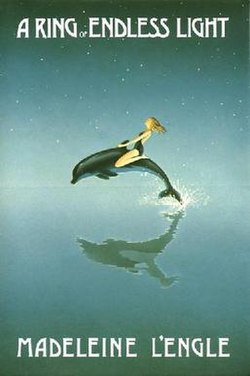
The road to hell... (Books - A Ring of Endless Light by Madeleine L'Engle)
If we knew each morning that there was going to be another morning, and on and on and on, we'd tend not to notice the sunrise, or hear the birds...... and, evidently, endless cliches. I never knew there were so many. I grant that this book is paved with good intentions as well, but too many of them packed for public display side by side for my taste. A little character development might have been nice. We know 'Grandfather' is dying and that he is good as good can be, but who the hell is he? And what does he do all day besides sit around trying to leave no cliche unspoken to his grandkids? If you are actually going to offer wisdom, it might help to have an in-depth discussion rather than skim the surface with bon mots. The Austin family, for all its supposed goodness, does very little in the way of talking about other people that is not about passing judgment on whether they are living in ways that are up to the Austin's expectations of what is good or what is right. Can't do it - sorry, Sheila. I'm sure Sheila probably has a very different take on this book, for anyone who is interested in a more positive take on it.
I like the old adage that we should live each day as though were going to live forever, and as though we were going to die to morrow.
Zachary doesn't have much joy. But neither do - did his parents. All that money - and they used it to spoil him rotten, not to love him. Poor little rich boy, eh?
I think we're given strength for what we have to carry. What I question is whether or not this burden is meant for you.
I do know that we're not good, and there's a lot of truth to the saying that the road to hell is paved with good intentions.
Friday, October 31, 2008
Nevermore! (Edgar Allen Poe's The Raven)
This post was a hit last Halloween, so I thought I would re-run it. A classic by the original American horror writer, Edgar Allen Poe. You can read The Raven below or listen to Garrison Keillor read it, in fact, listen to his whole Halloween show, or watch the Vincent Price video at the bottom of the Wikipedia link, or the Simpson's episode. Anyway you get your dose, it's great fun. This is the original version with the original spelling.
Once upon a midnight dreary, while I pondered, weak and weary,
Over many a quaint and curious volume of forgotten lore,
While I nodded, nearly napping, suddenly there came a tapping,
As of some one gently rapping, rapping at my chamber door.
"'Tis some visiter," I muttered, "tapping at my chamber door --
Only this, and nothing more."
Ah, distinctly I remember it was in the bleak December,
And each separate dying ember wrought its ghost upon the floor.
Eagerly I wished the morrow; -- vainly I had tried to borrow
From my books surcease of sorrow -- sorrow for the lost Lenore --
For the rare and radiant maiden whom the angels name Lenore --
Nameless here for evermore.
And the silken sad uncertain rustling of each purple curtain
Thrilled me -- filled me with fantastic terrors never felt before;
So that now, to still the beating of my heart, I stood repeating
"'Tis some visiter entreating entrance at my chamber door --
Some late visiter entreating entrance at my chamber door; --
This it is, and nothing more."
Presently my soul grew stronger; hesitating then no longer,
"Sir," said I, "or Madam, truly your forgiveness I implore;
But the fact is I was napping, and so gently you came rapping,
And so faintly you came tapping, tapping at my chamber door,
That I scarce was sure I heard you " -- here I opened wide the door; ----
Darkness there and nothing more.
Deep into that darkness peering, long I stood there wondering, fearing,
Doubting, dreaming dreams no mortal ever dared to dream before;
But the silence was unbroken, and the darkness gave no token,
And the only word there spoken was the whispered word, "Lenore!"
This I whispered, and an echo murmured back the word, "Lenore!" --
Merely this, and nothing more.
Then into the chamber turning, all my soul within me burning,
Soon I heard again a tapping somewhat louder than before.
"Surely," said I, "surely that is something at my window lattice;
Let me see, then, what thereat is, and this mystery explore --
Let my heart be still a moment and this mystery explore;--
'Tis the wind and nothing more!"
Open here I flung the shutter, when, with many a flirt and flutter,
In there stepped a stately raven of the saintly days of yore;
Not the least obeisance made he; not an instant stopped or stayed he;
But, with mien of lord or lady, perched above my chamber door --
Perched upon a bust of Pallas just above my chamber door --
Perched, and sat, and nothing more.
Then this ebony bird beguiling my sad fancy into smiling,
By the grave and stern decorum of the countenance it wore,
"Though thy crest be shorn and shaven, thou," I said, "art sure no craven,
Ghastly grim and ancient raven wandering from the Nightly shore --
Tell me what thy lordly name is on the Night's Plutonian shore!"
Quoth the raven "Nevermore."
Much I marvelled this ungainly fowl to hear discourse so plainly,
Though its answer little meaning -- little relevancy bore;
For we cannot help agreeing that no sublunary being
Ever yet was blessed with seeing bird above his chamber door --
Bird or beast upon the sculptured bust above his chamber door,
With such name as "Nevermore."
But the raven, sitting lonely on the placid bust, spoke only
That one word, as if his soul in that one word he did outpour.
Nothing further then he uttered -- not a feather then he fluttered --
Till I scarcely more than muttered "Other friends have flown before --
On the morrow he will leave me, as my hopes have flown before."
Quoth the raven "Nevermore."
Wondering at the stillness broken by reply so aptly spoken,
"Doubtless," said I, "what it utters is its only stock and store
Caught from some unhappy master whom unmerciful Disaster
Followed fast and followed faster so when Hope he would adjure --
Stern Despair returned, instead of the sweet Hope he dared adjure --
That sad answer, "Never -- nevermore."
But the raven still beguiling all my sad soul into smiling,
Straight I wheeled a cushioned seat in front of bird, and bust and door;
Then, upon the velvet sinking, I betook myself to linking
Fancy unto fancy, thinking what this ominous bird of yore --
What this grim, ungainly, ghastly, gaunt and ominous bird of yore
Meant in croaking "Nevermore."
This I sat engaged in guessing, but no syllable expressing
To the fowl whose fiery eyes now burned into my bosom's core;
This and more I sat divining, with my head at ease reclining
On the cushion's velvet lining that the lamp-light gloated o'er,
But whose velvet violet lining with the lamp-light gloating o'er,
She shall press, ah, nevermore!
Then, methought, the air grew denser, perfumed from an unseen censer
Swung by Angels whose faint foot-falls tinkled on the tufted floor.
"Wretch," I cried, "thy God hath lent thee -- by these angels he hath sent thee
Respite -- respite and nepenthe, from thy memories of Lenore;
Let me quaff this kind nepenthe and forget this lost Lenore!"
Quoth the raven "Nevermore."
"Prophet!" said I, "thing of evil! -- prophet still, if bird or devil! --
Whether Tempter sent, or whether tempest tossed thee here ashore,
Desolate yet all undaunted, on this desert land enchanted --
On this home by Horror haunted -- tell me truly, I implore --
Is there -- is there balm in Gilead? -- tell me -- tell me, I implore!"
Quoth the raven "Nevermore."
"Prophet!" said I, "thing of evil -- prophet still, if bird or devil!
By that Heaven that bends above us -- by that God we both adore --
Tell this soul with sorrow laden if, within the distant Aidenn,
It shall clasp a sainted maiden whom the angels name Lenore --
Clasp a rare and radiant maiden whom the angels name Lenore."
Quoth the raven "Nevermore."
"Be that word our sign in parting, bird or fiend!" I shrieked, upstarting --
"Get thee back into the tempest and the Night's Plutonian shore!
Leave no black plume as a token of that lie thy soul hath spoken!
Leave my loneliness unbroken! -- quit the bust above my door!
Take thy beak from out my heart, and take thy form from off my door!"
Quoth the raven "Nevermore."
And the raven, never flitting, still is sitting, still is sitting
On the pallid bust of Pallas just above my chamber door;
And his eyes have all the seeming of a demon that is dreaming,
And the lamp-light o'er him streaming throws his shadow on the floor;
And my soul from out that shadow that lies floating on the floor
Shall be lifted -- nevermore!
Happy Halloween.
Wednesday, October 29, 2008
On Delaying gratification (Books - A Ring of Endless Light by Madeleine L'Engle & Old School by Tobias Woolf)
Robert Frost made his visit in November of 1960, just a week after the general election. It tells you something about our school that the prospect of his arrival cooked up more interest than the contest between Nixon and Kennedy, which for most of us was no contest at all. Nixon was a straight arrow and a scold. If he'd been one of us we would have glued his shoes to the floor. Kennedy, thought - here was a warrior, an ironist, terse and unhysterical. He had his clothes under control. His wife was a fox. And he read and wrote books, one of which, Why England Slept, was required reading in my honors history seminar. We recognized Kennedy; we could still see in him the boy who would have been a favorite here, roguish and literate, with that almost formal insouciance that both enacted and discounted the fact of his class.
If I didn't know the setting of Tobias Wolff's Old School was a boarding school, I would still have pegged the narrator for an adolescent male and I still would have been hot to read it for its diction, and a tone that seems elegiac for a time gone by. So, why then am I reading A Ring of Light one of Madeleine L'Engle's Austin Family Chronicles series? Especially with all of her religiosity hanging out all over the place? Well, I swore I would read another of L'Engle's books since Sheila (who has a great post on Diner today, one of my favorite movies) enjoys her so much. She is very imaginative. It moves very quickly. I read twenty-five pages last night in under fifteen minutes. And the introduction, written by L'Engle's granddaughters has this to say:
All of Madeliein's writing, fiction and nonfiction, was an example of how all narrative is fiction, and all fiction can be true. She wrote and lectured extensively on the difference between truth and fact, arguing that it is through story that we human beings approach the truth, not through facts; which can only get us so far. As her granddaughters, this was both liberating and confusing...I am crazy about narrative and its function and so was taken with the introduction. I almost even agree with it, except to say that I think that we human beings approach not truth itself, but rather the feeling of truth, and that that is an important distinction. But as I weighed these two books in my hands last night, reading a page here and a page there, there is nothing particularly impressive about her writerly skills displayed in the early pages of this book, but her writing has a warmth and she renders the messiness of being in a family with verissimilitude. I also had a feeling that I would really like Old School, so I delayed reading it so that I can look forward to it. Is that daft or do you know what I mean?
Tuesday, October 28, 2008
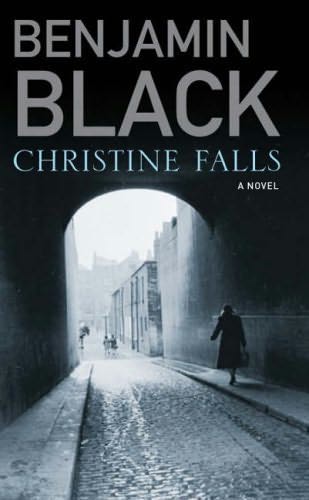
Lilting, melodic anti-mystery (Books - Christine Falls by Benjamin Black aka John Banville)
He was angry again, he was not sure why, exactly, for what he had learned from Sister Anselm had not been news to him, not really. He had begun to consider the possibility that this unfocused anger would be the condition of his life from now on, that he would have to keep bouncing along before it helplessly forever, like a piece of litter buffeted by an unceasing wind.A detective who is not really a detective, who investigates a crime, or possibly just an accident, that resulted from a wrong-doing he suspects his brother to have committed, but that man is not really his brother. I enjoyed the fact that somehow, even in this anti-mystery, the final scenes are set at a manor house with all the suspects present, but there is no denouement scene, with the detective gathering everyone in the drawing room. Rather, they gather without him as he watches from the distance.
He watched them gathering, and followed them into the drawing rom, where the funeral meats were set out, and as he listened to the hubbub of their mingled and clashing voices, a sense almost of physical revulsion welled up in him. These were the people who had killed Christine Falls and her child, who had sent the torturers after Doly Moran, who had ordered that he be thrown down those slimed steps and kicked and beaten to within an inch of his life. Oh, not all of them; no doubt there were those among them who were innocent, innocent of these particular crimes, at least. And he, how innocent was he? What right did he have to stand upon a height and look down on them, he who had not even found the courage to...Here the real conundrum is moral ambiguity and the fact that this anti-detective is in some way connected to all the dirty business involving pregnant Catholic women and their babies. In this anti-mystery, the story is all caught up not in events but in character, and Quirke, our anti-detective is, like many John Banville characters, a ruminative man. The mystery is an interesting one, sure, but not so interesting as its affect on Quirke. That is the meat of Black-Banville's book. That and the precise, sad, and melodic prose of a crack writer.
She told him, in that wispy voice she had developed lately, that sounded as if it was wearing out and would soon be just a sort of sighing, a sort of breathing, with no words.While a mystery is uncovered in this book, this writer takes the time to get what people look and sound like and what events mean just right. It also does not spoon-feed the reader, emblazoning explanations of who did what with ribbons and fanfare. We learn as Quirke learns - by implication, by accident. When we know who did it, the moment almost slips by - an anti-moment for an anti-mystery.
Great story - thanks Sheila. Here are my other thoughts on Christine Falls 1, 2, 3.
Sunday, October 26, 2008
Literary Criticism 101
The genius inheres in the precise observation, in the equally precise language, but above all in the illusion that the image has been received and processed in real time, when in truth Updike has slowed events to a dreamlike pace and given them a dream's hyperreality, so that the distinction between the actual and the imagined feels erased.
That is a hell of a sentence, and aspire I will.
Raw Theatre Prettied Up for Hollywood (Film - Dreamgirls)
Art Built on Character (Book - Christine Falls)
"Have there been any developments in the Dolly Moran case?" Quirke asked.
For a moment Hackett was silent and then began to laugh wheezily, his shoulders shaking. The tall, high-windowed housefronts seemed to peer down upon him in surprise and cold disapproval. "Ah, God, Mr. Quirke," he said with rich enjoyment, "you must go to the pictures an awful lot." He lifted his hand with the heel of the same hand wiped his brow and resettled the hat at a sharper angle. "Developments, now - let me see. We have a full set of fingerprints, of course, and a couple of locks of hair. Oh, and a cigarette butt - Balkan Sobrainie, I recognized the ash straightaway - and a lucky monkey's paw dropped by a person of Oriental origin, a lascar, most likely." He grinned, showing the tip of his tongue between his teeth. "No, Mr. Quirke, there have been no developments. Unless, of course, you'd call it a development that I've been directed to drop the investigation." Quirke stared at him and he tapped a finger to the side of his nose, still smiling. "Orders from on high," he said softly.A hilarious swipe at Sherlock Holmes, or any classic mystery. Benjamin Black's anti-genre intentions are also made plain by the form of the same excerpt. In a pop novel of a more expected ilk, we would a) know nothing about any peering housefronts and b) this scene would not be laid out as one paragraph, but as several. Each bit of dialogue on a separate line to move the eye along, as the only thing that usually develops in a conventional mystery is plot. But here character is developed while the plot moves forward and their integrity is communicated by that unbroken block of text. Their integrity is essential because the mystery here is not who did it, but why certain people are involved in these crimes. Bad things appear to have been done by relatively well intentioned people. Ah, but character is everything in this thoughtful mystery, because issues of morality are entirely driven by individual circumstances. Very few people don't know what's basically 'right,' but circumstances make them forget, or think they are the exception. This is where Black's writing shines.
Dolly Moran, done to death for the keeping of a diary; Christine Falls and Christine Falls's child, both lost and soon to be forgotten; all of them, all scorned by him, unvalued, ignored, betrayed even. And then there was Quirke himself, the Quirke he was taking grim measure of, Quirke dodging into Mcgonagle's of an afternoon to drink his whiskey and laugh at the memorials in the Mail - what right had he to laugh, how much better was he than the joxer scratching his balls over the racing pages or the drunken poet contemplating his failures in the bottom of a glass? He was like this leg, cocooned in the solid plaster of his indifference and selfishness. Again that face with the black-rimmed glasses and the stained teeth rose before him in the darkness of the window like a malign moon, the face, he realized, that would be with him always, the face of his nemesis.This sad contemplation displays such a lilting melody, and to use his own broken leg as a metaphor in this internal monologue is so... right. Another writer would chose a clever metaphor (actually, it's a simile) picked out of his own quiver, whereas here, the character chooses the simile from the force of his own circumstances. Ruing his own powerlessness, looking around him in this bar and seeing his own leg encased in something he cannot move, and snorting at it for its aptness. It is as if the writer is really an actor here.
Then, about fifty pages from the end, where I am now, Benjamin Black lobs a zinger into the plot. On the one hand, it really reeks a tad of melodrama, but I must admit I did not see it coming. Again I must be vague. But this development complicates the question of goodness and badness of certain behavior still further and really has me wanting to get to the end, to see how it all fits together. But I can't because I have so much school work to do today. That and a chamber music concert this evening.
Thursday, October 23, 2008
Literary Couples... and one threesome
Monica suggested this one:
Got this idea from Literary Feline during her recent contest:
“Name a favorite literary couple and tell me why they are a favorite. If you cannot choose just one, that is okay too. Name as many as you like–sometimes narrowing down a list can be extremely difficult and painful. Or maybe that’s just me.”
Wednesday, October 22, 2008
Morbid relfections (Books - Christine Falls by Benjamin Black)
It sometimes seemed to him that he favored dead bodies over living ones. Yes, he harbored a sort of admiration for cadavers, these wax-skinned, soft, suddenly ceased machines. They were perfected, in the their way, no matter how damaged or decayed, and fully as impressive as any ancient marble. He suspected, too, that he was becoming more and more like them, that he was even in some way becoming one of them. He would stare at his hands and they would seem to have the same texture, inert, malleable, porous, as the corpses that he worked on, as if something of their substance were seeping into him by slow but steady degrees. Yes, he was fascinated by the mute mysteriousness of the dead. Each corpse carried its unique secret - the precise cause of death - a secret that it was his task to uncover. For him, the spark of death was fully as vital as the spark of life.- Benjamin Black, I mean, John Banville, from Christine Falls
This paragraph makes me glad that a great writer (and a reflective mind) wanted to write mysteries.
Tuesday, October 21, 2008
The Tragedy of Insistence on Conformity (Books - Beneath the Wheel by Hermann Hesse)
Hans is not only an innocent, but a serious student, bearing the full weight of his teachers' and his father's expectations fully on his back. The most formative and beautiful experience Hans has at the academy is his friendship with Hermann Heilner.
With some astonishment Hans discovered how different all things looked to his friend than to him. Nothing was abstract for Heilner, nothing he could not have imagined and colored with his fantasy. Mathematics, as far as he was concerned, was a Sphinx charged with deceitful puzzles whose cold malicious gaze transfixed her victimes, and he gave the monster wide berth.Ultimately, however, the story is not a sweet, but a tragic one. Hans only has his eyes opened to a few new experiences, something one would hope for anyone preparing to move from childhood to adulthood. But these philosophical and physical stirrings make it hard for him to relate to any part of his life as he did before. His world becomes larger. The old rules no longer hold. And the adults in his midst are unable to show him ways he might continue to stay interested, other than simply to be obedient.
All these conscientious guides of youth - from the headmaster to Father Gibenrath, professors and tutors - regarded Hans as an impediment in their path, a recalcitrant and listless something which had to be compelled to move. No one, except perhpas Wiedrich, the sympathtic tutur, detected behind the slight noby's helpless smile the suffering of a drowning soul casting about desperately. Nor did it occur to any of them that a fragile creature had been reduced to this state by virtue of school and the barbaric ambition of his father and his grammar-school teacher.I wonder what Hesse would have thought of today's famously over-scheduled children, running from soccer, to play practise, to SAT prep course every afternoon of the week?
One of the lovliest sections of writing is occassioned by the greatest tragedy, the accidental death of a student named Hindinger, the son of a tailor from Allgau.
The teachers apparently regarded a dead student very differently from a living one. They realized for a fleeting moment how irrecoverable and unique is each life and youth, on whom they perpetrated so much thoughtless harm at other times...
Then came the burial. The coffin was given a place of honor in the dormitory and the tailor from Allgau stood beside it, watching everything that was being done. He was a tailor from head to toe; skinny and angular, he wore a black dresscoat with a greenish sheen to it, and narrow skimpy trousers. In his hand he held a shabby top hat. His small thin face looked grieved, sad and week, like a penny-candle in the wind; he was both embarrassed and overawed by the headmaster and the professors.
At the last moment, just before the pallbearers picked up the coffin, the sorry little man stepped forward once more and touched the coffin lid with timid tenderness. He remained there, helplessly fighting his tears, standing in the large quiet room like a withered tree in the winter - it was sorrowful to behold how lost and hopeless and at the mercy of the element he looked. The pastor took him by the hand and stayed at his side. The tailor put on his fantastically curved top hat and was the first to follow the coffin down the steps, across the cloister, through the old gate and across the white countryside toward the low churchyard wall. While singing hymns at the graveside the students annoyed the music-teacher by not watching his hand beating time. Instead they looked at the lonely, wind-blown figure of the little tailor who stood sad and freezing in the snow, listening with bowed head to the pastor's and headmaster's speeches, nodding to the students, and occasionally fishing with his left hand for a handekerchief in his coat without ever extracting it.
Beneath the Wheel is a swift moving, tragic yet passionate novel. I admire work that comes from strong feeling but nonetheless displays evidence of craft. I am glad that the German lit challenge floating around grabbed my will-o'-the-wisp attention so that I might re-read some Hesse. I think I might try a few more. In the meantime, here is my other post about Beneath the Wheel.
Monday, October 20, 2008
The duality of human nature (Books - Beneath the Wheel by Hermann Hesse)
...jobber and middleman, possessed no laudable or peculiar traits distinguishing him from his fellow townsmen. Like the majority, he was endowed with a sturdy and healthy body, a knack for business and an unabashed, heartfelt veneration of money; not to mention a small house and garden, a family plot in the cemetery, a more or less enlightened if threadbare attachment to the church, an appropriate respect for god and the authorities and blind submission to the inflexible laws of bourgeois respectability. Though no teetotaler, he never drank to excess; though engaged in more than one questionable deal, he never transgressed the limits of what was legally permitted. He despised those poorer than himself as have-nots and those wealthier as show-offs...
In every respect, his inner life was that of a Philistine. The 'sensitive' side of his personality had long since corroded and now consisted of little more than a traditional rough-and-ready 'family sense,' pride in his only son. and an occasional charitable impulse toward the poor...Enough of him. It would require a profound satirist to represent the shallowness and unconscious tragedy of this man's life. But he had a son, and there's more to be said about him.
Hans Giebenrath was, beyond doubt, a gifted child. One gathered as much simply by noting the subtle and unusual impression he made on his fellow students. Their Black Forest village was not in the habit of producing prodigies. So far it had not brought forth anyone whose vision and effect had transcended its narrow confines. Only god knows where this boy got his serious and intelligent look and his elegant movements. Had he inherited them from his mother?Hesse's chief obsession was the duality of human nature - the natural and impulsive along side the measured and ambitious - and his books waged a campaign for the value of cultivating the individual, creative, soulful side of ones nature. This book observes how the German educational system of the late nineteenth and early twentieth century, and indeed a whole way of life that might be termed 'traditional' crushed the life out of the individual spirit. The style of education at that time was predominantly classical. The basis of one's education was learning Latin and Greek, alongside German and some math. Seminary students also learned Hebrew. It's fascinating to me to read a fictionalized case for overthrowing tradition in a story that itself seems so representative of what is traditional, but that may be because half my family comes from Southern Germany. I really recognize this lyrical story-telling style, the romanticizing of childhood, the ways Hesse describes the natural world - they are very familiar to me. I am also re-reading this book, having read all of Hesse's book when I was in my teens and twenties. My reading then was partly about absorbing this part of my heritage at a time I was forming a sense of who I was. I really identified with my maternal grandparents, and a lot of the things that formed my intellectual and spiritual identity come from them. I tend to rebel against the predictability, the sureness of the bourgeois side of that culture, but a lot of this book feels like what I come from. Part of that impression might also be created by Michael Roloff's 1960s translation. I don't know if it is his style or Hesse's own that, even in talking about overturning tradition, reads as so quotidian and measured. I suppose one also might say that it reads as unambitious - getting out of the way of the story - and is, in that sense, fitting.
At the academy, Hans Giebenrath - the naive boy trying to live up to his Village's ambitions for him - meets Hermann Heilner a sensitive,rebellious and creative boy, and his sense of what life can be begins to open up. Hesse seems to offer these characters as externalizations of the two sides of human nature, at least that is the impression I am forming half-way into Beneath the Wheel. I see my own dualities - the creative and the scientific, the impulsive and the controlled - playing out before me in this novel.
Sunday, October 19, 2008
Whatever happened to...? (Books - Christine Falls by Benjamin Black aka John Banville)
Jude the Obscure
Middlemarch (in progress)
Among the Russians
Red Cavalry (in progress)
Darkmans
The Solitudes (started, don't know if I'll get through it)
Rhythms of the Brain
Neuroscience of Cognitive Development (in progress)
Attachment, Play, and Authenticity (in progress)
In the Land of No Right Angles
Do you see Flow My Tears, The Policeman Said, Christine Falls, or Beneath the Wheel anywhere on this list? Not to mention Old School or The Meaning of Night (soon to arrive in the mail). No? Well neither do I. I guess it's official. I've fallen off the list. It was bound to happen, I can only comfort myself with the fact that it took two months rather than two weeks. So much in the rest of life is obligatory. Pleasure reading must be frolicsome, I need to feel free to roam.
That being said
It was not the dead that seemed to Quirke uncanny but the living. When he walked into the morgue long after midnight and saw Malachy Griffin there he felt a shiver along his spine that was to prove prophetic, a tremor of troubles to come. Mal was in Quirke's office, sitting at the desk. Quirke stopped in the unlit body room, among the shrouded forms on the trolleys, and watched him through the open doorway. He was seated with his back to the door, leaning forward intently in his steel-framed spectacles, the desk lamp lighting the left side of his face and making an angry pink glow through the shell of his ear. He had a file open on the desk before him and was writing in it with peculiar awkwardness. This would have struck Quirke as stranger than it did if he had not been drunk. The scene sparked a memory in him from their school days together, startlingly clear, of Mal, intent like this, sitting at a desk among fifty other earnest students in a big hushed hall, as he laboriously composed an examination essay, with a beam of sunlight falling slantways on him from a window somewhere high above. A quarter of a century later he still had the smooth seal's head of oiled black hair, scrupulously combed and parted.
This is John Banville's alter-ego Benjamin Black's opening paragraph to Christine Falls, and while Banville may be slumming in another genre and feeling as frolicsome in his writing as I do in my reading, it doesn't seem to compromise the quality any. In just one paragraph and we have setting, characters established - drunk and dreamy versus earnest, angry and scrupulous, and character background promising the tension of the emotions of early friendships, a stark image, and an atmosphere of forboding - all written with clarity and beauty.
Mal is the son of a powerful judge Garrett Griffin. In his childhood, Griffin adopts Quirke from an orphanage and seems to favor Quirke as the boys grow up. But Malachy marries the woman Quirke loved and becomes a reputable obstetrition while Quirke becomes a pathologist and, his life not quite dealing him what he had hoped for, takes to drinking. The first fifty pages are reminding me a bit of East of Eden, with that brotherly theme playing prominently. Thanks for the recommendation, Sheila. I have also begun a nostalgic re-read of Beneath the Wheel as I have seen a German book challenge floating around the blog-o-sphere. I'm not doing the challenge, owing to my frolicsome nature, but I have been inspired by it. I was crazy about Hesse in my early twenties, so I am curious to see how he holds up to re-reading.
Saturday, October 18, 2008
A Room of Her Own
Virginia Woolf's writing room at Monk's House in Sussex from The Guardian's series, Writer's Rooms. George Bernard Shaw, Jane Austen, and Anne Enright are there too. I love these.
Happy, happy they that in hell feel not the world's despite (Books - Flow My Tears, The Policeman Said by Philip K. Dick)
This book, for example, is one long chase scene housing a philosophical meditation on what makes life worth living, and quotes from a John Dowling lute song. Jason Taverner, a famous television host and singer, and a type of human called a '6,' wakes up to find himself in a world almost exactly like the one he left, only he doesn't exist in it. No one has ever heard of him- a virtual nightmare for someone who enjoys his celebrity. So this book is, on the one hand, an exploration of how we define ourselves. Are we addicted to the approval of others? Do we rely only on ourselves? Does work define us? Can we live with the dark in us, or do we try to drown it out with messages of comfort or obliterate it with drugs? In his new world Taverner must get false documents and is pursued by a learned police general and they have have a game of cat and mouse that is evocative of the one between Raskolnikov and Porfiry, the criminal and police officer of Crime and Punishment. This duel is complicated by General Buckman's profligate sister, Alys, who is a key to the twist on which the plot turns. I won't spoil it for you, since that is one of the pleasures of reading a Philip K. Dick novel.
There is a triad of women Taverner encounters on his journey who are contrast enjoyably and are central to the plot. First there is Kate, the document forgerer he engages to make him false identification. She doubles an informer, adding tracking devices to the IDs for the police to get her husband out of forced labor, but she doesn't always turn her customers in. Sometimes she likes them and helps them out instead. She has some sort of mental illness that has her careening from a vulnerable little girl one minute to a ruthlessly manipulative operative the next, and when pushed to her limit, she simply lies down on the floor and screams. In some ways, she is every person - living by a moral code that is not absolute but flexible, and driven by her comfort level with other people, her fear, and her need for love. And she has a breaking point where her need becomes blinding and absolute.
Then there is Ruth Rae, the aging huanter of Vegas nightclubs, now on her 21st husband.
Ruth still had beautiful black hair, all coiled in an upsweep at the back of her head. Featherplastic eyelashes, brilliant purple streaks across her cheek, as if she had been seared by psychedelic tiger claws.
Dressed in a colorful sari, barefoot - as usual she had kicked off her high-heeled shoes, somewhere - and not wearing her glasses, she did not strike him as bad-looking. Ruth Rae, he mused. Sews her own clothes. Bifocals which she never wears when anyone's around...excluding me. Does she still read the Book-of-the-Month selection? Does she still get off reading those endless dull novels about sexual misdeeds in weird, small, but apparently normal Midwestern towns?
Somehow, I don't think that the fashions of the late sixties and early seventies would be endlessly perpetuated through the ages, but if you can get past this distraction, it is Ruth who drives home the central theme of this novel.
..."Love isn't just wanting another person the way you want to own an object you see in a store. That's just desire. You want to have it around, take it home and set it up somewhere in the apartment like a lamp. Love is" - she pause, reflecting, - "like a father saving his children from a burning house, getting them out and dying himself. When you love you cease to live for yourself; you live for another person."
"And that's good?" It did not sound so good to him...
..."It's better not to love so that never happens to you. Even a pet, a dog or a cat. As you pointed out - you love them and they perish. If the death of a rabbit is bad - " He had, then, a glimpse of horror: the crushed bones and hair of a girl, held and leaking blood, in the jaws of a dimply-seen enemy outlooming any dog.
"But you can grieve," Ruth said, anxiously studying his face. "Jason! Grief is the most powerful emotion a man or child or animal can feel. It's a good feeling."
"In what fucking way?" he said harshly.
"Grief causes you to leave yourself. You step outside your narrow little pelt. And you can't feel grief unless you've had love before it - grief is the final outcome of love, because it's love lost.
Ok, the love and sacrifice stuff is pretty cliched, but the novel is written in a popular idiom. This theme is endlessly played out because it is a universal and timeless conflict. How many movies, novels, pop songs, plays, television plots can you think of about the need for love and the fear of commitment (particularly when it comes to the young Western male). But Ruth Rae's point about grief is about one of the requirements for love - vulnerability. Without being open, we can't really love, and if we're open we risk being hurt.
The third muse, Mary Anne Dominic, is an insecure, overweight woman who makes pottery. Despite the fact that Taverner only sees her lack of superficial beauty when he first meets her, and only relates to her as someone who can help him (come to think of it, that is pretty much how he relates to everyone), and despite the fact that we learn she was emotionally crippled by her mother and this has made her neurotically fearful, her modesty and her self sufficiency end up making her the most attractive of the three women, and the most valuable to Jason Taverner's growth.
If you can get past the silliness of the 1970s lingo, the story is entertaining and at times quite gripping, and I found its discussion meaningful, even sophisticated. I am going to re-read a few more of Philip K. Dick's books and see how they hold up.
Flow my tears, fall from your springs!
Exiled forever let me mourn;
Where night's black bird her sad infamy sings,
There let me live forlorn.
Down, vain lights, shine you no more!
No nights are black enough for those
That in despair their lost fortunes deplore.
Light doth but shame disclose.
Never may my woes be relieved,
Since pity is fled;
And tears and sighs and groans my weary days
Of all joys have deprived.
Hark! you shadows that in darkness dwell,
Learn to condemn light.
Happy, happy they that in hell
Feel not the world's despite.
Thursday, October 16, 2008
Dreams, futile and vain
Okay–here was an interesting article by Christopher Schoppa in the Washington Post.
Avid readers know all too well how easy it is to acquire books — it’s the letting go that’s the difficult part. … During the past 20 years, in which books have played a significant role in both my personal and professional lives, I’ve certainly had my fair share of them (and some might say several others’ shares) in my library. Many were read and saved for posterity, others eventually, but still reluctantly, sent back out into the world.
But there is also a category of titles that I’ve clung to for years, as they survived numerous purges, frequent library donations and countless changes of residence. I’ve yet to read them, but am absolutely certain I will. And should. When, I’m not sure, as I’m constantly distracted by the recent, just published and soon to be published works.
So, the question is his: “What tomes are waiting patiently on your shelves?“
What characterizes those books that hang around and have even, in some cases, moved from place to place with me but aren't literally on the to-be-read list, is fantasy, sentimentality, or obedience. That is, I have some vision of myself reading them or being well read enough to have read them (fantasy), I keep them because they were part of my library or my grandparents' library and I can't part with them (sentimentality), or The Ragazzo won't let me throw them out because he thinks that he is going to read them or that they will be good 'guest room books,' if we ever have a guest room (his fantasy or sentimentality, my obedience).
In the third category are numerous books from the days when the Ragazzo did freelance editing and proofreading for a publishing company, and there is this series called A History of Private Life. I originally bought the volumes imagining they would be good research resources for plays and operas I was directing. I rarely used them and still have three volumes, The Rennaisance, Pagan Rome and Byzantium, and the Medieval world. I guess my fantasy of having read those has been transferred to The Ragazzo because I am no longer deluding myself on that score. In the second category are a number of books from my grandparents in German, which I don't read fluently, mostly poetry, and some original copies of All Quiet on the Western Front, The Golem, and some of Thomas Mann's novels. Others are in English, like a complete set of Andre Gide's diaries.
Then there is that first category, which the majority of books-in-waiting occupy. Take Robert Musil's The Man Without Qualities (please! take it!). I have tried valiantly. I have vainly imagined myself as being the person who has read it, but I never will. The same with The Crisis of Reason - European Thought, 1848 to 1914. I want to have read it, I bought it because of my obsession with the modernist period - let's say 1899 - 1920 - I figured it would be good to think about what preceeded it. It hasn't happened. Even now I look at it and think - this looks interesting! I should read it. I have a number of books on the modernist period which are well read, but others languish on the shelves - a book on Wittgenstein's Vienna, another on the Bauhaus movement, a history of fin-de siecle Vienna, and another on Expressionism in Twentieth Century Music. I have a number of books on the history of Saint Petersburg (Russia, not Florida). I haven't read those either. And I try to read Orlando Figge's cultural history of Russia called Natasha's Dance annually, but it has yet to capture my interest for more than 100 pages. Maybe when I retire. There are a bunch of books of source material for future imagined theatre or opera projects like, Visionaries about Marian visionaries (visions of the virgin Mary) - I had a whole plot sketched out that I thought would make a good opera. There is another show I had envisioned based on Aramis or The Love of Technology, a book about a guided-transportation system once designed for Paris that has never been realized. It combines the idea of an electrically powered subway system with the individual flexibility of the car and was among the technological fantasies envisioned to reduce our reliance on gas powered vehicles for individuals. I had a show idea about abandoned inventions and I guess I hang on to the book as a few poor sods probably hang on to the notion that some day the guided transportation idea might be revived. What romantics we are.
Wednesday, October 15, 2008
Goodies!
Now where did I read about this one? I have to be better about noting these things down. Someone raved about it. I am familiar with the plays of Swiss writer Max Frisch, but have never read one of his novels. Man in the Holocene was published in the late 1970s and concerns Herr Geiser, who lives alone in the Ticino - the Italian-speaking section of Switzerland. Through several days of heavy rains and threats of landslides he contemplates the fragility of memory and his existence. Not everyone's cup of tea most probably, but the writing is meant to be gorgeous and it is described that the violence of the terrain and the quietness of an interior monologue make for a meaningful parable.In the meantime, as I study for my midterm and try to choose a paper topic my poor little brain cannot handle Middlemarch so I decided to re-read some Philip K. Dick and chose Flow My Tears, The Policeman Said. He was already a bit dated when I read him in the 1980s, I'm curious how he will hold up 25 years later.
Tuesday, October 14, 2008
Normality may be dangerous
It belies the promise that we make to patients: that they can count on the medical system to give them their very best chance. It also contradicts the belief nearly all of us have that we are doing our job as well as it can be done.
The thing about the normal curve (pictured left) is that it is, well, normal. It defines a phenomenon in nature. By definition most people's performance falls in the middle, the numbers of those who are a little above or below average is smaller, and those who are exceptionally bad or good are very rare. If you improve the average score with a series of trainings, it is likely that the other scores will settle about that central score in the same pattern. And if occasionally someone's performance goes off the charts as exceptionally good or bad because they won a prize that boosted their confidence, or they experienced a personal tragedy, over time their performance will tend to become closer to average again - this is regression to the mean. It is a truism - the average performance is, by definition, average. Anyhoo, my point is that exceptional performance in any industry, even one that cares for our health - one where we want better than average care if we can get it - is abnormal. If it that is your aim you must find a way to constantly throw nature off course. Kolata's article quotes a Dr. at Massachusetts General Hospital as saying:
"musculoskeletal MRIs are read by someone who does musculoskeletal imaging every day"... It pays to check the credentials of a center's radiologists.But that got me thinking, is hyperspecialization really the answer? (I don't mean I want an anesthesiologist switching with a plastic surgeon every other thursday, but I am questioning reading only one kind of scan day in and day out). I can think of at least two advantages of specialization 1) the medical and technological knowledge base is forever growing and no one can keep up with every advance; 2) specialists develop expertise because they look at a far greater number of bone scans than they do liver scans and we want those with the most exposures to our type of tissue to be reading our scan - don't we? I'm not sure. There is an improvement in performance for experts as compared to novices but, on the other hand people habituate to what they are used to and over time there is a fall-off in the performance of those who must be vigilant in the same way for a long time. People burn out when they do the same thing over and over. I wonder if there isn't a point where the advantage gained by expertise is lost to burn out. Has this balance been studied?
As humans develop, we generally start a little hypothesis testing machines. We acquire as much knowledge as we possibly can, and then acquire skills too. After the basics - walking, talking, toilet training, tying our shoes, washing and feeding ourselves, reading, etc... the rest is gravy. Our acquisition turns to learning heuristics, that is we learn to take short cuts, saving time and freeing up cognitive resources for... well, just freeing up cognitive resources. In the wild we might have adapted this way so as to always have some cognitive power left for emergencies, today I guess it gives us time for Dexter and Gray's Anatomy or perhaps blogging. One might say we are wired to be lazy.
If excellent performance is not normal and we must throw nature off balance to continually do anything at exceptionally high level, what kind of environment would provide a balance of the right level of expertise with enough newness to keep those who work in healthcare (or any other industry that aspires to exceptional performance) on their toes?
Monday, October 13, 2008
Elsewhere is where I'd rather be...
The key virtue is close attention, immersion in the other: the questing, reasoning, "scientific" mode of Keats's negative capability. The track on which these questing spirits race, however, is far from fixed. Holmes's scientists roam far, literally and poetically, as the playful chapter headings suggest: "Joseph Banks in Paradise", "Herschel on the Moon", "Davy on the Gas".
As is the current mode, Holmes's book links science and imagination, so it is a must-have for me. While it is not out yet in the U.S., I link to the Book Depository if you click the title. They ship anywhere in the world for free! So, go for it.