Sunday, May 31, 2009

A dark secret in her past, or just malaise? (Books - The Biographer by Virginia Duigan)

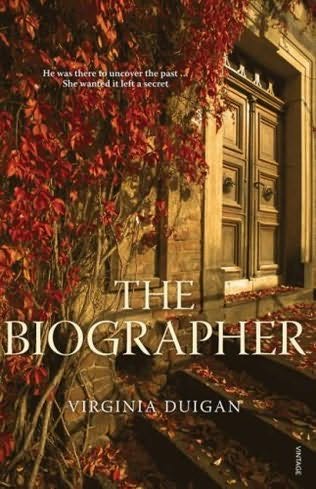
I have always thought I would like to write someone's biography one day, since I enjoy reading them so much. I even have someone in mind. That's probably why the plot description of Virginia Duigan's The Biographer so intrigued me. Greer, an Australian woman, is swept off her feet by Mischa, a Czech painter whose work is being shown at the gallery at which she works. Cut to 25 years later, said woman and said painter live in Italy on an old vineyard, sharing the group of old buildings with Rollo and Guy a couple, one paints and the other makes wine. Antony, who is writing Mischa's biography, comes to visit them. Greer is very uncomfortable about Antony uncovering her past, so the biographer's visit precipitates a spate of remembering, going through old diaries and letters, which is how we learn her story. Is there some bigger, darker secret troubling her or is she just uncomfortable because she left her husband to be with Mischa? I'm not sure. But the impending arrival and then the visit of the biographer is certainly creating disquiet for Greer a third of the way through this story. I had ordered this book to take with me on vacation, but I'm glad I'm reading it now because I'm feeling luke-warm about it. In the opening chaper, I had a very hard time keeping everybody's name straight. The story was hopping back and forth in time, casually mentioning people by name and I didn't know yet who they were. That straightened itself out. Duigan writes clear characters without writing caricatures, which I appreciate. The aging queen vintner, the crazy Polish housekeeper, and she really has the selfish artist down. Mischa is every inch the charismatic, unshaven, self-centered brute he should be. Here is her description of Mischa's painting:
I looked at the picture. It was of a piano in a paddock. Standing on the keys, feet apart, was a little barefoot Aboriginal girl dressed in oversized dungarees, staring the onlooker down with a truculent expression. She and the piano were painted very beautifully and meticulously. The paddock was reocgnisably Australian - brown, parched, with a huge expanse of blue sky and an extraordinary atmosphere of heat and blazing light - all that was painted very freely and expressively.
It's all very nice, but I haven't quite figured out why Greer is in such a tizzy. I find myself liking them all, except for Antony of whom I am suspicious, and that is as it should be. But so far Greer seems to be making a great deal out of not very much and I'm not sure why I should care. They are an entertaining enough bunch, Duigan moves skillfully between time periods, perhaps I am missing a cruicial piece of information, but right now it just seems to be a story about a woman who likes her private life to be private. We'll see what unfolds.

In the meantime, I have ordered a slew of books from the Book Depository and I really hope they arrive in time for our trip. Time to get to work on finishing my last paper of the semester.

Friday, May 29, 2009

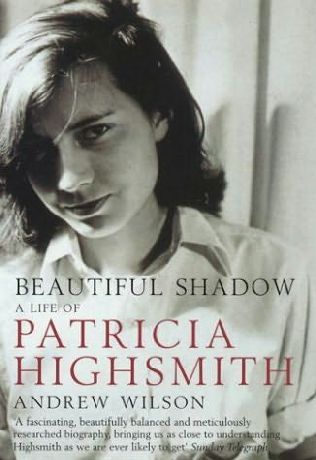
She was Ripley... (Books - Beautiful Shadow a Life of Patricia Highsmith by Andrew Wilson)

"After Pat's death, John Mortimer wrote a tribute, saying he thought she was in love with Mr. Ripley,' says Charles Latimer, 'but actually she was Ripley, or, I should say, she would have liked to have been him.'

When she spoke of Ripley in her later years, 'she would talk about him like he was a person who was very close to her,' says Bettina Berch. 'She'd defend him and think about what he would say about a certain situation. He was very real to her.' At the end of a letter to her fried, the photographer Barbara Kerr-Seymer, Highsmith signed herself 'Pat H., alias Ripley.'

'Tom Ripley is the gentleman as occasional murderer, a difference expressive of the ethical gap between the late nineteenth century and late twentieth,' he said. Symons believe that Highsmith's novels were remarkable as they suggested 'that a different and wholly personal code of morality should be substituted for the code of what society generally regards as important.' Indeed, Highsmith more or less stated as much in her 1966 book, Plotting and Writing Suspense Fiction. 'I find the public passion for justice quite boring and artificial, for neither life nor nature cares if justice is ever done or not.' In 1981 she elaborated on this when she told Diana Cooper-Clark of her fascination for amorality. 'I supposed I find it an interesting contrast to stereotyped morality which is frequently hypocritical and phony. I also think that to mock lip-service morality and to have a character amoral, such as Ripley, is entertaining.'

She also told one interviewer that she aligned herself with the criminal perspective because of her own innate sense of strangeness, which she traced back to her family background. 'It's true, I understnad nuts, kinky, kooky people,' she said. ' I don't understand ordinary people. Housewives. Maybe it's because I am not entirely normal! I myself have a criminal bent... I have a lurking liking for those who flout the law which I realise is despicable of me.'

Thursday, May 28, 2009

Life's too short for bad books...

btt button

In the perfect follow-up to last week’s question, as suggested by C in DC:Is there a book that you wish you could “unread”? One that you disliked so thoroughly you wish you could just forget that you ever read it?


In college I had to read Sartre's Being and Nothingness for a class on existentialism and I found it the most incomprehensible, solipsistic drivel I had ever come across and threw the hefty volume across the room. By the time I was done trying to finish it, the book was split in two. Of course, I could not claim to have come across all that much in my vast 18-years of experience and Dickens's Bleak House is a case in point. I read that book that same year in college. I also hated it and never finished it. I have since read it and raved about it here, here, here, here and here, which is among the reasons that I would never go so far as to wish I could 'unread' something. I was a young person of strong opinions. I am now a somewhat more middle-aged person of strong opinions, but I don't find myself wishing to unread books. Just about the only experiences I would wish to un-have are things I regret having said or done to other people. And I guess there are a couple of plays I acted in that I wish I could unrehearse and unact! But unread? No. I don't waste my time reading books I hate. I simply put them down, knowing I can always try them again later if they are supposed to be worth it, and see if my taste or my patience has changed. Life is too short for bad books or bad wine. If you don't like the way it tastes, pour the sucker out or use it to marinate a London broil and open a better one!

Wednesday, May 27, 2009

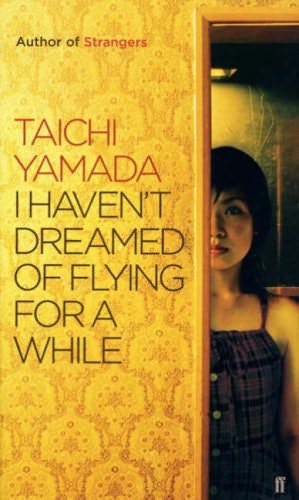
Forgotten how to dream (Books - I Haven't Dreamed of Flying for a While by Taichi Yamada)

I Haven't Dreamed of Flying for a While is a real surprise. If Gabriel Garcia Marquez wrote in Japanese...I'm repeating myself, I know, but magical realism is the shoe that fits. It's very hard to write about this interesting little book without giving its surprise away. I said a lot of what can be said in my first post. Man had a nervous collapse, stuck in a dead-end job, is recovering in the hospital from a broken leg and has a premonition of a train crash, followed by the real thing. This means that many casualties arrive at the hospital and he must share a room with another patient, a woman, and this encounter changes his life. That's all I can tell you about the plot if you are to enjoy the pleasures of discovery I did, which is only fair. Both of these characters ideas of what their lives should be like are shaken to the core. Now jump to the end of the spoiler alert if you don't want the plot revealed.
**SPOILER ALERT** For those of you who don't care, this book shares a plot idea with a film I saw this weekend The Curious Case of Benjamin Button, a recent film adaptation of a short story of F. Scott Fitzgerald with Brad Pitt and Cate Blanchett. It's a crap film actually, lugubrious story telling, has to show you everything, and has never met a cliche it didn't like. So what's the plot, you are wondering - getting younger. The woman in the hospital bed and Brad Pitt's character in the film both move backward in age. A film, being a largely visual medium, and contemporary film being largely about tricks, makes this all about makeup. Yawn. Pitt is already an actor who has trouble getting to himself, not that he doesn't try, but this emphasis renders him all but empty. ** ALERT OVER** In a book, this device becomes an excuse to go deep and explore the interior lives of these people - their expectations of themselves, their disappointments. Their unusual encounter in the hospital leads each of them to be able to reveal themsleves to each other. These are people who have forgotten how to dream. This fantastical happening, known only to each of them, creates a kind of intimacy through which they both get a chance to rediscover their vulnerability and they take it, they live a life in that dream, whatever the cost. The book has an unusual poetry and admits the reader to a singular world. I really enjoyed reading it.

Tuesday, May 26, 2009

In the wings...

Another couple of weeks and The Ragazzo and I will be on vacation in England, so I'll be selecting my vacation reads from among these (and anything I pick up along the way and since I know of two bookstores we will be visiting in London and we'll be visiting Hay-on-Wye, that is likely).

My Life as a Dog is one of my top 10 movies of all time, but I have never read the book. The paper I am writing now draws heavily on this story so I should have it at my finger tips. Ingemar is around 11 years old, growing up in late 1950s Sweden. His mother is dying and the film is about the anticipation and the aftermath of that event. His life is an absolute wreck. He has an angry adolescent brother, none of the relatives want to take him, and he is the type of kid to whom disasters constantly happen. He muses on the dog, Laika, sent up in Sputnik without any food. He feels it is important to experience life's tragedies in perspective, he tells us. The film is touching, but not a downer, I don't know what the book is like but I am about to find out.


All my English booky acquaintances have been going on about Sarah Waters latest, The Little Stranger but the book pictured left caught my interest first. The Night Watch is set near the end of World War II in London and moves backward in time through the lives of ordinary people. The Little Stranger is a Victorian era ghost story. They both sound like entertaining reads, and Dani seemed to enjoy The Little Stranger. It sounds like an addictive, wait I just have to read the end of this chapter kind of book. I hope so as The Ragazzo and I are planning on doing four things, hike, read, have tea, and see friends. Oh, and go to bookstores, and theatre, and opera. Ok, seven things.

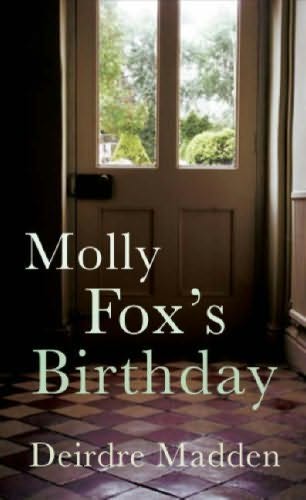
What Dovegrey had to say about this Orange Prize shorlister also caught my fancy. The central character is a woman of the theatre and the writer, Deirdre Madden, is Irish. So between my first career, the theatre, and my weakness for the Irish narrative voice (as if there is only one, but that little wee green island has churned out an impressive list of story tellers) I should have a good read ahead of me. The playwright muses over the nature of acting and writing as sculpters of identity, and the results sound as though they are thoughtful and moving.


It's A. S. Byatt's latest, what more can I say. I just read her sister's (Margaret Drabble's) book on moths, so I guess it is her sister's turn with dragonflies. Actually I don't know know much about this book other than the fact that it has a gorgeous cover and that Cornflower books is anticipating its pleasures too. Even when I haven't liked a book by Byatt, I have had to admire it. This sounds like it chronicles the end of innocence as the Victorian era gives way to the Edwardian.


I just picked Night Train to Lisbon off the bookstore shelf. It tells the story of a man whose life is changed by a chance encounter, in a bookstore no less. It sounds like it could either be wonderful or awful. But Isabel Allende liked it, the cover said so, and who am I to challenge her!


I read Olivia Manning's The Balkan Trilogy as part of The Outmoded Author's challenge a few years back and I tore through those 900 pages like wild fire. If you are not familiar with the book, you might know the television adaptation Fortunes of War. A young English husband and wife go to Bucharest on the eve of World War II. The community of ex-pats of which they become a part has some very memorable characters and in addition to the involving plot, the book is simultaneously a history lesson about how the war unfolded for the niaive. They escape to Greece and as the first trilogy ends, to the Levant where the aptly titled next three volumes take place.

Those are just some of the pleasures that await me in the wings. And now, I had better get working on that paper.

Sunday, May 24, 2009

The use of deviating from "normal" (Books - Beautiful Shadow by Andrew Wilson)

One paper yet to write, but the exams are done. Meanwhile, I have gotten through close to half of Beautiful Shadow a biography of Patricia Highsmith. What a life of tumultous romance, and endless moving from place to place - Texas to New York to Paris to Mexico to Venice to Positano (where part of The Talented Mr. Ripley is set).
'The individual has manifold shadows, all of which resemble him, and from time to time have equal claim to be the man himself'
That is the apt quote of Kierkegaard from Highsmith's journal with which Andrew Wilson begins his first chapter. Highsmith was certainly well acquainted with her dark side and seemed driven to write from and of it. It makes me wonder what she would have written had she not had such a hard time creating satisfying, stable relationships. In some ways she was just a natural outsider to experience in general, a reflective, serious person. But another influential ingredient was the fact that she was gay and lived in both a time and a country that was unaccepting of her feelings. Who's to say which came first, being gay or being an outsider but I have my suspicions. Regardless, this is the point of view from which she experienced life and the source that flowed from her. In some ways, she was so interested in the conflict and in the darkness, one could posit that she was drawn to loving people she couldn't have or that perhaps not having them was a kind of satisfaction for her:
From the beginning of their friendship, Highsmith knew that Rosalind was attached - her partner was the artist and gallery owner Betty Parsons - and it seems her very unobtainability was one of her most attractive qualities. 'When we love unrequited we are very much conscious that we are in love. That is all we have to think about,' she wrote. 'When our love is returned there is, in me, at least, a holding back, almost a fear of perfection.'
Certainly longing makes for great art so we as readers should not complain.

Highsmith considered that as writer she was an entertainer, yet her natural seriousness drove her to write each book as:
...an argument with myself, and I would write it whether it is ever published or not.
Not finding predictability in life, she cultivated a preferenced for exploring the chaos:
'Admit that human life can be guided by reason and all possibility of life is annihilated,' she wrote, quoting Tolstoy, in one of her journals. She celebrated irrationality, chaos and emotional anarchy, and regarded the criminal as the perfect example of the twentieth-century existentialist hero, a man she believed was 'active, free in spirit'.
Or, a quote from Karl Menninger's book The Human Mind which Highsmith read and was influenced by in her youth.

'The adjuration to be "normal" seems shockingly repellent to me; I see neither hope nor comfort in sinking to that low level. I think it is ignorance that makes people think of abnormality only with horror and allows them to remain undismayed at the proximity of "normal" to average and mediocre. For surely anyone who achieves anything is, a priori, abnormal...'

Great quote. Without divergence from normal we would have no inventions, no great leaders, nothing new in music, in architecture... From a genetic point of view, without mutation we have no variability in the genome and would cease to evolve and eventually die because of the microbes that would continue to evolve while we didn't. This is one of my favorite topics, positive deviance as Atul Gawande calls it. And with no variability in our environment, face it, we'd be bored to death. Well I would anyway.

I love the fact the Highsmith read pulp novels in order to analyze their writing techniques. I'll leave you with Andrew Wilson's description of the writing points she gleaned from them:
She admired them for their clear cut narratives and simple style, but at the same time she also revelled in a sense of superiority, a knowledge that she, in fact, could do better. At working she should remember to set the scene quickly and get straight to the point; she should write quickly and with ease, as too much effort would result in a tired style; describe only the feelings and viewpoint of the main characters; make sure the end result was entertaining, as this was prime reason people picked up a novel; and always try to leave the reader begging for more.

Thursday, May 21, 2009

Revelatory reads...

btt button

What book would you love to be able to read again for the first time?


It was between three for me, The Gold Bug Variations, For Kings and Planets and My Name Is Asher Lev. The third won out because the reading experience was so formative and the book has become so much a part of my own narrative. Chaim Potok's story is of a young Hassidic boy growing up post-World War II in New York and who displays not only a precocious talent for drawing and painting, but they seem to permit him to relate to his experience of himself and others and to give that some expression, in short they permit him to live. His insular culture does not offer education and practical training in what it takes to be an artist and so making that choice requires breaking away from his community. I'm neither Hassidic nor a painter, but I did feel very much an outsider while growing up and found permission to be myself through being an actor and director. Reading this book for the first time was a revelation that other people met the same incomprehension, had the same discussions with themselves, had the same types of struggles, that I did and that there were ways to live a satisfying life out of that experience. What an experience to find in a book; no wonder I like to read.

Now back to studying for finals.

Saturday, May 16, 2009

Two dreamers (Books - Beautiful Shadow by Andrew Wilison & I Haven't Dreamed of Flying for a While by Taichi Yamada)

I am deluged. One small paper, one final exam, and one big paper to go, so reading is occasional, moments caught on the subway (although even that is precious study time) or between 1 and 2 am as I try to clear my mind and get to sleep. That said, I am reading two terrific books.

I really loved Patricia Highsmith's The Talented Mr. Ripley although I was more lukewarm about its successor, Ripley Under Ground, but reading them really made me curious about their creator. Highsmith was a fascinating character herself. Very much living against the tide. The kind of character I really get. Andrew Wilson writes her life with a sensitive understanding of her outsider status and a lot of insight into her books and manages to make even Highsmith's early childhood interesting. This is a meaty rather than a lean model and it is reminding why I used to love reading biographies so much. Maybe this summer I'll tackle the 2 volume Orson Welles biography by Simon Callow that I received from Sheila! Exams always send me out in search of things I can look forward to.


Writer Junot Diaz recommended I Haven't Dreamed of Flying for a While in an interview some time back. It sports a sparse Japanese esthetic but its plot is florid with magical-realism. A middle-aged is confined to a hospital bed with a broken femur and a mess-of-a-life and he has an encounter with a woman in the next bed that completely changes his life.

I never would have thought I could become detached from all these things after just ten or so bedridden days. But when you spend most of your time staring up at a white ceiling, you can soon start to feel like you're floating further and further away. Or perhpas I'd just given up.

Despite my relctance to admit it, the feeling that my career had come to a dead end had soaked through me like water into a cotton rag, right from the very moment I got injured. And thought thhis sense seemed to press down on me with a great weight, it was proably the great mass of the sensation that actually helped me unload it, allowing a new me to surface; one that until now had been pushed deep down inside.

Taichi Yamada really thinks like an actor, his narrative is interested in getting you inside the singular experience of his characters and to give you the insight that will let you live in that moment with them.
For several days, my hours were dominated by uncontrollable feelings of hatred with which I didn't know what to do. But owing to the way my hatred was always directed at women, I felt such feelings stemmed from my relationship with my wife. Maybe somewhere inside I'd wished my wife were the type to drop everything and rush over as soon as she'd learned I'd been injured.
For one thing, this insight defies any cliche we might have built up in our head about what a married, forty-something, Japanese man's stay in the hospital look be like. For another, we're not learning through what happens per se, through action, because he's doing nothing at all. He's lying on his back and thinking. But that thinking is very active. The state he is in is the result of much rumination and fantasy. But it informs the point of view from which he experiences every person and happening he encounters in the novel and everything action he does take. This creates a suspense for him to do anything at all and the events of this novel seem to burst from a chrysalis. More on this book later. It's time to work.

Tuesday, May 12, 2009

We are where we come from, but that's not all we are (Books - The Peppered Moth by Margaret Drabble)

The multiple layers of Margaret Drabble's The Peppered Moth uncoil like the strands of DNA that are at its heart. The complicated story of who the women of Bessie Bawtry's family are - mother, daughter, granddaughter - reveal their code, but not their total meaning - which is inscrutable, as people are. Then they recoil themselves about you, twisting you into their helix so that their story swirls about you and it's not easy to escape.
Faro's DNA swab lies with many other Cudworth swabs in a laboratory. It is simple extract of Faro. But Far is not a simple person, and she too has been simplified by narration. We do not know much about Faro. Why, at her age, and with her beauty, is she living alone in a flat in Shepherd's Bush? Why, at her age, is she so obsessed by death...
And so it is with all of us, we are what we come from, but that is not all we are. That is the point of Drabble's novel in a nut shell. In her afterward she reveals that she was writing of her own mother. She may have felt that needed to be kept secret until the end so as not to simplify her motives but it was no surprise to me. Reading the scene with Chrissie taking in the death of her mother Bessie made it obvious to me the experience out of which Drabble wrote.
I wrote this book to try to understand my mother better. I went down into the underworld to look for my mother, but I couldn't find her. She wasn't there.
No wonder I was dreaming about Orpheus and Euridice and woke up with Gluck's music swirling about in my head! I had forgotten that I read that before going to sleep. In any event, reading Drabble's novel is more than a simple remembrance. The characters seem to exist in their own right - the world of the novel has an imaginative integrity that makes me want to read. Knowing the writer's process I could deduce from what this novel emerged and yet it was also more than that. My earlier feelings about this novel stand (here and here). With them, I will add that I particularly admire how Drabble writes character description (apropos for a book about who we are in the literary as well as the scientific sense.) These little summaries cut to the core of each person and the choice of words is idiosyncratic in the very best sense. I'll leave you with two.
Moira, who had lived upstairs, had not visibly improved with the passage of time - a pallid, whining, spiritless creature, a broken reed, a lower-middle-class misery, thin then and scrawny now, her face lined with endurance and forgiveness. She was wearing a prim dark-striped mannish suit, and her hair had turned a curious ancient tarnished yellow-green-grey, not unlike Auntie Dora's; it was tied back with a large black velvet bow which suggested a bisexual character from a historical costume drama.

Wow. I hope Drabble is far away when they write my epitaph.

Robert gave less obvious cause for anxiety: he was serious, scholarly, a little introverted. He was sent to a conventional prep school, then to a minor Yorkshire public school, well out of his mother's way. His progress reports were good. He plodded on, sharpening his critical faculties. His point hardened. Wastepaper baskets filled. He discarded, discarded. He was to become picky, pedantic. Even as a boy, he picked and pierced. He defended himself carefully, and protected his own core. Nobody could get near Robert.

Chrissie, in contrast, was emotional, female, flibbertigibbet. She veered and tacked and turned with the wind. She liked the wind. Like her uncle Phil Barron, she liked speed. She adored it. Yes, she took after the Barrons, not after the Cudworths and the Bawtrys, in her sporting skills. She could wack a rounders ball, serve an ace, dive off the top board and jump the long hump. She nearly killed herself when she was given her first two-wheel bicycle, a dashing little red Raleigh: she couldn't resist freewheeling down from Sowerbrigg Tops at thirty miles an hour, and ended up in hospital with a concussion and a split knee. This taught her no lesson: as soon as she could get back on again she did.
Drabble's narrative voice displays an omnicience so dry with wit that it crackles. I'll give you one example and then sign off for a day of neuropsychological assessments and paper writing.
Let's get back to Chrissie. Things may yet turn out well for her.

Chrissie, contemplating the choice between mustard-free ham sandwiches and lust, adultery and alcohol, was drawn strongly towards the latter package. Getting away fast and far was her plan.

Thursday, May 7, 2009

Origins expressed or silenced, hopes realized or buried (Books - The Peppered Moth by Margaret Drabble)

Along with the theme of origins in Margaret Drabble's The Peppered Moth that I mentioned in my first post - how our makeup, both biographical and genetic, influences what we become - is the flip side of that question, that is - can we escape? That seems very much the question for Bessie Bawtry as she grows up a Yorkshire mining town lass who qualifies for Cambridge. Now that I am halfway through, I have grown comfortable with Drabble's regular and sure prose that focuses very much on the inner life of her characters.
Bessie was depressed. She was sinking. Her body felt limp. Her mind felt limp, yet at the same time curiously overactive, with a detached hot invisible motion of its own, as though it were not really she herself who lay there. It was not Bessie Bawtry, late of Breaseborough Secondary and recently accepted at university, who lay there, in this small bedroom, in this small corner house. It was some simulacrum, some chrysalis, some meaningless waxy body contained, in which a new form of life was trying to hatch. Poor Bessie, we have been too hard on her. Our tone has been harsh and pitiless. It is the tone she taught us, it is true, but we must try to unlearn it, we must try to see her as she was, suffering, longing, vulnerable, unformed. How is she to know how to manage these hot flushes of grief, these night sweats and terror, these humiliations and tribulations? She reads for solace, for enlightenment, for escape, for a sight of the next rung upwards on the ladder, for the next gleam of light ahead that might lead her from the prison of her cavemind...But those other books, books that had seemed to lead her out into the bright air from the darkness of soot and gravecloths, they now confuse and alarm her. How can she cope with this rich world of words and language and light? She is a weak little grub. How could she have thought she could ever take part in the butterfly display of the educated world?

She lay still, in turmoil. A seething, a pregnant brewing, a splitting, a proliferation of particles. Is it as sickness, is it a fermentation, is it a couching, and what will it bring forth? Is it a growing or a dying?
On the one hand the old fashioned, omniscient narrator who speaks directly to the reader, who asks us to look down at the scene from a distance - to observe our heroine, to consider her state, to form an opinion about it. On the other this steady effusion of words that bubbles like a running brook and then occasionally cracks a smile "Poor Bessie, we have been too hard on her," and then without warning, surprisingly bursts into song.
The atmosphere of cloistered commitment suited Bessie Bawtry. It helped to distance and to neutralize the painful memory of the misconceived fun of Highcross House, fun which she had found so unfunny and so exclusive. She was not left out of things here. She was not besieged here by the threat of the strain of do-wacka-doo, oogie-oogie-wah-wah, hello Swanne, Ukelele Lady, and such rubbish. She did not have to try to shimmy like her sister Kate, or get to know Susie like we knew Susie, or imitate the vamp of Savannah, hard-hearted Hannah. Some of the young women knew some of the songs of the day, but their familiarity with them did not bring them much cachet.
I find this passage kind of odd, even given Drabble's love of play in language. It is as if she had a Tourrettic tic. There is plenty of expressiveness in the language of other paragraphs, but this sticks out as unnatural. Reading it was like watching my high school librarian dance to rock 'n' roll at a party, it's almost a little embarrassing. Aside from periodic losses of character, I am enjoying the progress of the story. Perhaps enjoying is not quite right - I am taken with Bessie and her progeny. What the attempt to escape yielded ten years down the line, twenty, a generation later, two. Whether we look through the lens of science with our knowledge of genes and inheritance or with a novelistic lens at the intertwining of events and motivations that are the life of a character, Drabble has taken the themes of how origins become expressed or silenced, hopes realized or buried, promises met or forgotten and fashioned a complex and involving novel which I am very much enjoying.

Tuesday, May 5, 2009

The secrets of attention all wrapped up...

Not..., according to John Tierney's article in today's Science Times:
Now that neuroscientists have identified the brain's synchronizing mechanism, they've started work on therapies to strengthen attention. In the current issue of Nature, researchers from MIT, Penn and Stanford report that they directly induced gamma waves in mice by shining pulses of laser light through tiny optical fibers onto generally engineered neurons. In the current issue of Neuron, Dr. Desimone and colleagues report progress using this "optogenetic" technique in monkeys.
This article focused around Winifred Gallagher's book about attention Rapt: Attention and the Focused Life which explores such subjects as the fact that attention is a limited resource, that it can be directed. It was written out of Gallagher's experience of wanting to control her attention away from the cancer diagnosis she received, so it would not completely take over her life. She cites William James as her muse "My experience is what I agree to attend to." That's really only one form of attention, one we have named selective attention, for obvious reasons. There are other mechanisms of attention, namely those which don't ask for permission - a car backfires as you are quietly having a drink at a sidewalk cafe and you jump, your body on guard, your heart beating quickly for a moment. A baby cries (evidently we may be hard-wired to never be able to ignore this sound). That is 'attention' too. But selective attention can be applied immediately after our attention has been wrested away by external stimuli, and that is Ms. Gallagher's interest. William James also famously said in 1890 that while everyone knows what we mean by attention we don't know precisely what it is:
Every one knows what attention is. It is the taking possession by the mind, in clear and vivid form, of one out of what seem several simultaneously possible objects or trains of thought. Focalization, concentration, of consciousness are of its essence. It implies withdrawal from some things in order to deal effectively with others, and is a condition which has a real opposite in the confused, dazed, scatterbrained state...
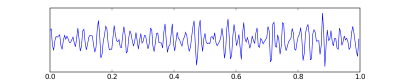
A prominent model of attention suggests that it involves the synchronous oscillation of neuronal activity, but what does that mean? Oscillation is the repetitive variation in time or space of something about a central point or between different states. For example, the swing of a pendulum about its center or the vibration of a plucked guitar string about its normal straight lines when at rest between its pegs. As Gyorgy Buzsaki writes in his fascinating book Rhythms of the Brain, those patterns exist due to forces in nature - what goes up comes down. Those rhythms of change are often illustrated as cycles per unit of time or a Hertz. Cells throughout the body, including the nervous system, are capable of generating patterns of such activity, with alternating high and low points about a center - working in concert to create self-sustaining patterns of behavior. They do so on a mechanical level so that we may walk, breathe, and circulate blood without consciously coordinating those tasks and giving away our precious limited cognitive resources just to stay alive. But patterns of firing are the coding of the cognitive activities of the brain as well. Many neuroscientists now think that, large groups of neurons synchronize their firing at a certain rate (namly the gamma frequency between approximately 30 and 90 Hz, pictured above) that may facilitate attention since, as Buzsaki writes:
Systems in balance are simple and hard to perturb.
Tierney describes the neurons as 'firing on and off,' which is not completely accurate. Neurons don't turn 'off' per se, but neurons some distance away from each other in our brains can synchronize the rhythm of their activity - that is to say, they line up the peaks and troughs of their wave-like pattern of variation. Say there are 2 competing stimuli in our visual field and we only wish to pay attention to one of them. Pascal Fries and his colleagues have shown that when the object we want to pay attention to is present, the gamma frequency increases in that group of neurons our visual system requires to "see" the desired object. We observe more intense firing as well as more synchronized firing specific to those neurons. Conversely, in those neurons that could give attention to the object we wish to ignore we observe a decreased firing rate and less synchronization of activity. So we see on the cellular level an analogue for what goes on at the behavioral level, that is, giving more cognitive resources to some processes while giving less of those resources to others.

The article mentions the prefrontal cortex as the source of this synchronizing gamma activity. I had thought that altered firing originated subcortically and a network of prefrontal and parietal activity were both necessary to apply it, but the prefrontal cortex is involved. Check out Tierney's article, it mentions some nifty new devices designed to artificially deliver a synchronizing jolt of gamma activity for those with brains that have a harder time doing so in a self-directed way. This is quite an innovation if it turns out to be both safe and effective.

Monday, May 4, 2009

He's no genius at life... (Film - Synecdoche, New York)

Take Don Delillo's White Noise mix in a little of Terry Gilliam's Brazil, stir well, and you might have something that starts to approach Charlie's Kaufman's crazy, visionary film Synecdoche, New York. Caden Cotard is a theater director in his forties, married to a painter, with a young daughter. They live in upstate New York (Schnectady, to be exact). He gets a nasty bump on his head and begins to have all sorts of symptoms that make him fear he is dying. His wife leaves him, he wins a genius grant and tries to create a theater project that is true to his lonely, painful experience of life. No matter how big the warehouse or cast, how much the sets looks like life, how close the dialogue gets to what was actually said, he is never satisfied because it's not life itself. Soon his warehouse contains another warehouse, and he casts an actor to play himself directing the play and another actor to play the actors he is directing. On some level the art you make will always be art, and it is one of the great cliches of the artists who work from ideals, that they will never approach the truth they seek. On the other hand, you don't have to look for ideal life in a work of theatre, if you have people who are actually alive playing the parts, that is a reality you cannot escape even if you try. But this film is about more than an artist who cannot be satisfied with his work, it is about a man who, sadly, cannot be satisfied with life because, in the end, we all die. That pain seems to equal reality for Cotard. And nothing he creates ever gets close to how he feels about it. OK, that's a platitude too, but as in White Noise it's how paralyzing fear of death is expressed that is the interest. I don't imagine either Delillo or Kaufman imagine that they invented existential angst. Charlie Kaufman creates a whacky, nightmarish life for Caden Cotard, precisely visionary and utterly fantastical (that's the part that feels like Terry Gilliam). Every so often, Cotard seems to wake from his dream and realize that another chunk of life has swept by him and still his great work is unfinished, still his wife has not come back to him. It is a tough film because Cotard can be unbearable to be around. A hypochondriacal schlub who just seems to make the same mistakes over and over. But someone who cares to live well and who loves strongly and who, no matter how many people show him love or respect, thinks he is alone in his suffering. And so he is.

The story starts out strongly and features a fantastic cast - Phillip Seymour Hoffman, Hope Davis, Catherine Keener, Diane Wiest. The film seems to go off the rails for a time because, as Cotard becomes sicker, the dream state takes over and gets wilder and wilder. There is a point where I wanted to be more certain what the hell was going on. Is this real? Is this fantasy? This film makes you work. If you want to enjoy what lies at the end of it, you have to persevere through it. What finally emerges is not exactly an original idea - a parable about not letting life pass you by - but the way it is told is original. I think this film has a sense of humor, as well as being both serious and beautiful. Hoffmans's performance is touching and committed. I particularly love the character of Hazel, the box office girl who becomes Cotard's assistant on his grand project. Hazel is utterly devoted to Cotard and to a life in theatre. While she too is lonely and an odd duck, she does not wait around, even while harboring a deep love for Cotard. In one scene we see her buy the house she lives in. The real estate dealer takes her around and one can clearly see fires burning in the walls, smoke seeping through the wallpaper, and yet Hazel buys it and lives in it for the rest of her life. The house is a marvelous evocation of its owner. There is this disaster looming, threatening to burn and destroy her, and yet no one talks about it. The fire is also the passion, that burns beneath her skin. It never destroys the house entirely, it just makes living in it a little warm and chaotic, occassionally a little smoky. That is the way this film operates. It physicalizes its themes. Kaufman is a clever vision maker, whose symbols operate on multiple levels. But he does more than make pictures. This is a director who knows how to work with actors. In the extra features on the dvd, Kaufman talks about the amount of time that Phillip Seymour Hoffman, Catherine Keener and he worked on creating the relationship between Cotard and his wife, even though the film begins as the marriage ends. He wanted us to believe that they had shared a past. This director gets actors - smart actors who don't just 'do' but who also think about what they do. He gets that something has to happen to them for us to believe that something is happening to them. That makes this film something more than clever and what could be a trite old story becomes alive in all its whackiness and is worth the work we do to stay with it. Kaufman's vision is smart, fresh, and also moving.

Sunday, May 3, 2009

House of Mirrors (Books - Ripley Under Ground by Patricia Highsmith)

What to say having finished Patricia Highsmith's Ripley Under Ground? Certainly it provided amusements in a macabre sort of way, superficially much like those in The Talented Mr. Ripley. My attention was taken and led me through to the end swiftly, even if it didn't create the incredible grip of suspense that the first Ripley book had. But what that first novel offered was a character study of a disturbed young man, pushed to psychopathy by an intense sense of victimization and defeat. He was a loser who so desperately wanted to be a winner he would do anything. He had lost everything, finally even himself and he replaces his lost self with the handsome, wealthy character of his friend Dickie Greenleaf, after murdering him. Tom Ripley assumes this new character first with facination. He is an amateur, committing awful crimes to save his life. The trouble is that in Ripley Under Ground, Tom has succeeded in that replacement. He is a winner. He is a professional. He has married a lovely woman. Collects beautiful art. Has a house in the country outside of Paris with one woman who serves him meals and another who cleans. Now Tom Ripley hires an artist named Bernard Tufts who create fake paintings of an artist who committed suicide several years earlier. This fraud earns him and a gallery who sells the work a decent income until a collector suspects the fraud and Tom must impersonate the long dead painter for whom they had created the character of a recluse. But now when Tom commits fraud and murder, it is just about perpetuating a scheme. It is about about not losing income, not being caught. He may be doing these things to save his skin, but not to save his life as he did in the first book.
He stared at 'Man in chair' over the fireplace, and bounced on his heels with satisfaction - satisfaction with it s familiarity, its excellence. Bernard was good. He'd just made a couple of mistakes in his periods. Damn periods anyway. Logically, 'The Red Chairs,' a genuine Derwatt should have the place of honour in the room over the fireplace. Typical of him that he had put the phoney in the choice spot he supposed.

or

'I cannot understand your total disconnection with the truth of things,' Murchison said. 'An artist's style is his truth, his honest. Has another man the right to copy it, in the same way that a man copies another man's signature? And for the same purpose, to draw on his reputation, his bank account? A reputation already built by a man's talent?'
It is as if Highsmith feels she must explain the book. Really she explains away the whole theme with that second paragraph, rendering the novel that follows a bland if somewhat sick amusement, even with all its bloody crimes and near misses. The same class of crime is being committed as in The Talented Mr. Ripley. The same themes of identity are being explored, but without the point. Ripley Under Ground toys with identity games because it worked in the first book, but it is just a house of mirrors.

Friday, May 1, 2009

A Rubbery Sense of Identity (Books - Ripley Under Ground by Patricia Highsmith)

With the economy gone to the dogs and our health going to the pigs and an all-round atmosphere of hysteria that is becoming the real reason for worry, I thought it the perfect time to bring back our favorite psychopath, Tom Ripley to really give us somewhere to place our anxiety. When last we met our hero in The Talented Mr. Ripley, he managed to improve his circumstances. Starting out, he was a poor abused orphan running tax fraud scams out of an accounting job in New York. He managed to pass himself off as the friend of a very rich young man, Dickie Greenleaf, whose father then sends him to Italy to try and lure his son back to the U.S. to and join the family business. Tom murders Dickie and manages to impersonate him for months and live off his money. Then he writes Dickie's will, making Tom the heir of his income and as the net tightens around him, Tom escapes to Greece. About 15 years later Tom is married and living near Paris with a fantastic art collection, but he hasn't lost his taste for scams. This time, he is having an artist paint pictures for a popular painter named Derwatt, who has drowned. They sell his paintings through a gallery, run an art school in his name, and endow him with a reclusive character and a residence somewhere in Mexico. As Ripley Under Ground begins, a wealthy art collector suspects that a work he bought from the gallery is a forgery and Tom decides to impersonate the painter to allay the collector's fears. Already one can see the layers of impersonation that are the theme Patricia Highsmith explores in the Ripley books - Tom is the master of manipulating identity because he is so disastisfied with his own. Tom wonders, as he readies himself for his role as Derwatt:
If one painted more forgeries than one's own paintings, wouldn't the forgeries become more natural, more real, more genuine to oneself, even, than one's own painting?
The thing that is so clever about this scam is that so many of the paintings bearing Derwatt's name are already forgeries, so if one has Tom Ripley's rubbery sense of identity one can equally ask - what is a genuine Derwatt painting? If there are more forgeries than there are actual Derwatt's and people pay for and enjoy the forgeries as originals, don't they become original. Well, no Tom, no, they don't . But Tom is unrivaled in the plasticity he is able to endow the props that constitute an identity - one's face, one's signature, one's clothes, the turn of phrase that other's recognize one by - these are all mere playthings to Tom. And he interacts with few people, manipulating things from a distance so that the life of the impersonated is just a shadowy illusion and those that have met him are then hard pressed to remember exactly who they met. This new scam is a bit different. Tom must assume a disguise and meet someone on demand - face to face - as the man he impersonates.

So far the plot is fun enough, but only having read a few chapters in, Highsmith has not yet embroiled us in the tremendous sense of suspense she was able to cook up by the end of first Ripley book. So far I am actually a little disappointed with the clumsy exposition and the feeling that her efforts to set up another clever impersonation for Tom are a bit contrived, but I am going to suspend judgment and read further since the first book really delivered the goods after a while. I also really wanted a plot-driven book to accompany the slower-paced Margaret Drabble novel I am reading. We are getting near the end of the semester and with the burden of a lot of projects, when I escape into a book I really want to be grabbed!

Monday, April 27, 2009

Writing for grown-ups (Books - The Peppered Moth by Margaret Drabble)

I have never read any of the work of Margaret Drabble, author of 13 novels and 2 biographies, editor of The Oxford Companion to English Literature, as well as being known for her personal connections as the sister of novelist A. S. Byatt and the wife of biographer Michael Holroyd. There is a wonderful portrait from the New York Times of Drablle and her husband here. Perhaps I am stalling since I have only read about 60 pages into The Peppered Moth and it really does take its time in revealing all the plot's secrets. So far, Dr. Hawthorn, geneticist, has come to Breaseborough in Yorkshire to address the town's people. They seem to have been part of a study he has done on their ancestry. Bessie Bawtry is one of those people and to tell that story, Drabble returns to Bessie's childhood.

The structure of DNA had not been discovered when Bessie Bawtry crouched under the table and brooded upon flight and murder. Genes were not then the fashion, as they are now. The Oedipus complex, in contrast, was already much discussed, in Vienna, in Paris, in London, if not yet in the South Yorkshire coal belt. (The son of a Midlands coal miner was even then writing about the Oedipus complex, but his works would not reach Bessie Bawtry for some years.) Both parent-murder and genes, however, had been around for a very long time, awaiting formal recognition. The revolutionary discoveries of molecular biology and digital electronics would, in a matter of decades, brings Dr. Hawsthorn to his Start Button, as he waited to impress the wonders of genes and genealogy upon his patient audience. Bessiet Bawtry could not forsee this future, or this past. But under the table her infant molecules yearned and jostled and desired. Or so we may, retrospectively, fancifully, suppose. Something had set her apart, had implanted in her needs and desires beyond her station, beyond her class. Will Dr Hawthorn diagnose and analyse the very gene that provoked her to attempt mutation? And will she succeed in her escape? To answer those questions we must try to rediscover that long-ago infant in her vanished world.

And so, the book slips back and forth, in and out, of Bessie's old age, childhood, teenage years, trying to make some sense of how our makeup, in the biographical as well as the genetic sense, makes us who we become. I cannot tell whether the genetics is going to be used literally or more as a literary device (since desiring to advance beyond your class would in no literal sense be contained in a single gene), but as genetics has entered the zeitgeist and at least a cursory knowledge of genes as the seeds of ancestry is possessed by most anyone with a high school education, they have also done double-duty as a metaphor, much as Freud's theories once did for theater and literature thirty yearas earlier (as Drabble points out).

Two of my favorite novels (The Gold Bug Variations and Hopeful Monsters) speak much to the influence of genes and genetic mutation upon the progress of individuals and their civilization and that is, no doubt, where this book is heading as the peppered moth of Drabble's title is often used as evidence of Darwin's natural selection played out in nature. So I am hopeful. I am enjoying two things in particular so far in Drabble's writing. One is her no-nonsense sentences.
Mrs. Bawtry, if asked, would have said that she loved her daughters. But she would not have expected the question, nor would she have liked it, and indeed in all her life it was never to be put to her.
The second is the way she slips this narrative in and out of times past and present, I was going to say 'furtively,' but actually that is not true. Her writing is the opposite of furtive. It puts everything out in the open. If Drabble is going to move the action from one period of time to another, her narrator says that is what she is doing and then she does it, much the way George Eliot uses narrative. She directs your attention where she wants it to go and makes no bones about jumping six years, from Bessie's childhood bout with the flu of 1918 to her high school years while referencing Dr Hawthorn in the novel's present time frame, upon whose slide presentation, we all wait with bated breath. In other words, Drabble writes for grown-ups. No magic tricks, no cuteness, and so far that is just fine with me.

Sunday, April 26, 2009

Romance, a haircut, and a little heaven... (Books - The Puttermesser Papers by Cynthia Ozick)

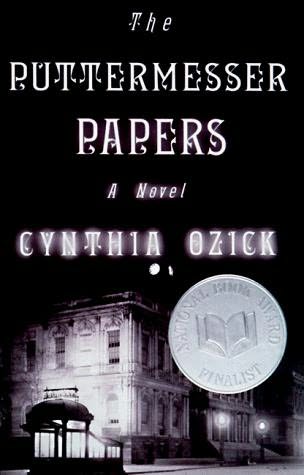
As we approach the last 3 weeks of the semester, I'm not sure how I am going to keep up here. I'll do my best. I managed to finish Cynthia Ozick's The Puttermesser Papers. Following her being elected mayor of New York with the help of her golem (see my earlier posts here and here), we see Ruth P. paired off, visited by a cousin from Moscow, and, finally, in paradise. One of the great pleasures of this book is the whimsical voice of its narrator:
Stop. Stop, stop! Puttermesser's biographer, stop! Disengage, please. Though it is true that biographies are invented, not recorded, here you invent too much. A symbol is allowed, but not a whole scene: do not accommodate too obsequiously to Puttermesser's romance. Having not much imagination, she is literal with what she has.
But invent she does! And Puttermesser does find romance, at least for a time - it's ok to tell you this as the chapter heading brazenly announces the fact. What I especially love about Puttermesser Paired is that the then well-into-middle-age Miss P, being by that time a confirmed bachelor in love with narrative, models her budding romance with one Rupert Rabeeno on the relationships between George Eliot and her husband (during their romance they read five biographies to each other aloud), and then later her husband's nephew, who is many years her junior. The difference in age between Rupert and herself is a source of great consternation for Ruth. Observe this quirky little scene Cynthia Ozick masterfully develops combining a haircut, an inner monologue and Ruth watching herself in the mirror:
After supper he cut her hair. The wisps fell from her nape and forehead, all over her shoulders and the floor. She watched in the mirror as he snipped,e vening out the sides: it struck her that she was not yet a hag. Tiny hyphens of hair-cuttings fuzzed her neck; he blew them down inside her blouse and over her back. Her mouth in the mirror was content. Her toungue slipped out like a shining lizard. He never thought of her as too old. Nothing grotesque lay between them. She believed that now.
Sensuality expressed in a haircut - this book is full of surprises like this perfect little moment involving thoughts, sight (not only we seeing Ruth, but Ruth seeing herself), sound (the scissors), and touch (the hair cuttings on her neck and then his breath).

The biggest surprise, shock really, is the final chapter Puttermesser in Paradise which appropriately has a very different tone from the rest. Short, sharp, a little ugly in some ways yet very beautifully imagined. It is best experienced following the rest of the book, so I'll leave off here with my strong recommendation that you read it for its fantastical narrative voice, its smart, lonely and touching heroine, or any other pleasures you might find in it.

Margaret Drabble's The Peppered Moth is up next. I've never read anything of her's before.

Thursday, April 23, 2009

Holding a mirror up to nature...

btt button

Question suggested by Barbara H: My husband is not an avid reader, and he used to get very frustrated in college when teachers would insist discussing symbolism in a literary work when there didn’t seem to him to be any. He felt that writers often just wrote the story for the story’s sake and other people read symbolism into it. It does seem like modern fiction just “tells the story” without much symbolism. Is symbolism an older literary device, like excessive description, that is not used much any more? Do you think there was as much symbolism as English teachers seemed to think? What are some examples of symbolism from your reading?

Symbol - Something that represents something else by association, resemblance, or convention,or, as a psychologist might use it - An object or image that an individual unconsciously uses to represent repressed thoughts, feelings, or impulses.

Symbolism - 1: the art or practice of using symbols esp. by investing things with a symbolic meaning or by expressing the invisible or intangible by means of visible or sensuous representations: as a: artistic imitation or invention that is a method of revealing or suggesting immaterial, ideal, or otherwise intangible truth or states.

I would say to your husband, dear h-o-b (husband-of-Barbara), good fiction old and new is full of people, places and events that represent intangible and otherwise immaterial truths or states. A fiction, by telling a story that didn't happen anywhere but in someone's imagination, or (in some cases) referencing events and people that happened differently in life, fashions stand-ins (symbols) for those characters, those happenings. In the alluring act of creation, those stand-ins will often take on a life of their own and do things or say things that never happened in the "true" events that may have been the starting point of the fiction. Language and literature, by their very nature, are rife with symbolism. That is not to say that every work of literature has the kind of intentional programmatic set of characters and events standing for another set of characters and events, as in, say, James Joyce's Ulysses, but the act of holding a mirror up to nature, as Shakespeare described art's purpose, is an act of symbolism. Furthermore, frustrating or not, if you had any good teachers who loved literature, they may not so much have been trying to get you to find the one-and-only hidden message that existed in the books you read like the dime in the black eyed peas or the prize in the cracker jacks, they were probably trying to get you to learn to invest in the experience of reading and get beyond either the superficial events of the story or the correct interpretation for getting an 'A' on your paper and instead allow the events and characters to stir up what associations and resemblances resonate for you given your experience of the world. That's part of the fun of being the audience of a piece of theatre, a painting, a book. Whatever the intention the creator of that work had, the experience of its audience is going to be full of the meanings and truths of their own lives. Hamlet is a story of a Danish Prince, it's also a story of adolescence, it's also a story of grief. Someone non-Danish and not born into a royal family can, if they appreciate the play at all, appreciate his indecision, his mourning his father, or some other aspect of the play. That is because Hamlet becomes a stand-in for us either individually or perhaps collectively, the play could be appreciated thinking of Hamlet as a nation that is responding to an attack. That is not to say that Shakespeare sat there thinking all these thoughts and filling his play with them and then disguising them so you had to look for them. But the experience of reading it can reveal them by the intersection of your mind and his work. A mystery story, while it can be a relaxing pasttime, can still have characters or events that evoke for us memories or experiences of our current life. A character can reminds us of someone we know. The murder can make us pause to think of the value of life, or the scene of the crime can conjure up a picture of a familiar house. The suspense of the events can raise our heartbeat. That is all accomplished by ink on a page. Remember this is a fiction. These specific things never happened. Our heart rate speeds up because of the investment we have in this unreality and the source of that is somewhere in our own lives. The fictional events stand for real ones, at least for the moment of our experiencing them. That is symbolism. But of course, there are other pleasures to appreciate in art - the technique of the painter for depicting light, or that writer for combining words in such a way that you were successfully transported to an unfamiliar place. Those can be satisfying reasons to appreciate a work of art too. I hope that, if you don't enjoy reading, that it's not because your experience of learning about it made you feel excluded from the world of books, as though you didn't have the talent to be a "good" reader. In my opinion, if you can find some pleasure in a book, that's good enough.

Wednesday, April 22, 2009

Puttermesser for Mayor! (Books - The Puttermesser Papers by Cynthia Ozick)

I have to be at the lab at 8 am today, so I don't have time for any lengthy thoughts, but in the section of Cynthia Ozick's The Puttermesser Papers entitled Puttermesser and Xanthippe, Ruth Puttermesser, disgraced city employee of The Department of Receipts and Disbursements, creates a golem out of the soil of her potted plants who gets her elected mayor. And this, naturally, puts her into a great tizzy about appointing commissioners. No, really. You will have to trust me that, as you get caught up in the rhapsody of Ozick's prose, this will all make perfect sense.
The new Mayor intends to recruit noble psyches and visionary hearts. She is searching for the antithesis of Turtelman and Marmel. For instance: she yearns after Wallace Stevens - insurance executive of probity during office hours, enrapture poet at dusk. How she would like to put Walt Whitman himself in charge of the Bureau of Summary Sessions, and have Shelley take over the Water Resource Development - Shelley whose principle it is that poets are the legislators of mankind! William Blake in the Fire Department. George Eliot doing Social Services. Emily Bronte over at Police, Jane Austen in Bridges and Tunnels, Virginia Woolf and Edgar Allan Poe sharing Health. Herman Melville overseeing the Office of Single Room Occupancy Housing...
What a riff. I think that one of the most deliciously fantastical sequences I have read in a long time. If you would care to dream along with Mayor Ruth Puttermesser, which writer - no, I'll open it up, which artist, writer, composer.... - would you appoint and to what position? My other post about the wonderful The Puttermesser Papers is here.

Tuesday, April 21, 2009

Magical Realism Meets the Department of Receipts and Disbursements (Books - The Puttermesser Papers by Cynthia Ozick)

With a name like Puttermesser, a girl from the Bronx is likely to be a little...different. Ruth leaves a blue-blood law firm to work for the Department of Receipts and Disbursements of the City of New York.
The successive heads of this department were called Commissioners. They were all political appointees - scavengers after spoils. Puttermesser herself was not quite a civil servant and not quite not a civil servant - one of those amphibious creatures hanging between base contempt and bare decency; but she soon felt the ignominy of belonging to that mean swarm of City employees rooted bleakly in cells inside the honeycomb of the Municipal Building. It was a monstrous place, gray everywhere, abundantly tunneled, with multitutdes of corridors and stairs and shafts, a kind of swollen doom through which the bickering of small-voiced officials whinnied. At the same time there were always curious farm sounds - in the summer the steady cricket of the air-conditioning, in the winter the gnash and croak of old radiators...

Puttermesser will always be an employee in the Municipal Building. She will always behold Brooklyn Bridge through its windows; also sunsets of high glory, bringing her religious pangs. She will not marry. Perhaps she will undertake a long-term affair with Vogel, the Deputy in charge of the Treasury, perhaps not.

The difficulty with Puttermesser is that she is loyal to certain environments.
She would rather study Hebrew grammar and read Plato in bed than have a roll in the hay with her paramour. Ruth Puttermesser is driven by scholastic achievement, the value of knowledge, and the beauty and power of language. In fact, she uses three Hebrew letters (and a little potting soil) to fashion herself a Golem - part surrogate daughter, part servant - who asks to be named Xanthippe.
"I want to be Xanthippe," the thing wrote. "I know everything you know. I am made of earth but also I am made out of your mind. Now watch me walk."
Golems are funny creatures of Jewish folk mythology, think Frankenstein only in a shtetl. Made of dirt and filled with life by a Kabbalistic incantation, in one case involving the three Hebrew letters for truth: aleph, mem, and tav - they are bound to do their creator's bidding - but usually do it a bit too literally and end of wreaking havoc on the world and then have to be dismantled - unenlivened. Which is accomplished by removing the letter aleph, leaving only mem and tav - spelling met, which means dead. Pretty clever huh? In any event, I won't ruin for you how Ozick combines this creature of 13th century mythology with her dreamscape of New York's municipal bureaucracy.

Ozick's prose is, itself, pretty incantory and deadly clever. Nearly every sentence conjures up irrepressible life and you don't really know where it is going to go either. She expects a fair bit of her reader. At one point she describes her heroine:
She disdained assertiveness. Her voice was like Cordelia's. At home, in bed, she went on dreaming and reading. She retained a romantic view of the British Civil Service in its heyday: the Cambridge Apostles carrying the probities of G. E. Moore to the far corners of the world, Leonard Woolf doing justice in Ceylon, the shy young Forster in India. Integrity. Uprightness.
In those four sentences she references Shakespeare and half of Bloomsbury. But don't get the impression that this makes The Puttermesser Papers heavy going. On the contrary, Cynthia Ozick's language is bouyant, swift-moving, and hilarious. I can't believe I have put off reading one of her novels for so long. Thank you, Mark Sarvas, for raving about the riches of this book - I'm loving it.

Monday, April 20, 2009

History as theater as history... (Theater - Mary Stuart)

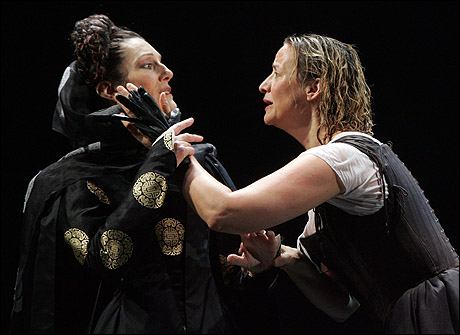
Broadway is sporting a new production of Mary Stuart. It's a new version of Shiller's classic play by Peter Oswald directed by Phyllida Lloyd and imported from London's Donmar Warehouse. I'm always glad when Broadway takes on a good play with a good team, it's too bad this production ends up being such a mixed bag. On the good side, the new version of the text is full-blooded, contemporary and accessible and except for what it takes on thematically (see below) does not draw much attention to itself. The two lead actresses are a dynamic pair, Harriet Walter and Janet McTeer are available to their circumstances, think on their feet, know how to use language but don't kid themselves that the play ends with the words they say. They both give effective and alive performances. Janet McTeer is particularly able to bring her character both a sense of grandeur and of the colloquial. I enjoyed Brian Murray a lot too, he plays the Earl of Shrewsbury with an obsequious, self-effacing exterior but a solid core, and he never pushes for effect. John Benjamin Hickey has his moments as well, but wears his English accent awkwardly and it seems to keep him from ever fully relishing the duplicitous realities of the Earl of Leicester's character. In fact, I found this production burdened often by theatrical cliche and generality, it felt very much like an opera production - long on general concept and short on human detail - and I would lay the responsibility for that at the doorstep of director Phillida Lloyd. The text and production saw much contemporary relevance in this famous story of Queen Elizabeth I of England and her insecure sense of her hold on the throne due to her rivalrous cousin Mary Stuart who is a Catholic and who flees Scotland after a coup there. She is imprisoned by Elizabeth and thus becomes a figure around which the papists and others who wished to depose Elizabeth rally. Lloyd and Oswald's Mary Stuart clearly references our own recent history and America and Britain's choice to always value security over displomacy or mercy. It is no accident, I think, that the actor Nicholas Woodeson playing Lord Burleigh, who engineers Queen Elizabeth's insecurity and strongly favors the beheading of Mary Stuart, looks so much like Dick Cheney. The production does not strain hard at all for this parallel and I found it resonant without being heavy-handed. Beyond this bold stroke of concept, I found the production lacking in subtlety of human interaction between the characters and their circumstances. It is unfortunate, for instance, that the long scene that opens the play featuring the usually able Maria Tucci as Mary Stuart's nurse and Michael Countryman as her jailer, is such a welter of stage cliches. This is one of the many details that makes this play feel like an opera. It's an "oh, you know" performance. Oh, you know, she's the old nurse. You know what old nurses are like. Just waggle your voice and your chin and look generally addled and....you know, old... and you'll be fine. If the director tried for anything more than that I would be shocked, given how good a caliber of actor she has. Hanna as played by Tucci feels like the mezzo nurse in a tired opera production, everyone always ignores those poor mezzos and focuses on the star Soprano - say Emelia to Desdemona in Otello or Alisa to Lucia in Lucia di Lammermoor. It would be nice if someone told the actors in the opening scene that they didn't have to scream the lines of the play to be heard. If they would just focus on doing something real - listening to each other, really folding that damn blanket, we might be drawn in. Now everyone coughs and rustles their programs and suffers through the exposition until the star enters. We perk up when Janet McTeer enters not merely because she played Nora so well on Broadway a few years ago, but because she speaks in what sounds like a normal voice and actually inhabits the details of her circumstances. The same problem existed in the performance of Chandler Williams as Mortimer, such a flurry of classical theater convention swirls around his generalities of young rashness - the way he throws his body about - I really don't know what he is doing or saying. But I in no way think or feel that this man is moved to eventual suicide by his new found religion or the imprisoned queen who embodies his faith. Although there are many moments to enjoy in this production, I thought that, with the exceptions already mentioned, this was lazy work, not on the part of the actors, if anything many of them work too hard, but on the part of the director. It seemed content to simply rely on its stars and its strong concept and cartoon-in the rest. I expected better.