Wednesday, September 30, 2009

The push and pull of it (Books - A Gate at the Stairs by Lorrie Moore)

I wrote in my last post on Lorrie Moore's new novel, A Gate at the Stairs, about the desperate need of the characters to feel connected, to touch and be touched. As I continue to read, Moore has me notice all the ways that human beings undercut that ability - depersonalize the most intimate of transactions. Sarah and Edward, an intellectual yuppie couple, adopt Mary-Emma:
"Here," Edward said, indicating, and they resumed their eading and signing. And then the strangest: they were writing checks, separate checks.

"Edward and I are splitting this down the middle," said Sarah. She was scribbling something on a scrap of paper, doing the arithmetic. "We like everything to be even between us." She pause, then murmured, "Though usually they're not even - just odd."
What would Solomon the Wise say about that?

Equally limiting is how many of us isolate ourselves almost reflexively with judgment of others. Moore shows us that in the racism of the residents of Troy, the small town in which Sarah, Edward, Mary-Emma, and the book's narrator Tassie, live. Sarah and Edward are white and they adopt a child who is part African-American. This really raises the hackles of many of the town's people, who seem unable to fathom a racially mixed family. Moore's talent is to deliver this criticsm of our social poverty with humor. This book seems to be all about the push and pull of human connection. Every pull toward the love of others is met by a complementary push away. Sarah desperately wants a child, but hires Tassie even before the adoption to care for her. Even a simple interaction between mother and daughter - a trip to the children's library - is clouded by Sarah needing to bake the library books she borrows for Mary-Emma in the oven, to kill any bacteria that might lurk on their pages before she is willing for her to touch them! The ultimate in control for a reader - sterilizing ones books! But nature has an odd sense of humor. The flip side of trying to control all sources of infection with disinfecting sprays and hand- wash is that we render ourselves less able to tolerate the simple invasions of daily existence. Overuse of antibiotics in medical care and in our food supply has produced in us less ability to resist infection and may even be responsible for the onslought of allergies so many suffer. When we suffer a wounded heart from loss of someone we love we often behave in ways that close us down to others, limiting even more one of the chief sources of our ability to recover. That seems to be true on a national level as well - one big attack has made us hypervigilant of future invasions - and at the same time has limited our openness to and tolerance for others, the flexibility of our legal system. Are we perfect now? Are we impervious? Will we never hurt again? And are we better for it? Those are the qualities of our modern world that reading Moore's book evokes for me, but it does so with subtlety and humor. Its environment is local - a specific small town. Its narrative is a personal journey, and yet it seems to be about the whole world.

Saturday, September 26, 2009

A meme, if you need a little distraction and, evidently, I do...

How on earth did this evolve? This is sooooo random. Thanks Matt.

1. Do you like blue cheese? Yumm. Especially with figs and a great white wine.

2. Have you ever been drunk? Are you kidding? Um, yes.

3. Do you own a gun? No. But I've fired a rifle so stay clear.

4. What flavor of Kool Aid was your favorite? Probably grape, but I don't really remember, the very though now is disgusting.

5. Do you get nervous before doctor appointments? Yes.

6. What do you think of hot dogs? To be honest I don't think of them at all. Weisswurst, knockwurst and bratwurst I enjoy on occasion.

7. Favorite Christmas movie? I don't go back to traditional favorites at Christmas or most other times. If I have free time I tend to watch something new.

8. What do you prefer to drink in the morning? Tea.

9. Can you do push ups? Yes, but not very well.

10. What’s your favorite piece of jewelry? I don't wear any unless a shirt requires cufflinks.

11. Favorite hobby? This is a book blog, any guesses?

12. Do you have A.D.D.? Diagnosed, no. But I am a multitasker.

13. What’s your favorite shoe? I have two feet, it would be more practical to have favorite shoeS.

14. Middle name? Not saying, I don't like sharing personal information on the internet.

15. Name 3 thoughts at this exact moment? 1) How old is the person who wrote this? 2)I really should be reading three articles related to my research. 3)This is really good tea.

16. Name 3 drinks you regularly drink? Tea, coffee, wine.

17. Current worry? My exams.

18. Current hate right now? Housework, especially laundry, and middle age spread.

19. Dum da dum dummmm what is that? That's the theme from Dragnet, isn't it?

20. How did you bring in the new year? We had a marvelous party, as Noel Coward would have said.

21. Where would you like to go? Portugal, France, Quebec, and Vancouver.

22. Name three people who will complete this? You know who you are.

23. Do you own slippers? Birkenstocks.

24. What color shirt are you wearing right now? Olive.

25. Do you like sleeping on Satin sheets? Not really, I have to keep picking myself off the floor when I slide out of bed.

26. Can you whistle? Yup.

27. Favorite color? Purple.

28. Would you be a pirate? Under what circumstances - who's offering what? Speak to my agent.

29. What songs do you sing in the shower? Usually classical stuff I have floating through my head - Verdi's Requium, some Mozart aria, or occasionally Soliloquoy from Carousel.

30. Favorite Girl’s Name? Emma.

31. Favorite boy’s name? Aaron.

32. What’s in your pocket right now? A tissue.

33. Last thing that made you laugh? Reading Lorrie Moore's new book.

34. Best bed sheets as a child? I had some with jungle animals on them.

35. Worst injury you’ve ever had as a child? Probably a fall I took in 1st grade which cut both knees, both elbows and my face.

36. Do you love where you live? I love my apartment and my neighborhood.

37. Revenge of the Nerds or Fast Times at Ridgemont High? Neither. But Diner is ok.

38. Who is your loudest friend? Laugher? Crier? Screamer? I will not say on the grounds that it may incriminate me.

39. How many dogs do you have? None. My life doesn't permit it. Neither does my apartment bulilding.

40. Does someone have a crush on you? No idea.

41. What is your favorite book? There are too many - see my side bar. Hopeful Monsters, The Gold Bug Variations, For Kings and Planets, The Chosen, Crime and Punishment..... are my usual answers.

42. What is your favorite candy? I don't really like candy but if pressed, very dark chocolate.

43. Favorite Sports Team? I don't see the point of watching team sports, but tennis is ok.

44. What song do you want played at your funeral? I haven't planned that far in advance.

Despearately seeking others to love (Books - A Gate at the Stairs by Lorrie Moore)

An aimless literature student at a small town college, Tassie Keltjin, answers an advertisement for a job as a babysitter. She ends up (at least by page 100) accompanying Sarah Brink, an aggressive yuppie restaurant owner, on trips to adoption agencies to meet mothers giving up their babies for adoption, one of them destined to become her charge. Tassie is an awkward, word-loving innocent who is out of her depth in this strange role - who wouldn't be? A babysitter without a baby. Each of the characters in this novel seems to be reaching out blindly for connection with others, their arms flailing in the empty space before them, only rarely striking a body or face to feel and then stumbling on again. The narrative voice is the first person - Tassie's - but she is telling this story from some time in the future by which everything has changed. It is tinted by Lorrie Moore's ruthless camera-like eye for character and her trademark humor, which I find laugh-out-loud funny, if a trifle vicious.
The woman of the house opened the door. She was pale and compact, no sags or pouches, linen skin tight across the bone. The hollows of her cheeks were powdered darkly, as if with the pollen of a tiger lily. Her hair was cropped short and dyed the fashionable bright auburn of a ladybug. Her earrings were buttons of deepest orange, her leggings mahogany, her sweater rust-colored, and her lips maroonish brown. She looked like a highly controlled oxidation experiment. "Come in," she said, and I entered, mutely at first and then, as always, apologetically, as if I were late, though I wasn't At that time in my life I was never late. Only a year later would I suddenly have difficulty hanging on to any sense of time, leaving friends sitting, invariably, for a half hour here or there. Time would waft past me undetectably or absurdly - laughably when I could laugh - in quantities I was incapable of measuring or obeying.

But that year, when I was twenty, I was as punctual as a priest. Were priests punctual? Cave-raised, divinely dazed, I believed them to be.

This combination of perspectives gives Tassie a strange combination of naivetee and wisdom and plumps this quiet story full of a subtle kind of suspense. It pushes me gently forward to see around the next bend how this clueless foal becomes the woman who narrates this story. More on it soon.

Thursday, September 24, 2009

Boo hoo!

btt button

What’s the saddest book you’ve read recently?

I had to think pretty hard to remember these, I guess my memory wears rose colored glasses. Herman Hesse's Beneath the Wheel is certainly the most tragic story I have read lately (within the past two years) and The Line of Beauty by Alan Hollinghurst also features a tragic central character who is drawn into a web of immense superficiality. They both are gripping narratives with compelling stories to tell. I also cry about the many unread books sitting on piles throughout my house begging to be read - those might be the saddest books of all!

Monday, September 21, 2009

A war run by psychopaths (Books - The Fall of Berlin 1945 by Antony Beevor)

It was a twisted road that led me to read Antony Beevor's The Fall of Berlin 1945. I have read several works of fiction this year set in Europe during and just after World War II - The Night Watch, Little Boy Lost, and Pictures at an Exhibition. Reading the second two books got me interested in post-war France and when Cornflower Books did a post on Beevor's book about Paris following liberation, I decided I wanted to read it and learn more about that strange, divided time in the history of that wonderful city. I looked Beevor up on line and ordered a second-hand copy and since I could get free shipping if I ordered a second from the same shop and since I remembered seeing Sheila reading his book about the siege of Stalingrad, I looked for that one and they didn't have it and so I ended up ordering his book on Berlin in the final year of the war instead. Usually I am not one for military history, but Beevor does more than discuss the movement of battalions and the shaving habits of famous generals, he is able to get at the tenor of the time, the desperation of the German troops who knew they were being led to slaughter, the sex-starved Russian men who readily raped German women but were reluctant to kill them because 'they weren't barbarians like the Germans.' Beevor really gets into the mind of the characters he is playing and tells the story of war as the story of the forces driving the behavior of crazed men, depicting Hitler's pathological denial of the true state of his campaign in 1945, the internicine rivalry between Himmler and Bormann, and Stalin's utter unpredictability. His general, Chernyakhovsky described him as "a living example of dialectical process. 'It's impossible to understand him. All you can do is to have faith.' Chernyakhovsky was clearly not destined to survive into the post-was Stalinist petrification," Beevor adds. "He was perhaps fortunate to die soon in battle, his faith intact." In these last months of the war, the Russians were able to maneuver their troops faster than the German's were able to relay messages between generals, which meant that the German plans were constantly made upon dated information. It is a fascinating pressure-cooker atmosphere with an unbelievably inhumane amount of carnage and Beevor makes mesmerizing drama of it in his history.

Saturday, September 19, 2009

Anti-intellectual bias & pulp, world war & great acting (Books - Night Train to Lisbon & The Fall of Berlin 1945 and Film - Charlotte Gray)

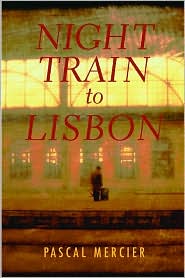
I finished Swiss author Pascal Mercier's controversial book Night Train to Lisbon. So is it brilliant or is it craptacular (a word I just heard on NPR)? For my money it's neither, but it is an engaging story and I would place it into a sort of intellectual pulp-fiction category. The central character, Gregorius, is a teacher of Latin, Greek and Hebrew in a high school. He plays chess for fun. He is a rather staid and sedate creature of habit who has a chance encounter with a Portuguese woman in his home city of Berne, Switzerland. This leads him to discover a philosophical memoir by a Portuguese doctor which seems to speak directly to him and drives him to leave his job and visit Portugal to learn everything he can about the life of Amadeu de Prado, the author of the book - a brilliant intellect, devout atheist, iconoclast, member of the resistance against Salazar, the authoritarian ruler of Portugal until the mid-1970s. Most of the critics who thought the book bombastic crap were American. I wonder if that is because the book is neither fish nor fowl? The writing is low-brow, unimpressive - it gets the job done but no better than the average pulpy thriller and is a little repetitive. And yet, it is filled with lengthy italicized philosophical paragraphs, people who speak dead languages, play chess for fun, doubt the existence of god and say so, and the action is largely of an introspective sort - one man trying to uncover another man's past in order to somehow transform himself. America is many things but our culture has a largely anti-intellectual bent. If something here is "heady" most people want to know and prepare themselves for it, or they want to just have fun, but those two things generally aren't supposed to overlap. You know all that stuff like opera and films you have to read - in Holland where I have worked for many years it always surprised me to see people under 30 years old out on dates for fun at the opera. I almost never saw that in New York, Chicago, San Francisco, Santa Fe (any of the American opera houses that I have worked in). To get back to the book, I didn't find Night Train to Lisbon terribly serious and I certainly didn't find it transformative, but the world it was set in was one of self-probing thought and love of literature and was very recognizable to me. The sudden change in this quiet, hypochondrical man was enlivening and what drove his curiosity drove mine and so I was engaged and entertained by it. Imagination, intimacy and language are described as Prado's sanctuaries by one of the characters in the book. That is the kind of place this book is. If you enjoy intellectual and bookish mysteries like those of Carlos Ruiz Zafon then you might also enjoy this book, although its pleasures are a little quieter than Shadow of the Wind. Speaking of pulp...

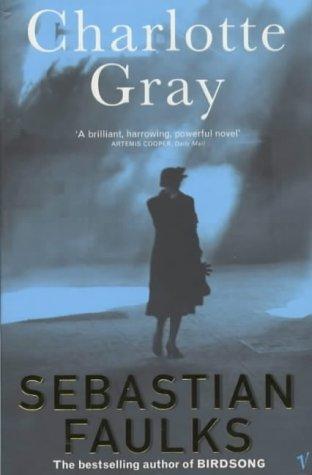
We saw the film adaptation of Sebastian Faulks's Charlotte Gray last night, which I borrowed from the library because Billy Crudup is in it. I haven't read the book but the film is every bit a trashy romance despite its setting in World War II France and England its action, which concerns a young Scottish woman who, speaking French, becomes an agent for the Brittish to aid the French resistance, and the serious choices Charlotte must make given her involvement with a Jewish family in Nazi-occupied France. The film was an interesting one to me for two reasons. The period is one I am very interested in right now. I am also reading Patrick Hamilton's The Slaves of Solitude set in a World War II London suburb and I'm reading Antony Beevor's The Fall of Berlin 1945, an excellent military and social history of the end of the war. And also because a completely predictable script rendered in a way I could only describe as flat, stale and unprofitable, was filled with such depth by its cast and the detailed direction of Gillian Armstrong. Cate Blanchett, Michael Gambon, and most of the cast were very good - specific and understated - but, as usual, Billy Crudup had that extra something that allows him to act circles around anyone else near him, whatever the material. He does his job - sure. He is committed to the world of his character, involved in his circumstances, aware of the technical requirements, moved in the right way at the proper times - but it is more than that. He lives in, but also around the character's life. He does more than embody his lines and actions as informed by his back story, he embodies his backstory. He is the circumstances you are witnessing and also the circumstances you haven't seen - things that came before, expectation of things to come, and probably things that are particular to Crudup's being and fantasy - things that are secret from us that we will never know, and yet are alive in Crudup's behavior which creates that which we experience in the film or play as his character. Whenever I see someone of those type of abilities work - Juliette Stevenson, Geraldine Page, Mark Ruffalo - I am reminded what it is I love about great acting. Ode to Billy over.

Now Lorrie Moore's latest waits in the wings and an interesting book entitled Identity and Story: Creating Self in Narrative a book about psychological research in the intertwined sub fields of self and narrative - an intersection I am obsessed with. Not to mention about 200 pages of homework to read by Tuesday.

Friday, September 18, 2009

Reading habits meme

Do you snack while you read? If so, favorite reading snack?

It's easier to ask when I don't snack. Olives, cheese, a glass of wine, a cup of tea are all fair game while I'm reading. Or, if I'm alone at home or at a restaurant, I'll read over a meal.

Do you tend to mark your books as you read, or does the idea of writing in books horrify you?
I mark my school reading. I used to engage in great enthusiastic dialogues with all my books, all over them in ink, but now for my pleasure reading I tend to use little post-it tabs and will occasionally make a note on one of them.

How do you keep your place while reading a book? Bookmark? Dog-ears? Laying the book flat open?

Bookmark. Usually bookmarks take on certain magical meanings related to the last book they marked and will, therefore, seem appropriate or inappropriate to the book in which I'm thinking of using them. I don't buy bookmarks, but when I go to favorite bookstores or visit new bookstores, especially while travelling, I'll try to get a bookmark from the shop. Then if my reading experience from that shop was favorable, that bookmark will become a favorite. Silly of me, I know, but true.

Fiction, Non-fiction, or both?
I read both, but I read more fiction for pleasure than non-fiction.

Hard copy or audiobooks?
I read books - those funny objects with ink printed on pages made of paper and those pages bound somehow within paper or hard covers. Audio books aren't books they're another medium, which is fine when I want a radio-like experience, but the auditory and the visual modalities are different. They collect different information from my environment. They require different organs, they use different parts of the brain to process them and, finally, they create different sensory, intellectual, and emotional experiences. When I wish to read, I want a book that I consume with my eyes, in silence. Listening to fiction or drama or journalism is fine, it's just something else altogether, even if the source was a book.

Are you a person who tends to read to the end of chapters, or are you able to put a book down at any point?
There are books where I cannot stand to not read to the end of the chapter, but it's a book-by-book need for me. It's not a regular neurosis. I can always find my place again in any book that really interests me.

If you come across an unfamiliar word, do you stop to look it up right away?
Depends on whether I'm home. If a dictionary is nearby I will probably look it up right away. Otherwise I will infer the meaning from context and will intend to look it up but it may not happen.

What are you currently reading?
I just finished Night Train to Lisbon. I'm in-progress with The Slaves of Solitude, Identity and Story, and The Fall of Berlin 1945 and Lorrie Moore's new book is waiting in the wings (I cannot wait to start that one!)

What is the last book you bought?
Just a few hours ago (shhhhh!) I bought a book called The First Interview - a book on clinical interviewing for my clinical externship and two books by Margaret Drabble, her early novel The Needle's Eye and her new memoir The Pattern in the Carpet.

Are you the type of person that only reads one book at a time or can you read more than one at a time?
As the answer above likely indicated to you, I have several in-progress at once.

Do you have a favorite time of day and/or place to read?
Any time. Any place. On public transportation, in bed, waiting for friends in a restaurant, standing on the subway platform - wherever.

Do you prefer series books or stand alone books?
Stand alone, I'm not opposed to a series, but it can make me a little neurotic about reading it in order or finishing it.

Is there a specific book or author that you find yourself recommending over and over?
Two - Hopeful Monsters by Nicholas Mosley and The Gold Bug Variations by Richard Powers. Over and over and over. And Crime and Punishment of Dostoevsky too.

How do you organize your books? (By genre, title, author’s last name, etc.?)
Loosely by genre and within that genre I might group a given author or theme, but basically by feel.

Thursday, September 17, 2009

Cynthia Ozick and the fun quotient

btt button

What’s the most enjoyable, most fun, most just-darn-entertaining book you’ve read recently?

The winner in the 'just-darn-entertaining' category this year would go to Cynthia Ozick's The Puttermesser Papers. What really gives this book the fun quotient for me is the fact that it is not merely entertaining. Ozick's prose is can be fluid or sharp but is always tinged by whimsy. Her humor is sophisticated. She can reference the Kabbalah, Shakespeare, and Bloomsbury in a single paragraph - and does. This is a bookish romp.

Wednesday, September 16, 2009

Artist's Private Spaces

Did you see Daphne Merkin's wonderful portrait of Margaret Drabble in the New York Times Magazine this weekend - Dame of the British Interior? She sets the scene expertly by relating her own experience of her visit to Drabble's home - her garden, and jigsaw puzzles. Among other things, this article stresses Drabble's reticence to make her writing overtly confessional and yet, somehow, Merkin balances that with being revealing enough to make a sympathetic and informative portrait. I have only read one of Drabble's novels - The Peppered Moth - and Merkin's piece made me hungry for more. Above are pictured Drabble's workspace (I love getting a glimpse of artists' spaces) and beneath that, her husband's (the biographer Michael Holroyd).

Sunday, September 13, 2009

Breaking free of the emptiness (Books - Night Train to Lisbon & Film - L'Emploi du Temps & Pierrot Le Fou)

The desire to break free of society's template and find one's more true self is, through no specific intention of my own, the theme of both the novel I am reading and the the two films I watched this weekend.

Laurent Cantet's L'Emploi du temps (Timeout is the American title) concerns Vincent, a reasonably well off French family man. Mom and 3 kids are installed in a well equipped and modern home, the in-laws live near by - and Vincent goes off to work, which keeps him on the road all week, calling in from meetings to apologize for yet another missed dinner. The trouble is, Vincent has been unemployed for months and the elaborate lie he embroiders about a potential job with the UN in Switzerland investing money to help under-financed countries develop infrastructure begins to take on a life of its own. He collects hundreds of thousands of francs simply by spouting unspecific rhetoric he has poached by stealing some of the U.N.'s public relations pieces from their lobby. I won't give the whole story away, but two things struck me about this dreamy, leisurely-paced film, one was the psychological insight about deception and especially self-deception, which I found detailed and subtly played Aurelien Recoing and the rest of the cast. The second was the emphasis on how devoid of meaning much of daily commerce is. The domestic scenes, the visits to school sports events and fairs are shot with warmth but distance, but all the scenes in the work world are icily cold, buildings are glass fortresses, people move their mouths in meetings and in phone conversation. Sentences come out, they contain the right catch-words but are devoid of any substance whatever. The biggest question the film left me with (and meant to leave me with, I believe) was whether Vincent really wanted to be in the game or not. It seemed as though his self-worth was really caught up in everyone thinking he was employed at this level. When the people around him thought he was they praised him and gave him money, his wife and parents felt more secure. But Vincent called his wife three or four times a day, not merely out of an insecure need to shore up the elaborate lie he had built, he also seemed to call because he needed connection with her and wanted her love. He seemed to crave connection with people around him and yet the people around him seemed to wish to connect most through his accomplishments. A quietly provocative film and surprisingly similar in some thematic ways to...

Jean Luc Goddard's 1965 Pierrot Le Fou which also explored opting out of society's conventions, but in a more manic and aggressive style. Pierrot who, he keeps telling the camera, is really named Ferdinand, is married to a wealthy Italian woman, lives in Paris, and reads art criticism as she plays tennis and tries to get her husband gainfully employed through Daddy. Early in the film, the couple attends a cocktail party in which the guests seem to spout nothing but platitudes and advertisement slogans. This was remarkably similar to L'Emploi du Temps emphasis on conventional society's reliance on empty rhetoric so that people in the course of daily interaction whether social or economic don't have to think. While Vincent had a quietly desperate need that vacillated between wanting to escape and wanting to take part so that he would be admired, Pierrot le Fou is angrily dismissive, (this is the 1960s, you know) condemnatory of valuing brand-name shampoo as war rages in Vietnam. Pierrot decides unequivocally to "drop out," as they said then, and run to the South of France with the babysitter who, incidentally, is being chased by Algerian gun men. He is played with iconic, cigarette-dangling insouciance by Paul Belmondo. She is played with irrepressible carelessness by Anna Karina. This is a courageously experimental film making with direct-audience address, characters bursting into song, voice-overs of quotes from art criticism, shots with colored filters over the lens. It's part screw-ball comedy, part musical, yet as violent as Quentin Tarratino's films, and is simultaneously serious social criticism. Although both character's want to drop out of conventional life, she is a nihilist, he is an intellectual wastrel. This is film making with both a lively spirit and an intellectual seriousness and that brings me to the book I have been reading over the past week...

Night Train to Lisbon by Pascal Mercier, a Swiss author now living in Germany, has received such a contradictory reception from its critics, I find it fascinating. The paperback edition is larded with hyperbolic praise for its seriousness, its philosophy. "It is a handbook for the soul..." the cover screams. "I read it in three nights and was then convinced to change my life," another said. Other critics not plastered across the book's back and front covers or first few pages found it "Fantastical, long-winded and dull..." or "turgid...bombastic." "Think of W.G. Sebald recast for the mass market: stripped of nuance, cooked at high temperature and pounded home, clause after clause." The controversy alone made me want to read it. In a sentence the novel concerns a Swiss teacher of dead languages who comes to life. A chance meeting with a woman on a bridge leads him to a philosophical book by a Portuguese doctor, which leads him to upend a life musty with routine and pursue the story of this man's life; but what this really is is a journey to himself. The passages from the philosophy book are a bit long-winded and very repetitive in theme. There is nothing particularly nuanced about this story (many of the critics blame the translator), but I am finding his book-laden adventure appealing to the bookish romantic in me and I am always a sucker for stories of self-discovery and escape from routine. In fact, it has been quite a weekend for them. I'll let you know when I'm done with it, on which side of the argument I landed.

Thursday, September 10, 2009

Information and chance to win a book

btt button

What’s the most informative book you’ve read recently?

Goodness, what book worth reading isn't informative, doesn't expose the reader to something new - either in its content or in the way it treats a subject I thought I knew already? Iris Murdoch's novel The Nice and the Good informed me about the experience of judging others while questioning one's own moral sense. The setting of the novel Little Boy Lost informed me about post World War II France. If by informative you mean "packed with facts," then any of the text books I have read for school qualify for that. Take Principles of Neural Science by Kandel, Schwartz and Jessell (I should say - take it, please!). It's about 10 pounds, 1400 pages on the electrical and chemical make-up of neurons and glia, their communicative properties, and how those result in behaviors such as motor movements, remembering, paying attention, perceiving the world. It's a feast of information and an aerobic workout all in one.

Anyone who can guess what the picture has to do with the question will be entered in a drawing to win a book! One answer each, through Friday evening. One winner will be drawn from any multiple correct answers randomly. Actually I didn't really handle that properly, since once one person wrote the answer in the comments, anyone could copy it! So I am going to close the contest and declare the person who gave the first right answer to be the winner in order to be fair to her. Congratulations Isabella! I'll be in touch.

Wednesday, September 9, 2009

A collection of treasures

Lots of goodies to look forward to in the coming weeks!

Cornflower Books tempted me with a write-up of Antony Beevor and Artemis Cooper's Paris After the Liberation 1944-1949, describing what is was like for General DeGaulle's government to receive a France divided into those who cooperated with the collaborationist Vichy government, those who were victims of it, and those who actively resisted. This was the setting of Marghanita Laski's wonderful novel Little Boy Lost. I'm interested to learn more about the period and I have heard a lot of praise for Antony Beevor's books about World War II. I also acquired his The Fall of Berlin 1945, so some history waits in the wings here at Bookeywookey.


I received an ARC of Robert Stone's new volume of short stories Fun With Problems, due out early next year. It is hailed as a collection of unsettling stories about longing, violence, black humor, sex, and drugs. This all gave me the impression that he would be something like Hunter S. Thompson, I writer I loathe, but dipping into the book a little, one of stories begins at a concert of Mahler's Das Lied von der Erde and I found myself attracted to the lean, wry prose and easy dialogue. What little I sampled reminded me more of Joan Didion. Stone is supposed to be a strong writer and as I have yet to read anything of his, I'm looking forward to being introduced.

Most of all, I am looking forward to Lorrie Moore's new novel, A Gate at the Stairs, which Jonathan Lethem gushed all over in the New York Times Review of Books a couple of weeks ago. My gosh, I have never read such admiration of one living writer by another. I would read Lorrie Moore's tea leaves, so I am thrilled she has written another full-lenth work of fiction. Her Who Will Run the Frog Hospital is a favorite of mine. Such complex understanding of character expressed deeply, simply, and also suprisingly.

Monday, September 7, 2009

New York, the ecosystem

It is not usual for me to think of the island I live on (Manhattan) as an ecosystem, but whether an environment is urban or rural it is still made up of flora and fauna, its materials exist uncultivated or are put to use as food, shelter, clothes, and means of travel. I live in an ecosystem as much as the next kangaroo and Manahatta, an exhibit currently on at The Museum of the City of New York, means to encourage its visitors to occupy that point of view for a while. It projects the viewer back to Manhattan in 1609 before Henry Hudson arrived, when it was inhabited by the Lenape people, forward to our own time, and beyond to a possible version of Manhattan in 2409. It's interactive maps let you view the island city block-by-city block, with every buildings and subway stations visible, or to see its many plants, its voles, bear, and bird species, where its springs and streams were, and where the Lenape had their trails to walk from camp to camp. Whether you live nearby or are coming for a visit (prior to mid October), I found it a provocative view of a place I generally think of very differently. If you can't make it, Manahatta is also a book and a website. Come and meet New York - the ecological community.

Friday, September 4, 2009

Rich imagery scratched with acid pen... (Books - The Slaves of Solitude by Patrick Hamilton)

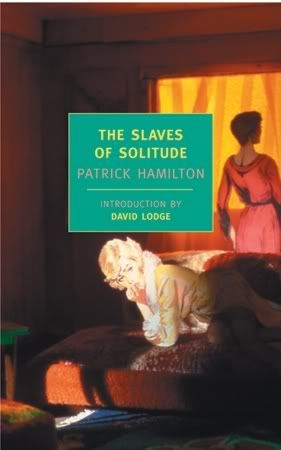
I am in one of those between books places in which I keep flitting from book to book, not really settling anywhere. Perhaps I'm unconsciously waiting for Lorrie Moore's new novel to arrive in the mail. Meanwhile,on John Self's recommendation, I started The Slaves of Solitude which chronicles the lonely lives of the denizens of a suburban boarding house near World War II torn London. Patrick Hamilton regards this petty, claustrophobic universe and its inhabitants with a gimlet eye:
Such was Miss Roach's pink boudoir in Thames Lockdon before dinner at night. Before washing she looked at what she could see of herself in the mirror - at the thin, bird-like nose and face, and the healthy complexion - too healthy for beauty - the open-air, sun-and-wind complexion of a uniform red-brick colour, of a texture and colour to which it would be impossible or absurd to apply make-up of any sort. She had, she knew, the complexion of a farmer's wife and the face of a bird. Her eyes, too, were bird-like - blackly brown, liquid, loving, appealing, confused. Her hair was of a nondescript brown colour, and she parted it in the middle. She was only thirty-nine, but she might have been taken foor forty-five. She had given up "hope" years ago. She had never actually had any "hope." Like so many of her kind - the hopelss - she was too amiable and tried too hard in company and conversation, and so sometimes gave an air, untrue to her character, of being genteel.
If I had been living at the same time as Hamilton (actually we may have barely overlapped but it's unlikely that we met) and had three wishes I would use one of them to wish that I never encountered Hamilton in a bar, train waiting room, or anywhere where we might both sit long enough for him to train lay his eye upon me and draw my portrait with his acid pen. His writing, though his vision is scathing, is redolent of rich imagery. It has an elegance.
London, the crouching monster, like every other monster has to breathe, and breathe it does in its own obscure, malignant way. Its vital oxygen is composed of suburban working men and women of all kinds, who every morning are sucked up through an infinitely complicated respiratory apparatus of trains and termini into the mighty congested lungs, held there for a number of hours, and then, in the evening, exhaled violently through the same channels.

The men and women imagine they are going into London and coming out again more or less of their own free will, but the crouching monster sees all and knows better.

But what a bleak, black vision.

Thursday, September 3, 2009

Big

btt button

What’s the biggest book you’ve read recently? (Feel free to think “big” as size, or as popularity, or in any other way you care to interpret.

That would be A. S. Byatt's The Children's Book. It is big in its number of pages, big in its ambitions to encompass many sweeping social, political, and artistic themes of a recent period of history in Europe (in my post on finishing it I called it 'vast'). Big in the cut of humanity it takes - bringing together the breadth of many characters' lives in this period over their whole length and weaving their stories together as a single narrative. Big in the sense that its reading demands much of your time and your brain. Here's what I said about it at length.

Monday, August 31, 2009

Truth stares. Time moves. (Books - The Nice and the Good by Iris Murdoch)

I had read nearly all of Iris Murdoch's novels but, could never seem to get past page 20 of The Nice and the Good. I had tried three times. So when Cornflower Book Group proposed it as this month's read, I took it as the perfect excuse to try one more time to get through it. Last night, I succeeded in finishing it. As usual, Murdoch has created a broad cast of memorable and flawed characters whose fate it is to be hopelessly intertwined. Ducane, a civil servant, has been charged with the task of uncovering the reason's for a fellow employee's mysterious suicide. As it becomes clearer who did what to whom, Ducane must decide what action he is going to take to hold the guilty parties responsible. But as he does he is, at the same time, involved himself in some activities of questionable good sense, if not morality, and this forces his reflection on the intentions and actions of ordinary people who do extraordinary things in the name of the recognizable motivators of ambition, greed, and desire. The characters range from young through old, wealthy and hard up for cash, hedonist and ascetic, ruling class and serving, Holocaust survivor and high class prostitute, jaded and blinded by young love.

Usually in a Murdoch novel, I find that the characters and their stories are so compelling that they subsume the book's higher ideas (because each of her books has them). One does traffic with the philosophical or moral questions she asks but one hardly notices. In The Nice and the Good she is not quite so successful at integrating the two, that or she intended for this novel to wear its theme on its sleeve, but I think not. Round about p 196, things began to pick up for me, interestingly just as the characters stopped thinking and began sleeping with people whom convention would tell them they probably shouldn't. Even as one character delivered the message:
And suppose that you had found what you were looking for, my dear child? Would you not have been led on from jealousy through deceit into cruelty? Human frailty forms a system, Jessica, and faults in the past have their endlessly spreading network of results. We are not good people, Jessica, and we shall always be involved in that great network, you and I. All we can do is constantly to notice when we begin to act badly, to check ourselves, to go back, to coax our weakness and inspire our strength, to call upon the names of virtues of which we know perhpas only the names. We are not good people, and the best we can hope for is to be gentle, to forgive each other and to forgive the past, to be forgiven ourselves and to accept this forgiveness, and to return again to the beautiful unexpected strangeness of the world. Isn't it, Jessica my child?
This scene is heated, touching and ultimately hilarious and from this point, the novel really picks up. Suddenly we know all of the characters intimately, because Murdoch has set up their backstory, woven a greatly complex inner life for each of them on which we get to eavesdrop, established their interrelationships and now we get the payoff. Only, in most of her novels she manages to do this while being entertaining. Here I really found myself trudging through the set-up. But I found that the scene excerpted above, Ducane's subsequent being drawn in to a web of kinky vices and blackmail, and especially a killer of a scene in which Ducane and Pierce, one of the novel's younger characters, are drawn into a life-threatening situation which I won't ruin by writing about it here, really were worth trudging through.

Love, death, truth, and responsibility for our actions, that's the book in a nutshell. As one character observes:
Truth stares. Time moves. But the butterfly kissing goes on, the lips just brushing, the long shining bodies juxtaposed with almost awkward tenderness, not quite embracing. How like Richard it all is, she thought, so intellectual, so sensual.
Ultimately I was glad that I stuck it out. Intellectual and sensual - exactly - and with an extraordinarily tense payoff scene.

My other posts on this book are here, here, and here.

Saturday, August 29, 2009

20 favorite leading men and then 2 more

It's a rainy Saturday and classes start Monday so this off Sheila via Nathaniel's Film Experience Blog- 20 favorite leading men +2 (todays choices, subject to change). Care to join in the fun? Names or pictures are fine. Don't take too long.


Spencer Tracy
Jimmy Stewart
Gael Garcia Bernal
Johnny Depp
Billy Crudup
Dustin Hoffman
Campbell Scott
Denholm Elliott
Daniel Day Lewis
Stephen Campbell Moore
Oleg Menshikov
Matthieu Kassovitz
Romain Duris
Alec Guinness
Kenneth Branagh
James McAvoy
Marlon Brando
Montgomery Clift
Sean Penn
Mark Ruffalo
oh... and Buster Keaton and Liev Schreiber

Friday, August 28, 2009

100,000 and counting!


That, as they say, is the money shot. Sometime during the night the 100,000th visitor clicked their way to Bookeywookey. Perhaps through a search engine, perhaps just following a series of links, perhaps through a fellow blogger, or perhaps it was a regular reader checking in - I don't know - but I am very glad of the community I have built through blogging - thank you all for stopping by to read about what I read, see in the theatre, have found nifty about the brain, my obsession with creative process, or the weird connections I like to make cross disciplines. I hope as I continue to write that more of you will leave the occasional comment - I've met so many great people blogging and enjoy getting to know my readers a little better. Now, on to the business of the day!

I finished Martin Millar's The Good Fairies of New York. It was humorous and fantastical romp that, in my estimation, went on a few more pages than its little joke could handle. Still, a goodish time, here are my thoughts.

I am not quite half-way through Iris Murdoch's The Nice and The Good which I am reading for Cornflower Book's Bookclub. It is a hybrid mystery, metaphysical rumination, and soap opera. I am generally a big fan of Murdoch's but I am generally finding this one trudgery, I really feel like I have to pull my Wellington's on to trudge through it. Somehow the components, the usual components in a Murdoch novel, aren't integrated. The usual deep analysis of character's thoughts read like footnotes:
Her love for men had always been somehow neurotic and unfulfilled, and this had been true even of her love for her husband. She had loved Alistair very much, but in a nervous plucking, lucked at way, and though both her body and her mind had been involved in this love they had never been in accord about it.
As the title suggests, the subject of all the rumination is moral behavior in both its internal and external guises:
Ducane could face being thought a brute, but could not face being thought a cold-blooded deceiver. What I can't bear is not being one but seeming one!
In this sense, this is really a book for our time. We seem to live in a time of rampant corruption (is it actually any worse, I wonder). I just wish the theme and the plot seemed to be woven of the same cloth. I hope I am able to get through it all by Sunday so that I can participate in the discussion.

I am also working on The Overflowing Brain, neuroscience researcher Torkel Klingberg's easily written book on how the brain that we ended up with as the genetic legacy of our Stone Age forebears is not wired for today's flood of incoming data. He discusses in (mostly) accessible language the intersection of attention and a type of memory called working-memory, and why and how they become maxed-out.

I also received two advance review copies (ARCs) recently that, though they cover vastly different topics, seem to me to reflect the same urge in book writing. They integrate multiple topics, one often a little arcane but sexy with one that is something of a niche market - very interesting to those who like it and dry to most other readers. Do any of these sound familiar: a history of the world through metal and microbes, a story of Western culture through spices? This is a sort of polymaths paradise. I have to admit that these two new books both hold a certain allure for me. Mr. Langshaw's Square Piano by Madeline Goold claims to tell the story of a cultural revolution caused by bringing pianos into the home. The Alchemy of Paint by Spike Bucklow claims to reveal the secret recipes of the medieval painter's palette while telling a story that partakes of devine myths as well as chemistry. Music and history, art and science - see what I mean? It's a polymathic pandemic. Actually, I don't mind this trend at all - its' right up my street. I think one's passionate interests, no matter how estoric, do become a lens through which we view the world. They can be both more singular and less dry than your average approach to history or science. If the writer successfully shares this abstruse interest with the reader it can become a point of entry to a topic they might have never otherwise gained admission to. I look forward to seeing how both these authors handle task.

Thursday, August 27, 2009

Lit-lite

btt button

What’s the lightest, most “fluff” kind of book you’ve read recently?


Funny you should ask, I tend to like my reading rich, I'm not big on fluff, but I have just been reading The Good Fairies of New York by Martin Millar. I think it was recommended on Neil Gaiman's blog but, to be honest, I don't remember. Gaiman is certainly all over this book. He wrote the introduction. It says so on the front cover. They quote the introduction on the back cover. The marketing placqarded all over this book feels a bit desperate. Any any rate, The Good Fairies is in the urban fantasy genre, think Charles de Lint only more jaded, or think Neil Gaiman, actually, only with more laugh lines, and with lots of kilts and Irish and Scottish reels thrown in. It is an amusing book, occasionally very funny, and I tore through most of its 200-odd pages in a single day, but there's not a lot to it. It's definitely lit-lite.

Dinnie, an overweight enemy of humanity, was the worst violinist in New York, but was prcticing gamely when two cute little fairies stumbled through his fourth-floor window and vomited on the carpet.

"Sorry," said one.

"Don't worry," said the other. "Fairy vomit is no doubt sweet-smelling to humans."

By this time, however, Dinnie was halfway down the stairs, and still accelerating.

"Two fairies just came through my window and were sick on the carpet!" he screamed on reaching Fourth Street, not fully realizing the effect that this would have on the passers-by till the men sweating with sacks round a garbage truck stopped to laugh at him.

"What'd you say?"

"Upstairs, gasped Dinned. "Two fairies, with kilts and violins and little swords...green kilts..."

It turns out there are Scottish fairies, black fairies, Italian fairies - who knew? - and they are always feuding with one another, and most of them are musicians, and there's a production of A Midsummer Night's Dream going on, bag ladies who are into classical Greek, a flower that keeps falling into the wrong hands. It's a romp, and once in a while I'm in the mood for light entertainment. I have been known to read a pulpish thriller or two in my time, often right after final exams or the opening of a show.

Monday, August 24, 2009

A child's naivetee rendered in a sophisticated narrative (Books - What the Birds See by Sonya Hartnett)

Sonya Hartnett was a new author for me and her What the Birds See a potent, deeply imagined, and lyrical book. Thank you A Devoted Reader for introducing me to it. Adrian is a sensitive nine year old who could live in a suburb anywhere. He is deeply lonely, having been first removed from the care of his mother, then rejected by his father, and finally placed in the care of his grandmother who, she makes quite plain, thought she was done with raising children. Then comes the disappearance of the Metford children:
Chistopher was five, with a child's ponderous gait; his older sisters, leggy as fillies, must match their pace to his. Zoe's thoughts would drift as she ambled, lingering on insects and flowers. Bending again to her garden, the mother knew without calculation that her children would be gone for half an hour: fifteen minutes to the shop, fifteen minutes home.

The route they'd take to the shop would bend around four corners of the suburban neighborhood: two right turns, two left. Their neighborhood was a modest one, and the distances between the corners were not great. The result of all the twisting was that no one who saw the Metford children walking through that clear afternoon would see them for very long.
There is a great precision in the way Harnett writes, and also a lyricism that renders this narrative slightly dreamy. As his wild hair is tamed by his grandmother she says:
"Don't fidget, Adrian."

"I'm not."

But his fingers are drawn like thieves to the glittering dresser set that hold pride of place on the table top, a hand mirror and hairbrush rested on a matching sparkling tray.
But her language is not pretty for prettiness's sake, nor is it dreamy for dreaminess's sake, it is meant to evoke the state of mind of Adrian - desperately lonely, inexperienced of the world, unsure how it works. His own fingers seem to him to have a will of their own. His naivitee makes it as if he is viewing the whole world through a sheer curtain, the details of forms only occasionally coming into focus.
It has never occurred to him - and he blushes faintly, for being so stupid - to think that children can vanish. The Metfords have not been lost or abandoned - they have been made to disappear. They have not run away - they have been lifted up and carried. They've been taken somewhere as distant as Jupiter. Adrian has never thought that an ordinary child, a kid like himself or Clinton or that freckle-nosed girl, might be of interest to anyone except family and friends, that an ordinary child could be worth taking or wanting, a desirable thing.
One of the most touching details of the novel is the fact that Adrian derives his greatest comfort not from a person or an animal but from a bronze bowl with a frieze of flowers, mounted on clawed feet with a carved cherub serving as the knob on the bowl's lid.
Three fingers fit nicely around the putto's tombola-sized head, and its chin is polished from years of being thus grasped to lift the lid, but when Adrian pincers its ears between his fingers, he imagines the cherub's shrieks of insulted rage. Of all the things in his grandmother's house, his favorite is this cocky angel on a bowl. It pleases him just to see it, to sniff its archaic aroma, to touch its patina hide.
Adrian uses this bowl, feeling its form, to comfort himself in moments of anxiety.

The striking narrative voice Harnett uses is an effective hybrid. It is at once child-like in perspective (but not childish and not cute) and yet adult in its knowledge for instance:
Arian does not know why, but every time Horsegilr's madness flares, he fears for the soundness of his own mind. He worries that what lives so violently within her is also living in him. He fears that Horsegirl is contagious, to nobody but him.
I can easily attribute those feelings to nine-year-old Adrian, but the sophistication surrounding it is from a more worldly perspective. Or:
Adrian has never thought that what happened to him had been cruel - children inhabit an animalistic world and accept with grace its harsh rules. He never considered anyone to blame but himself, really. But he'd been glad of the girt of anonymity that the new school have him: at just eight years of age, he had started over again.
Harnett's has imagined an original tale and told it in beautiful prose. Its effect is strikingly poignant. I recommend this book heartily.