


 This is my first encounter with best-selling British writer Sebastian Faulks. So far his latest, A Week in December, reads like a restless montage of contemporary ephemera - a literary equivalent of, say, the film Crash - reflecting the breadth of contemporary London life and its preoccupations - credit default swaps, multiculturalism, gaming with on-line avatars, and terrorism. He quick-cuts between segments (of substantial length) from the lives of a young woman who is a train-driver on the London underground, a hedge-fund manager, a young man in an islamist terrorist cell, a teenager who does nothing but smoke pot, eat pizza, and watch so-called reality television, and a few others, following their lives over a single week as their existences slowly converge in what feels likely to be disaster. This Robert Altmanesque technique does not shortchange the reader on detail within the individual segments. In fact, Faulks has accumulated scads of them which, as I read, I can't help thinking of how mind-numbingly specific to our own time they will become in about five minutes. Yet, the meta-story is told the through the confluence of these stories, which make for their own evocative rhythm that feels as though the segments are being viewed on simultaneous screens - hence the allusion to Crash - and whose appreciation is not particularly harmed by missing any particular detail of an individual segment.
She had not gone far before she encountered a man. He had cargo pants to the knee, bare torso and multiple piercings. His skin was light brown, though most of it was covered in tattoos; he carried a Uranium credit card (the highest rating) and a submachine gun in his right hand.Finn, the teenage TV addict watches a television interview with a schizophrenic:
Jenni sighed. This was not the kind of man she would have chosen, but she had learned that it was pretty much standard dress for men in Parallax. Most of the maquettes were scary and you just had to remind yourself that they might in reality be women or children - you absolutely could not rely in appearances; you had to disbelieve your eyes.
For the last fifteen years, Alan had been without a permanent home. He said he hadn't liked the hospital, it was loud and dirty, but at least he'd felt safe there.
"So," said Terry O'Malley, "as far as your accommodation's concerned, it seems you're in two minds about it."The characters in these parallel stories watch television to get the stories of real people, but they don't actually listen to them. They connect to tattooed gangsters and don't really know who they are. This is a world about being disconnected from each other and from our senses - the equipment that we have to collect information about the world and make predictions about behavior given what we can know about what exists outside of us. The only people alert to the details of their surrounds in this novel are those who want to place bombs in public places or who wish to make personal fortunes at the cost of billions in others' pension investments. This is our world, in case you didn't recognize it.
The audience laughed. "Schizophrenia...in two minds..." O'Malley underlined his joke for the slower ones.
"That's not what schizophrenia means," said Alan. "That's a misunderstanding. It's nothing to do with a 'split personality' or -"
"Sorry," said Barry Levine. "Which one of you said that?"
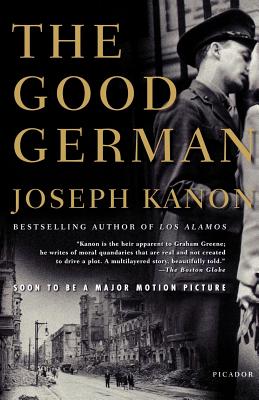 Joseph Kanon has been compared to Graham Greene, and having just read The Good German I can see why. He explores moral questions in a context where the political meets the personal but does so in a format that is recognizable as entertaining - the thriller. Kanon's plot doesn't baby the reader. It is intricate and he does not over-explain the action in a step-wise fashion - a quality I appreciate. Instead, events unfold fluidly through behavior and dialogue, their ambiguities intact. The setting of The Good German is just post-World War II Berlin. The concentration camps have been emptied. Berlin is rubble and the British, the Americans, and the Russians have carved it up into zones and are struggling over how justice can be wrought on the Germans. That's the political part of the story. Into this setting falls the body of an American soldier. No one knows who murdered him or why but a great deal of money is found on his corpse and American reporter Jake Geismar is not content to leave the story alone. That's the mystery/thriller aspect of the story. The book asks one question, the Germans were clearly responsible for the war but who do you hold accountable? The military sent to Berlin to clean up the mess seem to find that, beyond the Nazi party leadership and the camp guards, everyone else seemed to have been following orders or trying to stay alive. No ordinary individual German seems to think they had any culpability. Is a greifer (a spy who turned Jews and other criminalized groups in to the Nazi's) guilty? Even if they are Jewish themselves? How about a scientist who collected statistics for the experiments conducted on unwilling human subjects in the camps? That is the moral part of the story. In addition, Geismar left behind in Berlin a married woman with whom he had an affair and wants to know if she is still alive. That's the love part of the story and in Kanon's hands these four threads of this book blend unselfconsciously. His prose is entertaining but not too brisk at the outset. He takes his time developing the stories and their actors. His dialogue is clipped, sparse, and believable, the moral and political ambiguities are neatly plotted and make good drama, the history is accurate and detailed, and he is good at suspense too. In the last 100 pages there is a terrific escape and chase scene - a real white-knuckler. This is a book that just screams movie - and evidently it was made into one, although I haven't seen it. Have any of you?
 Good news! John Tierney has an article in today's Science Times on Matt Ridley's new book The Rational Optimist. Its thesis is that homo sapiens are unique not because of bigger brains, nor because of our ability to cooperate, but rather because we created ways to exchange goods and information.
"The extraordinary promise of this event was that Adam potentially now had access to objects he did not know how to make or find; and so did Oz," Dr. Ridley writes. People traded good, services, and most important, knowledge, creating a collective intelligence..."This lead to circulating the knowledge of domesticating crops, the development of alphabets, and number systems and, Ridley argues, the creation of measured time, because the worth of a good or service was measured in how long a person would have to work to pay for it. One might also argue that it circulated small pox and MacDonald's but that isn't mentioned.
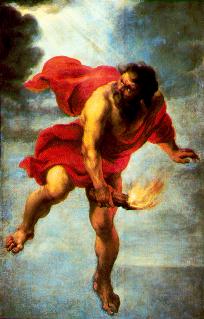
"The modern world is a history of ideas meeting, mixing, mating and mutating and the reason that economic growth has accelerated so in the past two centuries is down to the fact that ideas have been mixing more than ever before."His prediction is the spread of prosperity and happiness and the decrease of disease and violence. I will have to read the book to find out how he goes from point A to point B, and Tierney's piece certainly makes me want to, but I am not sure how mixing inevitably leads only to the progress of good things and the decrease of bad. One might argue that innovation is more likely to diffuse information, that is, that it will spread randomly until it becomes equally distributed. Is knowing more always better? The myth of Prometheus, pictured above, argued otherwise. What happens when bad things spread? The spread of what knowledge we have is inevitable, but is the eternal increase of knowledge inevitably positive? What happens the day that that knowledge includes the certainty of the destruction of our planet or the extinction of our species? But Ridley is a wonderful thinker and writer and amidst crashing markets, bombings, and the growth of the Tea Party, some unbridled optimism is welcome.
 Reading in the Brain by Stanislas Dehaene is a readable account of how the reading brain works, as well as how it doesn't. Given the fact that printed text is a relatively recent human invention and, given the time scale of evolution, the brain could not have evolved specialized structures for reading per se but rather has adapted structures that evolved for more general visual purposes and applied them to this specialized task which combines seeing and recognizing objects and the reception of the abstract thoughts of another person. The form of letters have little to do with the meaning they ultimately communicate. As a result it has become the work of seven to ten of our earlier years to learn rote the relationship between our culture's symbols representing the units of sound (phonemes). These are combined into (words) from which we generate continuous phrases and sentences which accomplish the transfer of information and point of view. This is done at a minimum with some coherence, if not also some beauty, and the composer of those same units of meaning doesn't even have to be around to explain himself. It might seem roundabout that printed text has to take a two step journey from sound to meaning rather than going straight to meaning, but this is what allows language to communicate abstract thought:
I suspect that any radical reform whose aim would be to ensure a clear, one-to-one transcription of English speech would be bound to fail, because the role of spelling is not just to provide a faithful transcription of speech sounds. Voltaire was mistaken when he stated, elegantly but erroneously, that "writing is the painting of the voice: the more it bears a resemblance, the better." A written text is not a high-fidelity recording. Its goal is not to reproduce speech as we pronounce it, but rather to code it at a level abstract enough to allow the reader to quickly retrieve its meaning.The brain accomplishes this remarkable feat, Dehaene tells us (without even being there), via two pathways that operate simultaneously when reading is fluent. One path transfers the letter-string to it sound content (and the motor requirements of our making that sound with our vocal apparatus) prior to its meaning, and the other that goes for the identity of the word first and then the sound. A great number of pages in the book is spent on discussing the fruits of Dehaene and his colleague Laurent Cohen's labors identifying the left hemisphere's visual word-form area, a region of the brain whose purpose seems to be to be the visual analysis of the symbols that make up letters and words irrespective of their superficial differences. That is to say we can read word, WORD, or even WoRd equally easily and can tell the difference between ANGER and RANGE. You can see the visual word-form area in the picture representing the relative activity of regions of Dehaene's reading brain below, its the area right above his ear. There are other areas that accomplish the conversion of printed text into units of sound, still others that agree on the meaning of the assembly given not only its form but its context.
 The typical right-handed person's brain has developed most of its key language processing areas in the left hemisphere (left handers are less reliable in this regard). This is true whether the personn reads from left to right or right to left and whether they read an alphabet whose symbols map to units of sound (as in these roman letters you are reading right now) or comprise pictures of whole words (as in logographic alphabets like Chinese). Dehaene, in fact, explores the evolution of different writing systems from pictoral markers in depth as he builds his case for how the human brain evolved the skill of reading, a section of the book I very much enjoyed.
We would not be able to read if our visual system did not spontaneously implement operations close to those indispensable for word recognition, and if it were not endowed with a small dose of plasticity that allows it to learn new shapes. During schooling, a part of this system rewires itself into a reasonably good device for invariant letter and word recognition.In the book's final chapter, Dehaene discusses cortical plasticity - a neuroscientific idea that is relatively recent and much in vogue. It is the ability of brain's neuron's to adapt their function from one purpose to another - for example, when a blind person's visual cortex cells become able to decode sensation of the fingertips to braille letters. Dehaene makes a case for the necessity of cortical plasticity in inventing cultural forms like number systems and the arts. It's one of those fun bits of reaching for the stars that a researcher has to save for when they write a book rather than a journal article. His voice comes off a little stuffy at times, but his theory is intricate - composed of many interleaving units - so his writing must be systematic in driving home each concept and then attaching is to its predecessor. His model for how the brain accomplishes reading, I must emphasize, is one of several, but he does acknowledge alternate viewpoints along the way. The lay reader may not find this book as accessible as Maryanne Wolf's Proust and the Squid, but it goes into more depth and synthesizes a lot of information into a coherent narrative arc. His diction is clear and the reading experience fluid and even entertaining. Dehaene's work is at the cutting edge of our understanding about the relationship between language and the brain so I found it a pleasure to get the story from one of its sources.
According to this view, our cortex is not a blank slate or a wax tablet that faithfully records any cultural invention, however arbitrary. Neither is it an inflexible organ that has somehow, over the course of evolution, dedicated a "module" to reading. A better metaphor would be to liken our visual cortex to a Lego construction set, with which a child can build the standard model shown on the box, but also tinker with a variety of other inventions.
My hypothesis disagrees with the "no constraints" approach so common in the social sciences, according to which the human brain is capable of absorbing any form of culture. The truth is that nature and culture entertain much more intricate relations. Our genome, which is the product of millions of years of evolutionary history, specifies a constrained, if partially modifiable cerebral architecture that imposes severe limits on what we can learn. New cultural inventions can only be acquired insofar as they fit the constraints of our brain architecture.
So … you’re halfway through a book and you’re hating it. It’s boring. It’s trite. It’s badly written. But … you’ve invested all this time to reading the first half. What do you do? Read the second half? Just to finish out the story? Find out what happens? Or, cut your losses and dump the second half.
If the book is trite, boring, and badly written I doubt I would have gotten half way (unless it's only 100 pages long - I'm willing to give most bad reading experiences 50 pages). There is no question for me on this point - dump it. What am I reading for? Fun, enlightenment, information - whatever the case - it's all for me. I have no obligation to anyone connected with my reading. Even if I have received the book for free to review I won't finish it (in fact, especially then, as I am trying to give an honest reaction to what I have read and it is usually something I would never have read in the first place). Who am I kidding? The author is not hanging around waiting for my opinion, ARCs are publicity, kids. I don't read for my many adoring fans, much as I love them both. Two exceptions - reading for school, I almost always complete assigned reading unless I am simply tortured by it, and reading something written by a friend, although my friends don't usually write things that are trite, boring, and badly written. They don't tend to sin in threes. Where I might sit on the fence is if a book has a dull subject but is brilliantly written (I almost never find this to be the case), or has a killer story but is written in illiterate fragments or a string of endless cliches. Even in these cases, I don't agonize over not finishing a book. Closing doors is healthy. There are enough choices to make in this information-saturated world and ruling one out lightens the burden. Lastly, although I sometimes talk about investing time, an economic metaphor in this case isn't entirely appropriate. If I have invested $1000 in a stock and it disappoints me by going down, to not sit it out means I have lost my money. Having spent a few hours in reading the first half of a book - if it was a good investment, then my time was not a wasted regardless of whether I continue or I stop. If it was obviously not a good investment from the get-go I shouldn't have read so far (and generally I don't). I may invest time to read, but it is only by continuing to invest it when I am getting nothing in return that I experience a loss. That is the reason I don't agonize about pulling out, there is only a cost for continuing. If a book is good enough to make me wonder whether, if I read on, it would improve then there is something compelling in it and I should consider the pleasure of that anticipation its own reward. Any way I look at it, reading is sheer indulgence and I'm going to trust my taste and follow my pleasure since I can't do that as relentlessly in most other areas of life. Anita Brookner's The Debut was her's in the fiction world (she had written art history prior to writing fiction); it was as well my first encounter with her writing, and I was pleasantly surprised. I had been led to expect the repressed work of a bookish spinster, but my experience of this novel about a young woman who has escaped into books to avoid the tyranny of her indulgent actress mother and clueless father, was of a literate mind which energetically subjugates words to its bidding to produce a wry, bittersweet story with acutely etched characters. Her's is a piquant voice, with a clearly defined moral stance, one whose observations are without mercy but also full of humor.
Dr. Weiss, at forty, knew that her life had been ruined by literature.
In her thoughtful and academic way, she put it down to her faulty moral education, which dictated through the conflicting but in this one instance united agencies of her mother and father, that she ponder the careers of Anna Karenina and Emma Bovary, but that she emulate those of David Copperfield and Little Dorrit.
[...]
And yet she had known great terror, great emotion. She had been loved, principally b a leading philologist at the Sorbonne, but that was not her story. Her adventure, the one that was to change her life into literature, was not the stuff of gossip. It was, in fact, the stuff of literature itself. And the curious thing was the Dr. Weiss had never met anyone, man or woman, friend or colleague, who could stand literature when not on the page.
... The taxi had unloaded George and Helen into a maelstrom of returning holiday makers, a world they did not know existed: Elderly men with veins standing out on their foreheads trying to cope with five suitcases, elderly women with swollen feet and glistening white cardigans bought especially for the holiday, enduing the fright of a lifetime in order to enjoy the pleasure they had promised themselves all through the winter, too many children, shrill with tiredness, their long hair sticking to their damp faces, their mouths smeared and stained with sweets and ice lollies, none of them aspiring even to the relative comfort of a taxi, but queuing patiently for buses, shifting their burdens from hand to hand, trying to quiet the children, longing for that cup of tea at home, safe at last for another year.Doesn't that paragraph makes you feel sticky with the grime of a long journey? Brookner's writing can appreciated for its precision, its delicious topography, its consistency of outlook, and its ability to call up visceral experience. There is another similarly potent paragraph on caring for an elderly invalid that is a gem.
In anticipation of writing about Anita Brookner's precisely observed, and sardonic The Debut in the coming days, here is a Paris Review interview with her from 1987. Very exacting in her moral outlook and somewhat rigid in her thinking, she started writing novels in her 50s and has produced one per year. This is the first of her's I have read. Great writing - a potent voice that envelops one in the world of her characters. It is fascinating, as always, to read of her process and her influences.
 William Trevor's new book Love and Summer is a wistful tale, redolent of lost chances. Its first third, as its characters are introduced, feels more like a set of short stories than a novel. The narrative ambles from neatly sketched character to neatly sketched character in desultory prose that eventually settles down to tell a predictable yet still involving story.
Miss Connulty didn't care any more. They could do what they liked: delicious death had been a richer compensation than she had ever dreamed of. She was in charge, and today she wore the pearls.Ellie Dillahan, an orphan in the care of the nuns, receives her good fortune in becoming the the servant of Mr. Dillahan, a farmer, who eventually marries her. Both women's routines are disturbed by the appearance of Florian Kilderry, a young dreamer on a bicycle.
She wondered if she would be the same herself; if she was no longer - and would not be again - the person she was when she had gone to Mrs. Connulty's funeral and for all the time before that. When he had asked whose funeral it was it had been the beginning but she hadn't known. When Miss Connulty had drawn her attention to him in the Square she had realized. When he'd smiled in the Cash and Carry she'd known it too. She had been different already when she stood with him in the sunshine, when he offered her the cigarette and she shook her head. Anyone could have seen them and she hadn't cared.Each woman has been rescued from misfortune, Ellie from loneliness and poverty and Miss Connulty from an early pregnancy out-of-wedlock. Each accepts her salvation into a passionless world of routine without question, realizing only later what they have given up, and in the heat of a summer, Florian Kilderry, almost a ghost haunting the ruins of his family's estate, ignites their fantasy.
 Carl Zimmer has an excellent piece in today's Science Times focusing on the notion of deep homology in genes. Deep what, you ask? Zimmer begins by writing about research to find genes that play a role in the growth of blood vessels. The hope is that if these genes can be identified, they can be turned off and slow the growth of tumors. The genes are part of the yeast genome which doesn't even have blood, let alone blood vessels, and Zimmer's article reveals why cancer researchers would bother to look at genes that repair cell walls in yeast.
In other words, new structures share common genetic ancestry with older structures. The human eye and the contemporary jellyfish eye, for example, evolved not from anything that looks remotely like an eye, but from cells in aquatic species that also had light-sensitivity. What these structures have in common is a genetic sequence that provides the template for the assembly of c-opsin - a light-sensitive protein. And that is the most important point that Zimmer's article and the articles by Shubin and Carroll make to me. Genes rarely directly make disease, they don't directly encode complex behavior, and they aren't even "designed" for the purpose of building a given anatomic structure per se. Genes sequence proteins and in the context of different organic substrates those proteins can be adapted for specific functions. It is fun to get lost in the speculative connections that books like Richard Powers's latest make about "happiness genes," and the like. But it is worth being cautious about allowing such dreams to drive scientific terminology. This is well illustrated by the following excerpt from Zimmer's article:Advances in developmental genetics, palaeontology and evolutionary developmental biology have recently shed light on the origins of some of the structures that most intrigued Charles Darwin, including animal eyes, tetrapod limbs and giant beetle horns. In each case, structures arose by the modification of pre-existing genetic regulatory circuits established in early metazoans. The deep homology of generative processes and cell-type specification mechanisms in animal development has provided the foundation for the independent evolution of a great variety of structures.
Then maybe we shouldn't call them neuron-building genes? It's easy, if one is driven by a passion for a narrow sliver of knowledge, to see everything as related to that expertise. It makes sense to drive hypothesis-making with our knowledge of genes, since their action precedes any biological function or structure we can observe, but this article reads like a cautionary tale regarding attaching structural significance to a gene if knowldge of its function is not secure. Genes sequence proteins. Genes sequence proteins. Read Zimmer's article - it combines clear writing about contemporary basic science with a good story about current newsy science. A really good piece.Scientists are also discovering that our nervous system shares an even deeper homology with single-celled organisms. Neurons communicate with each other by forming connections called synapses. The neurons use a network of genes to build a complete scaffolding to support the synapse. In February, Alexandre Alié and Michael Manuel of the National Center for Scientific Research in France reported finding 13 of these scaffold-building genes in single-celled relatives of animals known as choanoflagellates.
No one is sure what choanoflagellates use these neuron-building genes for. The one thing that is certain is that they don’t build neurons with them.
 I just came across two excerpts in Richard Dawkins's collection of science writing that reminded me what gives me pleasure about reading science. One is geneticist J. B. S. Haldane's "On Being the Right Size" and the other, Zoologist Mark Ridley's "On Being the Right Sized Mates" from his 1983 book The Explanation of Organic Diversity. Haldane's essay muses on how the physical structure of animals evolved to the "right" size for their makeup. As an example he uses the giants from the books of his childhood,
These monsters were not only ten times as high as Christian, but ten times as wide and ten times as thick, so that their total weight was a thousand times his, or about eighty to ninety tons. Unfortunately the cross-sections of their bones were only a hundred times those of Christian, so that every square inch of giant bones had to support ten times the weight borne by a square inch of human bone. As the human thigh-bone breaks under about ten times the human weight, Pope and Pagan would have broken their thighs every times they took a step. This was doubtless why they were sitting down in the picture I remember. But it lessens one's respect for Christian and Jack the Giant Killer.I love the fact that Haldane uses his childhood memory of Pilgrim's Progress to communicate to his reader what he is thinking about the physiological evolution of animal life. The best teaching occurs, I think, when the teacher themselves can get back to what initially ignited their own interest about their subject and communicate from that vantage point. Haldane then goes on a musing spree which covers the structure of members of the animal kingdom ranging from insects to giraffes. How an insect's structure allows it to fall without danger, but if it gets wet it is likely to drown. Tall animals require a certain strength pump and vessels for the circulatory system that convey blood to their extremities, however, this puts them at risk for high blood pressure or problems associated with vascular weakness. How do wings permit flight? How do different respiratory structures - those that have evolved with gills and those with lungs - accomplish the oxygenation of blood? And given these diverse means, what are the upper limits of the size of the animal that possesses them? Haldane not only informs us of the vagaries of the natural world we are a part of, he communicates the verve with which he observes that world, and with witty prose drives the reader forward. It is little wonder that he inspired Mark Ridley's observation that species have evolved to favor homogamy, that is, like mates with like. What I enjoyed about this brief essay is Ridley's debunking of the well-entrenched myth that in human affairs of the heart, opposites attract.
'it is a trite proverb that tall men marry little women...a man of genius marries a fool,' a habit which Murray explained as 'the effort of nature to preserve the typical medium of the race.' The same thought was expressed by the vast intellect of Jeeves, to explain the otherwise mysterious attractions of Bertie for all those female enthusiasts of Kant and Schopenhauer. The source of this proverbial belief is not certainly known; but one possibility can be ruled out. It did not originate in observation: humans mate homogamously (or perhaps randomly) for both stature and intelligence.Myth-busting is not just a darn good time - especially when indulged in with such gusto - but doubting our assumptions is vital to the continued development of our knowledge. This is also another of many instances in Dawkins's juicy compendium in which learning something new is married to lucid, entertaining writing. The danger of this volume, however, is its tendency to bloat the TBR list. I've made it a rule to only jot down my desired titles at this point, and not engage in any impulse buying. We'll see how long that holds! Here are my other posts related to The Oxford Book of Modern Science Writing 1, 2.
 Tatiana de Rosnay's Sarah's Key alternates two narratives, one set in 1942 as Paris's Jews are rounded up by their own police and sent to Auschwitz to impress the Nazis and their Gestapo, with whom they had recently allied themselves. The other set in 2002 Paris, as Julia, an American journalist married to a Frenchman, researches the story of Vel' d'Hiv' (the French name for the roundup). She discovers that the apartment that has belonged to her husband's family and into which they are planning to move after a renovation, was originally occupied by a Jewish family and suspects it may have been acquired through less than above-board methods. It becomes her obsession to find out who occupied that apartment and what happened to them and the knowledge changes her life as the book cover's blurbs assures me Sarah's Key will change mine. What amazed me rather was how predictable and lacking in personality this book club favorite is. It's pop-chick-lit meets pop-Holocaust novel. Think Sleepless in Seattle meets Life is Beautiful. Never complex, never subtle, Sarah's Key held not a single surprise for me either in how its historical plot unfolded nor its contemporary one. The writing was clunky - constantly explaining the obvious - usually with a cliche.
Her mother. Her father. Her brother. She missed them so much she felt physically ill. She felt as if she had fallen into a bottomless hole.
or
"I can still hear her scream," he whispered. "I cannot forget it. Ever."What Sarah's Key does have going for it is plot. Vel' d'Hiv' is heart wrenching history and the reader uncovers the details on a factual basis and on an imagined personal one, learning what happened as Julia learns it. It's a good device but the contemporary plot aligns with the historical one too neatly, the children in the story parallels Julia's pregnancy, the apartment she is renovating happens to have been inhabited by a Jewish family, I feel like the novel is constantly hitting me over the head to make sure I got it. I got it.
 Richard Bausch's new collection of stories, Something is out there. observes the strong passions of everyday life. I think his greatest skill is making what is internal - what is going on in the heart or the mind of his characters - external without our being precisely aware at the moment of the arrogance of the invasion. In the title story, the action is a kind of surreal malaise experienced by two sisters resulting from the shooting, earlier that day, of one of their husbands. As a blizzard envelops them, the two sons tend to the practical business of shoveling snow as they await the arrival of their cousin, the son of the other sister. One sister is forward-focused and a doer, the other ruminative and hysterical.
Dora wandered back into the kitchen and then on, to her room. The boys talked about shovbeling the walk again. Paula said to go ahead; it was something for them to do. She couldn't quite voice the thought - it was too ordinary, really, almost childlike - but it seemed impossible that the trauma of the afternoon's trouble and anxiety could be added to by anything serious where Christopher was concerned. The world she knew did not act that way. She wanted to say something to the boys - to tell them that the day's misfortune was sufficient, plenty enough for anyone, and surely the world would not add to all that. But then she understood the irrational nature of this line of thinking; there was not going to be anything sensible or logical about this day. She felt a little freezing current of air under her heart, and tried to concentrate on watching the boys shovel the walk again. They barely made any headway.How subtly and exactly he captures that wandery, threatening, other-wordly atmosphere of a confrontation with mortality - the aftermath of the storm of adrenalin, the sense-making exercises the mind engages in. Bausch doesn't write what Paula thought but rather what she doesn't think, but what sits at the edge of her mind behind her actions. Nor does he litter his prose with the predictable 'she thought to herself.' Instead he observes what people do, what they say, the idiosyncratic content of a sensory detail that comes to their awareness, and the understandings they then possess out of these experiences. That "freezing current of air under her heart," how perfect and precise a physical detail. A winter storm inside to match the winter storm outside.
"Give me a call before you leave town," Benjamin says to them both. "We could sit out on my balcony and share a bottle of wine." He realizes, as he speaks, how lonely this makes him sound, and as he tries to find something else to say, some words indicating with the proper amount of casualness that others would also be there, Jesse cuts him off. "We'll do that, you bet," he says in the tone of someone already forgetting the invitation, and walking away with his lovely woman on his arm, and his obvious pride in being happy, in love. Benjamin walks down the sidewalk, past an old man - the same old man, he realizes, that he had seen earlier - who comes storming by him with that rickety walk, hands shoved down in his pockets. The whole world is bright sun, and the man's eyes are narrow, furious, the mouth deeply frowning.What a masterful conflagration of detail, like an episodic stage play in which the summing of unrelated scenes creates a complex drama that the participants aren't event aware of.
I wrote in my last post on Richard Dawkin's fine collection of science writing of hypothesis testing - a part of the scientific method which helps us to build our body of knowledge about the world through disciplined comparison. This is how it works. Scientists pit a hypothesis that says that what they think is not true (the null hypothesis) against an alternate hypothesis (their own). For example, if the scientist is testing the effect of a drug to cure the common cold, he might take two groups of people with nasty colds, give one the drug and the other a sugar pill. His claim might be that those who took his drug will sneeze fewer times a day than those who took the sugar pill. His 'null hypothesis' would state that there will be no difference between the two groups - that both will sneeze the same number of times after taking the pill. This is the result he does not want. If his experiment is successful, he cannot prove his hypothesis per se, because no one can test every instance of something, but what the scientist can do is reject the null hypothesis to some degree of certainty. It is up to not just this probability,but also to the experimental design to say that the reason the sneezing decreased was the drug and not something else. Our experimental design would have to account for other explanations, such as the fact that the cold ended naturally on its own - something science calls controlling the experiment.'It has not escaped our notice that the specific pairing we have postulated immediately suggests a possible copying mechanism for the genetic material.'So creative scientists are also good at something that might be called informed musing. In fact most creative people of all kind are. I might add to Dawkins cautionary concluding sentence that a responsible reporter of science will always let you know which they are doing - testing a hypothesis or musing.
The quality of mind that enabled Watson and Crick to race ahead of their laboratory-based rival Rosalind Franklin is well demonstrated by that sentence, and it is shown again in the extract I have chosen from Crick's book Life Itself: Its Origin and Nature (1981). Watson and Crick were not only concerned with finding out how things actually are - although that was of course their ultimate goal. They also kept in mind the way DNA ought to be if it was to do its job as the genetic molecule, and this gave them a short cut, which was ignored by the painstaking Rosalind Franklin...it is in general true that deep cogitation on the way nature ought to be constitutes a good prelude to the eventual investigation of the way it actually is. Only a prelude, however: the ultimate test of an idea is not its elegance but how will it explains reality.
...build packets of order and complexity called bodies but at the cost of expending large amounts of energy. In Erwin Schrodinger's phrase, living creature 'drink orderliness' from the environment.Isn't that fantastic? He goes on to connect the building of a body with the need for information. That information must be storable (the DNA of our genome) and must be both readable and replicable. Less than two pages later, Ridley speaks of the year 1943 as the time when diverse ingredients began to coalesce in a way that would eventually transform how we know our world. Here is what I mean by a unique mind being able, through its own peculiar fund of knowledge and its uniquely creative disposition, to see what no one else can. Ridley writes of what Watson and Crick were up to, the tortures Josef Mengele was enacting at Auschwitz, the work of Oswald Avery that prefigured the connection of DNA to heredity, and the brilliant Alan Turing, who was creating a computation machine that also could store information, modify it, read it to enact functions, and replicate it. What Ridley sees and writes of with panache is the excitement in disparate disciplines that prefigured the connecting of biological code to heredity. It's a visionary discourse that exemplifies what I wrote of in the last post inspired by Dawkins's collection, that strong feeling precedes scientific inquiry.
 I have also continued my travels with another unique mind - that of Richard Bausch - in his latest story collection, Something is Out There. "Son and Heir" is a devastating portrait of dissolution of the aimless son of a college president. Lyndhurst, the son, is a pitiable character whose combination of pride and inherent mistrust leads him to make a series poor judgments. This mistrust is predicated on his having witnessed his respected father's infidelity toward his mother alongside the public continuance of their marriage - a hypocritical facade - to which Lyndhurst has developed over time his own facade of not caring. Here too we see information stored and replicated, this time in a maladaptive pattern, no doubt initially developed to protect Lyndhurst from hurt but, in the long run he is never able to modify his mistrustful picture of the world so that he might experience it as a place where effect can predictably follow cause. Bausch's portrait of Lyndhurst's anxiety and hurt are set in the context of the great power failure during the intense heatwave the Eastern half of the U.S. experienced several summers ago. He cooks them to the boil.
Bausch's narrative voice is patient, gentle, clearly of the South. His subject matter quotidian heartbreak - the strain in a marriage between an older and a younger artist, the selfless gesture of a son towards his dying mother, the adulterous adventure of a reverends wife.
I have also continued my travels with another unique mind - that of Richard Bausch - in his latest story collection, Something is Out There. "Son and Heir" is a devastating portrait of dissolution of the aimless son of a college president. Lyndhurst, the son, is a pitiable character whose combination of pride and inherent mistrust leads him to make a series poor judgments. This mistrust is predicated on his having witnessed his respected father's infidelity toward his mother alongside the public continuance of their marriage - a hypocritical facade - to which Lyndhurst has developed over time his own facade of not caring. Here too we see information stored and replicated, this time in a maladaptive pattern, no doubt initially developed to protect Lyndhurst from hurt but, in the long run he is never able to modify his mistrustful picture of the world so that he might experience it as a place where effect can predictably follow cause. Bausch's portrait of Lyndhurst's anxiety and hurt are set in the context of the great power failure during the intense heatwave the Eastern half of the U.S. experienced several summers ago. He cooks them to the boil.
Bausch's narrative voice is patient, gentle, clearly of the South. His subject matter quotidian heartbreak - the strain in a marriage between an older and a younger artist, the selfless gesture of a son towards his dying mother, the adulterous adventure of a reverends wife.Keeping strictly to the early-morning ritual, Diana prepared coffee, boiled one egg and lightly buttered two slices of toast for him, then put cereal on for the girls, and went and dressed for the day, while they ate. When they were finished, she rinsed the dishes and put them in the dishwasher. In the usual rush, she saw the twins off to school, brushing Lauren's hair for her, nagging Kelly about brushing her teeth thoroughly to get the food particles that had lodged in her braces. All as usual. So much the exact pattern of her mornings. The ordinariness of it made her happy, and it surprised her. It also increased her sense of unreality.The economy of this opening paragraph is a pleasure. We know Diana's day is structured, regular, but not a burden. That Diana's husband is a creature of habit, a reserved man - one egg, the toast lightly buttered - I call up the picture of an English parson. We also know that this will not be a typical day, but we don't know why, and so Bausch has created suspense in a scene of the most familiar ordinariness. Bausch fashions a world that is familiar almost to the point of cliche, but rescued from that fate by its being particular to individual lives. He accomplishes this through the use of detail. Each of the three worlds of his I have entered so far envelops me in its totality. We get to know its key citizens, usually just two or three people, very intimately. We go deep, not broad. The kind of encounter I leave feeling it has been of value.
Contrast this with the bestseller, Sarah's Key. Two alternating narratives, one set in 1942 as Paris's Jews are rounded up by their own police, one of many episodes in France's embarrassing Vichy past that had been swept under the carpet for many years. The other set in 2002 Paris, as an American journalist, who is married to a Parisian, takes ownership of an apartment originally inhabited by one of those Parisians who were shipped off to Auschwitz in 1942. De Rosnay tries for distinct voices - there is a third-person narrator in 1942, but one focused on the character of a young girl. This makes for a combination of omniscience and innocence that sounds awkward to the ear in a way that has yet to resolve itself sixty pages in. In 2002, we read the first-person voice of the American journalist, Julia. This tries for a relaxed, contemporary tone peppered with confessional detail about her marriage to Bertrand and her friendship with two cool gay fellows that I care nothing about, having not the slightest idea who she is, as well as awkward dialogue from her 11-year-old daughter.Bertrand waved to us, then pointed to the phone, lowering his eyebrows and scowling.Was this written for the Disney channel? "Like he can't get that person off the phone?" Like I can believe this sentence is being spoken by a Parisian 11-year-old who is continually 'scoffing' and 'adding grimly' - can she never simply 'say' anything? "First, her height, which dwarfed all her girlfriends - as well as her feet" Second, which comes after first, this is not a sentence. And, if I read this correctly, did her feet dwarf all her girlfriends?
"Like he can't get that person off the phone," scoffed Zoe. "Sure."
Zoe was only eleven, but it sometimes felt like she was already a teenager. First, her height, which dwarfed all her girlfriends - as well as her feet, she would add grimly...
"I have to go," I said. "Meeting with Joshua."School on Wednesday not on Thursday. Got it. Glad we got that exposition out of the way. I keep waiting for Mickey Rooney to run on from behind a curtain and sing a number.
"What do we do with Zoe?" asked Bertrand.
Zoe rolled her eyes.
"I can, like, take a bus back to Montparnasse."
"What about school?" said Bertrand.
Roll of eyes again.
"Papa! It's Wednesday. No school on Wednesday afternoons, remember?
Bertrand scratched his head.
"In my days it - "
"It was on Thursday, no school on Thursdays," Chanted Zoe.
"Ridiculous french education system," I sighed. "And school on Saturday mornings to boot!"
 The Ragazzo brough home a Belgian wheat beer flavored with coriander, orangeskin, and liquorice - Blanche de Namur. Great on a hot weekend afternoon, we found, with some hearty rye and a strong cheese.
 Ed Young of Not Exactly Rocket Science (an excellent science blog) has a great piece in New Scientist; think of it as a consumer's guide to critically reading genetics claims in the press. The habit of pitting nature and nurture against each other as mutually exclusive categories is as ubiquitous as the mind/body duality, and it is just as misguided. He also warns us that genes with catchy names are usually misleading. Check out his other concise, clearly written advisements via the link. I find that there is too little appreciation among the commonly educated person of what science does (as opposed to, say, the average understanding of the value of the medical practitioner whose practice is served by science but is not, generally speaking a scientist). I feel I should do more frequent science posts along with my book posts to address this imbalance! This post will give you some of each.
Living organisms are configured into layer upon layer of complex structure. Atoms are assembled into complex molecules; these react, via complex pathways in every cell, and indirectly lead to the entire interconnected structure that makes up a tree, an insect or a human. We straddle the cosmos and the microworld - intermediate in size between the Sun, a a billion metres in diameter, and a molecule at a billionth of a metre.What follows is a ode to the interrelatedness of what Rees calls inner and outer space that makes me want to immediately read his book. (Which I may do after I graduate). I have a feeling that this is going to be one of those books that leads to reading many other books. How very in the spirit of scientific inquiry. If you are interested in a volume that could whet your appetite for original writing by scientists, this is an enticing smorgassboard of excerpts as brief as they are various.


 Bernard MacLaverty's Cal - 150 pages that are as densely packed with passion and tension as any I've read in Dostoyevsky or Hardy. The 19-year-old title character lives in Northern Ireland. A Roman Catholic, he is hounded and physically attacked by the Protestant Orangemen. His friends have joined the IRA in response to the violence with which they are threatened. Cal finds the violence too much for him. The struggles of nations would not be important if they didn't effect the lives of individual people. This book is about the converging of conflicts political and personal - the political and religious struggles of an oppressed people, a first great passionate love, and the dilemmas of a sensitive and thoughtful teenager as he makes the moral choices that are going to shape his whole life. I felt deeply the greatness of these struggles as I read. Read my full rave here.
 This book has everything - love, suspense, moral conflict, social criticism, psychological acuity, and crack writing. It is pitch-perfect on the a fast-paced, ostentatious, brutal beauty of Rome. Lambert's writing is rich with observations both interior and exterior that imbue character and place with clarity and instantaneous complexity. This novel, though entertaining to read, is an unambiguous critique of the moral hypocrisy that infects the powerful and the nature of crime which combines an abuse of power with the dehumanization of innocent people. Read my full rave here.
 Molly Fox is a celebrated actress - a woman who delves deep into what makes up a 'self.' It is her profession to create characters from that knowledge through the medium of her self. Yet, when it comes to letting others truly know her, she does not. 'Can we ever know another?', this novel asks. The Irish novelist Deirdre Madden fashions a deep and beautiful book on this potentially abstract musing that is redolent with the pain of the distance we have from all others - even those we love most - and simultaneously rich with the rewards of the communion we can make through long acquaintance. She is particularly good at using the processes of the actor and writer to reflect on the ways we can inhabit the inherent contradiction of knowing another, but the mechanisms are so integrated with the events of this narrative that it is difficult to reveal them without ruining your reading of this book. This book is a powerful work of art with an undisturbable sense of wholeness. Read my full rave here.
 The struggle to keep the champagne bubbling when it's gone flat is the action filling Evelyn Waugh's 1930 satire Vile Bodies. Stephen Fry's brilliant film adaptation, Bright Young Things released in 2003 captures the feel of a breathless, manic party. Jim Broadbent, Stockard Channing, Peter O'Toole, Simon Callow, Stephen Campbell Moore, Emily Mortimer, James Mcavoy, Imelda Stuanton, and Fenella Woolgar are some of the beautifully cast actors who maintain an understated hysteria, if you can imagine understated hysteria. The love that director and cast have for these characters is what impresses me the most. It would be so easy to show us how vile these people are - how silly, how louche, how fey - but instead they love them to death. Raveworthy. Read my full rave here.
 Tell Me Everything by Sarah Salway . I opened this book last night and didn't stop reading it until I had finished it. The nearest voice I can think to compare Sarah Salway's to is Lorrie Moore's, and coming from me that is a big compliment. In it Molly experiences a few breaches of trust as a young woman that leave her seriously wounded. She closes down and protects herself by eating. When we meet her she has become one of life's castaways, seriously overweight without a job, a home, or any sense of herself. She meets five people - Mr. Roberts who gives her a job, Mrs. Roberts, Tim - a man of mystery, Liz - a librarian who recommends French authors, and Miranda, a hairdresser. With these relationships she begins to reclaim herself. The story is full of perfectly wrought descriptions, complex observations of human pain and fantasy, and cogent storytelling. Read my full rave here.


