Saturday, July 31, 2010

Delightful scientific romp...without costs (Books - Journey to the Centre of the Earth by Jules Verne)

I re-read Jules Verne's delightful scientific romp (for the first time since I was about 12 years old) in connection for a project at my lab. The connection between the book and my lab is a long story I won't get into, but I found myself drawn in all over again to the combination of curiosity about the facts that describe the actual we inhabit and a confection of suspense and adventure by the father of science fiction.

The story concerns a nineteenth-century German geologist and his naive nephew on a journey they try to make to the earth's core when they uncover an ancient cipher that gives them directions via the crater of an icelandic volcano (ring any bells?). Many of the details of the book are faithful to the mid-nineteenth century understanding that Verne's contemporary measurers and thinkers possessed. But there are also flights of sheer fancy that don't remotely conform to anything that could be possible. Progressing that far, I found that I was invested enough in the progress of the narrative to believe in them for the sake of the story.

Two things struck me about this fantasy. One was the preponderance not just facts we know and the hypotheses that flow from the knowledge naturally curious minds possess, but also the quality of thinking which we would term today "critical." For example:
"There is a positive pleasure even in feeling one's self getting into a denser atmosphere. Have you noticed the wonderful clearness of sound here?"

"Yes, indeed. A deaf man would soon get his hearing again."

"But this density will of course increase?"

"Yes, according to a somewhat indefinite law. It is true that the intensity of the weight will diminish in proportion as we descend. You know that it is on the surface that its action is most felt and at the centre of the globe objects have no longer any weight..."

"How shall we descend then?"

"Well, we must put stones in our pockets."

"I declare, uncle, you have an answer for everything."

I did not dare to go any father into the field of hypothesis, for I should have been sure to have stumbled on some impossibility, which would have made the professor start out again.

But it was quite evident that the air, under a pressure of possibly a thousand atmospheres, would pass at last into a solid state; and in that case, even supposing that our bodies might have held out, we should be forced to stop in spite of all the reasonings in the world.

But it was no use advancing this argument. My uncle would have met me with that everlasting Saknussemm, a precedent of not the slightest value, for even quoting the truth of the learned Icelander's narrative, this simple answer might be made to it: "In the sixteenth century neither barometers nor manometers were invented, consequently, how could Saknussemm know that he had reached the centre of the earth?"
There is a propensity to question, to doubt, out of respect not disrespect, that is evident in this book. There was a time criticism was deemed valuable to the accumulation of knowledge. I was also struck in this novel with this fact. When faced with a wall of granite that stood between them and the knowledge they sought, the solution of the professor and his nephew was dynamite. Symptomatic of all that is good but also all that has been destructive in our acquisition of knowledge - they blew it up. The result is that they gain the knowledge they seek but much havoc has been wrought in our attempt to understand the way the world works. Nuclear energy is one such example. With the hindsight of nearly 150 years, this novel offers clear examples of this urge naively pursued. Journey to the Centre of the Earth remains a fantastical entertainment but is unwitting about the potential costs of such exploration. However, these were salient to me in the light of the recent BP disaster, although this being what one would define in a literary sense as a comedy - there are no lasting consequences.

Wednesday, July 28, 2010

Novelties IX

Haven't done this in a while:

Eating:

Since they are available in abundance right now - zucchini sauteed in olive oil, cook until just tender, a little green onion for the last two minutes, then lots of mint and some basil mix it in for a minute, juice of a lemon, mash with a potato masher, eat on toast with ricotta or feta cheese or on pasta w/ parmesan and some pasta water. Mmmmmmm


Drinking: Lately I've been going for strong, black iced coffee - no sugar, no nothing.

Looking: My obsession with Almodovar's films has led me to the wonderful singer Caetano Veloso. Here he is singing Cucurrucucu Paloma in a scene from Almodovar's Talk To Her


Listening: I don't know if you ever listen to The Tavis Smiley Show on NPR, but he had on a panel discussion last weekend about the non-violence movement and the likelihood of a peaceful world in this century. Follow the link above. What I found most interesting about it was hearing a room full of adults talk with idealistic passion. It reminded me of something I have lost. In my late teens and early twenties I shared this same hope. My expectations of human nature, unfortunately, currently predispose me toward a more cynical view.

Surfing: 1, 2, 3, 4

Learning:

It's sex week at The Loom so go and learn something!

Don't believe everything you read.

And in the No... really department. Who can resist: MRI scans of fruits and vegetables? Not I. This is canteloup. Veggies are not just for eating any more.

Hat tip: Better Health via The Happy Hospitalist.

Saturday, July 24, 2010

Chronicling our lives (Books - The Imperfectionists by Tom Rachman)

With the amount of writing I have to do in the rest of my life right now, my reading and writing are both a bit curtailed. However, I did manage to finish one book this steamy Friday evening.

Tom Rachman's debut novel The Imperfectionists is about the lives of those who work for an American-owned, English-language newspaper in Rome and the progress of paper from an age of literary print-journalism to the electronic age. His writing is specific and observant:
Lloyd shoves off the bedcovers and hurries to the front door in white underwear and black socks. He steadies himself on the knob and shuts his eyes. Chill air rushes under the door; he curls his toes. but the hallway is silent. Only high-heeled clicks from the floor above. A shutter squeaking on the other side of the courtyard. His own breath, whistling in his nostrils, whistling out.

Faintly, a woman's voice drifts in. He clenches his eyelids tighter, as if to drive up the volume, but makes out only murmurs, a breakfast exchange between the woman and the man in the apartment across the hall. Until, abruptly, their door opens: her voice grows louder, the hallway floorboards creak - she is approaching. Lloyd hustles back, unlatches the window above the courtyard, and takes up a position there, gazing out over his corner of Paris.

She taps on his front door.

"Come in," he says. "No need to knock." And his wife enters their apartment for the first time since the night before.
Come on. Don't tell me you're not interested. The soap-opera that is that lives of his characters, who range from the veteran hack journalist to the obituary writer, from the CFO to a board member, to a reader, is passionate and often quirky. The way the set-pieces that constitute each chapter intersect with their era of newsmaking, and with each other, is the captivating accomplishment of this novel.

The themes - memory, loss of past, the need to chronicle our existence and, at times, the seeming waste of that activity too.
"What I really fear is time. That's the devil: whipping us on when we'd rather loll, so the present sprints by, impossible to grasp, and all is suddenly past, a past that won't hold still, that slides into these inauthentic tales. My past - it doesn't feel real in the slightest. The person who inhabited it is not me. It's as if the present me is constantly dissolving. There's that line of Heraclitus: 'No man steps in the same river twice, for it is not the same river and he is not the same man.' That's quite right. We enjoy this illusion of continuity, and we call it memory. Which explains, perhaps, why our worst fear isn't the end of life but the end of memories."
The chapters are stand-alone pieces. The choice detail capturing character or situation, the efficient passage of time, the perfect little twist that comes at their endings (occasionally a little too perfect) - all feel very much like short stories. I wouldn't say that every story is equally successful, but their final accumulation is quietly affecting and entertaining. I was particularly taken with the story **SPOILER ALERT** of the obsessive widow of a diplomat who has read each copy of the paper since the day in 1976 her husband was posted to Saudi Arabia, only it takes her so long that in the present day of the story, around 2007, she is still stuck on April 23, 1994 unable to move on because the following day was a traumatic landmark in her own life. **SPOILER OVER**

It is evident from this intelligent and somewhat nostalgic book that Tom Rachman places great value on the way that we record the events of our lives. His own move from journalist to novelist is an interesting coda to it. I would enjoy hearing him speak about the difference between the values a journalist and a fiction writer each bring the job of chronicling our memories and why he switched forms.

Sunday, July 18, 2010

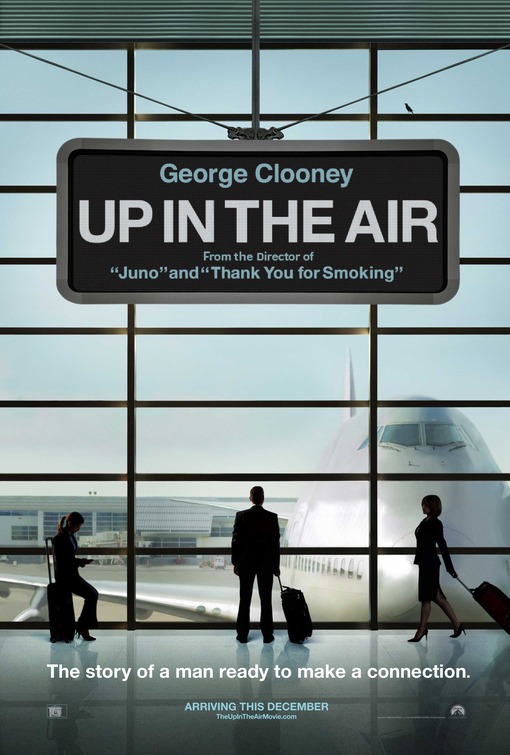
Artistic attempts to render the void and then fill it (Theatre - Teorema & Film - Up in the Air)


The two works of art I saw this weekend could not have been more different, but they both concerned people with lives of outer perfection but inner emptiness for whom a key event shatters their complacency.

One of the theatre directors I admire most, Dutch director Ivo van Hove, has a love of raw emotion exploding into unsuspecting lives and an interest in adapting either classic theatre works in provocative multi-layered ways or turning great film into theatre. I have seen many of his works - Ibsen's Hedda Gabbler, Eugene O'Neill's More Stately Mansions, Tennessee Williams's A Streecar Named Desire, Alice in Bed by Susan Sontag, and one of the best pieces of theatre I have ever seen, his adaptation of John Cassavettes cruel film Faces. Last night, members of his company Toneelgroep Amsterdam and a live string quartet, Blindman, performed his adaptation of Pier Paolo Pasolini's Teorema as part of this year's Lincoln Center Festival, one of the opportunities to see really interesting cutting edge international performing arts in New York every summer. Pasolini was an Italian avant-garde filmmaker, poet, and political activist who both led a life and composed work of passion and complexity. In Teorema a mysterious visitor enters the lives of a wealthy suburban family and shakes their empty routine to the core - for some of them this means awakening them to their basic drives for connection and sex, and for others it means stripping them clean of their trappings of wealth so that only their naked need remains. A large, grey, carpeted modern-home-like set was plopped into a large warehouse on Governor's Island in New York. So, as with many van Hove productions, the space played an important role in the theatrical experience. One had to take a Ferry and then walk 20 minutes on an Island with a compound that used to belong to the Coast Guard and now houses various artistic venues - it looks a little bit like something out of the Others compound in Lost.

In the Pasolini film, Terrence Stamp played the visitor, and his power was very much a religious one and the urges he released divine. In van Hove's adaptation, the visitor is a young vigorous man with the darker complexion and tight curls of someone who could be of Arab descent, his exact place of origin isn't all that important, what is important is that he is the "other" to the white, upper class family he visits. It is this otherness that seems to encourage these protected suburbanites to see this force in their visitor. In this production the force is more animal than divine, represented in this production by a scene the visitor enacts with a ferocious looking German Shepherd.

The visitor undoes each character in turn, but while the actors describe the acts he performs on them, in actuality it is they themselves that manipulate the visitor. He seems to become an excuse for them to release themselves, though they don't have to blame themselves for it, they can blame the unruly "other," unlike them with his darker skin, his freedom from possessions, his ease with his body. This is frequently a role "others" are given in societies. The magic and wealth that have been fictitiously given all Jews to possess, the violence and sexuality credited the black male, the bacchanalian carnality credited gay people, it seems to me that they project upon their other the force in themselves they desire most and are therefore most afraid of releasing (how Freudian of me). In any event, I found this choice a very effective one.

The text is a poetic, third-person narrative spoken by each character about himself over a microphone, creating a distance between them and their story. Yet while they narrate themselves they participate emotionally in what the character experiences in the story, so there is an alienating meld of voice-over and character, of closeness and distance that seems very much the point of the production. The people walk about holding themselves at arms length never entering their story, yet they are filled with fierce passions lying just beneath the surface. Once he has unburdened each of them of course he leaves. The cast then rip up the walls and the floor of the mod set, creating a passion-torn landscape. Then each ritualistically perform an extended monologue of where their unleashed passion took them after he had left, how they searched for him and never found him. Each character is liberated but finally undone, except for the servant, who I will discuss in a moment. Some of the images were quite effective. As the father walks naked through the rubble of his house, which is also the train station in his city, and tries to unleash a scream that can be heard above the roar of complacency, the stage picture evoked the violence of a Francis Bacon painting. Visceral, bloody like a piece of meat, a single agonized person in a space where modular walls are often visible against a larger and less clear background. I also very much enjoyed the use of a live string quartet, a rich sonority contrasting the otherwise cold palette of sound, lighting, and set, whose repertoire moves from becomes ever more atonal as the evening's dissolution progresses.

Unfortunately, I found the production somewhat undone by its own ideas. It was tied too slavishly to its pictures and theatrical rituals and shortchanged the story telling too much for my taste. The formality of having the visitor first encounter each of the family in turn and then having each of them ritualistically take turns in describing their unraveling (in the same order) became too predictable. The monologues' length did not sustain their interest given the repetitive structure and the familiarity of the physical trappings in this production which, although they partook of the language of experimental theatre, were well used cliches of the form. I have found many of van Hove's productions startlingly original, but this was not one of them. Van Hove also chose to depart from Pasolini's more religiously infused ideas, but with the character of the servant he never succeeded in replacing them with anything else. In the film, she goes home to her village and performs miracles, in this adaptation, she climbs stairs behind the set to theatrically approximate floating on a cloud, but then returns to the rubble of the set and sits smiling beatifically. I loved the performance of Frieda Pittoors, who played her, but bringing her back into the world seemed a poor choice. The cast was adventurous and I loved how generously and undemonstratively they brought themselves to the large passions of the play while speaking third-person narrative. This is a play about transformation and the actors did just that, they transformed inside and out. It gave a piece about emptiness a great deal of fullness which was very much the opposite experience that I had of Jason Reitman's film Up in the Air.

Everyone has been discussing this film as a break-through performance for George Clooney who plays Ryan Bingham, a man who fires people for a living while delivering them a cock-and-bull spiel about this being the first day of the rest of their lives opportunity. His only ambition in life is to become a 10 million mile frequent flyer. What are they talking about? I found this film a vapid exercise that never made a choice to reveal a character through complex dialogue or idiosyncratic behavior if it could do so through edited montage or cliched mannerism. And if Clooney ducked his head and shyly grinned one more time I was going to go for a long walk.

Although I don't choose to live in Omaha or Des Moines, I spent ten years in the middle of my large and various country and I thought Reitman was incapable of depicting what he put forward as average American life without mocking it. His characters perform empty rituals whether they fire people for a living or hold average jobs and aspire to fill condos and cars. Then they get married and everyone is filled with emotion for a day. No wonder all these loonies talk about the "sanctity of marriage," it seems to be one of the only times they're alive, if we are to believe this film. The combination of being the brother of the bride, discovering that his freewheeling-on-the-road-occasional fuck-buddy who he thought had the same values as he actually has a family, and the threat of becoming professionally redundant himself by a call center is supposed to humanize Clooney's character, but if he changes I didn't see it. And if he doesn't - what's this film about anyway?

Thursday, July 15, 2010

Hot enough for you...?

btt button

Well, folks, I don’t know about where you are, but right here, it’s HOT. So … when you think about “hot reading,” what does that make you think of? Beach reading? Steamy romances? Books that take place in hot climates? Or cold ones?

It's hot here too and that doesn't lead me to think of a particular genre but rather of just one book and one scene in that book:
The next day was broiling, almost the last, certainly the warmest, of the summer. As my train emerged from the tunnel into sunlight, only the hot whistles of the National Biscuit Company broke the simmering hush at noon. The straw seats of the car hovered on the edge of combustion; the woman next to me perspired delicately for a while into her white shirtwaist and then, as her newspaper dampened under her fingers, lapsed despairingly into deep heat with a desolate cry. Her pocket-book slapped to the floor.

"Oh my!" she gasped.

I picked it up with a weary bend and handed it back to her holding it at arm's length and by the extreme tip of the corners to indicate that I had no designs upon it - but every one near by, including the woman, suspected me just the same.

[...]

"The master's body!" roared the butler into the mouthpiece. "I'm sorry Madame but we can't furnish it - it's far too hot to touch this noon!"

What he really said was "Yes,...Yes...I'll see."

He set down the receiver and came toward us, glistening slightly, to take our stiff straw hats.

"Madame expects you in the salon!" he cried, needlessly indicating the direction. In this heat every extra gesture was an affront to the common store of life.

The room, shadowed well with awnings, was dark and cool. Daisy and Jordan lay upon an enormous couch, like silver idols, weighing down their own white dresses against the singing breeze of the fans.

"We can't move," they said together.

Jordan's fingers, powdered white over their tan, rested for a moment in mine.

"And Mr. Thomas Buchanan, the athlete?" I inquired. Simultaneously I heard his voice, gruff, muffled, husky, at the hall telephone.

Gatsby stood in the center of the crimson carpet and gazed around with fascinated eyes. Daisy watched him and laughed her sweet exciting laugh; a tiny gust of powder rose from her bosom into the air.

"The rumor is," whispered Jordan, "that that's Tom's girl on the telephone."

If you hadn't realized it at first, you have probably figured out by now that this is from F. Scott Fitzgerald's The Great Gatsby. It is THE hot scene in a novel, in my estimation. As I was walking in the 103 degree heat last week, I thought of Daisy and Jordan lying on their sofa with the fans whirring saying, "it's too hot to move." Later they all decide to drive into town (New York City) and go to the Plaza Hotel and Daisy wants to "hire five bathrooms and take cold baths," and that turns into an idea to have mind juleps. The heat, not only of the weather, but of the story with Daisy's dangerous affair with Gatsby coming to the boiling point. Such a fantastic book; there are scenes in it I can touch they are so real to me, and this is one of them.

Tuesday, July 13, 2010

A knowing heart and a forceful pen... (Books - Little Monsters by Charles Lambert)

Charles Lambert's 2008 debut novel Little Monsters is about how the quality of love we receive in our formative years can impact the love we express to others in the rest of our lives, whether that is in personal relationships, creative art, or political acts. I began writing my thoughts about it here. Through the book, we observe Carol, whose father murders her mother in parallel time periods: in the future immediately following the murder when she lives in the pub owned by her resentful Aunt, and forty years hence, when she seems forcefully compelled to rescue a young refugee at a 'humanitarian' camp where she works. This book's prose has a driven quality, although its pleasures are quieter than Any Human Face, Lambert's recent thriller-love story. His strength is an unflinchingly sensitive eye for the deepest layers of his characters' psyches.
For the first time in our lives together, we have made love in a greedy, selfish way I'd never imagined possible with Jozef, as though we have been starved and are fighting over food. Or maybe not selfish, but self-centred, when we have always been so aware of the other, of the other's pleasure, even at the cost of our own. Now I find what we do both exciting and repellent and these are somehow the same feeling; there is no contrast between them, as there should be. But what I feel, when we have finished and turn our backs to each other to sleep, consumed, is loneliness. I feel I have never known him and will never understand him; that my love for him has been built on gratitude, because he was there when I needed him, and looked after me. And I wonder, with a resentment that borders on despair, why he has never told me the truth about his life.
Lambert writes of the pain of existential longing with a knowing heart and a sure, forceful pen. He knows, as one character says to another in Little Monsters, that 'people are not simple,' and that's why I loved this beautiful novel. I feel I've discovered a deep well in Lambert. Sometimes his work evokes Hermann Hesse for me, although he is less of an innocent. How can it be so plain to an outside eye how we live out of the circumstances that formed us, while we are such a deep mystery to ourselves, he asks?

Saturday, July 10, 2010

Books on becoming... (Books - Microcosm by Carl Zimmer, The Statue Within by Francois Jacob, & Little Monsters by Charles Lambert)

Crazy week. I've been writing a paper in the lab (which means a lot of work-related reading), and it has been hot enough here in New York City to fry an egg on my face. I have read for fun here and there, on my commute and before I go to sleep, but not enough to finish anything. Here's what's at the top of the pile at bookeywookey:

Carl Zimmer writes eloquently in Microcosm of the biology, particularly the evolution, genetics, and the experimental manipulations applied to the single-cell microbe E. coli and what we can learn about our own species by studying it.
The threats faced by a starving E. coli are much like the ones our own cells face as we get old. Aging human cells suffer the same sorts of damage to their genes and ribosomes. People who suffer Alzheimer's disease develop tangles of misshapen protein in their brain - proteins that are deformed in much the same way some proteins in starving E. coli are deformed. Life not only grows and reproduces. It also decays.
Zimmer's writes writes a different kind of popular science book than many of those that gain popularity today. He fashions an elegant narrative line while not holding the reader's hand. If his story includes the role of the ribosome in protein synthesis or the notion of a genetic switch and you don't know what that means, he expects you to look it up. He also doesn't adhere to the scientific paper model of writing - say what you're going to do, do it, and then say what you have done - I appreciate this because it affords his narrative less excess verbiage and a greater sense of flow.

I've particularly enjoyed learning about the ways in which E. coli fashioned of identical DNA in the identical environment develop individual differences. Zimmer also makes the important point that it is E. coli that has allowed us to study the process of evolution directly. To see it before our eyes and collect evidence for it. We don't live tens of thousands of years and were not around for the entire process described by Darwin and his scientific descendants, and so we have relied on the evidence left behind in fossils. However, in an average month E. coli will produce more than 500 generations. We can see them reproduce, replicate their DNA, produce random mutations, and generate more of those mutations over time that favors their more effective survival in that environment, and this can happen on the scale of years rather than millennia.

Biologist Francois Jacob was one of the team who uncovered the mechanism by which genes regulate the production of proteins by studying E. coli. He trained as a doctor, fighting in the free French forces against the Germans in Africa in World War II. The serious injuries he sustained prevented him from work as a surgeon and so he ended up a microbiologist, eventually winning a Nobel Prize for his work. The Statue Within is his elegant philosophical memoir.
My obsession: a life that shrivels up, slowly rots, goes soft as a pulp. This worry about decline grabs me by the throat as I awake. In the brief interval between dream and waking, it flaunts before my eyes the frenzied dance of everything I would have liked to do, and did not do, and never will. As I turn over and over in my bed, the fear of the too-late, of the irreversible, propels me to the mirror to shave and get ready for the day. And that is the moment of truth. The moment for the old questions. What am I today? Am I capable of renewal? What are the chances I might still produce something I do not expect of myself? For my life unfolds mainly in the yet-to-come, and is based on waiting. Mine is a life of preparation. I enjoy the present only insofar as it is a promise of the future... Starting to work in Andre Lwoff's laboratory at the Pasteur Institute, I found myself in an unfamiliar universe of limitless imagination and endless criticism. The game was that of continually inventing a possible world, or a piece of a possible world, and then of comparing it with the real world. Doing experiments was to give free rein to every idea that crossed my mind...What mattered more than the answers were the questions and how they were formulated; for in the best of cases, the answer led to new questions. It was a system for concocting expectation; a machine for making the future. For me, this world of questions and the provisional, this chase after an answer that was always put off to the next day, all that was euphoric. I lived in the future. I always waited for the result of tomorrow. I had turned my anxiety into my profession.
Isn't that gorgeous? Old fashioned perhaps, the prose is purpler than what we would expect in a scientist's memoir today (or any memoir), but what passion and drive he conveys.

Another elegant and thoughtful wordsmith is atop the bedside pile. I wrote last week of Charles Lambert's most recent book Any Human Face, a thrillerish love story with serious moral underpinnings. That led me to finally read his first novel, Little Monsters, which I have owned for a year or more. I have quickly gotten half way into this fictional memoir of a somewhat cruel and isolating childhood. It was obvious to me upon picking up this book that I had never even read the opening paragraph:
When I was thirteen, my father killed my mother. Three days after that, I was taken away from the hospital by two people I had never seen before and would never see again, a man and a woman who used my name each time they spoke to me - Are you warm enough, Carol? Have you got your case, Carol? Carol, come along with us now - as if they knew me, although they didn't tell me their names. I must have shown willing somehow. I expect I nodded and did what I was told. I was put into a car that smelt new and then, when I was sitting alone in the back, they told me I was going to stay with Aunt Margot, who ran a pub called the Mermaid. I supposed I'd known that I wouldn't be taken home, but I was still surprised, and shocked, as I would have been no matter what the destination. They spoke about my aunt as though I was supposed to know all about her. They laughed when the man said I'd be able to get tipsy for nothing. That was the joy, he said, of living in a pub.
Well, he certainly knows how to get one's attention. I would have kept going had I read that paragraph before. The novel evokes for me themes of memory, loss, rescue, and what propels one to become the kind of adult they become. I am excited to read on.

Saturday, July 3, 2010

Thriller and love story on the surface, serious moral critique beneath (Books - Any Human Face by Charles Lambert)

It was probably a good year-and-a-half ago that Dovegreyreader conducted a wonderful interview with author Charles Lambert where I learned of his collection of stories The Scent of Cinnamon and his novel Little Monsters. I bought the second and for some reason it then festered on my TBR pile unread. Then a few weeks ago I heard described a new novel that Lambert had written set in Italy. I immediately ordered Any Human Face, it arrived this week and I glanced at the first page Thursday evening, becoming instantly hooked. I finished gulping it down this morning.

This is an unusual book in that it has everything - love, suspense, moral conflict, social criticism, psychological acuity, and crack writing - but none of it is expected. It is pitch-perfect on the a fast-paced, ostentatious, brutal beauty of Rome. Who the central character is purposely eludes the reader for some time, although in time the point of view unambiguously settles, but I will let you discover where by reading the book yourself. It moves back and forth between the 1980s and 2008, between Alex, Michel, and Andrew - all young gay men living in Rome. Bruno and Martin - two older journalists - and a wonderful character known as The Birdman, instantly recognizable to anyone who was familiar with the gay scene in the 1980s as the older man who takes in strays and mentors them while harboring an unrequited love - part queen of the bordello, part professor, part nurse, part mama. And three women - Alina, a generous and practical spirit, married to Martin. Daniela - an art critic with terrible taste and worse moral judgment, and The Girl - one of many victims of kidnapping and exploitative sex by higher-ups in Roman and or Vatican politics whose inner monologue Lambert imagines.

Lambert's writing is rich with observations both interior and exterior that imbue character and place with clarity and instantaneous complexity:
It took almost twenty minutes before they could sit down, at one of the tables up against the wall. Bruno told the waiter to bring some bread and a litre of local white. And four suppli. And four filetti di baccala. Alex had his elbows on the table, waiting for Bruno to tell him to shift them, feeling in the mood for a fight, nothing too serious, a touch of friction to remind them both that Alex had a mind and body, and not just body, of his own. He was still smarting from being called Alessandro, his real, despised name, although it might have been worse: Bruno might have said Sandro, as Alex's mother always did. His earlobe was warm, almost sore, from the pressure of Bruno's fingers, the edge of his broken, nictoine-yellowed nail.

Alex was wearing a T-shirt he'd bought that day, white, with Greek letters round the neck, but Bruno, the only person he knew who could read what they said, didn't seem to have noticed...
I love writing like this, a few sentences crammed with sensation that amount to a volume on the experiences to be found in this part of Rome - the sounds, sights, and smells. Alex's inner life is revealed - his youth, insecurity, and how he is different from the typical young man of his neighborhood of origin. The nature of his relationship with Bruno is not explained, but is there to be understood through the details. We learn of the difference classes each come from, and of Bruno's preoccupied state. This is masterful writing - characters and place, inner and outer realities, exposition and plot seamlessly interwoven and wrought through detail not prosaic explanation.

This novel is entertaining to read - a time capsule of 1980s Rome and of a type of gay culture I vaguely knew from New York in that period. Though the book is by no means limited to describing gay culture or relationships - there are loving and unloving people of all sorts in it. It is also a thriller packed with intrigue, sweating with suspense, whose narrative speeds along like a Maserati on the Via del Corso. The plot concerns a collection of photographs which include some sensitive police material and become a mortal threat to anyone who has been in contact with them. Andrew, who owns a bookshop and suffers from artistic pretensions, decides to mount a show together with Daniela (the art critic of doubtful taste) with some of these photographs. There are two outrages represented in these photos - one is the crime exposed by them (and is of such cost to those who would rather not have them on view) the other is Daniela's outlook that when reinterpreted in an artistic context they are rendered anonymous and harmless:
'These images are pure text, Andrew, used, abused, discarded text, crying out to be reinterpreted... She's pixels on paper, darling.'
This novel, though entertaining to read, is an unambiguous critique of the moral hypocrisy that infects the powerful. And the nature of that crime which combines an abuse of power with the dehumanization of innocent people pursuing their mundane pleasures, doing some sort of work, making the little mistakes and the helpful gestures that finally add up to their lives. It is Lambert's accomplishment with this novel that he drives home this point with the juxtaposition of richly imagined scenes rather than with explanation or grandstanding, and that these scenes do double duty as thriller and love story. I also appreciate it for the tender depiction of gay characters both young and old pursuing love and helping each other through the stages of their lives.

This is a superb novel, enjoyable on so many levels. I hope you will seek it out and read it. Now I'm going to try unearth Little Monsters without burying my bedroom and see what Lambert's first novel was like.

Monday, June 28, 2010

Fish with legs and other predictable oddities of nature (Books - Your Inner Fish by Neil Shubin)

Paleontologist Neil Shubin, a discoverer of Tiktaalik - a fish with legs which is one of the many thousands of clear demonstrations in nature of the evolution of species - has written an entertaining and swift-moving book about the nature of his work collecting fossils and why it matters. If you can get past the gimmicky title, and I didn't find it too hard, Shubin writes in a modest, approachable style, provides down-to-earth examples (pun intended), and conveys to the reader the excitement he feels about his work.

The work traces three lines of evidence that Shubin offers as a way to better understand our own origins - fossils, genes, and embryos. Shubin builds our understanding in the book's first pages of how knowledge about anatomy and geology are necessary in the use of fossils to understand the evolution of species.
The order of fossils in the world's rocks is powerful evidence of our connections to the rest of life. If, digging in 600-million-year-old rocks, we found the earliest jellyfish lying next to the skeleton of a woodchuck, then we would have to rewrite our text. The woodchuck would have appeared earlier in the fossil record than the first mammal, reptile, or even fish - before even the first worm. Moreover, our ancient woodchuck would tell us that much of what we think we know about the history of the earth and life on it is wrong. Despite more than 150 years of people looking for fossils - on every continent of earth and in virtually every rock layer that is accessible - this observation has never been made.
Once a certain body of information has been amassed about the age of rocks and the structure of the skeletons of ancient creatures, a scientist can begin to make predictions about the layers of rock in which they are likely to find a particular kind of fossil - even if that fossil has yet to be discovered. This is, in fact, exactly what Shubin and his team did:
It took us six years to find it, but this fossil confirmed a prediction of paleontology: not only was the new fish an intermediate between two different kinds of animal, but we had found it also in the right time period in earth's history and in the right ancient environment...

Darwin's theory allows us to make very precise predictions.
Shubin's ushers us into the world of genes building the reader's understanding with simple, clear language. He does the same for developmental embryology, telling the story of how multi-celled creatures like the sponge or us humans evolved from single celled ones with the advent of intra-cellular communication and substances like collagens and proteoglycans - the glue that hold cells together. My favorite story in the book was about single-celled creatures known as choanoflagellates, their similarity to a particular type of cell in the sponge, many of which assemble to form the prototype of a mouth, and the genetic evidence to suggest that structures of multiple cells in bodies evolved from the collaboration of single-celled creatures in just this way. What are the advantages of the body plans that evolved since algae and single celled flagellates? What are the liabilities, since we all know that single celled creatures are still in abundance and there is ample evidence for our imperfections in thrombosis, and choking (one could not call the fact that we use the same tube to both inhale and swallow food particularly intelligent design.

Shubin is an amusing teacher, giving us a primer in how to extract DNA with just a kitchen blender, some dish soap, and rubbing alcohol. Talking about the origin of hiccups and hernias as misbegotten legacies of evolution, and offering a wonderful lesson in heredity with a family tree of clowns that arises from run-of-the-mill humans with the single mutation of a red rubber nose, followed in the next generation by floppy feet, and then orange curly hair. Once he has laid the groundwork, Shubin then launches into his point about what information we can derive from the family tree of a species:
The real power of this family tree lies in the predictions it allows us to make... We can now... confidently reconstruct the relationships among long-dead animals and the bodies and genes of recent ones[.] We look for the signature of descent with modification, we add characteristics, we evaluate the quality of the evidence, and we assess the degree to which our groups are represented in the fossil record.
Shubin is an effective teacher because he doesn't forget that to communicate his subject is more than impressing us with his knowledge, it is allowing us to see his wonder at the world, the vulnerability he feels when he perceives we have learned something new about who we are, this permits the reader to share his passion for his subject without becoming experts ourselves and he accomplishes this most effectively in Your Inner Fish.

Thursday, June 24, 2010

More news than the news...

btt button

Do you read book reviews? Do you let them change your mind about reading/not reading a particular book?

Do I read reviews? Are you kidding? I write them, I had better read them. I read book reviews, theatre reviews, film reviews, music reviews, visual arts reviews and I read both the finer art of professional criticism and the opinions of my fellow enthusiastic amateurs. I read them for three reasons: 1) to become a better critic and reader myself; 2) to offer some structure and alternative point of view for my own opinion (if I have already read or seen the piece) or to advise me as to whether to read it or see it or listen to it, but with performing arts I do this less often. As I have been a professional in the field I often already know what I want to see and might save a review to read after I've seen it. Although, when I am visiting another city and want to see something I most certainly read the papers and the Time Out equivalent for suggestions. With books, I am interested in the recommendations of my fellow bloggers. That's part of the fun of being in this community, and over the years I have learned whose opinion is most often like my own. 3) Most importantly, I read reviews as a news source - a zeitgeist meter. The book review is the first section I go for in the Sunday paper. If I'm spending time in England, I'll read The London Review of Books. Once I'm done with graduate school, I will renew my subscription to The New York Review of Books. The books that are written in a time, and the opinion of contemporary writers and thinkers about them are a record of what our society is thinking about. I consider it more news than the news. I certainly trust it over any American television news source which, these days, is little more than packaged entertainment. Just one more "reality" television show. So, indeed yes, I read reviews and am glad to be influenced by them.

Tuesday, June 22, 2010

Serious cardplaying and how we make up our damn minds! (Books - How We Decide by Jonah Lehrer & The Cardturner by Louis Sachar)


The two books I just finished share a theme. Both address the mechanisms and consequences of decision making and both use card playing as an example, but one is fiction and the other non-fiction.

Jonah Lehrer's How We Decide begins with the premise that the age-old preference for rationality over emotionality does not always lead to better decision-making. He introduces the roots of this notion with a 101 of Western thought - Plato, Ovid, Descartes, Thomas Jefferson, Immanuel Kant, and finally Sigmund Freud covered in about three pages, all leading up to:
The simple idea connecting Plato's philosophy to cognitive psychology is the privileging of reason over emotion. It's easy to understand why this vision has endured for so long. It raises Homo sapiens above every other animal: the human mind is a rational computer, a peerless processor of information. Yet it also helps explain away our flaws: because each of us is still part animal, the faculty of reason is forced to compete with primitive emotions... This theory of human nature comes with a corollary: if our feelings keep us from making rational decisions, then surely we'd be better off without any feelings at all. Plato, for example, couldn't help but imagine a utopia in which reason determined everything. Such a mythical society - a republic of pure reason - has been dreamed of by philosophers ever since.

But this classical theory is founded upon a crucial mistake. For too long, people have disparaged the emotional brain, blaming our feelings for all of our mistakes. The truth is far more interesting... If it weren't for our emotions, reason wouldn't exist at all.
Actually, we're all animal. Lehrer's book goes on to illustrate the value of the "emotional brain" over its alter-ego the "rational brain" with effective anecdotes, which first build a case for its superiority and then concede that effective decision making depends, in fact, upon the type and context of the decision and that really both are useful. Lehrer's writing strength is an apparent ease and fluidity that gives his work accessibility. Each chapter begins with an illustrative story that is unthreateningly situated in a non-scientific genre: aviation, football, poker, directing television, battlefield maneuvers, politics. This device almost becomes gimmicky but it is effective. Lehrer skirts defining what rational thought or emotion are - he assumes that if we all use the terms that we know what we mean. Often, the data he cites situates a brain process in a particular region of the brain and supports this with fMRI data. "Twinges of feeling" originate in the amygdala, the orbitofrontal cortex coordinates this visceral data into the stream of more rational measurements and out pops a decision - or something like that. He offers a brief summary of the evolutionary development of the human brain which, unlike our phylogenetic predecessors, does not merely rely on "instinct" but allows us to organize cognition, give symbolic expression to abstract thoughts and emotions, accumulate knowledge to invent novel solutions, and to think about our feelings and our thoughts giving us distinct advantages as well as liabilities:
This is why a cheap calculator can do arithmetic better than a professional mathematician, why a mainframe computer can beat a grand master at chess, and why we so often confuse causation with correlation. When it comes to the new parts of the brain, evolution just hasn't had time to work out the kinks.
It's also what gives us by-products like rumination and neuroticism but, hey, there's a cost for everything.  Evolution is a process without a planned end product, so its results don't exist without "kinks." However, one could say that our ability to prioritize data is superior to that of the computer. We calculate more slowly but we have the capacity to tell the important from the unimportant. We work on different scales and solve different problems, is all. Sometimes Lehrer's story telling can make things a bit mushy. For instance, in an example from baseball he offers the reader a batter unconsciously interpreting anticipatory clues from minute details he perceives in how the pitcher grips the ball, the angle of the wrist - these are then somehow "seamlessly converted" into a feeling about the pitch. He does not say how or by what structures. Do these feelings precede the prediction or are they the prediction? And by feelings does he mean the emotion that he has written about, or an unconscious calculation (which strikes me, rather, as rational thought).

Lehrer offers a good chapter on the role of the neurotransmitter dopamine in making predictions by pitting what has been learned about nature to what is being observed. He focuses to largely good effect on the anterior cingulate cortex and its role in error detection - a vital ingredient in our brain's ability to predict - offering clearly explained examples from a variety of scientific literature including not only anatomy but physiology, chemistry, and artificial intelligence, keeping the examples focused and the writing chatty. He connects these concretely to the role of practice in learning and both the behavioral and the neural necessity of experiencing the "unpleasant symptoms of being wrong" so that our brains can revise their model. This would seem to belie the fashionable over-reliance on constantly shoring up self-esteem at any cost in the name of learning.

Lehrer also offers a chapter on the disadvantages of "relying upon our dopamine neurons" (a physiological oversimplification) and how this makes us vulnerable to seeing patterns in nature even when they don't exist, producing our belief in fallacies like winning streaks.  He presents equally engaging examples from the worlds of basketball, gameshows, and economics and some of the classic work of Amos Tversky and Daniel Kahneman. But Lehrer offers a frustrating example of loss aversion on the stock market which I believe he gets exactly wrong. His description of the neuroeconomics is fine, he just confuses probabilities calculated about the stock market in general with the likelihood of particular results for individual investors. It all very well to talk about the irrationality of investing in bonds because they give lower yields than stocks, but those probabilities are calculated over time for the entire market. Individual investors however purchase their investments on given days and must sell them on given days to achieve the benefits of their yield. Bonds may yield half of what stocks do in theory but in practice if you are retiring or must sell some of your shares to purchase a house or pay a large bill, you are stuck with the yield on that day. The reason to diversify ones portfolio is because the invidual's interaction with the market is actual not theoretical. If the stock market automatically yielded 8% for every investor regardless of timing and the bond market automatically yielded 4%, the brokers and advisers would be out of business!

Once covering the advantages and disadvantages of emotion, Lehrer goes on to do the same for rational thought, owning that one great use of rational thought is as a regulator of emotion:
How do we regulate our emotions? The answer is surprisingly simple: by thinking about them.
The prefrontal cortex allows each of us to contemplate his or her own mind, a talent psychologists call metacognition...The prefrontal cortex can deliberately choose to ignore the emotional brain.
This chapter offers some knuckle whitening writing from Lehrer as he describes the events in the cockpit during the famous Flight 232 as an example of the successful regulation of emotion by rational thought. However, there are times we evidently think too much.  Another chapter is devoted to that subject (after a detour into the application of all of these processes on making moral decisions). Finally, Lehrer reconciles the dual realms in a couple of chapters which employ examples from the world of professional poker and offers us some practical advice of how we may apply the knowledge we have gained. How We Decide is an eminently readable, almost breezy book that benefits from Lehrer's wide interests and effectively communicated enthusiasm for all things brainy, even if it sometimes suffers from some oversimplification or some conflation of neurophysiology with behavior. It dips into the hard science as necessary but should not unduly stress out the lay reader. While less dazzling than Lehrer's debut book Proust was a Neuroscientist, it tells a good story, hitting many of the key points of the psychology of making decisions, communicating all the while how this is a story about us.


Ironically, although The Cardturner is a work of fiction, it is less effective storytelling. The book is the latest effort of Louis Sachar who wrote the wildly popular Holes. While it leaves no doubt for Sachar's love of bridge, it doesn't leave me with any burning desire to go out and learn the game. About one-third of this novel is devoted to descriptions or bridge terms, bridge strategies, and bridge games, a fact which Sachar's narrator - the teenage Alton - apologizes for continually. He conveniently offers a little symbol where these passages begin and end so that one can skip over them and simply read the boxed summary at the end. This could potentially make for a very short read. Tolstoy might have thought of this technique and saved us all a whole lot of time. If Sachar knew he was writing a book on a subject no reader would be interested in, why did he bother? If he conversely believed that the story, his cleverly written narrative voice, or his believable enough teenage characters would interest us enough to be tricked into reading about bridge and discover that - hey this isn't so bad - why doesn't he allow one of those things to do the job? But he does neither. The narrative becomes a thinly veiled expression of his insecurity that we will find bridge either boring or inscrutable - and consequently I did. The story of teenage romantic confusion and coming into ones own is enjoyable enough. Alton's parents are in bad financial straits and they want him to befriend his very wealthy uncle so they are assured of an inheritance. Alton becomes the cardturner for his uncle, an avid bridge player, who has lost his sight. It has a convincingly writtten teenage first-person narrator, some dumb jokes about the Nixon era (one character's psychiatrist is named Dr. Ellsworth - get it?), a couple of well drawn characters - particularly in the rich uncle Lester Trapp, one or two suspenseful sequences, lightening-fast writing, and a lot of bridge. It will no doubt entertain some young adult readers and perhaps even make them curious about the game and, if so, Sachar will have achieved his goal. I was mildly entertained for a couple of hours but I was never wowed.

Monday, June 21, 2010

Our recent past celebrated by the music of the Beatles, a trip down Penny Lane (Film - Across the Universe)


Although I was alive in the 1960s, I was a little too young to have seen the Beatles live. That didn't keep me from being an avid fan of their music, with it's sophisticated lyrics, irrepressible melodies, and variety of musical textures. The first "grown up" record I ever bought my sister was their Revolver. Enough reminiscing. The reason for this stroll down memory lane is director Julie Taymor's 2007 homage to the Beatles and the context in which they made their music - Across the Universe. This was an era of immense culture clashes between the old ways of thinking and new, repression and freedom, experimentation and tradition, cynicism and idealism. A time when unjaded political activism mattered deeply in this country - which makes it an era very unlike our own. Through it ran a current of music, visual art, theatre, and writing, which was expressive of the spirit out of which is was born. Some of these passionate experiments look or sound silly today, but not the music of the Beatles. Taymor and her team took about a dozen of their songs and stapled them loosely to an iconographic story of the times - a string of cliches really, if I'm honest - but that doesn't matter in the end because they provide a dramatic scaffolding upon which these songs are reborn with a striking freshness. This is due, in part, to the qualities she draws from her talented, youthful cast - Evan Rachel Wood, Jim Sturgess, Joe Anderson, Dana Fuchs, Martin Luther,and T. V. Carpio. The story is but an excuse for an exercise in nostalgia, but the vision could only be Taymor's. The recreations of a 1960s Greenwich Village apartment feels just right, and the larger-than-life-sized puppets, the painted bus, and loopy Cameos from Bono and Eddie Izzard made me feel like I had woken up in Yellow Submarine. The cast do some beautiful singing-acting - they do the songs superficial musical justice too - but it is the way the life of their character finds a natural expression in songs that is the striking and effective accomplishment of this film, particularly as these songs are so well known it is hard to separate them from their original performances. Despite the hackneyed book, it is a touching paean to a valuable part of our recent past, one out of which our own era was born, and an unrestrainable celebration of an impressive body of creative work by a few artists of that time whose impact resonates afresh in Across the Universe.

Hat tip: Sheila (thanks, friend)

Saturday, June 19, 2010

Novelties VIII

Eating:
Our CSA has begun, so we get our weekly share of organic fruits, vegetables, and eggs. This has resulted in:

Swiss chard + scallions + oregano (fresh) + prosciutto + pasta + parmigiano (and a little pasta water) = yum

Little red potatoes + white onions + green onions + fresh thyme and oregano + bok choy + white beans + chorizo = yum (dress with a little white wine vinegar and you're set or add broth to make it a soup)

Drinking:
When the mercury goes over 80 it's time for rose. This one is like drinking strawberry juice while sucking on river stones. It's really dry and a good combination with salty and spicy foods.


Watching:
I really have a thing for Raul Esparza. Generously talented and vulnerable actor and singer (mostly on the stage). I've also recently been introduced to the (cancelled) series Pushing Daisies, which is imaginative but I do see why it could not sustain itself for more than a couple of seasons. In any event, here is a scene with Raul and the equally wonderful Kristin Chenowith. They don't allow me to embed it, so I provided the link.


Listening: It's Raul Esparza day so....the quality of these recordings aren't great but their content give you a good idea of the range of his vocal talents and the amount of himself that he brings to his work:


Surfing: 1, 2, 3


Learning:
Jonah Lehrer teaches us about something that is even worse for our brain than the internet. Lesson in a nutshell: Life is full of cognitive tradeoffs.

Friday, June 18, 2010

Man as hyperbole (Books: How we Decide by Jonah Lehrer & The Road to Xanadu by Simon Callow)


I find myself with so much reading and writing for work (and such a desire to be out and moving when I'm not working) that I'm getting through fewer books this summer than I am used to. The two I'm devoting the most attention to right now are Jonah Lehrer's latest - How We Decide - which, as its title indicates, discusses the mechanisms of decision making at the neural and psychological levels. It's very readable and he employs lots of accessible examples, staying on the light side of the science. I'll do a post on the whole thing when I have finished it but I became a fan of Jonah's with his first book Proust Was a Neuroscientist and I remain one as I read this.

The second is a two-volume biography of Orson Welles by actor/writer/director Simon Callow which I received from friend Sheila about a year ago (and I'm just getting to it now?!). You may remember Callow as the Reverend Bebe in the fantastic Merchant/Ivory adaptation of E. M. Forster's A Room With a View (and if you don't, watch the film again because it is well worth it). I have just begun the first volume of the Welles bio - The Road to Xanadu - and Callow is about as erudite and enthusiastic a biographer as one could hope for. I especially like his opening insights.
If you try to probe, I'll lie to you. Seventy-five percent of what I say in interviews is false. I'm like a hen protecting her eggs. I cannot talk. I must protect my work. Introspection is bad for me. I'm a medium, not an orator. Like certain oriental and christian mystics, I think the 'self' is a kind of enemy. My work is what enables me to come out of myself. I like what I do, not what I am...Do you know the best service anyone could render to art? Destroy all biographies. Only art can explain the life of a man - and not the contrary. (Orson Welles to Jean Clay, 1962)
Aint' that the truth. If only more artists felt this way. Now the performing arts seems to have become synonymous with personal confession and careers are sustained via industries of image-building. Although Welles was no exception to this in practice, only in theory.
Hitherto, the only credible representations of him have been those offered by John Houseman in Run-through and Michaeal Mac Liammoir in All About Hecuba and Put Money in they Purse. Both men engaged deeply with Welles and were beguiled and frustrated by him in equal measure. Their distinctly different views of him, though highly personal, are based on close observation and intense engagement, and written with precision and insight; both men were denounced by Welles, their witness called into question. I was lucky enough to know them personally and what they told me about Welles has been the starting point for my book, which is thus simultaneously a synthesis and a deconstruction.

Not bad credentials for one great artist becoming the biographer of another.

And Callow's explanation for why newspapers were such an important source for his book:
He publically constructed himself from the earliest age - my first press clipping is headed ACTOR, POET, CARTOONIST - AND ONLY TEN - in a medium that he courted and denounced in equal measure; and the press returned the compliment. Together they concluded a sort of Faustian pact wherein Welles was meteorically advanced by sensation -hungry newspapers, to whom he pandered shamelessly, until at the height of his fame he fell foul of them; saddled with a preposterous reputation and a personality drawn by him and coloured by them, he found himself unemployable, his work overshadowed by his everexapanding Self. Even his body became legendary, out of control; whatever his soul consisted of protected from the world by wadding. Locked in a personal relationship as complex and curious as that of Lear and his fool, Welles and the newspapers needed and abominated each other in a co-dependency that only his death dissolved. It is no coincidence that his most famous work is the apotheosis of the newspaper film.
Holy moly - Faust and Lear in one paragraph. This promises to be a thorough if hyperbolic journey and I think I'm going to love every crowded page of it.

Thursday, June 17, 2010

Books of the times...

btt button

Do you prefer reading current books? Or older ones? Or outright old ones?

I read them all. There is nothing about the time in which the book was written that is any guarantee of quality, although one would like to think that time provides a kind of filter so that more and more of the greatest works are what remain from times past. When push comes to shove I tend to read more recent books and books from our recent past. Recent books are a good measure of our own zeitgeist, particularly fiction, as wearing the mask of that form encourages a narrative that is not just descriptive of events but is rather of them, out of them. It is like sticking a tap into the heart of our times and seeing what flows beneath the surface. One quality that can be felt in writing of different eras is relationship to time. The quality of narrative flow is different in a book from 1860, a book from 1960, and a book from 2010 because the circumstances that surrounded the writing and the reading were so different. Writing for a pre-antibiotics reader, a pre-World War I reader, a pre television reader, or a pre-internet reader occasioned different relationships to lifespan, to the content of the human mind, to the rhythm and flow of information. I think it is those forces that make me expect a particular kind of music from writing of one period or another (although that expectation is not always met). It is this expectation that unconsciously draws me perhaps to wishing to read a book from one era or another.

Sunday, June 13, 2010

Battle of the brains...

I haven't actually read Nicholas Carr's new book yet - The Shallows: What the Internet is Doing to Our Brains, but as far as I have heard in two interviews with the author, the book is an expansion on his 2008 article Is Google Making Us Stupid? - Magazine - The Atlantic? It explores the impact of recent information technology on our intellects. The reviews I have read stress that the book is non-polemic and balanced argument but that hasn't stopped others from getting their knickers twisted in a knot. Steven Pinker offered a short, worthwhile counter-argument in this week's New York Times. Yes, the brain has and will continue to evolve in relation to the media in which it is steeped. We certainly cannot stop that process. Is Carr just in mourning for the change he fears because his business is narrative? Is he Chicken Little or does he have a valid point? Brains are admittedly diverse in their ability to concentrate broadly versus deeply. That would be true with or without the internet. Most people are in the middle of the curve. At each extreme end of that continuum is a cognitive style that is the hallmark of a diagnosable condition - Attention Deficit Disorder is characterized by (among other things) an inability to sustain attention on one point for an extended period of time. On the other end are Autistic Spectrum Disorders which are characterized by (among other things) a cognitive style that gets involved more deeply in details than the gist of things, and those on the spectrum generally have a harder time shifting from one point of concentration to another. Each of those cognitive styles has its assets and liabilities. Your technology-addled brain is here reading my blog, but this is a bookish blog and therefore you probably also manage to concentrate on a fair bit of full-length narrative, so have you read Carr's book? Will you? Personal feelings are not study data but what do you think?

Saturday, June 12, 2010

Power corrupts... except when its my power (Books - The Ropemaker by Peter Dickinson)

Peter Dickinson's The Ropemaker was the recommendation of a colleague who enjoys YA fantasy and since I too am an occasional fan, I decided to try it on for size. Written in 2001, it is now out of print so I decided to keep my eye out for likely bookstores on my recent Midwestern tour figuring that, in New York City bookshop stocks of a printing would be gone through quickly as demand is high but in a more out of the way place, it would take longer for a shop to sell out. My logic was rewarded. In the one independent bookstore in Charleston, West Virginia, there sitting on the shelf of the Young Adult section was a lone copy of The Ropemaker.

I wish I could say that I felt my patient search had been rewarded, but my reaction to this book was lukewarm. It offered me neither the commercial appeal, good characters, adequate writing and excitement of the Harry Potter books nor the higher brow adventure of His Dark Materials. The Ropemaker concerns Tilja, a girl in a family of magical women, with no powers of her own who must go on an expedition on whose outcome the very future of humanity depends. Needless to say, she find that her own powers, though different from those she sees in others, are far from useless, meets a young boy her age, and grows up along the way. The book is peppered with a lot of quasi-spiritual platitudes about what people were meant to do or descriptions of what I guess I would call intuition:
Her thoughts, if you could call them thoughts, were a muddle of astonishment and grief...

She couldn't possibly see the faint tracks they had so far been following, but her feet seemed to know the way.
Evidently learning ones magical powers involves a lot of experiences in which thought is insufficient and indeed in which individual body parts sometimes know a great deal more than our intellect. This was a recurrent refrain.

I read this book as an allusion to the idea that power corrupts and absolute power corrupts absolutely. An elderly ruler with lots of power (magic) attempts to keep order by regulating the use of magic with officials called Watchers, who themselves must have a lots of power to regulate the power of others. Consequently, the populace lives subjugated by fear and a hierarchy of petty bureaucrats with lesser power do what they can to feel on top of those below them by making threats and exacting bribes.

Tiljia's most important lesson is to learn of the alluring influence of power:
With a shock she realized that she was experiencing something she had never imagined, a sense of absolute power. All these people, even a great lord of the Empire, even the Emperor himself, were under her control. They could move, or not, as she chose. The thought was oddly frightening. If you had the power you wanted to use it. This must be what magicians were like, all the time.
This is the strongest part of the novel, though I found its execution pedantic and obvious. Perhaps I would have been a more forgiving reader at 12 - 15 years old, but generally I find that when a writer writes up to young readers instead of down, they rise to the occasion. The pacing of The Ropemaker was lugubrious, characters were sketched in generalities rather than specifics, and the narrative was bloated. I wish I could say I enjoyed the book more but this one was not a winner for me. Regardless, I thank my friend for the recommendation. I always like trying out books smart people like, even when I don't. Dickinson has won a number of awards, so others obvious don't share my opinion. Anyone else out there who has read something of his they enjoyed?

Thursday, June 10, 2010

Can I have your autograph?

btt button

Do signed copies excite you? Tempt you? Delight you? Or does it not matter to you?


Signed copies don't affect the content of a book, so in that way I can take or leave them, but they do make the book as physical object more exciting. If I like a book and author, and I like to own books (and I do) then having a signed copy enhances the pleasure of that ownership. I have even stood in line to get a copy of a book signed (Ethan Canin and Sasa Sanisic are the two authors I recall doing that for). I also think that a signed copy makes a good gift. I already like giving books as gifts and it makesa book a little more distinctive. It personalizes it.

Wednesday, June 9, 2010

Fiction upcoming...

On our recent travels, friends living near Indianapolis took us to a nearby town called Noblesville (pop. 28,500). Unfortunately it's claim to fame was a high KKK membership at one point, and a number of lynchings held in front of their courthouse, a lovely looking building now historic for this sad reason. Despite this, its two antique shops had a number of interesting books. One I had never heard of:

Anatole France's Penguin Island. My edition of it is an English translation published by Blue Ribbon Books in 1909. It's on lovely yellowed hand-cut pages with a lot of cotton content. Each chapter begins with an ornate dropped capital letter, decorated with a design that looks like a wood cut. The story is about a monk who comes upon a society of penguins who have, as the book jacket says
become endowed with the immortal souls of men and forthwith begin the establishment of a new code of manners and customs. Under the guise of penguins, Anatole Frances satirizes the institutions of men...
It seems writers in the early 20th century had to disguise stories that were highly critical of their readers by setting them on another planet or making them about another times period or another species. Good thing we don't have to do that now.

The other book is one I had vaguely heard of, World So Wide, by the prolific Sinclair Lewis, the author of 22 novels and 3 plays in his lifetime. This novel was his last and is set in Florence. It looks like a September romance and is billed as "slashing satire." My hard back copy is in lovely condition. Not exactly antique, it is from 1951.

Two tangible treasures from our travels give me some more fiction to look forward to this summer.