Saturday, October 30, 2010

Telling stories about stories about... (Books - The Private Lives of Trees by Alejandro Zambra)

It was Verbivore who alerted me to young Chilean writer, Alejandro Zambra, and his 2007 novella The Private Lives of Trees and I am glad she did. This is a smart little piece of self-reflective meta-fiction. A tale about a tale and about tale telling. At the same time, it has a cozy sweetness, despite having a protagonist who is about to (maybe) lose his wife.
Julian lulls the little girl to sleep with "The Private Lives of Trees," an ongoing story he's made up to tell her at bedtime. The protagonists are a poplar tree and a baobab tree, who, at night, when no one can see them, talk about photosynthesis, squirrels, or the many advantages of being tress and not people or animals or, as they put it themselves, stupid hunks of cement.
This evening, Julian tells Daniela this story as much for himself as for her because his wife and her mother, Veronica, is several hours late in returning home and Julian has a growing suspicion that might not do so. He makes a deal with himself that he will tell the story until she does or until he is sure she will not. As he does so, that imagined world gives way to others:
He sees Daniela sleeping, and he imagines himself, at eight years old, sleeping. It's a reflex: he sees a blind man and imagines himself blind, he reads a good poem and imagines himself writing it, or reading it aloud to nobody, driven on by the dark sound of the words.
or

He takes a long second to create, instead, an eye-catching room, replete with mirrors and a fountain that emits a subtle artificial noise. He imagines Veronica dulled by rough whiskey, topped off with a few lines of coke, moving, unhurriedly, on top of someone.
Julian has gotten into the habit of always imagining and drawing out his imaginings in his form and playing with them. It is an artist's habit. If he imagines, he writes. Zambra, the writer writing of the writer, plays with the written form as a hall of mirrors.
When someone doesn't come home in a novel, Julian thinks, it's because something bad has happened. But this is not, fortunately, a novel: in just a few minutes Veronica will arrive with a real story...
This works at most points in the novel except for Zambra's self-referential reference to his first book, Bonsai.
At the end of a cold night of writing, Julian decided to stop filling pages with diffuse and indecipherable stories; he would write, instead, the diary of a bonsai, a painstaking registry of the tree's growth. It seemed simple....
This reference got a little cute for me, it was as if Zambra couldn't figure out where the joke should end. The most powerful imaginings of this intellectual adventure, is Julian's imagining his step-daughter Daniela at 15, then at 30 years old, without a mother, reading this novel, which contains her 8-year-old self hearing a story about trees....

This is a story about how we remember in stories, project to our future with stories, how we comfort with stories, how indeed we create our lives through stories, or at least it feels that way while we are telling it. It is a swift and sweet read from a fresh voice (as translated by Megan McDowell). I'm tempted to get a copy of Bonsai and see what Zambra's debut was like.

Thursday, October 28, 2010

The risk of standing in another's shoes (Books - Comedy in a Minor Key by Hans Keilson)

Hans Keilson wrote Comedy in a Minor Key over fifty years ago after emigrating to Holland from Nazi-occupied Germany. Keilson was a child psychiatrist as well as an author, and a few of his books were recently re-released on the occasion of his 100th birthday. Comedy... concerns a Dutch couple who take in a Jewish man who must go into hiding or risk being deported to a concentration camp during the Nazi occupation of Holland. They risk their own lives to save Nico, as he is known to them. They give him a bed, food, and friendship, hiding him from the cleaning lady and the milkman, but when he dies they panic, because his dead body is more of a risk to him than his live one ever seemed to be.
Before the doctor left he went up to Marie, took her right hand in his hands, and said in a solemn voice, There is no one here to offer condolences to. That's often how it turns out. But still, it must be a loss for you. In fact, you probably have the most difficult burden - problem," he corrected himself...
"But it's not as dangerous as you think," the doctor continued, because he had the impression that they were still a little frightened. "There are a lot of other things that could have happened. Never mind, infectious diseases that we have to report - diptheria, a child with polio. That is very, very unpleasant. But there are also children born in circumstances like this..."

"That's impossible," Marie stammered. It was horrible to think of. Children? Did people have no sense of responsibility?

"Really, it's true," the doctor confirmed, having guessed Marie's thoughts. "I have personally brought quite a few into the world. Four little Jewish babies. Strong boys. They scream just like every child screams when it comes into the world. But that's the danger! Someone could hear them! The neighbors! In childless marriages, after twelve, fourteen barren years, suddenly there are children born. Naturally they are sent off to other families."
Keilson has an eye for the ironic detail that arises in the midst of everyday life. He smiles in the face of disaster - very much like Chekhov. These conflicts are life, he seems to tell the reader. The Nazis are murdering millions, a world war is fought, and people still have the nerve to be born, sicken, and die day every day. And he does so, at least in this translation by Damion Searls, in straight forward, everyday prose. His language is clean and his ironic eye is a compassionate one. As Marie takes care of Nico, first in health and then in sickness (it's almost a second marriage for her), she struggles to imagine herself in Nico's shoes so that she might understand him.
Then Nico came to her mind again. She had understood him. The whole time he was hidden in her house she thought she understood better and better - understood both him and the other thing that stood behind him, invisible, which he embodies - until at last, alone in his room, she got to what was behind his secret too. But now it seemed different to her, as though she herself had entered into this secret in a new way. And she remembered having seen, every once in a while, a flitting in his eyes as though dogs were hounding him.
Lovely writing. This story, like many that I like, is about the struggle to know another person's circumstances the way they do. It is can be difficult to know another's circumstances, especially if that is in any way unpleasant. For example, when someone is grieving or when they are ill. I think that might be why so many people think that other people are handling grief or illness well when they are being positive. This is more wishful thinking on their part, so that they might skirt negative feelings. As though in fear we might catch pain by imagining it. Standing in another's shoes is the only true way to imagine another's life, says this book. In that act is an element of risk, so not everyone is up to it. That practice is called compassion, and it is the subject of this wonderful little novella.

Saturday, October 23, 2010

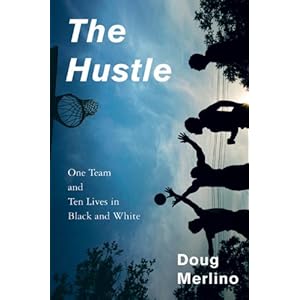
Playing ball to know the other (Books - The Hustle by Doug Merlino)

The Hustle by Doug Merlino is about the socio-politics, economics, and personal drama of relations between blacks and whites in America. Merlino, a journalist, (and also a friend and the provider of this advance copy) played on a basketball team in 1980s Seattle that was the dream- child of a black coach from the inner-city and a wealthy white entrepreneur. Both were fathers of teenage boys, both were proponents of the value of team sports for making men out of boys who can collaborate with one another on reaching a collective goal, but both wanted an experience for the boys of their city that was about building a less racially divided future. When Merlino learns of the death of one of his fellow teammates, he is moved to remember:
Reading the story again, it becomes clear that the reason Tyrell's death was considered worthy of the front page was his involvement in integration programs - there was one where wealthy families from the suburbs "adopted" poorer ones at holiday times; and there was our team. The reported spoke to Coach McClain, who told her, "We thought it was a good idea to expose these different kids to each other, to combine inner-city kids with rich white kids. And it worked."

I wonder if it had actually "worked" for anyone. Did any of the white kids still think about it? What had happened to my black teammates who'd gotten into private schools through Randy Finley's efforts? It was nearly twenty years since we'd all practiced together in the Lakeside gym. How had my teammates fared? What kind of men were they? Did anyone, like me, miss the amaraderie we got from playing together?
The basketball team was, in essence, a social experiment in knowing the other. Merlino fulfills that experiment in writing a book that attempts to understand whether they gained that knowledge and the men that the team members became as a consequence of it.

He takes on two roles in this book, one as a team-member who was affected by the experience, and who is touched as he gets to know each of his fellow team members as adults:
We pull up the driveway in front of my house, a large, gray, modernist structure with two gables. It has a basketball hoop and the outline of a key set in front of the three-car garage. Damian asks, "What side do you live on?"

"What do you mean?"

"Do you live on the right side or the left side?"

It takes me a second to catch on.

"It's just one house," I say, clutching my gym bag.

"You mean this is just for your family?"

"Yeah, we're the only ones who live here."

I pull the door open and thank Coach McClain for the ride.

"I'll see you guys at practice," I say and scurry into the house.

I'm embarrassed. All the gawking undermines the feeling fostered by playing on the team - that we are all equals. I worry that my teammates might not like me after seeing the house. The next day at school, Eric tells me that the guys had joked about my reaction on the way back to the Central Area, saying "He probably didn't invite us in because he was scared we'd steal everything."

[...]

There is nothing I can really say. I have never seen house and have no idea how he lives. For the whole season, the black side of the team always makes the commute north. We never visit the Central Area.
This is a personal, retrospective voice, one of memory. This is the less formal of the two. Merlino peppers his memoir with relaxed, chatty, diction:
On the court, though, the team kind of resembles the chickens - they get blown out in the three games they play.
Although full of perceptive details, the frequent use of phrases more typical of spoken diction, gives some of these passages an equivocal tone. This creates a modest character for Merlino the team member, one that is easy to read. It sometimes feels a less secure voice which can undermine his security as the chronicler of his teammates' personal narratives, but the positive side of that choice is that it communicates the unease of race as a subject that is so prevalent in America out of which Merlino writes. He writes these sections in the present tense which gives them immediacy:
JT joins the freshman basketball team and scrapes by in school. Then his mom, who has always been the center of his life, starts to use cocaine, and things quickly go south from there. Often when JT comes home, the shakes are drawn and all the lights are off. There's no food in the house. People stop by at all hours, laughing and talking while JT tries to sleep. One guy passes out in the living room with a stack of money piled on his belly. JT stops going to school, runs away from home, and takes to the streets, sleeping in bus shelters when he can't find any other place. He never plays organized basketball again.
This is, I acknowledge, a contemporarily accepted literary practice, but I sometimes found it jarring, so aware was I of the key function that memory was playing. I thought that the distance afforded by past tense might have been able to be more consistently played off of the writer's present knowledge. Granted, the use of present tense probably makes for a less choppy narrative.

Merlino's second role assumes a distinct narrative voice from the first. It is that of the journalist who gives us context - the social history of black Seattle, the economics of cocaine use in American cities, Seattle's tech boom and subsequent bust - and then brings it back to the story.
...On the West Coast, cocaine was brought up through Mexico and smuggled over the border, where it was then sold to already established street gangs in Los Angeles. They converted the powder to crack and began to sell it in their territories, with violence often erupting when one set infringed on the turf of another.

With their own markets saturated, the Los Angeles gangs began moving the drug to other cities, which was as simple as loading the trunk and heading up the freeway....The first time crack really registered in my consciousness came that March, when a different issue of Newsweek landed in our mailbox. The headline KIDS AND COCAINE was splashed on the front...
or
For middle-class people, this had been the model for decades - men went off to the office or factory, worked as part of a team within a formalized structure (the corporation or the state), played their part, and came home to the women and children. This had been the pattern since industrialization in the mid- and late 1800s, when youth sports leagues such as the YMCA and the AAU had been established. With men leaving farms to work in offices and factories, the idea of Muscular Christianity was that boys needed organized structures in which they could develop physically and enter into competition to avoid becoming too feminized. The skills learned on the field - stamina, discipline, sacrificing for the good of the team - were supposed to translate later into success in the working world. This was still the model when we were boys...
These passages are terse, energetic, and fact-filled. They provide context that is relevant to the story and efficiently tied it back to the personal narratives, and in contrast to the voice assumed in the personal narratives, this one projects confidence.

The Hustle brings together these two perspectives in one book that has value because it treats the sociopolitical history of race credibly while communicating its relevance to individual's lives. Race as it is dealt with in America today, is a subject that makes many non-American roll their eyes, but it is relevant to struggles in other countries that one can read in the papers every day: the Turkish workers in Germany, the North Africans in Holland, the Pakistanis in England. These have socio-economic and imperialist roots without the added burden of legalized slavery, but their relevance is still apparent. Race is a subject many Americans probably hoped they had gotten beyond by electing a Black president, but it is ubiquitous and, at this point in our history largely inseparable from socioeconomic inequity. The Hustle is an accessible source of insight. While it is useful to know facts about social, political and economic history of the relations between blacks and white in America, that can be comfortably distancing. At the end of the day its meaning is most apparent in its consequence to individual lives. The Hustle succeeds as a book by being honest about what's personal, clear-eyed about what is factual, and having its narrative driven by the emotions of nostalgia and loss. It is to be released in December but you can pre-order a copy here.

Thursday, October 21, 2010

Foreign invasion...

btt button

Name a book (or books) from a country other than your own that you love. Or aren’t there any?

You're kidding, right? How can you love books and reading and not read further afield than your own back yard? Understanding the experience of others is one of the chief reasons I read. A few favorite non-American titles are:

Any Human Face - Charles Lambert (Italy/England)
Molly Fox's Birthday - Deirdre Madden (Ireland)
Tell Me Everything - Sarah Salway (England)
Hopeful Monsters - Nicholas Mosley (England)
Cloud Street - Tim Winton (Australia)
Howards End - E. M. Forster (England)
The Glass Bead Game - Hermann Hesse (Germany/Switzerland)
Crime and Punishment - Fyodor Dostoyevski (Russia)
The Cherry Orchard - Anton Chekhov (Russia)
The Waves - Virginia Woolf (England)
A Very Long Engagement - Sebastien Japrisot (France)
Atonement - Ian McEwan (England)
A Fine Balance - Rohinton Mistry (India)
At Swim Two Boys - Jamie O'Neill (Ireland)
The Poems of Tomas Transtroemer (Sweden)
The Imposter - Damon Galgut (South Africa)
Mr. Mani
- A. B. Yehoshua (Israel)
Fall on Your Knees - Anne-Marie MacDonald (Canada)
How the Soldier Repairs the Gramophone - Sasa Sanisic (Bosnia-Herzegovina/Germany)

...and yourself?

Friday, October 15, 2010

Existential angst in Sussex (Books - The Secret Intensity of Everyday Life by William Nicholson)

How much is enough? At its core, William Nicholson's The Secret Intensity of Everyday Life is about abundance. When I began reading this book I was immediately grabbed by the quality of its prose, its succinct communication of character and situation with the right collection of details:
She recognizes the handwriting on the envelope. She drinks from her mug of tea, looks across the kitchen table at Henry, sees him absorbed in the triage of the morning post. One pile for the bin, one pile for later, one for now. He uses a paper knife when opening letters. Not a kitchen knife, an actual slender, dull-edged blade made for the purpose. The children silent, reading. Rain outside the windows puckering the pond.
There is a ton of information in that opening paragraph. A family is introduced. We know Henry is fastidious. And, although we are reading a third-person narrator, the woman who is the subject of the opening sentence is still nameless. Somehow this seems to make the point of view of this paragraph her's and, by the use of the word actual, we might conclude that she is something other than fastidious. Then there is that letter, who is it from? So Nicholson has also created a little suspense. Good writing.

Not only is Henry fastidious, his deep love for his wife, Laura, and their children makes him anxious about their possible loss. While Henry dotes on his family, he hates his job as a the writer and director of a television program on history, which features a celebrity scholar who receives all the credit for Henry's work. Laura's letter turns out to be from her first love, and so the lives of these upper-middle class Sussex suburbanites or really, villagers, is thrown into existential disarray. Henry, Laura, her first love, their employers, and family are the center around which revolve several other characters - a divorced mother and journalist whose child is bullied at school, the vicar who is more interested in preaching about kindness than about a god he has trouble believing in, a school teacher who would rather write for the theatre - we make desultory jumps from story to story as all fight the mundane battles of their exterior lives as well as the troublesome inner battles of doubt, disappointment, and what-ifs that can plague an adult life lived with ambition and insight. The central characters' more or less converge on a performance of Nozze di Figaro at Glyndebourne, which Nicholson uses as a suggestive scaffold for his own plot, which shares superficial similarities with the opera, including multiple characters' sexual hi-jinks, troubles in marriages, mistaken suspicions, and ultimate redemption.

On the one hand Nicholson treated the secret dread of his characters with loving depth and insight and he is capable of laying good prose on the page. However, I felt this insight was reserved for the characters who are (as far as I can tell) most like himself. Although he shows compassion to the only farmer left in the village, he never enters this character's head. He is pitied from the outside. He does try to enter the mind of an elderly, mentally-addled landlady, but that character comes off feeling satirized, rather than loved. The wealthier urban sister of Laura, who also attends the opera, is mocked outright:
Laura's Sussex life has no bearing on Diana's metropolitan concerns, and when her bored gaze passes regally over Laura's house and husband and children it's only to confirm that there's nothing here to merit her attention. Her habitual expression when spoken to is one of mild surprise, as if to say, 'How curious to think that this person imagines I want to hear this.'
This came off as its own kind of snobbishness to me. As if to say, if you have more money than me and live in the city, you cannot possibly have an interior life worthy of my examination. Nicholson likes to plumb the depths of disappointed adult ambition and desire, yet I found his writing of sex somehow not quite believable. I thought the two characters whose point of view he captured with the most verisimilitude and tenderness were the vicar, who offers more loving compassion to his parishioners as a doubter than many a bible-thumper, and the children. Nicholson writes beautifully of a two young childrens' psychic pain as they are the victims of their own heartache and attempts at social mobility.

Nicholson seems to have trouble trusting that his story will get his points across and can't resist peppering the narrative with instructions for what to read in it:
When are we supposed to be satisfied? Monogamy is just a social arrangement, introduced to protect property rights, subsequently elevated into a secular religion.
It's not that I disagree. I would just have Henry's point of view revealed from his behavior than have it close-captioned.
People want to tell their stories, but they're afraid they're too trivial to deserve the attention of others. They are trivial, perhaps, compared to the great dramas we read about in the newspapers. But if you could enter the minds of hearts of each person you meet in the course of a day I think you would be surprised by the intensity of their feelings. I may think I'm the only one whose voyage is through the wild seas, but we're all sailors in the storm.
Ok, ok, I know this is probably the paragraph that led to the creation of this entire book but really, if the novel doesn't communicate it well enough to leave this paragraph on the cutting-room floor then I'm not sure one can say it does its job. George Eliot pulls those grant thematic pronouncements off but from Nicholson's pen they read to me as a trifle insecure. At the end of the day, the use of the Nozze di Figaro and one of his character's own plays makes it obvious how the action will conclude, so the dramatic tension slackens over the concluding chapters of the novel and Nicholson fails to knit the separate skeins that comprise this novel's actions together as a cohesive whole. I loved the themes, but the overall impact of The Secret Intensity of Everyday Life fell a little flat for me.

Thursday, October 7, 2010

A collection of objets d'art (Books - Maiden Voyage by Denton Welch)

The past week has been a heavy one of studying for exams, writing papers, and school-related reading at bookeywookey. So I uncharacteristically had scarcely a minute to read anything of a more recreational nature. I finished Denton Welch's Maiden Voyage on a subway ride last Saturday but haven't been able to write about it until now. This book sits somewhere between novel and memoir. It concerns Denton Welch, an English boy, who at 16 feels very out of place because of his love for objets d'art and his hatred for his public school. He runs away and then gets sent to his father in Shanghai. The book concerns his year-long visit there as he flirts with soldiers (even in the 1930s he wrote openly of his attraction to men) and gets invited to people's homes because they have heard of his love for pretty things. It is unknowingly peppered with many instances of that institutionalized imperialist racism and antisemitism the British Empire was so famous for, which frequently had me cringing. Otherwise this book consists of two things an acute sensitivity to what surrounds him:
On the desk near the door was a lovely Greek bronze head. Its empty eye-sockets made it look blind and as if it were crying. The librarian showed us how the inlaid eyes would have fitted, and where tufts of hair were inserted in the holes on the scalp.

We left the library and went into the private dining room. A sticky-looking, empty medicine bottle was on the sideboard.

"The mixture. To be taken three times a day. His Grace the Duke of Devonshire," I read. I wondered what it had tasted like and what it was for. If I had been alone I would have smelled the bottle.
Welch has a talent for choosing the details that will help the reader have a fully sensoral appreciation for what he describes. He also makes smarter-than-his-years observations about many of the people he meets accomplished with the more-than-occasional well-turned phrase:
"People think that because you're grown up you don't want any fun."

"Yes, isn't it silly?" I said politely.

"Shut up all day in that uniform, you need a little freedom when you can get it," she mused as if talking to herself.

Now I knew why Nurse Robins was so quiet. She hated her uniform. She wanted to run in the fields, to trip over mole-hills and sprawl in the mud. She was Peter Pan to herself.
Or this moment of horror which, even though it seems a rip-off of the beating of the horse in Crime and Punishment is still a grotesque - horrible and beautiful:
One day as I walked through one of these mournful villages, I saw a strange creature steadying himself against the counter of an open shop. He was in rags, and his chin was covered with stubble, but he was young, and against the background of jeering Chinese faces his skill looked almost startlingly white...

I watched him trying hopelessly to push through the crowd. He was swaying dangerously and a vicious kick brought him down. He lay still, with his face in the gutter. People spat on his back where the white skin showed through the rents in his paper-thin shirt. Others aimed playful kicks at his hard, trembling buttocks. A little boy jumped on his shoulders and straddled his neck with small fat legs and dimpled knees. He grabbed two tufts of the man's hair and jigged up and down on his neck, riding him as if he were a horse.

I waited until the crowd melted away; then I went up to the man. He lay breathing into the dust, making a frightening, grating sound in his nose and throat. I was about to try to turn him over when he groaned and muttered something angrily. I stepped back and watched him staggering to his feet. He began to sway very slowly out of the village. I walked behind, keeping my eyes off him for fear of seeing him fall again.

Suddenly he began to sing, throwing his head from side to side, and waving his arms wildly. He shouted the words and rolled along as if he were happy; then, as suddenly as he had begun, he stopped. His hands dropped, his head fluttered weakly and he fell. But this time it was soft grass that received him. We were all alone in the country. I looked down at his face lying sideways amongst the blades of grass. A little tickle of saliva ran out of the corner of his mouth and lost itself in his young beard. He looked like Jesus.
I found the sections like the one above startlingly poignant, but these were set pieces amidst the second of the two features of Maiden Voyage - a tiresomely repeated refrain of someone or other saying "I have heard you like pretty things..." and young Denton going off to that someone's home and admiring their coffeepots and their little glass bottles or wishing to dress in a fez "like Disraeli in 1830." Just a few chapters before his departure and the book's end, Denton pays a visit to his selfish aunt, telling a story of a shameful childhood memory as the background to his present visit, which ends up being coincident with his uncle having a stroke:
I said good-night and went to my own room. There on the bedside table lay the Tales of Mystery and Imagination. I took the book up and wished that I could write a story about a mandarin swinging from the scarlet beam, my uncle's sudden stroke, Clutterbuck's sour philosophy, and my aunt's childish, pleasant love of show and her longing for affection.
He had, in fact, done just that. But I found myself wishing that he could have told more stories like it. It is one of the few satisfying sections of the book amidst what ends up feeling a frivolous collection of impressions loosely arrayed like the pretty objects he sees in the homes he visits. The book never finds a form that gives integrity and completeness to the full-length work suggested by the covers that collect its pages together. Its admirably precocious but finally a little precious, and makes me wonder if it is the strength of Welch's writing that so many admire or the experience of that writing in the context of the knowledge of his tragic accident at age twenty and subsequent death at thirty-three? I'm not sure yet what I think. I may have to read another of his books to decide.

Vacations are for reading...

btt button

A question much on my mind as I get ready to pack for vacation:When you travel, how many books do you bring with you? Has this changed since the arrival of ebooks?

As far as I am concerned, a vacation is an opportunity to read away from the typical pressures of life, acquire new books at bookstores I've never been to, take a look at the books in the libraries of the b&bs we stay at, and get through my stack of old New Yorker and New York Times Book Reviews to get new ideas for reading I want to do. In fact, a vacation is not a vacation for me if I can't read. On a ten day trip I might take 6 or 7 books with me and I will usually bring even more of them home. Sometimes I have even mailed a box home. And, no, ebooks have not changed this habit of mine, since I don't read books in electronic format. Were it not for my love of reading on vacation, I would be considered a very efficient packer. I generally take only one 25" suitcase and a small carry-on. They are just weighed down with books. So I wouldn't say I'm excatly your model unless you like heavy luggage.

Thursday, September 23, 2010

Selections from the top of the pile... (Maiden Voyage, The Hustle, The Oxford Book of Modern Science Writing, Microcosm, and Rhythms of the Brain)

btt button

What are you reading right now? What made you choose it? Are you enjoying it? Would you recommend it?

I'm reading three books actively even thought five appear on my sidebar:

Denton Welch's Maiden Voyage is a fictionalized memoir about a refined English boy who at 16 feels very much an outcast, hates his public school, and runs away. Welch wrote in the 1920s and 30s before dying very young from injuries sustained in a terrible accident. He is a writer's writer,admired for his use of memory and openness about his homosexuality. I have come to read this because so many English writers talk with admiration of his books. I'm just 50 pages in and haven't yet decided what I think, except to say that English fiction gets a lot of mileage out young boys in public schools, Dickens, Harry Potter...

My friend Doug Merlino has written a book about race relations in American via a memoir of his participation in a multiracial basketball team, an anomaly when Doug played the game in his youth in Seattle in the 1980s. I'm liking the unsentimental, reportorial voice and on the flip side the very personal take on a vast and unwieldy theme. I'm enjoying it for those reasons but as much for the fact that I finally get to read something by Doug, who I've known for some time but have yet to read a word from. The Hustle will be published at the end of this year and I recommend reading it once it is. It's an accessible way to think about a troubling cultural reality of the U.S., one whose legacy is still alive, and one which has its analogues in most other countries as well.

I have been dipping into Richard Dawkin's compendium of 20th and 21st century writing across the sciences for many months. The writers are various, treating subjects from consciousness to DNA to the mechanics of the spiral form in voices that range from erudite and polymathic to highly focused and down-to-earth. They each have in common a mastery of a way of understanding our world and a talent for sharing that knowledge and their feelings about it with the lay-reader. I am just loving The Oxford Book of Modern Science Writing and recommend it both for those who already like reading about science and especially for those who might be intimidated to read about it. This will allow you to drop in on various subjects in a multitude of styles and perhaps find some writers who you would enjoy reading more deeply.

I also have Carl Zimmer's Microcosm, a book about (of all things) the E. coli bacterium - a very interesting read. I seem to have gotten side tracked from Gyorgy Buzsaki's Rhythms of the Brain, a book about the oscillatory patterns that are found in nature, and in particularl in the electrical activity in the brain, and their significance. It's a more a read for the hard core aficianado than the tourist but I am finding it fascinating to think about and pertinent to my work in the lab.

And you...?

Tuesday, September 21, 2010

Watching out for common sense (Books - The Oxford Book of Modern Science Writing, ed. Richard Dawkins- "One Self" by Nicholas Humphrey)

I continue to dip into Richard Dawkins's impressive and diverse collection of science writing, The Oxford Book of Modern Science Writing, this time stopping to admire Nicholas Humphrey's essay on the self-organization of 'self.' How does the unity of our many selves create consciousness of a single self without direction, this essay asks? Humphrey meditates on the movements of his baby son and an analogy he makes of the tuning up of the separate instrumental players of an orchestra and their ability to play as one without a conductor. Dawkins admires Humphrey's ability to spot the important questions, particularly when, as he says, "they are camouflaged against a background of common sense," and that highlights one of the roles that great thinkers play. Common sense can be useful to every-day thinking, but not necessarily to the role of shifting paradigms in the science of consciousness. Scientific process must not be lured by the quick conveniences that our minds favor. Nothing may be taken for granted. And yet, Humphrey has the talent to couch his uncommon thinking in accessible prose so that the uncommon thought seems for the reader almost familiar.

Here are some of my other posts on The Oxford Book of Modern Science Writing: 1, 2, 3.

Sunday, September 19, 2010

The uncontestable beauty of life lived outside the bounds (Books - The Giant's House by Elizabeth McCracken)

I have a thing for writers who understand the experience of those who do not fit life's molds, and who make that less-than-common experience accessible to readers not merely making fashionable funkiness of it, a la the television show Ugly Betty, but rather by revealing the sheer and uncontestable beauty of being a somewhat strange self. Elizabeth McCracken is clearly one of those artists. The Giant's House is an exemplar of a work that celebrates the value and integrity of a life lived outside the bounds that the conformist majority believes they have set for everyone. The story of a small-town librarian, Peggy, and James, the tallest boy in the world, their life's ambitions, and their love for each other is a tender and sympathetic tale. They begin by sharing books, because they may escape the pain of their exile from most of the human race that way. McCracken gets inside the inside narrative, what we actors call the interior monologue, of her characters. That is her first-person, unreliable narrator's voice as Peggy, and she uses that inside knowledge as a story-telling device to draw in the reader.
I may be adding things. It's been years now, and nearly every day I dream up my hours and meetings with James Carlson Sweatt. I am a librarian, and you cannot stop me from annotating, revising, updating. I like to think that - because AI am a librarian - I offer accurate and spurious advice with no judgment, good and bad next to each other on the shelf. But my memories are not books. Blessing if they were. Then maybe someone would borrow one and keep it too long and return it, a little battered, offering money for my forgiveness, each memory new after its long absence.
She does not make humorous hash out of her subjects, but her tone is as wise and wry as its gets.
People thing librarians are unromantic, unimaginative. This is not true. We are people whose dreams run in particular ways. Ask a mountain climber what he feels when he sees a mountain; a lion tamer what goes through his mind when he meets a new lion; a doctor confronted with a beautiful malfunctioning body. the idea of a library full of books, the books full of knowledge, fills me with fear and love and courage and endless wonder. I knew I would be a librarian in college as a student assistant at a reference desk, watching those lovely people at work. "I don't think there's such a book - " a patron would begin, and then the librarian would hand it to them, that very book.
Unromantic? This is a reference librarian's fantasy.

A patron arrives, says, Tell me something. You reach across the desk and pull him toward ou, bear hug him a second and then take him into your lap, stroke his forehead, whisper facts in his ear. The climate of Chad is tropical in the south, desert in the north. Source: 1991 CIA World Factbook. Do you love me? Americans consumer 6.2 gallons of tea per capita in 1989. Source: Statistical Abstract of the United States. Synecdoche is a literary device meaning the part for the whole, as in, the crowned heads of Europe. I love you. I could find you British Parliamentary papers, I could track down a book you only barely remember reading. Do you love me now? We own that book, we subscribe to that journal, Elvis Presley's first movie was called Love Me Tender.

And then you life the patron again, take him over the desk and set him down so gently he doesn't feel it, because there's someone else arriving, and she looks oh, she looks uninformed.
If you have ever loved someone for or wooed someone with intellect, you will really get this love story. This may sound like a cop-out but The Giant's House is better revealed by reading it than by reading about it. Despite the little time I have to read fiction, I read some of it just a little slowly to delay its ending but I couldn't stop myself tearing through most of it. A lovely story.

Tuesday, September 14, 2010

Struggling to matter with one eye on the clock (Books - A Visit From the Goon Squad by Jennifer Egan)

Will Blythe in the New York Times Book Review thought it was "pitch perfect." Oprah called it a tour de force. Even Mookse and Gripes liked it. It is Jennifer Egan's new metafiction of linked-stories, a concoction about the passing of time and how money can't buy you love or a sense of purpose - A Visit From the Goon Squad. At its center are two mismatched survivors. Sasha, whose deep reservoir of loss originating in her teenage years made her grow up too soon (as the Elvis Costello song Goon Squad would have it) and have turned her into a kleptomaniac; ... and Bennie, an aging rock-and-roller whose refusal to grow up as he grew old has has left him loveless.

Each of the desperate souls in Egan's modern melange struggle to make their lives matter with, again with a nod to Elvis Costello, one eye on the clock.
"I'll check the bathroom," she told Alex, and forced herself to walk slowly around the elevator bank. The bathroom was empty. Sasha opened her purse, took out the wallet, unearthed her vial of Xanax, and popped one between her teeth. They worked faster if you chewed them. As the caustic taste flooded her mouth, she scanned the room, trying to decide where to ditch the wallet: In the stall? Under the sink? The decision paralyzed her. She had to do this right, to emerge unscathed, and if she could, if she did - she had a frenzied sense of making a promise to Coz.

The bathroom door opened, and the woman walked in . Her frantic eyes met Sasha's in the bathroom mirror: narrow, green equally frantic. There was a pause during which Sasha felt that she was being confronted; the woman knew, had known all along. Sasha handed her the wallet. She saw, from the woman's stunned expression, that she was wrong.
"I'm sorry," Sasha said quickly. "It's a problem I have."
[...]
Bennie's assistant, Sasha, brought him coffee: cream and two sugars. He shimmied a tiny red enameled box from his pocket, popped the tricky latch, pinched a few gold flakes between his trembling fingers, and released them into his cup. He'd begun this regimen two months ago, after reading in a book on Aztec medicine that gold and coffee together were believed to ensure sexual potency. Bennie's goal was more basic than potency: sex drive, his own having mysteriously expired. He wasn't sure quite when or quite why this had happened: The divorce from Stephanie? The battle over Christopher? Having recently turned forty-four? The tender, circular burns on his left forearm, sustain at "The Party," a recent debacle engineered by none other than Stephanie's former boss, who was now doing jail time?

The gold landed on the coffee's milky surface and spun wildly. Bennie was mesmerized by this spinning, which he took as evidence of the explosive gold-coffee chemistry. A frenzy of activity that had mostly led him in circles: wasn't that a fairly accurate description of lust?
The bright, angular specifics of Egan's observations and the rock-and-roll tempo of her writing supplies that frenzy her characters are caught up in. The point-of-view is a 20th-century, George Eliotish, all-knowing-eye that alternately offers the reader brilliant snapshots of the media-happy, magical-thinking zeitgeist of our own time, or of past episodes that were its antecedents. Character is, to my eye, Egan's strong suit. In A Visit From the Goon Squad they are imagined in multiple time frames, sometimes introducing us first to their present and then going back into the past. At others she slips into the very marrow of a new character - a fifty-something down-and-out rocker, a has-been PR doyen, or the adolescent son of an aging rocker - and then catapults us forward in time with one of those Eliotish observations of what will happen that just knocks the breath out of you. She uses character's psyches as the engine of their actions. Her diction is literate and distinctive, but this can be the magic ingredient that weaves the spell as much as the one that breaks it. For example, I love her use of the word "shimmied" above to perfectly capture the movement of the box in a words that also describes a dance move I associate with 1960s rock-and-roll. More rarely, as for example during a particularly formative episode in Sasha's past when Egan writes that a character "origamis" himself through a living room window, I want to scream at the use of a writerly verb at the expense of my involvement. There isn't any doubt she can write:
It's all still there: the pool with its blue and yellow tiles from Portugal, water laughing softly down a black stone wall. The house is the same, except quiet. The quiet makes no sense. Never gas? Overdoses? Mass arrests? I wonder as we follow a maid through a curve of carpeted rooms, the pool blinking at us past every window. What else could have stopped the unstoppable parties?

But it's nothing like that. Twenty years have passed.
Stunning, no?

Egan is at her most effective in this book when she weaves such an enveloping spell. She can also be hilarious, as in a chapter about a washed-up PR queen trying to revive the career of a despotic military dictator via a media campaign with a talentless B-movie star. I find her less so when she plays meta-fictional charades with forays into second-person narrative voice, celebrity journalism with foot notes, and chapters written as Power Point presentations - touches I may well have liked better if I had read these chapters as separate stories. But this book intends to mock the means it employs and sometimes those risks pay off. Egan uses hyperbole to communicate that hype does not equal content. She hops frenziedly from form to form teaching us that being busy is not happiness. Egan's book weaves together multiple layers of time and form that succeed in conveying the complexity of Egan's vision without explaining it to death however, at the end of the day, I would say that the book impressed me and challenged me more than it moved me.

Saturday, September 11, 2010

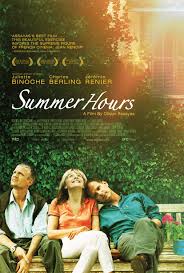
Is art precious for its beauty, its value, or its usefulness? (Film - Summer Hours by Olivier Assayas)

The 2008 film Summer Hours is all about legacy. It captures the lives of three siblings around the death of their mother, Helene, who was the keeper not only of their childhoods and the objects associated with it, but also of the memory of her uncle, a well-known painter. Frederic, the eldest son and only sibling still living in France, wants to preserve the house, its objects, and its artworks for continued use and pass it along to the next generation. Adrienne lives in the U.S. and Jeremie in China, they wish to sell everything as they are unlikely to use the house, having more use for its profits. The film explores the challenges inherent in passing things along to future generations. When 75-year-old Helene wants to speak to Frederic about what will fall to his care after her passing, he finds it too difficult to discuss her death. When Frederic, in turn, speaks to his teenage children about the art in the house, they try to admire it, but are really more interested in their music and their friends. Writer and director Olivier Assayas has an admirably light touch. He has the confidence to write good scenes, get people to come together and really do what his scripts say they do, and to let his camera simply observe them. I make that sound easy but it's not. That is the work of the filmmaker. Friend Sheila and I were talking about just this the other night. The medium of film is not celluloid - although that might be the chemical substance its sounds and images are recorded on. Its not even the camera, although without knowing to use lenses and cameras one could not make a film. It is people. The children play a game during the film's opening and they are obviously children playing with an interest in winning a game - not posing for the camera. It takes talent to show people being people. Actors can be very interested in themselves. They admire their own faces and their hard won talents. Assayas has cast beautifully Juliette Binoche, Charles Berling, and Jeremie Renier know what it means to inhabit a character whose life is full of details you never actually get to show, but which must precede their behavior in the story if it is to make sense. In Summer Hours- the characters act, not meaning demonstrate, meaning they do things. They meet, they mourn, they eat meals together, they make decisions - and the camera observes. They don't force themselves on the viewer. They do their jobs and if you are interested you may do your's.

Assays's mise en scene is smart. His camera celebrates the warmth, the lush and somewhat worn beauty of the house in the final summer that it is filled with its contents and people. After the death of Helene, he and his cameras walk through as the art and furniture are appraised for their value, now the house possesses the same contents, but the light is cooler, grayer. Epicures eye the Corot and the Hoffmann armoire over their expensive glasses. The stoves must be lit for warmth. The long-time caretaker of the house peers in the windows of her old home. In the film's closing scenes, we see the house's contents lodged in the Musee D'Orsay as a tour guide lectures her group on the history of desk we have come to associate with Helene's home. It is summer again. The nearly abandoned house is filled with Helen's grandchildren who party in its now raw, unfurnished rooms and its unkempt garden, blasting french rap and getting stoned. The place is obsolete - or is it? Assayas is smart enough not to decide for us. Time marches on but French law allows one to donate art to museums in exchange for a break on inheritance tax. The art may no longer reside in the home of the family whose ancestors acquired it, however one could say that many more members of future generations get to enjoy it. Is the vase by a great sculptor most valuable as a highly protected and revered possession of a museum or as the container of flowers in a home where it might at any moment be knocked to the floor by children playing? These are the questions one is left turning softly over in one's mind as the film ends. I learned on the DVD extras that to celebrate its 20th anniversary, the Musee D'Orsay, rather than making a straight, PBS-style documentary about their collection, commissioned films by real filmmakers to celebrate their birthday. Summer Hours, Assayas's contribution, is a thoughtful, tender, and quiet gem.

Saturday, September 4, 2010

Hans Keilson re-appreciated...

I would like to draw your attention to Steven Erlanger's tender portrait in The New York Times of nearly 100-year-old Hans Keilson, novelist, poet, child psychiatrist, and German Jewish exile now living in the Netherlands. Two of his novels now some 50 years old, The Death of the Adversary and Comedy in a Minor Key, have been re-released and were lauded in the New York Times Book Review a few weeks back by Francine Prose. I, for one, ordered them immediately. I admired Erlanger's perspective on Keilson's cultural heritage, life's work in psychology, and legacy of guilt, all of which combined their influence upon his writing.

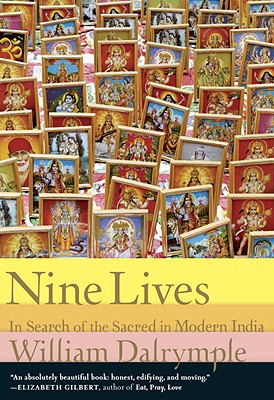
How the homogenization of the sacred diversity of India may impoverish our world (Books - Nine Lives by William Dalrymple)

English-born historian and travel writer William Dalrymple has spent 25 years writing about Asia, particularly India. His Nine Lives bemoans the erosion of the many idiosyncratic and little-known practices of faith, some ascetic, some hedonistic, some bloody, some obsessively non-violent, some monotheistic, others pantheistic, that have co-existed in the region comprising India, Pakistan, and Tibet. One price of the region's modernization is the homogenization of these traditions. Each of the nine lives he chronicles:
...is intended to act as a keyhole into the way that each specific religious vocation has been caught and transformed in the vortex of India's metamorphosis during this rapid period of transition, while revealing the extraordinary persistence of faith and ritual in a fast-changing landscape.
I have read his writing compared to Tracy Kidder, the author of Mountains Beyond Mountains, a brilliant portrait of the admirable but difficult activist Dr. Paul Farmer, and I would agree. One of Kidder's talents was putting himself into the narrative just enough to make give his reader access to the opinions and the feelings that are the fuel of his narrative, but not so much that the writing becomes about himself instead of his subject. Dalrymple claims that he wishes to absent himself from his narrative. I would say that he fails in that aim, but beautifully and usefully. He is exquisitely open to each of his subjects, yet his writing flows from the sense of impending loss he feels of each way of life that he records here. His narrative is colorful and specific, combining characterization, exposition of back story, or details about the culture or history pertinent to it, yet his economy of narrative gives reader the sense that they are in the presence of his subject, as it mimics the way we quickly get the essence of a person by the information we can take in with our senses when in their presence:
I had seen the tiny, slender, barefoot figure of the nun in her white sari bounding up the steps above me as I began my ascent. She climbed quickly, with a pot of water made from a coconut shell in one hand, and a peacock fan in the other. As she climbed, she gently wiped each step with the fan in order to make sure she didn't stand on, hurt or kill a single living creature on her ascent of the hill: of of the set of rules of pilgrimage fro a Jain muni or ascetic.
It is this combination of economy and vividness that gives Nine Lives, as a series of separate portraits, such a sense of flow as the depiction of the single and various place that is modern India. Books like this are exactly what keep me reading - insight into people and places completely different from my own realm of experience. A sense of wonder suffuses Dalrymple's expertise as we encounter the subjects of Nine Lives: Hari Das, a theyyam dancer of sacred stories, is worshiped as the evocation of a Hindu god when practicing the ritual, but the rest of the year he digs wells and works as a guard in a highly dangerous prison (jobs typically taken by the lowest classes in India). The devadasis, a once exclusive tradition in medieval Hindu practice of celebrating fertility and sexuality, are in Modern India little more than sex workers, at high risk for STDs. This once sacred tradition is now seen by most as little more than exploitation. The bhopas, singing bards of epic poems like the Mahabharata:
When this 4,000-line courtly poem is recited from beginning to end - which rarely happens these days - it takes five full nights of eight-hour, dusk-till-dawn performances to unfold. Depending on the number of chai breaks, bhajans (devotional hymns), Hindi film songs, and other diversions added into the programme, it can on occasion take much longer. But the performance is not looked upon as just a form of entertainment. It is also a religious ritual invoking Pabuji as a living deity and asking for his protection against ill-fortune.
Most of the bhopas are illiterate, many are still believed to have healing powers.

But lest you believe that Nine Lives is nothing but a travelogue of arcane and esoteric mystical practices, I also found the book illuminating about differences between Judeo-Christian traditions, Islam, Hindu, and Buddhism in ways that are useful to understanding some of the cultural tensions that drive today's political violence. Dalrymple's portrait of Lal Piri, a Sufi mystic (Sufism is a mystical sub-sect of Islam that looks for the divine within the practicer and historically evolved to include poetic scriptures and meditative practices familiar to the local Hindus in an effort to reconcile the Muslim and Hindu faiths) is revelatory about the origins of tensions between Muslims and Hindus as well as Muslims and the West:
Religiously conservative Hindus and Muslims both suffered the humiliation of colonial subjugation and had to watch as their faith was branded degraded and superstitious by the victorious colonisers and their missionaries. In both faiths, reform movements re-examined and reinvented their religions in reaction to the experience of conquest; but while Hindu reformers tried to modernise their diverse spectrum of theologies and cults to more closely resemble Western Christianity, Islamic radicals opted instead to turn their back on the west, and return to what they saw as the pure Islamic roots of their faith. In the aftermath of the brutal massacres by the British following the Great Uprising of 1857, Islamic radicals left the ruins of Delhi and the demolished Mughal court, rejecting both the gentle Sufi traditions of the late Mughal emperors and the ways of the West.

Instead, disillusioned refugees from Delhi founded a Wahhabi-like madrasa at Deoband which went back to Quranic basics the rigorously stripped out anything European from the curriculum. One hundred and forty years later, it was out of Deobandi madrasas in Pakistan that the Taliban emerged to create the most retrograde Islamic regime in modern history, a regime that in turn provided the crucible from which emerged al-Qaeda, and the most radical fundamentalist Islamic counterattack the modern West has yet had to face...

If it is the Islamists' assaults on India and the West that has understandably absorbed the Western press, it is sometimes forgotten that the Taliban are also at war with rival comprehensions of Islam...
I found Dalrymple's analysis of the religious influences of a struggle that impacts all of our lives at present very insightful. It is the roots of these conflicts in the realm of faith that drives the willingness of people to suicidal acts of violence. It is usually non-rational bases of experience that motivate people to hysteria and the certainty that they are right and all others wrong. It is among the, for want of a better phrase, practical uses of Dalrymple's observant and fluidly written book that he can use the political and cultural context of his nine portraits of seemingly irrelevant Asian mystics to give one blogger in New York City insight into his own life and some of the more pressing forces impacting it. Equally interesting was the conflict of Hindu traditions valuing asceticism in some instances and celebration of the sensual on the other - a tension evident in my own Puritain-founded country in the context of contemporary culture's celebration of diversity and tendency to reveal all.

Tuesday, August 31, 2010

Hurrah for positive deviance

Just a quickie today to say, if you haven't seen the piece in the Science Times on clinician and researcher Dr. Donald Redelmeier, take a look. I have a thing for people who can not just think out of the box (because that can be as hasty and end up as wrong as sticking with cherished notions - just because you think something or belive something doesn't make it true) but those who bother to question accepted wisdom and who put their hunches to the test. Here is one of those positive deviants that our belief-obsessed world so desperately needs in a nicely written profile by Katie Hafner.

Saturday, August 28, 2010

The presence of the artist in the art - developing talent versus promoting it (Exhibits - Matisse: Radical Invention & Film - A Single Man)


I just stared and stared at this painting at the stunning show currently on at MoMa - Matisse: Radical Invention, 1913-1917. Exploring its pleasures intertwined with the experience of the film I watched two night ago - A Single Man - to reveal to me something essential about my aesthetic taste. I like it when the act of creation shows (by design) in the work of art. Perhaps that is just because I made art myself for such a long time and because creative process is an obsession of mine. Perhaps the relationship goes the other way round - maybe I became obsessed with process because I have always been drawn to this kind of work. Whatever the case, this was very much evident in Matisse's work of this period. As he developed these paintings he adjusted the placement of figures as well as their form, he obscured details that he had earlier spent much effort in representing, and what's radical is that he leaves evidence of these changes rather than covering them up. It is a practice which creates a conversation between the subject of the art and the mode of its making, something I find interesting as well as inspiring. It is also a way for the artist to develop their talents, as awareness of technique progresses in parallel with the making of art, not separately from it. The simultaneous dialogue of the two is the artists' daily reality. That doesn't necessarily mean that it will always produce satisfying art, nor does it necessarily mean that this dialogue will be of interest to every member of the audience, but it is of great interest to me.

Matisse: Radical Invention is thoughtfully curated - it has a narrow thematic focus and therefore it is not too big (a pet peeve of mine with museum shows), it brings together different works of Matisse, not just the greatest hits, it creates a thoughtful narrative in tracing its theme of interest - a period of creative transformation in Matisse's art - seen against the backdrop of cubism in the art world and World War I in the world-at-large.

This experience was very much in contrast to that of watching A Single Man, photographer Tom Ford's feature film debut as both writer and director, adapted from the novel by Christopher Isherwood. I had heard a few interviews with Ford and his lead actor Colin Firth on the radio and was hoping for something better. The story concerns the last day in the life of a gay college professor in the 1960s who decides to commit suicide because of the sudden and devastating death of his partner of 16 years, and the unusual perspective that gives him on the things commonly around him in his daily life.

Ford, a visual artist, seems to have been captured by the notion of a unique perspective on the ordinary and perhaps felt his vision would express the lead character's heightened experience of the day. This was the film's defining feature, but the lack of access to other techniques was also its downfall. Every person in the film was beautiful - ridiculously so. Nicholas Hoult as the young student who becomes obsessed with his professor, was an expensive haircut draped in a pink mohair sweater that was glowed like cotton candy against his California tan. In fact, desserts are a good metaphor for the little visions of sweetness that Ford made of everyone George encountered, but there was no meal to accompany them. One could call this the heightened reality called for by the story, but I experienced it creating only an icy remove that destroyed any emotional impact this film could have had, despite Firth's intelligence, deep investment, and subtle portrayal. While this aspect of George's experience is important, it seems to me one should also be moved and this film's attempt at visual perfection held everything at arm's length.

One choice I particularly appreciated in this film was the lack of attention called to the sexuality of the lead character. Although his relationship was with another man and created interesting conflicts in the relationship between him and Charley (the female friend played by Julianne Moore), Colin Firth simply played George's circumstances and character qualities but did nothing to telegraph his gayness. He was middle aged, fastidious if a bit controlling, and was masculine. No limp wrist, no lisp. Thank you, Colin. Together the two of them captured that wonderful kind of friendship possible between a straight woman and a gay man that is full of intimacy but not sex and can be sustaining but can sometimes tip over into frustration for the woman if it is her primary intimate relationship, she is attracted to the man, and it cannot be consummated.

The actors were on their own (that or Ford could express his insight into the lead character but no other). The result was a beautiful performance from Firth but Julianne Moore's performance suffered for it. I find Moore a glimmering but delicate talent. Capable of flights of transparent vulnerability, she also reads to me across her body of work as wildly insecure. When she collaborates with a good director it is a joy to watch her. Here, while she communicated some of Charley's desperation to the screen it was too decorous. Her character is at the point where she can no longer control herself yet Moore's performance reeked of the kind of control exercised by an actor who is afraid to be unattractive. This coupled with Ford's own repressive control, motivated by his strictly visual talents, did not allow Charley the rawness a director like John Cassavetes and actress like Gena Rowlands might have brought to this part and this story. That, in my estimation, is what this film lacked. I wanted to feel the artistry, as with Matisse's painting, but not the artiness. I wanted to see the actor and film maker work together to make this story. I wanted to witness the beauty of the little accidents of human behavior, see her eye makeup smudge, see her nose run a little, not look at a Calvin Klein perfume advertisement. The limits of Ford's filmmaking were also evident in his use of music. With two composers, a music advisor, and a music consultant listed in the credits I felt as though too many cooks may have spoilt the sound track. The result was a hodgepodge of unspecific but superficially arty choices. I thought the choice of the aria "Ebben? Ne andro lontana" from the opera La Wally a particularly misguided choice, so associated is it with another high style film (and one I happen to love) - Diva. Similarly self-conscious choices visual choices also clouded the integrity of this film. The slow-motion sequences of waving children seen from a moving vehicle seemed to be straight out of Blue Velvet.

The 'making of' extra provided on the DVD was particularly embarrassing - self-aggrandizing and affected, with Ford's narrative scripted to death, interviews with each of the actors edited down to nothing but glib praises of Ford's filmmaking talents. Me thought the ladies did protest too much. It read like an advertisement - over controlled and pretentious - exactly the same problems as with the film itself. There is a difference between leaving elements of the creative process present in the work so it becomes a discussion between the artistic content and the art-making, and using the work of art to showcase one's talents at the expense of the content. Ford doesn't yet have the talent to recognize the difference.

Friday, August 27, 2010

Correcting our misinterpretations of the world (Books - Full House by Stephen Jay Gould)

As a working scientist, Stephen Jay Gould had a good deal of practice thinking about trends in the natural world in the language of statistics. Statistics get a bad rap as merely a fancy way to lie, but really they are a system of tools that allows us to infer the likelihood of something occurring in our world as a rule (and hence in the future) given what has already happened before in some subset of that world. For example, the likelihood that Drug X will cure a case of malaria can't be tested in the abstract, it must be tested by actually administering the drug to a group of people with malaria for, say, two weeks. At the end of that period, the number of people who survived or succumbed to the disease are counted. But we still don't know everything because a certain portion of any group would live or die anyway, those numbers will be estimated by comparing them to a group who does not receive the drug. This group should, if they are like most, have the same chance of living or dying as the other group. Then we can begin to infer how many people as a rule will survive because of the drug. Some math is applied to adapt the number from that small group and apply it to everyone, since it is impossible to give everyone the drug. The result is stated as a probability, the language of science, as it acknowledges the ubiquity of error and the inferential nature of estimates, as we can never know all the cases of anything.

Paleontologist, biologist, and science writer Gould was diagnosed with peritoneal mesothelioma at age 40, a disease with the median mortality rate of eight months. As most general readers of probablistic statements would, Gould first interpreted this statistic to mean he was likely to be dead in eight months however, his training as a scientist made him think twice about this interpretation of the median or the mid point of a group of numbers. This is one of three ways statistics describe the central tendency of any group of numbers - baseball scores, people who earn $30,000/year or more, people who will vote for Charlie Rangel in the next election, etc. Central tendencies are statistics way of summarizing what is usual in nature with one number. However, after thinking, Gould realized:
I am not a measure of central tendency, either mean or median. I am one single human being with mesothelioma, and I want a best assessment of my own chances - for I have personal decisions to make, and my business cannot be dictated by abstract averages. I need to place myself in the most probable region of the variation based upon particulars of my own case; I must not simply assume that my personal fate will correspond to some measure of central tendency.
Full House is a 190-page disquisition of what one might assume to be dry and obscure notions - means, modes and medians, spreads of scores, skewed averages - but because they spring from a personal confrontation with mortality as well as Gould's love of baseball, and because they are written in Gould's down-to-earth prose, this book is anything but dry. It is a lively, entertaining narrative on our tendency to misinterpret the world given our misunderstandings about what statistics are telling us. The writing is cogent, the format concise, and the references various as they are learned. Plato, Shakespeare, Huxley, Darwin, nameless drunks weaving down the sidewalk, Bill Gates, and the Brooklyn Dodgers all put in an appearance in Gould's attempt to make plain to the lay-reader concepts like measures of excellence, the likelihood of survival, or whether development - of skills or species - means a trend toward greater complexity or less. These phenomena are continually misrepresented in everyday conversation and reporting about our world, sometimes unintentionally and sometimes with malice aforethought. If you have ever wanted a better understanding the daily missives we receive in the language of probability through our senses or our news sources then read this book. The next time I teach a class which would benefit from an understanding of statistics, Full House is going to be required reading.

Tuesday, August 17, 2010

The value of picturing others (Books - Getting the Picture by Sarah Salway)

Sarah Salway's Tell Me Everything was not only my favorite novel of 2007, it introduced me to an artist who, like me, is fascinated by unusual human souls - the people life would typically try to ignore - obsessed with the creative process, and, through these common points I made a friend. So I read Sarah's recent novel Getting the Picture in that context (full disclosure complete).

The novel references a visit made by Maureen, a reserved, conventional, and married young woman, and her more adventurous friend, to Martin, a photographer who photographs woman nude. Martin not only ends up photographing Maureen, but also falling in love with her. Cut to the present day at Pilgrim House, a home to which Martin retires. There he writes long letters to Maureen, who has since died, and hatches a plan to be near George, her stern husband of many years, so that he may infiltrate her family. This body of the story is told through a series of letters, emails, and phone messages written by the book's cast of characters and in this way the reader uncovers the story (as Martin does), rather than reading a straightforward narrative account of it. This could be gimmicky but I found the form made the plot into a puzzle while at the same time making the novel very easy to read. One could call it a light read, but by that I don't mean insubstantial, because its themes are anything but. It deals with love and regret as seen from the perspective of the end of life. It observes the way people can close themselves off, how they can hide from the difficult experiences life throws one, particularly within families - and there are two families in this novel - one is Maureen's husband, daughters, and grand daughter and the other is the residents of Pilgrim House who themselves constitute a family. It also treats accessible human beings in a familiar, I would almost say ubiquitous situation - dealing with the needs of aging family members. It does so with realism and humor and it uses imagination to bring complexity and dignity to the aging characters; it does not rely on cliches, defining them by their diseases and limitations. In this way I would think Getting the Picture a shoe-in for book clubs. It is so much about our every-day experience. Upon finishing it, I immediately recommended it the Ragazzo's mother for her's.

I found Martin's need frighteningly desperate at times. He questions George trying to discover what he aspired to be in his youth. When he says "An accountant," Martin is incredulous:
I tried to look interested but not even his dreams were original. Remember you telling me you wanted to be the fairy at the top of the Christmas tree? And how you once spent all holiday crying because your father wouldn't put you up there. I would have made a tree big enough for you to stand on if you'd have spent even one Christmas with me. You know that. I felt like breaking down your window one Christmas when I saw you'd put up one of those artificial trees. I knew that wouldn't have been your choice.
Later in the story Martin sets himself up as a creative mentor to Robyn, George and Maureen's grand daughter, in a way that first seems helpful but later turns manipulative and even abusive of her. I'm not sure if Sarah intended Martin to come off as manipulative in a quirky but charming way or somewhat pathological, but his treatment of Robyn ultimately came off the latter to me.

The photographs in the novel function as icons, as they do in life, symbols of people - they are not the people themselves. Photographs are frozen in a past time, so this book also treats the theme of memory and how as one ages life can become less about day to day activities and interactions and more about past ones. Artists too can rely on memory to fuel their imaginations and there were times I could imagine Sarah, although I dont' know whether this is true, having found a few sepia photos at a flea market, and how these may have unleashed her imagination to create this story. What she has made in this novel is not as integrated a creation as Tell Me Everything, it does not have as coherent a narrative thrust, but nor do I think it means to. It is like a visual art installation in which each message is an image or object we can pick up in our hands. I am more aware of the artist working in this piece. In fact, when Martin mentors the character of Robyn to to try to bring the sullen teenager out of her self, it is through imaginative writing exercises that he is successful. So Getting the Picture means to make the reader aware of its process, it means to show its seams, for in some ways it is about the creation of character - in life as in art.

The novel's leitmotif is a photograph and a negative, if you will: the superficial versus interior knowledge of another person. The snapshot one gets when knowing someone only from the outside in a single context, versus who they are inside, who they are when they relate to their intimates, who they are to themselves in their fantasies, and sadly, who they become when there is no one to whom they show their deepest selves. As a literary device the letters and messages are an appropriate form for this novel in that they are like snapshots, you need more than one to know the whole story. And while a nude picture is literally revealing, it does not necessarily give the viewer an intimate relationship with the subject. However the subject themselves possesses that whole story and so posing for that photograph feels a kind of risk, perhaps akin to the risk we take when we tell someone we love them, or the risk artists take when they put themselves into their work. That is the reverse image contained in the novel, the risk that it takes to be known. This is not just the artists' journey, it is everyone's and this novel's message is that the risk is worth it.

Sunday, August 15, 2010

Broadway in love and war (Theatre - South Pacific & A Little Night Music)


Two musicals in two weeks, and on Broadway no less, that has to be a record for me and the Ragazzo. We saw the Lincoln Center Theater revival of Rodgers and Hammerstein's South Pacific last week and last night, Sondheim's A Little Night Music with two heavily announced cast replacements - Bernadette Peters replacing Cathrine Zeta-Jones and Elaine Stritch replacing Angela Lansbury.

South Pacific is as classic as they come and this production demonstrates that Rodgers and Hammerstein (and the director Barlett Sher) really knew what they were doing. Set in the Asian theatre of war during World War II, it manages to spin out 11 great songs with memorable melodies, tell a classic Broadway love story, have some great laughs, break your heart, seriously treat the subject of racism in American (this was written in 1949, mind you), create a good amount of suspense, and although it lasts three hours I was scarcely aware of the time. It was great to hear secure singing voices that could handle legit as well as belt voice production rather than over-miked pop yelling. Paulo Szot who played Emile de Becque, the French plantation owner on the Island with whom American Ensign Nellie Forbush falls in love, is an opera singer (as Ezio Pinza who created the role was). He showed a range of vocal colors and an ease of stage presence not common to opera singers. Laura Osnes as Nellie was charming and open, if a little green as a performer.

The production was long on character development rather than establishing stereotypes through behavioral shorthand as so many Broadway productions do. This is important since one of its subjects of the show is racism. Even the smaller, non-singing roles of the commanding officers were given detailed, lived-in-the-moment performances. There was a large male chorus of soldiers and Bartlett Sher made the smart and, no doubt, accurate choice to usually have the black and white soldiers working separately on stage. The choreography for the male chorus was particularly strong. Christopher Gattelli found a masculine guy-like repertoire of movements that let them move like their characters - American soldiers in the 1940s - and not like Broadway dancers. I thought Danny Burstein a stand-out as Luther Billis - hilariously funny, but played as a person not a clown. Sher's production with its fluid, cinematic set design, its detailed characters, strong singing, and topical story would travel well. Since so many of Broadway's recent successful musical productions have been British imports, I left this one hoping that the exchange might go the other way - any chance for a London transfer?

A Little Night Music is as rich a concoction as Stephen Sondheim ever composed. The story is adapted from Ingmar Bergman's Smiles of a Summer Night, a farcical meditation on the experience of love as we age. His musical inspiration was Brahm's Liebeslieder Waltzes. The sophisticated lyrics are strictly Sondheim's own, intellectualizing the world to hold his heart at arms length from the rest of him. Trevor Nunn's production has been roundly criticized but I'm not sure why. The set was simple and flexible, panels like antique mirrors framed the stage, through which could be seen either wall surfaces when the setting was indoors or trees when the setting was outdoors. My one complaint of this production would be that it was over-miked. Alexander Hanson, as Fredrik Egerman was the perfect mixture of assured performer and clueless middle-aged man, chasing after his youth by marrying a girl of 18 who is so terrified she refuses to have sex. His singing and acting were seamlessly blended, although if he had sung behind the beat a bit less I wouldn't have minded. Leigh Ann Larkin brought a no-nonsense freshness to her playing of the maid Petra and sang her great song I Will Marry the Miller's Son with intelligence and aplomb.

Bernadette Peters plays Desiree Armfeldt, an actress with whom Fredrik had once been involved and to whom he returns in dismay when his new marriage is on the rocks. Peters is a veteran performer of Broadway and of Sondheim in particular (she created Dot in Sunday in the Park with George). She has made her reputation playing tart, perky characters with her trademark voice, a combination of a little-girl cry, a sweetly produced top, and a brassy Broadway belt. But she is over 60 now (although she doesn't look it) and when I heard she had taken this role, usually played by a non-singing actress, I envisioned that she might be trying to re-make herself. Right from her entrance, hidden in a company dance number of waltzing couples at the show's opening, I could feel her presence because when she switched partners, her contrasting relationships to each were clearly expressed (although only subtly demonstrated outwardly). The highlight of the evening was her deeply inhabited Send in the Clowns - living the wounded irony of her character with a devastatingly raw emotion.

The production's other star - Elaine Stritch - is surely no typecast for Madame Armfeldt, the worldly dowager who has dandled, it seems, most of the European continent's male royalty of her day to attain her position of power. Now in her late 80s, Stritch is known for her her wry, sarcasm-soaked, roar of a voice, and an utterly transparent vulnerability that bleeds touching desperation, but she is all-American. Not a touch of any other continent across the Atlantic in her voice or manner. I found this a strange, idiosyncratic, but gutsy choice. Unstereotyped, sure, but that is what exciting performing art is all about. As a director and actor I loved casting or playing against type to reveal things about character more common choices never would. What Stritch brought to the evening was an amazing ability to be sharply attuned to her present moment, always responsive along with the ability to imbued the past of her character with blood and bone. Armfeldt's reminiscences of men that she shares with her grand daughter are not just the charming lines read by an elderly actress. It's so easy to say the words "Oh, I remember when...." in a shaky voice and to be applauded for one's past roles. But when Stritch as Armfeldt remembers a man, her person glows from the inside with the pleasure of that memory. She gave every word she spoke sense, and depth, when she could remember her lines. I suspect Stritch may have occasionally read from the text, and that was okay with me. In fact, I wish she had read more so that she had been more secure. Stritch's weakness as an actress has always been a desire to give such import to her text that she plays every word rather than moment to moment. One could fault her for that in A Little Night Music, but I can't say that it diminished my pleasure of seeing her in this role, or my enjoyment of Sondheim's sophisticated confection of a musical.