Thursday, March 31, 2011

The narratives that make us (Books - Rodin's Debutante by Ward Just)

I am a fan of Ward Just's writing - reflective, masculine fiction that often spans the lives of its central figures, exploring how the larger motivating forces that comprise their characters intersect with the contexts of politics, art, and the private realm to make up their lives. Exiles in the Garden, Just's last book concerned a photo journalist who turns his professional eye to art photography - does one find more meaning in life living inside the fray or out of it, this book asked. The Translator is about adapting to change both in the historical and the personal contexts. I found Forgetfulness a particularly masterful novel about living post-loss - do we best remember by seeking violent justice or through love?

Just's latest, Rodin's Debutante, has a four-part structure and a subtlety similar to that of The Translator, but like Exiles in the Garden it looks at the life of a creative artist in the context of the personal as well as the political spheres. Lee Goodell's family leave their small Illinois town in the wake of its first violent crime, a rape, and move to the Chicago suburbs. Lee attends Ogden Hall, a private all-boys school, coming of age by leading their failing football team to victory. These events are charted in an old-world, third-person narrative voice. There are two strongly formative life events that propel Lee into his adulthood, one is a meeting with Ogden's Hall's reclusive founder who attempts to share some life lessons with Lee. Chiefly he imparts that one's successes are more valuable than one's mistakes. The second is a Rodin bust, putatively of Tommy's Ogden's wife, Marie, in the school's study hall, which influences his decision to become a sculptor.
The day before Christmas robin's-egg-blue boxes arrived by special messenger at the homes of the twenty-two members of the Ogden Hall football team. They were from Tiffany's, New York. Each box contained a three-ounce silver cup with the boy's name and jersey number and the year engraved on the inside rim. The mothers noticed the stamp on the bottom that indicated sterling silver and said in astonishment, Well! My goodness! There was no notes with the box or any indication of who sent it, befuddling the mothers who insisted that their sons write a thank-you note at once; but there was no one to send it to. Lee Goodell knew, but he believed that Tommy Ogden was owed his anonymity, if that was what he wanted. He certainly did not want the old man to be inconvenienced, forced to read twenty-two notes of appreciation, all composed by hand in schoolboy script. The benefactor thus remained unknown. Lee was delighted by the gesture and wherever he went thereafter he took the silver cup with him in his shaving kit, wrapped in its yellow chamois sleeve. When ever he had something to celebrate he filled the cup with whiskey or cognac and gave the old man a salute before he drank it off; the vessel was identical to Tommy Ogden's. At such time he remembered the final game, Hopkins's two touchdowns and his one, the missed point-after, the cheering all afternoon, long-haired Willa jumping, Mr. Svenson's tears, and Tommy Ogden's open Cadillac idling beyond the far goalpost. A beautiful day, a beautiful season, and a secret to wrap things up. Yet it was also true that the day was never anything more than itself. If there was a metaphor present Lee never discovered what it was.
We then experience the birth of Lee into his adulthood, this related in the first-person. A violent crime also occurs around this time, but to whom and in what way I won't reveal to you. I wasn't always convinced of Ward's rendering of Lee's dialogue as a young man, so self-possessed did it sound. I also found it striking that, while the text could conjure up physical pictures of what female characters looked like, I could never envision the males. Although Lee is a memorable central character, I have no idea what he physically looks like. But Just writes beautifully solid prose that is compact while covering swathes of time. He tells stories about the ideas that form us - our taste, our morals, our politics - and reveals them through plot and structure.

The events that form us are clearly this book's refrain. Or more precisely, it's not the events themselves, but the narratives we develop of them. There is a handsome and pleasing neatness to the structure of Just's novel. Two beautiful events, and two violent events, each of which find eternal life as narratives. These narratives are, on the one hand, the psychological scaffolding of Lee's character and, on the other, creative works - like those Lee (and Just) make. It is not so much the veracity of the events that are vital to their power, rather that they capture what is of essence. Actually, the truth of the narratives' surface details are not the matter at all. Lee goes on to value learning from his mistakes much more than his victories, and the bust is not of Marie. The violent acts are, in fact, failed completely by narrative. They conceal more than they reveal and yet, their force is irrefutable, strengthening in the case of Lee and crippling in the case of the young women who is raped.

There is another notable theme in Rodin's Debutante, namely how mens' successes in our society are so often built on a foundation of cruelty toward women. Rodin's bust was, initially to have been of Ogden's wife Marie. But in an impotent gesture of revenge, Ogden denies his wife the money, building a private school instead. A young woman of lower class is raped, the precise events of the crime are not covered in the newspaper - as the illusion of stability and safety its middle-class residents survive on is more important to the men in power than the well-being of the crime's victim. Just writes of a world governed by men who careen between what they see as irresolvable choices: intellectuality and violence, brawn and kindness, pragmatic wheeling-dealing and reclusiveness, and remembering victories or losses. Lee learns the value of confronting both sides of his nature and tries to make something both honest and lasting out of that knowledge. His medium, as it is free of words, sometimes lies less, but as marble has less explanatory power it reveals less too and Lee seems content with that.

Friday, March 25, 2011

The tragedy of substituting convention for deep and independent thought (Books - Jude the Obscure by Thomas Hardy)

Thomas Hardy's Jude the Obscure is a tragedy, heavy with the inevitability of the great Greek plays. Jude Fawley is a poor man whose learns the trade of stone mason, but who is widely read, having passionately studied for years to fulfill his dream of studying at a university at Christminster (Hardy's fictionalized Oxford).
It was not till now, when he found himself actually on the spot of his enthusiasm, that Jude perceived how far away from the object of his enthusiasm he really was. Only a wall divided him from those happy young contemporaries of his with whom he shard a common mental life; men who had nothing to do from morning till night but to read, mark, learn, and inwardly digest. Only a wall - but what a wall!
But the learned dons won't have a poor man. Jude also falls in love with his cousin, Sue Bridehead, herself a brilliant, self-taught scholar. Both break away from loveless marriages to live with each other, but don't marry as they would rather love each other freely than out of obligation. However, Victorian society is not ready for such iconoclasm, preferring the contractual arrangement they recognize, however abusive or loveless, to a self-made household built on love and mutual respect. Jude and Sue are persecuted mercilessly for their choice.

Hardy's writing is richly descriptive and the ideas that pulse through this novel are strikingly modern. He is a master at scenes that externalize his character's conflicts, creating for the reader a visceral experience which doubles as a potent symbol. This one, a symbol of Jude's youthful ambition and impulsivity:
In the dusk of that evening Jude walked away from his old aunt's as if to go home. But as soon as he reached the open down he struck out upon it till he came to a large round pond. The frost continued, though it was not particularly sharp, and the larger stars overhead came out slow and flickering. Jude put one foot on the edge of the ice, and then the other: it cracked under his weight; but this did not deter him. He ploughed his way inward to the centre, the ice making sharp noises as he went. When just about the middle he looked around him and gave a jump. The cracking repeated itself; but he did not go down. He jumped again, but the cracking had ceased. Jude went back to the edge, and stepped upon the ground.

It was curious, he thought. What was he reserved for?
Later in the book, as Jude and Sue's dreams are repeatedly crushed by society's rules and their opportunities ever diminished (though neither of them are out of their 20s), Hardy's concentration moves from their dreams to their suffering:
At some time near two o'clock, when he was beginning to sleep more soundly, he was aroused by a shrill squeak that had been familiar enough to him when he lived regularly at Marygreen. It was the cry of a rabbit caught in a gin. As was the little creature's habit, it did not soon repeat its cry; and probably would not do so more than once or twice; but would remain bearing its torture till the morrow, when the trapper would come and knock it on the head.

He who in his childhood had saved the lives of the earthworms now began to picture the agonies of the rabbit from its lacerated leg. It it were a "bad catch" by the hind leg, the animal would tug during the ensuing six hours till the iron teeth of the trap had stripped the leg-bone of its flesh, when, should a weak springed instrument enable it to escape it would die in the fields from the mortification of the limb. If it were a "good catch," namely, by the fore-leg, the bone would be broken, and the limb nearly torn in two in attempts at an impossible escape.

Almost half-an-hour passed, and the rabbit repeated its cry. Jude could rest no longer till he had put it out of its pain...
The vividness of this scene made me literally cringe as I read it. It reminds me strongly of another great scene of an animal's suffering used as a symbol in a novel - the beating of the horse in Dostoevsky's Crime and Punishment. I usually think of these literary devices as dated yet, they make for bold experiential writing, not just intellectual exercise, and, as such, are tremendously effective.

Hardy's last and greatest novel (I think) tells us that people beg for conventions to resolve paradoxes inherent to human nature. They substitute them for deep and independent thinking because they find it so hard to live in the presence of more than one truth. Hardy is not just talking about the uneducated worker, but also of scholars and clergy - the learned men of his time. And when a few enlightened souls discover that they can have richer, happier lives by refusing to substitute convention for lives of courageous independence, those who crave the comforts of convention make sure that they're miserable for trying to do so. I was particularly struck by the modernity of this message re-reading the novel on the eve of my own marriage to the Ragazzo, whom many of you have read about here. It will be on our 10th anniversary.

Loving, adults who choose to create a family and share a celebration of their relationships are, of course, free to do so. And those who happen to be gay can also obtain a civil marriage license in five of the United States and D.C., and this is certainly progress of a sort. However, our federal government doles out more than 1,100 rights and privileges, some very substantial, based on the possession of that state-issued license if you are straight, but not if you are gay. This is the same document. We pay the same fee, and have the same ceremony and the same responsibilities, yet our federal government can treat us differently. This is legal inequity with personal, legal and financial consequences, not to mention emotional ones - here's one example. This is American law? I'm not talking about a religious rite. Those are determined by religious institutions, which are separate from the state under our constitution, and can opt to marry or not marry whom they choose.

The number of times we as a country have used the law to take away from one set of human beings what another has have been thankfully few, as they have always been mistaken. Our constitution declared black men and women to be 3/5 of a white person in order to justify the outrage of slavery. That was thankfully repealed, though the legacy of the institutionalization of such treatment continues. Women were denied the right to vote and run for public office in most states until under 100 years ago, and the legacy of their second class citizenship also persists. Our track record in abusing law to take away the privileges of a class of human beings is an ugly one. Repeating it would be foolish and yet many individuals not only possess such beliefs, but they run for public office on platforms which include legalization of them.

Some people use the argument of "tradition" against gay adults being allowed a civil marriage license. Which tradition are you talking about? The one where the contract gives the man ownership of the woman and her property? The one existing in many states until only forty years ago forbidding the marriage of two adults if they are of different races? Perhaps the one in multiple U.S. states that declares if two people live together for a significant period of time, declare and intend themselves to be married, referring to each other as such, that they are considered married in common-law (the exact requirements are different state to state). This status provides the legal benefits of a civil marriage and its dissolution actually entails a legal divorce. Yet the state of Kansas (for example) will honor that tradition and yet refuse to grant me a civil marriage license.

I love the fact that some people choose to criticize gay people's lack of stability and yet refuse us the very bricks and mortar that our society uses to build it. Hardy's Jude the Obscure has reminded me that conventions do not substitute for individual actions. It is our actions and feelings toward each other that have and will continue to be the meat of our relationship. Despite a soon to be filled-in license, we will face judgment from limited individuals and unequal treatment by our own government. The results of such narrow-mindedness and abuse are frequently tragic, as was true for Jude and Sue, but they shouldn't be. No person's happiness or freedom relies on the limits of another person's. As a supposedly free society we still have a lot of work to do.

I hope if you are happy for us, you will inform yourselves and others of the facts around legal marriage and consider its equitable application under United States law, whatever your religious proclivities:

Lambda Legal
Marriage Equality USA
Marriage Equality New York
Human Rights Campaign

In fact, I will be presenting my home State of New York with my bills for having to travel to Connecticut, where I can obtain a license, an expense not incurred by my straight fellow citizens. In addition, I will include a full report of the income the State of Connecticut and its businesses received from our time celebrating there. I am not expecting reimbursement.

These may sound like dour associations when most people are thinking of bells, fancy dress, dancing, and acquiring housewares, but I am jazzed by making the legal observation of our already established relationship an occasion for increased political awareness and hopeful progress. I hope you will join us in that celebration.

Friday, March 18, 2011

Mystery as Cure (Books - Memory Book by Howard Engel)

Memory Book by Howard Engel, in which detective Benny Cooperman awakens in a rehabilitation hospital unable to read but not to write (alexia sine agraphia) and unable to remember anything about the hit on the head that put him there, finished relatively grippingly. I had felt that the initial stages of the mystery were held back by the fact that the writing of the book was an exercise that author Howard Engel used to help in his adjustment to life with alexia sine agraphia (see my first post on this book). But having given over to this conceit, I ended up enjoying detective Cooperman and his cast of characters. Engel managed in the book's second half to ramp up both the pace and the suspense, and even to conclude with a somewhat tongue-in-cheek drawing room scene in which the detective assembles his suspects and reveals the answer to the mystery.

There were a few moments during which the hybrid nature of the novel ended up getting too cute, as for example, which Benny learns of the nature of his illness from his brother Sam, a physician, and replies
Sounds like a case for that American doctor, the one who wrote The Man Who Mistook His Wife for a Hat.
As Engel was a patient of Oliver Sacks, the author of that book, and indeed wrote the afterword for this one, I found the joke a little sophomoric. I was most taken with the writing, some of it quite eloquent, about this experience of being a patient with alexia and amnesia.
There are all kinds of sleep - refreshing all-nighters, fender-bending nightmares, catnaps, and deep oblivion - but for a sleep that gathers you up, seduces you, and turns off your lights there is nothing quite like hospital sleep. Sleep, the seductress of my waking hours, watched me closely, knew my weaknesses, held out lurid promises...

[...]

Then there were voices, far away, against an echoing background. I can't reproduce the words, not the exact words, one never can in a dream, but there were two voices talking about drugs and their cost. One voice, an English-accented voice, was telling the other not to be daft, that she shouldn't play at knowing what she was doing without measuring the cost. "Ecstasy," she said. "Have you lost your tiny mind?" The other voice was younger, guarding her ignorance with bluster.

"What's the harm?" Where had I heard such talk? Were they nurses talking near my bed? Right now, as I slept? Or were they seeds from my memory, dropped like acorns from my resting brain? Was it a fragment of another time and place?
Engel also allowed the pseudo-hardboiled detective banter of Cooperman to do double-duty as sarcasm about his illness.
"This is the real Sheila Kerzon. The imposter was Heather Nesbitt, her roommate. And, in a minute, without a net, I'm going to see if I can guess my own name."
I can only imagine that must have been liberating, and this reader some indication of the frustrating struggle that must have been behind the recovery from this illness that is belied by the creation of a detective novel while not being able to read!

Thursday, March 17, 2011

Mystery of himself (Books - Memory Book by Howard Engel)

I first learned of Howard Engel in A Man of Letters, a chapter in Oliver Sacks latest book The Mind's Eye, about a man whose stroke leaves him unable to read but not to write (alexia sine agraphia). This would be limiting for most adults, but is tragic for Engel who is a mystery writer. In Memory Book (2006) the detective of many of his mysteries - Benny Cooperman - awakens in a rehabilitation hospital, himself the victim of alexia sine agraphia due to a bop on the head. He must solve the mystery of how he got to be that way. What case was he solving, who hit him, and why? But before that, he must solve more pressing mysteries of how to make sense of the strange blobs on a page that he knows are letters which make words.
I looked around me blankly. I could see everything I could normally see. I saw the nurse, the curtains, the bump of my knees under the covers. Through the window, I could see the hospital across the street. There was nothing wrong with my vision. What's-Her-Name reached over to the folded newspaper by the window and handed it to me. I picked up the first section and opened it. I looked at it in disbelief. It could have been written in Serbo-Croatian or Portuguese or Greek. I couldn't make out the words. I squinted hard at the front page, recognizing the logo of The Globe and Mail. It was English, but the words below were foreign. My hands began to shake. Again I squinted hard; I could make out most of the letters - I saw "The" and "and" - but the normal black-and-white words kept their secrets from me...
Each time he awakens and meets someone, he must solve the mystery of how long has past since the last time he saw them, and whether he has already said to them the things he is saying, as he is also amnesiac. Benny Cooperman learns that he is repeating himself. He can't seem to hang onto the names of people, even with the "memory book" the hospital provides him.

This books reads as though Engel was using the writing, at least in part, as an exercise in recovery, which lends the book considerable professional interest for me as a neuropsychologist-in- training, but doesn't do much for the average pleasures of mystery reading. That part of the book I'm finding rather slow going. But Engel, no doubt, is finding his re-vamped visual system and memory of more immediate interest than plotting another book in the Benny Cooperman series. As such, I found his descriptions of building new routes to access old memories fascinating, and the delightful thing about the conceit of the mystery form his has chosen, is that he must imagine how that same experience would affect his detective Benny Cooper.
It was going to be a peculiar life, I had to admit: part of my old memory worked - I could still remember about the Battle of Hastings and when Julius Caesar crossed his Rubicon - but I could no longer remember the names of my many first cousins. While I was trying to list all sixteen of them, I had the haunting feeling that I had done this before. I didn't so much mind the duplication of the work as I did the feeling that I was looking over my own shoulder to see what was going on. I could remember Anna and her father, but I had lost his first name, And in order to remember his last name, I had to go back to Anna's, which, of course, was the same. I kept surprising myself with my own ingenuity; for instance, I was trying to recall the name Grant for some reason. I spent ten minutes going through the alphabet searching for the name. I succeeded only when I remembered that I'd once worked for a Saul Granofsky, whose daughters had changed their name to Grant. My memory was full of such filigrees of twisted silken strands. My new memory required me to build a latticework of aids to criss-cross my experience and expectation.
It remains to be seen how the mysteries, both of them, turn out. I'll keep you posted.

Friday, March 4, 2011

Probing the experience of seeing (Books - The Mind's Eye by Oliver Sacks)

I have always enjoyed Oliver Sacks's vivid, humane portraits. He is a doctor/author who has always managed to write about people instead of cases and in none of his books is that better exemplified than in The Mind's Eye, in which Sacks's experience of his own eye tumor is the subject of one of the pieces.

Each chapter in this latest collection focuses on a person whose visual system is somehow compromised or enhanced. I say visual system rather than eye because most of what we experience as 'seeing' is accomplished by the central nervous system. The retina, which is the curved screen upon which our lens focuses the light entering our eye, and that forms the back wall of our eye, is actually part of the CNS. It's like a little piece of brain that hangs by a stalk (the optic nerve). The characters of The Mind's Eye include a pianist who loses the ability to read music, a mystery writer who looses the ability to read words (but not to write them), and several people who are selectively blind for faces but not necessarily for other classes of objects. There is a chapter devoted to stereoscopy, or how the brain combines the images from our two two-dimensional retinas to create an illusion of three-dimensional space. In this case, a woman with life-long strabismus, who could not see in three dimensions because she viewed the world through one eye at a time, gains the ability to see in 3-D. I found this section particularly charming, not so much for the case study but because of the fact that Dr. Sacks, having developed an interest in stereoscopes in his childhood, built himself several:
So when, at the age of ten, I developed a passion for photography, I wanted, of course, to make my own pairs of stereo photos. This was easy to do, by moving the camera horizontally about two-and-a-half inches between exposures, mimicking the distance between the two eyes. (I did not yet have a double-lens stereo camera, which would take simultaneous stereo pairs).

After reading how Wheatstone explored stereoscopic effects by exaggerating or reversing the disparity between the two images, I began experimenting with this, too. I started taking pictures with greater and greater separations between them, and then I made a hyperstereoscope, using a cardboard tube about a yard long with four little mirrors. With this, I could turn myself, in effect, into a creature with eyes a yard apart. I could look through the hyperstereoscope at a very distant object, like the dome of St. Paul's Cathedral, which normally appeared as a flat semicircle on the horizon, and see it in its full rotundity, projecting towards me.
We were able to have fun before television and the internet! Sacks's memoir, Uncle Tungsten, is full of such examples of himself or members of his family pursuing their curiosity about the world's flora, fauna, and physical phenomena, through active research. I delight in the fact that Sacks was a member of the New York Stereoscopic Society prior to his own eye troubles (not to mention the American Fern Society and the New York Mineralogical Club, both mentioned in his bio). The fact that Sacks pursues his curiosities so avidly, whether about people or phenomena, is reflected in the way he listens to and relates the stories of his patients.

Through his case histories, Sacks also writes on how the brain evolved the skill of reading if it wasn't "designed to" do so, how our eyes take in surfaces and the boundaries between them but the brain constructs"objects" from them, the von Helmholz and Young theories of color vision, and how the brain is able to fill in holes in the visual field - both those naturally occurring in our blind spot (the place where the optic nerve exits from the retina) - and those created by injury or illness. Sacks's description of his own loss of vision is particularly evocative. He communicates through it not only how the brain constructs what we perceive from the cues the eyes collect, but also how the limits of the eye produce a different experience for the brain. When Sacks loses the peripheral visual field of one of his eyes to a tumor, he not only cannot see that portion of space, he seems to lose his awareness that it exists at all.
Kate and I finished our walk and headed back to my office. I walked ahead and got inot the elevator - but Kate had vanished. I presumed she was talking to the doorman or checking the mail, and waited for her to catch up. Then a voice to my right - her voice - said, " What are we waiting for?" I was dumbfounded - not just that I had failed to see her to my right, but that I had even failed to imagine her being there, because "there" did not exist for me.
The last chapter, which lends its title to the book, was most interesting to me. Mental imagery is a particular interest of mine. Sacks writes of neural plasticity (the reassignment of new functions to neural real estate). For example the reallocation of parts of the visual cortex to either hearing or touch for those who are blind. Or the science-fiction like work of neuroscientist Paul Bach-y-Rita , who takes advantage of such flexibility by connecting the output of a video camera, point-by-point to a grid on one of the most sensitive part of the human body - the tongue. Such a device enables blind people to walk across a room avoiding obstacles, to catch a ball rolled toward them, and make other such perceptual judgments not previously afforded them. Are these people "seeing," Sacks asks? Whether exploring case studies, the evolution of neuroscience, or more recent avances, Sacks's writing is probing, accessible, and humane in The Mind's Eye.

Sunday, February 27, 2011

Can a computer be smart or can it only be programmed to act that way? (Books - Final Jeopardy by Stephen Baker)

Final Jeopardy: Man vs. Maching and the Quest to know Everything concerns itself with the stunt planned by IBM to program a computer to play Jeopardy against human contestants. But Stephen Baker’s swift moving book doesn’t merely reveal backstage gossip like why the computer was named Watson or who designed his 'face,' the real reason to read this book is the story Baker tells about the nature of intelligence and whether machines can possess and use it.

 Baker, as IBM did, used the contest as a scaffold. For IBM this narrowed the scope of their research and imposed a schedule. For Baker it lent his narrative thrust toward a conspicuous end. It's almost a shame that we know the outcome, the contest having already been aired, but Baker writes well enough to squeeze suspense out of the story by connecting us to the stakes experienced by scientist David Ferrucci, and his team of programmers, designers, former Jeopardy contestants, and, of course, the public relations armies for IBM and Jeopardy.

I enjoyed Baker's lay-descriptions of the evolution of computing machines and how they differ from human brains: what kind of knowledge goes into them, what sorts of computations can be expected of them, what kinds of mistakes they make, how computers can learn and how we, in turn, can learn about the nature of intelligence through the exercise of programming them to do so.

For certain types of questions, Ferrucci said, a search engine could come up with answers. These were simple sentences with concrete results, what he and his team called factoids. For example: "What is the tallest mountain in Africa?" A search engine would pick out the three key words from that sentence and in a fraction of a second suggest Kenya's 19,340-foot-high Kilimanjaro. This worked, Ferrucci said, for about 30 percent of Jeopardy questions. But performance at that low level would condemn Watson to defeat at the hands of human amateurs.

Baker is adept at explaining how fact-based knowledge can be stored in and retrieved from the neural networks of the human brain. Key to his story about so-called artificial intelligence, he makes clear the difference between designing a machine that actually performs the steps of human-like cognitive processes in a silicon medium rather than an organic one versus one that looks as though it is problem-solving like a person, but is actually coming up with the answer via different processes.

Equally interesting was the discussion Baker's book provokes about what knowledge is for. This highlights the poverty of Ferrucci's tightly-focused imagination.
"You can probably fit all the books that are on sale on about two terabytes that you can buy at OfficeMax for a couple of hundred dollars. You get every book. Every. Single. Book. Now what do you do? You can't read them all! What I want the computer to do," he went on, "is to read them for me and tell me what they're about, and answer my questions about them. I want this for all information. I want machines to read, understand, summarize, describe the themes, and do the analysis so that I can take advantage of all the knowledge that's out there. We human's need help. I know I do!" 
Actually, you can't get all the information period, and the best computer can't either, so calm down, David. Knowledge is not just possessing facts, nor is it analyzing them. Analysis takes place at multiple levels. Merely determining which units within a narrative are the facts is itself analysis. And just what are facts: what are the facts of Oliver Twist, for example? Is Fagin a fact? Is the theft of a pocket handkerchief a fact? Is “some more?” Facts and the juicy stuff that can be derived from them are determined by an intersection with the point-of-view of the individual using them.

To be fair, Ferrucci understands these limitations and his project embraces the challenge of finding a solution. Ultimately, the machines that we can imagine now will likely be better at generating lists for hypothesis development than they will be at making inferential leaps. The gains made in problem solving by sudden departures from the knowledge tree or standard method are legendary - that's the 'creative' part of creative problem solving and is the very stuff of the creative leap that so often precedes a solution.

Other scientists, such as Joshua Tenebaum at MIT think that one day computers will generate concepts and make inductive leaps, but that is hard to imagine reading Baker’s account of parsing the words of a single Jeopardy question well enough to determine the category of knowledge to search (let alone to answer it). A great deal more than computing speed is necessary before computers can accurately comprehend human emotion, make inferences, and take control from their inventors like Hal in 2001: A Space Odyssey. Tenenbaum said it best:

"If you want to compare [artificial intelligence] to the space program, we're at Galileo," Tenenbaum said. "We're not yet at Newton." 
Baker's book is thoughtful, informative, and really amusing, without being pseudo-science. I'm passing my copy along to my Uncle who was a contestant on Jeopardy in the 1970s. I think he should get a kick out of it.

Friday, February 25, 2011

Tellings stories to keep a son alive (Books - To the End of the Land by David Grossman)

When Ora's son Ofer decides to stay beyond his required military service in the Israeli army to serve in an important military mission rather than hike with her in the Galilee, Ora feels hurt and deserted. She commandeers Avram, her husband's best friend and her old love, who has been living on the fringes since his capture and torture in the Yom Kippur War, to hike with her in a desperate act of avoidance. If she is not there to receive the news that Ofer has been killed, she reasons, he is not dead. She can indefinitely keep him alive by telling the stories of Ofer, his brother Adam, his father Ilan, and herself, to Avram. This is story telling as an act of defense. People approached with love are bottomless, says David Grossman's powerful new novel To the End of the Land, no matter how much you know, there is still more. This act of desperate story telling doubles as an act of intimacy, because Avram has missed out on Ofer's childhood, refusing to see him even though he is actually Ofer's father.
Thousands of moments and hours and days, millions of deeds, countless actions and attempts and mistakes and words and thoughts, all to make one person in the world.

She reads it to Avram.

"He'll be fine, you'll see. We're making it so he'll be fine."

[...]

"One person, who is so easy to destroy. Write that."

He writes.
This book, in some ways, is nothing more than the act of trying to capture a life, hold it still so one can appreciate its beauty, yet those things that make it most beautiful aren't there when you hold them still. Grossman captures both the sweetness and regret which, for Ora turns to loss, when Ofer returns to the army. He writes with directness that is visceral, delicate, and complex.
Two decades earlier, in the garden at night, in the middle of hanging up the boys' clothes, Ilan had walked through the crowded lines and hugged her, and they had both rocked together, entangled in the damp laundry, laughing softly, sighing lovingly, and Ilan had whispered in her ear, "Isn't it, Orinkah? Isn't it the fullness of life?" She had hugged him as hard as she could, with a salty happiness pulsing in her throat and had felt that for one fleeting moment she had caught it as it rushed through her, the secret of the fruitful years, their tidal motion, and their blessing in her body and his, and in their two little children and in the house they had built for themselves, and in their love, which finally, after years of wandering and hesitating, and after the blow of Avram's tragedy, was now, it seemed, standing up on its own two feet.
At the same time, Ora and Avram, walk a trail that circumnavigates their country, acquiring a knowledge of their country which neither of them had had before. Grossman does not makes this Israel a symbolic or one-sided representation, it includes Jew and Palestinian,peacenik, military zealot, and those who are ambivalent and tormented by guilt . The others they encounter on the trail - the hippy guru and his followers, a widowed Dr. interviewing each person he meets on the trail, and particularly the wild dog which ends up becoming subdued as she follows them, give the tail a classic epic quality. The dog, particularly, seemed almost the mirror spirit of Ora herself - from wild to domestic, as Ora profresses from domestic to wild.

We come to know all the characters in To the End of the Land deeply and richly. Many others have written about the monumental creation of Ora, comparing her to Tolstoy's Anna Karenina, so I thought I would focus my thoughts on Avram, also a strikingly well-written, uncliched character, who strongly evoked a few intensely creative misfits I have known in my life. He seemed a creative act of love and I wondered of his origins. Admirable and pitiable. A deeply original spirit, instilling the love of others, but not because he is physically attractive. Rather because he is prolific, brilliant, playful, but also deeply afraid, childish, demanding, his brilliance finally holding others at a distance.
"Even before Ofer was born, ever since the war, since you came back, I've lived with the feeling that I'm always being watched by you."

There. She'd told him what for years had embittered and sweetened her life at the same time.

"Watched how?"

"In your thoughts, in your eyes, I don't know. Watched."

There were days - but of course she will not tell him this, not now - when she felt that at each and every moment, from the second she opened her eyes in the morning, through every motion she made, every laugh she laughed, when she walked and when she lay in bed with Ilan, she was acting a part in his play, in some made sketch was writing. And that she was acting for him perhaps more than for herself.

"What is there to understand here?" She stops and suddenly turns around and unwillingly hurls at him: "It's something Ilan and I felt all the time, all those years - that we were acting out a play on your stage."
This is a potent scene, perhaps the one that stayed with me most even after nearly 600 pages of text. In some ways, Avram took on the spirit of Israel in the book - an alluring, inspiring presence that elicits the passion of others, but also consumes them to protect itself.

It is impossible to read David Grossman's To the End of the Land now without knowing that, while writing it, his son Uri was killed while doing his military service. In some ways To the End of the Land is a deeply political work. Born of grief and anger at continued aggression as the only solution. There is a particularly memorable segment in the book that struck me as arising from the madness of grief. Set around a series of bus bombings, Ora compulsively rides the buses, trying to fit herself into the head (perhaps) of a bomber.

However, despite its length and sweep, and its complex reckoning with the legacy of war upon which the existence of that nation (some say) survives, Grossman's book finally treats Israel as a character, and in so doing becomes an intimate work. One about the struggle to encompass the complexity of others deeply.

Here is my other post about To the End of the Land.

Tuesday, February 22, 2011

The 3 faces of Shirin (Irianian Film Blogathon)


Shirin is a 12th-century poem of the Persian people, telling of the great love of King Khosrow for the Armenian princess Shirin. Some see it as a tale of her sacrifice, as she agrees to marry Khosrow despite her love for Farhad, an artist. As the king has banished him, one could also see it as her submission, or alternatively perhaps his genuine success at wooing her through valiant acts. The great Iranian filmmaker Abbas Kiarostami's unusual 2008 film of Shirin does not show actors enacting the characters and plot of the poem, it rather collects the great actresses of Iran (plus Juiliette Binoche) in a movie theatre to watch one of the many film adaptations of Shirin. The film is a series of lingering and luxurious close-ups on the actresses, reacting to the film as we hear its sound track. We see them watch, many of them with an exquisite relaxed privacy, as they concentrate quietly on the well-known story, then gasp, then smile, then weep. One feels, at times, that we are getting demonstrations of that rare commodity in acting referred to as 'being private in public,' as each woman seems to experience the story for herself in the darkened theatre.

When I watched the film this summer, I thought first that I was seeing an experimental film about women whose individual experiences of Persian pride or romantic longing are subdued by a repressive regime, only to be let out in the dark of the theatre. This was an homage to the artistic roots of the Persian people and the freedom woman once had to be themselves. But is that really what I was seeing? Then I watched a documentary on the making of Shirin and learned that the actresses were each shot alone in a couple of theatre seats watching some ideal movie in their mind's eyes as Kiarostami whispered directions to them between takes. He spliced their individual sessions together later. At first I felt had. Kiarostami first manipulated his actresses. Whipped them into whatever state he wanted through private means, and then he sicced them on me, with a film that has no meaning for me playing in the background, to make me believe they happened together. However, I directed actors for years, using whatever means I wanted to end up with behavior or relationships that created an experience for the audience. In the end, it was hard to get too resentful of Kiarostami for using whatever means he had to make the art he wanted. So what, then, was I watching?

Shirin then became for me the ultimate exercise in artifice. I was allowed to see the results of each actress's very private story, not knowing what it was, but experiencing it used in the context of this national story. One could say this was each artist's own private Persia (Iran). In this film I watched many actresses I didn't know have private fantasies. The lingering concentration on their secret inner stories had a certain beauty, but it was ultimately a little precious. Despite my love for acting and for individual narratives, I was not interested in watching it again. But then Sheila created the Iranian Film Blogathon and I was forced to think about the film again, this time in light of film director Jafar Panashi's 6-year prison sentence and the repression of his voice for the next 20 years. In this context, Shirin again became something else.

Now Shirin became a meditation on individualism. Each woman's face was a voice. Each voice was silent outside, but in the darkened theatre they were free to sing their private songs. Now I loved knowing of their manipulation because I was aware how private their inner content really was. It could, in fact, have nothing to do with Shirin. And in light of that it was unrepressable. Kiarostami himself could tell them whatever he wanted, but Juliette Binoche or Hedye Tehrani were free to remember their first kiss or think of what they would have for dinner that evening. This was more like going to a gallery than a film, I became more aware of what I was bringing to the story (although I had brought something before - I had brought along my slightly judgmental artist-self - but I wasn't aware of that context, nor did I get absorbed enough in the film to shed it). Now, half in touch with my own life the whole time, I looked deeply into a face sometimes, drifted off at others. I looked at one face while remembering another. Then I dipped into my own private memory. It's the way I look at paintings or photographs. This time I came to the film with a mission to speak out on behalf of the silenced voice of a fellow artist. I'd like to think, perhaps, that that motivated state is a little closer to what it it's like to watch the film as an Iranian (although I am surely exaggerating the similarity as my circumstances are far safer and more comfortable). Now the layers of narrative - the epic poem's, Kiarostami's, the actress's, my own personal and political - interacted: the historical facts of the poem, the mundane tangible realities of making and attending an art film, the psychological reality of the woman as actress, and then as the character of "audience member," the psychological reality of myself as another audience member, the private thoughts and fantasies I brought to viewing the film. No wonder dictatorships fear artists - religious dictatorships even more so - they would like to dictate each citizen's inner content: their morals, their symbols. The complexity of the contributions meeting in this film is uncontrollable. And this film of women's faces is a powerful protest in a culture in which so many women are silenced by the wearing of the veil. Shirin now became a protest film because its about the kind of speaking-out that it much harder to stop. Granted, imprisonment is stopping Panashi's film output, but it is not necessarily stopping his thoughts, nor is it stopping the many other like-minded souls giving their individual thoughts a voice, even if they are currently just thinking those thoughts to themselves in the darkness of a theatre.

Saturday, February 19, 2011

Required reading for xenophobes (Books - The Arrival by Shaun Tan)

Shaun Tan, an Autstralian artist, and a prolific author of picture books, created The Arrival, a graphic novel which beautifully evokes the mystery, terror, and wonder of moving to a new country after having to leave the land of your origin due to persecution. The immigrant experience is ubiquitous to every family if you are American (or Australian, or Canadian) and not of an indigenous people, and in those countries, this means the majority of us. The book's sepia-toned illustrations combine the look of old photos and leather suitcases with a worn, warm sense that this story happened in the not-too-distant-past. It's Seussian cyberpunk machinery and musical instruments have a not-too-distant-in-the-future feel to them, as if to place the story out of time, reminding the reader that people are still immigrating and will continue to do so. The architecture has a place-less urban feel to it, so that this story is about anywhere. Most effective to the sense of mystery experienced by the are the strange animals and especially the fact that documents, signs, money, and newspapers are printed in an unfamiliar alphabet. This renders the story a completely graphic one for the reader not only because Shuan Tan writes graphic novels, but because the experience of the new arrival to a country where you don't know the language is disorientation. All of life must be experienced graphically, rather than via written or spoken language. The form of The Arrival is ideally suited to its content in creating not just a story, but an experience, one that is engaging, inventive, and touching. And it is a beautifully produced object to boot.

Every age in which countries experience strife, a certain part of the populace is going to blame what they lack on new arrivals and write laws to inconvenience them or build walls to keep them out. The Arrival should be required reading for them. Anyone want to purchase this book for a few folks down in Arizona?

Thursday, February 17, 2011

Before the narrow, dark tunnel that is trying to complete a Ph.D., the breadth of my interests used to be more regularly reflected in what I wrote about here. Posts on film, theatre, and opera, weekly posts on science, on poetry and poets, the occasional recipe and wine recommendation, and periodic appreciations of other bloggers' posts, participation in weekly memes, and yearly reading challenges, talk about upcoming events in my fabulous city, the literary world, or the blogosphere. I have had to narrow the field a little of late and focus more single-mindedly on what I'm reading. But I am never one to wear blinders.

My dear friend and fellow blogger Sheila is a film appreciator and critic, an avid reader of history, particularly of the area encompasing Eastern Europe, Eurasia (the 'stans), and the Middle East (think the Ottoman Empire) , and a crack writer, is incensed by Iran's imprisonment of their great film directors, Jafar Panahi and Mohammed Rasoulof, and has decided to host an Iranian Film Blogathon next week. I, for one, am participating. Consider joining Sheila, myself, and the many others who will be viewing and writing on Iranian film (no experience necessary, see Sheila's comment), or stopping by the sites that have and reading about it.

On 20 December 2010 Panahi, after being prosecuted for “assembly and colluding with the intention to commit crimes against the country’s national security and propaganda against the Islamic Republic,” was sentenced to six years in jail and subjected to a 20-year ban on making any movies, writing screenplays, giving any form of interview with Iranian or foreign media, and leaving his country. Rasoulof received a similar sentence.

Hundreds of filmmakers, critics, writers, actors, producers, and several human rights organizations and government representatives have been vocal in their opposition to his imprisonment. Many individual gestures, such as Sheila's, this one at The Tarpeian Rock, and his inspiration at Audiovisual Salvage, are attempting to raise awareness. I love the chain-like succession of gestures that has evolved into this blogothon, like fire catching from a tinder. Pass it on!

Or go catch a film by Panahi or Rasoulof at the Asia Society's tribute running from February 25 - March 11 at:

Film Series: A Tribute to Iranian Filmmaker Jafar Panahi

Asia Society and Museum
725 Park Avenue
New York, NY 10021

Pass it on.

Wednesday, February 16, 2011

We're a work in progress...

Carl Zimmer has an excellent post today on George Williams, a little known evolutionary biologist who made some important additions to our understanding of the mechanisms of natural selection.
Many scientists believed, for example, that natural selection often produced adaptations that benefited entire groups.Why did animals get old and die, for example? Why didn’t animals just keep humming along until they were killed by a predator or a pathogen? Death had to be good for something, and one popular idea was that death benefited entire groups of animals. By dying, older individuals stepped out of the way for younger ones.

One day, Williams heard this idea for the umpteenth time,during a lecture by a renowned ecologist named A.E. Emerson. “My reaction was that if Emerson’s presentation was acceptable biology, I would prefer another calling,” he later wrote.

Check out the post for more.

Saturday, February 12, 2011

Complex worlds, simple means (Books - Complex Worlds from Simpler Nervous Systems & To the End of the Land by David Grossman)

Given that classes have started up and the books I'm reading are all on the large side, I haven't finished anything this week, but I noted a common theme in the reading that is consuming my interest.

Frederick Prete, Ph.D. has edited Complex Worlds from Simpler Nervous Systems (MIT Press, 2004), a collection of the writings of scientists who study how creatures with much smaller nervous systems than our own perform what we think of as complex cognitive functions. The Portia spider, for example, whose brain is literally the size of a pin, can filter out extraneous sensory information from among the plentiful array of moving and still things that are the surrounding forest, to focus in on a single speck that is its prey. Over the course of 20 minutes, although its prey is quite close, Portia can plot a detour so that it will not be caught stalking it. The nervous systems of insects were, until the 1970s, thought of as no more than basic reflex machines. Yet this process could be seen as involving planning, decision making, and delayed gratification - processes we would more commonly associate with vertebrates. Another chapter explores how honeybees can apply abstract properties to novel circumstances. Neuroscientist Michael Land writes:
My favorite example of sensory simplification is the technique that fiddler crabs use to distinguish predators (requiring escape) from conspecifics (which can be fought, mated, or ignored). Instead of identifying predators (usually birds) from their form (beak, legs, etc.), all the fiddler crab has to ask is "Does this moving object intersect the horizon?" Since a line joining the crab's eye to the horizon is at crab height, anything above this is bigger than the crab, and so is probably bad news. Anything below the line is, at least, not life threatening. Simple though this is, it does require the crab to keep its elongated eye accurately aligned with the horizon, and for this it uses both visual and statocyst [invertebrate balance organs] reflexes.
Nature has evolved many ways for creatures to accomplish complex behaviors that are not dependent on the combinatory possibilities afforded our species with its billions of neurons. While that volume of cells allows us infinitely more options for interrupting and modify processes, I doubt that spiders become neurotic. This book offers a fascinating collection of such examples written at a high level of detail (so you have to really want to dive in) but at a moderate level of technicality (i.e., its not as complex as a scientific journal article). The prose is accessible, at times even entertaining.

David Grossman's To The End Of The Land has me utterly absorbed. It is a book of great human depth written with an astonishingly simple structure, a small number of central characters, and a single action propels the whole complex creation. There's that parallel I was speaking of. Three teenage patients meet while ill in the hospital during the 1967 war in Israel - one woman: Ora, and two men Ilan (good looking and ordinary), and Avram (a person of magnetic and dazzling originality). Ilan and Ora marry, having two sons - Adam and Ofer. This creates two overlapping triangles, both with Ora at their apex and two men at their base (two her lovers, and two her sons).

The present time frame of the narrative is another war for which Ora's son Ofer volunteers to extend his compulsory military service rather that go on a hiking trip with Ora in the Galilee. Ora, fearing his death, comandeers Avram, from whom she has been estranged, to go on the hike with her as a way to escape the news reports and the long wait to find out if Ofer survives. The single action of the novel, embodied in the hike, is a desperate act of memory during which Ora uses interior as well as exterior narrative to prolong Ofer's life. Grossman's narrative is intimate in that come to know the very souls of Ora and Avram, and epic in its sweep across the decades that have encompassed Ora's and Avram's lives and the geographical space that is Israel. It is work of deep human feeling; long, but not longer than the action of the story seems to require, and confidently paced so that I have no desire to leave, only to know more.

Saturday, February 5, 2011

An old soul's compassion for the longing of others and a great desk (Books - Great House by Nicole Krauss)

I am a big fan of Nicole Krauss's The History of Love. Reading it catapulted me into reading something else of her's immediately, so taken was I with the distinct narrators she created in that book, and the thread of intense longing that ran through it. Great House is a group of interconnected stories whose point in common is a huge desk whose presence or absence in the characters' lives is as hulking as it is indelible. The desk has had many owner's - it makes its way from a German Jewish refugee who becomes an English writer, to a Chilean poet who is eventually a victim of Pinochet's killings, to a lost and lonely writer in New York, to a Hungarian Jew transplanted to Israel who deals in restoring to the original owners the furniture plundered by the Nazis. So its narrative is long, the path twisted and sometimes obscured, it is touched by many lives. The desk also has many drawers, so many that its contents are unknowable. This desk is Peer Gynt, the title character of the great Ibsen play, who likens himself to an onion. He peels away layer after layer of himself only to find more and more beneath. He finds he has no one kernel, no single essence that is Peer. This desk in its size and its unknowability is an intriguing metaphor for the way the characters in the Great House strive to know one other person, a person for whom they feel powerfully and yet cannot fully know. The desk is a surface upon which narratives are created, yet we cannot look within. Sometimes one person cannot know another because one vanishes before the other can reach out. Sometimes there is a wall between them due to a wound or a regret. Sometimes a person insists on being unknowable. And just because we love and want to know them does not mean that they can or will reveal their secrets. Sometimes they cannot even reveal those secrets to themselves. What do you think think keeps psychologists in business? And novelists. Krauss's desk could be a gimmick, but it doesn't feel that way. It is more a meeting place of narratives. The narratives of people who long to know another and the loss they feel at never fully achieving that intimacy. Our witnessing their meeting is a beautiful, sad, and mysterious reading experience.

Great House is a more unruly, more jagged, less fully complete work that the neat entertainment provided by The History of Love. The four narrators have distinct voices, as in the first book. Three of the chief characters are older, Krauss seems an acutely sensitive ventriloquist when it comes to the minds and souls of characters who have lived many years longer than she. The four stories are broken in half, each of them interrupted and then completed (after a fashion) in the second half. This felt somewhat arbitrary. In one case, I had a hard time remembering the details and was irritated at having to go back. I know that Krauss wanted to four narrative lines to work together as a whole and wanted us to sustain interest across them so that they yielded their final fruits together, but I am not sure this completely works. In one case, the narrator speaks to an unknown judge of some sort, addressing him as "your honor." This technique I found very intriguing. As I got to know more and more of the story behind this narrative, I had to wonder who was judging her and for what crime. This piqued my curiosity, pulling me through to the end. The story of the English author was told by her widowed husband, who only learns secrets about his somewhat reticent wife very late in their lives. This story contains stories within stories. So many, in fact, that I sometimes forgot where I started. I found this distanced me from the emotion of the man's disappointment at not being allowed to know his wife as intimately as he would have wished. Yet this was convincingly justified in his retiring and academic English character. The most intriguing of the stories was Lies Told by Children. In it the Hungarian Jewish refugee combs the world looking for looted furniture and objets d'art as his two brilliant and eccentric children live in a London house with overgrown vines. It had a gothic and twisted feel and makes me curious to see Krauss attempt a longer fictional work with similar younger characters. The most touching of the lot, was True Kindness, the story of another widower, an Israeli, who in his struggle to not be a sentimental or weak parent to his sensitive son has created an unbridgeable distance between them as adults. I deeply appreciated and enjoyed the individual worlds and their related themes. In fact, I might have appreciated their collective presence even more without the attempt to sum them all up in the somewhat oblique and elegiac couple of pages that conclude Great House. But regardless, I am left with the impression that Nicole Krauss is possessed of a fertile imagination and an old soul's compassion for the longing of others that she translates with precise and poignant writing into books of great beauty, books that I will look forward to reading. Here is an interview with her.

Sunday, January 30, 2011

Narrowing the scope to describe man in extremis (Books - Survival in Auschwitz by Primo Levi)

In 1943 Italian chemist Primo Levi, a Jew, was captured by the Fascist Militia and eventually transported to Auschwitz in 1944, where he somehow survived until the end of World War II. His Survival in Auschwitz, written just a year later, is, on its surface, a remarkably dispassionate document. It records the conditions under which he and his fellow inmates lived to remind the German people, he wrote in his first preface to the book, what they had done, and it is a portrait of people in extremis - what occupies their thoughts, their code of behavior, how they survive, and how they die. To accomplish this he circumscribes the scope of his job (like any good artist):
...we can perhaps ask ourselves if it is necessary or good to retain any memory of this exceptional human state.

To this question we feel that we have to reply in the affirmative. We are in fact convinced that no human experience is without meaning or unworthy of analysis, and that fundamental values, even if they are not positive, can be deduced from this particular world which we are describing...We do not believe in the most obvious and facile deduction: that man is fundamentally brutal, egoistic and stupid in his conduct once every civilized institution is taken away...we believe, rather, that the only conclusion to be drawn is that in the face of driving necessity and physical disabilities many social habits and instinct are reduced to silence.

Levi buttresses himself with a philosophical stance that frames this work, that specifically limits his considerations:
Sooner or later in life everyone discovers that perfect happiness is unrealizable, but there are few who pause to consider the antithesis: that perfect unhappiness is equally unattainable. The obstacles preventing the realization of both these extreme states are of the same nature: they derive from our human condition which is opposed to everything infinite. Our ever-insufficient knowledge of the future opposes it: and this is called, in the one stance, hope, and in the other, uncertainty of the following day. The certainly of death opposed it: for it places a limit on every joy, but also on every grief. The inevitable material cares opposed it: for as they poison every lasting happiness, they equally assiduously distract us from our misfortunes, and make our consciousness of them intermittent and hence supportable.
The way Levi sets his limits allows him to think enough to engage in the act of writing and permits us the possibility of reading it without simply contemplating a void of infinite horror. It keeps this book from being something other than a single deafening scream. Victor Klemperer accomplishes a similar feat in his diaries of life as a Jew in Dresden under the Nazis. He was not incarcerated or murdered in a camp as he way married to an Aryan, but the laws systematically removed his right to work, denied him access to food, transportation, or medicine, stripped him of citizenship, subjected him to forced labor, and eventually forced him into the ghetto. Klemperer chose to bear witness to this erosion of his rights and his dignity as well as to document the Nazi's co-opting of the German language to accomplish their purposes. But it is the specific adoption of a circumscribed task that is supported by a mission, as well as the perseverance to write through it, whatever the feelings, that leaves us these valuable records of survival in the midst of systematic dehumanization.

Levi's record is delivered with stoicism, as if he will not allow the Nazi's the pleasure of derailing his mission by devolving into hysteria, however, there are some remarkable flashes of what can only be described as irony:
This is the reason why three-year-old Emilia dies: the historical necessity of killing the children of Jews was self-demonstrative to the Germans.
And then he commits the only act of defiance he can given the fact that she is dead, he remembers her.
Emilia, daughter of Aldo Levi of Milan, was a curious, ambitious, cheerful, intelligent child; her parents had succeeded in washing her during the journey in the packed care in a a tube with tepid water which the generate German engineer had allowed them to draw from the engine that was dragging us all to death.
I particularly admired Levi's portraits of four fellow prisoners, Schepschel, a Galician saddler who survived via an opportunistic will to do so, Alfred L., a formerly powerful industrialist who survived via disciplined maintenance of a respectable appearance, Elias Lindzin a dwarf from Warsaw who survived via brute force, and Henri who survived via intelligence and pity for others. Most interesting in this section of the book, was Levi's imagining whether each survived the war, if so how he might live in the world, and whether Levi would wish to encounter them as free men, should they still be living. He cuts himself off from musing too long, however, stating that life outside of Auschwitz is not within the purview of the book. There are already plenty of stories, he writes, about life outside.

This is a difficult book, to be sure, as it is so relentlessly focused on cruelty. But it is nonetheless a readable book for it is not merely about suffering, but also about friendship, survival, pity, and understanding. So when you're up for it, I urge you to add to your knowledge of history and of human nature by reading it. I will leave you with one last story Levi relates of Fraulein Liczba and Frau Meyer.
...They have smooth, rosy skin, beautiful attractive clothes, clean and warm, blond hair, long and well-set; they speak with grace and self-possession, and instead of keeping the laboratory clean and in order, as they ought to, they smoke in the corners, scandalously eat bread and jam, file their nails, break a lot of glass vessels and then try to put the blame on us; when they sweep they sweep our feet. They never speak to us and turn up their noses when they see us shuffling across the laboratory, squalid and filthy, awkward and insecure in our shoes...

These girls sing, like girls sing in laboratories all over the world, and it makes us deeply unhappy. they talk among themselves: they talk about the rationing, about their fiances, about their homes, about the approaching holidays..."Are you going home on Sunday? I am not, traveling is so uncomfortable!"

"I am going home for Christmas. Only two weeks and then it will be Christmas again; it hardly seems real, this year has gone by so quickly!"

...This year has gone by so quickly. This time last year I was a free man: an outlaw but free. I had a name and a family, I had an eager and restless mind, an agile and healthy body. I used to think of many, far-away things: of my work, of the end of the war, of good and evil, of the nature of things and of the laws which govern human actions; and also of the mountains, of singing and loving, of music, of poetry. I had an enormous, deep-rooted foolish faith in the benevolence of fate; to kill and to die seemed extraneous literary things to me. My days were both cheerful and sad, but I regretted them equally, they were all full and positive; the future stood before me as a great treasure. Today the only thing left of the life of those days is what one needs to suffer hunger and cold; I am not even alive enough to know how to kill myself.

If I spoke German better I could try to explain all this to Frau Meyer; but she would certainly not understand, or if she was so good and intelligent as to understand, she would be unable to bear my proximity and would flee from me, as one flees from contact with an incurable invalid, or from a man condemned to death. Or perhaps she would give me a coupon for a pint of civilian soup.

This year has gone by so quickly.

Saturday, January 29, 2011

Recent acquisitions department...

I am not following the current path of many of my colleagues in the book blogosphere, reading only books from my existing TBR pile for a designated period of time. I cannot make claims to such virtue. Au contraire. I was tempted. I indulged willingly, and oh such treasures await me:

This may not be the enticing morsel to everyone that it is to me, but this collection of chapters on congenital and developmental brain disorders covers the current knowledge of, clinical research on, diagnosis and treatment of the disorders that most commonly effect children. Pediatric Neuropsychology should be a useful addition to my professional library.

It was the New York Times Review of Books that led me to Ian Frazier's new book Travels in Siberia. Interesting how we can visit Siberia now, just as people visit the concentration camps in Poland and Germany. Interesting too to have this history of repression published now in a supposedly democratic Russia, (but really it is an oligarchy just as it has always been, whether under the Tsar, Stalin, or Medvedev). This may seem like a tangent, but stay with me: my finding this in the NYTBR reminds me of the movie that The Ragazzo and I watched last night - Sidney Pollack's 1975 thriller Three Days of the Condor with Robert Redford and Faye Dunaway. Before I describe it, let me use one sentence to say what an artist Pollack is - what effective performances he encourages from his actors, how improvisatory he makes situations feel, even with less than the most subtle actors, how accidental his settings feel with the way he directs the background. This is subtle stuff but it is is essential in helping the viewer to believe in the situations shown in a film. To return to the point, in Condor, Redford plays a CIA employee whose job it is to read everything current, no matter the genre, and feed it into a computer. The computer looks for patterns of information and changes in those patterns over time to see if what the world is writing and reading about reveals anything that the rest of "intelligence" doesn't. Aside from being a well-made thriller with a somewhat prophetic plot, I bring it up here because it speaks to a point I have always made about why I read the book reviews of any paper first (aside from the fact that I like it), because it's more news than the news. It reflects what people are thinking about, even if they don't know they're thinking about it. As for Frazier's book, it is part travel book, part history, and part portrait of some of the great Russian's involuntarily exiled to Siberia. I'm fascinated by Russian history and this bleak geographic prison with its rich history.

Journalist Alan Riding introduces us to the collection of writers, artists, and performers who remained in Paris during the Nazi occupation in And the Show Went On. Riding asks - were they "saving" French culture by working or were they simply collaborationists?

The value of Doubt is a favorite subject of mine in my self-righteously, faith-obsessed, country. Jennifer Michael Hecht's books is a history of great doubters from the Greeks and Thomas Jefferson to H. L. Mencken and Werner Heisenberg, with whom the Uncertainty Principle is associated.

Dutch novelist and cognitive psychologist Paul Verhaeghen has written what most critics agree is an ambitious and intellectual challenging book about a woman attracted to neo-Nazis in contemporary Berlin called Omega Minor which I heard about through Charles Lambert, a novelist I very much admire. Described by one critic as a mishmash of heart-rending horror and hilarious sex, of Hinduism and theoretical physics, of Greek mythology and Hebrew lore, this novel seems to have the reach of another one of my favorites Hopeful Monsters by Nicholas Mosley, so I'm going to give it a try. I have a feeling it will be awfully great or greatly awful.

I am a great admirer of the South African novelist Damon Galgut, as is evident from my thoughts on his The Imposter and The Good Doctor, so reading his latest In A Strange Room, a booker Prize finalist last year, was a no-brainer for me. I'll read anything the man cares to write.


Cynthia Ozick's other work has offered such an interesting combination of qualities: erudite, observant, hilarious, and literary. Her 1983 novel The Cannibal Galaxy is about a French Jewish immigrant to the American Midwest and his encounter with a scholarly prodigy and her mother.

Wendy Moffat's wonderful biography of E. M. Forster which I wrote about last week reminded me of a hole in my knowledge of poetry - Greek poet C. P. Cavafy. I decided to patch this hole with Daniel Mendelsohn's recent translation of his collected works, something to savor over time.

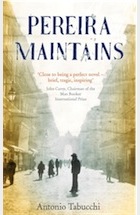
Finally, John Self spoke highly of Italian novelist Antonio Tabucchi's 1994 book Pereira Maintains. A brief work about an insular widowed journalist's political awakening.


This spate of voracious greed probably erupted because classes are beginning again on Tuesday and I forsee the end of freedom to read as I know it. A last hurrah, you know? Indulge me a little.

Thursday, January 27, 2011

Human stories told for nothing: The utter waste of war. (Books - A Long Long Way - Barry)

I had only ever heard of Irish novelist and playwright Sebastian Barry's The Secret Scripture, which I assumed (wrongly) to be some sort of commercialized quasi religious tripe, given the American cover which had a picture of an angel, and the fact that everyone was reading it. It put me right off. So last week, when my research advisor (an Irishman) put of copy of Barry's A Long Long Way into my hands, calling it one of his favorite books, I was forced to acquire an informed opinion of Sebastian Barry. That, and I was able to find out what my advisor liked in a book. That long preamble out of the way, I have to say that A Long Long Way was passionately written and devastating in its depiction of the human waste of war, in this case World War I.

It concerns Willie Dunne, a 5' 6" volunteer in the Royal Dublin Fusiliers. Irish participation in World War I aggravated an already fractious climate in the fight for home rule in Ireland, which came to a head in the Easter Rebellion in 1916. The rebellion led to a growth in popularity of the Irish republican movement. When the German front began to collapse, the British seriously needed soldiers and were forced to enact home rule. Willie Dunne was among the many Irish soldiers fighting a war on two fronts, one against the Germans, the other an internal battle among allegiances toward family and country. A Long Long Way is Willie's story.
He was a little baby and would be always a little boy. He was like the thin upper arm of a beggar with a few meagre bones shot through him, provisional and bare.
Barry has a poet's gift for grouping everyday words into elegiac sequences. He makes no bones about the fact that this is going to be a story of heartbreak.
And all those boys of Europe born in those times, and thereabouts those times, Russian, French, Belgian, Serbian, Irish, English, Scottish, Welsh, Italian, Prussian, German, Austrian, Turkish - and Canadian, Australian, American, Zulu, Burkha, Cossack, and all the rest - their fate was written in a ferocious chapter of the book of life, certainly. Those millions of mothers and their million gallons of mothers' milk, millions of instances of small-talk and baby-talk, beatings and kisses, ganseys and shoes, piled up in history in great ruined heaps, with a loud and broken music, human stories told for nothing, for ashes, for death's amusement, flung on the mighty scrapheap of souls, all those million boys in all their humours to be milled by the mill-stones of a coming war.
Human stories told for nothing. Words to choke a reader with sadness, and bitter words coming from a writer.

I found this cataclysmic story utterly enveloping. I could read it and be involved anywhere, on a crowded bus or in the quiet of my home. Barry has a sure hand in painting landscapes:
The field flowers were just appearing; light rains washed and washed again the pleasing fields. In those parts the farmers seemed to have decided that they might prepare to sow a harvest. The little villages seemed queerly optimistic; perhaps the human hearts were infected with whatever infects the very birds of Belgium. The sun lay along objects with indifferent and democratic grace, gun-barrel or ploughshare. The war was like a huge dream at the edge of this waking landscape, something far off and near that might ruin the lives of children and old alike, catastrophe to turn a soul to dry dust.
...and he people's them with incisive sentences:
He was mopping at his eyes with his sleeve like a bad actor. His big, doughy face was melting and as red as a red arse.
Usually I can't stand battle scenes. Whether in history or fiction, I find them impossible to envision, possibly because I can't see any people in them and find it impossible to see in my mind's eye the abstraction of a battalion. Not so with Barry's. His battle scenes, though virile and violent, are also populated. He is observant of the people in them:
The guns went on wailing and caterwauling. There were ferocious blows and bangs and thumps. The sergeant-major, for reasons of his own, was whistling 'The Minstrel Boy' now low under his breath, which was a curious fact, since he never whistled. Willie could see in his mind's eye the gunners work their guns, the way they were so used to it, and knew all the movements, like in a Saturday dance. Like they were waltzing or something with those metal guns.
And he writes damn good dialogue too. You can tell that Barry wrote for the theatre. It would be so easy to speak this lines:
'All the fucking lads up there. You should see the place. It's just a flat fucking few acres with little spots of white dust on it where the fucking houses were. And those devious Ulster lads from the 36th milling about and calling us wonderful fucking Paddies, that's what they said, and shaking our hands, And Australians and all kinds of mad bastards. And hundreds and hundreds of fucking Boche surrendering and shouting out that fucking Kamerad thing they do, and you couldn't blame them. What a fucking to-do. You wouldn't see it in Dublin on a Saturday night in the fucking summer, Willie. We're after winning this one. Isn't that a fucking how-are-you for the books?'
What Barry makes most plain in this beautiful book is the confusion and the utter waste of war, even in the case of a noble cause. It ruins the men (and now women) who fight it, the earth under them, the families they left behind. It ruins lives not even totally formed yet. One of its great tragedies, this book tells us, is that it ruins boys before they ever grow up enough to know their own minds.
Now the battalion in reserve was supposed to appear behind them in a bit and surge on wonderfully to Langemarck. Not a soul living seemed to be near them, nor a soul behind. All was a blank, black sheet of murderous nothing. It was daylight and the war had fogged the world.