Some people say I'm precocious. They say it mainly because they think I know difficult words for a little boy. Some of the difficult words I know are: sordid, disastrous, immaculate, pathetic, and devastating. There aren't really that many people who say I'm precocious. The problem is I don't know that many people. I know maybe thirteen or fourteen people, and four of them say I'm precocious. They say I look older. Or the other way around: that I'm too little to know words like that. Or back-to-front and the other way around, sometimes people think I'm a dwarf. But I don't think I'm precocious. What happens is I have a trick, like magicians who pull rabbits out of hats, except I pull words out of the dictionary. Every night before I go to sleep I read the dictionary. My memory, which is really good, practically devastating, does the rest...
Monday, October 29, 2012
Growing up minus the childhood (Books - Down the Rabbit Hole by Juan Pablo Villalobos)
Tochtli is a precocious seven-year-old, although he protests otherwise, who lives in a palace with its own zoo and is obsessed with hats, difficult words, and Liberian pygmy hippopotami.
Sunday, October 28, 2012
Being rich ain't all its cracked up to be (Books - The Patrick Melrose Novels by Edward St. Aubyn)
Alcohol addiction,heroin addiction, incest, your father's public humiliation of your mother - seems a small price to pay for unconscionable wealth and a villa in Provence, no? Patrick Melrose grows up with a seemingly unreasonable share of horror on the one hand and neglect on the other, which lead to a sense of aimlessness, some very persistent chemical dependencies, and an extraordinary amount of self-disgust. Thank goodness Melrose becomes reflective enough so that this account of his first 45-or-so years is more than a parade of ghoulish abuse. Indeed, Edward St. Aubyn's Patrick Melrose novels: Never Mind, Bad News, Some Hope, Mother's Milk, (The Patrick Melrose Novels, Picador, 2012) and At Last (Farrar, Straus and Grioux, 2011) are mercilessly observant of a world of advantage and indulgence, while at the same time being brutally funny. Their narrative arc traces the legacy of cruelty and narcissism that first mangles and imprisons the mind of its protagonist and eventually liberates it over nearly 900 pages that read like wild-fire consuming the lavish homes of Southern California millionaires, only here, most of the residents seem unwilling to leave their burning homes. The events were sometimes so dreadful that I had to remember to close my mouth, which hung agape. So precise was the scrutiny St. Aubyn gave his characters, it was like looking at a collection of extraordinarily insects, still alive, pinned inside a luxurious display case. But the cruelty is ultimately redeemed by a vision that is humane, even forgiving, but never pacifying. Having read the first four novels collected in a single volume, as I reached the last word of Mother's Milk, I said aloud 'Oh my god,' and went out the next day to buy At Last, which had recently been published separately.Monday, October 15, 2012
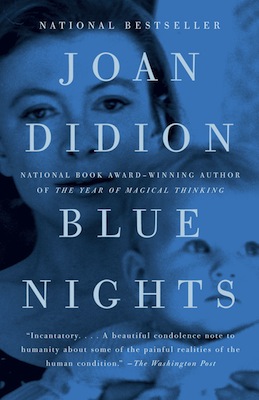
The public voice of our frailty (Books - Blue Nights by Joan Didion)
If you read Joan Didion's A Year of Magical Thinking, in which Didion, through writing, relentlessly observes herself in the act of grieving her husband during the year following his sudden death from a heart attack, I imagine you have read, or are thinking about reading, Blue Nights. Blue Nights, although it is an act of mourning her daughter Quintana, who died scarcely a year after her father, is not just more of the same. A Year of Magical Thinking was written through the raging storm. The book is brutal. Didion is dogged in examining her replacement of ordered thought with irrational and yet sensible struggles to undo the death of her husband - John Gregory Dunne - via special deals she makes with the universe. In it, she calls less on their life prior to his death, instead replaying the evening of his death over and over. In Blue Nights, Didion has allowed more time to pass since her daughter's death before writing. Here there is less the feeling of a disaster film shot from the cockpit of a crashing plane, and more the feeling of an invocation. They are both books of mourning, but in Blue Nights Didion calls on memory to wonder at the life and death of her daughter, to actively feel the pain of two losses - one of Quintana, the other of herself - and to assuage them. She uses repetition of form not exactly to reign in the emotion, but to structure it, so that the book is a conscious act of creation rather than simply an outpouring of raw grief. I thought its form evocative of a sestina which, Mary Kinzie's A Poet's Guide to Poetry tells us, is a formal verse structure with 39 lines containing 6 stanzas of six lines whose end words repeat verbatim in the following stanzas in a highly prescribed fashion. The seventh stanza uses all six end-words, also in a specific way. The repetition creates recurrent sounds, allowing a particular theme to echo as a refrain (as grief does with repeated memories). The highly stereotyped order, when used well and pitted against complex emotions, creates esthetic tension and that is precisely how it functioned in Blue Nights.
Saturday, October 13, 2012
Piteable men building their positions of strength on the backs of formidable women (Books - Three Strong Women by Marie NDiaye)
Three Strong Women by Marie NDiaye (Alfred A. Knopf, 2012), has received some strong press and the prestigious Prix Goncourt. The author's literary prowess won her a publisher for her first novel at age 18. Fernanda Eberstadt's fine review of this book in The New York Times Book Review informs us:
The expectation — whether menacing or well meaning — that NDiaye should “represent” multiracial France, or be considered a voice of the French African diaspora, has often dogged her. In fact, as NDiaye is at pains to make clear, she scarcely knew her Senegalese father, who came to France as a student in the 1960s and returned to Africa when she was a baby. Raised by her French mother — a secondary school science teacher — in a housing project in suburban Paris, with vacations in the countryside where her maternal grandparents were farmers, NDiaye describes herself as a purely French product, with no claim to biculturalism but her surname and the color of her skin. Nonetheless, the absent father — charismatic, casually cruel, voraciously selfish — haunts NDiaye’s fiction and drama, as does the shadow of a dreamlike Africa in which demons and evil portents abound, where the unscrupulous can make overnight fortunes and, with another turn of the wheel, find themselves rotting in a jail cell.
Thursday, October 11, 2012
Re-imagining Shakespeare's fairy kings and foolish mortals (Books - The Great Night by Chris Adrian)
It was Sam Ruddock's review that led me to Chris Adrian's The Great Night, an unrestrained hooplah of a novel that re-imagines Shakespeare's A Midsummer Night's Dream, placing it in Buena Vista Park in contemporary San Francisco. It's quite a ride. Adrian is not only a well-regarded writer, he is also a fellow in pediatric hematology-oncology, which leads me to assume he has probably seen his share of painful loss and human suffering. Interesting then that his characters Henry, Will, and Molly - the equivalent of the quartet of mortal young lovers in Shakespeare's play - have not only deeply suffered, but their lives are irrevocably driven by their suffering. One could say they are completely lost in it as they are lost in the park. The royal fairy couple, Tatiana and Oberon, are not broken up over a changeling in this take, they are grieving their child's death from leukemia. The rude mechanicals of Shakespeare are translated to a group of homeless people rehearsing not the myth of Pyramus and Thisbe but a politically-driven musical based on the film Soylent Green, no really. Puck is still a big trouble-maker. It is the unleashing of his power in the service of Tatiana and Oberon's unmitigated grief that drives the tangled, hallucinatory drama of healing that comprises the action of this novel.
Sunday, October 7, 2012
The story of the 20th century as the search for a 'self' (Books - Any Human Heart by William Boyd)
It seems that my vacation reading brought an unintentional spate of novels built on the autobiographical form. In most ways, What is the What could not be more different than William Boyd's Any Human Heart but they both involve relating the events of a life from a subjective point of view. Any Human Heart (a recommendation of Danielle's - another good one - thanks!) is the picture of a century. The 20th century, to be exact, but it is told through the journals of one Logan Gonzago Mountstuart, a British subject born in Uruguay and sometime resident of England, America, Nigeria, and France.
Saturday, October 6, 2012
Lost it all but rich in "selves" (Books - What is the What by Dave Eggers)
What is the What is the first of Dave Eggers's books I have read. It is distinct and unusual. It tells the harrowing story of Valentino Achak Deng, one of the 'Lost Boys' of Sudan, relating the events of his life that finally brought him to Atlanta in the U.S., but it bills itself as both an autobiography and a novel. An autobiography because Achak Deng related his life story to Eggers himself. A novel, I guess, because Eggers took liberties with his story to make it into a readable book. As I started writing the first sentence of this post I was going going to describe the story as 'unreal,' so mind bogglingly awful are many of the events. Perhaps this is why Eggers wanted to create from its events rather than simply try to record them. Sometimes the truth is unbelievable, or perhaps he (wisely) mistrusted his ability to relate only the facts since no one - not Deng in the telling nor Eggers in the retelling - truly leaves a story unchanged. In any event, the result is outrage-provoking yet beautifully fashioned, compellingly told, and, finally, warming.
Thursday, October 4, 2012
Negotiating science in politics (Books - The Art and Politics of Science by Harold Varmus)
Before taking off for points east, I read The Art and Politics of Science a sciency memoir by Harold Varmus, whose Nobel Prize-winning work helped reveal the connection between viral oncogenes and cancer. Dr. Varmus ran the National Institutes of Health (NIH) during the Clinton presidency and now heads Memorial Sloan-Kettering Cancer Center, one of the leading research and treatment facilities for cancer in the world. It is his success in the combined realm of science and policy-making that made me most interested in reading this swift-moving, easy-going account of a singularly impressive career. Owing to my backlog of posts I will attempt to keep this brief.
Returned from places distant, diverting, and delicious
We're back. The Ragazzo took way better pictures than I did. But here are a few of mine from a walk on the Sussex downs, a view of Ljubljana - the capital city of Slovenia - from the castle which overlooks it, and Lake Bled, a beautiful area of Slovenia where we took a hike - you can see the Alps in the background. Misha Matthew correctly identified all of the locations on my Vacate quiz and will be receiving a book on distant lands! Congratulations, Misha.
I didn't actually take any pictures in Venice or London and my pictures from Vienna are pretty boring but the trip wasn't. We managed to get opera tickets in Vienna and see a performance of Elektra and even before we left, we booked tickets for Scenes From an Execution a Howard Barker play from the 1970s about the freedom of the artist. The primary character is loosely based on Renaissance painter Artemisia Gentileschi and the play is being given a new production at the National Theatre in London starring Fiona Shaw and with a favorite English actress of mine - Phoebe Nichols. The British public seems less than happy with the production if the Guardian article I linked above is any indication, but I thought it intelligent and elegantly produced. We ate well in Venice and stayed in some beautiful and unique places. The train ride from Vienna to Ljubljana offers spectacular scenery and an honest to goodness dining car with linen tablecloths and decent, if not elegant, food.
In addition I read 5 novels, so I really have some catching up to do here. In the coming days I will post on David Egger's What is the What, William Boyd's Any Human Heart, Chris Adrian's The Great Night, Marie Ndiaye's Three Strong Women, and Never Mind by Edward St. Aubyn. In fact, I'm in the middle of his Patrick Melrose novels right now and they are brilliantly written, riveting, and hilarious even as the action is mind-bogglingly ghastly. More to follow.
I didn't actually take any pictures in Venice or London and my pictures from Vienna are pretty boring but the trip wasn't. We managed to get opera tickets in Vienna and see a performance of Elektra and even before we left, we booked tickets for Scenes From an Execution a Howard Barker play from the 1970s about the freedom of the artist. The primary character is loosely based on Renaissance painter Artemisia Gentileschi and the play is being given a new production at the National Theatre in London starring Fiona Shaw and with a favorite English actress of mine - Phoebe Nichols. The British public seems less than happy with the production if the Guardian article I linked above is any indication, but I thought it intelligent and elegantly produced. We ate well in Venice and stayed in some beautiful and unique places. The train ride from Vienna to Ljubljana offers spectacular scenery and an honest to goodness dining car with linen tablecloths and decent, if not elegant, food.
In addition I read 5 novels, so I really have some catching up to do here. In the coming days I will post on David Egger's What is the What, William Boyd's Any Human Heart, Chris Adrian's The Great Night, Marie Ndiaye's Three Strong Women, and Never Mind by Edward St. Aubyn. In fact, I'm in the middle of his Patrick Melrose novels right now and they are brilliantly written, riveting, and hilarious even as the action is mind-bogglingly ghastly. More to follow.
Saturday, September 15, 2012
Vacate!
Friends and new acquaintances, we're off to points east for a little bit - a late vacation. Below are the pix of our destinations. The closest guesses (as in most geographically specific) will be entered in a drawing. One winner will be selected when we return (you can live anywhere) . The winner can choose 1 book related to travel or places other than the place you live - fiction or non-fiction, travel, history, world politics, or recipes of distant places - exact details of the offer to follow on our return. Friends, relatives, and others who know our travel plans are not eligible. Answers by email please, not by comment: bookeywookey@gmail.com. Please put 'VACATE drawing' in the subject line. I will, of course, require the name and mailing address of the lucky winner.
Thursday, September 6, 2012
Encore, encore (Books - A Positively Final Appearance by Alec Guinness)
Following my enjoyment of Alec Guinness's 1995-6 journal My Name Escapes Me I couldn't help launching directly into his journals covering 1996-8 A Positively Final Appearance. Although roughly chronological the second volume is more organized by theme. Being a little older, Guinness seems more focused on his declining physical powers and the death of friends. He reflects more negatively on the state of the world and makes fewer excursions. The consequence was fortunate for his reader as the book is peppered with sometimes hilarious, sometimes touching anecdotes of Marlene Dietrich, Michel St Denis,
Humphrey Bogart, Edith Evans, Beatrice Lillie, and the like, that I could lap up with a spoon. He also tucks away perceptive readings of verse, and observations on plays and acting offered, not instructively, but because it is his habit and his pleasure to think about them. I'll offer you a few...
Monday, September 3, 2012
Aesthetics transforms vision and the mind, which transforms aesthetics... (Books - The Age of Insight By Eric Kandel)
There has been a bevy of books examining wider aspects of culture as they intersect with brain science written by scientists in the past year: Consciousness: Confessions of a Romantic Reductionist by Christof Koch, The Age of Insight by Eric R. Kandel, Who's In Charge?: Free Will and the Science of the Brain by Michael S. Gazzaniga, and Thinking, Fast and Slow by Daniel Kahneman. They are written by senior neuroscientists and written for the general public I wrote about the Gazzaniga here, I will write on Koch in the coming weeks, and I have yet to finish the Kahneman, but I just completed Eric Kandel's The Age of Insight (Random House, 2012).
The eminent Nobel-Prize winning neuroscientist satisfyingly brings together modernist art, the Viennese Secession to be precise, the study of the unconscious mind emerging during the same period, and what the development of neurobiology and cognitive psychology can contribute to our understanding of human-ness. His self proclaimed aim is to bring together science and art, his mechanism is to address what we know about how the brain accomplishes visual perception, creativity, and feeling. The result is a fluidly written account, fueled by a lifetime in neuroscience and a passion for painting, particularly portraiture.
A talent for wonder (Books - My Name Escapes Me by Alec Guinness)
In preparation for watching the recent film version of John Le Carre's Tinker, Tailor, Soldier, Spy, I got the 1979, 6-episode, made-for-BBC version to watch first. I know that I had seen some part of it before, but never the whole thing, and never with the amount of attention required to follow the amount of story telling conveyed through behavioral detail. It is wonderfully slow paced, unlike anything one can see on television now - without the cutting back and forth every five seconds, between seventeen different cameras - lest we linger, lest we see the lie before us, get bored, and change the channel. The music for it was very good too. Ian Richardson's performance is wonderfully animated, but the real pleasure of it was Alec Guinness's close-to-the-chest portrayal of George Smiley. He is one of those actors whose performances always make me think, well he's not really acting, that's just who he is.
Friday, August 31, 2012
Knowledge + taste = meaningful judgment
The excellent Daniel Mendelsohn, sings his creed at Page-Turner on the job of a critic. (The title for this post is his formula, not mine.)
I remember, too, something that Vendler wrote, years later, in a piece about a volume of Merrill’s work that was published after the poet’s death, at the relatively early age of sixty-eight—about how, now that Merrill was gone, he wouldn’t be around to show her how to grow old. I read this with astonishment. So this was what poetry was for: to show you how to live. As for Kael, the sheer extremity of her enthusiasms, the ornery stylistic over-seasoning, the grandiose swooping pronouncements, made it clear that there was something enormous at stake when you went to the local movie theatre.A thoughtful, instructive, and balanced essay.
Sunday, August 26, 2012
A Winter's Tale for the End of Summer (Books - Winter's Tale by Mark Helprin)
In the waning days of summer, I have been energetically immersed in reading, but not so inclined to write. I can probably blame it on all the writing I'm doing at the lab. That's as good an excuse as any. You should be able to read some sort of mention of The Rational Optimist, Consciousness, and Winter's Tale one of these weeks, if that's what you're pining for. And I should be done with Eric Kandel's The Age of Insight soon. The last one is a book after my own heart on the subject of neuroscience and Viennese art, no really. I intend to finish it soon, even if only to have read it prior to visiting Vienna in a few weeks. Now that I have started my fingers going, maybe I'll share less of a coherent review than some disjointed thoughts about my re-read of Mark Helprin's Winter's Tale now, prior to my book club showing up here to eat fruit and cheese and discuss it.
What a passionately lyrical saga Mark Helprin has fashioned in Winter's Tale (Harcourt Brace & Co., 1983) . It is a moralistic tale, a love story, a fantasy, and an absolute love song to a fictionalized late 19th century New York City. I was aware as I read of how highly literate the narrative voice is, even while being thoroughly submerged in the lightening-fast 700 pages which are romantic, imaginative, and often thrilling.
Saturday, August 4, 2012
An antidote to summer - the useless poems of Gennady Aygi
Some snowy poems as an antidote to the dog days of summer. Jamie Olson writes informatively on the dissident form and ordinary content in his review of a new translation of Russian poems Into the Snow: Selected Poems of Gennady Aygi. Sounds enticing.
The difference between Aygi’s ars poetica and Mandelstam’s lies in the way the two poets represent poetry itself. Both of them believe that other aspects of experience lack something essential, but while Mandelstam implies that the aesthetic power of poetry can fill that gap, Aygi dismisses even his own art as powerless. If a dissident is one who rejects the dominant ideology, then for Aygi that rejection applies in some sense to poetry as well.On Berfrois.
Thursday, August 2, 2012
Tracing the moral decay of politics (Books - Echo House by Ward Just)
Ward Just is justifiably ranked among the top writers on American politics in fictional form. Some consider Echo House (Houghton Mifflin, 1997) his masterpiece. It follows a family of Washington insiders, as they are now affectionately called, from the 1940s to the 1980s. It is not my favorite of Just's books, that place would have to be reserved for Forgetfulness, but it is a solid novel partaking of a solid tradition chronicling succeeding generations of a family. The Washington Post characterizes Echo House as the story of the "decline" of the Behls and certainly they don't maintain their grip on power through holding office, but I would frame it as their evolution, as they adapt to a morally decaying political context.
Thursday, July 26, 2012
The passage of time and the creative art of biography (Books - The Stranger's Child by Alan Hollinghurst)
Taking place across a span of nearly 100 years, Alan Hollinghurst's recent The Stranger's Child (Alfred A. Knopf 2011) offers simultaneous accounts of how the passage of time has affected both English literary and gay cultures. Its title, adopted from Tennyson's elegy In Memoriam, concerns the short life of the poet Cecil Valance (a contemporary of Rupert Brooke's though a fictional creation of Hollinghurst's, and a thoroughly convincing one) and those who survive him. But it is less about the life of Cecil Valance who is, after all, a second-rate poet who died in his 20s, than about what is made of the life of Cecil Valance. Sometimes when a life is noticed as remarkable, people take possession of it. Some wish to live vicariously, others romanticize, demonize, lionize, criticize. That life becomes a symbol whose role it is to fulfill the needs of its creators, but people, like complex works of art, are not so quickly summed up.
Tuesday, July 24, 2012
One great talent appreciates another
The great rhapsodist of the American theatre, Tennessee Williams, on the fragile yet directed talents of actress Sandy Dennis.
Hat tip: Sheila.
Check out the whole web site - it has one wonderful clip after another on the personalities and processes of great actors.There is a belief among some--primarily critics--that an actress willfully commits to the commission of a particular set of mannerisms and attitudes...
Hat tip: Sheila.
Sunday, July 22, 2012
What to do when the cake doesn't turn out the way you expect
A truly lovely tribute to Nora Ephron by Nathan Englander at Page-Turner with excellent thoughts on creative process.
And that to me is a good way to sum up what being a working artist is all about. It’s about being a person who makes real things in a real world.
Subscribe to:
Posts (Atom)