Showing posts with label memory. Show all posts
Showing posts with label memory. Show all posts
Saturday, August 16, 2014
Longing for a world both near and far (Books - The Emigrants by W.S. Sebald)

Sunday, November 4, 2012
The riches and burdens of family legacy (Books - The Scientists by Marco Roth)

Another New York story was the subject of The Scientists by Marco Roth (Farrar, Straus and Giroux, 2012) which I was convinced was a novel, but turns out to have been a memoir. It tells of a thirty-something New Yorker whose father, a medical researcher, contracted the HIV virus in the 1980s.
Tuesday, December 22, 2009
Frantic end of the year listmaking and my best non-fiction read for 2009
It's that time again when I look back over the year's reading and make best-of lists to review it for quality and suddenly get competitive with myself and make frantic year-end goals so as to achieve a certain quantity. With 49 books read this year and 2 seriously in-process, it is probably reasonable to shoot for 52 books this year - which would be an average of 1 per week. Not bad, seeing I'm earning a Ph.D. and only 3 of those books listed were for school. (I listed the school-related reading that actually involved reading a whole book that might be of some general interest but I did not list every text book or professional journal articles, which comprises most of my school reading).
As for best-of lists I will start with non-fiction, of which I read very little this year (a few are still in the works).
The Invention of Air - Steven Johnson
Children and Grief: When a Parent Dies - J. William Worden
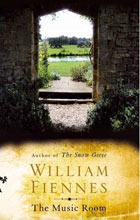
The Music Room - by William Fiennes
The Man With the Shattered World - A. R. Luria
The Snow Geese - William Fiennes
Beautiful Shadow - Andrew Wilson
Ethics in Psychology and the Mental Health Professions - Koocher & Keith-Spiegel
Picasso and Lump: A Daschund's Odyssey - David Douglas Duncan
If I actually finished 1 of the 3 non-fiction books in the works: 3 Case Histories of Freud or Antony Beevor's The Fall of Berlin 1945, or Margaret Drabble's recent memoir, that would be a respectable 9 non-fiction books of the 52 I plan to read this year, or 17%, more than I expected.
I won't include the 3 partially read books in my consideration of this year's best non-fiction but a quick look at the list easily whittles it down to just 2 titles: The Music Room and The Invention of Air. I just re-read my initial posts on these 2 titles and my choice for best non-fiction read of 2009 goes to The Music Room by William Fiennes which I found "touching and thoughtful, indulging in the sweetness of memory but never tumbling into maudlin longing."

To come, my 2009 picks for YA fiction, mystery, perhaps a sci-fi/fantasy choice, and fiction.
As for best-of lists I will start with non-fiction, of which I read very little this year (a few are still in the works).
The Invention of Air - Steven Johnson
Children and Grief: When a Parent Dies - J. William Worden
The Music Room - by William Fiennes
The Man With the Shattered World - A. R. Luria
The Snow Geese - William Fiennes
Beautiful Shadow - Andrew Wilson
Ethics in Psychology and the Mental Health Professions - Koocher & Keith-Spiegel
Picasso and Lump: A Daschund's Odyssey - David Douglas Duncan
If I actually finished 1 of the 3 non-fiction books in the works: 3 Case Histories of Freud or Antony Beevor's The Fall of Berlin 1945, or Margaret Drabble's recent memoir, that would be a respectable 9 non-fiction books of the 52 I plan to read this year, or 17%, more than I expected.
I won't include the 3 partially read books in my consideration of this year's best non-fiction but a quick look at the list easily whittles it down to just 2 titles: The Music Room and The Invention of Air. I just re-read my initial posts on these 2 titles and my choice for best non-fiction read of 2009 goes to The Music Room by William Fiennes which I found "touching and thoughtful, indulging in the sweetness of memory but never tumbling into maudlin longing."
To come, my 2009 picks for YA fiction, mystery, perhaps a sci-fi/fantasy choice, and fiction.
Tuesday, March 17, 2009
Fugetaboutit - the perils of memory
 Why do we forget, asks an article in today's Science Times by Natalie Angier with a fun look at a couple of questions about memory.
...there are plenty of...examples of memory's whimsy and bad taste - like why you may forget your spouse's birthday but will go to your deathbed remembering every word of the Gilligan's Island theme song...Memory comes in different flavors. The mind preserves traces of facts, events, or sequences of tasks that we perform with our body differently. Each are encoded in a different way and different brain structures are involved in storing and retrieving them. One of the more generally accepted models of memory includes a structure called "working memory" which takes something that has entered our awareness - a phrase, say - and maintains it by mentally rehearsing it over and over under its trace becomes more solidified. Later on, and much of this is thought to happen while we sleep, the brain through a fascinating volley of patterned firings consolidates that information. It actually physically changes the properties of cells when you remember something. It is generally thought that the memory of your friend's face or that great meal in the Provence isn't stored whole in one drawer but that its elements are distributed and each time that they are accessed they are re-assembled. Today's article discusses the advantage that music confers in general upon words, by adding structure. It also does a good job on why many of us cannot remember jokes but the $64,000,000 questions - why we forget that birthday... There are several reasons why, although someone's birthday is symbolically important, it is so hard to remember - 1) it is a number or complex of words and numbers that has no particular meaning, i.e. December 3rd does not mean Charlie. It just happens to be Charlie's birthday, it could just as well be any other day. So the detail of that number is small and 2) it is arbitrary, and if we want to confer upon it the association of Charlie we would have to rehearse it but 3) we heard it only one time (unless Charlie is obsessed with our remembering it). Add to that the problem called interference - there are 364 other numbers it could be and some of those numbers are other people's birthdays - so somewhere in our mind a certain subset of those 364 numbers has had importance attached to them and those numbers could be shared exactly or could include December 13 or November 3rd. Well, you get my point. There are several other differences that Charlie's darn birthday has from the words for the Gilligan theme. The theme song is not only heard repeatedly and structured by being attached to a melody, but 5) it doesn't have to come up at any point in particular, we can just remember it when we want to. Charlie's birthday has to be held in mind and then brought to surface at a particular point in time - a particularly tricky type of memory. Like thinking in the morning - I have to pick up that sweater from the cleaners on the way home from work - and then forgetting by 5:45 pm for three days in a row. Finally there is the difference between remembering something because it is obligatory versus remembering something because it's fun. 6) The obligation to remember creates pressure and neither the encoding nor the retrieval of memory work particularly well under too much of it. So the more you pressure yourself about not forgetting that birthday, the more likely it is you may forget it. Kind of irritating - huh? But now you have 6 excuses.
Subscribe to:
Posts (Atom)