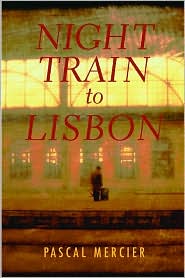
I finished Swiss author Pascal Mercier's controversial book
Night Train to Lisbon. So is it brilliant or is it craptacular (a word I just heard on NPR)? For my money it's neither, but it is an engaging story and I would place it into a sort of intellectual pulp-fiction category. The central character, Gregorius, is a teacher of Latin, Greek and Hebrew in a high school. He plays chess for fun. He is a rather staid and sedate creature of habit who has a chance encounter with a Portuguese woman in his home city of Berne, Switzerland. This leads him to discover a philosophical memoir by a Portuguese doctor which seems to speak directly to him and drives him to leave his job and visit Portugal to learn everything he can about the life of Amadeu de Prado, the author of the book - a brilliant intellect, devout atheist, iconoclast, member of the resistance against Salazar, the authoritarian ruler of Portugal until the mid-1970s. Most of the critics who thought the book bombastic crap were American. I wonder if that is because the book is neither fish nor fowl? The writing is low-brow, unimpressive - it gets the job done but no better than the average pulpy thriller and is a little repetitive. And yet, it is filled with lengthy italicized philosophical paragraphs, people who speak dead languages, play chess for fun, doubt the existence of god and say so, and the action is largely of an introspective sort - one man trying to uncover another man's past in order to somehow transform himself. America is many things but our culture has a largely anti-intellectual bent. If something here is "heady" most people want to know and prepare themselves for it, or they want to just have fun, but those two things generally aren't supposed to overlap. You know all that stuff like opera and films you have to read - in Holland where I have worked for many years it always surprised me to see people under 30 years old out on dates for fun at the opera. I almost never saw that in New York, Chicago, San Francisco, Santa Fe (any of the American opera houses that I have worked in). To get back to the book, I didn't find
Night Train to Lisbon terribly serious and I certainly didn't find it transformative, but the world it was set in was one of self-probing thought and love of literature and was very recognizable to me. The sudden change in this quiet, hypochondrical man was enlivening and what drove his curiosity drove mine and so I was engaged and entertained by it. Imagination, intimacy and language are described as Prado's sanctuaries by one of the characters in the book. That is the kind of place this book is. If you enjoy intellectual and bookish mysteries like those of Carlos Ruiz Zafon then you might also enjoy this book, although its pleasures are a little quieter than
Shadow of the Wind. Speaking of pulp...

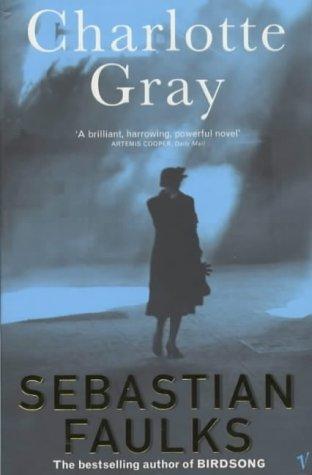
We saw the film adaptation of Sebastian Faulks's
Charlotte Gray last night, which I borrowed from the library because Billy Crudup is in it. I haven't read the book but the film is every bit a trashy romance despite its setting in World War II France and England its action, which concerns a young Scottish woman who, speaking French, becomes an agent for the Brittish to aid the French resistance, and the serious choices Charlotte must make given her involvement with a Jewish family in Nazi-occupied France. The film was an interesting one to me for two reasons. The period is one I am very interested in right now. I am also reading Patrick Hamilton's
The Slaves of Solitude set in a World War II London suburb and I'm reading Antony Beevor's
The Fall of Berlin 1945, an excellent military and social history of the end of the war. And also because a completely predictable script rendered in a way I could only describe as flat, stale and unprofitable, was filled with such depth by its cast and the detailed direction of Gillian Armstrong. Cate Blanchett, Michael Gambon, and most of the cast were very good - specific and understated - but, as usual, Billy Crudup had that extra something that allows him to act circles around anyone else near him, whatever the material. He does his job - sure. He is committed to the world of his character, involved in his circumstances, aware of the technical requirements, moved in the right way at the proper times - but it is more than that. He lives in, but also around the character's life. He does more than embody his lines and actions as informed by his back story, he embodies his backstory. He is the circumstances you are witnessing and also the circumstances you haven't seen - things that came before, expectation of things to come, and probably things that are particular to Crudup's being and fantasy - things that are secret from us that we will never know, and yet are alive in Crudup's behavior which creates that which we experience in the film or play as his character. Whenever I see someone of those type of abilities work - Juliette Stevenson, Geraldine Page,
Mark Ruffalo - I am reminded what it is I love about great acting. Ode to Billy over.
Now Lorrie Moore's latest waits in the wings and an interesting book entitled
Identity and Story: Creating Self in Narrative a book about psychological research in the intertwined sub fields of self and narrative - an intersection I am obsessed with. Not to mention about 200 pages of homework to read by Tuesday.