Showing posts with label music and cognition. Show all posts

Friday, January 1, 2010

The music of our brain (Film - The Music Instinct & Book - Rhythms of the Brain by Gyorgy Buzsaki)

Typically, the new year is rung in here with friends and fondue but The Ragazzo has been so sick that he was in bed and I celebrated by doing the laundry, watching a video, and going to bed at 10:30. Woo- hoo. Hope you brought in 2010 with more appropriate pomp.

The Music Instinct: Science and Song
is the video I watched. It is a film by Elena Mannes first aired on PBS. I received it from The Ragazzo's brother and sister-in-law this christmas and it is about the latest research on music and neuroscience - one of my pet topics. It features all the usual PBS-type folks - musicians Bobby McFerrin and Yo-yo Ma, Oliver Sacks, and physicist Brian Greene - but it had pretty decent coverage of the major researchers in the relatively small field of music and cognition. It begins with a discussion between scientist Daniel Levitin and musician Bobby McFerrin asking - "Why music?" Levitin was the most well known researcher in the film because of his book This is Your Brain on Music, but they also had John Sloboda, Robert Zatorre, Isabelle Peretz, Sandra Trehub, and Aniruddh Patel (among others) - all respected researchers in the field. It was better than some pop-science I've seen in presenting more than one side of an argument, but it did not offer a narrative that clearly told the inexperienced viewer that that is what it was doing. It wanted, like most television fare, to make grand claims that could not be supported by the research presented. They ended with the Audra McDonald's voice-over saying - "Why music? It is written into our very being. Science is showing us that song is at the core of life." The film is straining to tell us that music is tied in some essential way to our DNA, although in actuality the film ended with a few differing opinions about why humans make music and it would have been more honest to have told that story. However it makes for an engaging primer on the subject for the lay-person and I found the inclusion of Brian Greene useful in that the program discussed not just the esoteric musings of a small group of specialized researchers about why music might have evolved in human culture whether as an adaptive feature or as a useless adornment, Greene discussed music as a physical phenomenon - a patterned disturbance of air - or a wave - and Levitin stressed music's ability to coordinate the firing of neurons and that reminded me of a book I have been meaning to pick up for the last six months - Rhythms of the Brain by Gyorgy Buzsaki - so I unearthed it and began reading last night (we really know how to party here at Bookeywookey central).

Buzsaki book does not address music per se, it focuses on rhythm, particular oscillatory patterns or periodic disturbances to a system or state as they occur across time. This phenomenon is found throughout nature and Buzsaki is particularly interested in groups of neurons that fire in patterns, establishing a temporal metric which could then organize larger patterns of activity among cells in the brain. This is seen as a self-organizing action that subsequently impacts the brain's cognitive and motor functions and whose temporal nature is essential to what may be the brain's primary reason for existing - predicting what will occur next in the environment.
Predictions and relationships are constructed by ordering the succession of events according to elapsed subjective time. We are usually able to say which of two events happened before the other...the cause precedes the effect in time.
If one observes how reactive systems evolved from single-cell creatures to nerve nets in hydra to complex mammalian brains over millenia, the substantial adaptation offered by a brain like ours is that of predicting events before they occur and the ability to more sophisticatedly collect data from our environment and use it to intercede in what would otherwise be an automatic repertoire of responses.

Buzsaki's range of knoweldge is broad - bringing in chaos theory, electrophysiology, mathematics and biology. His language is the language of science - when he day dreams he tells you so and when the information he presents has been measured via experimental means and expressed as a probability (as all study conclusions are) he tells you that. His writing is down-to-earth and very engaging and since he writes about the phenomenon of rhythm, I find his thinking stimulating for relating one of the features of music (which evolved along with the rest of the natural cultural word) with brain function. A superb book so far.

Buzsaki and my continued exploration of the superb Irish novelist Deirdre Madden with her The Birds of the Innocent Wood make up my reading as 2010 begins. And yourself?

Tuesday, May 20, 2008

Seranading brain and body


David Dobbs's article in Today's Science Times speaks of Dr. Conrad Claudius, a surgical resident, whose research on music and healing suggests that music's effects could result from a combination of increased production of pituitary growth hormone combined with a drop in stress hormones, although not every one agrees.


And Sara Reistad-Long reports on research that older brains may broaden their focus of attention:

"It may be that distractibility is not, in fact, a bad thing," said Shelly H. Carvard..."It may increase the amount of information available to the conscious mind."

For example, in studies where subject are asked to read passages that are interrupted with unexpected words or phrases, adults 60 and older work much more slowly than college students. Although the students plow through the texts at a consistent speed regardless of what the out-of-place words mean, older people slow down even more when the words are related to the topic at hand. That indicates that they are not just stumbling over the extra information, but are taking it in and processing it.

When both groups were later asked questions for which the out-of-place words might be answers, the older adults responded much better than the students.

Thursday, January 24, 2008

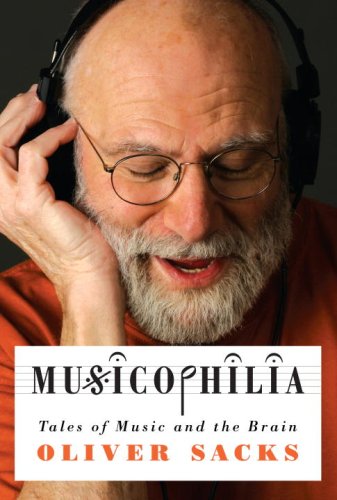
Music upon which hangs his very existence (Books - Musicophilia by Oliver Sacks)


Most people I talk to have not heard of my very favorite books - Cloud Street, Hopeful Monsters, The Goldbug Variations, although everyone who comes here is sick of them by now, but if you're still curious about my faves check out my side bar for a list. So I'm going to skip today's Booking through Thursday prompt and continue instead talking about Musicophilia, Oliver Sacks' latest book. This post along with this one constitute my musings on it.

An entire chapter of the book is devoted not to the subject of music per se, but rather to a particular patient's amnesia, and the temporary relief that music provides him. There is not only one kind of memory, but several, or if you asked the memory scientist Endel Tulving, he would say several hundred! Some of the more common divisions of memory you may have heard of are short-term memory and long-term memory - others divide memory into declarative or explicit memory, which requires consciousness for retrieval, and procedural (implicit) which does not. Explicit memory can be further divided into semantic memory (fact based knowledge, for example the name of the capital of Australia), and episodic memory (memory specific to a place and time). Autobiographical memory is often grouped under the explicit category, but it is arguably a maverick category as one could say our identity stays with us, whether we think consciously about it or not. But how can we retrieve memory without thinking about it? You do it thousands of time each day - you don't have to remember how to eat, how to walk down the stairs, what your name is (most of the time!), what the word 'the' means, where it should come in a sentence, etc.. We could not live or think without our procedural memory.

Multiple kinds of memory means many ways the system can break down. Say the word "amnesia" and a 1950s film might pop into view. The blurry screen clears, a nurse in one of those peculiar hats comes into view. She is looking down at a man in pajamas, who is uttering the words "Where am I? Who are you? I don't know who I am." Amnesia is often selective for memories that occurred before the accident or illness, sparing those that come after, or vice-versa, events up to the accident are remembered but the patient cannot form new memories. Generally there is a blackout period around the time of the accident as well. But sometimes, the victim is not even that lucky. Sacks writes of his patient Clive Wearing, a musicologist and musician, who had everything but his procedural memory completely wiped out by encephalitis while in his forties. He wasn't even lucky enough to be given a span of memory that lasted a few minutes, his lasted seconds.
His ability to perceive what he saw and heard was unimpaired. But he did not seem to be able to retain any impression of anything for more than a blink. Indeed, if he did blink, his eyelids parted to reveal a new scene. The view before the blink was utterly forgotten...It was as if every waking moment was the first waking moment. Clive was under the constant impression that he had just emerged from unconsciousness because he had no evidence in his own mind of ever being awake before...."I haven't heard anything, seen anything, touched anything, smelled anything," he would say. "It's like being dead."

One doesn't have direct awareness of one's own amnesia and lacking memory, one makes the most plausible inferences possible to make sense of ones world. Clive is understandably devastated, becomes horribly depressed, is institutionalized for many years but eventually emerges having found some ways of coping moment-to-moment. He develops a constant stream of joking, repetitive chatter - that is an immediate response to whatever is said to him. It consists of puns, rhymes - scripts that are half sense, half nonsense all emerging from somewhere in his procedural memory.
Clive's loquacity, his almost compulsive need to talk and keep conversations going, served to maintain a precarious platform, and when he came to a stop, the abyss was there, waiting to engulf him.

Amazingly, through even the worst of Clive's disorientation, his musical abilities are preserved. He can sing from a score, play the organ:

The momentum of the music carried Clive from bar to bar. Within the structure of the piece, he was held, as if the staves were tramlines and there was only one way to go. He knew exactly where he was because in every phrase there is context implied, by rhythm, key, melody...when the music stopped Clive fell through to the lost place. But for those moment he was playing he seemed normal.

It is as if the autobiographical, episodic, and intellectual framework that is the scaffolding for the rest of us is temporarily supplied for Clive through the music. He still doesn't know who he is, but the context that is the music makes the next moment inevitable, and he can use it as a stepping stone to put one foot forward. It's a remarkable story about a tenuous survival and it alone is worth getting this book for.

Monday, January 21, 2008

Music and the Brain (my favorite topic and the subject of Oliver Sacks latest book - Musicophilia)


We get married to it, buried to it, come of age to it, finish our schooling in-step to it, put our children to sleep with it, soothe our broken hearts, celebrate our births, pray to our gods, and woo our mates to it. Shakespeare told us it is the "food of love," Nietzsche said without it "Life would be an error." What is it about certain sounds that make them music to our ears and are they merely, as Steven Pinker proclaimed, "a cocktail of recreational drugs that we ingest through the ear," did music's genesis precede spoken language, did it arise from the cadences of the spoken word, is it the by product of motherese - the sing-songy enhancements of the rhythms and pitches of speech that parents use to talk to their babies. Many scientists feel these exaggerations are they way we acquire language. No one can agree about the origins of music but most seem to agree that it really matters to us.

A little primer on some of the basic knowledge we have about music as a form and how it is processed in the brain, since this is a speciality of mine:

Music has existed almost as long as human civilization and across its many cultures. Archeologists discovered a perforated bear bone in Slovenia that is argued to be a "flute" from the Paleolithic ear, making it approximately 36,000 years old. What is it? A complex and conscious use of sound made by humans for humans. Music is generally characterized as having patterns of pitch and meter, but there are, of course, exceptions. Music exists without pitch in drumming, and without meter in chant or alap, an Indian form.

Through its early cognitive processing, it is collected from the environment as any sound would be but scientists do not agree about its exact trajectory through the auditory system. Processing music involves segregating the sounds from their background and analyzing timbre, pitch, both horizontal progress (sounds happening in sequence, i.e. melody) layered simultaneously (chords), and time (meter and rhythm). Interactions with the music's performance - facial expressions of the performer, context of the performance, text, the listener's own associations with superficial features, and their own life events also make up the experience of music.

Individually sequenced pitches are processed in terms of direction and interval size and referenced to a scale, which will vary with culture. Simultaneously presented pitches are references to their conformity to, or violation of, learned combinatory principles. Like the acquisition of syntax for language, these principles are acquired in infancy by musicians and non-musicians alike and require no explicit training. Temporal information is processed in terms of duration of segments and general underlying beat. Whether processing of these components of music happens in music-specific networks of the brain is a hotly debated topic, but brain damage studies have shown that more and more aspects of this process happens in music-specific networks of brain areas. Melody recognition and tonal perception occur in music-specific networks (Peretz & Hyde, 2003). Pitch discrimination appears to occur in separate circuits in the brain from those which process pitch for language (Peretz, 2002) For a while, the story went that language was processed only on the left side of the brain and music on the right but a study by Robert Zatorre (2002) suggests that the right hemisphere specializations are actually specific to detailed spectral discrimination (which happens to be useful for processing melodies) whereas the left is better for rapidly changing temporal information, as is useful for speech. The brain distinguishes between pitch for speech and pitch for tone early on in processing a sound - although this happens differently for tonally based languages like Chinese.

In terms of function there are clear distinctions between music and language. Music must be sound and must have order, but it does not communicate truth or falsity nor can one order a pepperoni pizza with music or schedule a meeting. Language need not be sound at all (as in sign language or in writing) but it is dependent on order, and its function is communicating meaning. Language is remembered for meaning, rarely for it features (its exact words and their sounds) unless word-for-word memorization is the goal. If the meaning of a sentence is recalled, one can sometimes reconstruct the features of language using logic, whereas music can only be remembered for its features. We would be hard pressed to reconstruct notes and rhythms from the sadness they evoked, but if music possess any content aside from the sounds themselves it would seem to be emotion that gives it meaning.

I am crazy about the intersection of music and cognition - it is to be one of my areas of research once I'm out of school. That is why Oliver Sacks' latest book is such, well, music to my ears. Sacks divides his book into four sections - one on people who become suddenly possessed by music without these having been the case before, the second is about degrees of enhanced or impaired skills in the realm of music - from savants to those who have disorders of pitch or rhythm, the third deals with memory and movement in relation to music, and the last with emotion and identity. I am just completing the second section. If you have never read an Oliver Sacks book, his focus is not the neuroscience of music in general, he is a physician (although his scientific skills and interests span a wide range) but as a clinician he encounters individuals with specific problems. His strength as a clinician appears to be his ability to get to know these people as people rather than as problems, and his strength as an artist is his ability to tell their stories with compassion, and with just as much insight as he has but his stories are not all success stories and sometimes his expression is one of admiration for his patient, or awe, or sorrow for the limits of our knowledge and his ability to alleviate the suffering of a person.

The stories he tells are uncanny. Sacks could just parade his patients oddities around as a kind-of modern day freak show, but his writing shows far more humanity than that. In this book we meet a physician who, as a result of being struck by lightening is possessed by a sudden love of/obsession for piano music. Another chapter is devoted to auditory hallucinations and other forms of internally generated auditory perceptions - like mental imagery- and their frequency of occurrence in all sorts of people. I myself pretty much have music playing in my head all day long. When I think about it I can vary the piece, or the artist, or the orchestration - even if I've never heard a version like that before. Sometimes I can get stuck and become the victim of a sort of demon internal-i-pod, but mostly we have a friendly relationship. An entire chapter of Sacks' book is devoted to this and, while the internal generation of perceptions were once thought to be the province only of schizophrenics it is now found that the phenomenon is much more wide-spread. Sacks' tells of of Jerzy Konorski, a Polish neurophysiologist, who argued in the 1960s that hallucinations can occur because the neurological pathways for sensory information flow two ways rather than one. This was a radical concept then but these feedback connections are now a well-known phenomenon and are known to account not only for images and hallucinations but are part of the way we all perceive our environment on a daily basis (Foxe & Simpson, 2002).

Anyway, I can just go on and on when it comes to music and the brain, in fact I have so I'll cut to the chase. I am enjoying Musicophilia tremendously. It is accessibly written, warm and humane in its outlook - the tremendous curiosity for knowledge and the capacity of this brilliant man to be continually awed by human nature is inspiring, yet he never lectures you about it - he communicates it through his own experience of the world. I have found every one of Sacks' books a compulsive read and find this one to be no different. If I hadn't been working so much in the lab over the last few days I'm sure I would already have finished it. More on this book and some of its stories later.