Showing posts with label poems. Show all posts
Showing posts with label poems. Show all posts
Tuesday, July 8, 2014
Only through time time is conquered (Books - Time Present and Time Past by Deirdre Madden)

Wednesday, February 29, 2012
Beautiful little accidents of everyday experience (Books - You Do Not Need Another Self-Helf Book by Sarah Salway)
 Sarah Salway, friend and author of the novels Tell Me Everything and Getting the Picture (among others), has just published her first volume of poetry! What better way to ring in March? It boasts the smile-inducing title You Do Not Need Another Self-Help Book, and after reading it, you probably won't. The book features verse and prose poems, mostly contemporary subject matter, and a good deal of first-person voice (but not exclusively). They are sexy, reflective, funny, clever, even cheeky, but mostly these are intimate and generous poems. You can feel the poet reaching beyond her comfort to give you something of herself. I admire the way Sarah courts everyday experience, like shopping or little moments of regret, for accidents which reveal something fresh about being inside of our lives, and how she then uses her craft to create something of lasting worth and beauty from them.
I am delighted to participate in her virtual poetry reading by presenting Sarah's own reading of "Dad Plays St George."
You may purchase the book here: http://www.pindroppress.com/?page_id=440 or here.
For other stops on the virtual poetry reading tour, click here for the list of links.
Thursday, February 2, 2012
Wislawa Szymborska, spirited Polish poet - Her poems make me say 'Yes, exactly.'

Thursday, October 6, 2011
Inflorescence - Swedish Poet Tomas Transtromer wins the Nobel Prize for Literature
In-flo-res-cence - from the Latin inflorescere - to begin to blossom. 1. the producing of blossoms; flowering; 2. the arrangement of flowers on a stem or axis; 3. a flower cluster on a common axis; 4. flowers collectively; 5. a solitary flower, regarded as a reduced cluster.
Today's Nobel Prize winner in literature, Swedish Poet Tomas Transtromer, has long been a favorite of mine.
Dream Seminar
Four thousand million on earth.
They all sleep, they all dream.
Faces throng, and bodies, in each dream -
the dreamt-of people are more numerous
than us. But take no space...
You doze off at the theatre perhaps,
in mid-play your eyelids sink.
A fleeting double-exposure: the stage
before you out-manoeuvred by a dream.
Then no more stage, it's you.
The theatre in the honest depths!
The mystery of the overworked director!
Perpetual memorising of new plays...
A bedroom. Night.
The darkened sky is flowing through the room.
The book that someone fell asleep from lies still open
sprawling wounded at the edge of the bed.
The sleeper's eyes are moving,
they're following the text without letters
in another book -
illuminated, old-fashioned, swift.
A dizzying commedia inscribed
within the eyelids' monastery walls.
A unique copy. Here, this very moment.
In the morning, wiped out.
The mystery of the great waste!
Annihilation. As when suspicious men
in uniforms stop the tourist -
open his camera, unwind the film
and let the daylight kill the pictures:
thus dreams are blackened by the light of day.
Annihilated or just invisible?
There is a kind of out-of-sight dreaming
that never stops. Light for other eyes.
A zone where creeping thoughts learn to walk.
Faces and forms regrouped.
We're moving on a street, among people
in blazing sun.
But just as many - maybe more -
we don't see
are also there in dark buildings
high on both sides.
Sometimes one of them comes to the window
and glances down on us.
Fire Jottings
Throughout the dismal months my life sparkled alive only when I made love with you.
As the firefly ignites and fades out, ignites and fades out, - in glimpses we can trace its flight
in the dark among the olive trees.
Throughout the dismal months the soul lay shrunken, lifeless,
but the body went straight to you.
The night sky bellowed.
Stealthily we milked the cosmos and survived.
Romanesque Arches
Inside the huge romanesque church the tourists jostled in the half darkness.
Vault gaped behind vault, no complete view.
A few candle-flames flickered.
An angel with no face embraced me
and whispered through my whole body:
'Don't be ashamed of being human, be proud!
Inside you vault opens behind vault endlessly.
You will never be complete, that's how it's mean to be.'
Blind with tears.
I was pushed out on the sun-seething piazza
together with Mr and Mrs Jones, Mr Tanaka and Signora Sabatini
and inside them all vault opened behind vault endlessly.
A Page of the Night-Book
I stepped ashore one May night
in the cool moonshine
where grass and flowers were grey
but the scent green.
I glided up the slope
in the colour-blind night
while white stones
signalled to the moon.
A period of time
a few minutes long
fifty-eight years wide.
And behind me
beyond the lead-shimmering waters
was the other shore
and those who ruled.
People with a future
instead of a face.
More of Tomas Transtromer's poems are linked via my side bar under the heading Inflorescence and then his name.
Today's Nobel Prize winner in literature, Swedish Poet Tomas Transtromer, has long been a favorite of mine.
Dream Seminar
Four thousand million on earth.
They all sleep, they all dream.
Faces throng, and bodies, in each dream -
the dreamt-of people are more numerous
than us. But take no space...
You doze off at the theatre perhaps,
in mid-play your eyelids sink.
A fleeting double-exposure: the stage
before you out-manoeuvred by a dream.
Then no more stage, it's you.
The theatre in the honest depths!
The mystery of the overworked director!
Perpetual memorising of new plays...
A bedroom. Night.
The darkened sky is flowing through the room.
The book that someone fell asleep from lies still open
sprawling wounded at the edge of the bed.
The sleeper's eyes are moving,
they're following the text without letters
in another book -
illuminated, old-fashioned, swift.
A dizzying commedia inscribed
within the eyelids' monastery walls.
A unique copy. Here, this very moment.
In the morning, wiped out.
The mystery of the great waste!
Annihilation. As when suspicious men
in uniforms stop the tourist -
open his camera, unwind the film
and let the daylight kill the pictures:
thus dreams are blackened by the light of day.
Annihilated or just invisible?
There is a kind of out-of-sight dreaming
that never stops. Light for other eyes.
A zone where creeping thoughts learn to walk.
Faces and forms regrouped.
We're moving on a street, among people
in blazing sun.
But just as many - maybe more -
we don't see
are also there in dark buildings
high on both sides.
Sometimes one of them comes to the window
and glances down on us.
Fire Jottings
Throughout the dismal months my life sparkled alive only when I made love with you.
As the firefly ignites and fades out, ignites and fades out, - in glimpses we can trace its flight
in the dark among the olive trees.
Throughout the dismal months the soul lay shrunken, lifeless,
but the body went straight to you.
The night sky bellowed.
Stealthily we milked the cosmos and survived.
Romanesque Arches
Inside the huge romanesque church the tourists jostled in the half darkness.
Vault gaped behind vault, no complete view.
A few candle-flames flickered.
An angel with no face embraced me
and whispered through my whole body:
'Don't be ashamed of being human, be proud!
Inside you vault opens behind vault endlessly.
You will never be complete, that's how it's mean to be.'
Blind with tears.
I was pushed out on the sun-seething piazza
together with Mr and Mrs Jones, Mr Tanaka and Signora Sabatini
and inside them all vault opened behind vault endlessly.
A Page of the Night-Book
I stepped ashore one May night
in the cool moonshine
where grass and flowers were grey
but the scent green.
I glided up the slope
in the colour-blind night
while white stones
signalled to the moon.
A period of time
a few minutes long
fifty-eight years wide.
And behind me
beyond the lead-shimmering waters
was the other shore
and those who ruled.
People with a future
instead of a face.
More of Tomas Transtromer's poems are linked via my side bar under the heading Inflorescence and then his name.
Sunday, December 5, 2010
Poem for a child from his father (An Inflorescence - Where's The Moon, There's The Moon - poems by Dan Chiasson)
In-flo-res-cence - from the Latin inflorescere - to begin to blossom. 1. the producing of blossoms; flowering; 2. the arrangement of flowers on a stem or axis; 3. a flower cluster on a common axis; 4. flowers collectively; 5. a solitary flower, regarded as a reduced cluster.
 My once weekly series of poetry and poets has become a whole lot less frequent. But having read Dan Chiasson's new volume of poems published this year: Where's the Moon, There's the Moon I couldn't resist. The volume's centerpiece is the 27-stanza title work - full of paradox - at times playful, at times very dark. That work's title suggests a story one might read to a child, but it is not childish or child like. Its events, such as they are, include a child reading an animal book, but its gist is more brooding, existential. Chiasson the father talking to his son about being both a father and son himself. A book for his son, and in that way a children's book. It appears to come from a feeling of having become unmoored.
I am not going to offer the title work in its entirety, as I often have with poems in the past, just that excerpt above. I encourage you instead to buy the book, because I doubt the market for contemporary works of poetry is all that swift. I'll offer instead one of the volumes other works, Thread. Laid out simply on the page, it is a work of straightforward, declarative diction on the one hand, but complex rhythms bury themselves within larger structures, as in his play with the second, third and fourth lines. The second line, for example, could offers either his denial or his declaration of himself as an anchor and yet, if you obey the line-break, then he is frayed, and then he exemplifies this by breaking his line of thought with the parenthetical phrase "and this I feel perpetually," ending with the notion that he ought to make himself clear. Yet somehow, he has. This is a self-reflective poem, but a funny one too, I think. In addition, here is a good recent interview with Chiasson from moreintelligentlife.com. and here is my other post on some of his earlier poems.
Thread
I lack the rigor of a lightning bolt,
the weight of an anchor. I am
Frayed where it would be highly useful -
and this I feel perpetually-to make a point.
I think if I can concentrate I might turn sharp.
Only, I don't know how to concentrate -
I know the look of someone concentrating,
indistinguishable from nearsightedness.
It is hard for the others to be near me,
my silly intensity shuffling
a zillion insignia of interiority.
Being near me never made anyone a needle.
 My once weekly series of poetry and poets has become a whole lot less frequent. But having read Dan Chiasson's new volume of poems published this year: Where's the Moon, There's the Moon I couldn't resist. The volume's centerpiece is the 27-stanza title work - full of paradox - at times playful, at times very dark. That work's title suggests a story one might read to a child, but it is not childish or child like. Its events, such as they are, include a child reading an animal book, but its gist is more brooding, existential. Chiasson the father talking to his son about being both a father and son himself. A book for his son, and in that way a children's book. It appears to come from a feeling of having become unmoored.
If I look to the opposite shore and greet myself there,Its lines, in their length and in their song-like declaration of 'I,' have a Whitmanesque feel. Each stanza is a single long sentence. Like many of Chiasson's poems, he seems to be talking to the reader right off the page.
if I call out to myself come here
and watch myself laboriously construct from shore-things
a boat, and watch myself over the waters come rowing,
but, crossing the midpoint between shores,
out in the middle of the colorless lake,
no longer approaching, no longer coming closer,
disappear, where am I now, has my boat capsized?
bear with me while I try to convey what I want to convey:Rare vocabulary and obtuse symbols are not his modus operandi however, these poems flirt, perhaps purposefully or perhaps as a result of where they come from in the poet, with more contradiction, he quotes Yeats, offers passages that are resistant, at first, to any direct explicative translation, they are more enigmatic, more after capturing feeling, more obscure than his previous ones. They require the reader to peer around corners, meaning is not packaged and ready for consumption right off the page. I don't feel comparisons to other writers are always fair, but the title poem had very much the feeling of something by Pablo Neruda, which surprised me given the previous work of Chiasson I have read, but I offer that comparison most appreciatively. I feel like I am continuing to mine new things from these poems as I read them over.
my father's distance and yet the tendency of distant things
to become central...
I am not going to offer the title work in its entirety, as I often have with poems in the past, just that excerpt above. I encourage you instead to buy the book, because I doubt the market for contemporary works of poetry is all that swift. I'll offer instead one of the volumes other works, Thread. Laid out simply on the page, it is a work of straightforward, declarative diction on the one hand, but complex rhythms bury themselves within larger structures, as in his play with the second, third and fourth lines. The second line, for example, could offers either his denial or his declaration of himself as an anchor and yet, if you obey the line-break, then he is frayed, and then he exemplifies this by breaking his line of thought with the parenthetical phrase "and this I feel perpetually," ending with the notion that he ought to make himself clear. Yet somehow, he has. This is a self-reflective poem, but a funny one too, I think. In addition, here is a good recent interview with Chiasson from moreintelligentlife.com. and here is my other post on some of his earlier poems.
Thread
I lack the rigor of a lightning bolt,
the weight of an anchor. I am
Frayed where it would be highly useful -
and this I feel perpetually-to make a point.
I think if I can concentrate I might turn sharp.
Only, I don't know how to concentrate -
I know the look of someone concentrating,
indistinguishable from nearsightedness.
It is hard for the others to be near me,
my silly intensity shuffling
a zillion insignia of interiority.
Being near me never made anyone a needle.
Saturday, January 2, 2010
Rhythm on the brain (An Inflorecence - Poet Rachel Wetzsteon)
In-flo-res-cence - from the Latin inflorescere - to begin to blossom. 1. the producing of blossoms; flowering; 2. the arrangement of flowers on a stem or axis; 3. a flower cluster on a common axis; 4. flowers collectively; 5. a solitary flower, regarded as a reduced cluster.
 Since I appear to have rhythm on the brain these days (see below), it would be remiss of me not to include a little poetry in ushering in our new year. Sadly, my acquaintance with New York poet Rachel Wetzsteon has been occasioned by her death. I thank fellow blogger and excellent poet Mark Doty for the introduction nonetheless. I admire local artists - those who pursue deep knowledge of a subject, a place, a color - through their medium as the magnificent playwright Horton Foote did for his corner of Southern Texas, or as Agnes Martin's deep investigation of feeling through her minimalist expressionist paintings in fields of gentle color. That is what Rachel Wetzsteon seemed to be doing in her intense, wry, urban compositions largely set in the Morningside Heights neighborhood of New York. I want to read more.
As both Mark and the New York Times offered her poem "Sakura Park" I thought I would post these two - the first an unseasonal invocation to autumn, the second a playfully intelligent evocation on longing:
twenty years from now, and I start tapping hexameters
up and down the shoulder-blades of my beloved (insert
auspicious, trustworthy-sounding, stolid but fun name here
for I can conjure none), I hope I do it right,
never losing sight of the skin whose golden toughness
allows the counting, never moving my fingers so briskly
that I can't hear his breathing, and never forgetting, even
in the lonely heights of sublimest inspiration—
What is your substance?... O rose ... and grey and full of sleep—
to flip the warm flesh over and whisper, It had to be you.
 Since I appear to have rhythm on the brain these days (see below), it would be remiss of me not to include a little poetry in ushering in our new year. Sadly, my acquaintance with New York poet Rachel Wetzsteon has been occasioned by her death. I thank fellow blogger and excellent poet Mark Doty for the introduction nonetheless. I admire local artists - those who pursue deep knowledge of a subject, a place, a color - through their medium as the magnificent playwright Horton Foote did for his corner of Southern Texas, or as Agnes Martin's deep investigation of feeling through her minimalist expressionist paintings in fields of gentle color. That is what Rachel Wetzsteon seemed to be doing in her intense, wry, urban compositions largely set in the Morningside Heights neighborhood of New York. I want to read more.
As both Mark and the New York Times offered her poem "Sakura Park" I thought I would post these two - the first an unseasonal invocation to autumn, the second a playfully intelligent evocation on longing:
Commands for the End of Summer
i.
Deepen,
leaves, not with what
has made us sorry but
with what was profound about that
sorrow.
ii.
Make me
spontaneous,
gathering winds, but don’t
blow so giddily I teeter
too much.
iii.
Songs I
listened to all
summer long, accept my
thanks: to regress is not to move
backward.
iv.
Splash of
patchouli on
my wrist, remind me that
in this cauldron there is a world
elsewhere.
v.
Smile! Those
days of humid
agony have earned you
the right to a hundred purple
sunsets.
vi.
Come, fall,
I can feel you
stirring, I can hardly
wait for the things that will happen
come fall.
Five-Finger Exercise
When things get hot and heavy this weekend or one Augusttwenty years from now, and I start tapping hexameters
up and down the shoulder-blades of my beloved (insert
auspicious, trustworthy-sounding, stolid but fun name here
for I can conjure none), I hope I do it right,
never losing sight of the skin whose golden toughness
allows the counting, never moving my fingers so briskly
that I can't hear his breathing, and never forgetting, even
in the lonely heights of sublimest inspiration—
What is your substance?... O rose ... and grey and full of sleep—
to flip the warm flesh over and whisper, It had to be you.
Saturday, August 22, 2009
William Carlos Williams poem of a Saturday afternoon...
I've posted some of William Carlos Williams's poems before but not this one and, having just heard it read by Bill Irwin, I have to share it. It's lovely. Williams was a physician as well as a poet, I can only imagine he must have had a humorous bedside manner. That was just what the doctor ordered.
The Thinker
My wife’s new pink slippers
have gay pompons.
There is not a spot or a stain
on their satin toes or their sides.
All night they lie together
under her bed’s edge.
Shivering I catch sight of them
and smile, in the morning.
Later I watch them
descending the stair,
hurrying through the doors
and round the table,
moving stiffly
with a shake of their gay pompons!
And I talk to them
in my secret mind
out of pure happiness.
Wednesday, July 1, 2009
Meditations in an Emergency (Poem by Frank O'Hara picture by me)
 The day's musings are by Frank O'Hara, not me. His warped angle was necessary to counteract all the rain and all the talk. This poem has the best opening line.
Meditations in an Emergency by Frank O'Hara
Am I to become profligate as if I were a blonde? Or religious as if I were French?
Each time my heart is broken it makes me feel more adventurous (and how the same names keep recurring on that interminable list!), but one of these days there'll be nothing left with which to venture forth.
Why should I share you? Why don't you get rid of someone else for a change?
I am the least difficult of men. All I want is boundless love.
Even trees understand me! Good heavens, I lie under them, too, don't I? I'm just like a pile of leaves.
However, I have never clogged myself with the praises of pastoral life, nor with nostalgia for an innocent past of perverted acts in pastures. No. One need never leave the confines of New York to get all the greenery one wishes—I can't even enjoy a blade of grass unless I know there's a subway handy, or a record store or some other sign that people do not totally regret life. It is more important to affirm the least sincere; the clouds get enough attention as it is and even they continue to pass. Do they know what they're missing? Uh huh.
My eyes are vague blue, like the sky, and change all the time; they are indiscriminate but fleeting, entirely specific and disloyal, so that no one trusts me. I am always looking away. Or again at something after it has given me up. It makes me restless and that makes me unhappy, but I cannot keep them still. If only i had grey, green, black, brown, yellow eyes; I would stay at home and do something. It's not that I'm curious. On the contrary, I am bored but it's my duty to be attentive, I am needed by things as the sky must be above the earth. And lately, so great has their anxiety become, I can spare myself little sleep.
Now there is only one man I like to kiss when he is unshaven. Heterosexuality! you are inexorably approaching. (How best discourage her?)
St. Serapion, I wrap myself in the robes of your whiteness which is like midnight in Dostoevsky. How I am to become a legend, my dear? I've tried love, but that hides you in the bosom of another and I am always springing forth from it like the lotus—the ecstasy of always bursting forth! (but one must not be distracted by it!) or like a hyacinth, "to keep the filth of life away," yes, there, even in the heart, where the filth is pumped in and slanders and pollutes and determines. I will my will, though I may become famous for a mysterious vacancy in that department, that greenhouse.
Destroy yourself, if you don't know!
It is easy to be beautiful; it is difficult to appear so. I admire you, beloved, for the trap you've set. It's like a final chapter no one reads because the plot is over.
"Fanny Brown is run away—scampered off with a Cornet of Horse; I do love that little Minx, & hope She may be happy, tho' She has vexed me by this Exploit a little too.—Poor silly Cecchina! or F:B: as we used to call her.—I wish She had a good Whipping and 10,000 pounds."—Mrs. Thrale.
I've got to get out of here. I choose a piece of shawl and my dirtiest suntans. I'll be back, I'll re-emerge, defeated, from the valley; you don't want me to go where you go, so I go where you don't want me to. It's only afternoon, there's a lot ahead. There won't be any mail downstairs. Turning, I spit in the lock and the knob turnsWednesday, April 15, 2009
Les Nuits d'Ete...
 This is a week of intense writing as I have 3 projects due for school, so it was lovely to be able to dash downtown yesterday evening to my old stomping ground and see a concert featuring one of my former students at Alice Tully Hall. I don't generally review the work of people I know, so I'll just offer an appreciation - Sasha's Cooke's debut New York concert with orchestra singing Les Nuits d'Ete was uncommonly self-possessed. She brought something distinctly personal to Berlioz's setting of Theophile Gautier's poems - singing them with great warmth. Really lovely stuff. Here's one, just for fun - Dites, la jeune belle...
Say, young beauty,
Where do you wish to go?
The sail swells itself,
The breeze will blow.
The oar is made of ivory,
The flag is of silk,
The helm is of fine gold;
I have for ballast an orange,
For a sail, the wing of an angel,
For a deck boy, a seraph.
Say, young beauty,
Where do you wish to go?
The sail swells itself,
The breeze will blow.
Is it to the Baltic?
To the Pacific Ocean?
To the island of Java?
Or is it well to Norway,
To gather the flower of the snow,
Or the flower of Angsoka?
Say, young beauty,
Where do you wish to go?
Lead me, says the beauty,
To the faithful shore
Where one loves always!
This shore, my darling,
We hardly know at all
In the land of Love.
Wednesday, December 10, 2008
Ladies and gentlemen...Hart Crane

- And Bees of Paradise

I had come all the way here from the sea,
Yet met the wave again between your arms
Where cliff and citadel - all verily
Dissolved within a sky of beacon forms -

Sea gardens lifted rainbow-wise through eyes
I found.

    Yes, tall, inseparably our days
Pass sunward.  We have walked the kindled skies
Inexorable and girded with your praise,

By the dove filled, and bees of Paradise.


Chaplinesque

We make our meek adjustments,
Contented with such random consolations
As the wind deposits
In slithered and too ample pockets.

For we can still love the world, who find
A famished kitten on the step, and know
Recesses for it from the fury of the street,
Or warm torn elbow coverts.

We will sidestep, and to the final smirk
Dally the doom of that inevitable thumb
That slowly chafes its puckered index toward us,
Facing the dull squint with what innocence
And what surprise!

And yet these fine collapses are not lies
More than the pirouettes of any pliant cane;
Our obsequies are, in a way, no enterprise.
We can evade you, and all else but the heart:
What blame to us if the heart live on.

The game enforces smirks; but we have seen
The moon in lonely alleys make
A grail of laughter of an empty ash can,
And through all sound of gaiety and quest
Have heard a kitten in the wilderness.
Friday, November 7, 2008
Living as variously as possible (An Inflorescence - Mark Doty & Frank O'Hara, poets)
In-flo-res-cence - from the Latin inflorescere - to begin to blossom. 1. the producing of blossoms; flowering; 2. the arrangement of flowers on a stem or axis; 3. a flower cluster on a common axis; 4. flowers collectively; 5. a solitary flower, regarded as a reduced cluster.
 This Friday sees an abbreviated version of my occasional poetry series An Inflorescence (see my side bar), today featuring contemporary New York poet Mark Doty whose own site I found in a round about way via Books, Inq. a new favorite place.
He has Frank O'Hara's gravestone, pictured on his website, which was reason enough for me to linger
Indeed. I am a rabid O'Hara fan, as you may know - 1, 2, 3, - I have read some of Doty's poems before, but only noticed today in Signal, which he posts in full on his site, how evocative he is of O'Hara. Not in form, Doty is more formal, as in 'adhering to form' as opposed to 'featuring repressed subject matter,' and I like that in a poem. Look at the orderly vertical column of paired lines in Signal.
 As with O'Hara, he takes modern colloquial trademarks and plays with them by formalizing them as poetry. Here the abbreviated language one would find in a sign becomes the quick, blunt rhythm of New York City. He "letters" the poem, with caps and italics, as the sign would be lettered - a sort-of meta poetry. His diction is colloquial as is O'Hara's, using phrases like "Not likely" or conjunctions like "everybody's." This poem has two other O'Hara-esque features - one is a sense of humor, though with its own Doty-ish character, being less breathless, more refined, than O'Hara. Here is an excerpt of O'Hara's Steps:
A little crazy, it sounds like he just ran up a flight of stairs and he's bursting to tell you what he saw, and yet it is soooo good.
The other wonderfully O'Haran thing Doty does in a way totally his own is create accidentalish quality to the language that makes me feel as though he wrote it there on the street on a tiny scrap of paper so he wouldn't forget it. This casualness is belied by both the poem's form, as well as the thoughtful journey it takes (on the subway, actually) but it is one of the features that marks the poem of its time and place - my time, my city - in a way that I adore in O'Hara and and now in Mark Doty's work too. The poem is inherently readable and there is pleasure in appreciating its surface qualities. Yet, if you do a little work, it reveals more - complexities of structure, word play, urban images, artistic references... all sorts of fun. Dive in if you're game. Here's the whole poem.
Happy Friday. I'm off to an exam on neurotransmitters.
 This Friday sees an abbreviated version of my occasional poetry series An Inflorescence (see my side bar), today featuring contemporary New York poet Mark Doty whose own site I found in a round about way via Books, Inq. a new favorite place.
He has Frank O'Hara's gravestone, pictured on his website, which was reason enough for me to linger
"Grace to be born and live
as variously as possible"
Indeed. I am a rabid O'Hara fan, as you may know - 1, 2, 3, - I have read some of Doty's poems before, but only noticed today in Signal, which he posts in full on his site, how evocative he is of O'Hara. Not in form, Doty is more formal, as in 'adhering to form' as opposed to 'featuring repressed subject matter,' and I like that in a poem. Look at the orderly vertical column of paired lines in Signal.
LOST COCKATIEL, cried the sign, hand-lettered,
taped to the side of a building: last seen on 16th
between Fifth and Sixth, gray body, orange cheek patches,
yellow head. Name: Omar. Somebody's dear, I guess,
though how do you lose a cockatiel on 16th Street?
Flown from a ledge into the sky he's eyed
 As with O'Hara, he takes modern colloquial trademarks and plays with them by formalizing them as poetry. Here the abbreviated language one would find in a sign becomes the quick, blunt rhythm of New York City. He "letters" the poem, with caps and italics, as the sign would be lettered - a sort-of meta poetry. His diction is colloquial as is O'Hara's, using phrases like "Not likely" or conjunctions like "everybody's." This poem has two other O'Hara-esque features - one is a sense of humor, though with its own Doty-ish character, being less breathless, more refined, than O'Hara. Here is an excerpt of O'Hara's Steps:
...where's Lana Turner
she's out eating
and Garbo's backstage at the Met
everyone's taking their coat off
so they can show a rib-cage to the rib-watchers
and park's full of dancers with their tights and shoes in little bags
who are often mistaken for worker-outers at the West Side Y
why not
the Pittsburgh Pirates shout because they won
and in a sense we're all winning
we're alive
A little crazy, it sounds like he just ran up a flight of stairs and he's bursting to tell you what he saw, and yet it is soooo good.
The other wonderfully O'Haran thing Doty does in a way totally his own is create accidentalish quality to the language that makes me feel as though he wrote it there on the street on a tiny scrap of paper so he wouldn't forget it. This casualness is belied by both the poem's form, as well as the thoughtful journey it takes (on the subway, actually) but it is one of the features that marks the poem of its time and place - my time, my city - in a way that I adore in O'Hara and and now in Mark Doty's work too. The poem is inherently readable and there is pleasure in appreciating its surface qualities. Yet, if you do a little work, it reveals more - complexities of structure, word play, urban images, artistic references... all sorts of fun. Dive in if you're game. Here's the whole poem.
Happy Friday. I'm off to an exam on neurotransmitters.
Friday, October 31, 2008
Nevermore! (Edgar Allen Poe's The Raven)

This post was a hit last Halloween, so I thought I would re-run it. A classic by the original American horror writer, Edgar Allen Poe. You can read The Raven below or listen to Garrison Keillor read it, in fact, listen to his whole Halloween show, or watch the Vincent Price video at the bottom of the Wikipedia link, or the Simpson's episode. Anyway you get your dose, it's great fun. This is the original version with the original spelling.


Once upon a midnight dreary, while I pondered, weak and weary,
Over many a quaint and curious volume of forgotten lore,
While I nodded, nearly napping, suddenly there came a tapping,
As of some one gently rapping, rapping at my chamber door.
"'Tis some visiter," I muttered, "tapping at my chamber door --
Only this, and nothing more."
Ah, distinctly I remember it was in the bleak December,
And each separate dying ember wrought its ghost upon the floor.
Eagerly I wished the morrow; -- vainly I had tried to borrow
From my books surcease of sorrow -- sorrow for the lost Lenore --
For the rare and radiant maiden whom the angels name Lenore --
Nameless here for evermore.

And the silken sad uncertain rustling of each purple curtain
Thrilled me -- filled me with fantastic terrors never felt before;
So that now, to still the beating of my heart, I stood repeating
"'Tis some visiter entreating entrance at my chamber door --
Some late visiter entreating entrance at my chamber door; --
This it is, and nothing more."
Presently my soul grew stronger; hesitating then no longer,
"Sir," said I, "or Madam, truly your forgiveness I implore;
But the fact is I was napping, and so gently you came rapping,
And so faintly you came tapping, tapping at my chamber door,
That I scarce was sure I heard you " -- here I opened wide the door; ----
Darkness there and nothing more.
Deep into that darkness peering, long I stood there wondering, fearing,
Doubting, dreaming dreams no mortal ever dared to dream before;
But the silence was unbroken, and the darkness gave no token,
And the only word there spoken was the whispered word, "Lenore!"
This I whispered, and an echo murmured back the word, "Lenore!" --
Merely this, and nothing more.

Then into the chamber turning, all my soul within me burning,
Soon I heard again a tapping somewhat louder than before.
"Surely," said I, "surely that is something at my window lattice;
Let me see, then, what thereat is, and this mystery explore --
Let my heart be still a moment and this mystery explore;--
'Tis the wind and nothing more!"
Open here I flung the shutter, when, with many a flirt and flutter,
In there stepped a stately raven of the saintly days of yore;
Not the least obeisance made he; not an instant stopped or stayed he;
But, with mien of lord or lady, perched above my chamber door --
Perched upon a bust of Pallas just above my chamber door --
Perched, and sat, and nothing more.

Then this ebony bird beguiling my sad fancy into smiling,
By the grave and stern decorum of the countenance it wore,
"Though thy crest be shorn and shaven, thou," I said, "art sure no craven,
Ghastly grim and ancient raven wandering from the Nightly shore --
Tell me what thy lordly name is on the Night's Plutonian shore!"
Quoth the raven "Nevermore."
Much I marvelled this ungainly fowl to hear discourse so plainly,
Though its answer little meaning -- little relevancy bore;
For we cannot help agreeing that no sublunary being
Ever yet was blessed with seeing bird above his chamber door --
Bird or beast upon the sculptured bust above his chamber door,
With such name as "Nevermore."

But the raven, sitting lonely on the placid bust, spoke only
That one word, as if his soul in that one word he did outpour.
Nothing further then he uttered -- not a feather then he fluttered --
Till I scarcely more than muttered "Other friends have flown before --
On the morrow he will leave me, as my hopes have flown before."
Quoth the raven "Nevermore."
Wondering at the stillness broken by reply so aptly spoken,
"Doubtless," said I, "what it utters is its only stock and store
Caught from some unhappy master whom unmerciful Disaster
Followed fast and followed faster so when Hope he would adjure --
Stern Despair returned, instead of the sweet Hope he dared adjure --
That sad answer, "Never -- nevermore."
But the raven still beguiling all my sad soul into smiling,
Straight I wheeled a cushioned seat in front of bird, and bust and door;
Then, upon the velvet sinking, I betook myself to linking
Fancy unto fancy, thinking what this ominous bird of yore --
What this grim, ungainly, ghastly, gaunt and ominous bird of yore
Meant in croaking "Nevermore."
This I sat engaged in guessing, but no syllable expressing
To the fowl whose fiery eyes now burned into my bosom's core;
This and more I sat divining, with my head at ease reclining
On the cushion's velvet lining that the lamp-light gloated o'er,
But whose velvet violet lining with the lamp-light gloating o'er,
She shall press, ah, nevermore!

Then, methought, the air grew denser, perfumed from an unseen censer
Swung by Angels whose faint foot-falls tinkled on the tufted floor.
"Wretch," I cried, "thy God hath lent thee -- by these angels he hath sent thee
Respite -- respite and nepenthe, from thy memories of Lenore;
Let me quaff this kind nepenthe and forget this lost Lenore!"
Quoth the raven "Nevermore."
"Prophet!" said I, "thing of evil! -- prophet still, if bird or devil! --
Whether Tempter sent, or whether tempest tossed thee here ashore,
Desolate yet all undaunted, on this desert land enchanted --
On this home by Horror haunted -- tell me truly, I implore --
Is there -- is there balm in Gilead? -- tell me -- tell me, I implore!"
Quoth the raven "Nevermore."
"Prophet!" said I, "thing of evil -- prophet still, if bird or devil!
By that Heaven that bends above us -- by that God we both adore --
Tell this soul with sorrow laden if, within the distant Aidenn,
It shall clasp a sainted maiden whom the angels name Lenore --
Clasp a rare and radiant maiden whom the angels name Lenore."
Quoth the raven "Nevermore."
"Be that word our sign in parting, bird or fiend!" I shrieked, upstarting --
"Get thee back into the tempest and the Night's Plutonian shore!
Leave no black plume as a token of that lie thy soul hath spoken!
Leave my loneliness unbroken! -- quit the bust above my door!
Take thy beak from out my heart, and take thy form from off my door!"
Quoth the raven "Nevermore."

And the raven, never flitting, still is sitting, still is sitting
On the pallid bust of Pallas just above my chamber door;
And his eyes have all the seeming of a demon that is dreaming,
And the lamp-light o'er him streaming throws his shadow on the floor;
And my soul from out that shadow that lies floating on the floor
Shall be lifted -- nevermore!
Happy Halloween.
Sunday, September 21, 2008
Book Reviews as News, Gerard Manley Hopkins, and an appreciation (Books, books, books)
I managed to catch up on three weeks of Times Book Reviews and still get a good deal of my school reading done, take a walk in the park, cook buckwheat pasta with tomatoes onions mushrooms and broth, and watch an episode of Rome - a productive Saturday for feeling so completely lacking in energy as I did. And we drank cups and cups and cups of tea. To no avail. I felt as floppy as Raggedy Andy.
The Books Reviews, read in sequence, are like a little snapshot of our zeitgeist. Just say Käse. Really they are more news than the news. Take the two weeks bookending September 11 - what was the theme? The new Paul Auster, the new Philip Roth, the new Francine Prose - they all deal with death. I'm a fan of Paul Auster so I'm likely to read his new Man in the Dark despite the lukewarm reception it has gotten everywhere including in this review by Tom LeClair. What did he expect writing about an unfulfilled book critic with terrible insomnia! I love to read about Philip Roth; I love hearing interviews with him about his writing, but I have yet to make it through a single of his books. Maybe it's a generational thing. I have heard those who do admire him say that his latest, Indignation, is not the book to start on. Maybe that means I'll like it. In his gushing encomium on the front page of this week's Book Review David Gates cannot stop himself from telling the book's secret. Although, the way he described the book, I had guessed it before he gave me a chance to debark. So if you are at all interested in reading this book, don't read this review until after you have read the book. Of her twelve novels and host of other books I have only read Blue Angel by Francine Prose. I thought it wicked and well crafted but haven't yet tried another. Any recommendations from fans of her work? Leah Hager Cohen's assessment of Goldengrove, Prose's latest, is unenthusiastic at best. As a writer, how do you like up to a name like Prose? It does make me want to read Gerard Manley Hopkins's poem Spring and Fall: To a Young Child though, which figures prominently in the novel:
Again, the theme seems to be aging and death - as with Auster and Roth - but this time addressed to a child who can not yet know of her loss consciously, but feels it just the same. The poems brilliance is, I think, that this rich juxtaposition of innocence and the perspective that comes with self awareness is packed into fifteen lines cloaked in the lilt of rhyming couplets. It gives the verse an almost wry smile, while the eyes of its 'I' are filled with tears. As if that 'I' could be speaking those words to the child and because of the lovely sounds made by the lines she would feel comforted, despite their content.
Speaking of the price of self awareness, today's Times has an appreciation of recently deceased author David Foster Wallace, by A. O. Scott that is really, well, appreciative, and quite beautiful.
Finally two other books that stood out in these weeks of reviews other than the three biggies were Dry Storeroom No. 1 by Richard Fortey, The Secret Life of the Natural History Museum. Fortey, who works for London's museum, catalogues the contents of its back rooms, pickling his description with anecdotes about its former employees and its store of ephemera. And the other book I was drawn to was The Time of Their Lives, Al Silverman's portrait of The Golden Age of Great American Book Publishers, Their Editors and Authors. Bruce Jay Friedman writes an amusing and informative review that despite any criticisms still leaves me wanting to read 500 pages of anecdotal nostalgia about my favorite topic - books! There is a world of fresh print out there for us to covet (in the inimitable style of our trusty Dewey) so I am getting off my duff and reading some of it.
The Books Reviews, read in sequence, are like a little snapshot of our zeitgeist. Just say Käse. Really they are more news than the news. Take the two weeks bookending September 11 - what was the theme? The new Paul Auster, the new Philip Roth, the new Francine Prose - they all deal with death. I'm a fan of Paul Auster so I'm likely to read his new Man in the Dark despite the lukewarm reception it has gotten everywhere including in this review by Tom LeClair. What did he expect writing about an unfulfilled book critic with terrible insomnia! I love to read about Philip Roth; I love hearing interviews with him about his writing, but I have yet to make it through a single of his books. Maybe it's a generational thing. I have heard those who do admire him say that his latest, Indignation, is not the book to start on. Maybe that means I'll like it. In his gushing encomium on the front page of this week's Book Review David Gates cannot stop himself from telling the book's secret. Although, the way he described the book, I had guessed it before he gave me a chance to debark. So if you are at all interested in reading this book, don't read this review until after you have read the book. Of her twelve novels and host of other books I have only read Blue Angel by Francine Prose. I thought it wicked and well crafted but haven't yet tried another. Any recommendations from fans of her work? Leah Hager Cohen's assessment of Goldengrove, Prose's latest, is unenthusiastic at best. As a writer, how do you like up to a name like Prose? It does make me want to read Gerard Manley Hopkins's poem Spring and Fall: To a Young Child though, which figures prominently in the novel:
Margaret, are you grieving
Over Goldengrove unleaving?
Leaves, like the things of man, you
With your fresh thoughts care for, can you?
Ah! as the heart grows older
It will come to such sights colder
By and by, nor spare a sigh
Though worlds of wanwood leafmeal lie;
And yet you will weep and know why.
Now no matter, child, the name:
Sorrow's springs are the same.
Nor mouth had, no nor mind, expressed
What heart heard of, ghost guessed:
It is the blight man was born for,
It is Margaret you mourn for.
Again, the theme seems to be aging and death - as with Auster and Roth - but this time addressed to a child who can not yet know of her loss consciously, but feels it just the same. The poems brilliance is, I think, that this rich juxtaposition of innocence and the perspective that comes with self awareness is packed into fifteen lines cloaked in the lilt of rhyming couplets. It gives the verse an almost wry smile, while the eyes of its 'I' are filled with tears. As if that 'I' could be speaking those words to the child and because of the lovely sounds made by the lines she would feel comforted, despite their content.
Speaking of the price of self awareness, today's Times has an appreciation of recently deceased author David Foster Wallace, by A. O. Scott that is really, well, appreciative, and quite beautiful.
Finally two other books that stood out in these weeks of reviews other than the three biggies were Dry Storeroom No. 1 by Richard Fortey, The Secret Life of the Natural History Museum. Fortey, who works for London's museum, catalogues the contents of its back rooms, pickling his description with anecdotes about its former employees and its store of ephemera. And the other book I was drawn to was The Time of Their Lives, Al Silverman's portrait of The Golden Age of Great American Book Publishers, Their Editors and Authors. Bruce Jay Friedman writes an amusing and informative review that despite any criticisms still leaves me wanting to read 500 pages of anecdotal nostalgia about my favorite topic - books! There is a world of fresh print out there for us to covet (in the inimitable style of our trusty Dewey) so I am getting off my duff and reading some of it.
Friday, December 14, 2007
An Inflorescence (James Schuyler - Making the everyday ephemeral)
In-flo-res-cence - from the Latin inflorescere - to begin to blossom. 1. the producing of blossoms; flowering; 2. the arrangement of flowers on a stem or axis; 3. a flower cluster on a common axis; 4. flowers collectively; 5. a solitary flower, regarded as a reduced cluster.
James Schuyler's private life has remained relatively private but we do know that he was born in 1923 in Chicago, and lived nearly all of his adult life in New York, writing poetry in the company of other New York modernists like John Ashbery, Frank O'Hara, and Kenneth Koch. He was gay, he published 21 volumes of poems, letters, and journals, he suffered from manic depression. His poems seem to have a breezy conversational ease but they pan a finely focused lens on everything around - preserving assiduously what is there: friends, flowers, addictive pills, lovers, a leaky ceiling, an Italian notebook - lending these ordinary elements romance and an icing of humor. On the page his poems seem to alternate between lean, narrow columns rarely even cut into stanzas, like skinny skyscrapers, or they are composed of lines of enormous breadth, rife with punctuation - as in The Morning of the Poem, one of the landmark long-length poems of modern American poetry.
In those lean poems I love to observe what Schuyler leaves for one to infer, as in the second poem "and you/getting up, put on/your daily life." I love the many things that can mean. "October" is so symmetrical - it's perfectly made so that nothing interferes with my ability to hear, see and taste - "Apples/come home crisp in bags" you have to crunch that phrase, just like apples. The interplay between autumn leaves on the trees and the books scattered on his bed - simple but not trite. The Fairfield in "Gray Day" is Fairfield Porter, the painter. There is a real at-home feeling in that poem - I feel as though I've wandered into that house to spy on him in that cushy chair, with that regal cat stalking around, unnoticed. And that last poem is like being lost in mists of gray shadow and light.
 Schuyler, Ashbery, Koch, 1956
Blue
beautiful New
York sky harder
so much than
soft walls you
see here around
it shadowy lamp
lighted plaster
smoothed by a hand
wielded trowel and
roller painted
by hand: Puerto
Rican blue pressed
tin ceiling sky
up into and on
which a white cup
(more of a mug)
falls, falls up-
ward and crack
splits into
two glazed
clay clouds
In earliest morning
an orange devours
the crusts of clouds and you,
getting up, put on
your daily life
grown somewhat shabby, worn
but comfortable, like old jeans: at the least,
familiar. Water
boils, coffee
scents the air
and level light plunges
among the layering boughs of a balsam fir
and enflames its trunk.
Other trees are scratched lightly on the west.
A purposeful mutt
makes dark marks
in blue dew. The day
offers so much, holds
so little or is it
simply you who
asking too much take
too little? It is
merely morning
so always marvelously
gratuitous and undermanding,
freighted with messages
and meaning: such
as, day
is different from the night
for some; see
the south dazzle
in an effulgence
thrown out by an ocean;
a myriad iridescence
of green;
the shape of the cold egg
you break
and with a fork
again break
and stir and pour
into a pan, where it lightly hisses.
The sediment
in your mind sinks
as something rises
in it, a thought
perhaps, like a tree when it
is just two green
crumpled bits of tape
secured to grit; a
memory - beyond
a box of Gold Dust
laundry soap a cherry
in full flower and
later full of fruit;
a face, a name
without a face,
water with a name:
Meditarranean, Cazenovia or
iced, or
to be flushed
away; a
flash of
good humor, no
more than a
wink; and the sun
dims its light
behind a morning
Times of cloud.
October
Books litter the bed,
leaves the lawn. It
lightly rains. Fall has
come: unpatterned, in
the shedding leaves.
The Maples ripen. Apples
come home crisp in bags.
This pear tastes good.
It rains lightly on the
random leaf patterns.
The nimbus is spread
above our island. Rain
lightly patters on un-
shed leaves. The books
of all litter the bed.
Gray Day
"There is a cloud,"
Fairfield used to say,
"that stretches from
Richmond to Bangor:
its center is Southampton."
Today,
gray day,
its center is
Bridgehampton,
a nimbus over the pond
you made,
where a willow
jerks its leaves
and the oxeye daisies
stand in unserried ranks.
Helena is on a bench
by the pond, writing
a poem, I bet.
I opt
for the living room and
the squishy chairs
and Rachmaninoff
played by Richter
(who else?) and
here come Oriane
with her ragged ruff:
"Oriane, there are hairs
all over my blazer:
would you care
to discuss it?" She
would not and stalks
haughtily out of the room,
leaving me with the music
and a window
full of leaves.
Cornflowers
After the stormy night:
the crack of lightning and
the thunder peals (one bolt
fell in my street!)
the cornflowers (or are they
bachelor's buttons?) stand,
ragged scraps of sky, in
a shrimp-cocktail glass on
thin green stems with thin
green leaves, so blue, so blue
azure as sky-blue eyes
the cornflowers (I wish
I were wading through a
field where they bloom)
tattered tales of my life.
The light within
and the light without: the shade
of a rainy April morning:
subtle shadows
cast backward by lamplight
upon daylight,
soft unforceful daylight,
the essence
of cloud cover
descending mistily into the street:
and the unwhitely
white surround of a curling photograph
models itself
as north light
modeled the face in the photograph:
and against a window
a tree shows
each lightly tinted leaf
another shadowy shade, some
transparently, some
not: and, in the corner
the dark bisected
by the light that falls
from without (created
by its absence)
lies luminous within itself:
the luminous dark within.
James Schuyler's private life has remained relatively private but we do know that he was born in 1923 in Chicago, and lived nearly all of his adult life in New York, writing poetry in the company of other New York modernists like John Ashbery, Frank O'Hara, and Kenneth Koch. He was gay, he published 21 volumes of poems, letters, and journals, he suffered from manic depression. His poems seem to have a breezy conversational ease but they pan a finely focused lens on everything around - preserving assiduously what is there: friends, flowers, addictive pills, lovers, a leaky ceiling, an Italian notebook - lending these ordinary elements romance and an icing of humor. On the page his poems seem to alternate between lean, narrow columns rarely even cut into stanzas, like skinny skyscrapers, or they are composed of lines of enormous breadth, rife with punctuation - as in The Morning of the Poem, one of the landmark long-length poems of modern American poetry.
In those lean poems I love to observe what Schuyler leaves for one to infer, as in the second poem "and you/getting up, put on/your daily life." I love the many things that can mean. "October" is so symmetrical - it's perfectly made so that nothing interferes with my ability to hear, see and taste - "Apples/come home crisp in bags" you have to crunch that phrase, just like apples. The interplay between autumn leaves on the trees and the books scattered on his bed - simple but not trite. The Fairfield in "Gray Day" is Fairfield Porter, the painter. There is a real at-home feeling in that poem - I feel as though I've wandered into that house to spy on him in that cushy chair, with that regal cat stalking around, unnoticed. And that last poem is like being lost in mists of gray shadow and light.
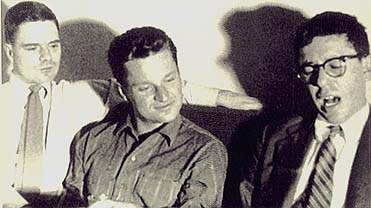 Schuyler, Ashbery, Koch, 1956
Blue
beautiful New
York sky harder
so much than
soft walls you
see here around
it shadowy lamp
lighted plaster
smoothed by a hand
wielded trowel and
roller painted
by hand: Puerto
Rican blue pressed
tin ceiling sky
up into and on
which a white cup
(more of a mug)
falls, falls up-
ward and crack
splits into
two glazed
clay clouds
In earliest morning
an orange devours
the crusts of clouds and you,
getting up, put on
your daily life
grown somewhat shabby, worn
but comfortable, like old jeans: at the least,
familiar. Water
boils, coffee
scents the air
and level light plunges
among the layering boughs of a balsam fir
and enflames its trunk.
Other trees are scratched lightly on the west.
A purposeful mutt
makes dark marks
in blue dew. The day
offers so much, holds
so little or is it
simply you who
asking too much take
too little? It is
merely morning
so always marvelously
gratuitous and undermanding,
freighted with messages
and meaning: such
as, day
is different from the night
for some; see
the south dazzle
in an effulgence
thrown out by an ocean;
a myriad iridescence
of green;
the shape of the cold egg
you break
and with a fork
again break
and stir and pour
into a pan, where it lightly hisses.
The sediment
in your mind sinks
as something rises
in it, a thought
perhaps, like a tree when it
is just two green
crumpled bits of tape
secured to grit; a
memory - beyond
a box of Gold Dust
laundry soap a cherry
in full flower and
later full of fruit;
a face, a name
without a face,
water with a name:
Meditarranean, Cazenovia or
iced, or
to be flushed
away; a
flash of
good humor, no
more than a
wink; and the sun
dims its light
behind a morning
Times of cloud.
October
Books litter the bed,
leaves the lawn. It
lightly rains. Fall has
come: unpatterned, in
the shedding leaves.
The Maples ripen. Apples
come home crisp in bags.
This pear tastes good.
It rains lightly on the
random leaf patterns.
The nimbus is spread
above our island. Rain
lightly patters on un-
shed leaves. The books
of all litter the bed.
Gray Day
"There is a cloud,"
Fairfield used to say,
"that stretches from
Richmond to Bangor:
its center is Southampton."
Today,
gray day,
its center is
Bridgehampton,
a nimbus over the pond
you made,
where a willow
jerks its leaves
and the oxeye daisies
stand in unserried ranks.
Helena is on a bench
by the pond, writing
a poem, I bet.
I opt
for the living room and
the squishy chairs
and Rachmaninoff
played by Richter
(who else?) and
here come Oriane
with her ragged ruff:
"Oriane, there are hairs
all over my blazer:
would you care
to discuss it?" She
would not and stalks
haughtily out of the room,
leaving me with the music
and a window
full of leaves.
Cornflowers
After the stormy night:
the crack of lightning and
the thunder peals (one bolt
fell in my street!)
the cornflowers (or are they
bachelor's buttons?) stand,
ragged scraps of sky, in
a shrimp-cocktail glass on
thin green stems with thin
green leaves, so blue, so blue
azure as sky-blue eyes
the cornflowers (I wish
I were wading through a
field where they bloom)
tattered tales of my life.
The light within
and the light without: the shade
of a rainy April morning:
subtle shadows
cast backward by lamplight
upon daylight,
soft unforceful daylight,
the essence
of cloud cover
descending mistily into the street:
and the unwhitely
white surround of a curling photograph
models itself
as north light
modeled the face in the photograph:
and against a window
a tree shows
each lightly tinted leaf
another shadowy shade, some
transparently, some
not: and, in the corner
the dark bisected
by the light that falls
from without (created
by its absence)
lies luminous within itself:
the luminous dark within.
Subscribe to:
Posts (Atom)