Showing posts with label Neuropsychology. Show all posts

Sunday, March 6, 2016

The science of autism is a story of real people (Books - In a Different Key by John Donvan & Caren Zucker)

Ruth had stopped doubting herself the morning she saw Joe do a jigsaw puzzle upside down.  For some time, she had been nagged by a feeling that he was not like her other children in some crucial way.  Six months earlier, Joe had stopped speaking, even though, up to that point, he had seemed to be developing normally...

And then there were these puzzles.  He was working on one just then, a map of the United States whose parts were sprawled, like him, all over the kitchen floor and through the doorway into the living room.  He was getting it done: New Hampshire met Maine, and New Mexico snapped in next to Arizona.  But he was getting it done fast, almost too fast, Ruth felt, for a two-year-old.  On a hunch, she knelt down to Joe's level and pulled the map apart, scattering the pieces. She also, deliberately, turned each piece upside down, so that only the gray-brown backing was showing.  Then she watched what Joe did with them

He seemed not even to notice.  Pausing only for a moment, Joe peered into the pile of pieces, then reached for two of them.  They were a match.  He immediately snapped them together, backside-up, between his knees on the floor.  It was his new starting point.  From there he kept going, building, in lifeless monochrome, out of fifty pieces, a picture of nothing. 

What John Donvan's and Caren Zucker's In a Different Key: The Story of Autism (Crown Publishers, 2016) is especially good at, is conveying a picture of autism historically, scientifically, and socially, by telling the stories of the people involved.  One in 68 children have a diagnosis, so it's hard to live in today's America without hearing about autism.  Understood as a lifelong neurodevelopmental disorder, it is diagnosed based on impairments in communication, especially social relatedness, and a restricted repertoire of activity and interests. The dysfunctions it results in manifest themselves in different persons as impaired eye contact, failure to develop peer relationships, an absence of or delay in developing communicative speech, an inability to conceive of other people's mental states or emotions, lack of spontaneous imaginative play, inflexible adherence to routines which are disruptive to daily functioning, and persistent preoccupation with part of objects rather than their conventional uses, symptoms which must be present prior to three years-of-age to be diagnostically relevant and which often are noticed suddenly, after a period of apparently typical development.

Sunday, October 25, 2015

Two memoirists of passion (Books - Love is Where it Falls by Simon Callow & On the Move by Oliver Sacks)

In the last several months I read the memoirs of two fascinating, beloved, gay, British-born public figures.  One was published recently, the other 15 years ago.  One works in one of my areas of expertise - the arts - and the other in the other - the science of the brain.  The authors were actor Simon Callow and Dr. Oliver Sacks.  Their books are Love is Where it Falls (Penguin Books, 2000) and On the Move: A Life (Knopf, 2015).  Their books are forthright and generous, the authors deeply giving of themselves, and they are crack writers.  Knowing them now, as I do, it is fitting that these copies are signed.

She had, she said, been walking down Piccadilly, musing on the fact that it was Moliere's birthday and that not a single actor in England would know, much less care.  Musing on this sad reality, it had suddenly struck her that, yes, there was an actor in England who would know and care: me.  And so she had gone into Fortnum's and ordered the wine and had it sent to me, to celebrate, with my actor friends, the great playwright's birthday.  
So begins an unlikely romance between a fierce, 70-year old theatrical literary agent, Peggy Ramsay, and 30-year-old actor Simon Callow.  I find myself wanting less to write about the merits of this book than to quote from it.  These two live passionately and are attracted to each other so relentlessly, because their taste in art is not so much an aesthetic about life's decor as a deeply held principle about the way to live it.
We must feel, that is everything. We must feel as a brute beast, filled with nerves, feels, and knows that it has felt, and knows that each feeling shakes it like an earthquake. 
or
I do so passionately believe that the only meaning of life is life, that to live is the deepest obligation we have, and that to help other people live is the greatest achievement. It's in that light that I see acting, and that alone.


Oliver Sacks has written so humanely and observantly of his patients' lives (for instance here and here), and so openly of his peculiar fascinations, that this memoir, and this is the third of his books that might be classified as such, was a welcome departure.  Here, finally, Sacks scrutinized as deeply and wrote as openly about his own life - particularly his inner life. This was welcome not only in knowing more about so great a man and storyteller, but also because one read it in the context of his impending death (about which he wrote so beautifully here and here) and because one could feel in the narrative drive this desire to share it all before it was too late.

Early in Sacks's writing career, the great poet W. H. Auden said to Sacks
You're going to have to go beyond the clinical... Be metaphorical, be mystical, be whatever you need.
This is really where Sacks's writing succeeds so magnificently in combining what is true with what feels true in a story. I cherish his writing and hope to celebrate his life in a live program in the coming year.


Friday, October 31, 2014

Distinguishing between data & interpretation in popular science can help the public learn to think about the evidence (Books - The Organized Mind by Daniel J. Levitin)

Nowadays, the outcome of every scientific study is expected to be instantly useable by the public.  News media demands ready-made dietary and medical advice, politicians and business people demand data to shore up the opinions they already hold, many funders want only outcomes that will translate to curing disease now.  As nice as it would be to cure on demand, that would be as likely as making a hits of every Broadway tryout.  Scientific "hits" are the product of fortuitous accident and incremental accumulation of knowledge, which usually includes more rejected possibilities than confirmed ones.

Pop-neuroscience satisfies this expectation with books falling somewhere between science and self-help.  Daniel J. Levitin's The Organized Mind (Dutton, 2014) creatively hews to this formula. I thank Dutton, a Penguin imprint, for my copy.  Of course the popularity of science, is not all bad.  It is wonderful to have the ear of non-scientists and encouraging that interest requires that the public enter the discussion somewhere.  But books that realistically convey how experimental outcomes find their way into the fund of general knowledge are in short supply.  The wider the dissemination of half-baked knowledge, the more discerning the eager-to-consume non-scientist must become.  In this age in which everything from raw experimental data and top notch interpretation to crackpot appropriation of small study outcomes and outright lies are easily available on line, and look superficially the same, the scientist has a responsibility to help the public develop a critical eye.

Thursday, April 18, 2013

Keeper of the cabinet of human curiosities (Books - Hallucinations by Oliver Sacks)

Now nearly 80, neurologist, writer, and keeper of the cabinet of human curiosities - Oliver Sacks - has written his 12th book.  This one is on activations of the perceptual systems that are produced by internal rather than external stimulation or Hallucinations (Knopf, 2012).  They run the gamut.  You can smell them, hear them, see them, and feel them.  They can have their origin in disease processes, chemicals, injury to the nervous system, or sensory deprivation.  They can take the form of geometric patterns, religious conviction, snatches of music, or little people (Lilliputian hallucinations).  I too have seen a patient with this last form of hallucination.  Her's were holding their heads in their hands (detached from their necks), but it didn't seem to cramp their style any.  I think that the term is probably my favorite in neurology.

I have always admired Sacks's writing about his patients because I feel that I am reading about people rather than cases.  I am a great admirer of Sacks's early books like An Anthropologist on Mars and The Man Who Mistook His Wife for a Hat, both are less continuous narratives than Hallucinations or Sacks's recent Musicophilia and The Mind's Eye.  Rather than thematic in nature, these earlier books are simply collections of essays on human beings whose strange neurologic cases make them fascinating, but who otherwise have little or no relation to each other.  I found some of the material included in Hallucinations had to stretch to be subsumed under the book's theme.  While I found most of the material interesting, an episodically constructed book might have been a more natural and satisfying form.

On more than one occasion in this book (and his last, The Mind's Eye) Sacks becomes his own subject. In this case, he writes frankly of his experimentation with hallucinogenic drugs, a piece that appeared in The New Yorker last year, and of a serious hiking accident during which Sacks says that a voice commanded him to keep going. 

I am always impressed by the historical sources Sacks cites.  They immediately make me want to visit the library.  Jackson's original papers on epilepsy and aphasias, are cited in Hallucinations.  Perhaps this is not as enticing to the average lay-reader, but for a neuroscientist, these are the golden oldies. Jacksonian seizures were named for John Hughlings Jackson.

Hallucinations makes colorfully clear that the mechanisms in the brain that eventuate patients' perceptions in the absence of external stimulation can be diverse.  The light patterns that are experienced in the aura prior to migraine might be thought of as electrical disturbances like a wave passing across the visual parts of the brain.  Whereas the hallucinations reported around near death experiences such as a floating above one's own body may occur due to stimulation of the right angular gyrus, one of several brain regions implicated in a circuit that according to Sacks mediates body image and vestibular sensations.  The vision of a dark tunnel with light at the end may be the result of decreased circulation to the retina, which narrows the visual fields.

The most remarkable of the cases Sacks writes of in Hallucinations was that of an 86-year-old English man who already had glaucoma and macular generation, but when a stroke compromises his right occipital lobe he loses vision completely in his left visual field.  What is most interesting is that he is not aware of his loss
...his brain appears to fill in the missing parts.  Interestingly, though, his visual hallucination/filling in always seem to be context-sensitive or consistent.  In other words, if he is walking in a rural setting, he can be aware of bushes and trees or distant building in his left visual field, which when he turns to engage his right side, he discovers are not really there.  The hallucination do, however, seem to be filled in seamlessly with his ordinary vision.  If he is at his kitchen bench, he "sees" the entire bench, even to the extent of perceiving a certain bowl or plate within the left side of his vision - but which on turning disappear, because they were never really there.  Yet he definitely sees a whole bench, with no clear separation between parts composed of hallucination and true perception.
The human brain is a remarkable country and it is always enjoyable to travel there with Oliver Sacks as your guide.

Tuesday, May 15, 2012

Building a forgotten identity one word at a time (Books - New Finnish Grammar by Diego Marani)

Language is identity, according to Diego Marani's New Finnish Grammar (2000).  It was originally written in Italian, recently translated into English by Judith Landry, and short-listed for the Independent Foreign Fiction Prize.  Dr. Petri Friari, a neurologist aboard a German hospital ship in 1943, discovers a man barely alive with no memory and no language.  Wearing a Finnish navy uniform jacket with Sampo Karjalainen embroidered on it, Dr. Friari identifies his patient as Finnish.  It is difficult to say whether it is the evidence that convinces him or the fact that Dr. Friari is himself a Finnish exile and for this reason has taken his patient's case very much to heart.  At any rate, the Dr. teaches him some language basics and ships him back to Finland advising him that in learning the difficult language he could reclaim his memory and, thereby, himself.

Friday, March 18, 2011

Mystery as Cure (Books - Memory Book by Howard Engel)

Memory Book by Howard Engel, in which detective Benny Cooperman awakens in a rehabilitation hospital unable to read but not to write (alexia sine agraphia) and unable to remember anything about the hit on the head that put him there, finished relatively grippingly. I had felt that the initial stages of the mystery were held back by the fact that the writing of the book was an exercise that author Howard Engel used to help in his adjustment to life with alexia sine agraphia (see my first post on this book). But having given over to this conceit, I ended up enjoying detective Cooperman and his cast of characters. Engel managed in the book's second half to ramp up both the pace and the suspense, and even to conclude with a somewhat tongue-in-cheek drawing room scene in which the detective assembles his suspects and reveals the answer to the mystery.

There were a few moments during which the hybrid nature of the novel ended up getting too cute, as for example, which Benny learns of the nature of his illness from his brother Sam, a physician, and replies
Sounds like a case for that American doctor, the one who wrote The Man Who Mistook His Wife for a Hat.
As Engel was a patient of Oliver Sacks, the author of that book, and indeed wrote the afterword for this one, I found the joke a little sophomoric. I was most taken with the writing, some of it quite eloquent, about this experience of being a patient with alexia and amnesia.
There are all kinds of sleep - refreshing all-nighters, fender-bending nightmares, catnaps, and deep oblivion - but for a sleep that gathers you up, seduces you, and turns off your lights there is nothing quite like hospital sleep. Sleep, the seductress of my waking hours, watched me closely, knew my weaknesses, held out lurid promises...

[...]

Then there were voices, far away, against an echoing background. I can't reproduce the words, not the exact words, one never can in a dream, but there were two voices talking about drugs and their cost. One voice, an English-accented voice, was telling the other not to be daft, that she shouldn't play at knowing what she was doing without measuring the cost. "Ecstasy," she said. "Have you lost your tiny mind?" The other voice was younger, guarding her ignorance with bluster.

"What's the harm?" Where had I heard such talk? Were they nurses talking near my bed? Right now, as I slept? Or were they seeds from my memory, dropped like acorns from my resting brain? Was it a fragment of another time and place?
Engel also allowed the pseudo-hardboiled detective banter of Cooperman to do double-duty as sarcasm about his illness.
"This is the real Sheila Kerzon. The imposter was Heather Nesbitt, her roommate. And, in a minute, without a net, I'm going to see if I can guess my own name."
I can only imagine that must have been liberating, and this reader some indication of the frustrating struggle that must have been behind the recovery from this illness that is belied by the creation of a detective novel while not being able to read!

Thursday, March 17, 2011

Mystery of himself (Books - Memory Book by Howard Engel)

I first learned of Howard Engel in A Man of Letters, a chapter in Oliver Sacks latest book The Mind's Eye, about a man whose stroke leaves him unable to read but not to write (alexia sine agraphia). This would be limiting for most adults, but is tragic for Engel who is a mystery writer. In Memory Book (2006) the detective of many of his mysteries - Benny Cooperman - awakens in a rehabilitation hospital, himself the victim of alexia sine agraphia due to a bop on the head. He must solve the mystery of how he got to be that way. What case was he solving, who hit him, and why? But before that, he must solve more pressing mysteries of how to make sense of the strange blobs on a page that he knows are letters which make words.
I looked around me blankly. I could see everything I could normally see. I saw the nurse, the curtains, the bump of my knees under the covers. Through the window, I could see the hospital across the street. There was nothing wrong with my vision. What's-Her-Name reached over to the folded newspaper by the window and handed it to me. I picked up the first section and opened it. I looked at it in disbelief. It could have been written in Serbo-Croatian or Portuguese or Greek. I couldn't make out the words. I squinted hard at the front page, recognizing the logo of The Globe and Mail. It was English, but the words below were foreign. My hands began to shake. Again I squinted hard; I could make out most of the letters - I saw "The" and "and" - but the normal black-and-white words kept their secrets from me...
Each time he awakens and meets someone, he must solve the mystery of how long has past since the last time he saw them, and whether he has already said to them the things he is saying, as he is also amnesiac. Benny Cooperman learns that he is repeating himself. He can't seem to hang onto the names of people, even with the "memory book" the hospital provides him.

This books reads as though Engel was using the writing, at least in part, as an exercise in recovery, which lends the book considerable professional interest for me as a neuropsychologist-in- training, but doesn't do much for the average pleasures of mystery reading. That part of the book I'm finding rather slow going. But Engel, no doubt, is finding his re-vamped visual system and memory of more immediate interest than plotting another book in the Benny Cooperman series. As such, I found his descriptions of building new routes to access old memories fascinating, and the delightful thing about the conceit of the mystery form his has chosen, is that he must imagine how that same experience would affect his detective Benny Cooper.
It was going to be a peculiar life, I had to admit: part of my old memory worked - I could still remember about the Battle of Hastings and when Julius Caesar crossed his Rubicon - but I could no longer remember the names of my many first cousins. While I was trying to list all sixteen of them, I had the haunting feeling that I had done this before. I didn't so much mind the duplication of the work as I did the feeling that I was looking over my own shoulder to see what was going on. I could remember Anna and her father, but I had lost his first name, And in order to remember his last name, I had to go back to Anna's, which, of course, was the same. I kept surprising myself with my own ingenuity; for instance, I was trying to recall the name Grant for some reason. I spent ten minutes going through the alphabet searching for the name. I succeeded only when I remembered that I'd once worked for a Saul Granofsky, whose daughters had changed their name to Grant. My memory was full of such filigrees of twisted silken strands. My new memory required me to build a latticework of aids to criss-cross my experience and expectation.
It remains to be seen how the mysteries, both of them, turn out. I'll keep you posted.

Friday, January 7, 2011

Case study of a prodigious memory (Books - The Mind of a Mnemonist by A. R. Luria)

Russian neuropsychologist A. R. Luria's books might be considered the prototype for Oliver Sacks's. Sacks is a neurologist rather than a neuropsychologist, but both saw patients with atypical brains (whether the person was born that way or injured) and both sought to understand the consequences of those differences not only upon their cognitive processes - reasoning, perception, memory - but upon the whole make up of the human being. Luria is the author of several classic books in the field, the most notable of which are two slim case studies of men with unusual minds - The Man with a Shattered World and The Mind of a Mnemonist. The former is a portrait of a man with a gun shot wound to the brain sustained in 1943 and who can, as a result, only experience the world in fragments (click the title to link to my write-up of it). The latter, concerns S., a man whose synesthesia provides such stark and indelible experiences of objects and events that he appeared to remember a limitless amount of information.

Synesthesia is a condition experienced by approximately 1 in 200 people, in which one sensory experience (say, seeing the letters of the alphabet) consistently evokes another sensory experience whose source is not in the external environment, but in the person's mind. For example, a person may see each letter of the alphabet in a distinct color, even though the ink on the page is black, or each musical note heard on the scale might be accompanied by a particular taste. Generally these relationships are consistent, that is, 'a' will always appear light blue and 'b' brick red. For a long time, scientists doubted the veracity of these reports, thinking that the synesthetes simply had strong imaginations and only felt as though they saw blue, or perhaps they were people with a psychological makeup such that they wanted attention for having an unusual skill, but it has since been shown that this experience has all the verisimilitude of a perception of an external stimulus, despite the fact that the synesthete's brain is producing the accompanying experience. V. S. Ramachandran explains how this was tested in his book A Brief Tour of Human Consciousness

The Mnemonist's memory was prodigious.
Experiments indicated that he had no difficulty reproducing any lengthy series of words whatever, even though these had originally been presented to him a week, a month, a year, or even many years earlier. In fact, some of these experiments designed to test his retention were performed (without his being given any warning) fifteen or sixteen years after the session in which he had originally recalled the words.
Not only that, he could produced them backwards.
I recognize a words not only by the images it evokes but by a while complex of feelings that image arouses.
However, what S. failed to encode was the associations among the elements of his memory traces  - the glue that gives what we remember its meaning. So the very techniques that gave S. his prodigious memory compromised his ability to capture the gist of of what he was remembering. In fact, S. often struck those he met as disorganized and not terribly bright, as impressive as were his memory talents. Indeed, the multiple sensations called up by his synesthesia were an impediment to his everyday functioning.
When I ride in a trolley I can feel the clanging it makes in my teeth. So one time I went to buy some ice cream, thinking I'd sit there and eat it and not have this clanging. I walked over to the vendor and asked her what kind of ice cream she had. "Fruit ice cream," she said. But she answered in such a tone that a whole pile of coals, of black cinders, came bursting out of her mouth, and I couldn't bring myself to buy any ice cream after she'd answered that way...
People in my field, particularly in its inception, often learned about normal brain function from atypical brains. Although the writing is a bit repetitive, Luria's portrait is a brief, vivid, and humane introduction to neuropsychological case studies for anyone interested in an introduction.

Friday, June 18, 2010

Man as hyperbole (Books: How we Decide by Jonah Lehrer & The Road to Xanadu by Simon Callow)


I find myself with so much reading and writing for work (and such a desire to be out and moving when I'm not working) that I'm getting through fewer books this summer than I am used to. The two I'm devoting the most attention to right now are Jonah Lehrer's latest - How We Decide - which, as its title indicates, discusses the mechanisms of decision making at the neural and psychological levels. It's very readable and he employs lots of accessible examples, staying on the light side of the science. I'll do a post on the whole thing when I have finished it but I became a fan of Jonah's with his first book Proust Was a Neuroscientist and I remain one as I read this.

The second is a two-volume biography of Orson Welles by actor/writer/director Simon Callow which I received from friend Sheila about a year ago (and I'm just getting to it now?!). You may remember Callow as the Reverend Bebe in the fantastic Merchant/Ivory adaptation of E. M. Forster's A Room With a View (and if you don't, watch the film again because it is well worth it). I have just begun the first volume of the Welles bio - The Road to Xanadu - and Callow is about as erudite and enthusiastic a biographer as one could hope for. I especially like his opening insights.
If you try to probe, I'll lie to you. Seventy-five percent of what I say in interviews is false. I'm like a hen protecting her eggs. I cannot talk. I must protect my work. Introspection is bad for me. I'm a medium, not an orator. Like certain oriental and christian mystics, I think the 'self' is a kind of enemy. My work is what enables me to come out of myself. I like what I do, not what I am...Do you know the best service anyone could render to art? Destroy all biographies. Only art can explain the life of a man - and not the contrary. (Orson Welles to Jean Clay, 1962)
Aint' that the truth. If only more artists felt this way. Now the performing arts seems to have become synonymous with personal confession and careers are sustained via industries of image-building. Although Welles was no exception to this in practice, only in theory.
Hitherto, the only credible representations of him have been those offered by John Houseman in Run-through and Michaeal Mac Liammoir in All About Hecuba and Put Money in they Purse. Both men engaged deeply with Welles and were beguiled and frustrated by him in equal measure. Their distinctly different views of him, though highly personal, are based on close observation and intense engagement, and written with precision and insight; both men were denounced by Welles, their witness called into question. I was lucky enough to know them personally and what they told me about Welles has been the starting point for my book, which is thus simultaneously a synthesis and a deconstruction.

Not bad credentials for one great artist becoming the biographer of another.

And Callow's explanation for why newspapers were such an important source for his book:
He publically constructed himself from the earliest age - my first press clipping is headed ACTOR, POET, CARTOONIST - AND ONLY TEN - in a medium that he courted and denounced in equal measure; and the press returned the compliment. Together they concluded a sort of Faustian pact wherein Welles was meteorically advanced by sensation -hungry newspapers, to whom he pandered shamelessly, until at the height of his fame he fell foul of them; saddled with a preposterous reputation and a personality drawn by him and coloured by them, he found himself unemployable, his work overshadowed by his everexapanding Self. Even his body became legendary, out of control; whatever his soul consisted of protected from the world by wadding. Locked in a personal relationship as complex and curious as that of Lear and his fool, Welles and the newspapers needed and abominated each other in a co-dependency that only his death dissolved. It is no coincidence that his most famous work is the apotheosis of the newspaper film.
Holy moly - Faust and Lear in one paragraph. This promises to be a thorough if hyperbolic journey and I think I'm going to love every crowded page of it.

Saturday, July 25, 2009

Mishmash (Books - David's Revenge, The Manual of Detection, The Nice and the Good, and The Mind of a Mnemonist)

I haven't been sticking to any one book lately, so this is going to be a mishmash-post. I have continued reading David's Revenge by Hans Werner Kettenbach and marketed on the cover, unfortunately, as a "terrifying novel from a leading thriller writer." It concerns the visit of a Soviet Georgian man to a German school teacher's home, I do a complete plot set-up here. It's a pity it was pitched as a thriller, because that may have given me false expectations. The book is clearly playing with interesting themes of racial and nationalist politics, the relationship between immigrants and their host culture, and what happens to one man's cherished liberal beliefs when he feel threatened in his own home, but that threat is more intellectual than it is physical. I kept waiting as I read for the intense level of tension that I associate with a thriller to kick in. It didn't. Half-way through, I feel like I know exactly where the plot is heading and I find the writing clumsy and so have lost interest. I'm going to abandon this one.

The Manual of Detection by Jedediah Berry continues with its playfully childish tone and its surrealist set-design, it is more of an amuse-bouche than a serious meal and its entertaining but I never want too big a portion. I finally gave in and started Iris Murdoch's The Nice and the Good. She is one of my favorite writers and I wanted something substantial but amusing and that is exactly what she usually delivers. This book actually flirts with the mystery genre as well, a first in my experience of Murdoch's many books, but with her usual eye for detail and head for philosophical resonance:
A head of department, working quietly in his room in Whitehall on a summer afternoon, is not accustomed to being disturbed by the nearby and indubitable sound of a revolver shot.

At one moment a lazy fat man, a perfect sphere his loving wife called him, his name Octavian Gray, was slowly writing a witty sentence in a neat tiny hand upon creamy official paper while he inhaled from his breath the pleasant sleepy smell of an excellent lunch-time burgundy. Then came the shot

[....]

Octavian noticed the neatness of the recently clipped grey hair upon the warm vulnerable neck. He had an impulse to touch it, to touch the material of Radeechy's jacket, to pulp it timidly, curiously. Here were the assembled parts of a human being, its clothes and carnal paraphernalia. The mystery appalled him of the withdrawal of life, the sudden disintegration of the living man into parts, pieces stuff. Radeechy, who muffed most things had not muffed this.
I'm looking forward to my first Murdoch in a while and am glad Cornflower Books has ended up choosing it for the August book club.

Finally, having read A. R. Luria's The Man with the Shattered World earlier this summer, I was tempted to read his other "neurological novel" called The Mind of a Mnemonist: A Little Book about a Vast Memory. I actually found a copy sitting around my lab this week, so I borrowed it. It concerns a famous patient of Luria's whose curious condition gave him an unlimited memory as well as synesthesia. Synesthetics regularly merge information from one sense with information from another sense, even though the second sensation is not actually part of the stimulus in nature. Say, every time they see a shape it is accompanied by a taste or every time they read a letter it is a certain color (even though all the ink is actually black). Luria's writing about his famous patients is fascinating.

Saturday, June 27, 2009

Romantic science (Books - The Man with a Shattered World by A. R. Luria)

Before Oliver Sacks made neuropsychology comprehensible to the masses there was a Russian neurologist named Aleksandr Romanovich Luria. He worked from the 1920s - 1970s and while the field of neuropsychology did not yet really exist, his interests in psychoanalysis as well as neurology led him to study the fascinating disorders that can effect language, the ability to engage the will to use the muscles, or strange afflictions of perception, attention, or memory in a new way. Oliver Sacks tells us in his introduction to The Man with a Shattered World:
What was distinctive in his approach from the start, and formed a constant thread in all his explorations, was his sense that even the most elemental functions of brain and mind were not wholly biological in nature but conditioned by the experiences, the interactions, the culture, of the individual - his belief that human faculties could not be studied or understood in isolation, but always had to be understood in relation to living and formative influences.

Luria prefigured Sacks in writing what he termed "Romantic Science,"
Romantic scholars' traits, attitutdes, and strategies...do not follow the path of reductionism, which is the leading philosophy of the classical group. Romantics in science want neither to split living reality into its elementary components nor to represent the wealth of life's concrete events in abstact models that lose the properties of the phenomena themselves. It is of the utmost importance to romantics to preserve the wealth of living reality, and they aspire to a science that retains this richness.
So Luria wrote neurological novels (his term), The Man with a Shattered World being one. His approach created, in essence, the newish science of neuropsychology. This style of writing was purposefully accessible, painting a portrait of the patient as a complete person, revealing through a literate synthesis of behavior, brain anatomy, and being a new analysis of the unusual cases that Luria saw, with the dual aim of creating both a new understanding and a deeper compassion for this patient.

The tools of neuropsychology have advanced considerably, allowing us to peer inside the human brain in multiple ways with a much finer resolution. Decades of study have led to a far more nuanced understanding of the way brain influences behavior, but the job of a good neuropsychologist (for which I am studying) has remained essentially the same.

If this field interests you at all, even as a tourist, Oliver Sacks's essay length portraits of his patients are long on compassion and readability and short on technicalities and follow in the footsteps of Luria. They are a great place to start, but it was interesting for me to finally go to the source of it all and read one of Luria's narratives. The Man with a Shattered World is an accessible account that alterrnates between the patient's own painstakingly executed diaires and Luria's commentary. The victim of a gunshot wound in 1943, Zasetsky begins with almost no language at all. He ends up regaining some of his power to communicate but only with great effort. He can perceive the world only in small fragments, as many of the parts of the brain that synthesize the parts into wholes have been obliterated by his bullet wounds (isn't war wonderful?). His ability to identify objects is preserved, but his ability to name those objects is compromised and his sense of where those objects are in space or, often, how to use them, is destroyed. He retains memories of distant childhood, but his ability to learn new information consciously is severely limited, coming only after long labor.
Again and again I tell people I've become a totally different person since my injury, that I was killed March 2, 1943, but because of some vital power of my organism, I miraculously remained alive. Still, even thought I seem to be alive, the burden of this head wound gives me no peace. I always feel as if I'm living out a dream - a hideous, fiendish nightmare - that I'm not a man but a shadow, some creature that's fit for nothing...
Due to the patient's memory, the narrative is necessarily repetitive. As literature that might become tedious but taken as the product of his behavior, this become a tool - the only tool available to the neurologist of 1943 - to identify the location of Zasetsky's brain injury, the kinds of problems he was likely to have, and some notion of the skills he might have had a chance of recovering. Sad though it is, brain injury has been one of the chief tools we have had to confirming our understanding of normally functioning brains. We might believe through experimentation that a particular part of the brain functions in a particular way, but it is only by losing that part of the brain, and consequently that function, that we can confirm that hypothesis. When patients come to a neurologists office, it is exceedingly rare that we will drill a hole through the scalp to peer inside. Even the pictures we can make with MRI are limited in what they tell us. Behavior is still the chief measure of the neuropsychologist in diagnosing complaints. In any event, to return to The Man with a Shattered World, whether experienced as a strange sort of memoir-biography or as an artifact of a science in its infancy, makes for interesting and quick reading and I now want to read Luria's other neurological novel, The Mind of a Mnemonist some time soon.

Tuesday, May 5, 2009

The secrets of attention all wrapped up...

Not..., according to John Tierney's article in today's Science Times:
Now that neuroscientists have identified the brain's synchronizing mechanism, they've started work on therapies to strengthen attention. In the current issue of Nature, researchers from MIT, Penn and Stanford report that they directly induced gamma waves in mice by shining pulses of laser light through tiny optical fibers onto generally engineered neurons. In the current issue of Neuron, Dr. Desimone and colleagues report progress using this "optogenetic" technique in monkeys.
This article focused around Winifred Gallagher's book about attention Rapt: Attention and the Focused Life which explores such subjects as the fact that attention is a limited resource, that it can be directed. It was written out of Gallagher's experience of wanting to control her attention away from the cancer diagnosis she received, so it would not completely take over her life. She cites William James as her muse "My experience is what I agree to attend to." That's really only one form of attention, one we have named selective attention, for obvious reasons. There are other mechanisms of attention, namely those which don't ask for permission - a car backfires as you are quietly having a drink at a sidewalk cafe and you jump, your body on guard, your heart beating quickly for a moment. A baby cries (evidently we may be hard-wired to never be able to ignore this sound). That is 'attention' too. But selective attention can be applied immediately after our attention has been wrested away by external stimuli, and that is Ms. Gallagher's interest. William James also famously said in 1890 that while everyone knows what we mean by attention we don't know precisely what it is:
Every one knows what attention is. It is the taking possession by the mind, in clear and vivid form, of one out of what seem several simultaneously possible objects or trains of thought. Focalization, concentration, of consciousness are of its essence. It implies withdrawal from some things in order to deal effectively with others, and is a condition which has a real opposite in the confused, dazed, scatterbrained state...
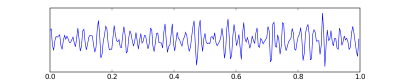
A prominent model of attention suggests that it involves the synchronous oscillation of neuronal activity, but what does that mean? Oscillation is the repetitive variation in time or space of something about a central point or between different states. For example, the swing of a pendulum about its center or the vibration of a plucked guitar string about its normal straight lines when at rest between its pegs. As Gyorgy Buzsaki writes in his fascinating book Rhythms of the Brain, those patterns exist due to forces in nature - what goes up comes down. Those rhythms of change are often illustrated as cycles per unit of time or a Hertz. Cells throughout the body, including the nervous system, are capable of generating patterns of such activity, with alternating high and low points about a center - working in concert to create self-sustaining patterns of behavior. They do so on a mechanical level so that we may walk, breathe, and circulate blood without consciously coordinating those tasks and giving away our precious limited cognitive resources just to stay alive. But patterns of firing are the coding of the cognitive activities of the brain as well. Many neuroscientists now think that, large groups of neurons synchronize their firing at a certain rate (namly the gamma frequency between approximately 30 and 90 Hz, pictured above) that may facilitate attention since, as Buzsaki writes:
Systems in balance are simple and hard to perturb.
Tierney describes the neurons as 'firing on and off,' which is not completely accurate. Neurons don't turn 'off' per se, but neurons some distance away from each other in our brains can synchronize the rhythm of their activity - that is to say, they line up the peaks and troughs of their wave-like pattern of variation. Say there are 2 competing stimuli in our visual field and we only wish to pay attention to one of them. Pascal Fries and his colleagues have shown that when the object we want to pay attention to is present, the gamma frequency increases in that group of neurons our visual system requires to "see" the desired object. We observe more intense firing as well as more synchronized firing specific to those neurons. Conversely, in those neurons that could give attention to the object we wish to ignore we observe a decreased firing rate and less synchronization of activity. So we see on the cellular level an analogue for what goes on at the behavioral level, that is, giving more cognitive resources to some processes while giving less of those resources to others.

The article mentions the prefrontal cortex as the source of this synchronizing gamma activity. I had thought that altered firing originated subcortically and a network of prefrontal and parietal activity were both necessary to apply it, but the prefrontal cortex is involved. Check out Tierney's article, it mentions some nifty new devices designed to artificially deliver a synchronizing jolt of gamma activity for those with brains that have a harder time doing so in a self-directed way. This is quite an innovation if it turns out to be both safe and effective.

Tuesday, July 15, 2008

Not-for-Tourists Guide to Dyslexia (Books - Reading David by Lissa Weinstein, Ph.D.)


My advisor at school had loaned this book to me months ago, as I am training in her child neuropsychology lab. Lissa Weinstein (the author - a clinical psychologist and also a prof at my program) has a son, David, who was diagnosed with dyslexia. Reading David chronicles their parallel experiences from first noticing the problem through around 5th grade. Both mother and son write (once the son is articulate enough to contribute) and the mere presence of his sections tell a story all by themselves. The book is not only arranged chronologically it was actually written as the events unfolded, i.e. mother and son do not try to remember long after the fact what happened. The writing gave them each an outlet for their frustrations. It also gave David a grown-up and meaningful, and positive activity that involved language, which was otherwise a source of misery for him.

Dyslexia, Dr. Weinstein tells us straight from the National Institute of Child Health is:

one of several distinct learning disabilities. It is a specific language based disorder of constitutional origin, characterized by difficulties in single word decoding, usually reflecting insufficient phonological processing abilities. These difficulties in single word decoding are often unexpected in relation to age and other cognitive and academic abilities; they are not the result of generalized developmental disability or sensory impairment. Dyslexia is manifested by variable difficulty with different forms of language, often including , in addition to reading problems, a conspicuous problem with acquiring proficiency in writing and spelling.


It is Dr. Weinstein's habit that whenever she faces a big challenge, she ends up at the library reading about it. Rather than leaving us to face this technical definition alone, Weinstein breaks it down into its component parts, explaining and reflecting on each one. The book has several strengths, and one of them is Dr. Weinstein's ability to explain everything in accessible terms. She is a deft storyteller - using colorful, clear language to describe not only what is going on but how it feels to her, and she allows her son to explain for himself how he feels. She clearly wants this to be the NFT (not for tourists) guide to dyslexia and wants both parent and child to go to it not only for information but for emotional support. This is apparent in the other strength of this book - Dr. Weinstein's honest unstinting observation of herself and the openness with which she puts on the page her fears for her sons future, her sense of inadequacy as a parent, her anger at the events and, at times, her son. It's a relief to read a story-of-an-illness book (not my favorite genre) that is not sentimental. People are not perfect (and I don't mean the people with the diagnosis) but rather the people around them. It may be irrational or unattractive to get angry at your child for not acquiring the ability to read with the same amazing seemingly automatic ease as most other children, and it may not portray one in the best light to admit to those feelings, but they are common and Weinstein's ability to identify them in herself and own up to them is refreshingly honest and will, I'm sure, be useful to others in the same role who think they are failing for feeling angry.

There are some very good sections in which Dr. Weinstein describes how she fooled herself into thinking that David was just a unique original and didn't really have a problem so that she could delay getting him tested.

These errors were something different from troubling speech sounds. These were near misses, mistaken efforts to describe a picture that he recognizes but can't retrieve the exact name. I'd heard these funny things in his speech before, him using big words when little ones would do, like saying, "It's a blustery day" at age two and a half instead of, "It's raining." In my mind, I'd defined him as an unusual child with a huge vocabulary.

There are also several good sections on her frustration at not being able to carry over her professional knowledge or distance into situations where she needed to make a decision about or advocate for her own son. Another on her son's anger and fear at his differences:

"You made this happen to me. You made me look at the letters when I wasn't ready. You made me hate them. You made me feel stupid." The veins are popping on his forehead. He's held this in a long time. His bitterness is a rodent, running so rapidly across the room that a moment later we tell ourselves we've never seen it.

And a very funny section about his inability to spell, except when it comes to profanity:

"F-U-C-K, That's fuck. I can spell that correctly." David takes a moment to view his handiwork on the thirty Post-it notes he's using to decorate the kitchen instead of doing his homework. There are other words too, like B-I-T-C-H and S-H-I-T. They are all spelled correctly, with the exception of K-I-K MY A-S-S. It's a pity, because kick is one of his spelling words.

"Why can you spell all the curse words right, David?"

"It's easy. You can sound them out."

That can't be correct. Because by any logic, if you can spell fuck with its silent "c," you should be able to put that same "c" in kick. If you can spell bitch the right way, you shouldnn't be wpelling witch as "witz." So what is it?

Dirty words are E-X-C-I-T-I-N-G. David like to write them, say them over and over, and look at them. The thrill gets him past his wish not to see and his difficulty memorizing. Eventually, he could be taught to connect bitch and witch.

Which echoes David's own advice in the Lessons Learned chapter that mother and son wrote together, in which he tells other children who are dyslexic that they will learn to read. Aside from the disadvantage of sometimes having the mother/son sections repeat each other too closely, it's one of the pleasures of the book to witness David's growth in confidence in the humor of his later sections in which he advises fellow travelers how to avoid homework. "Start a fight with your brother," he advises. "This is sure-fire!" or

Figure our what your parents are really interested in. Do they like your drawings? Start drawing. Do they like you to be curious about things? Now is a good time to ask questions. This works best if there's something your mom or dad want to show you or teach you about. For example, my dad loves rock and roll. He's always getting these videos from the video store on the history of rock and roll. Homework time is an especially good opportunity to offer Dad some alone time with you. Maybe you should watch that video he got out. When I tried this, Dad had no clue. I thought Mommy would hit the ceiling. She kept yelling "Larry, he has to do his homework! What are you doing?" She didn't yell at me, though. She yelled at Dad.

Future Ferris Bueller? Could be. But David has sober advice for kids like himself as well offered in a section he insisted on calling Permanent Scars. His function in the book is to voice some of the feelings kids like himself might have but are unable to express. This could be useful for helping a parent understand what it might be like for their child to be inside the problem of dyslexia and I can imagine it being equally useful for a child who will often assume that other people have not gone through what they are experiencing and that there is no way out. Dr. Weinstein also offers concise paragraphs in this section as well on issues such as Getting Evaluated, Getting Help, What you Can Do, and Life Lessons which might be be entitled What you Can't Do.

Dr. Weinstein and her son have opened themselves up to the reader in a personal, fast-moving story that should offer practical advise and companionship for others on the same journey.

Bernard LacLaverty's Grace Notes is up next...gorgeous writing!