Wednesday, March 31, 2010

Adventure story meets Joseph Cornell Box (Books - The Selected Works of T. S. Spivet by Reif Larsen)


Reif Larsen's debut novel, The Selected Works of T. S. Spivet is a delightful hybrid of a child's adventure story and a Joseph Cornell box. In it, T. S., the 12-year-old son of a scientist (mother) and cowboy (father) living in Montana, comes of age as he compulsively maps everything from the structure of a goat's eye, to the positions of his hands when he fidgits, to the pattern of dinner conversation between his family before and after the death of his younger brother. Although the story is set today, he and his mother seem a throw-back to the 18 and 19th century polymathic scientist, who studied each thing in the natural world that piqued their curiosity, making copious notes and accurate diagramatic drawings in their notebooks. No phenomenon seems to skirt T.S.'s fascination, how his sister (the one fairly typical member of the family) shucks corn, the possible movements of a pair of hands playing cat's cradle, these drawing and their notes accompany the text as marginalia - in a handsome, large-format hardcover published by Penguin Press - but they probably occupy 30% of the book, and they are anything but thematically marginal.

The action of the story unfolds when T.S. receives a call from the Smithsonian Institute that he has received an award. His mentor, a college professor, has been submitting his maps and the Smithsonian is unaware that their honoree is 12-years-old. T.S. decides to hop a boxcar (another throw back) to Washington D.C. replete with his drafting equipment to accept his award. The book is at once adventure story, fantasy, and fictional biography. The terribly intelligent portrait of a unique young brain and an overly cute gimmick that, when push comes to shove, works because it is more than its gimmick. The story is really about finding one's way in the world after great loss. Arcana may seem to sidetrack the story, but they are really the means by which T. S. and his mother can pursue intellectual fasicnation and avoid the pain they feel after the death of their brother/son Layton (and the more general loneliness they experience as being outcast because of their tremendous intelligence). I feel that Larsen occasionally skips some essential details about Spivet's journey that bother me (like how on earth he goes to the bathroom over two days on a freight locomotive). We don't have to imagine any other details, so why this one? Prudishness? A lot of the time the loss of minutia wouldn't bother me, but in this case minutia is constantly the point, so it seems a serious omission. Larsen also relies too heavily on deus ex machinae to get him out of some narrative holes he has dug himself into, but the book's depth of feeling brings it all together. I can forgive some of the silliness because the character convinced me and his story moved me.

I make the Joseph Cornell parallel because, although Larsen uses words (and pictures) to tell his story, it is more the construction of elements I am aware of than his prose. One doesn't admire Cornell's draftsmanship or painting, it is his placement of ephemera in a box containing sub-compartments and drawers, that creates a poem out of ordinary postcards, clay pipes, and other kitsch. In our assembly of them, we have an experience and perhaps even arrive at some meaning their whole conveys. Larsen's book functions similarly. Although arrows direct you to each note from a specific place in the text, you decide if and when you read the note on Montana's water table. There is a hands-on, game-like quality to the reading of Larsen's book and its experience is an object which is rare in books today. Although a youngster could certainly read it with enjoyment, this strikes me more as as a grown-up adventure story about a 12-year-old. I can also see it having both computer game and film potential, so I am sure the publisher is delighted. All in all, The Selected Works of T.S. Spivet is an inventive, entertaining, and very touching debut novel. I look forward to Reif Larsen's next discovery.

Monday, March 29, 2010

To avoid life's questions or to court them? (Books - Nothing is Black by Deirdre Madden)

Deirdre Madden has become my Irish muse. Her humane, compact novels vibrate like lovingly crafted string instruments. Sometimes it is the solo voice we hear - with the idiosyncratic personality driven art of the singer - sometimes it is the more richly resonant overtones of several strings played at once. But the song is always infused with distinctive personality - a complex human song, sometimes one that doesn't even know it wants to be sung. Many of her characters are artists - writers, visual artists - who live their lives against the grain trying to both maintain their privacy so that they don't lose the thing about their vision that is singular, and also enrich themselves of humanity so that they may produce a thing that is authentic and useful in that it can speak to others.

Very often, these artists are coming into contact with people who don't produce art themselves, but who are beginning to feel the confines that normally define their lives press up against them. In Nothing is Black, Claire, a painter living in remote Donegal, hosts her afluent cousin, Nuala. Nuala has recently lost her mother and despite her professional success has encountered a crisis:
The waitress brought her coffee, and as Nuala stirred it, she notice the spoon, noticed how heavy and cool it was. she put it on the saucer, and continued to look at it as she drank. And then something quite extraordinary happened.

She realized that she wanted the spoon. No matter that the name of the hotel was stamped upon it; no matter that she had at home a splendid canteen of silver cutlery, a wedding present she had never used; no matter that she had access to any amount of spoons and forks in the restaurant. No, it was that spoon and no other she wanted, and she had never wanted anything so much since she had been a child...
And from that point Nuala's life ceases to resemble the comforting thing she had aspired to. That grain that Madden's artists live against - here it is. Nuala's grief and uncertainty must be lived out away from the eyes of her usual audience, so that they are not too disturbed by the way her urges rub up against the confines of propriety. It is this departure of an ordinary person from their everyday seeking out the richly uncertain realm of the artist that is Madden's specialty.

The cousins Claire and Nuala from an interesting counterpoint of the ways humans can try to understand the mystery of living inside of our bodies and our lives as sentient beings.
No, she didn't understand life. She knew how it operated, but she didn't understand it. Did anyone, though?

Kevin and Nuala had finished their meal, and signaled to the waitress to bring them their bill. After they'd gone, she moved to clear the table, They'd left her the biggest tip she'd had all season. She wonder if this was to make up for the fact that they'd taken the pepper pot with them. No, she'd never understand what went on in people's heads, not if she lived to be a hundred.

[and]
'Daddy, why have some birds got blue eggs and some speckledy eggs? How many colours are there in the whole world? Is there a word for the colour a shadow is? shy is grass green? Is white really a colour?'

Her parents both agreed that she would keep a nation going.

She liked the words for the colours: yellow, green, red. Then she learnt new words. Turquoise, vermilion, aquamarine. Ochre, crimson, puce. This love of colour did not diminish as she grew up. The questions never ended, they became more complex, the only difference was that she stopped going to her father for answers to them. She was sitting in the studio reading Frida Kahlo's notes on colour.

Brown: colour of mole, of the leaf that goes. Earth.

Yellow: madness, sickness, fear. Part of the sun and of joy.

Cobalt blue: electricity and purity. Love.

Black: nothing is black, really, nothing.

'Daddy,' she'd said when she was eight, 'why do people keep saying the sky is blue, when it almost never is?' He'd laughed aloud at that.
These seem to be emblematic of Nuala and Claire's experience of the world. The first based in rules of cause and effect - if one thing occurs then another occurs as a balancing force. Whereas Claire's world is more immediately experiential, less rule bound. One seems to be an exercise in avoiding questions, the other in courting them. The interior struggles of her characters' lives are the action of Madden's novels. It would be cliched to say she that she crafts her prose simply or directly. Because simplicity and directness in prose about elusive subjects in anything but simple and is more than likely arrived at through effort. But her prose seems simple and direct, which is its art. And its intensely human complexity is its beauty. If you have not yet sampled Deirdre Madden's thoughtful, singular body of work, I urge you to get started. Here are my thoughts on Molly Fox's Birthday, One by One in the Darkness, Hidden Symptoms, The Birds of the Innocent Wood, Remembering Light and Stone, and Authenticity. I am growing sad now because I think I have read every one of Madden's novels. I guess that just means I will have to read some of them again.

Friday, March 26, 2010

The outcast's vision (Books - Thursday's Child by Sonya Hartnett)

What a dark and yet loving universe Sonya Hartnett has created in Thursday's Child. It reads almost as a hybrid of Walker Evans's dust bowl depression photographs crossed with a great novel looking back on hard childhood, say, A Tree Grows in Brooklyn. I offer up a photograph as a comparison with a novel because not only does Hartnett create a compelling retrospective voice in her narrator Harper Flute - at once naive in her child self and observant in her adult self looking back. She also creates several scenes that sear themselves on the memory as stark images. Abject poverty and loss haunt the Flute family. Loss of children, of means, and finally of dignity.
For a moment everything was strange. And then it was awful, and it hasn't stopped being that way. Sometimes I can hardly breath; I can't fill my lungs. I can hear him crying and he won't go quiet...
But deep beneath the earth lives a character who is at once a wild creature and also a member of the Flute family. It is his interaction with them that form the spine of this novel. This combination of fantasy and hard realism is my favorite aspect of Thursday's Child. Harnett also includes what I have come to recognize as her signature theme - the childhood experience of being the outcast. Not only does she tell of the pain of its exclusion, but also of the unique perspective it affords one. The place of exile often is a room with a view, and allows its inhabitant to develop powers of observation. I'll leave you with one of them, a portrait of behavior during the depression:
"But I'll tell you what I think's the worst thing, and it's to do with the ladies. Some of them, the only way they can hold their heads high when they've got nothing, no money, no milk for the baby, no husband worth having - the only way they can show the neighbors that they're still respectable people is to keep the house clean. The idea being, I suppose, that decent folk live in decent homes. And there's women going demented trying to make the house spotless, women who start to see dirt everywhere, as if it's got in under their eyes, women going slowly mad. The lucky ones get sent to the hospital but most of them aren't lucky. Most of them die jabbering on the kitchen floor, killing themselves to show they're upstanding. Dying for dirt in a dirty old world. It's funny, in a way: something went askew on the other side of the globe and now our mothers are losing their minds."

If you have yet to discover Sonya Hartnett, I recommend her novels highly. Here's my other post on this one as well as my posts on Surrender and What the Birds See.

Thursday, March 25, 2010

The pause that refreshes or a deathly silence?

btt button

Do you take breaks while reading a book? Or read it straight through? (And, by breaks, I don’t mean sleeping, eating and going to work; I mean putting it aside for a time while you read something else.

As someone who generally reads more than one book at a time, as well as having a fair bit of reading for school, it is the natural state of things to take breaks. Reading one book straight through is the exception, not the rule, although the length of the break could suggest that I have lost interest. Usually I switch between two or three books at a time as the interest strikes me; I'm not methodical about it. Sometimes a book will grab me by the horns as this one did lately, and this one, and then I will answer its call and read away until it's done. Sometimes, a book-in-progress sits for months atop the pile before I dive in again, reading 100-page chunks at a time. Middlemarch is like that for me. I know I will finish it. I'm just not in the right mood to read it through. With others though, that long pause is a death knell, the sure sign that I've moved on to another book, even if I can't quite admit it yet.

Monday, March 22, 2010

The past brought richly into the present (Books - Thursday's Child by Sonya Hartnett)

I so enjoyed Sonya Hartnett's Surrender and What the Birds See that I have come back for more. Thursday's Child displays some of the qualities I am beginning to think of as her trademarks - it is a sophisticated narrative written in a retrospective voice yet specifically for young readers, it takes on serious subjects such as death, poverty, the experience of the outcast, and childbirth unstintingly without lecturing or romanticizing them, it does not produce caricatures in the place of characters.

Let me say why I find the retrospective voice she opts for here so richly complex. This point-of-view always is because it takes on one human being from two time periods, creating perspective as one is innocent of the events before them and the other is knowledgeable. Furthermore, we generally know who a present-tense voice is by what they do, or what an omniscient narrator tells us about them. Here, we steadily build our knowledge of who the 7-year-old Harper is through her actions and her dialogue, however we have the mystery of the contemporary and much older Harper - who is she? What are the intervening events between this story we are hearing of her childhood and her telling of it? What occasioned her telling us this story? Is she 'the writer' or someone else? And Harnett believes that young readers can and wish to handle a story with those elements in it. Kudos to her.

In this story, set during hard times, Harper's younger brother Tin undergoes a transformative experience. I won't tell you what it is because, although only 20 pages from the book's opening, I found it very suspenseful. This leads him to burrow underground, literally to dig himself further and further beneath the house in which Harper and the rest of her family live. What a active image for a writer to choose, what stark circumstances she writes of, although she does so with warmth, insight, and even humor sometimes, and what a strong premise on which to base a novel. I am not through the story yet, so I will leave you with the opening of Hartnett's Thursday's Child:
Now I would like to tell you about my brother, Tin. James Augustin Barnabas Flute, he was, born on a Thursday and so fated to his wanderings, but we called him Tin for short. He wasn't my youngest brother, because it's right to count in Caffy, but I never saw Tin an old man or even a young one, so he stays just a boy in my mind. Tin's bound up in childhood forever, as far as my recollection goes, although the last time I saw him he was wizened and looking ancient as the hills. Memory is eccentric, how it stalls when it wants to. The dogs that we owned - I don't remember a single one of them ever being a puppy. they were born antiquated and rickety, those hounds, whelped under the veranda with their prime well and truly past them...
Immediately I hear that voice in my head. I'm not reading print, I'm hearing a speaker, and if I think about it, she has a specific age, a hair color, a vague face is even beginning to form. Writing that lives.

Sunday, March 21, 2010

Consciousness as the ultimate baseline (Books - i of the vortex - Llinas)

When I last wrote of Rodolfo Llinas's 2001 i of the vortex - a grand plan to explain the concept of self as a product of the brain cells that create it - he had made a case for describing 'self' as the centralizer of the brain states out of which predictions about the world emerge and 'mind' as the internalization of potential movement. If the first half of the book proposes what these two constructs are in the language of the brain, the second half of the book fleshes out how they are accomplished given the evolution of the nervous system from single-celled creatures.

The binding together of events in the external world and internally generated representations of them is accomplished when brain cells are able to fire together. This requires some sort of device that creates a common metric, but not in the sense that a conductor leads the members of the orchestra. This metric is self-generated - like Orpheus Chamber Orchestra - who play without a conductor. Llinas offers his candidate for such a brain process and structure.

Llinas's persuasive argument is a trajectory from a description of fixed action patterns (FAPs) - fixed repertoires of muscle movement that always occur together - to emotions, qualia (the subjective experience of something), to consciousness. Rather than the brain executing separate steps that coordinate millions of neurons and 100s of tendons and muscles to run or lift food to the mouth, they are grouped as a single unit, an FAP, to help the brain economize its efforts - think of macros on your computer. This is an adaptive mechanism because it is not practical to have to plan out how to run from an oncoming car. Llinas proposes that emotions too are a kind communicative FAP - a given state, say fear - elicits emotions and with it, dozens of facial muscles conform in such a way to communicate to any member of our species that a given plan of action is necessary. As Llinas puts it:
The reduction of all possible choices to a useful set of the most probable solutions for the particular situation is a necessary prerequisite to effective behavior. The strategy of reducing choice by picking any solution, regardless of its potential feasibility just to save time, is counterproductive, so natural selection has weeded it out. Another example: what if the control panel of a modern fighter jet had, instead of all those complicated instruments, a little face that tells you how everything is, at that moment, by its expression? You are in heated battle; there is no way that you would be able to look at every instrument and gauge under such conditions. So you have a face - if the face is smiling it means "Do what you must! Don't worry about the condition of the plane, you don't have time!" You need an apparatus that can direct one to focus and choose - and that is consciousness. The face is transforming all the incoming information into one coherent event. Because operating from a single event is always easier, it is far more powerful than continuously having to take into consideration an ever changing set of variables within an ever changing point of governance. That is why there is but one seat of prediction.
Llinas then extends this argument with a leap that describes qualia (subjective experience) as internalized FAPs. If I understand him correctly, he posits consciousness as an experiential baseline against which other qualia can be measured, which makes sense to me since perception is accomplished by the nervous system measuring change and change must always be measured against something.

Llinas then offers two more chapters about the evolution of language and the notion of collective states of mind which, in my opinion, he would have been better off leaving on the cutting-room floor. These chapters are far less well reasoned than the rest of the book. They rely on solipsism and a little too much hand waving and leave the end of an otherwise tight and learned book feeling a little amateurish. He never distinguishes languages from other forms of communication, and the book devolves from a well reasoned thesis to loose musings that make it seem as if Llinas will only be happy if he can write a book that offers a grand theory of absolutely everything instead of a clear argument about the evolution of the nervous system in accomplishing those constructs we call 'self' and 'consciousness.' Minus the final two chapters, Llinas offers a clearly drawn argument, much of which should be accessible to the ambitious lay reader (except for the chapter on neurophysiology). He does so in an almost chattily friendly tone that keeps his narrative moving and offers vivid and pleasurable examples that range from Schumann etudes to Dante's Inferno and the art of Kiki Smith.

Thursday, March 18, 2010

Form emerges from the meeting of artist and content

btt button

Which do you prefer? Lurid, fruity prose, awash in imagery and sensuous textures and colors? Or straight-forward, clean, simple prose?

Form should emerge from the meeting of artist and content. I am not drawn to one or another kind of prose in the abstract. Most experienced writers' voices are distinctive, and likely they are drawn to particular kinds of stories and at particular times I find myself drawn to them. Perhaps to echo some feeling or rhythm I have brewing inside me but can't put the words to, or perhaps to counter it. But I wouldn't want Hemmingway to write Margaret Drabble's stories, nor would I want her to have written about Scout and Atticus, and to ask William Maxwell to write Shakespeare's plays would be ludicrous. Prose is an artform. It has a place for both decorative beauty and utility, obfuscation and clarity. Bring it on and keep it various.

Tuesday, March 9, 2010

Angels and demons meets William Faulkner (Books - Surrrender by Sonya Hartnett)

Laid up with a champion case of bronchitis, I've been alternating my school work with Thomas Mann's TB sanitorium antics in The Magic Mountain (appropriately enough) and I thought, I could use something a bit less... phlegmatic. Little did I suspect that Sonya Hartnett's Surrender would also feature one of two narrators with a disease resembling TB, but the book is so good that I wasn't discouraged from finishing it. I read her What the Birds See last year. She is an Australian author writing for and about children who find they don't fit the molds life provides for them. She does so with lyricism and imagination instead of the ridiculously pedantic messages I so often see in books for young people about how they should behave. Surrender is a literate novel told by two alternating first-person narrators - Gabriel the angel and Finnegan the wild demon - at least one of them, we are warned, is not necessarily trustworthy.
I am Gabriel, the messenger, the teller of astonishing truths. Now I am dying, my temperature soaring, my hands and memory tremoring: perhaps I should not be held accountable for everything I say.
As Gabriel lies in bed dying, he and Finnegan remember the events of their relationship that lead up to the heavily veiled circumstances that are the book's substance. We don't know precisely where we are or what has lead up to our being here. This creates in Hartnett's hands suspense rather than confusion - suspense that pulled this reader through the twin narratives like a strong magnet. Again her subject is a young person who is painfully alienated from everyone around him. She tells his story of isolation in elegiac strains that most evoked for me William Faulkner or the poet James Wright:
Breathing is an undertaking: it takes minutes to sigh. My rib cage is the hull of a wrecked and submerged ship. My arms, thin as adders, are leaden as dropped boughs. The mattress, my closest friend, has been carved by the knots of my unfleshed bones into a landscape of dents. The soul might rise, but the body pulls down, accepting the inevitable, returning to where it began.
Harnett's angel isn't necessarily always good nor is her demon all bad. This refusal to render black and white judgments on her characters has real purpose and is a strength of the novel. It asks the reader to revel in their ambiguity. Characters who are complex souls, not caricatures or walking illustrations of moral points-of-view, an unreliable narrator, nearly metric prose, place and situation not immediately explained - I know adult readers who would probably find Surrender challenging. But I commend Harnett for writing sophisticated literature for young people that shows them that someone believes that they can read with discernment. Surrender is tight, mysterious, lyrical and tragic - a gorgeous novel for a reader of any age.

Sunday, March 7, 2010

Mind and brain - partners in movement (Books - i of the vortex by Rodolfo Llinas)

Rodolfo Llinas's 2001 book, i of the vortex attempts to bridge our knowledge about the concepts of mind and self and our knowledge about brain cells. Somehow when our brain receives sensory stimuli from some source in the world (say a little red car driving down the street) - light acts upon the retina, waves of compressed air act upon the ear's basilar membrane - if that information is to be used, its gets recreated as an image represented in the language of the brain. If we aspire to own such a car, our interest will perceive the its meaning as the object we are saving to buy. If we are in the middle of the street and the car is driving towards us at 80 miles per hour, we will perceive its meaning as a heavy piece of metal with potential to do us harm and a good reason to move our legs and get out of the way. The pieces of information are reassembled in such a way that they are relevant to given states. An image is made of 'car' in one context or another and yet, if we opened the brain and looked at the tissue that made that image, we would see nothing that looks like a car. The car doesn't drive onto ones retina, and resemble a car as it makes its journey from our eye to our thalamus to our cortex. What goes in does not come out, but is an image translated into the language of electrical changes spoken by our neurons and generated according to a context that gives the image potential use. Mind, according to Llinas, is the present internal state that determines the creation of that image relative to its use given that state. Relative to predictions it makes about the events occurring around us, the brain plans movement, executing the command to carry out such movement if it is necessary.
The central generation of movement and the generation of mindness are deeply related; they are in fact different parts of the same process. In my view, from its very evolutionary inception mindness is the internalization of movement.
However, different states are concurrently overlapping and vying for primacy in each of us at any one moment. In the example above, our red car could be not only our heart's desire but also a potentially lethal projectile at the same time. Yet, if our brain is to make its predictions useful, there must be some arbiter of these concurrent states.
Self is the centralization of prediction.
Llinas then relates how potential movement may have determined the evolution of the brain as its looks today and how the brain's cells carry out the twin functions of creation of states and prediction of future needs, given what we know about their properties. Which has taken me to the half-way point.

Llinas's writing is cogent and quickly paced. This book is really philosophy married with neuroscience and Llinas is skilled at describing abstract concepts, attaching them to the structural and electrical facts of neurons, without losing either thread. Some ability to walk around in the language of contemporary neuroscience is necessary to get through the chapter on neurons. It is written at a graduate text book level, but having only one chapter to spend on these intricacies he writes an effective summary. I don't know if that will make it easier for the first-time reader or more difficult. I will know better when I reach the end of his argument if one could skim this chapter and still get the gist of the integration Llinas is trying to build between brain and mind. His is a grandiose plan - the flip side of Buzsaki's more narrowly focused and longer work on the brain's oscillatory properties. Llinas seems to want to devise the integrated theory of absolutely everything - mind, brain, self, consciousness - we have all the information we need, the premise seems to say, all that's left is for me to tie it all together. I'm glad to report that so far, he builds his story methodically and makes his connections modestly.

Sunday, February 28, 2010

Silver Lining?

Jonah Lehrer has an excellent article in today's New York Times Magazine about a new way that a psychiatrist and an evolutionary psychologist, Paul Andrews and Andy Thomson, are thinking about depression, or at least one of its features - rumination. If it such a widespread condition, they ask, then is it possible that it is somehow adaptative? Don't worry, both the article and the scientists are not belittling the pain of being depressed.

Lehrer explores their idea that rumination, which is typical to the grief reaction, is more than simply pessimism, it is also the kind of extended expenditure of mental energy on a problem out of which can be born new understanding. The ruminative feature resembles a part of the cognitive process that often results in successful creations. I would add my thought that, in a situation of pain or loss, the lack of interest in activity, food, or sex, keeps one physically passive at a time when the prediction-making part of us does not have the optimal setting for activities requiring good coordination and fast reaction-time, and we may therefore make bad judgments. So instead our body demands that we sit, collect, and turn things over. This could also be another adaptive feature of the mechanism. Lehrer also gives space in his article to discuss the criticisms many psychiatrists have of this new notion.

I would have appreciated brief inclusion of the current theories of what is happening not just in the psyche, but in the brain, during depression. One theory receiving a lot of attention is that of reduced neurogenesis (less creation of new neurons) in certain parts of the brain. I wonder how this correlates with or contradicts Andrews and Thomsons hypothesis? Their idea began with the prevalence of depression, which Lehrer describes as 7 percent. Is that a world-wide statistic? A Western society statistic? An American statistic?

I have often heard the construct of depression critiqued as an illness of wealthy privileged societies. That made me think two things: a) adaptation occurs by random mutation (although it's the Natural Selection part that people most like to focus on) and, b) the notion of which features are adaptive for humans needn't be monolithic. Humans haven't all evolved to one perfect homogeneous species and stopped. We are evolving many different features. Some of us are hairy, some smooth. We have different pigments shading our skin, which were adaptations to different environments. We have different length femurs, so why not different cognitive styles? Most of us are no longer hunters and gatherers. Perhaps we are becoming aware of a random mutation that gives us a different default setting for our prediction-making organs (our brains) to favor periods of less action, less reproducing, and more rumination. Perhaps in certain contexts in which humans live this will make us more adaptive and therefore it will survive over the long run. Perhaps the features of it that are maladaptive in other contexts will result in it disappearing over millenia. We won't be around to find out. But I am glad for Lehrer's thoughtful look at scientists who are trying to look at a cultural and scientific phenomenon with a longer view. I always admire his writing and, as usual, this piece gives us insight into novel thoughts about topical issues of mind and psyche. It also rekindled in me some thoughts about our society's knee-jerk propensity to always value happiness above grief, anger, passion, or doubt. We have a range of affective states. Perhaps each part of that range has its uses.

Saturday, February 27, 2010

Swiss irony and New York satire (Books - The Magic Mountain by Thomas Mann & Chronic City by Jonathan Lethem)

I'm currently reading two books critically observant of the times in which they were written, one ironic and one outright satiric. In Thomas Mann's The Magic Mountain, Hans Castorp arrives at a sanatorium near Davos, Switzerland (interestingly now the home of the World Economic Forum) ostensibly to visit his cousin, there for a TB cure. Castorp is a slave to habit and creature comforts that insulate him with a false sense of the predictability of life and that, in fact, make him critical of anything or anyone who would dare to upset his sense of propriety and that blind him utterly to his own mediocrity:
As is apparent, we are attempted to include anything that can be said in Hans Castorp's favor, and we offer our judgments without exaggeration, intending to make him no better or worse than he was. Hans Castorp was neither a genius nor an idiot, and if we refrain from applying the word "mediocre" to him, we do so for reasons that have absolutely nothing to do with his intelligence and little or nothing to do with his prosaic personality, but rather out of deference to his fate, to which we are inclined to attribute a more general significance...

A human being lives out not only his personal life as an individual, but also, consciously or subconscioiusly, the lives of his epoch and contemporaries; and although he may regard the general and impersonal foundations of his existence as unequivocal givens and take them for granted, having as little intention of ever subjecting them to critique as our good Hans Castorp himself had, it is nevertheless quite possible that he senses his own moral well-being to be somehow impaired by the lack of critique. All sorts of personal goals, purposes, hopes, prospects may float before the eyes of a given individual, from which he may then glean the impulse for exerting himself for great deeds; if the impersonal world around him, however, if the times themselves, despite all their hustle and bustle, provide him with neither hopes nor prospects, if they secretly supply him with evidence that things are in fact hopeless, without prospect or remedy, if the times respond with hollow silence to every conscious or subconscious question, however it may be posed, about the ultimate, unequivocal meaning of all exertions and deeds that are more than exclusively personal - then it is almost inevitable, particularly if the person involved is a more honest sort, that the situation will have a crippling effect, which, following moral and spiritual paths, may ever spread to that individual's physical and organic life. For a person to be disposed to more significant deeds that go beyond what is simply required of him - even when his own times may provide no satisfactory answer to the questions of why - he needs either a rare, heroic personality that exists in a kind of moral isolation and immediacy, or one characterized by exceptionally robust vitality. Neither the former nor the latter was the case with Hans Castorp, and so he probably was mediocre after all, though in a very honorable sense of that word.
Ouch. Such is the affectionate contempt with which Mann introduces us to his protagonist! One can see him glancing over his pince-nez with arched eyebrow. Much of the first 100 pages of The Magic Mountain is devoted to regaling us, in similarly full-throated detail, to the many residents of the sanitorium. There is a magnitude of detail that reminds me of Dickens treatment of character, although less baldly hilarioius. His tongue is planted more firmly in his cheek. Dickens makes a bold pen and ink sketch but it feels rather as if Mann has gone through his characters' dossiers.

Whereas with Jonathan Lethem's Chronic City full-out, well-crafted hilarity seems to constantly be the whole point. Lethem dishes it out equally for character, situation, or dialogue:
He was, that first time, lapsed into what I would soon learn to call one of his "ellipsistic" moods. Perkus Tooth himself later supplied that descriptive word: ellipsistic, derived from ellipsis. A species of blank interval, a nod or fugue in which he was neither depressed nor undepressed, not struggling to finish a thought nor to begin one. Merely between. Pause button pushed. I certainly stared. With Tooth's turtle posture and the utter slackness of his being, his receding hairline and antique manner of dress - trim-tapered suit, ferociously wrinkled silk with the shine worn off, moldering tennis shoes - I could have taken him for elderly. When he stirred, his hand brushing the open notebook page as if taking dictation with an invisible pen, and I read his pale, adolescent features, I guessed he was in his fifties - still a decade wrong, though Perkus Tooth had been out of the sunlight for a while. He was in his early forties, barely older than me. I'd mistaken him for old because I'd taken him for important. He now looked up and I saw one undisciplined hazel eye wander, under its calf lid, toward his nose. That eye wanted to cross, to discredit Perkus Tooth's whole sober aura with a comic jape. His other eye ignored th gambit, trained on me.

"You're the actor."
And so Chase Insteadman, retired child actor living on residuals, and our protagonist, meets Perkus Tooth in a vaguely fantasized New York City. I'm about 50 pages into Lethem's new novel, so I've made half the progress I have in the Mann (although percentage-wise I'm much further along), but I have no good feeling as yet what Lethem is up to. The characters are quirky, his social satire is viciously fun:
No male arriving in the Woodrows' circle was ever spared preemptive marking with Thatcher's scent. When spirited off to another duty, Harriet retailed a few facts about Richard, who she called her "secular date."

"You mean 'platonic,' I think"

"Platonic, secular, old friends. Anything between us is unimaginable."
It's hilarious and intelligent writing, but so far seems to just careen from beautifully described joke to beautifully described joke without indicating why I might care. I'm entertained enough, but what's it all about, Alfie? I suppose that with Mann's book I have the advantage of hindsight. World War I has become part of history, as has Mann's book, whereas I must discover Lethem's world as I go. I'm looking forward to catching the thread of this narrative and, given Lethem's other strong writing, I imagine that I will.

Thursday, February 25, 2010

The pleasures of insufficiency...

btt button

Suggested by Janet: I’ve seen this quotation in several places lately. It’s from Sven Birkerts’ ‘The Gutenberg Elegies: The Fate of Reading in an Electronic Age’:

“To read, when one does so of one’s own free will, is to make a volitional statement, to cast a vote; it is to posit an elsewhere and set off toward it. And like any traveling, reading is at once a movement and a comment of sorts about the place one has left. To open a book voluntarily is at some level to remark the insufficiency either of one’s life or one’s orientation toward it.”

To what extent does this describe you?

To travel to another place (or time) is certainly one kind of volitional reading experience. When I conducted an informal research project (1, 2) on susceptibility to the reading experience, the sense of being transported away from the place we're in or to another place, was a commonly reported occurrence in the 92 respondents who participated, so one might even say that it is more than merely metaphoric. I do sometimes specifically read to go elsewhere, i.e. to escape, however I can also read to go more deeply towards myself. I would consider that a travel of sorts, but not a move away. I also read volitionally for information, and when I do I feel rather that I am holding my place in the present by seeking a specific piece of information referent to it. I may go briefly to another place, but with one eye fixed firmly on my current location. I'm reading to come back when the information is gained. It's like beginning to go through the wardrobe to Narnia, but constantly looking back and seeing the coats.

As for the second part of the question, I would answer yes. To seek the world of a book is to at some level admit the insufficiency of your current place and time, but not necessarily admit its wholesale failure. I read for new experience and new information and insomuch as I do that, I must be considering my current fund of information or my current experience less than perfectly pleasing. I know we supposedly seek pleasure and avoid danger on a very basic level, but I think of complacency as a dirty word. I want new experiences - set in fiction or as memoir, biography or travelogue - I crave to know more about the states and actions of other people, other places, and other times. I want new recipes, new scuttlebutt about Stalin, a new way of thinking about the impact of World War I, new information about how the brain works, new insight into a favorite artist's process (and a picture of their work space) and a new story about some attorney who contracts a disease that forces him to walk endlessly forward. I want the frame they provide to open up the way I experience my own life or to reinvigorate what I think I already know. I want after reading to see greener greens. I want my wine to taste better. I want to enrich the context that is my life, and to the extent that I crave that, I admit its current insufficiency. That's not to say that I'm eternally miserable, only that I know that I don't know everything and that its worth finding out more. And inherent to that ritual of going out from this place to new places via books (and other means like experience of other arts, or actual travel) is the search for new books, their acquisition, and the pleasant anticipation of reading them from this place of comfort. I enjoy that pleasure every day, which is to say that being in this place of insufficiency is not endless pain, even if I live in longing. If I'm honest about it, it will never be sufficient and that insufficiency is, in itself, a kind of pleasure.

Monday, February 22, 2010

Layer upon layer.... (Books - Magic Mountain by Thomas Mann, The Interpretation of Dreams by Sigmund Freud, & Film - Tarnation)

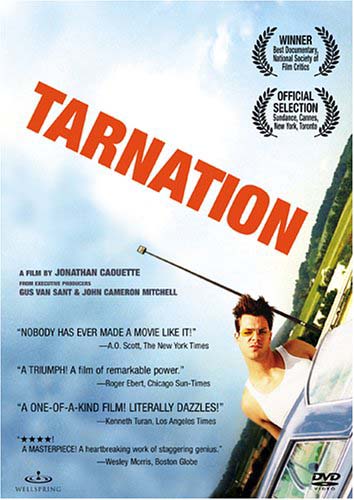
Jonathan Caouette's film Tarnation, a recommendation of friend Sheila, is a disturbing and ultimately redemptive blend of autobiography, docu-drama, and performance art. Passionate, personal, and breathlessly edited, the film is a long scream of pain for his mother, who was mistakenly given multiple shock treatments which have left her an unstable mess but who is nonetheless deeply loved by her son. Caouette was raised first in foster care and then by his delusional grandparents. From a very early age, Caouette has documented his life using video. He was also aware that he was gay and taped himself performing monologues as female characters starting around age 11. These disturbingly observant, maturely ironic pieces seem to serve as psychological stand-ins both for Caouette's pain at the abuse he experienced and that of his mother. I watched this artfully edited collage of pain both wanting to hide from the bald confessional nature of it and fascinated by the way Caouette used film and characters that are at once him and his family, but also artistic creations, as a sort of therapeutic diary to grow into the evidently responsible, self-aware, and loving adult he has become.

This was an interesting counterpoint to Freud's The Interpretation of Dreams, which I read in large part yesterday. Think what you will of the man, but his ideas of the influence of unconscious drives on our behavior, the literary structures he provided to understand the mind (id, ego, superego), and his techniques for unlocking those buried parts of us that are troublingly influential via associative talk and understanding how to read the symbols they use to hide behind have indelibly influenced the way we think and talk about thought, mind, personality, and culture. It was an apt to companion piece to Caouette's film/diary in which the forces of drive in the context of a repressive culture, have their devastating influence on personality, and are ultimately released through multi-layered symbols - the actually personalities of Jonathan and his mother on the deepest level, the level of the characters he played in his life to survive them, and the most visible layer of the work of art he fashioned to depict them.

The third work I experienced this weekend (although I barely had 20 minutes to touch it) was Thomas Mann's Magic Mountain. Nearly a contemporary of Freud, Mann's work famously evokes the political and cultural forces impinging on the European continent through the characters inhabiting a sanitorium high on a Swiss Alp. All three of these pieces struck me for their use of symbol - letting one thing stand for another, a feature not only of art and psychology but of spoken language, which represents concepts symbolically and written language represents the sounds of spoken language symbolically. These are all fashioned the sum of electrical bursts and the forces that inhibit them in our brain - acts that are decidedly not symbolic but literal and whose computational sum result in our cognitive and motor activities, the states from which they emerge, and whose experience we describe as behaviors and the forces that motivate them.

Saturday, February 20, 2010

The inexorable drive forward or just a way out of the rat-race? (Books - The Unnamed by Joshua Ferris)

I am not one of the bookish set that raved on about Joshua Ferris's Then We Came to the End, but that may only be because I have not yet read it. If his new The Unnamed is any indication, I should go out and get a copy immediately. Mark Sarvas's gush sealed the deal on my picking up The Unnamed, a novel about a high-powered New York attorney who contracts an illness which compels him to walk without stopping until he drops in his tracks from exhaustion. Or is it an illness? Perhaps is his psyche calling out for a break from the rat-race. And no, the treadmill doesn't work. He has to cover ground.

'...a dazzling book about a marriage and a family...' the jacket waxes on. Dazzling maybe, but no, it's not. As I read it, this book is about an individual and nature. His nature. This is King Lear, and Ferris writes some chapters that are a worthy analogue to Lear's howl on the moors. Tim's drive forward is bigger than marriage, it's bigger than career, it's more essential than family. He walks right out of a multi-million dollar case he is in charge of for his law firm, he sacrifices body parts to frost bite. I'm reading Freud's seminal work on understanding the mind through dreams for a class right now. Our favorite Viennese Victorian doctor envisions the events of dreams as encoded messages about those deepest wishes and fears we cannot give voice to. The mind symbolizes them (says Freud) so that in their disguise they get past the censor (our conscious mind) and find a partial expression that can then be interpreted. That is what Ferris has created in The Unnamed, a Freudian symbol for the inexorable drive forward. Sometimes that drive is the life force itself. Sometimes it can take on a more destructive character but can be sublimated, kept within the lines culture approves of, as career ambition. But then there are those other times that it takes on a more elemental cast. Witness, for example, Clinton and Monica Lewinsky. What possessed him, we ask? Well, something bigger than the either his marriage or the presidency - institutions that we imagine should be strong enough to keep our natures in line.
So much of who he was was involuntary...The only control over the coursing world that he retained in his littleness was his selfless refusal to turn.
Every drive forward, we would like to think, can be answered by turning around. Except at those times when it can't. This beautiful, sad, strong novel is about those times.

Thursday, February 18, 2010

Does reading Magic Mountain count?

btt button

You may have noticed–the Winter Olympics are going on. Is that affecting your reading time? Have you read any Olympics-themed books? What do you think about the Olympics in general? Here’s your chance to discuss!

That's an easy one. No, it's not affecting my reading time in the least. No, I have not read any Olympics-themed books although I have begun re-reading Magic Mountain which is set on an Alp and for which, if I finish, I should probably get a medal. And, I don't actually think much about the Olympics, unless I'm made to, like right now. I don't have a television (although I do have a monitor on which I watch DVDs). If I'm going to do anything even vaguely related to sports or fitness, I'm going to do it, not watch it. I like to hike and to ice skate, but then I want to do it, not watch someone else do it. I know the athletes have trained for years and have developed grace or strength I could never imagine having in my wildest dreams, but they have plenty of other admirers and I don't really care for competition. I don't even like it in the arts. That is a cultural pastime I do participate in, but I don't watch the Oscars or the Tonys either. I don't get enough exercise as it is. I barely get to see my friends. I almost never go to the theatre any more, and although some people think I read a lot, it's not enough for me, so the last thing I'm going to do is crowd my life with corporate-sales-driven sports programming on television. Sorry. There are too many better things to do.

Monday, February 15, 2010

Read along...

My friend and fellow blogger at Criticlasm is making his way through War and Peace. If ever you were tempted and felt like you had a better chance of finishing it if you had company - now is your chance to join A Year of War and Peace. And more power to you. I feel I have greater odds finishing a Ph.D. in neuroscience, and sometimes even that seems a stretch

Sunday, February 14, 2010

Novelties VI

Eating: I was introduced to these chickpea flour pancakes from Andalusia by Mark Bittman, who calls himself the Minimalist Chef. Yum.


Drinking: Hannes Schuster 2007 St. Laurent is a light-bodied, bright red, with sweet/tart cherries but also an earthy funkiness. Complex, delish, and not for the Merlot drinking crowd.


Watching: We've been getting into the BBC television versions of Ruth Rendell's books. They call them mysteries, but they're not classic who-dunnits. Some of them are more like Patricia Highsmith stories. And they frequently have good actors in them like Colin Firth and Phoebe Nicholls.


Listening: To the late, great Lorraine Hunt Lieberson


Surfing: Super Dilettante, Absorbed in Words, Ivan Terestchenko, Science-Based Medicine, Words to Eat By


Learning: These last few weeks I have been interested by my class readings and lectures on different theories of what defines a 'self,' by thinkers such as William James, Roy Baumeister, Erving Goffman, Hazel Markus, and Dan McAdams.

So, what's new with you?

Saturday, February 13, 2010

The 20th century as patient (Books - The White Hotel by D. M. Thomas)

I read D. M. Thomas's 1981 novel, The White Hotel, in connection with a class I'm taking on psychoanalytic theory - how it was born out of the science and the symbols of its time and place, how its practice impacted individual lives and culture, and how psychotherapeutic processes evolved from it. The novel is a remarkably potent record of the life of one woman, a Ukrainian opera singer, living in Vienna in the early part of the 20th century. To say she is one woman is misleading, she is a many-layered affair and that is one of the book's points. One of Freud's chief metaphors for his psychoanalytic process was archeology, and that is an apt and visible metaphor played out in this novel as it is the unearthing of the meanings of not only one individual's life, but the lives of the denizens of the 20th century. It also evoked for me Ibsen's Peer Gynt, and his discovery as the end of his life as he faces the Button Maker (the play is a must read) that a person's identity is like an onion. As you peel away the layers, you keep finding more.

One could say that the book's different sections introduce us to our protagonist as biographical fact, as dream, as a third person's imagining of her, as a result of natural forces (the drive for pleasure, or toward death), or her self as the product of world events, or fate if you prefer. Or one might say that the book's structure, which includes her life as a fever-dream of a poem, her journal, a case study of her psychoanalytic sessions with Sigmund Freud (this chapter is in a tour-de-force act of ventriloquism. Thomas as Freud is superb), a more conventional third-person narrative of the facts of her life without psyeudonym, and the aftermath of these creative acts - each of which were 'her' - as they unfolded into what became her life. Id. Ego. Super-ego. One can look back and create sense through narrative, Thomas seems to say, but no analysis has all the answers. The only final version of a life, is discovered after it was lived. Analysis is not about truth per se, it's about interpretation so that one can live with the events that came before. However, it does not determine what will happen in the future. The forces that impinge on a single life are more than personal or even interpersonal. We are also made by our culture, and by history. In the final chapter we see how the pieces that make up I/Anna/Elisabeth live in the punishing facts of Stalin's selling out the Jews of Russia to Hitler and his SS and, at once, how the symbols that have been born again and again through the different narrative interpretations that are all aspects of the same woman are finally given their ultimate truth. The facts are searingly cruel but one's experience of life is itself a creative act, and one can see how our protagonist finds coherence and solace through what she has created and Thomas (the ultimate creator in this case, no matter how temporarily real she becomes) makes a wounded patient of each inhabitant of the 20th century and attempts to help us find beauty (for there isn't much sense) there as well.

When I finished Thomas's novel at 1 am, there was no way I could go to sleep, so, at the recommendation of Mark Sarvas, I started The Unnamed, Joshua Ferris's new novel. I barely began it before the effects of the White Hotel began to wear off enough for me to go to sleep, but The Unnamed already has me in an iron grip. I expect that you should hear more soon.

Thursday, February 11, 2010

Peddling our vice to minors...

btt button

Suggested by Barbara H: How can you encourage a non-reading child to read? What about a teen-ager? Would you require books to be read in the hopes that they would enjoy them once they got into them, or offer incentives, or just suggest interesting books? If you do offer incentives and suggestions and that doesn’t work, would you then require a certain amount of reading? At what point do you just accept that your child is a non-reader? In the book Gifted Hands by brilliant surgeon Ben Carson, one of the things that turned his life around was his mother’s requirement that he and his brother read books and write book reports for her. That approach worked with him, but I have been afraid to try it. My children don’t need to “turn their lives around,” but they would gain so much from reading and I think they would enjoy it so much if they would just stop telling themselves, “I just don’t like to read.”

Maybe they're not telling themselves anything, maybe they really don't like to read. There are many different kinds of brains. Reading may be associated with great pleasures for some of us - maybe because we were really good at it, maybe because it helped us to escape doing other things, maybe because it allowed us to be alone - it gave us pleasure, but not everyone is like us. As the book Proust and the Squid discusses, our brains did not evolve with reading "in mind." Collecting information while solitary from a bunch of arbitrary symbols that have nothing to do with the sounds they represent, then linking them into groups which have little to do with the concepts they represent, and then tying that to information others tell us we are meant to have or stranger still to imaginary people and places that come alive in our heads might be completely nonsensical to some people. It comes very naturally to us bookey types, but for others it is unnatural or even difficult. Perhaps they are more skilled with gathering information from what they hear. Maybe they are better at processing non-verbal information that represents concepts through two and three dimensional constructions. Not every one of those people has a learning disorder, although if that difference is very extreme then that could be the case, but there is a natural range of cognitive strengths and weaknesses and reading may not be your childrens' strength.

Forty years ago we had many fewer choices for either amusement or for information. There weren't 200 television channels and there was no internet. If you needed information for school or for your own interest, you went to an encyclopedia, The Reader's Guide to Periodical Literature, or to the card catalogue. You will notice, you even had to read to know what to read! Now we have so many choices and there is so much information. Reading may seem to a child to be completely overwhelming or completely unnecessary. Turn off your television, and limit their TV and hours on the computer.

So how to get a kid to read - I wish I knew since I love it too. With a younger one - read to them, read around them. With any age, notice what their interests are and give them books about that. Notice your child - do they like solitary activities or those in groups? They may not like to read because they have to do it alone. Perhaps there are some organized peer activities that involve books, the characters from books, or writing. Do they like pictures? Although some think it sacrilege, many kids begin to love reading through comic books. Are they impatient? Can they not sit still? Maybe they can act out the story of a book either as they read it or after they have read it. Any time they do talk about a story, television program, or film - do they go for plot, language, character, or design? See what it is they connect to. If they like pirates, get them a pirate book. Notice their style - do they want to do what you or their father does or would they sooner be caught dead? A child can define themselves by doing things and liking things that are different from their parents. That may be a way to identify with a peer group.

Ask yourself - do they really not read at all or do they not read what you want them to read or not feel the same way about it that you do? Do they read sports in the newspaper? Do they read information on the internet? How much reading are they doing in school? We cannot control what is fun for other people and there are plenty of people whose brains don't work like ours and whose taste are not like ours. My style would not be to assign a book and have a child write a book report. I used to have to practice penmanship during the summers. I hated it, it did not make my writing any better, in fact it made me hate writing more. My handwriting is still terrible and I survive. If you give an assignment, I would make it indirect, short, and interesting to them. Perhaps a conversation at the dinner table about an article in the day's paper or about a single paragraph in a book about something that would interest them, or someone they know. Tell them an hour before dinner, 'there's a little piece in the paper today I want to ask you about. Take a look at it before dinner.' And if you ask them a question, make sure you listen to their answer. Don't say anything about reading. Don't ask them if they liked reading it. Focus on the content and on them. If they ask you a question about something they want to know, pull down a book and show them the information on the page. If they don't read it, read it to them.

Lastly, it is important in today's world that people be capable of gathering information by reading, comprehending it, and using it to reason and problem solve, so if you have a real concern that your child has a hard time doing anything of these things - get them evaluated by a neuropsychologist. For the teenager, if they are adequate but you are concerned at their attaining enough competence in one of the above areas so that they will will have access to a certain level of education, explain that to them and get them involved in some specific activity for a limited amount of time each week, perhaps with a tutor, the way you would give someone a vitamin to supplement a poor diet or an exercise to strengthen a weak limb. But if they can read at an adequate level, have many things they enjoy and excel at, and simply don't relate to it the way you and I do, that just may be a difference that, in the long run, you have to accept. Although, over time, people have been known to change.

Saturday, February 6, 2010

Bits and pieces composing the whole (Books - The Pattern in the Carpet by Margaret Drabble)

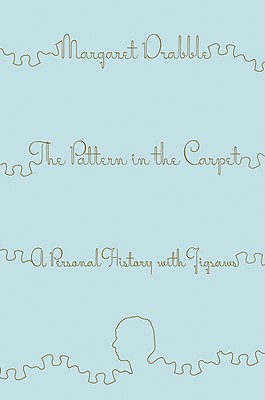
I have at last finished Margaret Drabble's memoir cum cultural history of puzzles - The Pattern in the Carpet. I say 'at last,' not because I am revising my earlier warm feelings for the book, I'm not. But it drums up a more leisurely rhythm than the resumption of clases affords me. Between the book ends of Drabble's memories of her Auntie Phyl, begun reluctantly after her earlier fictional attempt at writing about her mother, and reflections on her own aging, are multiple desultory narratives of puzzles, games, and mosaics - their history, their use, anecdotes, and literary mentions of them. I particularly enjoyed this, about homophones and her love of Jules Verne via Gregory Benford's anecdote:
Verne even influenced those who didn't quite know how he was. Isaac Asimov once told me that when he was still a young science fiction fan he found himself listening to a lecture about a great foreign writer, a master of fantastic literature. But Asimov couldn't recognise the name. Giving the French pronunciation, the lecturer said 'Surely you must know Zuell Pfern,' and described From the Earth to the Moon. Asimov replied in his Brooklyn accent, 'Oh, you mean Jewels Voine!'
Or some delightful ephemera on Convergence, an important work by the abstract expressionist Jackson Pollack, which achieved far more reknown as a jigsaw puzzle than as a painting. Or this quote from Virginia Woolf's Diary, September 1924 which reflects:
...on the heterogeneity of daily life and its mixed tapestry composed of postmen, invitations to Knole, and lectures on the League of Nations... 'All this confirms me in thinking that we're splinters and mosaics; not, as they used to hold, immaculate, monolithic, consistent wholes.'
As much a comment on the important change Woolf's point-of-view wrought upon the fictional form as it is a fitting comment reflecting on Drabble's use of the jigsaw or mosaic as metaphors for the putting together of a picture of life. I don't think it would be cute to call them bits and pieces - this is rather the point of the book. I probably could have done with a few fewer anecdotes in the final reckoning, but none of the information Drabble delighted in researching and presenting was a chore to read, I felt that had I returned to the theme of Auntie Phyl, Drabble's own reflections on aging, memory, writing sooner, the work as a whole might have possessed more integrity. How much and which of these pieces should make up the whole we apprehend, is indeed the meditation of this book. The writer's assembly of pieces makes a willful creation - a story, a novel - just as actual factual circumstances give shape to a person's life, although the narrative can be written and re-written and those facts interpreted by recalling them idly or actively, consciously or unconsciously. Whether this whole is a work of fiction or a life, its summing up will be a collection of pieces whose assembly finally gives us satisfaction or not. While I didn't love every piece, The Pattern in the Carpet did produce a very satisfying whole.