Sunday, March 31, 2013
A modern novel of compassion and contradiction - (Books - A Tale for the Time Being by Ruth Ozeki)

Tuesday, March 26, 2013
Film - Our Man in Havana (1959)

Saturday, March 23, 2013
Film - Safety Not Guaranteed (2012)

Friday, March 22, 2013
A revolution without a cause (Theatre - Neva by Guillermo Calderon)

Tuesday, March 19, 2013
Film - My Week With Marilyn (2011)

Monday, March 18, 2013
Theatre - Cat on a Hot Tin Roof

Mendacity is the system that we live in. Liquor is one way out an' death's the other.
Why is it so damned hard to talk?
Like E.M. Forster, he exhorts us to stop lying and connect to others, even if it's tough. They couldn't have been more different writers, but both were gay, so they were familiar with the ways that society expected them to lie.
Saturday, March 16, 2013
Are we many selves or just one self? (Books - Dark Matter by Juli Zeh)
I have actually finished three books in the last two weeks, started two more (the new Oliver Sacks - Hallucinations - and a review copy of A Tale for the Time Being), and attended two interesting science talks, but you couldn't tell that from a visit to bookeywookey lately. I have had some very long days at work and every moment of writing time has gone to my dissertation, so I have been letting things slip around here. I'm afraid I may not remember Tenth of December, the much-talked-about short story collection by George Saunders, well enough to write about it. I don't know that I will have time to write about the discussion of collaborations between scientists and educators, or the other on how scientists and members of the media communicate relationships between brain and behavior. I hope I can get to Vaclv Havel's memoir To the Castle and Back, but for the moment, I'll write something about Juli Zeh's Dark Matter, because it is freshest in my mind.
 Juli Zeh is a German writer and the sometimes stilted, but still involving, translation is by Christine Lo. I learned about Dark Matter from Lizzy Literary Life - an excellent recommendation, thank you Lizzy. It is a smart, inventive mystery by a German writer about two physicists and two detectives each, in their way, struggling with love and each, in their way, struggling with time. The two physicists, Oskar and Sebastian, share a long, tangled past full of deep love. This love has persisted even as their diverging opinions about the nature of time and the universe has created an animus between them. Rita Skura, one of the two detectives, is an odd duck. A self-conscious giant, brusque, married to her work, Rita is so acutely sensitive to, and also alienated from, people that she has terrible judgement about them. She would seem to be miscast as a detective, but learned from her mentor, Detective Schilf, that if she went with the opposite of her instincts, she would be dead-on. When she fails to solve a particularly sensitive series of murders in a hospital in the city of Freiburg, where she lives and works, Schilf is called in. Schilf is a schlumpy, asocial being, but the combination of a recent fatal diagnosis and a new relationship has spurred him to action. Although he is meant to help solve the hospitals murders, these overlap with another murder and the kidnapping of Sebastian's son. These two detectives are likeable, idiosyncratic creations that add much enjoyment to the reading of this unconventional mystery.
 Juli Zeh is a German writer and the sometimes stilted, but still involving, translation is by Christine Lo. I learned about Dark Matter from Lizzy Literary Life - an excellent recommendation, thank you Lizzy. It is a smart, inventive mystery by a German writer about two physicists and two detectives each, in their way, struggling with love and each, in their way, struggling with time. The two physicists, Oskar and Sebastian, share a long, tangled past full of deep love. This love has persisted even as their diverging opinions about the nature of time and the universe has created an animus between them. Rita Skura, one of the two detectives, is an odd duck. A self-conscious giant, brusque, married to her work, Rita is so acutely sensitive to, and also alienated from, people that she has terrible judgement about them. She would seem to be miscast as a detective, but learned from her mentor, Detective Schilf, that if she went with the opposite of her instincts, she would be dead-on. When she fails to solve a particularly sensitive series of murders in a hospital in the city of Freiburg, where she lives and works, Schilf is called in. Schilf is a schlumpy, asocial being, but the combination of a recent fatal diagnosis and a new relationship has spurred him to action. Although he is meant to help solve the hospitals murders, these overlap with another murder and the kidnapping of Sebastian's son. These two detectives are likeable, idiosyncratic creations that add much enjoyment to the reading of this unconventional mystery.
 Friday, March 8, 2013
Film - Mary Queen of Scots (1971)

Mary Queen of Scots (1971) suffers from a turgid, 1970s script, some wooden acting from Patrick McGoohan and Daniel Massey, however the young Glenda Jackson manages to combine being commanding and vulnerable. It is a pleasure to watch the young Vanessa Redgrave, Ian Holm, and Timothy Dalton before they grew into themselves, and history has provided a cracking good story.
Wednesday, March 6, 2013
Scientist as harridan, Hollywood icon, and bad dresser

Dr. Patricia Fara, historian of science at Cambridge, bemoans in Nature today the role biographers have played in reinforcing stereotypes of women in the sciences and mathematics in Women in Science: Weird Sisters?.
It seems that being an ordinary woman with a stellar scientific career is simply not enough: to be marketable, she must also be odd. Dust jackets entice purchasers by rebranding an overlooked character as a unique female individual — in other words, as a weird woman.
Converting female scientists into publishing opportunities may sell books, but it does the cause of equality in science no favours.
Her critique offers a list of recent biographies which, despite any shortcomings, profile some important scientists such as Rosalind Franklin, Dr. Jocelyn Bell, and, Hedy Lamarr, no really.
Tuesday, March 5, 2013
The allure of the counterintuitive - is it good or bad for science?
There is a good critique on how the popular press hypes social science research in The American Scholar: The Allure of the Counterintuitive by Jessica Love. Well worth a look. I very much agree with her point that the press gives very little space to studies which are
Hat tip: The Dish
incremental, for work that shores up and teases apart, for work that complicates, for work on the boundary conditions...But Love seems to feel that the appeal of the counterintuitive is damaging to science because people will be so entrained to hype that they will not support studying brain processes that appear to be obvious. However, I would argue that interest in counterintuitive conclusions is an opportunity to argue for why we study the brain, its behaviors, and its less visible processes (like the electrical and chemical signalling whose outcome are our cognitive functions) in the first place. Even though our minds are are own, we do not have conscious access to all its processes. This is an opportunity to explain just that, and in the case of neuroscience conclusions are even less obvious. Although our minds 'think' our neurons do not. We do not know before studying brain processes which hypotheses will confirm our common sense notions and which will not. So, while I get a little tired of "hey wow" science and do not like inaccurate popular press interpretations of studies, the allure of the counterintuitive offers an opportunity to better explain critical thinking and experimental processes if it is used well.
Hat tip: The Dish
Sunday, March 3, 2013
Opera and the Holy Grail - Parsifal


The Met's new Parsifal directed by Francois Girard, with beautiful sustained singing, precise rich playing from the orchestra, and intelligent performances by Rene Pape, Peter Mattei, and Jonas Kaufmann. Wagner bombastically told us that his five-and-a-half-hour quasi-pagan-quasi-christian-sci-fi myth shouldn't be staged. In my opinion, it is his best score, so I'm glad no one has listened to him. It wasn't the first thing Wagner was wrong about. The production smartly doesn't focus on the action of the story or try for ridiculously literal effects like flowers and grass on stage. These are symbols. Instead, it directs our attention to the themes and lets the human beings convey what it is like to be players in a grand scheme. Taking on the pain of mankind is an experience on a geological scale. This production is physically stark but striking, communicating the reach of the myth with clarity and gravitas.
Saturday, March 2, 2013
Film - The Scarlet Empress (1934)

Having just read Robert Massie's vivid biography Catherine the Great, we got Josef von Sternberg's very loose film adaptation of her diaries - The Scarlet Empress - an absurd, expressionist, Hollywood-ized concoction starring Marlena Dietrich as the sex-starved naif turned dominatrix- Empress. In an interview done in the 1960s, Sternberg who was born in Vienna without the 'von,' emigrated to New York at the age of two, and dropped out of a Queens high school, described himself as 'having no influences' and doing everything himself - design, cinematography, etc.... This film reeks of such arrogance. He clearly allowed no one to interfere with his vision and it's too bad. He could have benefited from hearing the word 'no.' The film has that sort of amateurish hysteria marked by someone who thinks that all he has to do to make a great film is control every lighting angle and the texture of every closeup, but he simply has no idea what to do with the human beings cluttering up the set and he is clueless about casting. Louise Dresser plays the Empress Elizaveta (daughter of Peter the Great) looking like one of those classic 1930s Hollywood middle-aged matrons and sounding like Lucille Ball playing a slattern. The man cast as the head of the Russian orthodox church read his lines like John Wayne.
Tuesday, February 26, 2013
Who says people who play early music don't know how to have fun?
Philippe Jaroussky singing Ohime, ch'io cado by Claudio Monteverdi
Hat tip: The Ragazzo
Sunday, February 24, 2013
Of moral compasses and light-meters - on becoming sensitive (Books - The Starboard Sea by Amber Dermont)

Tuesday, February 19, 2013
Film - Songcatcher (2000)

A university-educated musicologist (the passionate Janet McTeer) goes 'up the mountain' to collect the authentic folk music of Appalachia. Songcatcher (2000) is not the strongest script in the world, but it has Janet McTeer and Pat Carroll in it and it tells a good story about having the strength to go one's own way.
Monday, February 18, 2013
Film - The Iron Lady (2011)

Meryl Streep and Jim Broadbent are wasted on The Iron Lady (2011) dir. Phyllida Lloyd. The film tries desperately, if not to portray Margaret Thatcher sympathetically, at least to trace the origin of her rabid fiscal conservatism and inhumane governing choices. It doesn't succeed. Being a shopkeeper's daughter or being laughed at by school chums needn't make one unempathic. In fact, it could easily do the opposite. Meryl Streep has so much age makeup on that she looks like a lizard, and the film chooses to tell its story of fairly recent history via so many cliched montages, with such a baldly commercial soundtrack, that I wondered why they didn't make a 10 minute music video and have done with it. The endless montages - Maggie at home, Maggie losing the election, Maggie winning the election, Maggie ruining the British economy, the masses mad at Maggie and rioting in Brixton, Maggie fighting in the Falklands, in addition to being banal, seemed to wish to skirt actual scene writing so that the film wouldn't have to have an opinion on her politics. Want a lesson in what austerity does to an economy, America? Look at Thatcherism. Anyway, her austerity was a lie. She was glad to spend millions of pounds when it came to a war in the Falklands. Given the way she decimated funding for the arts in Britain, as a director I certainly wouldn't have wanted the job of directing her biopic.
Sunday, February 17, 2013
What we go to art for (Books - Artful by Ali Smith)

Saturday, February 16, 2013
Ted's Library Tour!

Thursday, February 14, 2013
Wednesday, February 13, 2013
The solo voice in NYC

The 105th Helicon Symposium, a series of salon-like chamber music concerts in intimate settings, presented solo works by Bach, including Johnny Gandelsman playing the Chaconne from the violin Partita #2 in D Minor. It's meditation listening to an extended piece for a single instrument while New York's own never-ending score plays in the background.
Brooklyn Rider
The Knights
Tuesday, February 12, 2013
Film - L'Illusioniste (2010)

L'Illusioniste, a melancholy and beautifully detailed animated film from the makers of The Triplets of Belleville.
Sunday, February 10, 2013
Breathing life into a world of hoplessness and decay (Books - The Witch of Exmoor by Margaret Drabble)

Saturday, February 9, 2013
Being private in public - Film: Amour (2012)

Tuesday, February 5, 2013
Film - Looper (2012)

Rian Johnson's Looper with Joseph-Gordon Levitt and Bruce Willis is a really well-done time-travel/dystopian thriller, but the real star of the flick is a performance by 8-year-old Pierce Gagnon - wonderful actor.
Sunday, February 3, 2013
I hear god's voice: symptom or calling? (Books - Lying Awake by Mark Salzman)

Saturday, February 2, 2013
Film - Jean Michel Basquiat: The Radiant Child (2010)

Jean Michel Basquiat: The Radiant Child directed by Tamra Davis captures the feel of the early 1980s NYC downtown arts scene and the vibrant painter Jean Michel Basquiat. He went from living on the streets of the Village to being a millionaire in a couple of years. He was called some sort of savage innocent, but Basquiat thought that they wouldn't have used such language if he had been a white painter.
Friday, February 1, 2013
New York's Mayors In the Spotlight

He was a three-term mayor of New York City from 1934-45. Just five feet tall and energetically motivated to do right by the common person. They wrote a Broadway musical - Fiorello! - about him in 1959, which I saw last night, presented by Encores. He was Fiorello H. LaGuardia.

He was another three-terrm mayor of New York City from 1978-89. Irrepresively fiesty, he pulled the city out of near bankruptcy. There's no musical...yet, but a documentary film about him premiered just a few days ago. He was Ed Koch and he died this morning at 88.
Sunday, January 27, 2013
Film - The Horse's Mouth (1958)

Alec Guinness did his own adaptation of Joyce Cary's novel The Horse's Mouth directed by Ronald Neame in 1958. Painter Gully Jimson (played by Guinness) is a single-minded bastard who lives only to transfer what is in his head to paint - and to drink occasionally. The story is hilarious and excruciating. It let's one imagine what the world would look like if everyone were pure, unregulated id.
Saturday, January 26, 2013
Theatre - Opus No. 7
Saw this last weekend - wonderful improvisatory and lively piece of theatre.

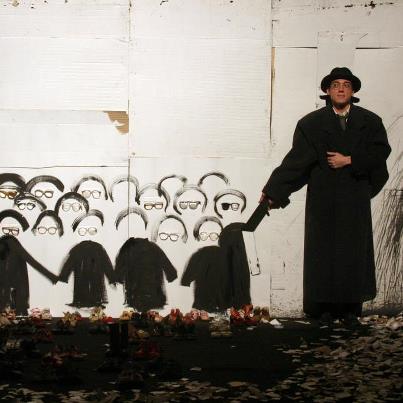
Opus No. 7
Dmitry Krymov Lab - Moscow School of Dramatic Art
St. Ann's Warehouse
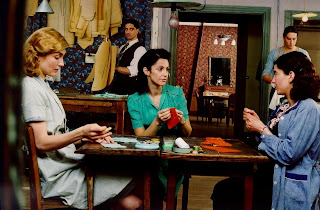
Film - Almost Peaceful (2002)
Because of my dissertation writing schedule, I'm feeling a little restricted in the additional writing I can do. One book post per week seems to be the limit right now, but that shouldn't keep me, I'm now thinking to myself, from posting a picture or a few words on the other cultural or scientific encounters of my NY existence. So I'll start with the film I saw last night. No review, just an image or two from Almost Peaceful, a French film released in 2002 about a group of Jews who work for a tailor in Paris after World War II and how they try to get back on their feet. The film really focused on the meaning of people being with people. You know how you can sometime know you are going to like a film because of the way people are arranged in the frame? Well, I feel I can, at any rate.


Saturday, January 19, 2013
Birds eye view (Books - Fly Away Peter by David Malouf)

Sunday, January 13, 2013
A socio-political, musical, map that is the zeitgeist of NW London (Books - NW by Zadie Smith)

Saturday, January 5, 2013
In the harsh light of day... (Books - Swimming Home by Deborah Levy)
He leaned his head out of the window and felt the cold mountain air sting his lips. Early humans had once lived in this forest that was now a road. They knew the past lived in rocks and trees and they knew desire made them awkward, mad, mysterious, messed up.Her prose shines the garish light of a hangover over all she surveys - things are too brightly colorful, too clear, they make your eyes hurt, and her characters get now how perfectly obvious the whole mess was before. The thing is, I've not been drinking, and I felt like I got it from the start.
To have been so intimate with Kitty Finch had been a pleasure, a pain, a shock, an experiment, but most of all it had been a mistake. He asked her again to please, please, please drive him safely home to his wife and daughter.
'Yes,' she said. 'Life is only worth living because we hope it will get better and we'll all get home safely.'
Tuesday, January 1, 2013
2012 - the year that was
A New Year's Day meme. I did this last year and it turned out to be a pretty good year, maybe it will work again. Feel free to steal and modify it.
1. What did you do in 2012 that you’d never done before?
Published an article in a non-science journal. Created a book club. Ate zucchini, hazlenut chocolate cake while looking at the Julian Alps.
2. Did you keep your new years’ resolutions, and will you make more for next year?
I don't know what I said I would do last year and, doubtless, I didn't do it. This year I will write my dissertation and defend it. That is the one and only plan I am making.
I don't know what I said I would do last year and, doubtless, I didn't do it. This year I will write my dissertation and defend it. That is the one and only plan I am making.
3. Did anyone close to you give birth?
Yes, a friend in the midwest.
4. Did anyone close to you die?
Parents of childhood friends and a remarkable Prof in my PhD program.
5. What countries did you visit?
England, Austria, Slovenia, and Italy.
England, Austria, Slovenia, and Italy.
6. What would you like to have in 2013 that you lacked in 2012?
A PhD. A salary. Hair on the top of my head, but let's be reasonable.
7. What dates from 2012 will remain etched upon your memory, and why?
My 50th birthday. Well, because it was my 50th and the Ragazzo got really sick, and 20 children lost their lives in CT. It couldn't quite be called joyous.
8. What was your biggest achievement of the year?
Reaching 50, I guess, although all I did was look before I cross, buckle in, and take my vitamins.
Reaching 50, I guess, although all I did was look before I cross, buckle in, and take my vitamins.
9. What was your biggest failure?
I said this last year but I'm not sure that I improved: I talked more than I listened. I answered more than I asked.
10. Did you suffer illness or injury?
Aside from a rotten sinus infection, and an annoying stomach thing, I was pretty fortunate.
11. What was the best thing you bought?
I got a great tie and scarf in Vienna and saw a lot of terrific theatre performances.
I got a great tie and scarf in Vienna and saw a lot of terrific theatre performances.
12. Whose behaviour merited celebration?
President Obama stood up for gay marriage in an election year. How the world has changed.
13. Whose behaviour made you appalled and depressed?
13. Whose behaviour made you appalled and depressed?
Is it too much of a cliche to say most of the United States legislature?
14. Where did most of your money go?
15. What did you get really, really, really excited about?
Obama's standing up for gay marriage. Our train trip to Slovenia. Cute puppies. Seeing the play Scenes From an Execution after imagining it for 25 years. The Halloween party we did at work for the kids two days after Hurricane Sandy. A meeting that I had regarding future work. Seeing a number of my old students perform.
16. What song will always remind you of 2011?
None comes to mind.
17. Compared to this time last year, are you:
a) happier or sadder?
b) thinner or fatter?
c) richer or poorer? - you don't say in what, so if we're not counting dollars and cents, definitely richer.
18. What do you wish you’d done more of?
Had meaningful exchanges with friends, family, and new acquaintances. Written. Followed through.
None comes to mind.
17. Compared to this time last year, are you:
a) happier or sadder?
b) thinner or fatter?
c) richer or poorer? - you don't say in what, so if we're not counting dollars and cents, definitely richer.
18. What do you wish you’d done more of?
Had meaningful exchanges with friends, family, and new acquaintances. Written. Followed through.
19. What do you wish you’d done less of?
Acted without awareness. Made commitments I couldn't keep.
20. How did you spend Christmas?
At the in-laws making schnitzel, cucumber salad, opening presents with the kids, and singing carols.
21. Did you fall in love in 2011?
Once or twice.
22. How many one-night stands?
None, thanks for asking.
23. What was your favourite TV program?
24. Do you hate anyone now that you didn’t hate this time last year?
Yes, and I'm much better at it.
26. What was your greatest musical discovery?
I'm loving Lorraine Hunt Lieberson's recording of Les Nuits d'Ete
and Radu Lupu's recording of Schumann's Piano Concerto in A minor
27. What did you want and get?
A more unified experience of myself.
28. What did you want and not get?
Although gay people can now marry in nine of the United States and D.C., the federal government does not confer more than 1,000 benefits upon us that it gives straight people who have paid the same fee and sworn to the same terms of that contract.
28. What did you want and not get?
Although gay people can now marry in nine of the United States and D.C., the federal government does not confer more than 1,000 benefits upon us that it gives straight people who have paid the same fee and sworn to the same terms of that contract.
29. What were your favourite performances this year?
Films:
Margaret (2011)
Another Year (2010) - appropriately enough
Blue Valentine (2010)
This is Not a Film (2011)
Copie Conforme (2010)
Red Riding Trilogy (2009)
Theatre:
Uncle Vanya by the Sydney Theatre Co. w/ Cate Blanchette
Orpheus and Euridice chor. Pina Bausch by Paris Opera Ballet
Scenes From an Execution - Nat'l Theatre, London
Timon of Athens - Nat'l Theatre, London (HD simulcast)
Donka: A Letter to Chekhov - BAM
The Other Place - Broadway w/ Laurie Metcalf
30. What did you do on your birthday, and how old were you?
I worked, went to a very elegant restaurant and turned 50.
I worked, went to a very elegant restaurant and turned 50.
31.What one thing would have made your year immeasurably more satisfying?
Equal treatment under the law, as detailed in #28.
32. How would you describe your personal fashion concept in 2011?
I manage to get dressed every day, occasionally that included a tie. Fashion concept? Let's not go crazy.
33. What kept you sane?
Did something keep me sane? If so, it was probably the Ragazzo.
34. What political issue stirred you the most?
Where do I begin? I am appalled at the resistance to offering healthcare as a basic right of citizenship in this rich and technically advanced country. I am amazed that when so many people are murdered in cold blood all some can think about is their personal right to own a gun. I am terrified that Antonin Scalia actually imagines that he or anyone else interprets the Constitution exactly as it was written. We would still have slavery and women would not be able to vote if that were the case. I continue to be amazed that relatively smart people imagine that the only thing between them and better lives is government. They are in denial about how reliant we all are upon each other for basic services. If they want electricity coming to their homes, trash collected, safe meat and dairy to eat, coordinated help after hurricanes, relatively safe household products, we need to have regulation and we need to pay taxes. Making everything answerable only to profit has been disastrous for so many industries - look at the airlines, health insurance, for-profit prisons are a true desecration of justice.
35. Whom did you miss?
My dad. My grandparents.
36. Who was the best new person you met?
I met a really cool woman at a wedding two days ago who works on biodiversity in cities.
37. Tell us a valuable life lesson you learned in 2011:
I worked on being more mindful of things as they are.
I worked on being more mindful of things as they are.
38. Quote a song lyric that sums up your year:
This doesn't sum up my year, but I think Noel Coward is as good a way as any to ring in the New Year.
Quite for no reason
I'm here for the Season
And high as a kite,
Living in error
With Maud at Cap Ferrat
Which couldn't be right.
Everyone's here and frightfully gay,
Nobody cares what people say,
Though the Riviera
Seems really much queerer
Than Rome at it's height,
Yesterday night-
I went to a marvelous party
With Nounou and Nada and Nell,
It was in the fresh air
And we went as we were
And we stayed as we were
Which was Hell.
Poor Grace started singing at midnight
And didn't stop singing till four;
We knew the excitement was bound to begin
When Laura got blind on Dubonnet and gin
And scratched her veneer with a Cartier pin,
I couldn't have liked it more.
I went to a marvelous party,
I must say the fun was intense,
We all had to do
What the people we knew
Would be doing a hundred years hence.
Dear Cecil arrived wearing armour,
Some shells and a black feather boa,
Poor Millicent wore a surrealist comb
Made of bits of mosaic from St. Peter's in Rome,
But the weight was so great that she had to go home,
I couldn't have liked it more.
People's behaviour
Away from Belgravia
Would make you aghast,
So much variety
Watching society
Scampering past,
If you have any mind at all
Gibbon's divine Decline and Fall
Seems pretty flimsy,
No more than a whimsy,
By way of contrast
On Saturday last-
I went to a marvelous party,
We didn't start dinner till ten
And young Bobbie Carr
Did a stunt at the bar
With a lot of extraordinary men;
Dear Baba arrived with a turtle
Which shattered us all to the core,
The Grand Duke was dancing a foxtrot with me
When suddenly Cyril screamed "Fiddledidee"
And ripped off his trousers and jumped in the sea,
I couldn't have liked it more.
I went to a marvelous party,
Elise made an entrance with May
You'd never have guessed
From her fisherman's vest
That her bust had been whittled away.
Poor Lulu got fried on Chianti
And talked about esprit de corps.
Maurice made a couple of passes at Gus
And Freddie, who hates any kind of a fuss,
Did half the Big Apple and twisted his truss,
I couldn't have liked it more.
I went to a marvellous party.
We played the most wonderful game,
Maureen disappeared
And came back in a beard
And we all had to guess at her name!
We talked about growing old gracefully
And Elsie who's seventy-four
Said, "A, it's a question of being sincere,
And B, if you're supple you've nothing to fear."
Then she swung upside down from a glass chandelier,
I couldn't have liked it more.
Monday, December 31, 2012
Rediscovering art in suffering, rediscovering language in silence (Books - The Life of an Unknown Man by Andrei Makine)

I'm not Russian, Lea. I'm Soviet. So you see I'm filthy, stupid, and vicious. Very different from all those Michel Strogoffs and Prince Myshkins the French are crazy about.
Thursday, December 27, 2012
Bookeywookey's best fiction reads of 2012
And now, my favorite fiction reads of the year (excluding re-reads which are obviously already favorites).
Toby's Room by Pat Barker
The Patrick Melrose Novels by Edward St Aubyn
Any Human Heart by William Boyd
What is the What by Dave Eggers
The Stranger's Child by Alan Hollinghurst
Be Near Me by Andrew O'Hagan
Nineteen-Seventy-Four by David Peace
The Life of an Unknown Man by Andrei Makine
I enjoyed looking over all the fiction I read this year. The worlds I inhabited thanks to the authors were so varied, full of strong characters, sharp observations, and the narrative technique, particularly in this short list, was sure. I'm not sure whether I am going to end up wanting to add Andrei Makine's The Life of an Unknown Man to the list of contenders (addendum: see above) , as I'm in the middle of it now, but here are the four, upon looking back, that I think the best of the best. Click the titles for links to my posts about them.


Toby's Room by Pat Barker
The Patrick Melrose Novels by Edward St Aubyn
Any Human Heart by William Boyd
What is the What by Dave Eggers
The Stranger's Child by Alan Hollinghurst
Be Near Me by Andrew O'Hagan
Nineteen-Seventy-Four by David Peace
The Life of an Unknown Man by Andrei Makine
I enjoyed looking over all the fiction I read this year. The worlds I inhabited thanks to the authors were so varied, full of strong characters, sharp observations, and the narrative technique, particularly in this short list, was sure. I'm not sure whether I am going to end up wanting to add Andrei Makine's The Life of an Unknown Man to the list of contenders (addendum: see above) , as I'm in the middle of it now, but here are the four, upon looking back, that I think the best of the best. Click the titles for links to my posts about them.


Wednesday, December 26, 2012
Bookeywookey's best biography and memoir reading of 2012
I noticed that I returned to a reading pleasure of old this year. I used to read many more biographies and autobiographies than I have in the past few years (especially when I was acting), but in 2012 I read many more. Here were the highlights.
Catherine the Great by Robert Massie
Blue Nights by Joan Didion
A Positively Final Appearance by Alec Guinness
My Name Escapes Me by Alec Guinness
Winter Journal by Paul Auster
It is difficult to pick a 'best' from this list since the straight, long-form biography of the empress of Russia is so different from the memoir form, which is different again from Joan Didion's deep elegiac reflection on the loss of her daughter. Good thing I don't have to choose. These were all great, but I'll single out:


Monday, December 24, 2012
Bookeywookey's best non-fiction (non-biographical) read of 2012
Time for the annual best-of ritual. I'm dividing my non-fiction category into life story forms (biography, memoir) and anything else. Here were the non-biographical non-fiction highlights of my 2012 reading:
The Emperor of all Maladies by Siddhartha Mukherjee
Remarkable Creatures by Sean B. Carroll
The New Jim Crow by Michelle Alexander
Behind the Beautiful Forevers by Katherine Boo
In Europe by Geert Mak
There isn't a single title in this list that I wouldn't strongly recommend. Since The Emperor of all Maladies and Behind the Beautiful Forevers got a lot of air time from others, I think I'll call it a tie between In Europe and Remarkable Creatures. I found In Europe impressive for combining tremendous scope - covering all of Europe and the 20th Century - with a sense of the impact of history on individual human beings. Remarkable Creatures makes an adventure story out of a narrative that shows how science done by individual mavericks contributes to the fund of general knowledge.


The Emperor of all Maladies by Siddhartha Mukherjee
Remarkable Creatures by Sean B. Carroll
The New Jim Crow by Michelle Alexander
Behind the Beautiful Forevers by Katherine Boo
In Europe by Geert Mak
There isn't a single title in this list that I wouldn't strongly recommend. Since The Emperor of all Maladies and Behind the Beautiful Forevers got a lot of air time from others, I think I'll call it a tie between In Europe and Remarkable Creatures. I found In Europe impressive for combining tremendous scope - covering all of Europe and the 20th Century - with a sense of the impact of history on individual human beings. Remarkable Creatures makes an adventure story out of a narrative that shows how science done by individual mavericks contributes to the fund of general knowledge.


Sunday, December 23, 2012
2012 reading roundup - let's do the numbers
I feel a little behind in my accounting. I always enjoy my annual review of where my reading tastes took me over the year. So, let's see what kind of reading year I had in 2012.
I have completed 60 books to date, writing about 58 of them. I have a few more in-progress and am likely to finish 1 or 2. Genre categories are not mutually exclusive. If a book falls into more than 1 category, I list it in both.
Books read: 60
written by men: 44
written by women: 16
in translation: 5
re-read: 2
published in the past year or so: 19
fiction: 31
non-fiction: 28
on the fence: 1
poetry: 1
biography/autobiography/memoir: 9
history/political affairs/social science: 9
science: 9
I'm a little surprised I got through so much, but I'm conscious as I'm beginning to write my dissertation, that next year's numbers are likely to be a lot more modest. Not that I won't be reading, it will be many more science articles next year and many fewer books. Or at least, that's what I expect.
Next up: my best-of lists for 2012.
Happy holidays everyone.
I have completed 60 books to date, writing about 58 of them. I have a few more in-progress and am likely to finish 1 or 2. Genre categories are not mutually exclusive. If a book falls into more than 1 category, I list it in both.
Books read: 60
written by men: 44
written by women: 16
in translation: 5
re-read: 2
published in the past year or so: 19
fiction: 31
non-fiction: 28
on the fence: 1
poetry: 1
biography/autobiography/memoir: 9
history/political affairs/social science: 9
science: 9
I'm a little surprised I got through so much, but I'm conscious as I'm beginning to write my dissertation, that next year's numbers are likely to be a lot more modest. Not that I won't be reading, it will be many more science articles next year and many fewer books. Or at least, that's what I expect.
Next up: my best-of lists for 2012.
Happy holidays everyone.
English innocence in Weimar Germany (Books - The Temple by Stephen Spender)

Thursday, December 20, 2012
An unforgiving island and a story woven to pass the time (Books - San Miguel by T.C. Boyle)

Her first impression was of nakedness, naked walls struck with penurious little windows, a yard of windblown sand giving onto an infinite vista of sheep-ravaged scrub that radiated out from it in every direction and not a tree or shrub or scap of ivy in sight. There was nothing even remotely quaint or cozy about it. It might as well have been lifted up in a tornado and set down in the middle of the Arabian Desert. And where were the camels? The women in burnooses? She was so disappointed - stunned, shocked - that she was scarcely aware of the boy as he pushed open the rude gate for her. "You want I should put the things in the parlor?" he asked.The characters did not, as the book's jacket suggest, read like examples of strength, they are simply people, very flawed people who could be petty, who could give up, who could be jealous, overly ambitious, loving, and, yes, determined. The advantage of this was that they were unpredictable. I felt like I was spying on these people in their lives, that if they turned around and saw me they would feel interrupted and self-conscious. Without a theme to give the reading a unifying purpose, the job of Boyle's narrative was to keep me interested in the place and the characters and it is his talent that he does. This felt like old fashioned storytelling - not a narrative to sell an idea but a story woven to pass the time, to entertain, to hold the reader's interest.
Saturday, December 8, 2012
Voluptuary and statesman (Books - Catherine the Great by Robert K. Massie)

Sunday, December 2, 2012
World War I and the changing roles of women and men (Books - Toby's Room by Pat Barker)

Saturday, December 1, 2012
Justice does not banish loss (Books - Berlin Cantata by Jeffrey Lewis)

Saturday, November 24, 2012
Are the reports of the death of publishing greatly exaggerated?

How did J.K. Rowling stand up to Amazon?
Russian e-pirating of books - it creates free loaders, but it also widens an author's readership and may ultimately boost legal sales.
Listen to the podcast here:
Publishing: Adapt or Die - On The Media
It's their usual deep level of reporting - critical, with a somewhat bemused tone.
Friday, November 23, 2012
Humane political thought as it arises from facing the conflict in ourselves (Books - Isaiah Berlin: A Life by Michael Ignatieff)

Subscribe to:
Posts (Atom)