Monday, November 17, 2008

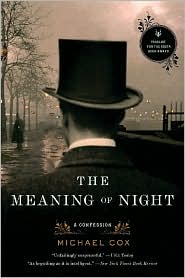
Blood lines and books (Books - The Meaning of Night by Michael Cox)

**SORT-OF PLOT SPOILER** There is probably someone out there with a good explanation for this: why do so many Victorian era stories hinge on lineage - cradle switches, people who are not who we think they are, and the like? I wonder if it's to do with Darwin or if it preceded his writing? Does anyone have a theory? Lineage certainly plays a key role in the plot of The Meaning of Night.
I had taken the decision to abandon my given name of Glyver, except of course with respect to those few, like Le Grice and Tom Grexby, who already knew me. It was not mine by birth but was a kind of alias, imposed on me, without my knowledge or consent by others. What loyalty did I owe the name of Glyver? None. Captain Glyver was not my father. Why, then, should I bear his name? I was who I was, whatever I chose to call myself; and so, until I could redeem my rightful name and title, I would put on whatever pseudonym suite my present purposes. My whole life would be a disguise, a daily change of dress and character. I would inhabit a costumed world, entering now as one character, now as another, as circumstance demanded. I would be Incognitus. Unknown.
The actor's fantasy! Do you know that when Dustin Hoffman was working on the film Tootsie (if you haven't seen it - see it. It is so much fun) he actually went out to lunch with someone - I think it may have been Sidney Pollack - to try out his female character and see if he he would be recognized? This idea of name, of blood, as identity is in one way an extension of the institution of class. One was born into ones class and traversing those blood lines was tricky business. This is an English story, born of a country with a royal family and a parliament, containing a House of Lords. So certainly pedigree takes some precedence in a different way than it would in a country founded on Whitman's creed of the individual:
I CELEBRATE myself, and sing myself,
And what I assume you shall assume,
For every atom belonging to me as good belongs to you.

[...]

I exist as I am, that is enough,
If no other in the world be aware I sit content,
And if each and all be aware I sit content.

One world is aware and by far the largest to me, and that is myself...

But in Michael Cox's wonderful story it is lineage that drives our narrator's sens of identity and it is reclaiming what he believes to be his lineage that gives him and the plot of this book its sense of purpose.

Another pleasure of this novel, is that our narrator and at least two other characters, are obsessed with books and in particular collecting rare books. One key twist in the plot has already hinged on a rare book. Another important character has a collection of rare antique erotic books. A third lives at Evenwood - the estate of the lineage in question - which houses a private library of immense size and value. Cox's descriptions of the library take up whole chapters and are a delight to this bibliophile. I am buried deep in the plot of this book now and it has me by the scruff of the neck.

Friday, November 14, 2008

A chinese box of a revenge novel, with footnotes (Books - The Meaning of Night by Michael Cox)

Michael Cox's The Meaning of Night is one of those books that invites comparisons. Maybe that's because it delights in playing with form, in this case the 19th century English saga of love, intrigue, and revenge. From the pages and pages of review quotes, critics also seemed to think so - Trollope, the Brontes, Wilikie Collins, Charles Dickens - I'll add two more to that list - Donna Tartt and Dostoyevski. Dostoyevski, and in particular, Crime and Punishment, because if this is a story of anything, it is a story of obsession. Our author is so dedicated to avenging the wrongs done him by his mortal enemy, that the first pages are devoted to an act of senseless murder that is a rehearsal for the eventual real one. The anonymous author's identity, we discover, is buried beneath layers of obfuscation aided by Cox's Chinese box structure for this book. As I wrote in my last post, the story is couched as an anonymous confession, written in the 1850s but discovered in 1948. It features a 'copy' of the original title page, an 'introduction' by an academic authority on Victoriana, and the story is liberally footnoted. The revenge our author seeks is against an old school chum who is, in the present day of the manuscript, a famous writer. This gives Cox the additional pleasure of providing some of the backstory of the relationship between our narrator and his erstwhile friend in the form of a memoir written by this friend. So while the first part of the book is by our narrator about the friend, we now peel back a layer and are offered a chapter about our narrator written by the friend. Supposedly. If we trust our narrator's sanity, and at this point I am beginning to doubt it. As our narrator says:
The boundaries of this world are forever shifting - from day to night, joy to sorrow, love to hate, and from life itself to death; and who can say at what moment we may suddenly cross over the border, from one state of existence to another, like heat applied to some flammable substance? I have been given my own ever-changing margins, across which I move, continually and hungrily, like a migrating animal. Now civilized, now untamed; now responsive to decency and human concern, now viciously attuned to the darkest of desires.
That is a pretty fair description of our narrator's state of mind, and our's if Cox is getting his way with us. His game is creating a delicious puzzle of read. Take this paragraph immediately following the manuscript by said writer/enemy/friend and future victim:
A touching account, is it not? And I am naturally sensible of the encomia that he has seen fit to bestow on me. We were friends for a time: I acknowledge it. But he come the litterateur too much - seeing significance where none existed, making much of nothing, dramatizing the mundane: the usual faults of the professional scribbler. This is memory scrubbed and dressed up for public consumption. Worse, he exaggerates our intimacy, and his claims on the matter of our respective intellectual characters are also false, for I was the careful scholar, he the gifted dabbler.

This playful little game is the aspect of the book that reminds me of Donna Tartt, that and the fact that it is keeping me up nights. This is the first book I have read in a while which creates in me that need to read just one more page, and then just the next chapter, and then next. I am nearly 200 pages in now, and more than 100 of them I read last night. The night before an exam on synaptic modulation by second messengers. What was I thinking?

Thursday, November 13, 2008

I am large, I contain multitudes...

btt button

I’ve asked, in the past, about whether you more often buy your books, or get them from libraries. What I want to know today, is, WHY BUY? Even if you are a die-hard fan of the public library system, I’m betting you have at least ONE permanent resident of your bookshelves in your house. I’m betting that no real book-lover can go through life without owning at least one book. So … why that one? What made you buy the books that you actually own, even though your usual preference is to borrow and return them? If you usually buy your books, tell me why. Why buy instead of borrow? Why shell out your hard-earned dollars for something you could get for free?

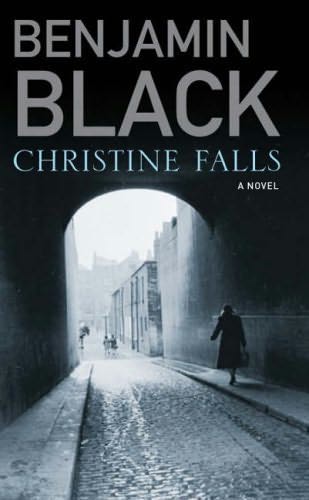
Why buy? A timely question as we approach the holidays during a recession - says the cynic in me. But I do buy. I love the library, but I love the bookstore more. I grew up using the library. I still use it for DVDs of films, for purely recreational reading, like most mysteries or thrillers. I recently read Christine Falls by Benjamin Black aka John Banville. That book came from the library. I don't read all that many mysteries and I don't tend to value most of them for their writing as I do other genres (although that was an exception). I'm just munching on them like snacks; I don't go to them for nourishment. I am planning to try a few novels of John Updike's that were mentioned in a recent review. Some of his earlier books are no longer in print and when I have tried to read his work before - buying a second-hand copy once in a shop - I didn't care for it and ended up re-selling that book. So in trying Updike on for size, I am going to use the library. But if I end up liking what I read, I will more likely buy future Updike novels.

I buy books because I value books and by extension the people who create them. I worked as a theatre artist for 23 years, (and may yet have some more blood in me). I always resented people simply expecting free tickets - do they expect free appointments at the dentist or free groceries? What I do as an artist (even the fun stuff) is serious, deeply considered, full of purpose and at times sacrifice, as is any other worthy pursuit. If my culture values it they should pay for it. That is how we show what we value in the American marketocracy. I love books. I prize what they contain as well as how that is fashioned in both a word-follow-word way and in terms of greater structure, voice, point-of-view. I marvel not just at the talent (whatever that is) that goes into their making, but also at the scholarship, the industry, the persistence, the ingenuity, the pieces of self that go into writing a good one. The people who do that work should be paid for it. So should those whose industry supports the producing and dissseminating of books.

I am curious about the world and am an information junkie. I want the information that most intersects with my interests at hand. I am particularly partial to people and their narratives, so I love fiction, drama, and biography. If I have enjoyed a book and gotten something from it, I want it around me. Partly that is so that I can refer to it again. Some books I might go to again for information, others for comfort, sustenance or inspiration. When I directed theatre and opera I needed Anton Chekhov, Clifford Odets, and Horton Foote around me. When I acted and taught I needed the books of the great acting teachers. I needed the biographies of the great composers, directors and actors whose stories could give me something to aspire to, remind me of what was possible, or what is valuable. They are my context. My history. If I do theatre, I build upon the foundations they laid. But also, I want the simple pleasure of their company. Each book contains a whole world in it. I can look at their spines and smile or sigh as I partake of that world again by reference as I pass.

The variety of my interests and they way I apply my intellect to them is a driving force behind my personality, for better or for worse. In that way my home library is also identity constructing. The books around me are part of the narrative of who I am. They house me, they add certain colors and textures materially to my environment, they lend me support, comfort, and provide the information that my work requires that I have at hand, but if they are my context, they also project that context to anyone who sees them. My house if full of shelves and those shelves are full of books because I am full of what they contain. That is who I am. 'I am large, I contain multitudes.' So said Walt Whitman, and so say the books that surround me.

Tuesday, November 11, 2008

Malcolm Gladwell - guru or parasite? & Is the notion of genes just a lot of baggage?

Malcolm Gladwell (The Tipping Point, Blink) has a new book - Outliers - about what makes a superstar - genes? happenstance? 99% perspiration? Some think he is a pop-psych guru, he thinks he's just a parasite, according to a New York Magazine profile by Jason Zengerle.

Hat tip: Books, Inq.

And speaking of genes, what an awful segue, today's Science Times devotes itself to the subject.

Article on RNA interference - proteins are supposed to be the foundation of what happens in our body. Many proteins are the switch for whether a gene facilitating a certain process is "turned on" or "turned off." Our RNA provides a template for the construction of proteins. This process would not try to destroy proteins once their made but instead would inhibit their formation altogether.

Carl Zimmer writes informatively on The Rest of the Genome, which includes a good primer on terminology you might see tossed around in reading about the latest genetic news in the popular press - genome, chromosome, intron. The article addresses the fact that although the decoding of the genome was announced in 2000, that covered only the parts that carry the information for encoding proteins, leaving nearly 99% of gene as terra incognita. Now what?

Natalie Angier's shorter article is my favorite of the three. She explores the more philosophical side of the subject. If genes don't account for every cell in the body - what does?
Scientists are also learning that many of the gene-free regions of our DNA are far more loquacious than previously believed, far more willing to express themselves in ways that have nothing to do with protein manufacture.
Historian of science, Evelyn Fox Keller says that the language of genes is a holdover from chemistry and physics:
The language is historical baggage...It comes from the expectation that if we could find the fundamental units that make stuff happen, if we could find the atoms of biology, then we would understand the process.

But the notion of the gene as the atom of biology is very mistaken...DNA does not come equipped with genes. It comes with sequences that are acted on in certain ways by cells.
Most of our understanding of science likes to reference common structures. Atomic structure is like the solar system, crystal structure is like tinker toys, and we love to anthropomorphise the mechanisms of pretty much everything in the body. Neurons are said to "talk." The brain's processes are described to resemble thinking. RNA is said to "read" sequences of amino acids encoding proteins. This article says that if we try to reduce a gene to something we already know, we may never understand its complexities.

Sunday, November 9, 2008

Disturbing the universe (Opera - Dr. Atomic by John Adams & Peter Sellars)

American composer John Adams and librettist Peter Sellars have created an unlikely hybrid in Doctor Atomic - an abstract documentary opera on the creation of the atomic bomb. A documentary because it is based on actual occurrences and people. Abstract because while it focuses on the days approaching the testing of the bomb at Los Alamos, it is less a linear story than a collage. It uses projection and sculpture, going back and forth from the daily activities at Los Alamos to the interior monologues of J. Robert Oppenheimer, a leading physicist on the project, and his wife Kitty, and includes two poems - one a sonnet of John Donne's and the other Muriel Rukeyser's Easter Eve 1945. These varied components hang together on a score strongly consistent in temperament and sonority. Opening each of the two acts act is a recorded soundscape evoking the period and atmosphere of those days - bits of radio, sounds of machinery, jeeps driving around the dessert, the thunder storms that plagued the testing schedule. But this gives way to Adams orchestral music, which is brash, solid, evocative and intense. Modern textures mix with beautiful lyrical lines. You know what century you are in and you can feel the disturbance in the universe that is the theme of this work.

The Manhattan Project led to the development of a bomb that worked via the fission of the uranium atom, splitting it into small parts to cause the release of tremendous amounts of energy. Some also call it the birth of “Big Science.” The destructive force of the bomb was meant to be unparalleled, but once unleashed it would literally mean that humans could destroy everything. J. Robert Oppenheim, may have been a leader of the project, but he was also a voice of conscience. Quoting the Bhavagad Gita he wrote “Now, I am become Death, the destroyer of worlds.” Once accomplished, this disturbance in the physical structure of the universe would leave the world a less stable place. While our increased knowledge would facilitate victory in war, it precipitated a world with political and humane problems never before contemplated. Dr. Atomic is a meditation on disturbance at these multiple levels and is beautiful in its sensitive expression of conscience and appropriately unsettling.

The production, directed intelligently by Penny Woolcock, is strong on story-telling. She is master for using people and things on stage to make our progress from event to event clear. There is none of the Met's typical sloppiness and nineteenth century stage clichés of people getting up on boxes to sing solo lines. Stage action was human and necessary. However Ms. Woolcock was less adept in her ability to develop the vertical line of the piece - the point in soliloquoy or aria when time’s literal progress stops and the inner workings of a person’s mind or soul unfolds before us. Here is where theatre engages in a little “quantum physics” of its own, defeating the typical laws and time and space, travelling in a way that memory and imagination allows. In these equally important moments of Dr. Atomic Ms. Woolcock seemed to have left the performers to their own devices. They became unrooted, and frozen in general attitude. It was a shame because the score and libretto in Kitty's Oppenheimer's scene in Act II were crazily inventive and an opportunity for complex internal conflict expressed with challenging music. An Act I scene meant to develop the Oppenheimers relationship, and the only time we see them together, was strangely disconnected and made unimaginative use of a silly choreographed dance rather than having these troubled human creatures connect to their love, or their pain in its absence, their feelings of inadequacy, or their feelings about anything at all. A more thoughtful development of the character of Pasqualita - the Oppenheimers’ housekeeper - might have helped sustain our interest in her long aria that opened Act II. The production seemed to want to use her as a spiritual symbol of the indiginous culture of New Mexico and perhaps stand for the parts of Los Alamos history that were more respectful of nature, but between desultory staging and textual references to vishnu and the trinity, I couldn't figure out what was intended.

Otherwise the production was strongly satisfying. Its physical elements were creative, functional, and a pleasure to look at. The Met chorus was used as an effective narrator and their performance was uncharacteristically precise and energetic. The role of J. Robert Oppenheimer is written with wide ranging emotional and musical tessitura. Gerald Finley's performance was human and involving, and his singing sumptuous. This was particularly apparent in the aria that closed Act I, a setting of John Donne’s Holy Sonnet XIV, chosen because it inspired Oppenheimer to name the bomb test site Trinity. It was the highlight of Dr. Atomic’s lyrical side. The writing of this opera was effective in not burying the story either in the development of technology, or in sentimentality for our lost innocence. The structure of the piece, building to the Trinity test, drummed up tension in the final ten minutes that really made my heart pound. As a whole the opera was thoughtful about human responsibility in the face of our ever increasing knowledge and movingly resonant, even topically so, but not preachy.

Batter my heart, three person'd God; for, you
As yet but knocke, breathe, shine, and seeke to mend;
That I may rise, and stand, o'erthrow mee,' and bend
Your force, to breake, blowe, burn and make me new.
I, like an usurpt towne, to'another due,
Labour to'admit you, but Oh, to no end,
Reason your viceroy in mee, mee should defend,
But is captiv'd, and proves weake or untrue.
Yet, dearely'I love you,' and would be loved faine,
but am betroth'd unto your enemie:
Divorce mee,'untie, or breake that knot againe;
Take mee to you, imprison mee, for I
Except you'enthrall mee, never shall be free,
Nor ever chast, except you ravish mee.

Saturday, November 8, 2008

Thought and language, revenge and alienation (Books - Thought and Language & The Meaning of Night)

Lev Vygotsky was an influential psychological theorist who worked from the 1920s - 1930s in Russia. I know of him only as the mentor of the great neuropsychologist A. R. Luria who wrote the amazing story The Mind of a Mnemonist. This week my advisor loaned me one of Vygotsky's books, Thought and Language, hmm I wonder why I would be interested in that. I've just been reading the introduction by Alex Kozulin which, although it is written pedantically and with an excess of jargon, is the only biography of this fascinating man I know of. Sadly, he worked only 10 years before dying, not in one of Stalin's gulag's - that was my first guess - but of tuberculosis.
A student of literature, philosophy, and esthetics, Vygotsky plunged into psychology at the age of twenty-eight, and died of tuberculosis ten years later. A prodigal reader, he felt equally at home with commentaries on Shakespeare's tragedies, the philosophy of Hegel, and clinical studies of the mentally retarded. A profound theoretician, he was also a man of practise who founded and directed a number of research laboratories, including the first Russian Institute for the Study of Handicapped Children. As Stephen Toulmin so aptly remarked, Vygotsky carried an aura of almost Mozartian giftedness. And yet he lived in times that were hardly favorable to Mozarts.

Evidently he wrote a book in 1925 called The Psychology of Art, as it is about my two intertwined fields and was written our of life in Russia in the 1920s, I have got to get my hands on a copy. Kozulin observes, and I may paraphrase:
Vygotsky never believed that psychological inquiry should be considered as a goal in itself. For him, culture and consciousness constituted the actual subject of inquiry, while psychology remained a conceptual tool, important but hardly universal.

Vygotsky was primarily interested in the development of language in its relation to thought. Language and speech occupy a special place in his s psychological system because they play a double role. On the one hand, they are a psychological tool that helps to form other mental functions; on the other hand, they are one of these functions, which means that they develop in the context of one's culture.

Vygotsky observed that preconceptual, and even mythological thinking not only is characteristic of children and the mentally ill, but also forms the basis of the everyday, normal reasoning of adults.
I need another book to read, as my mother would say, like a hole in the head, but I am finding it fascinating and can comfort myself that it is school related even while I am really just reading it to enjoy myself.

I also began The Meaning of Night by Michael Cox yesterday evening. I needed an entertaining and cozy read and Middlemarch was not going to do it. The hyperbole that grace the cover of this 2-inch-thick paperback compare Cox to Wilkie Collins, Charles Dickens and the Brontes. Cox is a scholar, writer, and editor of literary Victoriana and burst onto the scene with this fictional work of his own a couple of years ago. It skillfully evokes his period of expertise while not falling prey to becomming an exhibit. It is little wonder so many readers have raved about The Meaning of Night if the first fifty pages are any indication.

Take the opening:

After killing the red-haired man, I took myself off to Quinn's for an oyster supper.

It had been surprisingly - almost laughably - easy.

And then a short while later:
For you must understand that I am not a murderer by nature, only by temporary design and necessity - a justified sinner. There was no need to repeat this experimental act of killing I proved what I had set out to prove: the capacity of my will to carry out such a deed. The blameless red-haired stranger had fulfilled his purpose, and I was ready for what now lay ahead.
The budding psychologist in me says, 'yeah, right.' And so Cox establishes the driving force of this mock-Victorian epic of revenge. What I am enjoying most are the rituals Cox has created to seduce you into the world of his tale. The story is couched as an anonymous confession, written in the 1850s but discovered in 1948. It features a 'copy' of the original title page, an 'introduction' by an academic authority on Victoriana, and the story itself is liberally footnoted. While this might break the stream of one's reading to offer contextual information on the one hand, these footnotes, whether truthful or invented, are themselves part of the fictional universe. Its a theatrical framing device - like Bertolt Brecht's alienation effect. Hard core Brechtians might claim otherwise, but I have always found that attention to the artifice is useful in drawing an audience more deeply into the universe of the fiction because, if even the interruptions are part of it, one's belief becomes more imperterbable. It is the opposite of asking the audience to suspend one's disbelief - it rather invites one's belief. "Here is a manuscript," says the author. "Here are the circumstances under which it was discovered. I am the man who found it." This is all fiction. And then, as you read, up pops the frame - "Don't forget that this is a story," say the footnotes, but in the meantime the fact that this is a novel by a contemporary writer named Michael Cox has been buried three layers beneath the artifice of the frame. It is a device I have enjoyed using in my theater and opera productions because it doesn't take the audience's faith in the fictional world for granted and also because if the creator is imaginative, these devices are fun for the audience. This reader is certainly enjoying the way Cox has invited him into the world of The Meaning of Night at any rate.

The Ragazzo and I are off to the Met this afteroon. Doctor Atomic is by contemporary American composer John Adams and is about J. Robert Oppenheimer and the creation of the atom bomb. I've been looking forward to this one.

Friday, November 7, 2008

Living as variously as possible (An Inflorescence - Mark Doty & Frank O'Hara, poets)

In-flo-res-cence - from the Latin inflorescere - to begin to blossom. 1. the producing of blossoms; flowering; 2. the arrangement of flowers on a stem or axis; 3. a flower cluster on a common axis; 4. flowers collectively; 5. a solitary flower, regarded as a reduced cluster.

This Friday sees an abbreviated version of my occasional poetry series An Inflorescence (see my side bar), today featuring contemporary New York poet Mark Doty whose own site I found in a round about way via Books, Inq. a new favorite place.

He has Frank O'Hara's gravestone, pictured on his website, which was reason enough for me to linger

"Grace to be born and live
as variously as possible"

Indeed. I am a rabid O'Hara fan, as you may know - 1, 2, 3, - I have read some of Doty's poems before, but only noticed today in Signal, which he posts in full on his site, how evocative he is of O'Hara. Not in form, Doty is more formal, as in 'adhering to form' as opposed to 'featuring repressed subject matter,' and I like that in a poem. Look at the orderly vertical column of paired lines in Signal.

LOST COCKATIEL, cried the sign, hand-lettered,
taped to the side of a building: last seen on 16th

between Fifth and Sixth, gray body, orange cheek patches,
yellow head. Name: Omar. Somebody's dear, I guess,

though how do you lose a cockatiel on 16th Street?
Flown from a ledge into the sky he's eyed

As with O'Hara, he takes modern colloquial trademarks and plays with them by formalizing them as poetry. Here the abbreviated language one would find in a sign becomes the quick, blunt rhythm of New York City. He "letters" the poem, with caps and italics, as the sign would be lettered - a sort-of meta poetry. His diction is colloquial as is O'Hara's, using phrases like "Not likely" or conjunctions like "everybody's." This poem has two other O'Hara-esque features - one is a sense of humor, though with its own Doty-ish character, being less breathless, more refined, than O'Hara. Here is an excerpt of O'Hara's Steps:
...where's Lana Turner
she's out eating
and Garbo's backstage at the Met
everyone's taking their coat off
so they can show a rib-cage to the rib-watchers
and park's full of dancers with their tights and shoes in little bags
who are often mistaken for worker-outers at the West Side Y
why not
the Pittsburgh Pirates shout because they won
and in a sense we're all winning
we're alive

A little crazy, it sounds like he just ran up a flight of stairs and he's bursting to tell you what he saw, and yet it is soooo good.

The other wonderfully O'Haran thing Doty does in a way totally his own is create accidentalish quality to the language that makes me feel as though he wrote it there on the street on a tiny scrap of paper so he wouldn't forget it. This casualness is belied by both the poem's form, as well as the thoughtful journey it takes (on the subway, actually) but it is one of the features that marks the poem of its time and place - my time, my city - in a way that I adore in O'Hara and and now in Mark Doty's work too. The poem is inherently readable and there is pleasure in appreciating its surface qualities. Yet, if you do a little work, it reveals more - complexities of structure, word play, urban images, artistic references... all sorts of fun. Dive in if you're game. Here's the whole poem.

Happy Friday. I'm off to an exam on neurotransmitters.

Thursday, November 6, 2008

Bookish Gifts

btt button
What, if any, memorable or special book have you ever gotten as a present? Birthday or otherwise. What made it so notable? The person who gave it? The book itself? The “gift aura?


Four immediately flew to mind. For my graduation from college, one of my housemates (still a close friend) gave me a second-hand, two volume set of Jane Eyre and Wuthering Heights. They are a large format, hardcover 1943 edition, illustrated, with the text in two columns on the page, pictured above. Lovely books, very substantial, curl-up-by-the-fire editions. One of my other housemates gave me my Riverside complete Shakespeare, which I still treasure. The third was Sheila's gift to me of Chris van Allsberg's The Mysteries of Harris Burdick. I loooove this book. It is in a large, children's book format and consists of black and white drawings which are of identifiable things - people, objects, a ship, etc... - but their content is provocatively ambiguous. On the facing page is a single sentence, adding mystery rather than clarity. They are wonderful to read before going to sleep - great dream fodder - but my main use of them has been for various structured improvisation exercises with my acting students over the years. I have traveled everywhere with this book. It's dust jacket is now, well, dust, and the binding is all torn up. A well-loved favorite. Finally, one of the first presents The Ragazzo gave me was a soft-cover copy of Arturo Perez-Reverte's The Flander's Panel, which I think I had already owned but hadn't read. So now, of course, I have two copies. His early mysteries are great fun.

Wednesday, November 5, 2008

America makes good on its promissory note

As regular readers know, I don't do politics here, but I will do a little history followed by a little psychology. Our economy may be in the pits but Dr. Martin Luther King's promissory note may have finally been honored with the election of Barak Obama. The bank of justice is not bankrupt. From I have a dream... to this in forty-five years. The reason I think it bodes well for my country is not because Democrats have defeated Republicans, but because Americans showed that they can adapt as the world becomes different. I don't think anyone should wait that long for equal treatment under the law, especially here, but history is probably not on my schedule. We did not change easily, nor did we change quickly but we did adapt and change - that is one of the chief indicators of psychological health. It gives me hope of other changes to come. "We cannot turn back."

Here is Dr. King's 1963 speech, how does it read to you today?

I am happy to join with you today in what will go down in history as the greatest demonstration for freedom in the history of our nation.

Five score years ago, a great American, in whose symbolic shadow we stand today, signed the Emancipation Proclamation. This momentous decree came as a great beacon light of hope to millions of Negro slaves who had been seared in the flames of withering injustice. It came as a joyous daybreak to end the long night of their captivity.

But one hundred years later, the Negro still is not free. One hundred years later, the life of the Negro is still sadly crippled by the manacles of segregation and the chains of discrimination. One hundred years later, the Negro lives on a lonely island of poverty in the midst of a vast ocean of material prosperity. One hundred years later, the Negro is still languished in the corners of American society and finds himself an exile in his own land. And so we've come here today to dramatize a shameful condition.

In a sense we've come to our nation's capital to cash a check. When the architects of our republic wrote the magnificent words of the Constitution and the Declaration of Independence, they were signing a promissory note to which every American was to fall heir. This note was a promise that all men, yes, black men as well as white men, would be guaranteed the "unalienable Rights" of "Life, Liberty and the pursuit of Happiness." It is obvious today that America has defaulted on this promissory note, insofar as her citizens of color are concerned. Instead of honoring this sacred obligation, America has given the Negro people a bad check, a check which has come back marked "insufficient funds."

But we refuse to believe that the bank of justice is bankrupt. We refuse to believe that there are insufficient funds in the great vaults of opportunity of this nation. And so, we've come to cash this check, a check that will give us upon demand the riches of freedom and the security of justice.

We have also come to this hallowed spot to remind America of the fierce urgency of Now. This is no time to engage in the luxury of cooling off or to take the tranquilizing drug of gradualism. Now is the time to make real the promises of democracy. Now is the time to rise from the dark and desolate valley of segregation to the sunlit path of racial justice. Now is the time to lift our nation from the quicksands of racial injustice to the solid rock of brotherhood. Now is the time to make justice a reality for all of God's children.

It would be fatal for the nation to overlook the urgency of the moment. This sweltering summer of the Negro's legitimate discontent will not pass until there is an invigorating autumn of freedom and equality. Nineteen sixty-three is not an end, but a beginning. And those who hope that the Negro needed to blow off steam and will now be content will have a rude awakening if the nation returns to business as usual. And there will be neither rest nor tranquility in America until the Negro is granted his citizenship rights. The whirlwinds of revolt will continue to shake the foundations of our nation until the bright day of justice emerges.

But there is something that I must say to my people, who stand on the warm threshold which leads into the palace of justice: In the process of gaining our rightful place, we must not be guilty of wrongful deeds. Let us not seek to satisfy our thirst for freedom by drinking from the cup of bitterness and hatred. We must forever conduct our struggle on the high plane of dignity and discipline. We must not allow our creative protest to degenerate into physical violence. Again and again, we must rise to the majestic heights of meeting physical force with soul force.

The marvelous new militancy which has engulfed the Negro community must not lead us to a distrust of all white people, for many of our white brothers, as evidenced by their presence here today, have come to realize that their destiny is tied up with our destiny. And they have come to realize that their freedom is inextricably bound to our freedom.

We cannot walk alone.

And as we walk, we must make the pledge that we shall always march ahead.

We cannot turn back.

There are those who are asking the devotees of civil rights, "When will you be satisfied?" We can never be satisfied as long as the Negro is the victim of the unspeakable horrors of police brutality. We can never be satisfied as long as our bodies, heavy with the fatigue of travel, cannot gain lodging in the motels of the highways and the hotels of the cities. We cannot be satisfied as long as the negro's basic mobility is from a smaller ghetto to a larger one. We can never be satisfied as long as our children are stripped of their self-hood and robbed of their dignity by a sign stating: "For Whites Only." We cannot be satisfied as long as a Negro in Mississippi cannot vote and a Negro in New York believes he has nothing for which to vote. No, no, we are not satisfied, and we will not be satisfied until "justice rolls down like waters, and righteousness like a mighty stream."

I am not unmindful that some of you have come here out of great trials and tribulations. Some of you have come fresh from narrow jail cells. And some of you have come from areas where your quest -- quest for freedom left you battered by the storms of persecution and staggered by the winds of police brutality. You have been the veterans of creative suffering. Continue to work with the faith that unearned suffering is redemptive. Go back to Mississippi, go back to Alabama, go back to South Carolina, go back to Georgia, go back to Louisiana, go back to the slums and ghettos of our northern cities, knowing that somehow this situation can and will be changed.

Let us not wallow in the valley of despair, I say to you today, my friends.

And so even though we face the difficulties of today and tomorrow, I still have a dream. It is a dream deeply rooted in the American dream.

I have a dream that one day this nation will rise up and live out the true meaning of its creed: "We hold these truths to be self-evident, that all men are created equal."

I have a dream that one day on the red hills of Georgia, the sons of former slaves and the sons of former slave owners will be able to sit down together at the table of brotherhood.

I have a dream that one day even the state of Mississippi, a state sweltering with the heat of injustice, sweltering with the heat of oppression, will be transformed into an oasis of freedom and justice.

I have a dream that my four little children will one day live in a nation where they will not be judged by the color of their skin but by the content of their character.

I have a dream today!

I have a dream that one day, down in Alabama, with its vicious racists, with its governor having his lips dripping with the words of "interposition" and "nullification" -- one day right there in Alabama little black boys and black girls will be able to join hands with little white boys and white girls as sisters and brothers.

I have a dream today!

I have a dream that one day every valley shall be exalted, and every hill and mountain shall be made low, the rough places will be made plain, and the crooked places will be made straight; "and the glory of the Lord shall be revealed and all flesh shall see it together."

This is our hope, and this is the faith that I go back to the South with.

With this faith, we will be able to hew out of the mountain of despair a stone of hope. With this faith, we will be able to transform the jangling discords of our nation into a beautiful symphony of brotherhood. With this faith, we will be able to work together, to pray together, to struggle together, to go to jail together, to stand up for freedom together, knowing that we will be free one day.

And this will be the day -- this will be the day when all of God's children will be able to sing with new meaning:

My country 'tis of thee, sweet land of liberty, of thee I sing.

Land where my fathers died, land of the Pilgrim's pride,

From every mountainside, let freedom ring!

And if America is to be a great nation, this must become true.

And so let freedom ring from the prodigious hilltops of New Hampshire.

Let freedom ring from the mighty mountains of New York.

Let freedom ring from the heightening Alleghenies of Pennsylvania.

Let freedom ring from the snow-capped Rockies of Colorado.

Let freedom ring from the curvaceous slopes of California.

But not only that:

Let freedom ring from Stone Mountain of Georgia.

Let freedom ring from Lookout Mountain of Tennessee.

Let freedom ring from every hill and molehill of Mississippi.

From every mountainside, let freedom ring.

And when this happens, when we allow freedom ring, when we let it ring from every village and every hamlet, from every state and every city, we will be able to speed up that day when all of God's children, black men and white men, Jews and Gentiles, Protestants and Catholics, will be able to join hands and sing in the words of the old Negro spiritual:

Free at last! Free at last!

Thank God Almighty, we are free at last!
Tuesday, November 4, 2008

"Curiosity did not kill this cat." - Studs Terkel

We voted at 6:45 this morning and there were lines already. People are passionate about voting in a way I can't remember seeing since McGovern vs. Nixon in 1972. Turned on the radio on returning and there were not just the expected exit polls, but also exit stories - people speaking of what was happening at their polling place or who they voted for. It seemed a fitting tribute for Studs Terkel who died just a few days ago at 96 years of age. Terkel was a Chicago radio broadcaster and the Pulitzer Prize winning oral historian of America. He collected the stories not just of the illustrious, but of the common man (or woman), starting with his book Working in 1974. It told the stories of America's workers, how they ended up with the job they had and what their working life was like, or really more than that - how it felt to do the work they did. It was later turned into a decent but somewhat pedestrian musical. I tried to find a link to a song or two on YouTube, but it was all tinny-sounding home videos of high school productions. Terkel collected stories on many themes of American life throughout the century - the Depression, the so-called American dream, World War II, race, faith, and aging. I think of his work as the inspiration for Story Corps, the booths that have popped up around America, where folks can tell friends or family their story, preserve and archive it. He made the collecting of the stories of ordinary people a serious pursuit. I see narrative as central to the human condition in more than one way. For one thing, it is the way that the bunch of cells called our 'brain' makes up that construct we call our 'mind.' I am a devotee of the value of the narrative for building and mainting a healthy self as well as for sharing the essence of one's self with others, which is the ways bonds are forged between people in families, friendships, and society at-large. Studs was a monument to the value of having simple curiosity in other people. A most admirable and respectable trait. As he put it, "curiosity did not kill this cat."

I link to Studs's own site above on his name, it has a bio and radio clips, as well as summaries of his books. Here are obits from The Guardian, BBC, The Chicago Tribune, and The Times.

Monday, November 3, 2008

Worldly readers...

I got one of those little map thingies (see side bar). I thought it would be fun to see where you all came from (it was). It looks like I have a little work to do on Greenland, The Congo, and Kamchatka.

DFW

A wonderful, painful remembrance of David Foster Wallace - his struggles with writing, with meaning something, and with depression - from Rolling Stone by David Lipsky.

Hat tip: Judith Fitzgerald at Books, Inq.

Sunday, November 2, 2008

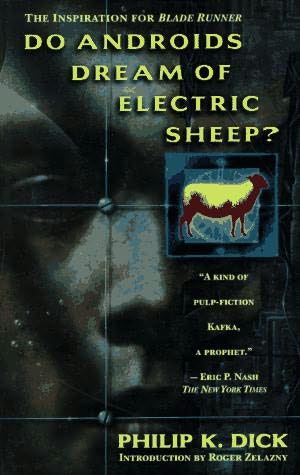
Remembering electric sheep (Books - Do Androids Dream of Electric Sheep by Philip K. Dick)

Following my re-read of Flow My Tears, The Policeman Said just a few weeks ago, I decided to give another of Philip K. Dick's books a second look and began Do Androids Dream of Electric Sheep before going to sleep. If the man could do nothing else, he can sure come up with a title. This 1968 sci-fi thriller is set in what is now the not so distant future, 2021. Post apocalyptic earth is littered with fallout and houses only the portion of the human race that has not emigrated to other planets. In addition, there is a race of androids and our hero, Rick, has been hired to "retire" some of them.

Two features of Dick's imagined future stand out to me - Rick and his wife each have something called a Mood Organ, on which one can dial-up to regulate ones hormones and neurotransmitters to produce a specific mood either on-order, or one can pre-program a schedule.
"I'll dial what's on my schedule for today." Examining the schedule for January 3, 2021, he saw that a businesslike professional attitude was called for. "If I dial by schedule" he said warily, "Will you agree to also?" He waited, canny enough not to commit himself until his wife had agreed to follow suit.

"My schedule for today lists a six-hour self-accusatory depression," Iran said.

"What? Why did you schedule that?" It defeated the whole purpose of the mood organ. "I didn't even know you could set it for that," he said gloomily.

"I was sitting here one afternoon," Iran said, "and naturally I had turned on Buster Friendly and His Friendly Friends and he was talking about a big new item he's about to break and then that awful commercial came one, the one I hate; you know, for Mountibank Lead Codpieces. And so for a minute I shut off the sound...At that moment," Iran said, "When I had the TV sound off, I was in a 382 mood; I had just dialed it. So although I heard the emptiness intellectually, I didn't feel it. My first reaction consisted of being grateful the we could afford a Penfield mood organ. But then I realized how unhealthy it was, sensing the absence of life, not just in this building but everywhere, and not reacting - do you see? I guess you don't. But that used to be considered a sign of mental illness; they called it 'absence of appropriate affect.' So I left the TV sound off and I sat down at my mood organ and I experimented. And I finally found a setting for despair." Her dark, pert face showed satisfaction, as if she had achieved something of worth. "So I put it on my schedule for twice a month; I think that's a reasonable amount of time to feel hopeless about everything, about staying here on Earth after everybody who's smart has emigrated, don't you think?"
Mental illness was on of Dick's obsessions as a writer. As I mentioned in my review of Flow My Tears... Dick may be imagining the future, but his real subject is his own present. Mood altering drugs were less sophisticated in the 1960s but no less available. There were accepted varieties for one class - Valium, alcohol, nicotine, barbiturates - and a different sort for those outside the mainstream - marijuana, LSD, etc... And complete control of one's every mood seemed not such a stretch, for a future 50 years hence. Indeed, today we can and do control mood and consciousness with drugs ever more subtly. In some ways this is much to our advantage - better anesthetics, better drugs for schizophrenia and depression. And in others there are still those of us who are harboring fantasies of being cured of all feeling and any difference we have from others.

The second feature of Dick's imagined 2021 I was struck by was his version of keeping up with the Joneses. It consists not of coveting thy neighbor's car or television but instead, their animals. In his imagined world, people aspired to own animals - people of means owning the larger farm animals and letting them graze on the roofs of their skyscrapers. Those who could not afford a horse or sheep, could either settle for ordering a mouse or a cricket, or they could purchase android animals (hence the 'electric sheep' of the title).

This novel was adapted for the Ridley Scott film Blade Runner. This is my second reading of the novel and I saw the film as well, but right now I am not remembering very many specifics of the plot, although I have some vague hints. Perhaps we could work on those drugs for memory...

Not writing about the writing life (Books - Old School by Tobias Wolff)

What I like about getting to turn the clock back (literally, not figuratively) is that it was light out when I woke up, that there's Darjeeling in the pot, fruit and cereal in a bowl, I'm at my desk writing on a Sunday morning, and it's not yet 7.

I don't want to add too much more to my previous comments (here and here) about Tobias Wolff's novel Old School, because I don't want to ruin it for those who haven't yet read it, just to say that it is a marvelous book about how a formative experience in prep school was the making of a writer, and why that matters. Although Wolff would say:
The life that produces writing can't be written about. It is a life carried on without the knowledge even of the writer, below the mind's business and noise, in deep unlit shafts where phantom messengers struggle toward us, killing one another along the way; and when a few survivors break through to our attention they are received as blandly as waiters bringing more coffee.
After the retrospective events there is an epilogue which, unfortunately, I found much less interesting than the body of the story. It was as if there was a whole other story to tell, and yet it is relegated to an afterthought to this one. I was left dissatisfied by this epilogue despite the fact that its relationship to the events of the story-proper is crucial. That fact notwithstanding, this is a passionate book about the value of writing and is told in a way that gives one the feeling that it must be true. I still recommend it strongly.

Saturday, November 1, 2008

Ventriloquism, fractals, and the dying gasps of Camelot (Books - Old School by Tobias Wolff)

Tobias Wolff's Old School is a literature lover's dream. I am about three-quarters of the way through this wonderful novel after only a single sitting. It is set at a fancy boys' prep school in 1960, right after the election of JFK. It is narrated retrospectively from the point of view of a former scholarship student and aspiring writer. His school frequently invites famous writers as guest speakers. It gives talented upper-classmen the opportunity to compete for one meeting with the guest by submitting their own writing, which will be judged by the writer.
If the school had a snobbery it would confess to, this was its pride in being a literary place...Dean Makepiece had been a friend of Hemmingway's during World War I and was said to have served as the model for Jake's fishing buddy Bill in The Sun Also Rises. The other English masters carried themselves as if they too were intimates of Hemmingway, and also of Shakespeare and Hawthorne and Donne. These men seemed to us a kind of chivalric order. Even boys without bookish hopes aped their careless style of dress and the ritual swordplay of their speech. And at the headmaster's monthly teas I was struck by the way other masters floated at the fringe of their circle, as if warming themselves at a fire.

How did they command such deference - English teachers? Compared to the men who taught physics or biology, what did they really know of the world? It seemed to me, and not only to me, that they knew exactly what was most worth knowing. Unlike our math and science teachers, who modestly stuck to their subjects, they tended to be polymaths. Adept as they were at dissection, they would never leave a poem or a novel strewn about in pieces like some butchered frog reeking of formaldehyde. They'd stitch it back together with history and psychology, philosophy, religion, and even, on occassion, science. Without pandering to yoru presumed desire to identify with the hero of a story, they made you feel that what mattered to the writer had consequence for you, too.

With his preferences clearly stated, Wolff has set the stage for not only a story about the forming of young souls, but also for some enjoyable literary ventriloquism - first in the writing of the young contestants and later in the spoken words of the visitng writers, all actual literary giants - Robert Frost, Ayn Rand, and, although I haven't gotten to that part yet, Ernest Hemmingway.

Here he writes as Bill White, the narrator's roommate - a Jewish student trying to pass for gentile - and his competition for meeting poet Robert Frost. White has already written most of a novel:
Have to take my hat off to you, said Montague. Tricky bit of tradecraft, given the circumstances. Storm blowing the damned tent down, and the geaters into the liquor. I shan't forget it.

Not al all, not at all, said Dr. Coates. The merest intern could have done as well - probably better.

I shan't forget it, Montague repeated. I'm forever in your debt, he added coldly.

Aren't we all, said Ashley, pouring herself another scotch. She stared at the falling snow. Whatever would we do withouth the good doctor's services?

You bitch, said Montague. You perfectly beautiful bitch.

As our narrator observes

... Bill was a contender. His characters were stiled but he had confidence and his storeis were eventful and closely detailed... Bill's talent was particularity. How the snow creaked underfoot on a very cold clear day, or what the low white sun looked like though a tangle of black branches. The tackiness of a just-oiled rifle stock, the tearing sound of a bored woman brushing out her long hair in front of a fire. Everything in his work was particular and true except the people.

Wolff gets obvious pleasure in this novel from role playing as different sorts of writers in this book, and then discussing everything from the mechanics to the value of such writing. But better than that, he wholly integrates those discussions into the larger intention of the book, which (at this point) seems to be a discussion of the value of literature in general and the coming-of-age of young literary minds and spirits in a changing world.

In a particularly enjoyable section of the novel, the winner of the Robert Frost competition is a surprise, having written a slavish immitation of their guest and entitled it First Frost. In it, a farmer contemplates death as au tumn approaches. While the students closest to the young poet know the poem to be a naive aping, Frost interprets it as a roguish take-off on himself. This perpetuates a discussion between two of them as to whether the meaning of a piece of writing is contained in the writer's intentions or the reader's interpretation:
George's poem isn't that bad, I said, if you read it a certain way.
As a take-off, you mean.
Right, as a take-off.
But it isn't a take-off.
It could be. That's how Frost read it.
But it isn't. And you know that.
It doesn't matter what I know.
Bullshit.
It doesn't. Let's say you find a bottle. You're walking on the beach and you find George's poem in a bottle. You don't know anything about the person who wrote it, you just have the poem. You'd probably read it as a take-off.

Frost's visit occassions the asking of a provocative question by one faculty member as to:
...whether such a rigidly formal arrangement of language is adequate to express the modern consciousness. That is, should form give way to more spontaneous modes of expression, event at the cost of a certain disorder?

Modern consciousness, Frost said. What's that?

Ah! Good question, sir. Well - very roughly speaking, I would describe it as the mind's response to industrialization, the saturation propaganda of governments and advertisers, two world wars, the concentration camps, the dimming of faith by science, and of course the constant threat of nuclear anihilation. surely these things have had an effect on us. Surely they have changed our thinking.

Surely nothing. Frost stared down at Mr. Ramsey.

If this had been the Last Judgment, Mr. Ramsey and his modern consciousness would've been in for a hot time of it. He couldn't have looked more alone, standing there.

Don't tell me about science, Frost said. I'm something of a scientist myself. Bet you didn't know that. Botany. You boys know what tropism is, it's what makes a plant grow toward the light. You don't have to chase down a fly to get rid of it - you just darken the room, leave a crack of light in a window, and out he goes. Works every time. We all have that instinct, that aspiration. Science can't - what was your word? dim? science can't dim that. All science can do is turn out the false lights so the true light can get us home.

Mr. Ramsey began to say something, but Frost kep t going.

So don't tell me about science, and don't tell me about war. I lost my nearest friend in the one they call the Great War. So did Achilles lose his friend in war, and Homer did no injustice to his grief by writing about it in dactylic hexameters. There've always been wars, and they've always been as foul as we could make them. It is very fine and pleasant to think ourselves the most put upon folk in history - but then everyone has thought that from the beginning. It makes a grand excuse for all manner of laziness.

But about my friend. I wrote a poem for him. I still write poems for him. Would you honor your own friend by putting words down anyhow, just as they come to you - with no thought for the sound they make, the meaning of their sound, the sound of their meaning? Would that give a true account of the loss?

Frost had been looking right at Mr. Ramsey as he spoke. Now he broke off and let him eyes roam over the room.

I am thinking of Achilles' grief, he said. That famous, terrible, frief. Let me tell you boys something. Such grief can only be told in form. Maybe it only really exists in form. Form is everything. Without it you've got nothing but a stubbed-toe cry - sincere, maybe, for what that's worth, but with no depth or carry. No echo. You may have a grievance but you do not have grief and grievances are for petitions, not poetry.
If I may butt in here. First, the question itself, is full of such wonderful assumptions - many of us would have our own, perhaps somewhat different list 48 years later, and would have as many questions about how the tension between form and content would address the issues on our mind today. On the one hand Frost's answer is beautiful, an ode to form, but one might say it is a defensive ode. That Frost, the old poet, was a man of yesteryear in the year that JFK took the office of president (even though he spoke at the innauguration) and that the work of Ginsburg or Kenneth Koch or Frank O'Hara were not free of form, nor was there an absence of thought given to the relationship between sound and meaning. But Frost could not see this new form as form, so different was it from what he was used to. It's like the structures observed in nature which we initially could only see as chaotic, but which higher mathematics now describes as a recursive pattern it has called a fractal. And this speaks to the even larger picture Wolff is painting not just of form and content in literature, but in our lives. He was writing in an age when the superiority of the prep school and Harvard, the good ol' boy network, segregation, rituals of debutante balls - familiar forms - were having to give way to new forms. And this struggle isn't over yet.

I really admire how the smaller discussion of writing and its value, and the amusement of the way Wolff asumes the characters of Frost and, later, Ayn Rand, combine with the larger mission of observing a changing world - hearing the dying gasps of Camelot. I have a bit further to go, but I am finding the marriage of the writing and the observations on an individual character and a societal level really satisfying. I have a full day of school work before me, but I hope to finish Old School before the weekend is out.

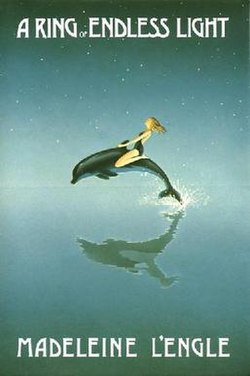
The road to hell... (Books - A Ring of Endless Light by Madeleine L'Engle)

I've given up on Madeleine L'Engle's A Ring of Endless Light after 80 pages. Chalk it up to my not being or having been an adolescent girl, or chalk it up to her brand of spirituality which, although tame in itself, is always worn on her sleeve in a way I simply find aggressive - the plots in her books are constantly veering off in directions that will give adults opportunities to give the kids religious life lessons in the most baldly didactic fashion - but most of all it is because these lessons are delivered as such milky platitudes. I swear, in the space of about three pages we got:

If we knew each morning that there was going to be another morning, and on and on and on, we'd tend not to notice the sunrise, or hear the birds...

I like the old adage that we should live each day as though were going to live forever, and as though we were going to die to morrow.

Zachary doesn't have much joy. But neither do - did his parents. All that money - and they used it to spoil him rotten, not to love him. Poor little rich boy, eh?

I think we're given strength for what we have to carry. What I question is whether or not this burden is meant for you.

I do know that we're not good, and there's a lot of truth to the saying that the road to hell is paved with good intentions.
... and, evidently, endless cliches. I never knew there were so many. I grant that this book is paved with good intentions as well, but too many of them packed for public display side by side for my taste. A little character development might have been nice. We know 'Grandfather' is dying and that he is good as good can be, but who the hell is he? And what does he do all day besides sit around trying to leave no cliche unspoken to his grandkids? If you are actually going to offer wisdom, it might help to have an in-depth discussion rather than skim the surface with bon mots. The Austin family, for all its supposed goodness, does very little in the way of talking about other people that is not about passing judgment on whether they are living in ways that are up to the Austin's expectations of what is good or what is right. Can't do it - sorry, Sheila. I'm sure Sheila probably has a very different take on this book, for anyone who is interested in a more positive take on it.

Friday, October 31, 2008

Nevermore! (Edgar Allen Poe's The Raven)


This post was a hit last Halloween, so I thought I would re-run it. A classic by the original American horror writer, Edgar Allen Poe. You can read The Raven below or listen to Garrison Keillor read it, in fact, listen to his whole Halloween show, or watch the Vincent Price video at the bottom of the Wikipedia link, or the Simpson's episode. Anyway you get your dose, it's great fun. This is the original version with the original spelling.


Once upon a midnight dreary, while I pondered, weak and weary,
Over many a quaint and curious volume of forgotten lore,
While I nodded, nearly napping, suddenly there came a tapping,
As of some one gently rapping, rapping at my chamber door.
"'Tis some visiter," I muttered, "tapping at my chamber door --
Only this, and nothing more."
Ah, distinctly I remember it was in the bleak December,
And each separate dying ember wrought its ghost upon the floor.
Eagerly I wished the morrow; -- vainly I had tried to borrow
From my books surcease of sorrow -- sorrow for the lost Lenore --
For the rare and radiant maiden whom the angels name Lenore --
Nameless here for evermore.


And the silken sad uncertain rustling of each purple curtain
Thrilled me -- filled me with fantastic terrors never felt before;
So that now, to still the beating of my heart, I stood repeating
"'Tis some visiter entreating entrance at my chamber door --
Some late visiter entreating entrance at my chamber door; --
This it is, and nothing more."
Presently my soul grew stronger; hesitating then no longer,
"Sir," said I, "or Madam, truly your forgiveness I implore;
But the fact is I was napping, and so gently you came rapping,
And so faintly you came tapping, tapping at my chamber door,
That I scarce was sure I heard you " -- here I opened wide the door; ----
Darkness there and nothing more.
Deep into that darkness peering, long I stood there wondering, fearing,
Doubting, dreaming dreams no mortal ever dared to dream before;
But the silence was unbroken, and the darkness gave no token,
And the only word there spoken was the whispered word, "Lenore!"
This I whispered, and an echo murmured back the word, "Lenore!" --
Merely this, and nothing more.


Then into the chamber turning, all my soul within me burning,
Soon I heard again a tapping somewhat louder than before.
"Surely," said I, "surely that is something at my window lattice;
Let me see, then, what thereat is, and this mystery explore --
Let my heart be still a moment and this mystery explore;--
'Tis the wind and nothing more!"
Open here I flung the shutter, when, with many a flirt and flutter,
In there stepped a stately raven of the saintly days of yore;
Not the least obeisance made he; not an instant stopped or stayed he;
But, with mien of lord or lady, perched above my chamber door --
Perched upon a bust of Pallas just above my chamber door --
Perched, and sat, and nothing more.


Then this ebony bird beguiling my sad fancy into smiling,
By the grave and stern decorum of the countenance it wore,
"Though thy crest be shorn and shaven, thou," I said, "art sure no craven,
Ghastly grim and ancient raven wandering from the Nightly shore --
Tell me what thy lordly name is on the Night's Plutonian shore!"
Quoth the raven "Nevermore."
Much I marvelled this ungainly fowl to hear discourse so plainly,
Though its answer little meaning -- little relevancy bore;
For we cannot help agreeing that no sublunary being
Ever yet was blessed with seeing bird above his chamber door --
Bird or beast upon the sculptured bust above his chamber door,
With such name as "Nevermore."


But the raven, sitting lonely on the placid bust, spoke only
That one word, as if his soul in that one word he did outpour.
Nothing further then he uttered -- not a feather then he fluttered --
Till I scarcely more than muttered "Other friends have flown before --
On the morrow he will leave me, as my hopes have flown before."
Quoth the raven "Nevermore."
Wondering at the stillness broken by reply so aptly spoken,
"Doubtless," said I, "what it utters is its only stock and store
Caught from some unhappy master whom unmerciful Disaster
Followed fast and followed faster so when Hope he would adjure --
Stern Despair returned, instead of the sweet Hope he dared adjure --
That sad answer, "Never -- nevermore."
But the raven still beguiling all my sad soul into smiling,
Straight I wheeled a cushioned seat in front of bird, and bust and door;
Then, upon the velvet sinking, I betook myself to linking
Fancy unto fancy, thinking what this ominous bird of yore --
What this grim, ungainly, ghastly, gaunt and ominous bird of yore
Meant in croaking "Nevermore."
This I sat engaged in guessing, but no syllable expressing
To the fowl whose fiery eyes now burned into my bosom's core;
This and more I sat divining, with my head at ease reclining
On the cushion's velvet lining that the lamp-light gloated o'er,
But whose velvet violet lining with the lamp-light gloating o'er,
She shall press, ah, nevermore!


Then, methought, the air grew denser, perfumed from an unseen censer
Swung by Angels whose faint foot-falls tinkled on the tufted floor.
"Wretch," I cried, "thy God hath lent thee -- by these angels he hath sent thee
Respite -- respite and nepenthe, from thy memories of Lenore;
Let me quaff this kind nepenthe and forget this lost Lenore!"
Quoth the raven "Nevermore."
"Prophet!" said I, "thing of evil! -- prophet still, if bird or devil! --
Whether Tempter sent, or whether tempest tossed thee here ashore,
Desolate yet all undaunted, on this desert land enchanted --
On this home by Horror haunted -- tell me truly, I implore --
Is there -- is there balm in Gilead? -- tell me -- tell me, I implore!"
Quoth the raven "Nevermore."
"Prophet!" said I, "thing of evil -- prophet still, if bird or devil!
By that Heaven that bends above us -- by that God we both adore --
Tell this soul with sorrow laden if, within the distant Aidenn,
It shall clasp a sainted maiden whom the angels name Lenore --
Clasp a rare and radiant maiden whom the angels name Lenore."
Quoth the raven "Nevermore."
"Be that word our sign in parting, bird or fiend!" I shrieked, upstarting --
"Get thee back into the tempest and the Night's Plutonian shore!
Leave no black plume as a token of that lie thy soul hath spoken!
Leave my loneliness unbroken! -- quit the bust above my door!
Take thy beak from out my heart, and take thy form from off my door!"
Quoth the raven "Nevermore."
And the raven, never flitting, still is sitting, still is sitting
On the pallid bust of Pallas just above my chamber door;
And his eyes have all the seeming of a demon that is dreaming,
And the lamp-light o'er him streaming throws his shadow on the floor;
And my soul from out that shadow that lies floating on the floor
Shall be lifted -- nevermore!

Happy Halloween.

Wednesday, October 29, 2008

On Delaying gratification (Books - A Ring of Endless Light by Madeleine L'Engle & Old School by Tobias Woolf)

There is nothing like an enticing first paragraph.
Robert Frost made his visit in November of 1960, just a week after the general election. It tells you something about our school that the prospect of his arrival cooked up more interest than the contest between Nixon and Kennedy, which for most of us was no contest at all. Nixon was a straight arrow and a scold. If he'd been one of us we would have glued his shoes to the floor. Kennedy, thought - here was a warrior, an ironist, terse and unhysterical. He had his clothes under control. His wife was a fox. And he read and wrote books, one of which, Why England Slept, was required reading in my honors history seminar. We recognized Kennedy; we could still see in him the boy who would have been a favorite here, roguish and literate, with that almost formal insouciance that both enacted and discounted the fact of his class.

If I didn't know the setting of Tobias Wolff's Old School was a boarding school, I would still have pegged the narrator for an adolescent male and I still would have been hot to read it for its diction, and a tone that seems elegiac for a time gone by. So, why then am I reading A Ring of Light one of Madeleine L'Engle's Austin Family Chronicles series? Especially with all of her religiosity hanging out all over the place? Well, I swore I would read another of L'Engle's books since Sheila (who has a great post on Diner today, one of my favorite movies) enjoys her so much. She is very imaginative. It moves very quickly. I read twenty-five pages last night in under fifteen minutes. And the introduction, written by L'Engle's granddaughters has this to say:
All of Madeliein's writing, fiction and nonfiction, was an example of how all narrative is fiction, and all fiction can be true. She wrote and lectured extensively on the difference between truth and fact, arguing that it is through story that we human beings approach the truth, not through facts; which can only get us so far. As her granddaughters, this was both liberating and confusing...
I am crazy about narrative and its function and so was taken with the introduction. I almost even agree with it, except to say that I think that we human beings approach not truth itself, but rather the feeling of truth, and that that is an important distinction. But as I weighed these two books in my hands last night, reading a page here and a page there, there is nothing particularly impressive about her writerly skills displayed in the early pages of this book, but her writing has a warmth and she renders the messiness of being in a family with verissimilitude. I also had a feeling that I would really like Old School, so I delayed reading it so that I can look forward to it. Is that daft or do you know what I mean?

Tuesday, October 28, 2008

Lilting, melodic anti-mystery (Books - Christine Falls by Benjamin Black aka John Banville)

The ending of Benjamin Black's (aka John Banville's) anti-mystery, Christine Falls, did not disappoint.
He was angry again, he was not sure why, exactly, for what he had learned from Sister Anselm had not been news to him, not really. He had begun to consider the possibility that this unfocused anger would be the condition of his life from now on, that he would have to keep bouncing along before it helplessly forever, like a piece of litter buffeted by an unceasing wind.
A detective who is not really a detective, who investigates a crime, or possibly just an accident, that resulted from a wrong-doing he suspects his brother to have committed, but that man is not really his brother. I enjoyed the fact that somehow, even in this anti-mystery, the final scenes are set at a manor house with all the suspects present, but there is no denouement scene, with the detective gathering everyone in the drawing room. Rather, they gather without him as he watches from the distance.
He watched them gathering, and followed them into the drawing rom, where the funeral meats were set out, and as he listened to the hubbub of their mingled and clashing voices, a sense almost of physical revulsion welled up in him. These were the people who had killed Christine Falls and her child, who had sent the torturers after Doly Moran, who had ordered that he be thrown down those slimed steps and kicked and beaten to within an inch of his life. Oh, not all of them; no doubt there were those among them who were innocent, innocent of these particular crimes, at least. And he, how innocent was he? What right did he have to stand upon a height and look down on them, he who had not even found the courage to...
Here the real conundrum is moral ambiguity and the fact that this anti-detective is in some way connected to all the dirty business involving pregnant Catholic women and their babies. In this anti-mystery, the story is all caught up not in events but in character, and Quirke, our anti-detective is, like many John Banville characters, a ruminative man. The mystery is an interesting one, sure, but not so interesting as its affect on Quirke. That is the meat of Black-Banville's book. That and the precise, sad, and melodic prose of a crack writer.
She told him, in that wispy voice she had developed lately, that sounded as if it was wearing out and would soon be just a sort of sighing, a sort of breathing, with no words.
While a mystery is uncovered in this book, this writer takes the time to get what people look and sound like and what events mean just right. It also does not spoon-feed the reader, emblazoning explanations of who did what with ribbons and fanfare. We learn as Quirke learns - by implication, by accident. When we know who did it, the moment almost slips by - an anti-moment for an anti-mystery.

Great story - thanks Sheila. Here are my other thoughts on Christine Falls 1, 2, 3.

Sunday, October 26, 2008

Literary Criticism 101

Let me mention, if you haven't already read it, the editor of The New York Times Book Review, Sam Tanenhaus, has written a review of John Updike's latest novel The Widows of Eastwick, that occupies the cover page of this Sunday's issue. It is richly contextualized by a thorough reading of Updike's large body of work, a well-informed cultural perspective, and is warmly appreciative of Updike's writing. It sent me immediately to the New York Public Library website to reserve a few books. Tanenhaus writes the kind of literary criticism I can only aspire to:
The genius inheres in the precise observation, in the equally precise language, but above all in the illusion that the image has been received and processed in real time, when in truth Updike has slowed events to a dreamlike pace and given them a dream's hyperreality, so that the distinction between the actual and the imagined feels erased.

That is a hell of a sentence, and aspire I will.

Raw Theatre Prettied Up for Hollywood (Film - Dreamgirls)

On a completely different note, The Ragazzo borrowed the DVD of Dreamgirls from the library and we watched it last night. I saw the show on Broadway back in the early 1980s and I find the piece much more suited to the stage than film. The film is prettied up and I don't really like the pop-i-fied take on the music. I know it suits the contemporary artists they cast and the tastes of this age, but the original music had a more gospel/R&B sound to it, as did the music of the age of the story. I found it a particularly strange choice considering that the show is about having integrity and going your own way, but I get why they did it. The Broadway take also had these fantastic sections of what, in opera, one would call sprechstimme. A type of music that is both conversationally spoken and also sung at the same time. I remember this from the original Broadway show because it was an almost classical musical touch, but done in the lingo of urban African American culture that was entirely familiar to me from daily life. It was very exciting to hear and made the acting and singing one thing. In the film, although it was done with skill, lines were either spoken or sung and they were rarely acted with the energy, character, or precision of the Broadway show. The exceptions were Eddie Murphy, the man can sing, move, act, - he really is the most incredible chameleon -and newcomer Jennifer Hudson. While she does not have the seismic force of Jennifer Holliday, who created the role of Effie on stage, she brings the role and especially her big aria - I'm Not Going - a refinement all her own. And her talent just oozes out of her. Beyonce does the Diana Ross role justice and really does sing the hell out of her big song. Jamie Foxx should be singled out for a performance which, no matter which facet you examine - singing, acting, or just walking across a space - is utterly lacking in talent, charisma, or basic sense. He doesn't even emote badly, and he sure can't sing. They put seven different wigs on him and changed his costumes about 150 times. It doesn't help. He's a walking void. All in all the movie is too refined and packaged a take on this show for my taste, but it is a good story and some of the songs are satisfying. For those of you who have never seen it. Here's a link to an excerpt of the original stage production from the 1982 Tony Awards on YouTube. I remember the moment in the usually staid awards show that the audience started shouting - the place went beserk. Jennifer Holliday does not do the pretty-picture version of this part. It is down and dirty and spectacular.