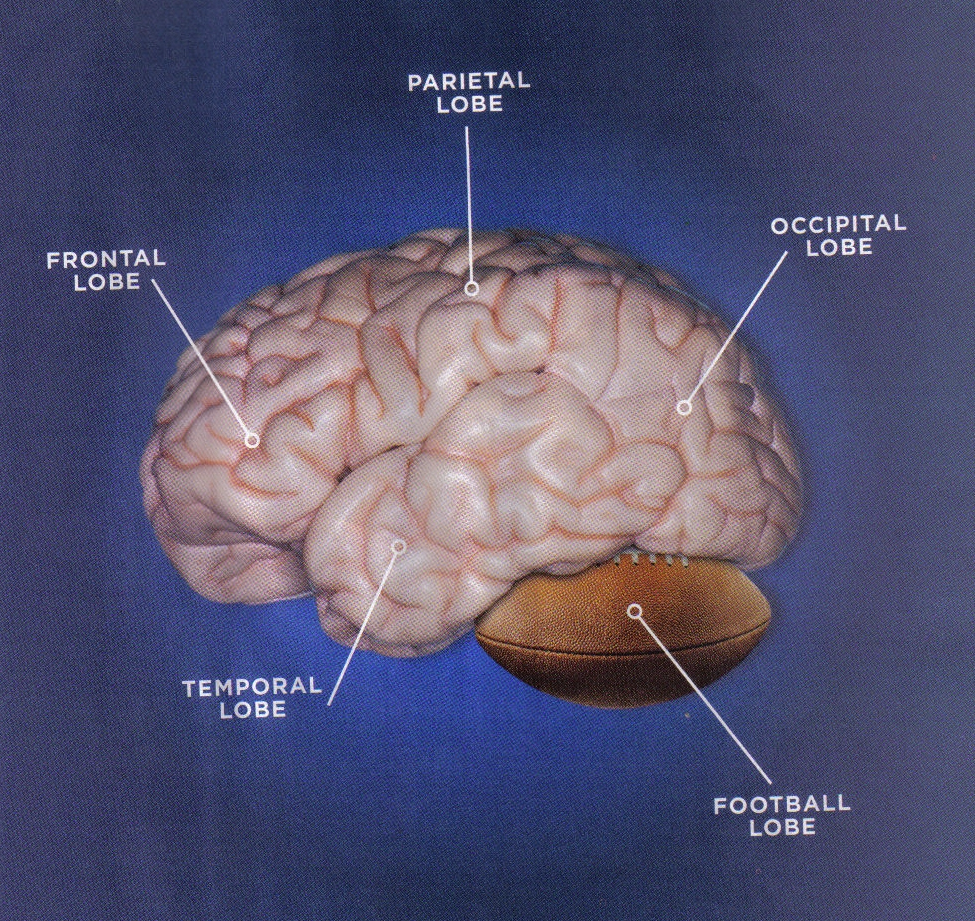
Our relationship to "the economy" amounts to the same thing. For a while it seemed to be one long Superbowl, - our perception of the market was driven only by our knowledge of gain, but that could not continue. The game does not last for ten consecutive seasons. The risks were always there. Likewise our country is still earning trillions of dollars for its goods and services, just as it did a few years ago, but now we perceive only the risk. In our relation to the economy we are driven by our most primal motivators - hunger and fear. We have traditionally associated football with the most primitive in us and the economy with sophistication but maybe its really the other way around. Ultimately, it is not just the economy that has to turn around, it is us. We are going to have to re-learn our sense of possibility for investors to perceive secure structures when they see markets and banks to perceive earners where they now perceive only risks for foreclosure. However, acquiring knowledge takes time and the brain has to perceive actual changes in its environment to learn new things. That means that substantive changes in how markets run and how, buyers, lenders, and sellers are regulated will have to occur if the economy is to turn around. The government can't simply pour our money into corrupt institutions without requiring any changes, while buying our silence with tax cuts, we're not that stupid. Individuals and businesses were already pouring money into the same markets for years - that's what produced this mess. Now we see bottom-up the rampant greed that has been the result of deregulation where before our top-down processes had led us to perceive only the gains. The solution is not simply spending money, but a process of filling us with new knowledge so that what we perceive has fresh meaning for us.
Monday, February 2, 2009
The Superbowl bringing out the sophisticated in us, and what that tells us about the economy
Our relationship to "the economy" amounts to the same thing. For a while it seemed to be one long Superbowl, - our perception of the market was driven only by our knowledge of gain, but that could not continue. The game does not last for ten consecutive seasons. The risks were always there. Likewise our country is still earning trillions of dollars for its goods and services, just as it did a few years ago, but now we perceive only the risk. In our relation to the economy we are driven by our most primal motivators - hunger and fear. We have traditionally associated football with the most primitive in us and the economy with sophistication but maybe its really the other way around. Ultimately, it is not just the economy that has to turn around, it is us. We are going to have to re-learn our sense of possibility for investors to perceive secure structures when they see markets and banks to perceive earners where they now perceive only risks for foreclosure. However, acquiring knowledge takes time and the brain has to perceive actual changes in its environment to learn new things. That means that substantive changes in how markets run and how, buyers, lenders, and sellers are regulated will have to occur if the economy is to turn around. The government can't simply pour our money into corrupt institutions without requiring any changes, while buying our silence with tax cuts, we're not that stupid. Individuals and businesses were already pouring money into the same markets for years - that's what produced this mess. Now we see bottom-up the rampant greed that has been the result of deregulation where before our top-down processes had led us to perceive only the gains. The solution is not simply spending money, but a process of filling us with new knowledge so that what we perceive has fresh meaning for us.
Saturday, January 31, 2009
Development of one kind or another (Books - Theories of Development, Brain Architecture, The Seance)
We've been displaced by some work we're having done on our apartment, sleeping and showering at mother-of-bookeywookey. In addition, class reading has descended with a mighty fist, so I have not had a lot of time for fun reading lately.
I continue to make my way through William Crain's Theories of Development, which although work-related, is enjoyable to read. It's a good overview of the major theorists of what is called psychological development, although that usually covers only infancy through early adulthood. A few of them, like Erik Erikson, did include later adulthood in his stages of development. Until rather recently it was thought that the brain finished developing when we reach around 21 years old and becomes much less adaptable. It was also thought that brain cells did not die. Modern neuroscience has informed us otherwise that the brain is changeable throughout the life span, so if our structure doesn't stop changing then neither does the behavior that results from it. This book is a very good summary of the major theories of development from Freud and Piaget to Skinner and Chomsky. I'm reading a version from 1992 which is not contemporary by a long shot as far as the neuroscience is concerned, but Crain approaches his subject more from a psycho-social point of view than a physiological one. He summarizes the experimental work of Piaget in considerable detail. As I have only read about Piaget's theories and never read his work directly, I am enjoying the many examples of the experimental observation that went into the development of his stages.
Another detail I found interesting was the critique of education reforms in light of Piagetian theory. Crain writes about both the Cold War era race to educate American children to catch up to the math and science skills of their Russian counterparts with the advent of "New Math." It asked children who have not yet developed the capacity for abstract or hypothetical thinking to employ those abilities in the way it taught those subjects. Having been the victim of New Math for two years, I can attest to how frustrating I found it. A similar race developed with Japan in the 1980's which did not succeed in boosting the quality of science and technology education of our young children but rather made parents anxious about their children starting their education early enough. This resulted in forcing learning processes on young children that are not natural to their level of development and their associating learning with stress. I wonder what future research will tell us about the disaster called 'No Child Left Behind.'
Another side of development is covered in Larry W. Swanson's Brain Architecture, which actually is class reading, but is far from as dry as its title. His interest is anatomy, as the title suggests, but his perspective is how the structures of nervous systems added 'improvements' as creatures evolved in response to their environments.
Constance, our heroine, in John Harwood's new book The Seance, in her efforts to cure her mother of paralyzing melancholia by convincing her that she has seen her long-dead daughter, visits many mediums. At one she encounters Vernon Raphael from the Society for Psychical Research, who debunks fraudulent mediums.
Another detail I found interesting was the critique of education reforms in light of Piagetian theory. Crain writes about both the Cold War era race to educate American children to catch up to the math and science skills of their Russian counterparts with the advent of "New Math." It asked children who have not yet developed the capacity for abstract or hypothetical thinking to employ those abilities in the way it taught those subjects. Having been the victim of New Math for two years, I can attest to how frustrating I found it. A similar race developed with Japan in the 1980's which did not succeed in boosting the quality of science and technology education of our young children but rather made parents anxious about their children starting their education early enough. This resulted in forcing learning processes on young children that are not natural to their level of development and their associating learning with stress. I wonder what future research will tell us about the disaster called 'No Child Left Behind.'
"...Frankly, Mr. Raphael, if I could find a medium who could convince her that Alma is safe in Heaven, I would want her to have that comfort. And so I wondered - whether there is anyone you could recommend."I am finding Constance Langton a persistent and resourceful heroine. I am enjoying watching her development (to stay on a theme) into a formidable young woman.
"My business, Miss Langton" - he sounded more amused than indignant - "is to expose frauds, not to recommend them."
"It is all very well for you, Mr. Raphael, who are clever and confident and at home in the world, but for those like my mother, who are simply crushed by the weight of grief, why deprive them of the comfort a seance can bring?"
"Because it is false comfort."
"That is a harsh doctrine, Mr. Raphael; a man's creed, if I may say so. Have you never lied, or keep silent, to spare the feelings of another? If you had lost a brother, let us say, and your own mother had been prostrated by grief, would you sternly insist - as my father did - that she take no comfort in seances?"
Thursday, January 29, 2009
Medium or just a girl who needs to be loved? (Books - The Seance by John Harwood)
I could not understand it, but nevertheless the suspicion took root and grew. It explained why Mama had loved Alma so much more than me, and why I was never any comfort to her, and even why, as I sometimes guiltily suspected, I did not love her as much as I ought to.It is one of those things the human mind does - try to find the sense of what happens to us, even when there is none. Harwood imagines Constance's isolation from a child's point of view. It is an essential part of the plot's set-up. One day, when Constance is in her teens, her father abruptly leaves and Constance must care for her mother. She fakes a trance in which she speaks to her mother in her long-dead sister's voice and this is the first thing in a decade to wake her mother from her catatonia. So Constance begins to research seances and visits a medium for advice.
"I know it was wrong to deceive her," I said, "but Mama has been so unhappy for so long, and if only she could be certain that Alma is safe in Heaven, I think she might recover."And that is, among other things, the question I expect this ghost story will explore. So far, Harwood has created a suitably sepia-toned atmosphere with the chill just beginning to creep in.
"You musn't reproach yourself, my dear. For all you know, it was your sister's spirit moving you to speak; you might have the true gift and not know it yet."
Wednesday, January 28, 2009
How do two people write a mystery? (Books - The Locked Room by Maj Sjowall and Per Wahloo)
Martin Beck felt his first working day was at an end. Tomorrow he'd go and have a look at this locked room himself. What was he to do tonight? Eat something, anything, and then sit leafing through books he knew he ought to read. Lie alone in his bed and wait for sleep. Feel shut in.The mystery is set in an era that follows a nationalization of the Swedish police force in the mid-1960s. They are critical of Sweden's social system, of the new force's leaving tens-of-thousands of crimes unsolved and particularly of the arming of Sweden's police.
In his own locked room.
All of a sudden, situations that formerly could have been cleared up by a single man equipped with a lead pencil and a pinch of common sense required a busload of patrolmen equipped with automatics and bullet-proof vests.Let's just say that Sjowall and Wahloo give you their moralizing straight-up, no chaser.
The long-term result, however, was something no one had quite foressen. Violence breeds not only antipathy and hatred but also insecurity and fear...
What I want to know is how two people write a mystery. Did they alternate chapters or what? It has that feeling - pockets of reportorial context, sections of swift-moving plot, and some tremendously awkward dialogue in this translation by Paul Britten Austin. Does an inept cop with the name of Bulldozer really say:
So do you maintain you haven't met Malmstrom and mohren or even heard from them in the last six months?But I am going to try to stick it out. The puzzle has me intrigued and I want to see whether the authors' moral stance on the Swedish police is just a pet peeve that made its way into the novel because they couldn't help themselves or because it contributes to the story.
Tuesday, January 27, 2009
Science and Headlines
So what's to like? That is science. Do two studies, get two conflicting results. Every study done does not instantly lead to advice that makes a succinct headline or a product you can market. I really like the fact that the article reported about the process in the context of what would be big news if it turns out to be correct. However, two conflicting results means the story is that more work is necessary. In science, if you want to know about the influence of one thing on another, you have to come up with a way to isolating that factor from all the other things that could also affect the result, it's known as a control. I wish science in popular news venues would write a little more about the controls. For instance, in the first study mentioned, it would be useful to know the experimenters controlled for the effect of age and exercise, which are both known to effect memory. I like the fact that the reporter, Pam Belluck, mentioned one hypothesis held by the first lab that did not work out. Great! Searching for the answer to a mystery is a great story. If people were pitched a little more about process, they might develop greater understanding and less fear about the subject. Flashes of great insight is not the whole story. Maybe editors can take a cue from our new president and report a little more on the science. How about: Two Studies Create a Debate About The Effect of Diet on Memory. I know. It's not sexy. It won't sell papers.
Sunday, January 25, 2009
From whence come ideas? (Books - The Invention of Air by Steven Johnson)
...when tools for measuring increase their precision by orders of magnitude, new paradigms often energy, because the new found accuracy reveals anomalies that had gone undetected. One of the crucial benefits of increasing the accuracy of scales is that it suddenly became possible to measure things that had almost no weight.The discovery of 'airs' or gases at that time rests on the fact that if you heat certain substances, they lose a very small amount of its weight because they release something (a gas) into the air. The fact of this weight change was only measurable on a very sensitive scale, as the weight lost is relatively small. But the fact of this weight change was the evidence of the existence of this gas, which is not visible to the eye.
As to why Priestley, Johnson tries to dispell the myth of scientific eureka moments and to put in its place the notion of long development:
What's interesting about Priestley is not that he had a hunch, but rather that he had the intelligence and the leisure time to let that hunch lurk in the background for theirty years, growing and evolving and connecting with each new milestone in Priestley's career. We know that epiphanies are a myth of popular science, that ideas don't just fall out of the sky, or leap out of our subconscious. But we don't yet recognize how slow in developing most good ideas are, how they often need to remain dormant as intuitive hunches for decades before they flower. Chance favors the prepared mind, and Priestely had been preparing for thirty years. We talk about great ideas using the language of flashes and instant reveleation, but most great ideas happen on the scale of generations, not seconds.This becomes another moment for a disquisition by Johnson on the spreading of ideas through networks, which is a veritable obsession with him. He sees them everywhere but I am sure that he would argue, that's because they are everywhere, and I would be inclined to agree with him. He continues to develop the idea he introduced in the first chapter about the coffee houses of the era being much like the internet of the present - a forum for connection. But in this chapter he talks about the connection of the inventor to the network of ideas and associations that are peculiarly his:
...the inventor networks with his own past selves, his or her ability to keep old ideas association alive in the mind. If great ideas usually arrive in fragments, a partial cluster of neurons, then part of the secret to having great ideas lies in creating a working environment where those fragments are nurtured and sustained over time.Networking with your own past selves - as though each of our thoughts and experiences begin as separate skeins that reach back in time, but are finally woven together into cloth. I thought too how those would not be only intellectual skeins, but also purely sensoral ones (things we see, hear, or smell over time), as well as elements of emotion and personality. Lovely thought, Mr. Johnson. It seems similar to what you have done in this book - weaving what might be seen as wildly divergent strands into whole cloth both useful and beautiful.
Friday, January 23, 2009
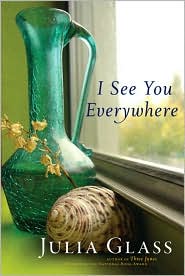
Two parts of one whole (Books - I See You Everywhere by Julia Glass)
Glass's writing is fluid and elegant, but also contemporary. I'll leave you with a paragraph:
When Ray came into my life, he was just that: a shaft of sunlight invading a murky room. I had been married for too long to a genteel but oblivious man whose still waters hid many things but not, after all, an undertow of passion. At first, the decorum and calm in my marriage had been such a relief that I thought, So this is it. But then I met Ray, and I knew, thought it made me sadder than I had every been, This is it. He called me Miss Fever, Miss Open Flame, Miss Hundred and Ten in the Shade - and, once, Miss Bases Loaded Tying Run on Third No outs. One day our illicit gymnastics left his handprints in the new gray carpet of my office; that night, I locked the door so the cleaning lady couldn't remove them. Next morning, when I walked in and saw again the image of his hands, ghostly as petroglyphs, I began to shake. I locked the door for another hour. I was certain that my life as lived (so cautiously) was over.
The original developmental psychologists (Books: Theories of Development by William Crain)
Nature is like a hidden tutor who prompts the child to develop different capacities at different stages of growth.
Rousseau sets out four developmental stages, what a child was capable of acquiring during each one and how. They're reminiscent of Piaget's or Erikson's stages (they are traditionally the ones I think of as developmental psychologists). Both Locke and Rousseau offered their theories of educating children to become "successful" adults. Locke seeing this success defined by the adult's ability to control individual desires - to seek the approval of society so that one might serve it. Whereas Rousseau saw people as driven by primitive urges, fighting being crushed by society. He felt that a successful education permitted the adult to develop independent ideas and morals so as to stand up to society rather than conform to it. We're still playing out this debate today. If any of you are fans of Lost, you will recognize it as one of the themes of the show, hence a character named John Locke.
Thursday, January 22, 2009
The yin and the yang of it...
Since “Inspiration” is the theme this week … what is your reading inspired by?
You. That's a little glib, I know, but the dialogue that is the world wide web gives me lots of ideas for reading and it keeps me energized because my reading happens in the context of someone other than me. Writing about my reading pushes me to read better, more closely, and to form opinions as I read, not just let it wash over me. But the flip-side is equally true, my other inspiration is simply my whim. Reading is a totally self-centered realm (in the best sense). I get to be curious about what ever I want and to satisfy that curiosity by following my nose. I read what I want, when I want, and I depend on no one to do it. Except the writer and the library or bookshop. And that's the yin and the yang of it.Wednesday, January 21, 2009
Not what you think... (Books - I See You Everywhere by Julia Glass)
Louisa's smart, smarter than me in the report-card sense, but whenever she's nervous, she babbles. Today, day two of my renewed consciousness, she's worse than ever, as if she's burning off extra fuel. I guess she's just glad I'm alive, and if I weren't so drugged up, I hope I'd be touched. "So I get home," she's saying. "Hugh's already asleep, I've had too much wine, and what do I find on the machine but one of Mom's classic soliloquies. Something like 'Clem's been in a serious accident, honey, I'm not at home because I'm here with her and your father's back and forth because there's a hurricane off Bermuda - Ethan or Efram, I think; your father says it's a bad sign that here we are not even August and already up to E. C and D passed us by, but B was a very close call. Great for the roses, though. You can't speak to her, I'm afraid, but call this number, I'm giving you this number, just a second, hang on, it's here in my purse. Is it as hot down there as it is up here? Yes, here it is, right, so call and say you love her. Will you do that, please? She can't talk, but have them leave her a message, I'll call you later,'"And that sums up this lovely book perfectly both in its form and its content. It is a series of chapters, each separated by three years, that track the lives of the two sisters. Glass writes each chapter alternately in Clem's voice and then Louisa's. Many of the chapters, like this one, have a stand-alone, short story quality to them. I believe that is the form that they first existed in. In each one it is apparent not just how completely different the two sisters are as people, but how much they depend on each other to define themselves. Glass has made the sister's voices and points of view distinct, but my one quibble with the book as a novel is that I sometimes find the tone of the chapters too various to hang together. But then I find myself justifying that in the changes in Clem and Louisa's circumstances, their age, their relationships, the settings, and the fact that time elapses between each chapter that we don't witness first hand and regardless, they are a pleasure to read.
Louisa stops pacing. So of course I have no idea where 'here' is or who 'they' are, but I call the number, I'm frantic, and this woman answers, 'I see you?' as if I'm expected to answer, 'Aha, but I see you, too!' Like a game of some kind. All I can say is 'You see me? How?' and she laughs. 'That's a new one,' she says. 'This is intensive care,' and I freak out. I can't believe she's laughing."
"That's cute," I say. "Like, ICU in my dream. ICU on the Johnny Carson show. ICU everwhere."
"More like, ICU every time all hell breaks loose. For both of us."
The scene I excerpted is also emblematic of this book because what you get at first hearing is not really not what is being said. You might think you're reading another little monologue in the voice of the risk averse sister, and you are. But what you are really reading is a small part of complex novel that is an even smaller part of each of these sisters' lives, we only see the parts when they are thrust together "every time all hell breaks loose," as Clem says, It is told through accumulation, through repetition and variation until you finally realize you are reading something you didn't expect, 'I.C.U.' and not 'I see you.' Although both are equally true. I'm not quite finished with it, but three quarters of the way through Glass has created a warm and touching book whose characters feel deeply real and that lets its pleasures emerge quietly out of character study.
Sunday, January 18, 2009
It's in the air... (Books - The Invention of Air by Steven Johnson)
But his History was as much a breakthrough for its form as for its content. He had invented a whole new way of imagining science; instead of a unified, Newtonian pronouncement, Priestley recast natural philosophy as a story of progress, a rising staircase of enlightenment, with each new innovation building on the last. In his prologue to the History, he contrasts his method favorably with the existing genres of civil history and natural history: the epic stories of kings and wars and famines, or the meticulous inventories of nature - insects, rocks formations, flowers - that had become commonplace over the preceding century. There were great lessons and pleausres to be found in those other forms of writing, Priestley argued, but they lacked the definitive movement toward clarity and understanding that could be found in his own philosophical history...The story of scientific narrative is one of two themes Johnson mines in his opening chapter. The second is the notion of innovative streaks, both on the individual and societal level. Why do a few people seem to have a disproportionate share of the big ideas, Johnson asks, and why does the popularization of those ideas seem to occur in bursts. This is a discussion Johnson covers ably in fifteen pages of easy and even amusing narrative. He puts the theories of Thomas Kuhn's 1962 book The Structure of Scientific Revolutions, which imagnes a small center of change, starting in the lab with the scientist and radiating outward, alongside the notion of the ecosystem:
Ecosystem theory has changed our view of the planet in countless ways, but as an intellectual model it has one defining characteristic: it is a "long zoom" science, on that jumps from scale to scale, and from discipline to discipline, to explain its object of study: from the microbiology of bacteria, to the cross-species flux of nutrient cycling, to the global patterns of weather systems, all the way out to the physics that explains how solar energy collides with the Earth's atmosphere.This interconnected network model is a favorite of Johnson's - how ideas move for the cellular networks of the human brain to cultural systems like the economy, to massive forces like energy. This notion, contrary to Kuhn's, sees large pattern of changes occurring when large simultaneous cultural forces align or, you could say, when the notion is 'in the air.' Johnson, with a nod to Tom Standage's book A History of the World in Six Glasses, half-jokingly credits the emergence of the coffee house culture with the birth The Age of Enlightenment. Starbucks, take note.
I had looked at both Johnson's book and another - Julia Glass's novel I See You Everywhere on the same evening in a bookstore a couple of weeks back. Both are new and in nicely designed hardcover editions, with attractive jackets. Both are of a size agreeable to hold in ones hand, but it was the end of the semester and I was hardly likely to start them immediately, so I ordered them on line. Having first admired them, and then waited for them, and then placed them on the to-be-read-sooner-rather-than-later pile I had enjoyed anticipating them, particularly Glass's novel whose opening pages had a warm, comforting feeling to them. I found myself almost loath to begin I See You Everywhere so much had I enjoyed my anticipation of it. But start I did and now having written about Steven Johnson writing about Priestley writing about science, I have a little writing about science I should do myself. So I will force you to anticipate my thoughts on Julia Glass's new novel until later.
Saturday, January 17, 2009
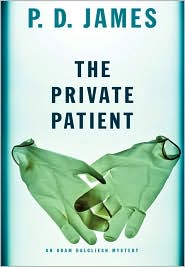
A mystery inside a mystery (Books - The Private Patient by P. D. James)
He sometimes wondered what it would be like to find that secret door said to be open to the lightest touch, and to feel this burden of guilt and indecision fall from his shoulders. But he knew that one dimension of human experience was closed to him as was music to the tone deaf.
...and how they appear to others.
Mogworthy, an incongruous Cerberus, had changed into a shiny blue suit and striped tie, which gave him the look of an ancient undertaker, and stood beside her, back to the fire, the only one on his feet. He turned to glare at Dalgliesh as they entered; the glare seemed to Benton more minatory than aggressive.
I love the fact that she gets not one but two mythological references into two sentences. The Private Patient satisfied me in the ways that the traditional British mystery always does, particularly one crafted by P. D. James.
There are two books waiting for me at the library but it is six degrees, or something like that, outside and I may not want to make the walk. I also have a section of my paper to write today, so I don't know what I will end up reading next.
Friday, January 16, 2009
Chaos bursts through careful control (Books - The Private Patient by P. D. James)
The lease was long and renewable; she would have liked to buy the house, but knew that it would never be for sale. But the fact that she couldn't hope to call it entirely her own didn't distress her. Most of it dated back to the seventeenth century. Many generations had lived in it, been born and died there, leaving behind nothing but their names on browning and archaic leases, and she was content to be in their company.And then, the set-up:
[...]
The City which lay below was a charnel house built on multi-layered bones centuries older than those which lay beneath the cities of Hamburg or Dresden. Was this knowledge part of the mystery it held for her, a mystery felt most strongly on a bell-chimed Sunday on her solitary exploration of its hidden alleys and squares? Time had fascinated her from childhood, its apparent power to move at different speeds, the dissolution it wrought on minds and bodies, her sense that each moment, all moments past and those to come, were fused into an illusory present which with every breath became the unalterable, indestructible past.
It was now eight-thirty and she was in her bathroom. Turning off the shower, she moved, towel-wrapped, to the mirror over the washbasin. She put out her hand and smoothed it over the steam-smeared glass and watched her face appear, pale and anonymous as a smudged painting. It was months since she had deliberately touched the scar. How, slowly and delicately, she ran a fingertip down its length, feeling the silver shininess at its heart, the hard bumpy outline of its edge. Placing her left hand over her cheek, she tried to imagine the stranger who, in a few weeks' time, would look into the same mirror and see a doppelganger of herself, but one incomplete, unmarked, perhaps with only a thin white line to show where this puckered crevice had run. Gazing at the image, which seemed no more than a faint palimpsest of her former self, she began slowly and deliberately to demolish her carefully constructed defences and let the turbulent past, first like a swelling stream and then a river in spate, break through unresisted and take possession of her mind.All of James's books invest in a thorough set-up with lots of insight into character, which I love, but I find this one particularly unhurried. No pressure here except to get the job done - to introduce each character in turn and each plot-line with equal care and the tone proper to their circumstances. Some are to be essential to solving the mystery, others are, no doubt, destined to become red herrings, but to stint on any of them would be to give away which is which. James spends 100 pages making us acquainted with the investigative journalist Rhoda Gradwyn, the renowned plastic-surgeon George Chandler-Powell, hired to remove Rhoda's own legacy - a scar she has had since childhood. James spends a chapter on each member of the staff of Chandler-Powell's private clinic, housed in his historic manor in Dorset.
I don't think it is merely coincidental that P.D. James as an older writer is writing about time, about age, but I also don't think it is a merely a preoccupation with self. The past is, I'm sure, going to be essential to solving the mystery. In the same way, I don't thing that the fact that the writing here is methodical is a quirk of James's style through which we have to suffer to get to the good stuff. It is a deliberate voice chosen to express the way that Chandler-Powell and Rhoda Gradwyn are methodical. Both are characters who have come out of chaos in their pasts and have reacted to it by putting a good amount of control into their lives. The routine of their work, their weekly schedule, the food they eat and when they eat it, each of these aspects of their lives is highly controlled and has an old-fashioned rhythm to it. So it is a surprise when, following the surgery, Rhoda suddenly sees a ghostly figure around her bed making ritual gestures just prior to murdering her (this is not a spoiler, we know she will die from the first sentence of the book). I really like this touch for two reasons - this otherworldly figure clad in white could be a nurse, surgeon, or someone who has taken surgical scrubs, mask, and gloves from the premises and who is seen through Rhoda's post-anesthetic haze - it could also be something otherworldly bursting through the protective veneer of these controlled lives just at the moment of the crime. As though it reaches through, perhaps from the past? I don't know yet. But the book's tone changes with the crime - as lives change as the result of a murder - and with the introduction of detective Adam Dalgleish and his team comes a more modern-day percussive, chaotic rhythm. Murder cuts into Gradwyn's world and keeps her new face an eternal mystery.
Wednesday, January 14, 2009
I have always depended on the kindness of strangers... (Books - Twilight & Moonbeam Alley by Stefan Zweig)
But as soon as he left she felt as if the weight of the silence were descending on her twice as heavily as before, as if she alone had to hold up the high ceiling, she alone must keep back the advancing darkness. She had never known how much a single human being can mean to another, because she had never been lonely before. She had never thought more of other people than of air, and one does not feel the air, but now that solitude was choking her, only now did she realise how much she needed them, recognising how much they meant to her even when they deceived and told lies, how she herself drew everything from their presence, their easy manners, their confidence and cheerfulness. She had been immersed for decades in the tide of society, never knowing that it nourished and bore her up, but now, stranded like a fish on the beach of solitude, she flinched in despair and convulsive pain...**MAJOR SPOILER ALERT**
Madame de Prie first tries to do what she is used to - manipulate friends in high places, take a young lover in order to feel more powerful than someone else, and finally beg those in power to reinstate her. None of these succeed in changing her circumstances, so she changes her attitude, accomplishing this by planning her own death. ** SPOILER FINISHED**
What is unusual about this story is its tone, which feels for all the world like a fairy tale, dark though it may be. There is a magical, dark-and-stormy-night mood to this piece which is a parable about valuing others more than ones position or wealth. The story is also nearly prophetic in light of Zweig's own experience of and response to forced exile from his native Austria by the Nazis.
The accompanying piece, Moonbeam Alley, concerns an encounter had by a German traveler on his way home by ship, with a woman and a man, both of whom he encounters in a seedy bar in an alley near the docks.
I liked such alleyways in foreign towns, places that are a disreputable market-place for all the passions, a secret accumulation of temptations for the sailors who, after many lonely days on strange and dangerous seas, come here for just one night to fulfill all their many sensuous dreams within an hour. These little side-streets have to lurk somewhere in the poorer part of any big city, lying low, because they say so boldly and importunately things that are hidden beneath a hundred disguises in the brightly lit buildings with their shining window panes and distinguished denizens. Enticing music wafts from small rooms here, garish cinematograph posters promise unimaginable splendours, small square lanterns hang under gateways, winding in very clear invitation, ussuing an intimate greeting, and naked flesh glimpsed through a door left ajar shimmers under gilded fripperies. ..But all this is hidden in modestly muted yet tell-tale fashion behind shutters lowered for the look of the thing, it all goes on behind closed doors, and that apparent seclusion is intriguing, is twice as seductive because it is both hidden and accessible. Such streets are the same in Hamburg and Colombo and Havana, similar in all seaports, just as the wide and luxurious avenues resemble each other, for the upper side and underside of life share the same form. These shady streets are the last fantastic remnants of a sensually unregulated world where instinct still has free rein, brutal and unbridled; they are a dark wood of passions, a thicket full of the animal kingdom, exciting visitors with what they reveal and enticing them with what they hide. One can weave them into dreams.This story, although it sets the atmosphere beautifully, almost lost me, because it appeared to do nothing else for some time. But once our narrator meets the central character, things get interesting. The story is built around a central psychological surprise that I won't disclose as it is the whole story. The set-piece of this story is a brilliant ten-page monologue about obsession of one person for another that has me sold on this story as perfect for adaptation to a one-man drama. As a director, I used to read constantly with an eye to what story might adapt well to drama, but I haven't been drawn to that characteristic in a story in some time. The translation by Anthea Bell, as with her work on Sasa Stanisic's How the Soldier Repaired the Gramophone, feels fluid, natural and stylistically right for the period. I'm going to get cracking on this idea so you had better no steal it. In the meantime, I'm grateful to John Self for recommending these wonderful stories and to Dovegrey for seconding that emotion. I third it, and get them in this elegant little edition, it's a pleasure to read.
May I have the envelope please...
I was going to post on Stefan Zweig's Twilight but then Matt gave me this nifty recognition a couple of days ago and it's taken me this long to figure it out. Thank you, Matt. I'm honored to be honored. It's the Premio Dardos or Darts Award which, well I'll let them say it.This award acknowledges the values that every blogger shows in his or her effort to transmit cultural, ethical, literary, and personal values every day. The rules to follow are:
1) Accept the award, post it on your blog together with the name of the person who has granted the award and his or her blog link.
2) Pass the award to 15 (actually 10) other blogs that are worthy of this acknowledgment. Remember to contact the bloggers to let them know they have been chosen for this award.
So there you have it. I most gratefully follow rule #1 by accepting this award and posting it, but as for rule #2 I say - rules, schmools, I'm doing this my own way - and passing it on to just a few blogs, even if someone has honored them already. Please hold your applause until the end of the presentation.Although Cornflower Books is a fairly new place, Cornflower is an old hand at bringing us her observation on books, cakes, and other various and sundry. A visit to her place is like being invited to someone's comfy kitchen for tea and a chat. I found out about A. S. Byatt's upcoming book at her house and so, Cornflower, I honor you.
Notes of an Anesthesioboist is exactly what it says. Our fearless, reed-sucking goddess of sleep shares her thoughts on her work, her reading, cooking, family life. A thoughtful, nourishing place to visit and for that I honor her.
C.B. and his faithful friend Dakota get a lot of books in. That is, C. B. reads 'em and Dakota eats 'em. The trick is to see which one gets to them first. C.B. is an energetic reader, an involved member of his community, and I find his author interviews a particularly good reason to visit and to give him this honor. The name of the blog is Ready When You Are, C. B.
I always enjoy seeing what author Sarah Salway will offer next in the way of writing prompts, following her visits to writer's workshops and artists colonies, and especially her exploits with shopping trolleys, and so I honor Sarah's Writing Journal.
The Mookse and the Gripes is the place to go when you want to dive head-first into an in-depth reading of meaty literature like the poetry of Walcott or Robert Penn Warren's All the King's Men. I have gotten more than a couple of good recommendations here so, Mookse, please accept this honor with my thanks.
Last, but certainly not least, I choose to honor my dear friend and fellow-blogger Sheila for her passionate writing on her reading, her film going, her favorite actors, and her friends and family (she is a prolific memoirist at the moment) at The Sheila Variations. For being a consistently fun, provocative, and raucus read, Sheila, I honor you.
And now, please give a hearty roar of approval to these bloggers by checking out their sites if you haven't already.
Tuesday, January 13, 2009
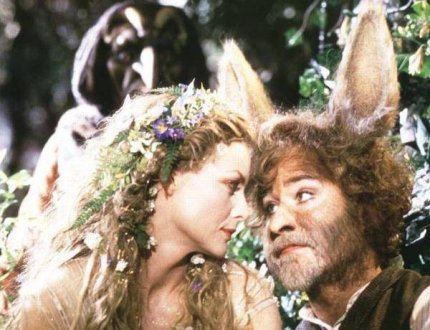
What fools these mortals be...
Captain of our fairy band,
Helena is here at hand,
And the youth, mistook by me,
Pleading for a lover's fee.
Shall we their fond pageant see?
Lord, what fools these mortals be!
- William Shakespeare - A Midsummer Night's Dream
When a female prairie vole’s brain is artificially infused with oxytocin, a hormone that produces some of the same neural rewards as nicotine and cocaine, she’ll quickly become attached to the nearest male. A related hormone, vasopressin, creates urges for bonding and nesting when it is injected in male voles (or naturally activated by sex).Oxytocin, produced during childbirth and nursing, is the same chemical that stimulates bonding between mother and child. So motherly love is, neurochemically, the prototype of adult love. I am sure Dr. Freud, wherever he is, has just lit up a celebratory cigar and the attachment theorists are throwing a champagne party!
Monday, January 12, 2009
Good witches and bad (Books - The Witches of Eastwick by John Updike)
The other pleasure this novel offers is the writing and whether Updike is exercising his "good witch" or his bad, he attains simultaneously erudition, comedy, and majesty. Take these two descriptions of the witches, one early in the novel reveling in Sukie's beauty and the other later, basking in the demise of Jane, they exemplify using talents, this case Updike's writing talents, in the service of the light and the dark:
Sukie was the most recently divorced and the youngest of the three. She was a slender redhead, her hair down her back in a sheaf tirmmed straight across and her long arms laden with these freckles the cedar color of pencil shavings. She wore copper bracelets and a pentagram on a cheap thin chain around her throat. What Alexandra, with her heavily Hellenic, twice-cleft fatrues, loved about Sukie's looks was the cheerful simian thrust: Sukie's big teeth pushed her profile below the brief nose out in a curve, a protrusion especially of her upper lip, which was longer and more complex in shape than her lower, with a plumpness on either wide of the center that made even her silences seem puckish, as if she were tasting amusement all the time.
and
"Isn't this cozy!" Jane Smart cried, coming in late, wearing almost nothing: plastic sandals and a gingham mini with the shoulder straps tied at the back of the neck so as not to mar her tan. She turned a smooth mocha color, but the aged skin under her eyes remained crepey and white and her left leg showed a livid ripple of varicose vein, a little train of half-submerged bumgs, like those murky photographs with which people try to demonstrate the existence of the Loch Ness monster. Still, Jane was vital, a thick-skinned sun hag in her element.
A lusty, energized, potent, and, at times, uncomfortable novel, but the writing is always an alluring pleasure. My other posts on it are here, here and here.
Next up: Stefan Zweig's Twilight and Moonbeam Alley put out in a beautiful compact edition by Pushkin Press on paper so yummy I could eat it.
Saturday, January 10, 2009
The sentence as a one act play (Books - The Witches of Eastwick by John Updike)
Four characters comprise the dramatis personae - three people hearing the car and one driving it (I guess there are five characters if you count the ex-husband). There is not just a car - but a specific model - filling out our understanding of our driver's class, her taste, her self-image. They all hear her car. They do this together, as if it stops whatever action they were engaged in. And not only can they hear it, we can hear it too because Updike chooses such specific verbs. He doesn't tell us that the car merely drove away, or drove quickly, or that it tore down the driveway (somewhat cliched). The gray Corvair convertible starts up, spins out and crackles down the drive. I don't want to spout such nonsense as "great writing is all in the verbs," but precise verbs go a long word towards placing the reader somewhere specific. Three sounds occur because of our driver's circumstances, of which we know something if we have read the preceeding sentences, but even without doing so one can form a specific impression - mine is one of haste, and possibly daredevil carelessness but there could be some anger in there too. The reader too hears three sounds. Driving away can sound like hundreds of things but the crackling of a sports car's wheels on a driveway is much more precise, it permits the reader to hear something close to what the writer imagines, rather than to simply guess at the sounds or interpolate their own generic car driving away noise. With the additional knowledge of the car, its driver, and her audience of listeners one sentence becomes a mini-drama complete with actions, relationships, scenery, props, and sound effects.
They all heard her car, a pale gray Corvair convertible with front-wheel drive and her ex-husband's vanity plate ROUGE still on the back, start up and spin out and crackle away down the drive.
Friday, January 9, 2009
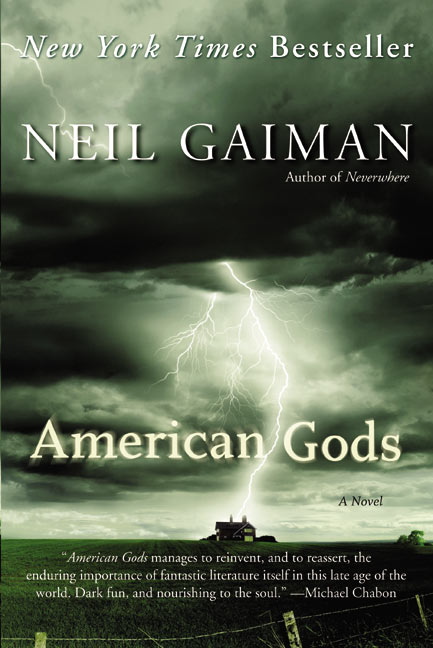
The celebration of people for who they are (Books - American Gods by Neil Gaiman)
Nature gone awry (Books - The Witches of Eastwick by John Updike)
The platter was coarse tan earthenware gouged and glazed with the semblance of a crab. Cancer. Alexandrea feared it, and saw its emblem everywhere in nature - in clusters of blueberries in the neglected places by rocks and bogs, in the grapes ripening on the saggin rotten arbor outside her kitchen windows, in the ants bringing up conical granular hills in the cracks in her asphalt driveway, in all blind and irresistible multiplications.
"Your usual?"
[...]
"I guess it's still tonic time," Alexandra decided, for the coolness that had come in with the thunderstorm some days ago had stayed. "How's your vidka supply?" Someone once told her that not only was vodka less fattening but it irritated the lining of your stomach less than gin. Irritation, psychic as well as physical, was the source of cancer. Those get it who leave themselves open to the idea of it; all it takes is one single cell gone crazy. Nature is always waiting, watching for you to lose faith so she can insert her fatal stitch.
I enjoyed this section on a number of levels. Updike captures that sort of obsessional neurotic fear one can get caught in from time to time, where one see the object of one's fear everywhere. It is itself a sort of cancer, the growth of a seed of knowledge gone amok. Then there is Updike's making literature of science. Although it is a little less absolute that Alexandra's understanding would have it, cancer is thought to occur when the programming that governs the balance of cell replication and cell death goes awry. Finally though, what I like most about this passage, is that the witches in relation to the sedate Rhode Island town they inhabit are themselves forces of nature gone crazy. That is what witchcraft is about, the harnessing of nature's powers to achieve some end (it doesn't have to be nefarious). I am experiencing Updike's novel as a comic take on the way suburbia has tamed the forces of nature in us all.
Wednesday, January 7, 2009
Did you hear the one about Medea? (Books - American Gods by Neil Gaiman)
Odin, here named Wednesday, stiffs a waitress in order to have some money to carry out his pre- war preparations.
"This isn't necessary," said Shadow. "I said I get the idea. You could do this to anyone, couldn't you? Tell me bad things about them."In what I am assuming was the climax scene, although I could be surprised, the warring parties meet at a motel that is in the exact center of America for a purpose I won't divulge. One of the modern-day gods trying to win Shadow over to their side is Media.
"Of course," agreed Wednesday. "They all do the same things. They may think their sins are original, but for the most part they are petty and repetitive."
"An that makes it okay for you to steal ten bucks from her?"
Wednesday paid the taxi and the two men walked into the airport, wandered up to their gate. Boarding had not yet begun. Wednesday said, "What the hell else can I do? They don't sacrifice rams or bulls to me. They don't send me the souls of killers and slaves, gallows-hung and raven-picked. They made me. They forgot me. Now I take a little back from them. Isn't that fair?"
"Media. I think I have heard of her. Isn't she the one who killed her children?"Neil Gaiman is a funny guy. He finds lots of opportunities for clever humor admidst his premise of a war for governance over the American soul. He manages to turn his many spiritual/cultural notions into page-turning fiction. His creative fantasy is prolific and well-meaning, but the whole things never rises above mildly entertaining for me. And I am still waiting for the thirty-page tangent about a serving girl from Cornwall and the various graphic sex scenes that popped up through the narrative to weave themselves into the vast cloth that is American Gods. I am sure they are going to figure soon, in what feels like the book's denouement, but 500 pages seems a long time to wait for it. So far, my favorite book of Gaiman's is still Coraline.
"Different woman," said Mr. Nancy. "Same deal."
Tuesday, January 6, 2009
Air had to be invented? (New Acquisitions Department)
The other is Julia Glass's recent novel I See You Everywhere. I enjoyed her Three Junes when that first came out but, for some reason, was not interested by her second book enough to read it. This one was sitting out on the new fiction table and I picked it up to read a few sentences. I was taken instantly by the narrative voice, and that is always a good sign. The narrator is a self-described loner (but not a sociopath, she warns us) and spends the evening of her 25th birthday glazing porcelain and listening to Ella Fitzgerald. She is one of two sisters, and it is their relationship that forms the centerpiece of this novel.
Meanwhile, vacation is clearly over as I spent all day yesterday working on various home and school projects (we're having the bathroom redone and The Ragazzo was stripping the old paint and wallpaper off the walls this weekend. What a mess). All that by way of saying, the reading is likely to slow down a bit. I have managed to get through a good deal more of Neil Gaiman's American Gods, which, in 450 pages, has managed to come together a bit (see my first post). I'll post on that anon but right now, it's off to the dentist.
Sunday, January 4, 2009
A writer who takes the trouble (Books - The Witches of Eastwick by John Updike)
Coal pulled her on, past a heap of barnacled square-cut rocks that had been part of a jetty built when this beach was the toy of rich men and not an overused public playground. The rocks were a black-freckled pale granite and one of the largest held a bolted bracket rusted by the years to the fragility of a Giacometti.That description expects something of the reader. Updike's spare use of commas makes one slow down to feel the rhythm of the sentence. They build detail upon detail in multiple realms at once. In the first sentence, we see the rocks as barnacles but the in the context of both the town's geography and its sociology. In the second we learn of the rock's specific identity and then, in addition, this rock's unique detail of a bolted bracket whose shape we can clearly see in our mind's eye, if we are well-versed in modern sculpture.
This train of paragraphs in which Alexandra, one of the three witches, takes her dog Coal for a walk on the beach, also does service as a lengthy description of Alexandra herself.
Alexandra wore her hair in a single thick braid down her back; sometimes she pinned the braid up like a kind of spine to the back of her head. Her hair had never been a true clarion Viking blond but of a muddy pallor now further dirtied by gray. Most of the gray hair had sprouted in front; the nape was still as finespun as those of the girls that lay here basking. The smooth young legs she walked past were caramel in color, with white fuzz, and aligned as if in solidarity...What a couple of paragraphs. I am going to march through my reading of them. We begin by learning just a little about what Alexandra looks like (we have learned more before this point) but Updike cannot do that without making a comparison, as I see it, it is Alexandra's own comparison of herself to the sea of youth in which she is awash. We can feel in that description her yearn to be sexual but her awareness of her own middle-aged status, her lack of physicality as she resents the boys' "insolent" game of Frisbee and then feel the slap of the insult on her back. "Hag," a nasty slap if she is already feeling her age, although the word does double-duty as a synonym for witch. Updike cannot resist adding Alexandra's notion that she could have mistook the sound of the surf for a word with an "a" vowel in it. A highly unlikely mistake, adding both humor from the third-person narrator, and awareness of a slightly desperate optimism from the interior perspective of Alexandra that this narration affords the reader. I love the mixture of the sexual and the inanimate that repeats itself again and again - the boy murmuring into the girls throat like a microphone, the rusted barbed wire and youth, the condoms and the stryrofoam. Finally, I love to death the fact that the plants growing on the beach are given their names - beach pea and wooly hudsonia. It is the mark of a writer who takes the trouble to see and to write precisely so that what we read can feel effortless. That or it indicates he can name them on sight as handily as he can a Giacometti. If the reader cares to do a little research, then he can see along with the writer, the patterned, eucalyptus-green leaves of the beach pea, and immerse himself further in the world of the story rather than skim across the surface of the narrative with the general knowledge that there is some sort of plant there. I also like the fact that this detail can flow from the twin perspectives of the narration, both from the third-person omniscient narrator who knows everything we need to be told, and Alexandra's interior perspective. It struck me as I read that sentence that, as a witch, she might know the names of the local flora.
Coal plunged on, snorting, imagining some scent, some dissolving animal vein within the kelpy scent of the oceanside. The beach population thinned. A young couple lay intertwined in a space they had hollowed in the pocked sand; the boy murmured into the base of the girl's throat as if into a microphone. An overmuscled male trio, their long hair flinging as they grunted and lunged, were playing Frisbee, and only when Alexandra purposefully let the powerful black Labrador pull her through this game's wide triangle did they halt their insolent tossing and yelping. She thought she heard the word "hag" or "bag" at her back after she had passed through, but it might have been an acoustic trick, a mistaken syllable of sea-slap. She was drawing near to where a wall of eroded concrete topped by a helix of rusted barbed wire marked the end of public beach; still there were knots of youth and seekers of youth and she did not feel free to set loose poor Coal, though he repeatedly gagged at the restraint of his collar. His desire to run burned the rope in her hand. The sea seemed unnaturally still - tranced, marked by milky streaks far out, where a single small launch buzzed on the sounding board of its level surface. On Alexandra's other side, nearer to hand, beach pea and wooly hudsonia crept down from the dunes; the beach narrowed here and became intimate, as you could see from the nests of cans and bottles and burnt driftwood and the bits of shattered Styrofoam cooler and the condoms like small dried jellyfish corpses.
I have a whole additional rant on how I read what the witches stand for in this suburban Rhode Island beach town, but I'm going to save that for another post.
Friday, January 2, 2009
Well-imagined gods and shadows (Books - American Gods - by Neil Gaiman)
Apparently his employer and his cronies are gods of a non-judeo-christian variety (Odin, Frau Holle) but Shadow is too dull or too logical to realize it for over 150 pages. I am enjoying Gaiman's sense of humor, his collection of antiquated gods whose importance never took hold in America, are self-important and hungry for some realm in which they can wield their power - they remind me of a few boards of directors I've been around (I've been around some great ones too). Despite their various powers, Gaiman humanizes the gods with amusing flaws. When he and Wednesay (his empoyer) stay overnight with several cronies in Chicago, one of his hostesses can, it seems, harness the power of the moon but she can't cook worth a damn. The best scene so far has been a meeting of these old gods, accessed by riding the largest carousel in the world, housed beneath Frank Lloyd Wright's House on the Rock. Gaiman uses this to begin to reveal to Shadow who he is among. They travel "in the minds" of one of the gods, and Shadow is then capable of seeing each of the deities in their many guises simultaneously.
He was looking at Mr. Nancy, an old black man with a pencil mustache, in his check sports jacket and his lemon-yellow gloves, riding a carousel lion as it rose and lowered, high in the air; and, at the same time, in the same place, he saw a jeweled spider as high as a horse, its eyes an emerald nebula, strutting, staring down at him; and simultaneously he was looking at an extraordinarily tall man with teak-colored skin and three sets of arms, wearing a flowing ostrich-feather headdress, his face painted with red stripes, riding an irritated golden lion, two of his six hands holding on tightly to the beast's mane; and he was also seeing a young black boy, dressed in rags, his left foot all swollen and crawling with blackflies; and last of all, and behind all these things, Shadow was looking at a tiny brown spider, hiding under a withered ocher leaf.I love the freeness of Gaiman's fantasy and its specificity. I love that the gods would exist in multiple forms at the same time in a way that the human mind could not see. This is all revealed to Shadow following an elaborate description of the carousel, the result being that I heard the calliope and barrell organ music that grinds from an old carousel as this scene took place - it created a marvelous old-carnival atmosphere that was just perfect. However, 160 pages in although I know that Shadow works for Wednesday, and although I know that Wednesday and his godly band are being threatened by another as yet nameless group, I really don't know anything else. Several chapters have been interspersed with this story that have included wildly graphic sex that showed up in the story for no reason I could fathom and the story of Essie Tregowan, the daughter of a Cornish cook who ends up in America. I trust these are all going to fit together in a way that will make me gasp with recognition but right now I am finding the whole effect is disjointed and I'm getting a little impatient for a story that hangs together.
Thursday, January 1, 2009
Sending up Chicago's Gold Coast (Books - The Actual by Saul Bellow)
Backtracking to some brief thoughts on my last read of 2008, Saul Bellow's novella The Actual. I found it a fluid, mischievous set of intertwining character studies at the center of which is Harry Trellman, a Chicago businessman - an eternal outsider with a talent for assessing character.
It's easy enough to see what people think they're doing. Nor is what they really are up to hard for common sense to make out. The usual repertories of strategems, deceits, personality rackets, ringing the changes on criminal cunning, are hardly worth examining.Bellow maintains this chatty, appropriately cumbersome, smart-boy-up-from-the-streets voice for Harry throughout the book's 100 pages. The plots concerns Harry's 40-year high school crush on Amy Wustrin who, in the book's present time frame has divorced Harry's best friend. She is an interior decorated for the ultra wealthy. The story has some marvelous send-ups of the whimsical upper crust of Chicago society. In the most memorable scene in the story, a social climber who has spent several years in jail for trying to have her wealthy husband knocked off, pours tea onto Amy Wustrin's lap in order to manoeuvre her into the bathroom and pursuade her to inflate her estimate of her apartment's furniture. It is simultaneously hilarious, tense, and embarrassing. I found the book swift-moving, entertaining, skillfully set up, and well written, but I can't say I had the impression I was reading a gushworthy masterpiece. I am not going to ruin the story the way the book cover does, but I wasn't surprised where it led and found that rather than making the piece profound, it rendered it into a one-joke wonder. Still, it's worth a read, and I may search out some complete reviews by critics who thought it particularly good to see if I can learn something. So far, I am a bigger fan of Bellow's longer works.
Best laid plans
So … any Reading Resolutions? Say, specific books you plan to read? A plan to read more ____? Anything at all?
Name me at least ONE thing you’re looking forward to reading this year!
That being said, I have a scrumptious stack teetering by my bed and a wonderful fantasy that I am going to read them all in 2009. Ha, ha, the joke's on me. I've already begun Middlemarch and I intend to finish it before the spring. I also began Neil Gaiman's American Gods this morning at about 2:30 when I finally got into bed. I've been told by several trusted sources that this is the Gaiman novel to try. I liked Coraline, and I had mixed but generally positive reactions to The Graveyard Book, but I could not for the life of me get into Neverwhere. One of the review blurbs on my copy said that I was sure to like American Gods "if you have enjoyed John Crowley's Little Big." I didn't enjoy Little Big at all, but I'm going to give this one a shot and if I make it, I am told I should read Anansi Boys after that. Some other books on the stack I'm excited about:
The Scientific Life - Steven Shapin
Jude the Obscure - Thomas Hardy
Twilight - Stefan Zweig
Beware of Pity - Stefan Zweig
The Chateau - William Maxwell
The Imposter - Damon Galgut
Self-Organization in Biological Systems - Camazine, et al.
Freedom & Neurobiology - Richard Searle
Travels with Herodotus - Ryszard Kapuscinski
Collected Stories - Tennessee Williams
...and yourself?
Subscribe to:
Posts (Atom)