Tuesday, December 15, 2009

Creative analysis - in truth fiction, in fiction truth (Books - The Semantics of Murder by Aifric Campbell)

Irish novelist Aifric Campbell's debut, The Semantics of Murder, was published last year in England and just this month in the U.S. I'm delighted to have been sent a copy so that I might tell you about it. The story is based upon the still unsolved murder of linguist Richard Montague in Beverly Hills in 1971. An erudite scholar and organist, Montague was gay and preferred the company of what is known as rough trade, by whom he was presumed to have been murdered. Montague's chief contribution to linguistics was a method of analyzing language employing mathematical logic that admitted no difference between natural languages like French and artificial languages like those used in programming. An idea whose resonance is felt in Aifric's novel which is centered around two users of language - Montague's (here Robert Hamilton) fictional brother Jay Hamilton, a psychoanalyst living in London - and writer Dana Flynn, Robert Hamilton's biographer. Both create characters based upon the lives of others and perhaps one could look at the analyst's semantics as "natural" and the writer's as "artificial," although nothing is really that simple, where the heck does that leave the biographer?
The neon eye of his sleeping laptop pulsed in the shadowy outreaches of the desk. Jay opened Cora's casebook. during his psychoanalytic training, Metzling had encouraged the class to make detailed notes straight after each session, like how a suicide fantasist sat in a chair, or how a depressive avoided eye contact. Jay used to fill pages with his clients' free associations, tracing the footprints of their childhoods, the forgotten tastes and sensation that lingered between the shadowland of memory and imagination, until he realised the futility of it all, the stunning irrelevance of the truth. After all, even Freud had admitted that it was the imagined past he was seeking, that biographical truth could be left to the historians. These days Jay's notes were outline sketches, a series of fragments, sometimes just single words that blossomed into the stories they might later become. An impressionistic starting point was all he needed to begin. The light sharpened, a plot slowly emerged and then he could stop listening to the client and simply select what suited.
Jay Hamilton, as a psychoanalyst, listens to the associations of others. The hope is to discover the truth (although there could be 100 of them) that lives beneath their words, helping them to frame a coherent narrative - one they can live with - that is the process of a successful psychotherapy. This indeed is an issue of semantics - the study of the meaning of language. Jay Hamilton also creates fictions under a pseudonym that are based upon his more interesting cases - hey, it worked for Freud. The trouble here is that Hamilton has stopped listening for the purpose of treating his patients and now relates to his patients only as fodder for fiction.

Dana Flynn, having earned a reputation for her biography of Alan Turing (another brilliant and complex thinker, who was gay, and whose life ended under suspicious circumstances), has turned his interests to Robert Hamilton (aka Richard Montague). She visits Jay to learn about his brother, exhuming Robert's memory for Jay in a challenging way, one that raises his defenses.
'Sometimes we look for conspiracy theories when we are unwilling or unable to accept the truth. When it is too painful. We rail against the truth when we think it's unfair. A little childish don't you think?' Her mouth stretched into a grim smile. 'You were angry that Turing died young and brilliant. You believed he was betrayed in the end by those who courted him. And now you're angry about Robert, so you want to make his murder more than it is. You want a better story.'
Ain't that just the pot calling the kettle black? Unsurprisingly, there is a lot of psychoanalysing going on in this novel. The story is an intelligent one with both an intellectual and a murder mystery element. There is a well integrated side-plot, in which one of Jay's patient's - Cora, the subject of his latest fiction - acts out in a surprising way. Cora is an analogue of Freud's famous case study 'Dora,' a patient through whom Freud explained some of the more influential of his ideas of repression, hysteria, and transference. This case is one critics point to as illustrative of the fact that Freud insists to strictly upon the objective truth of his analytic interpretation.

Aifric's book is more a contemporary novel with an unsolved crime in its plot than a conventional who-done-it. I have to say, I found the intertwined concepts of narrative identity, personal history, and truth and fiction more compelling than the mystery, which I had figured out fairly early in my reading. Perhaps everyone will not find the secret as obvious as I did, but given that fact, I would have preferred more of Aifric's smart cat and mouse maneouvering between Jay and Dana Flynn in which the reader knows something that one character does not. I think I would have found that more suspenseful than what felt to me like an artificial holding out. I would like to go more into the ways the secret fits well with the book's subject matter, but I feel that would give a little too much away.

Lastly, the theme of life-as-narrative is satisfyingly complemented as well as complicated by the mirror image theme of narrative-as-life. Aifric herself holds a linguistics degree. She has also studied both psychoanalysis and creative writing. If she will indulge me in a little creative analysis, it seems to me that we have in Jay and Dana two stand-ins for Aifric as she deals with the competing drives of the excitement to discover the truth of Montague's murder (semantics of a natural language), and the guilt of raising the dead by probing that history and then creating fiction of it (semantics of the artificial language). But as the truth remains unknown, it can only result in a fiction, and Aifric has created, in The Semantics of Murder, a smart and multi-layered read. And anyway, didn't Montague say that the natural and artificial languages are no different?

Sunday, December 13, 2009

The failure of civilization beautifully expressed (Opera - From the House of the Dead by Leos Janacek)

Leos Janacek, the early 20th century Czech composer wrote music of a distinctive lyrical angularity. The pieces generally have an off-kilter, often hesitant rhythm, yet can be suffused with longing at some times and a sweet simplicity at others. His nine operas are no less idiosyncratic, setting unusual material such as the story of a fox serialized in drawings and stories in a local newspaper (Cunning Little Vixen), a play about an inheritance by Karel Capek that concerns a 300-year-old opera diva (The Makropulos Case), or The Excursions of Mr. Broucek, who travels in the opera's first act to the moon and in its second to 15th century Prague. His music was deeply informed by the folklore of Moravia, which he researched throughout his life. He meant his operas and songs not to force the texts to be subservient to his music but rather, he wrote his music to the rhythm and prosody of the Czech language.

I was delighted that the Metropolitan Opera finally mounted a new production by the sometimes controversial French director Patrice Chereau of Janacek's last and rarely done opera From the House of the Dead. It is based on Dostoevsky's writings about life in a Siberian prison in the 1860s. There is no story per se, it is rather an atmosphere piece in which the rituals of daily life, the resignation, and occasional flights of hope of the prisoners are chronicled. The story is not linear but the prisoners share their lives with each other through narratives and raunchy sketches for entertainment and these have a more traditional linear backbone if one needs a such a structure on which to hang ones hat, and clearly some of the mystified Met audience did. Chareau found a wonderful balance between evoking the sameness, the bleakness of vision of the place, the energy of a community whose members help keep each other alive, and the stories of the individuals who make up this community - who they loved and are loved by - each given dignity through these stories. There is the wonderful friendship that develops between Gorianchikov - a gentleman prisoner - and the youngest prisoner - Alyeya - whom Gorinchikov teaches to read. Particularly poignant is the story of Shishkov, set as a 20-minutes monologue by Janacek, and brought to vivid life in the richly played performance of Peter Mattei. Conductor Esa-Pekka Salonen and the Met orchestra found an almost romantic richness to the music; the overture is a stunner. Set designer Richard Peduzzi created a concrete box with moving walls that is always a prison, but could be a prison anywhere and at any time. It has a hulking and domineering character at some moments and a tight claustrophobic one at others.


I particularly loved the opening of the second act, which transforms the space by dumping thousands of torn books on the stage - they produce a sound like a single, catastrophic explosion, dust flying everywhere and then the prisoners emerge through this cloud of dust doing their punitive work. I found this image multi-layered and evocative of, on the one hand, the futility of their work, and on another the laying to waste of words, of ideas, and of law. The futility was expressed in the instantaneousness of the mess. A mess simply made so that they might clean it up. And, if they ever get through the mountain of trash, a new load would simply be dumped there so that they may start over again. The mess was one of books, of text, as if to express the laying to waste of individual narrative, of the record of humanity, of ideas, and also of the law. Prisons express the ultimate failure of civilization, whether the culture is democratic or totalitarian, and whether the crimes committed are genuine psychopathic outrages or crimes of the expression of ideas that should not be crimes at all. We can scream all we want about the indecency of someone's crime, political disagreement, or fatal mistake but, when we take away someone's humanity we lessen our own. We may convince ourselves that it is less heinous when we feel sure of the seriousness of the crime and I am not beneath feeling jail is the proper place for people who have done certain things, but I do not pretend that this is civil or loving impulse or that it solves the problem of crime. This production documents the life of unjust imprisonment anywhere and in any age and simultaneously celebrates the humanity of those individuals lost inside. It also gives an important and little-produced 20th century piece of music-theatre a deserved and sensitive production that is beautiful to look at and listen to. I hope the Met brings it back in future seasons.

Thursday, December 10, 2009

Marking books

btt button

Suggested by Tammy:What items have you ever used as a bookmark? What is the most unusual item you’ve ever used or seen used?

I have never in my life purchased a bookmark, although I enjoy using the bookmarks provided by bookstores. In fact they take on a certain character for me from having been associated with a particular kind of reading experience and then I end up having a sort-of magical thinking in when I am going to use that bookmark next, as though it might confer upon the next book the former reading experience. I guess I take the word kind of literally, as though whatever is used truly 'marks' that book rather than merely holding my place. But I have also used theatre and opera ticket stubs, boarding passes, plane and train tickets, old metro cards, Amsterdam tram tickets, London Tube tickets, dry cleaning bills, restaurant bills, receipts (for the book itself and for other things), envelopes both with and without their contents, shopping lists, coupons, utility bills, postcards, business cards, ribbon, wedding invitations, benefit invitations, recipes, newspaper clippings, old phone messages - I was quite surprised in re-reading a book a few years ago to see my father's handwriting (he's been dead for many years) on a phone message he took for me 25 years ago! My grandfather, who had a terrific library, tended to use old postcards and birthday cards from friends and relatives and enjoyed finding them when re opening old books, which brings me to the second part of the question - the most unusual bookmark I have ever seen used. That would have been one my grandfather used. When I inherited portions of his library and decided to read one of his books, I was surprised to discover my own mother's birth announcement had been his bookmark!

Sunday, December 6, 2009

Complex narratives in science as in art (Books - Generosity - an enhancement by Richard Powers)

I wrote in my first post about Richard Powers's new novel Generosity that I was afraid this was going to be one of his novels that I couldn't get through. I am glad to say it did not turn out that way. For about the first 100 pages, Powers's narrator, Russell Stone, struggles with paralyzing self-consciousness to have enough gumption to live his life and to love another person in the novel's present time frame, and to write this novel in the future. This reader had to wonder if it wasn't really Powers's struggle we were witnessing. Too many writerly exercises: - riff-like paragraphs that are nothing more than lists to effect a jump-start:
Blogs, mashups, reality programming, court TV, chat shows, chat rooms, chat cafes, capital campaigns, catalog copy, even war-zone journalism all turn confessional. Feelings are the new facts. Memoir is the new history. Tell-alls are the new news.
I felt at times like I was watching someone trying to unplug and when he was finally released he was unwilling to shut off the flow.

Or the narrator writing about his self-consciousness, his disbelief in narrative, so that those words, no matter how doubt-filled, in the act of dropping onto the page, create the very narrative he fears eludes him.
Plot is preposterous: event following event in a chain of clean causes, rising action building to inevitable climax and resolving into meaning. Who could be suckered by that? The classic tension graph is a vicious lie, the negation of a mature grasp of reality. Story is antilife...
I feared that the novel would bet mired in this Escherian act of self-reflection, and at times it got a little cutsie, but in fact, that act became useful and to answer your question, dear narrator, it is I who could be suckered by that. It ultimately became, as this book's title suggests, a generous act to have this struggle before us. The act of creating an artistic narrative became a stand-in for the narrative that we "write" as our identity, and moreover the narrative that nature assembles of our amino acids, abbreviated A, C, T, and G, that are arrayed to write the long narrative of our genome - yet another way that units are strung together to make up individuals and their characteristics. These intertwining themes of narrative are assembled in a simple plot that makes up a complex book. Simple in that Russell's writing class tells us there are only 12 possible plots. This one concernins Russell (a writer), Candace (a psychotherapist), and Thassa (an Algerian refugee and film student). Thassa, despite a life of suffering, violence, and displacement, strikes anyone who meets her as the most irrepresibly joyous and self possessed person alive. An entrepreneurial geneticist, Thomas Kurton, learns of Thassa and studies her. He claims that her genome contains the genetic code that most disposes people toward happiness. This turns her into public property. I won't tell you whether she triumphs or becomes the victim of this attention, since that is the plot and was, for the first half of the book, what kept me reading. The book is rendered complex because it contains yet another layer of narrative in the character of Tonia Schiff, a television science journalist who is making a program about Kurton. It interweaves the questions of what it means to make a narrative that is "true" or "false" - fact or fiction. Can the story that is oneself be changed? Psychotherapy would say that it can. The book probes in some technical detail the inter-influential forces of nature and nurture on the development of personality - is happiness a thing or a concept? Is it contained in a chemical sequence? Is there a secret that can guarantee anyone happiness? Is it ethical to profit from such knowledge, whether it is Kurton who could profit from his discovery of Thassa's genome or Thassa who receives lucrative offers from companies that wish to harvest her eggs?

I am glad to say that about one third of the way through the book, the writing got over its attack of the cutsies and tells a story compelling for its complexity and its convincing characters and, once in a while, there is even some terrific writing:
He actually sits to eat, like it's some holiday. It is: spontaneous Healing Day. He closes his eyes and hold a winter strawberry to the tip of his tongue. The fruit is spongy and sublime. The Arabica - as thick as his confusion - gingers as it hits the back of his throat. He can't imagine what Thassa's standing state of grace feels like; an hour of being her would blow him away. But this morning's gratuitous pleasure gives him an inkling...
When Powers gets out of himself about the writing (or out of Russell's self if the self-consciousness that occupies the 1st part of the novel is indeed all a creation) he knows how to let a moment bloom in all its detail - to give birth to an entirely new world that exists only in his head and yet becomes totally alive for us and to makes us not only believe that this content exists for the moment but to enjoy the form with which he gave it life for its originality.

There are many times when the scientific and artistic themes of this book overlap perfectly.
This whole thing is bogus. Nothing as complicated as feeling can possibly reduce to genetics.
In attempting to create a work of art whose original impetus was the complexity of some experience, what artist has not encountered the same gulf - the same certainty of failure? That is the success of the melding of themes Powers has wrought in Generosity. Early on in the book, I felt Powers writing was too simplistic. He telegraphed his ideas to the reader to make sure we would get them. Later, he goes off on jazz-like paragraphs about signal-to-noise ratio, protein synthesis, alleles, Lamarckism, feedback loops, and color-enhanced fMRI without pausing for breath. I think there is still much to enjoy without getting every word of these paragraphs. They become like musical refrains about our technology-obsessed age that are not critical to following the plot. Although I think it is Powers's synthesis of these topics in all their technical rigour, together with an acute ear for the zeitgeist, a hilarious spoof of Oprah in a television host named Oona (and a scathing critique of her obedient sheep-like audience), and a love story for geeks with real verisimmilitude, that made this book truly satisfying for me.

He tries in this entertaining book to communicate some notions worth entering general knowledge such as the idea that:
Genes don't code for traits. They synthesize proteins. And single proteins can do incredibly different things, depending on where and when they're produced... We have no gamplign gene, no intelligence gene, no gene for language or walking upright or even a single gene for curly hair, for that matter. We certainly possess no set of genes whose function is to make us happy.
But, you know, even if we possessed knowledge of such genes, this novel says, we would not loose the pain of anticipation, the thrill of possessing a secret, or obviate the power of falling in love. The mystery of experience can be embraced through the lens of science but it cannot be explained away.

Saturday, November 28, 2009

Novelties IV

Eating: Sweet potato, red pepper, black bean salad w/ cilantro and a lime jalapeno dressing. It seemed to be a hit at Thanksgiving. Here's the recipe.

Drinking: Chateau Le Pavillon de Boyrein 2006 Graves

Watching: The last of the fall colors on my walks.

Listening:


Surfing: 1, 2

Learning: The reason that conservatives are happier than liberals, at least according to these two researchers. There is no ideology anymore - it's all psychology.

So, what's new with you?

The rewards of chosing the harder path (Books - The Needle's Eye by Margaret Drabble)

The long holiday weekend gave me a clean apartment, enough left-overs not to cook for a week, and a chance to catch up on old New York Times Book Reviews and finish Margaret Drabble's The Needle's Eye. What luxury - to sit in a chair uninterrupted for 3 hours and read. The problem with reading book reviews is that I now have a list of new titles it would be nice to have!

As for The Needle's Eye, my early impressions 1, 2, were driven by my reaction to the narrative voice, which I found fussy and prim, but my feelings towards the novel were warmed by Drabble's observant and deep rendering of character and the progress of the two central characters, Simon and Rose, which I had written of earlier. This is a novel about the tension that exists, as one develops insight, between being true to oneself and understanding and forgiving of others. The latter third of the book reminded me in many ways of a good Iris Murdoch plot, in which the foibles of multiple characters one has gotten to know so well become entangled and, if the pain isn't too much (usually their are some tragedies or at least near misses in Murdoch), deeper knowledge of self and sometimes love of others finally emerges. Rose, who has grown up in a largely loveless and monied household, falls in love with Christopher - a passionate, unsuitable, aspiring businessman. After the obligatory 6 months abroad, they marry and have 3 children together. She writes a check for the full amount of the money due her on her 21st birthday to build a school for an African village. Christopher and Rose then live in comparative poverty and later, due to fairly typical issues, their marriage ends in divorce. Rose is driven to live a more purposeful and more loving life than that she was given as a child, and pursues this notion of authenticity with some degree of hysteria. Her actions are tinged with the religious fanatic's lust for purity. She is not living life unless she is really working at it.

Into this mess drops loveless Simon who, having achieved his professional ambitions, is bored silly by his marriage to a socially ambitious wife and paralyzed by his lack of passion. His friendship with Rose begins as she needs advice on an impending court appearance during which Christopher will try to gain custody of their children. Rose and Simon's friendship becomes not precisely a love affair, but definitely an affair of the heart, and as intimate as a relationship can be. Simon observes in Rose someone determined to do what it takes to live out her values. This is a story of what we choose to spend our passion on. Ultimately our values are not abstract concepts held in our hearts, they are enactments realized through our actions in the context of our messy lives. Rose can give away her money, but finds that these values cannot be lived in isolation from her children or her marriage any more than they can from her past as the daughter of a wealthy family. One might label the book a coming of age novel, and in some ways it is, but for some, self-knowledge never begins and for all regardless, time marches forward. In this story Drabble shows us how development is shaped by purpose and by love. We may come of age at 21, and supposedly our frontal lobes are fully developed by then. But reaching voting and drinking age, coming into our legacy, or achieving synaptic maturity doesn't mean everything stops. We come of age again and again throughout our lives. Certainly we can see change in people and things around us even if we would rather not see it in ourselves. Drabble ends the novel with a marvelous picture of Rose's slum neighborhood becoming gentrified and her house tripling in value and finally being renovated. No matter that Rose wishes a meager existence, that must be lived in the context of the people and the forces around her. We are left with a picture of Rose, her husband, her father, Simon, his wife, and their children living in the context of the forward flow of time - as physics and biology dictate we must experience it - and those people reaching out for the those things around them that give them company when they feel alone, purpose when they feel meaningless, solidity when they become unmoored.

Drabble has concocted a rich and thoughtful novel. I think that some of my frustration with the narrative voice was a function of having to read it in too many short sessions. The sweep of time it encompasses is well matched to the swathes of its narrative that are embroidered rather than simply wrought. They were more pleasurably experienced having a longer time in which to read them. The bounty of this story and Drabble's rich development of character is a suitable reward and reason enough to read The Needle's Eye.

Sunday, November 22, 2009

How narrative creates us (Books - Generosity by Richard Powers; A Brief Life by Juan Carlos Onetti; The Needle's Eye by Margaret Drabble)

Three very important words: new Richard Powers. A writer who just can't stop writing about how what we know makes up who we are. A theme that has kept me returning to him book after book. Although I count his Gold Bug Variations as among my Top-10, I cannot say I have enjoyed all his books equally,in fact, there are two I just couldn't get through. But in the ones I have read, like The Echo Maker and Galatea 2.2 and especially the Gold Bug Variations, I am always astonished how he takes a fascination in our information-driven culture - the genetic code, artificial intelligence, virtual reality, a neuropsychological pathology called Capgras syndrome - and uses it not merely to structure the book, but to intersect with the basic ingredients that give character meaning - their loves, their drives, their identity. In Generosity: an enhancement for only the second time, I believe, Powers writes about writing. Also for the second time he writes about genetics. The emotional themes seems to be happiness and love. The writing has an effusive, run-on feel to it. An almost commercial chatty diction, lots of lists for sentences. I am finding it a bit annoying, truth be told. The opening of the book feels like it emerged from a writing exercise. I'm a creative-process fanatic, so I have no objection to that. I just don't want to be aware of it as I'm reading.
I give myself a first assignment: Russell Stone in one hundred and fifty words.

Start with this: His earliest crime involved a book about a boy whose marvelous scribbling comes alive. ...
Powers seems to be using the writing device as a type of virtual reality, an idea I am enjoying although it seems as perhaps the writer's faith was tested as he started this book and he's left feeling he must apologize for it.
No, you're right: those streets don't really run that way. That neighborhood is a little off. The college isn't quite there; it's not that college.

This place is some other Second City. This Chicago is Chicago's in vitro daughter, genetically modified for more flexibility. Ad these words are not journalism. Only journey.
That's may just be my feeling. What he is telling us he's doing is making a fiction and that we are supposed to take this fiction as a parallel for the creation of a genetic code. That's what you did in Gold Bug Variations, Richard, and I got it without the instruction manual. I'd rather discover through the reading how to put your ideas together. Is this Richard Powers for Dummies or what? I'm feeling a little anxious that this is going to be one of those Richard Powers books I can't read. Which is too bad, because I so look forward to his books. I'm going to give this one some more time.

I was delighted to receive an advanced reading copy of A Brief Life by a Uruguayan novelist I had never heard of - Juan Carlos Onetti. He lived in Buenos Aires and Madrid, wrote from the 1930s to the 1960s, and is described as the South American parallel of Beckett or Camus. The narrative floats in and out of time frames without preamble as our hero Brausen, moves from disatisfying life circumstances - a job that bores him, a wife who is recovering from surgery - to listening to his neighbors. Brausen uses this as a springboard for an existence that takes place in an imagined town - Santa Maria - through the lives of many characters he creates so that he doesn't have to live in his own life. It's a dark and highly imaginative work so far. I'm looking forward to reading more.

I am still making my way through Margaret Drabble's The Needle's Eye and still finding the narrative voice irritatingly verbose, but I keep coming back to it because the central characters Simon and Rose have won me over. There is nothing that is surprising to me about their blossoming friendship but I am particularly liking the way Simon, tight-laced ambitious, barrister that he is, is being revealed to himself as someone who can love. Moreover, someone who can love what he isn't supposed to love. He is seeing himself as someone he didn't know before. Rose is leading a less than conventional life, and can acknowledge her faults, but seems to be unable to live anything else. They both crave a more just world, Rose through giving away her money and living with the same means as those poorer than herself, and Simon, having worked his way up from poverty, through the law. How I just wish the diction were less runny:
It was he himself that was swamped. A bad word, swamped: because what he was, was dry, dry as a bone. And he wanted everything to be as dry as himself so that he would not be reminded of thirst. That woman in the off-licence, how her evening's plans had rejected and excluded and judged him. There was nothing to be done about it, nothing, there was nothing in himself that could save him: there was nothing to be done in life, but to keep going, keep working - and work, yes, he always came back to this point because work, could be done.....
How very Uncle Vanya. I wish the occasional sentence could have one verb. Her plans had rejected AND excluded AND judged him. And I understand the power of repetition as a rhetoric device but I would find it more persuasive if it were used more sparingly. Despite my complaining, the writing has clearly not sacrificed authority as the characters' lives are gripping my interest.

Saturday, November 21, 2009

A fruitful collaboration

If you have enjoyed any of the Richard Pevear and Larissa Volokhonsky translations of the great Russian novels as I have (I have yet to read their War and Peace but I really liked the Anna Karenina and the Crime and Punishment) then you might enjoy this interview with them from the Wall Street Journal. They're working on Dr. Zhivago now. That might be worth a re-read when it's published. I really enjoyed it the first time around.

Hat tip: Mark Sarvas

Friday, November 20, 2009

Novelties III

Installment #3:

Eating: Delice de Bourgogne - It's a triple-creme cheese. Buttery, nutty, mushroomy, with a little tartness. It's good with a fruity white wine with some acidity like a dry Riesling or Gruner Veltliner, or a lighter Red. I had it with a light Bordeaux. Nice too with a little fruit, like figs or raspberries.

Drinking: Fresh-pressed apple juice (not cider). Mmmmm.

Watching: Ready Steady Cook. One of my favorite British cooking shows in which two chefs compete against each other to make a meal in 20 minutes with ingredients for which they were not prepared.

Listening: I guess this counts as watching too...

Surfing: 1, 2

Learning: How to make poached salmon in mustard cream sauce in 20 minutes.

So what's new with you?

Thursday, November 19, 2009

Here to stay...

btt button

Today’s question was suggested by Barbara: Do you think any current author is of the same caliber as Dickens, Austen, Bronte, or any of the classic authors? If so, who, and why do you think so? If not, why not? What books from this era might be read 100 years from now?

I am not sure what qualities Barbara thinks give Dickens, Austen, and Bronte their status but I would say that, through a combination of insight, talent at telling an entertaining story about the big and constant forces in our lives, and the good luck of growing popular, they have endured. I was thinking about this yesterday as I was reading Richard Powers's new novel. I think his fascinations are very much our current information-oriented obsessions and despite the fact that he is a terrific writer, I think most of his books will probably not endure. Margaret Drabble is compared to Woolf and Eliot in the introduction to The Needle's Eye. I can certainly see the Eliot comparison in her diction but I wonder if this picture of 1970s values will end up telling the story of a corner of the world that still exists in 100 years. It feels a limited world even though I am enjoying the story, and I am finding the narrative voice equivocal rather than authoritative. However, I could see at least one or two of the works of her sister A. S. Byatt enduring. I see the work of Bernard MacLaverty lasting, as I said when I read Cal. He tells a great story about the same kinds of things Shakespeare and Austen wrote about - strong passions personal and national. The kind of subjects that drive lives. In addition, Ireland has a great literary tradition and that movement will produce readers. I cannot see Philip K. Dick's books surviving as anything more than quaint relics. They haven't even really survived 35 years. I cannot see Harry Potter surviving more than a generation. They're entertaining, but their ache to be popular will, I think, be very transparent, their voices generic, and their characters nothing but cute in 20 years time. But I can see Stephen King survivng. He's an entertaining story teller and a combination of real specificity about the world he creates and the way he puts words together will probably keep readers up nights 100 years from now. I see Chaim Potok's work surviving as Austen's has because it builds with words a corner of the world most people don't know so that they can see and hear it. In that world he places a story any of us would know but, because its setting is so specific, we think its stories would be different from ours. His loving point of view is evident in his telling of the story. That is, as I am writing this, a key feature of the kind of writing I predict has staying power - papable point of view in a narrative voice. In fact, isn't that finally what gives great works their authority. Virginia Woolf's ecstatic liquid poet with a glint of irony. George Eliot's voice-over-of-god narrative voice - who would dare throw one of her books away? That narrator would reach out through the pages and command one to put her back on the shelf.

Monday, November 16, 2009

Forget and forgive? (Books - Forgetfulness by Ward Just)

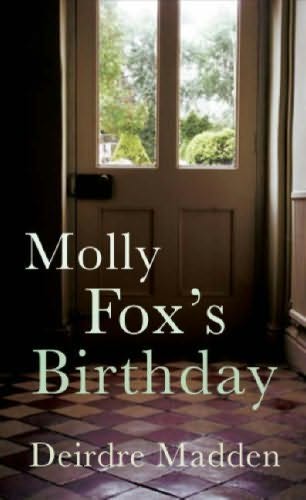
I had my introduction to Ward Just's work with his newest novel, Exiles in the Garden, just a few weeks ago. That book made enough of an impression on me to want to read more. Thank you Mike B. and JRJ for both recommending Forgetfulness, which I finished last night. This is the best fiction I have read since Molly Fox's Birthday. A marvelous and potent book about our recent past, and it is no easy feat to write a novel of our time without trapping the book in lingo and preoccupations soon to be forgotten, joke intended.
** THIS WHOLE REVIEW IS A SPOILER, SORRY. THERE IS NO WAY TO WRITE ABOUT WHAT IS GREAT IN THIS BOOK AND NOT WRITE ABOUT THE PLOT** The book, opens with Florette, a French woman, who becomes trapped in a snowstorm in the Pyrennes on her afternoon walk, breaks her ankle, and is picked up by three strangers who carry her on a stretcher as she slowly dies while moving out of present and past reveries. I wrote about my initial thoughts here. The rest of the novel follows Thomas, Florette's husband, a transplanted American painter, as he adjusts to his life without her.

Thomas's two boyhood friends, who work for the CIA, figure prominently in Forgetfulness. The worlds of this novel are post-9/11 Europe and America and, in a nutshell, Ward considers deeply with this book versions of life post-pain, post-loss, in which one seeks justice and in which one does not. Thomas is a painter, a man prone to reflection rather than violence. But he has done his share of odd jobs for his friends working in espionage. He now must wonder if any of his past actions could have been responsible for Florette's death. Bernard is determined to help his friend by pulling some strings and capturing the men who murdered Florette. He does so, and the crux of this novel is his arranging Thomas's witnessing their interrogation by a French operative expert (who moonlights doing Moliere with the Comedie Francaise). Ward's prose is measured, unsentimental, yet he is capable of drumming up a storm of tension as he does in a magnificent extended scene during which these two artists, the interrogator Antoine, and the painter Thomas, try to exact their measure of justice from the suspects. (I won't say how). The scene is a tour-de-force. I scarcely breathed as I read it, just wishing I could move my eyes faster.
Florette was not an ordinary woman, though I suppose that could be said of almost any woman. No one you knew well was ordinary - and if you loved her, then she was not only not ordinary but unique.
This is the crux of suffering, isn't it? Loss is entirely personal. Your loss is a fact, terrible though it might be. My loss is a tragedy. Victims of wars have been saying some version of this to each other as justification for their next killing for as long as there have been nationalistic or tribal struggles. Ward mixes political players and artistic ones like an artist mixing paints on his palettes, blending the two impulses of humanitarianism and desire for retribution. The impact of this book is how Ward allows them to play out in the hearts and the actions of artist and interrogator.

At one point in the book, Thomas visits one of the cemeteries on the Somme and reflects on World War I.
The Great War was a titanic struggle, a soul struggle, a struggle of civilizations, except it was the same civilization divided only by language and national custom. No one who lived through it returned from it entirely sane. No revenge was too harsh for the victors, no bitterness too deep for the defeated. The war glorified the values of the slaughterhouse. Nothing could justify it. Nothing could even the score, though a generation later the Germans would try.
The depiction of a struggle of civilizations sums up this novel perfectly, except in this case, the characters of individual men stand for the forces that motivated nations. After loss it can feel like the only way to survive is to remember. Justice for some is to pound our memory of our loss into the face of whomever we blame. If the men in a jail cell in Le Havre really did murder Florette and are successfully manipulated, will that really get them to mourn her uniqueness as Thomas does? And if one chooses not to hit back - does that really mean we've forgotten? Forgetfulness is at once deeply considered and action packed. The writing is calm and masterful and its preoccupations are still, largely, our own. It is everything I hope for in a great novel.

Thursday, November 12, 2009

Reading for obligation or for love?

btt button

Suggested by JM:“Life is too short to read bad books.” I’d always heard that, but I still read books through until the end no matter how bad they were because I had this sense of obligation. That is, until this week when I tried (really tried) to read a book that is utterly boring and unrealistic. I had to stop reading. Do you read everything all the way through or do you feel life really is too short to read bad books?

Obligation to whom? Your time is your own; waste it if you wish. I really do feel that life is too short to read bad books, eat junk food, or drink bad wine. I've said it before and I'll say it again! That is not to say, that our tastes, our interests, or our talent as readers doesn't change. So while I feel no obligation to read anything I don't want to (except for a school assignment), I am not ashamed to try something again and am willing to contradict my original opinion by liking it. That happened with Bleak House and it happened with Iris Murdoch's The Nice and the Good (that didn't take until the 4th try). I actually think you do the writer greater honor if you read the book when you are best disposed to appreciate it rather than as some sort of intellectual vitamin pill or dreary chore. Read for love (or at least for like) and you might find you are a better reader.

Tuesday, November 10, 2009

Such stuff as dreams are made on...

Benedict Carry reports today in the Science Times on recent research into the role of dreams by Dr. J. Allan Hobson of Harvard.
Drawing on work of his own and others, Dr. Hobson argues that dreaming is a parallel state of consciousness that is continually running but normally suppressed during waking.
Hobson sees this state tuning the brain for what it will encounter while awake. Dr. Mark Mahowald, another sleep researcher, praises Hobson's work for not letting psychological or literary notions of dreams drive his hypotheses.
Most people who have studied dreams start out with some predetermined psychological ideas and try to make dreaming fit those. What I like about this new paper is that he doesn’t make any assumptions about what dreaming is doing.
I appreciated the reporting which restrained itself from making fantastic claims and instead offered competing interpretations and some of the current sleep and dream research of other labs. The article made a point worth emphasizing - this neuroscientific research on the nature of dreams does not empty a dream of its narrative content nor obviate its psychological interpretation. It makes a hypothesis built on neuropsychological bases and tested with the tools of that trade, and offers an interpretation of its results about what function dreams might fulfill in the brain.

Sunday, November 8, 2009

What drives us to act? - (Books - The Needle's Eye by Margaret Drabble & Forgetfulness by Ward Just)

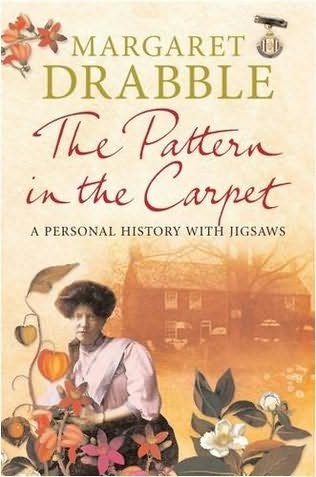
I'm slowly working my way through two novels now, whenever I can catch a moment. Having read Margaret Drabble's recent novel, The Peppered Moth, based on the life of her mother, a fact that causes her great distress, led me to begin her latest book - The Pattern in the Carpet - a non-fictionalized memoir of her aunt which doubles as a history of puzzles and games. I had also recently acquired The Needle's Eye which many of Drabble's admirers think her strongest novel. I have begun reading it and find myself much more interested in returning to it than to The Pattern in the Carpet when I dip into a book before bed. Set in the 1970's, The Needle's Eye relates the intertwining stories of Simon, a reserved man who ascended from the lower to the upper classes of British society, becoming a lawyer. He encounters Rose, a divorced mother of three from a very wealthy family. Rose gave away all her money and lives the voluntary life of the working poor, encountering incomprehension from her family and derision from the press. Simon lived through ambition and now, having the model job and the model family (though in appearance only) doesn't know what to do with himself. He seems to have no passion, no interests, he is unable to connect, to feel his feelings and to act from them. Rose appears to live from clumsy impulse to impulse but is very much alive. Their story is told in lengthy swathes of omniscient narrative in a voice that I'm finding a bit circumlocutory, but the characters are richly drawn and I am interested to see what will happen.

Having just enjoyed my first Ward Just novel, his latest, Exiles in the Garden, I was interested to reading something else of his. Forgetfulness was among his books on the shelf at the bookstore on Friday and it seemed the one to read next. It has a stunner of an opening - for thirty pages, a woman named Florette, is carried on a stretcher through the Pyrenees in the snow having broken her ankle while walking. She doesn't know the men who are carrying her, nor where she is being taken, and she seems unable to speak. It is an interior monologue that moves back and forth between memory and the present. **SPOILER** It is obvious from the get-go that it will end in her death. Her husband, Thomas, a painter and occasional CIA operative, wants to know if her death is merely an accident or if she was murdered because of his work. **SPOILER OVER** Following the tense, hypnotic opening, the present-time action of the book is written in lean, clean prose. The dialogue between Thomas and his two American friends has the feel of a Mamet script - it is very recognizably a conversation between adult American males, but his writer's ear has rendered that artfully rather than simply transcribed dialogue from the corner bar. Being American in Europe post-9/11 is a theme that swirls through this story. Early in it several American tourists come to a bar in the small French town where Thomas and Florette live, and make quite an ugly show of themselves because they don't enjoy the wine they are served.
...It was a terrible thing, nine-eleven, but -

But nothing. But nothing. Jock's life is ruined. And he's angry. He's going to stay angry and that's his right because his life is ruined.

[...]

When they were alone at last, Thomas and Florette sat in a zone of silence, working the incident in their minds. There seemed nothing of it to discuss usefully except the question of forgiveness, mercy offered to a man living in darkness and hating every second, knowing all the while that those most directly responsible were dead and could not be called into account. He was an awful son of a bitch but his situation was not enviable. Grievous injury did not ennoble a man except in special circumstances.
Now it is Thomas who lives in darkness and wants to call to account those who took what he loved. Will he stay angry or be ennobled is the question I ask as I read on. I'm very taken by both the spare writing and the gripping story. I am liking this one even better than Exiles in the Garden.

Friday, November 6, 2009

Novelties II

I said this would be an occasional series. Here's installment number 2. What's new for me in:

Eating: Dark chocolate with chili, courtesy of The Ragazzo. Lindt makes a good one, but I know there are others out there. It's not what you think. The chili flavor combines with the chocolate the way hazelnut does to make a different taste that accentuates certain pleasures of the chocolate. This adds a very slight tang but there is just a touch of heat. I'm toying with the idea of using some to make a chicken mole, but I may just want to eat it all.

Drinking: Huang Mountain Hairpoint Green Tea - yummy, with a pronounced vegetal flavor and a very green color.

Watching: Hitchcock. What a body of work the man produced. Lately we've seen Rear Window, The Birds, and The Man Who Knew Too Much. There has been much to appreciate in Jimmy Stewart's acting too.

Listening: Perhaps I'm the last person to hear of these guys, but if you haven't checked them out - Pomplamoose Music is simply awesome. They do covers of everything from Simon and Garfunkle and Edith Piaf to Biancee. They work with the instruments they have at hand and they are genuine, passionate, immediate, and iresistably creative. I'm crazy about them.

Web surfing: These amazing photos,

Learning: There's a difference between being humiliated and being humbled and I might want to work on it, that's what my friend Kate said.

So, what's new with you?

Thursday, November 5, 2009

Reading lives...

btt button

Which do you prefer? Biographies written about someone? Or Autobiographies written by the actual person (and/or ghost-writer)?

Memoirs can be wonderful. To hear the writing voice of someone you know for something else, acting or politics, and to see what it is they choose to show of themselves can be very revealing. Alec Guiness has written a couple of wonderful volumes about himself, as has writer May Sarton and I love publisher Katherine Graham's Personal History. I also love reading letters or journals - painter Emily Carr, composer Ned Rorem, and actor John Geilgud all come to mind. The journals of Victor Klemperer are an amazing history of the Nazi's infiltration of German life kept day by day. I find them particularly interesting when the writing makes me think that they were not intended for publication. These form an autobiography of sorts that's an analogue of a candid photo as compared to a studio portrait. Ghost written autobiorgraphies really depend on the quality of the ghost writer. Superstar-of-the-moment books obviously mass produced to sell as many copies as possible hold no interest for me. Great biographies are a favorite genre of mine. David McCullough's biography of John Adams is a masterpiece and I remember loving Merle Miller's oral biography of Harry Truman. I have Simon Callow's two volumes about Orson Welles from my friend Sheila sitting on the top of the pile for a time I get enough brain space to dive into them. While I enjoy a mammoth toe-nail-clippings-and-all biography, I have a special admiration for the succinct telling of a life with a specific angle. The one that rapidly comes to mind is Mountains Beyond Mountains, Tracy Kidders' masterful portrait of physician Paul Farmer. An inspiring book if there ever was one. I'm aware in it that a writer has choosen to write a particular story in a particular way, the life that is the subject does not entirely engulf the work of art that is the book, if that makes any sense.

I'll try to add links to this post this evening, right now I'm late for Grand Rounds!

Sunday, November 1, 2009

Are you in or are you out? (Books - Exiles in the Garden by Ward Just)

I had yet to read a book by Ward Just before picking up his latest, Exiles in the Garden. It is set in Washington D. C. and concerns Alec Malone, a senator's son who rejects a life in politics in favor of one as a photographer. It also concerns the women in his life, particularly Lucia, a Swiss emigre searching for a sense of belonging. Actually, that is what everyone in this book is doing, looking to belong somewhere or to something or someone. All the characters we meet from the 1960s to the 2000s are in various stages of aloneness or togetherness. We watch Alec's father's protracted final illness in which he searches his memory for clues of what connected him to life - politics - and his incomprehension at his son's disinterest in pursuing that calling. For a while, Alec and Lucia live in a house with a garden in Georgetown next to one inhabited by Central European immigrants, ambassadors and attaches, who hold frequent parties that are typical of the life Lucia misses in Switzerland. She hungrily attends them to bathe in that sense of familiarity, while Alec is more of a loner, a voyeur (not inappropriate for a photographer). Alec begins his professional life as a photojournalist but later becomes an independent artist.

The key event of the book is Alec's refusal of a job shooting the Vietnam War, ostensibly because Lucia doesn't want him to go, but mainly because he is troubled by the fact that most photography is useless and the pictures would not contribute anything of value. They were not service to country at all - they would have just a sham sort of meaning.
Alec wondered if he had made a mistake refusing the managing editor's offer. And did doubt lead him to his father's office seeking - what? Absolution? An argument? In the newspaper business war was the jewel in the crown. And his father was correct, he did have the eye for it and the agility. At the age of ten, Alec was taking photographs for the old man's campaign, learning to blend into the scenery, though the trick was to make not yourself but your camera disappear. Your eyes did the work but in the excitement of the moment your eyes were filled with emotion. Probably the same was true for a war, perhaps more emotion than your eyes could accept, not that it mattered now. Whether his father was correct about fear was another question, one that could be answered only in the event. The truth was, Alec had no desire for the war, and desire always came first. Without desire you were not a craftsman but a careerist doing what they told you to do in hopes that something wonderful would happen, a prize or a shot such as Capa's of the falling militiaman.
This choice of Alec's is the crux of the novel, and an interesting one too given that Just himself was a war correspondent turned novelist. Are you in or are you out - this book asks. It is hardly an accident that Lucia is Swiss - the supposedly neutral nation (although inaction is action too, of a sort, it has consequences at any rate). Both Alec and Lucia's relationships to their fathers are central to this story. Alec has a troubled relationship to his, as his choices in life are driven by very different engines. Lucia romanticizes hers, who she never met as he disappeared during the war and supposedly died there, but there are rumors that he was a resistance fighter and ultimately survived.

This book is about exile versus belonging - does one live in the fray or outside it? It doesn't pass judgment on the choice but rather examines the kind of people who make each - what motivates them, their satisfaction or dissatisfaction. Actually, that's not completely true, I felt the narrator ultimately did judge Lucia - despised her even - but that is because the story is ultimately Alec's. While Lucia is an exile in the sense that she lives away from her country of origin, Alec is an outsider wherever he goes. He lives on the fringe, observing and capturing bits of time. Focusing on Alec, it is not inappropriate that the book's voice is a detached one, gliding across 50 years time, landing just on the key episodes that end up joining together as a tale of key episodes rather than as a conventionally detailed plot. For a while I was dissatisfied by the sense that I was never really getting to know the characters, the narrative was composed of great swathes of generalities. But I found that the details accumulated and by the book's end I knew these people, could anticipate their behavior, and cared about their choices.

Having read this latest book of Just's, I am now interested to read an earlier one. Any recommendations?

Thursday, October 29, 2009

The blurb...

btt button

Suggested by Jennysbooks: Something I’ve been thinking about lately: “What words/phrases in a blurb make a book irresistible? What words/phrases will make you put the book back down immediately?”

I don't think there is a word or phrase in a blurb or review quote that will make or break me. Perhaps if a blurb characterized a book as full of blood and gore, or if something in it indicated that the subject or narrator of the book were obnoxiously holy, racist, sexist, or homophobic I would probably put down the book, but it's the general thrust of blurbs that speak to me. It puts me off when there are too many blurbs. Some paperbacks have pages of them from every newspaper in the world. Make a choice. They rarely say anything different. Many compare the writer to another writer, usually one that has sold many books. Sometimes I am aware that a blurb was only stuck in because it mentioned yet another author's name, on the chance that that one comparison will be the only writer the prospective customer has ever heard of. It's especially ridiculous when two successive blurbs compare the author to such different authors that the comparisons clearly don't reflect the publisher's opinion about they book, they just reflect their desire to sell more copies by appealing to different markets - say, "reminds me of Nicholas Sparks..." and "this is a great novel in the tradition of Faulkner." Desperation is the greatest turn-off in book sales. The surest way to get me not to buy a book is to use hyperbole. "The greatest," "the best," "it will change your life," "more meaningful than the bible, only shorter." Give me a break.

Generally it is the quality of the author of the blurb or quote makes a difference, unless I know that there is an established connection between the blurb author and the book's. I have seen blurb's written by an author's mentor. That like having a review written by your mother. But if the blurb writer is a talented writer and says something specific about the book that makes me think that it has an original voice or tells an involving, moving, or important story, combines ideas in unique ways, or captures a period or place I'm interested in creatively, I might go for it. If it's a review quote I am also swayed, snob that I am, by the literary quality of the publication the review came from. Basically, if a good writer tells me this book or writer has value and the subject matter or genre doesn't put me off, I might be reeled in. Just don't try too hard.

That would be the perfect costume for a literary Halloween party - go as The Blurb! But if you do it, please remember to credit me.

Monday, October 26, 2009

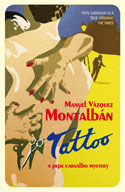
Ex-cop, ex-Marxist, gourmet noir (Books - Tattoo by Manuel Vazquez Montalban)

I received a review copy of the re-issue of of Manuel Vazquez Montalban's Tattoo last week. Serpent's Tail press has reissued several of his Pepe Carvalho mysteries in attractive paperback editions with retro covers. The time is the mid 1970's as Spain is extricating itself from dictatorship. The setting - Barcelona and Amsterdam. The plot is uncomplicated. It features the mystery of a corpse found floating in the sea, its face so badly destroyed he can only be identified by a tatoo. Pepe Carvalho is hired to find out who it was. It was perfect timing for a book like this as I am knocked out by a nasty upper respiratory bug and was in desperate need of something occupying and not too heavy. This is noir with a wink. Montalban's Carvalho is a hardboiled philosopher who has checked out of caring too much about anything except sex and food, or as Montalban writes:
'What are you exactly? A cop? A Marxist? A gourmet?'

'I'm an ex-cop, an ex-Marxist and a gourmet.'

What I enjoyed most is how Montalban didn't merely dress up a classic mystery with Carvalho's quirks. He informed even his detective's crime solving skills with these same characteristics:
His mind began to fill with the old logic that sought links between cause and effect, between good and evil. But as soon as this logic became demanding and insistent, an alarm bell went off in his head, and he dismissed all the arguments. He wanted nothing more to do with any analysis of the world he lived in. He had long since decided he was on the journey between childhood and old age of a personal, non-transferable destiny, of a life that nobody else could ever live for him, no more, no less, no better, no worse. Everybody else could go get stuffed. He had deliberately restricted his capacity for abstract emotion to what he could get from the landscape around him. All his other emotions were immediate, skin deep.
This is a man who uses old copies of Don Quixote from his library of several thousand volumes as kindling so that he can have the comfort of a fire while he eats the bacalhao he prepared. You will sooner see him sauteeing onions and tomatoes than packing a pistol and trailing suspects, though he does his reluctant share of those more typical detective-like activities as well. Carvalho may be nihilistic but Tattoo is entertaining as well as swift-moving. I noticed that there is another mystery set in Buenos Aires. I may try that one next.

Saturday, October 24, 2009

Novelties I

I'm going to institute an occasional series - Novelties, I think I'll call it. About once a month I'm going to list a new thing (or two) I've: eaten, drunk, watched, listened to, visited on the web, and learned lately - since life should be full of novelty, of newness. What would York be without the New? What a shot in the arm Orleans got. Feel free to join in...

Eating: kholrabi slaw - julienned kholrabi (or green cabbage), sliced radishes, lots of fresh cilantro, in mustard cumin dressing - mmmmm.

Drinking: Gobelsburger Gruner Veltliner

Watching: The films of Almodovar -bought a boxed set with most of this master filmmaker's work - an amazing and singular body of work.

Listening: Der Rosenkavalier - I've been listening to the classic 1950s von Karajan recording with Elisabeth Schwarzkopf and Christa Ludwig, but I have the Solti recording with Regine Crespin and Yvonne Minton coming in the mail.

New places I'm visiting on the web: Seven Impossible Things..., The Hermitage, Armel Gaulme.

New thing I learned: That such a thing as a knitwear comb or sweater comb exists. They are meant to comb away the pills on your knit clothes and make them look like new. Now to find one...

Thursday, October 22, 2009

Lunching with Chekhov...

btt button

If you could ask your favorite author (alive or dead) one question … who would you ask, and what would the question be?


I would ask Anton Chekhov to tell me as much as he could about what it was like to collaborate with Stanislavski and all the Moscow Art Theatre folks on THE THREE SISTERS and THE CHERRY ORCHARD. I would serve a long lunch and there would be several bottles of wine (or vodka if he preferred) so that I could ply as much out of him as I possibly could.

Tuesday, October 20, 2009

You must remember this...

Nicholas Wade reports in today's Science Times on the work of Dr. Gero Miesenböck's lab. Its carnival-barker headline cries: Researchers Create Artificial Memories in the Brain of a Fruitfly. If one reads the article, its claims are a little more circumspect but no less impressive. The lab identified dopamine producing neurons in the nervous system of flies that seem to perpetuate shock avoidance behaviors. These cells do their work by converging on a second class of neurons - Kenyon cells - which receive information about stimuli from the fly's antennae. Typically the fly can be conditioned to learn avoidance of a stimulus other than the shock - like a particular odor perceived by the antennae or a flash of light - through conditioning. Conditioning creates an association between the shock and the new stimulus which results in the fly behaving to the light or odor as it would naturally behave to a shock - by avoiding it. Miesenböck and friends genetically manipulated the flies so that their Kenyon cells would automatically respond to the light flash as though it were a shock without ever having been conditioned to do so. Then they then tested their manipulation by doing a typical conditioning experiment through which the flies would learn to associate a smell with the light, reacting with avoidance.

When lasting learning is accomplished, exposure to certain stimuli perpetuates structural or chemical changes in neurons. Any time cell structure is altered, a gene must first be induced to create a chemical template that leads to the assembly of a protein. Proteins are the basic units of cellular components, whether structural or chemical. The presence of these proteins, then result in the proper change in the cell which might be the production of a neurotransmitter, or the insertion or removal of a particular type of channel into a neuron membrane. The researchers in this case, altered the gene directly, creating a fly that never had to learn to respond to a light flash as though it were a shock. Through multiple experiments like these they hope to map the neural circuits that associate stimuli with behavior and lay bare the circuitry through which creatures learn.

It all makes me think of this little ditty, sung by Sam in Casablanca (words and music by Herman Hupfeld). It seems today to typify associative learning. Now, if we decide it, flies must remember this. No fundamental rules apply...

This day and age we're living in
Gives cause for apprehension
With speed and new invention
And things like fourth dimension.

Yet we get a trifle weary
With Mr. Einstein's theory.
So we must get down to earth at times
Relax relieve the tension

And no matter what the progress
Or what may yet be proved
The simple facts of life are such
They cannot be removed.]

You must remember this
A kiss is just a kiss, a sigh is just a sigh.
The fundamental things apply
As time goes by.

And when two lovers woo
They still say, "I love you."
On that you can rely
No matter what the future brings
As time goes by.

Moonlight and love songs
Never out of date.
Hearts full of passion
Jealousy and hate.
Woman needs man
And man must have his mate
That no one can deny.

It's still the same old story
A fight for love and glory
A case of do or die.
The world will always welcome lovers
As time goes by.

Oh yes, the world will always welcome lovers
As time goes by.

Monday, October 19, 2009

A refusal to be ordinary (Books - The Victoria Vanishes by Christopher Fowler)

The Victoria Vanishes was a funny, smart, and satisfying mystery, containing Christopher Fowler's trademark detective team - Bryant and May and their Peculiar Crimes Unit - and driven by a disdain for the ordinary.
'I hate small-mindedness,' he suddenly announced after several minutes of contemplative silence. 'The notices everywhere warning us not to trip over or turn left or take our dogs off leads. That annoying recorded voice in post offices telling you which counter is free. I bought some peas in the supermarket last week and do you know what it said on the packet? "Does not contain nuts." I hate the endless admonishments of a nanny state that lives in fear of its lawyers...

Once our children played on bomb sites and collected exploded shells. Now they're driven to school by paranoid parents in SUVs. The determination of dullards can always be counted upon to challenge the merits of innovators.' He noisily sucked on the pipe until the bowl's embers sparkled against the cloud-grey waters. 'To be popular in this city you have to be average, and the PCUs unusual approach to the attainment of excellence won't allow it to survive.'
Bryant's cranky refusal to be ordinary (as if it were a choice) is the amusing common theme of this entertaining detective series and an older London that is visible beneath the veneer of the contemporary one is its backdrop. Fowler celebrates the value of people who don't fit in with wonderfully written characters, and weaves the treasures of his city's history cleverly into the intriguing plots of his mysteries. This one had a particularly good twist, although I found the denoument a little on the long winded side. The final pages offer a list of the pubs and their addresses that Fowler mentions (pubs are the important element of London history that figure in this book). An excellent resource for my next trip to London!

Here are my other posts on The Victoria Vanishes 1, 2.

Saturday, October 17, 2009

Adding to the bookish frenzy...

After all that noble stuff in my last post about my great weeding habits (I sound like Elmer Fudd) I must now report that it is all bunk. Don't believe that guy who wrote here on Thursday. On Friday I acquired 3 new treasures and I'm darn pleased about it.

Having reading Irish novelist Deirdre Madden's latest, Molly Fox's Birthday, this summer and raved about it, and then having read an earlier work of her's - One by One in the Darkness - and confirmed my admiration of the humanity of her vision and the sophistication of her voice, I decided I wanted to see from whence it all came. I ordered her first novel - Hidden Symptoms (1986) - from a second hand bookseller and it arrived yesterday. Theresa, a university student, experiences her faith come up against the cruelty of the violent death of her brother. Her The Birds of the Innocent Wood, Authenticity, and Remembering Light and Stone also sound like thoughtful and complex works that are going to be worth reading. Much to look forward to!


Last night, before meeting an old friend for dinner, I was near a bookstore - a rare occurrence these days - and dropped in for a browse. A few dollars later I was the proud owner of two new novels - Ward Just's recent Exiles in the Garden. He is an often praised novelist I have yet to read. This work sounds an interesting mix of politics and moral choices from an American as well as a European perspective. The other is Joseph Kertes new epic novel set in Hungary under Nazi occupation. Gratitude involves fictional characters interacting with Raoul Wallenberg, an actual figure from recent history - a Swedish humanitarian who worked to rescue Jews from murder by the Nazis. The novel is compared to The Garden of the Finzi-Continis, that's a jacket blurb to live up to. I'm excited to see how it holds up!

Thursday, October 15, 2009

Controlling the bookish frenzy

btt button

When’s the last time you weeded out your library? Do you regularly keep it pared down to your reading essentials? Or does it blossom into something out of control the minute you turn your back, like a garden after a Spring rain? Or do you simply not get rid of books? At all? (This would have described me for most of my life, by the way.) And–when you DO weed out books from your collection (assuming that you do) …what do you do with them? Throw them away (gasp)? Donate them to a charity or used bookstore? SELL them to a used bookstore? Trade them on Paperback Book Swap or some other exchange program?


I live in a New York City-sized apartment and therefore weed my library regularly. For a while, early in my career working as a theatre-artist, I ate my way (literally) through many books and LPs. I would sell them off a little at a time to meet my bills for rent or food. Occasionally I will look for a book and think, what ever happened to that one, and then think - Oh! I must have eaten it. Nowadays I weed the collection to make sure there is only one row of books per shelf and to keep the piles of books-to-be-read to a controlled frenzy. Generally I'll bring them to Strand Book Store and get a little cash for them. Sometimes I'll give one away here or to a friend. I have yet to use a trading forum.

Wednesday, October 14, 2009

The feeling of having time stretch before you... (Books - The Pattern in the Carpet by Margaret Drabble)

Margaret Drabble writes in the introduction to The Pattern in the Carpet about the discomfort she experienced in writing about members of her family in her novel The Peppered Moth.
I wrote brutally about my mother's depression, and I never wish to enter that terrain again. It is too near, too ready to engulf me as it engulfed her...I had hoped that writing about her would make me feel better about her. But it didn't. It made me feel worse.
Uncomfortable or not, Drabble is at it again, writing in this book about her Autie Phyl and in the even less-disguised form of a memoir, although the book is doing double-duty as a history of puzzles and other pastimes. Whether her reticence is cultural or personal, healthy or not I am glad she's gotten over it.
As she went to bed that night, she said that she wished we had been able to finish the jigsaw. 'It's a pity,' she said, as she gave up. 'It's a pity.' It was the last evening of the last summer. We had tried to finish it. We sat up late, past midnight, struggling with patches of tree and fern and grass and sky. In the morning, we would have to drive away and leave it incomplete on its table, for others to finish another day. It was unsatisfactory. She knew she would never come back. She knew it was her last summer with us It was Thursday, 7 August 1997, and she was eighty-eight. She was getting older, and I was getting older, and the journey back to her home was across country and very long. Next year, even if she were still alive, it would be too much for both of us. Neither of us mentioned this. There were many things we never mentioned. But she knew, and she knew I knew.
In a way this is a book of unmentionables, since Drabble was never going to write about family again. The tone she sets with that opening paragraph is calm and measured. It feels, indeed, like one of those late summer evenings that feel they could go on for ever. I found myself reading the narrative bibliography of this book before starting the story-proper. Drabble seems to have had a grand time researching childhood pastimes, card games, collections, and puzzles. Her description of how one title led to another made me envious of her research in the subject, before remembering that I have nothing to envy. I have a least two papers to write this semester and if I find that pastime so romantic, why haven't I made more progress?

Drabble's description of how and why she did, and still does, puzzles:
We always started with the frame. Auntie Phyl taught my sisters and me how to pick out all the straight-edged pieces of jigsaw first, to find the corners, and to build up the four sides. then we would begin to sort the colours, and to construct areas of the picture. Unlike some people, we did not have a set procedure for this stage of the puzzle, and we were never of the willfully austere school that does not look at the picutre on the box. Looking at the picture for us was part of the pleasure. Doing a jigsaw was not an intelligence test, or a personality assessment programme; it was a pursuit that lay somewhere between creation and imitation and discovery and reverie. And it was not, fur us, a form of competition.
That is just how my grandmother and mother taught us to do puzzles. I loved the feeling of having time stretch in that seemingly endless way before me! The last two sentences in the above paragraph interested me particularly. Drabble defines puzzles very much in the negative, and since her rivalrous relationship with her sister A. S. Byatt is somewhat renowned, it is interesting that one of the attractions she feels towards puzzles is that they provided a refuge from competition. In any event, more on this book as I continue my reading of it.

Friday, October 9, 2009

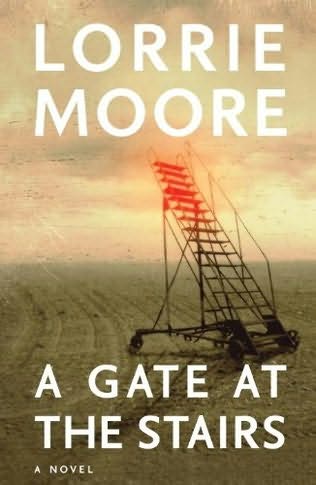
Water, water everywhere... (Books - A Gate at the Stairs by Lorrie Moore)

I read Lorrie Moore's new novel, A Gate at the Stairs, as a subtle tragedy on the wastefulness of our recent past, using a personal narrative to tell a story of wide-reaching cultural disconnect. How, in this world, we can have had the ultimate in freedom but have failed to be responsible, so much desire but have failed to connect, so much knowledge and yet have been so unwise. We trade rhetoric about racial prejudice in America like tupperware, but the words are hollow and lack follow through. We have betrayed our role as stewards of the free world.

Tassie, the young narrator in A Gate at the Stairs, faced with the possibility to learn of a rich world at her university, fills her time with courses on wine tasting and film scores (not that those are inherently bad subjects). A young woman adopts a baby and then immediately goes back to work, leaving someone else in charge. This book is filled with a deep aching loss in the midst of abundance. It is rendered elegiacally, almost calmly (except for one key narrative of heart-racing tension), yet it is filled with Lorrie Moore's trademark humor too and an almost accidental quality to the action. Ultimately it leaves the reader, I think, with a glimmer of hope in our ability to learn from our lives. I found it poignantly beautiful and have continued to think about it since I finished it. Here are my other posts on it 1, 2, 3.

Tuesday, October 6, 2009

The uses of poppycock.

In today's Science Times Benedict Carey reports on a series of studies about total nonsense.
The brain evolved to predict, and it does so by identifying patterns. When those patterns break down - as when a hiker stumbles across an easy chair sitting deep in the woods, as if dropped from the sky - the brain gropes for something, anything that makes sense...The urge to find a coherent pattern makes it more likely that the brain will find one.
Experimentally this was investigated by Drs. Travis Proulx at University of California and Steven J. Heine at University of British Columbia by exposing subjects to either an absurd short story or to a more conventional one. Following this exposure, the students studied strings of letters with no apparent relationship to one another. Those students exposed to the absurd story remembered the letter strings far more accurately than the group that read the other story. The experimenters attribute that accuracy to their ability to create new patterns. Here's a link to the study.

Artists have used this technique for years. Courting a sense of disorientation can often be better fuel for creative explosion than a technique or rehearsal process that proceeds logically through steps of increasing knowledge and order. I'd love to do a variation on the reported study. It might be meaningful to find two varying situations for the same story rather than test two different stories, that is, create or identify one group for whom the story or some other stimulus is absurd and another for whom it is not and test their memory accuracy. A religious stimulus could be interesting - there are people for whom certain patterns of information or iconography possess serious meaning but which non-believers find to be absurd nonsense. How would these groups perform on the memory test if exposed to the exact same stimuli? This makes me want to run out and read Jabberwocky rather than an article on sub-cortical brain systems involved in visual perception in order to prepare for this morning's test.

Monday, October 5, 2009

First prize for most beautifully painted toenails goes to... (Books - The Victoria Vanishes by Christopher Fowler)

Have I mentioned what a funny writer Christopher Fowler's is? He writes the quirkiness of his detective duo - Bryant and May - with insight into what it is that makes certain people uncomfortable about those who think and behave differently from themselves. The Peculiar Crimes Unit may be abused as a garbage heap for unsolved cases, a place to lay blame for failure, but at its best it is meant to take advantages of the eccentricities of Bryant and May in solving the unusual crime, finding the unordinary criminal thinking - an unconventional mind is going to have greater success getting inside the mind of an unconventional criminal.

I did mention that the first chapter of The Victoria Vanishes sports a murder. The second sports a wake, the wake of the PCU's coroner - Oswald Finch who dies under his own examination table in the morgue, as Arthur Bryant eulogizes:
'...and now he'll never get to enjoy his twilight years in that freezing, smelly fisherman's hut he'd bought for himself on the beach in Hastings. Now I know some of you will be thinking "And bloody good riddance, you miserable old sod," because he could be a horrible old man, but I like to believe that Oswald was only bad-tempered because nobody liked him. He had dedicated his life to dead people, and now he's joined them.'

One of the station house girls burst into tears. Bryant held up his hands for quiet. 'This afternoon, in a reflective mood, I sat at my desk and tried to remember all the good things about him. I couldn't come up with anything, I'm afraid, but the intention was there. I even phoned Oswald's oldest school friend to ask him for amusing stories, but sadly he went mad some while back and now lives in a mental home in Wales.'

Bryant paused for a moment of contemplation. A mood of despondency settle over the room like a damp flannel. 'Oswald was a true professional. He was determined not to let his total lack of sociability get in the way of his career. True, he was depressing to be around, and everyone complained that he smelled funny, but that was because of the chemicals he used. And the flatulence...'
I can just imagine Fowler chortling at his desk as he wrote Bryant's eulogy for Oswald. It's black humor, to be sure, but it's not that often that reading gives me a good old out-loud guffaw. Evidently the book won 2009's Last Laugh Award for funniest crime novel - it sounds like the awards they think up for children in elementary school or summer camp just so that everyone gets one and doesn't burst into tears. 'And Virginia wins first prize for most beautifully painted toenails on the left foot...'

Sunday, October 4, 2009

Unconventional crime solving and coming of age in a void (Books - The Victoria Vanishes & A Gate at the Stairs)

Classes + 3 experiments + seeing patients has thrown me into overdrive and my entire schedule out of whack. It is leaving me much less time for reading not related to school. When I do find the time, it seems to be in smaller chunks because I fall asleep - I can't get up a good head of steam on any of my reading right now much as I enjoy the few minutes I can snatch each night. Lately I've been flitting back and forth between books already started and a bunch of recently acquired treasures:

I have written about Christopher Fowler's less than ordinary detective team - Bryant and May - and their Peculiar Crimes Unit
before here and here. When all other units fail, this rag tag bunch of thinkers-out-of-the-box handles crimes that don't fit the conventional mold. Fowler combines a good sense of comedy, an enjoyment of London history (the theatre during WW II, underground waterways, and now the venerable institution of the English pub), and a well-plotted mystery. I have been looking forward to another one. The Victoria Vanishes opens with a murder that gives an example of the way Fowler's writing combines a good sense of atmosphere and an intense energy:
It was ridiculous, she was surrounded by people but the noise of laughter and conversation was drowning her out. The crush of customers made her even more invisible. He was hurting her now. She tried to squirm out of his embrace.

Something stung her face hard. She brought her free hand to her cheek, but there was nothing. It felt like an angry wasp, trapped and maddened in the crowded room. Wasn't it too early in the year for such insects?

And then he released her arm, and she was dropping away through the beery friendship of the bar, away from the laughter and yeasty warmth of life, into a place of icy, infinite starlight.

Into death.

I am struck currently in Lorrie Moore's A Gate at the Stairs by the character of Sarah - a white, yuppie restaurant owner who adopts an African American child. She ends up, because she experiences the racist comments of some of her neighbors, creating a support group for multi-racial families. Moore can at once treat the subject seriously and mine it for great comedy. We experience the group meeting through Tassie's ears - the college student hired to babysit Sarah's adopted daughter Mary-Emma - as a desultory stream of empty rhetoric about Muslims, black hair, racism, vegetarians, Jews, Karl Rove, Pete Seeger, and humane treatment of chimpanzees. The group seems, like the adoption, to be another of Sarah's empty promises. It's full of the surface of the thing, but not the intellectual focus or the depth of love needed to do it seriously. Just like television. I laugh at Moore's script of these meetings, but I cringe too as this is Tassie's coming of age story and rather than an environment rich in love, good or outlandish taste, complex political discussion (conservative or liberal), or even drugs or music, it is filled with an unloved baby, a loveless marriage, professional ambition, uninformed fear of others, college courses in wine tasting, and people who cannot talk to each other. They engage in parallel monologues so empty of substance that the air can be heard to whistle through them.

I wanted to write about Margaret Drabble's new memoir The Pattern in the Carpet too, but I am going to hold off on that as I have to get to the lab (yes, on Sunday).

Thursday, October 1, 2009

Liar, liar, pants on fire

btt button

Suggested by Monibo. Saw this article (from March) and thought it would make a good BTT confessional question:

Two-thirds of Brits have lied about reading books they haven’t. Have you? Why? What book?

We don't do that on this side of the Atlantic (yeah, right). I know that there are any number of school assignments I have suggested that I read by nodding knowingly. As an undergraduate I couldn't stand Dickens's Bleak House. I now love it, but at the time I could not get through it and so I had my roommate tell me the story in order to write my final. I think I may also have claimed to have read all of Shakespeare's work in my time and there are probably a couple of poems and plays I still haven't gotten around to (I find Henry VI and Henry VIII deadly boring). For the most part, the vast amount of books I haven't read just provides me with the certainty that there is lots out there to look forward to. I don't feel as though I have to lie about it.