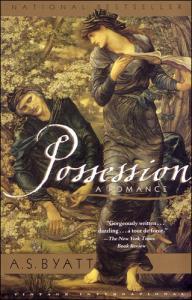
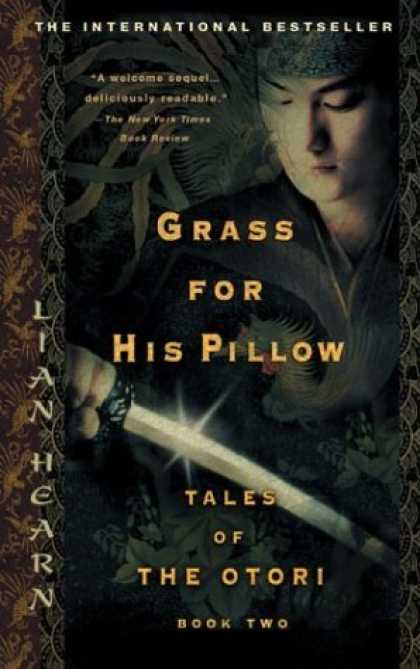
For my other thoughts about Possession take a look here, here, here, here, here, and here.
Next up: Man in the Holocene by Max Frisch.
Literature good and bad, theater,and neuroscience....no really.
I can't write down Gode's way of telling things. My father has from time to time encouraged her to tell him tales which he has tried to take down verbatim, keeping the rhythms of her speech, adding nothing and taking nothing away. But the life goes out of her words on the page, no matter how faithful he is. He said once to me, after such an experiment, that he saw now why the ancient Druids believed that the spoken words was the breath of life and that writing was a form of death.I thought those interesting, perhaps even risky, words to put into a book about writers and writing. As though Byatt were purposely calling our attention to the potential of the writer's words to fail to convince, even as she hopes to convince us of the verrisimilitude of her multiple universes. Or perhaps she is reminding us that what we are reading is, too, a tale and that written words cannot possibly do justice to the actual events.
Know you not that we Women have no Power
In the cold world of objects Reason rules,
Where all is measured and mechanical?
There we are chattels, baubles, property,
Flowers pent in vases with our roots sliced off,
To shine a day and perish. But you see,
Here in this secret room, all curtained round
With Vaguest softness, all dimly lit
With flickerings and twinklings, where all shapes
Are indistinct, all sounds ambiguous,
Here we have Power, here the Irrational,
The Intuition of the Unseen Powers
Speaks to our women's nerves, galvanic threads
Which gather up, interpret and transmit
The unseen Powers and their hidden Will.
This is our negative world, where the Unseen,
Unheard, Impalpable, and Unconfined
Speak to and through us - it is we who hear,
Our natures that receive their thrilling force.
Come into this reversed world, Geraldine,
Where power flows upwards, as in the glass ball,
Where left is right, and clocks go widdershins,
And women sit enthroned and wear the robes,
The wreaths of scented roses and the crowns,
The jewels in our hair, the sardonyx,
The moonstones and the rubies and the pearls,
The royal stones, where we are priestesses
And powerful Queens, and all swims with our Will.
I was so pathetically easy to forget about Chuck, to talk about prom even though I didn't give a shit about prom. Such was life that morning: nothing really mattered that much, not the good things and not the bad ones. We were in the business of mutual amusement, and we were reasonably prosperous.reflective:
I spent the next three hours in classrooms, trying not to look at the clocks above various blackboards, and then looking at the clocks, and then being amazed that only a few minutes had passed since I last looked at the clock. I'd had nearly four years of experience looking at these clocks, but their sluggishness never ceased to surprise. If I am ever told that I have one day to live, I will head straight for the hallowed halls of Winter Park High School, where a day has been known to last a thousand years.funny:
both my parent are therapists, which means that I am really goddamned well adjusted.dead-on about adolescent nerds:
Ben's voice rose with excitement. "You were with Margo Roth Spiegelman last night? At THREE A.M.?" I nodded. "Alone?" I nodded. "Oh my God, if you hooked up with her, you have to tell me every single thing that happened. You have to write me a term paper on the look and feel of Margo Roth Spiegelman's breasts. Thirty pages minimum!"and beautiful:
"I want you to do a photo-realistic pencil drawing, " Radar said.
"A sculpture would also be acceptable," Ben added.
Radar half raised his hand. I dutifully called on him. "Yes, I was wondering if it would be possible for you to write a sestina about Margo Roth Spiegelman's breasts? You six words are : pink, round, firmness, succulent, supple, and pillowy."
"Personally," Ben said, "I think at least one of the words should be buhbuhbuhbuh."
Margo, as always, biked standing up, her arms locked as she leaned above the handlebars, her purple sneakers a circuitous blur. It was a steam-hot day in March. The sky was clear, but the air tasted acidic, like it might storm later.
Do you give books as gifts?
To everyone or only to select people?
How do you feel about receiving books as gifts?
Yes, but not exclusively. Yes, but not always. I love it, unless I don't like the book.
There are two kinds of gift giving. With one kind you give someone what you know they want because you ask them - 'is there anything special you want for your birthday... chanukah... christmas...whatever?' That's sort of parental gift giving (in-laws included, or in my case in-not-laws) . It's safe. It either comes from fear of disappointing someone, or a life-long habit of giving your children what they want. So on the one hand, it's really generous. The receiver gets exactly what they want, but they don't get a surprise, nor do they get one of the important by-products of the other kind of gift. I'll explain in a minute. Giving what you know the recipient wants is safe and generous, but it's unimaginative. Going to someone's Amazon gift list is a second cousin of this approach, there's an added surprise of which of the many things you want you will receive. Gift cards is another relative of this approach - the recipient can get themselves whatever they want whenever they want it, and these days, the buyer doesn't even have to get their lazy ass to the actual store. I saw cards for Barnes and Noble, Loews, Macy's, Starbucks, and who knows what else, all spinning on a rack at Staples, which is a mere block from my house. Granted, it's awfully convenient to shop this way, given how busy life can get.
The second kind of gift means the giver has to imagine what the recipient might like. Now this is Rorschach-like test of the giver, the giver puts themselves into the gift (there's that important by-product I was talking of earlier) because at the end of the day they only have their own taste, their own intellect, or the courage of their convictions, that this gift will be meaningful, useful, or appreciated. You are also giving the gift of reflection. You are telling the receiver what you think of them with your choice. That is an act of boldness, a risk taken for the person, which is itself a gift. (That, or you are one of those gift-givers who gives something you think will be good for the recipient. Yuck, is all I have to say to that! That's like inviting someone to dinner and feeding them a vitamin.) Another relative of this kind of gift is making someone something. With any type 2 gift, you have thoughtfulness and the element of surprise, but the recipient could already have one or, worse yet, have never wanted that hideous duck-shaped lint brush to begin with.
I do frequently give books as gifts because, let's face it, I like books. The receiver knows they are getting something that I, think is valuable and desirable. And when I do, I give a book I think the recipient would enjoy or find meaningful. If a child doesn't like to read, I might still consider giving what I think is a really great book in the hopes that they will. But I won't give a adult who I know to be a non-reader a book. That's just obnoxious. When I meet and get to know a person, one of the ways I characterize them is by what they read (if they are an avid reader). I know I am someone's friend when I know what they have read. And then I sift through my great reading experiences and think - of those, what would this person like? I am really asking how can I take a great experience that I had alone and share it with someone. And I cannot think of a better gift than that. Or sometimes I haven't read the book and I am asking them to have the experience for me by proxy. If someone reads I won't buy a book every time. Sometimes some music, a tin of tea, or those funky martini chillers just seem the right thing. But usually I will buy a book. For one thing, I can go to a bookstore, preferably a real, old-fashioned one with a door on the front and books on shelves. Although on-line ones with free shipping really rock with my graduate student's schedule. It also means I can avoid the hated task of waiting on line at the post office.
As for receiving books as gifts, I love them, except when I don't. That's the risk the giver takes. But I appreciate them no matter what. The real fun is getting a book I don't already have, that I never asked for (or even better, that I have never heard of) and loving it! I read On Beauty after receiving it as a gift from a friend. I got A Night at the Opera - which is a guide to opera plots, singers, and such, but written as a spoof. It's a hoot, and not only did I not know it. I would never have thought to buy it for myself. I have also received the book-equivalent of the duck-shaped lint brush. But not every gift has to be wildly imaginative. I love getting a gift card for a book store. I'm thrilled when someone takes a title off my wish list. Really. It's a gift. Bring it on - I love getting stuff. My birthday was just last week and I don't mind late gifts, but we already have a duck shaped lint brush, thanks.
This morning, for the first time in many years, I passed the shop on Seymour Street. I saw the melancholy sign in the window which announced that it was closing down and through the glass the rails on which the clothes hung, half abandoned, as if the dresses and coats, blouses and sweaters had fled in the night, vanished down the street, flapping their empty arms.The tone is set in two simple sentences. The story will look back and there will be much sadness in it. Such a clear image, those clothes have created for me, and I haven't yet met a single character. Grant does this with each person and place that we meet - she walks around in its details, picking out a few choice bits that end up singing out - like the really great voice in a big chorus.
Our flat was rented, for a pittance. The bowler-hatted ladies of the Women's Royal Voluntary Service found it for my parents when they arrived in England in 1938 as young refugees from Budapest. There is a photograph of them turning the key in the front door, their smiles like wooden postboxes. Safely on the other side, they bolted it, and tried to come out as little as possible. They had brought with them a single piece of furninshing: an ivory Chinaman with an ebony fishing rod which was a wedding present from my mother's aunt. For the Coronation of the Queen they bought a television which they coddled with their constant anxious attention, worryin that if they left it off too long it would refuse to turn back on, for sets in those days needed 'warming up,' and supposed it got too cold? Would it die altogether, out of spite for their neglect?It was at 'smiles like wooden postboxes,' that I myself smiled, though not particularly like a postbox, and settled in for a good read. More to come.
for many of them, the previously expanding market gave them a sense of power along with something as strong as a drug: thrill.He made me think anew about this crisis. One theories of drug addiction these days is that there may be a subset of people who live in a perpetual state of "unrewardedness" because they lack one of the receptor subtypes for dopamine (D2). They may end up becomming addicts to self-correct this natural void within. How many of those who worked in investment firms did so not because they enjoy a thrill but because they need one? When I read about past economic booms and their subsequent busts - e.g. tulip mania - a period in seventeenth century Holland during which the price of tulip bulbs soared to exceed the annual salaries of the average skilled worker by many times - the people involved appeared to participate in a kind of mass madness. When we have enough distance from the delusion that perpetuated our recent greed and the crisis of confidence that popped the bubble, perhaps it will strike us that this period was no different. Building reality checks both for individuals who need a thrill and for institutions who need profit might be desirable if they cannot help pursuing them. It further might be useful for us all, if their pursuit perpetuates a delusional sense of power, since we all seem to end up sharing in the delusion... or so Dr. Friedman's article made me reflect.
As I looked at the fragile pair, Ciara and Patrick, a whole human life seemed to be passing me by Time still turned away on a reliably rotating axes, but I had jumped off, and I stood watching it revolve from a distance, distant and unreal and above all silent, just as when we were children, Ciara, Patrick and I used to see the big wheel at the centre of Funderland amusement park in Ballsbridge. Their timed world drifted across to me like faraway fairground music, indeed, heavy with nostalgia, but, compared to the life I now had, repulsive and banal.It is as though, through playing with these texts, that Niall is able to unravel the narrative thread that is his life. Where once he had a sweater that held its shape and that could be useful to warm him, he now simply has a tangle of yarn. There is also a theme of mental wholeness here, but it is more subtly interwoven with the story than in Thirteen.
You have to be always drunk. That's all there is to it—it's the only way. So as not to feel the horrible burden of time that breaks your back and bends you to the earth, you have to be continually drunk.
But on what? Wine, poetry or virtue, as you wish. But be drunk.
And if sometimes, on the steps of a palace or the green grass of a ditch, in the mournful solitude of your room, you wake again, drunkenness already diminishing or gone, ask the wind, the wave, the star, the bird, the clock, everything that is flying, everything that is groaning, everything that is rolling, everything that is singing, everything that is speaking. . .ask what time it is and wind, wave, star, bird, clock will answer you: "It is time to be drunk! So as not to be the martyred slaves of time, be drunk, be continually drunk! On wine, on poetry or on virtue as you wish."
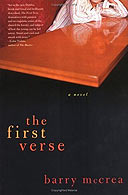
As I felt my hand falling over the bookspines I already knew that over this hung worlds. Two mutually exclusive universes were in the balance, teetering over the tiny gap in the space-time continuum which was my choice. As I went back to the beginning of the rows of books and touched each title as I ran my finger along, I knew that the passage I chose would be either ambiguous and a confirmation of what Fionnuala was saying, a triumph for Ian, for all those people, for all those adolescent dreads of emptiness to follow; or else it would be something else, the opposite, unimaginable. I wished so deeply for it to work, a choice between a past I knew stretching drearily on out into an eternal, colourless future, and the possibility of fullness and newness and things I didn't know. I could feel the inevitability of the dull and the mundane creeping in, the ridiculousness of anything except that the world was as Fionnuala said, and these two were just arrogant and unfriendly thrity-year-olds who took their party games extremely seriously and were irritated by our undergraduate enthusiasms and fears. I tried to push that out of my mind as I stopped at a thick book, but my heart was already falling. I flicked through Ulysses and the probability waves all came crashing down around each other and collapsed into a singularity...The coincidences begin to pile up and Niall wants to know what this ritual is really all about, but his new friends become mysterious and evasive. McCrea is acute in his depiction of the psychological complexities of a young man moving from adolescence to adult-hood, but he's not pat. That personal Bildungsroman is mirrored by another, this one of the city of literature - Dublin. McCrea can also write thriller-like scenes that have me tearing the pages, I'm trying to turn them so fast, but the book constantly eschews what is obvious. The First Verse is an enticing mix of the supenseful supernatural and the literary that has this reader in its thrall. Think of the addictiveness of Donna Tartt's The Secret History, only the reach of the story's themes is broader and the writing style more elegant.
- And Bees of Paradise
I had come all the way here from the sea,
Yet met the wave again between your arms
Where cliff and citadel - all verily
Dissolved within a sky of beacon forms -
Sea gardens lifted rainbow-wise through eyes
I found.
Yes, tall, inseparably our days
Pass sunward. We have walked the kindled skies
Inexorable and girded with your praise,
By the dove filled, and bees of Paradise.
Chaplinesque
We make our meek adjustments,
Contented with such random consolations
As the wind deposits
In slithered and too ample pockets.
For we can still love the world, who find
A famished kitten on the step, and know
Recesses for it from the fury of the street,
Or warm torn elbow coverts.
We will sidestep, and to the final smirk
Dally the doom of that inevitable thumb
That slowly chafes its puckered index toward us,
Facing the dull squint with what innocence
And what surprise!
And yet these fine collapses are not lies
More than the pirouettes of any pliant cane;
Our obsequies are, in a way, no enterprise.
We can evade you, and all else but the heart:
What blame to us if the heart live on.
The game enforces smirks; but we have seen
The moon in lonely alleys make
A grail of laughter of an empty ash can,
And through all sound of gaiety and quest
Have heard a kitten in the wilderness.
An unremarkable swottishness and a cheap, almost corrupt knack for exams had got me easily through secondary school at the Jesuit Gonzaga College, and covered me with the scalps and headdresses of local competitions. And then in my last year of those mediocre gifts, in combination with a modest flair for foreign languages, had brought something more exciting my way. It took the form of a new Trinity College scholarship, only two in Ireland, the Beckett Foundation Fellowship, to study French and English literature. It entitled me to "Commons" - dinner in the huge Dining Hall every evening at six - and, more importantly, to roms (which means a room) in Trinity, a fact which enabled me to move out and leave, after nineteen years, the draughty Victorian house of my parents and of my childhood, atop the sad swell of the sea at Dun Laoghaire.And if his knack for exams is cheap, could one perhaps call his knack for words rich? Our narrator tell us not soon after:
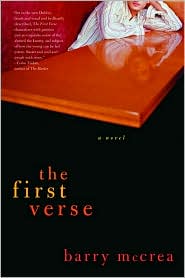
I would have been more aware of this as a rite of passage, the extreme unction of my childhood, setting off into the city to seek my fortune, but my mind had room only for Ian O'Neill.The plot already has me in its grip, but not a paragraph is left unfestooned with deft metaphor or filigreed adverb - 'extreme unction of my childhood,' 'cannibalistic fervour.' I don't have a feeling yet for whether I think the tone belongs to the writer or the character, but I find it a little cocky. That may turn out to be appropriate, or to be worth it. If the man can write, why hide his light under a bushel?
I find I am at ease with other imagined minds - bringing to life, restoring in some sense to vitality, the whole vanished men of other times, hair, teeth, fingernails, porringer, bench, wineskin, church, temple, synagogue and the incessant weaving labour of the marvellous brain inside the skull - making its patterns, its most particular sense of what it sees and learns and believes. It seem important that these other lives of mine should span many centuries and as many places as my limited imagination can touch. For all I am is a nineteenth-century gentleman plumb in the midst of smoky London - and what is peculiar to him is to know just how much stretches away from his vanishing pin-point of observation - before and around and after - whilst all the time he is what he is, with his whiskered visage and his shelves full of Plato and Feuerbach, St. Augustine and John Stuart Mill.That, by the way, is a love letter.
The precious - letters - are too much and too little - and above all and first, I should say, compromising.I wish as I read the letters for the satisfying snap of the the two lovers flying together after being held apart for months by convention, propriety and lengthy sentences. And yet, simultaneously, I hope that they never will. LaMotte is a poet in her own right whose hard won freedom is in itself a creation. She deserves to keep it. Her twin in the present is the scholar Maud Bailey who, though successful, works in a somewhat isolated realm of all women scholars making careers of studying women's literature or the wives of literate men.
What a cold sad word. It is His word - the World's word - and her word too, that prude, his Wife. But it entails freedom.
I will expatiate - on freedom and injustice.
The injustice is - that I require my freedom - from you - who respect it so fully. that was a noble saying of yours about freedom - how can I turn from...
I will put in Evidence a brief History. A History of little nameless unremembered acts. Of this our Bethany cottage - which was named for a reason. Now to you and in your marvellous Poem - Bethany is the Place where the master called his dead friend to resurrection beforetimes and particularly.
But to us Females, it was a place wherein we niether served nor were served - poor Martha was cumbered with much serving - and was sharp with her sister Mary who sat at His Feet and heard His Word and chose the one thing needful. Now I believe rather, with George Herbert, that "Who sweeps a room as for They laws - Makes that and the action fine." We formed a Project - my dear Companion and myself - to make ourselves a Bethany were the work of all kinds was carried on in the Spirit of Love and His laws. We met, you are to know, at one of Mr. Rusin's marvellous lectures on the dignity of handicraft and individual work. We were Two - who wished to live the Life of the Mind - to make good things. We saw after thought that if we put together the pittances we possessed - and could come by by giving drawing lessons - or by selling Wonder Tales or even Poems - we might make ourselves a life in which drudgery was Artful - was sacred as Mr. Ruskin believes is possible - and it was shared, for no Master...we were to renounce. Not the lives that then encompassed us - cramped Daughterly devotion to a wordly mother - nor the genteel Slavery of governessing - those were no loss - those were gleefully fled and opposition stunachly met. But we were to renounce the outside World - and the usual Female Hopes (and with them the usual Female Fears) in exchange for - dare I say Art...
"Was it important?" asked the grey voice, with no indication of whether the "importance" was scholarly, passionate or cosmic.I found this moment so, well, - exposed. Here is someone who has devoted her life to knowledge of one arcane subject who would gladly repress others' knowledge of her to protect her character. The woman is long dead. It's pathetic, really - and so perfect. I can imagine Beatrice Nest so clearly. This book is remarkable. Part romance, part literary ventriloquism act, part detective story, part social criticism of the roles to which women are relagated in the patriarchal machine, and part send up of academia - both the aspect of it that is all hallowed halls and the part that is more like cut-throat industry. The pairing of contemporary and historical figures adorned with the accoutrements of meta fiction - is now a well worn fictional form - but it is hard to not make the structure into mere conceit. This novel's structure is rock solid, but it is structure, that is, it lies beneath. Byatt is subtle with it, driving the story with character, with plot, and with great writing, not by exposing the cleverness of its underpinnings. Another book I have always felt does that successfully is Richard Powers' novel The Gold Bug Variations. Interestingly they came out at around the same time. It might be interesting to ponder what that is all about. Maybe in some future post.
"I don't know. It might change our views of - of his work, I supposed a bit."
"What do you want of me?"
"A Xerox of those two letters. If it can be done, a copy of the Journal, between those dates. Not to tell Professor Cropper. Or Professor Blackadder. Yet. We discovered this ourselves - "
Beatrice Nest seemed to think for a longish time, her face propped in her hands.
"This - what you're so excited about - it won't- it won't expose her to ridicule - or - misapprehension? I've become very concerned that she shouldn't be - exposed is the best word I suppose - exposed."
He wondered how he would ever be able to sleep when he was this worried and hopeless and then, almost to his surprise, for two or three hours, he slept.It's a quibble, I know, but you cannot be surprised that you are going to sleep, because you cannot be aware of going to sleep. That surprise could only happen retrospectively, upon waking. And while I understand that Gaiman has employed an omniscient narrator, his narrator's voice tries hard to keep us close to Bod's own experience at most times. Moments like this pulled me out of the narrative flow of time. Mostly I found myself amused by this book, but never deeply engaged by the story, or warmed by the fires of nostalgia that can be stirred when reading evokes the excitement of a great childhood reading experience. But I was appreciative of its playfully imagined "other side," as a means by which a young hero could take on one of the great mysteries.
Indeed, her unkempt appearrance would have been given less emphasis if she had been a man, but opera has a pretty glitzy veneer. The first class of every year of teaching opera singers acting, I would have at least one student show up to class in a suit or evening gown until I posted notices that sweat pants were preferred. Anyhoo, what I like about this review is how it recognizes the contradictions that were embodied in this single person (as is true of most of us) and sees these two books as a more honest portrait than either one of them alone. I really enjoyed this one excerpt Kennicott quotes from Caldwell's own memoir Challenges: A Memoir of my Life in Opera, not so much for the discussion as to the degree of Caldwell's self knowledge but because it places in context the job she took on as an artistic director in the United States:Is that why she grew so obese? It seems a ridiculous question, the sort that would never be asked of a male conductor...Caldwell's physical size very quickly became a kind of shorthand for her reputation. In her best years, during the 1960s and 70s, the artist with a charming indifference to her physical self was seen as a maverick and an eccentric. But when everything started to fall apart, the overweight impresario was seen as out of control and undisciplined.
The truth was, she was all of those, and as long as she could scrape together the money, the maverick could do her astonishing work. But when the money ran out, memories of the maverick were almost instantly effaced. Her cultural exchange with the Soviet Union was a critical triumph, but she never bothered to cover the bills. Personal pressure from no less than Secretary of State George P. Shultz was required to keep the thing from becoming a fiasco.
The closest that Caldwell comes to acknowledging her deeper flaws in Challenges: A Memoir of My Life in Opera is an observation she borrows from one of this country's most influential leaders in the arts: "McNeil Lowry, head of the Ford Foundation, once said that when he went into a room he could always spot the arts directors because they all appeared to be somewhat wounded," she writes. "They were too thin or too fat; they smoked too much, or were nervous, because their fund-raising responsibilities weighed so heavily on them."Having both run and assisted the running of several small theatre companies in the U.S., and knowing many others who have and do run them, I got a big chuckle out of that. And as I write this with the radio giving reports of hysteria over that abstraction called "the economy," and wealthy industries desperate for bailouts, my thoughts turned to a different kind of poverty we experience here by virtue of how little emphasis is placed on culture, on experiences of beauty and richness in the course of educating our children and living our daily lives as adults. How much better the world can be for those who would sacrifice everything - their possessions, their health, their physical attractiveness - just to make something that looks or sounds exceptional, and how mistrustful and disrespectful we can be of that impulse. It may not seem on the same order as the drop in the Dow but that is a kind of poverty too.
Swedish researchers presented evidence that the brain, when tricked by optical and sensory illusions, can quickly adopt any other human form, no matter how different, as its own.In today's Science Times Benedict Carey reports on soon to be published research which suggests that people will not only be convinced that they have temporarily assumed a new physical form, but that this experience can alter behavior - making people "less anxious about racial differences," when they assume another skin color, convincing people to exercise more after seeing themselves as someone more fit, or giving people extra confidence when they felt they had become more good-looking. Many psychotherapies work with techniques that help people get outside their own perspective into another's - transforming marriages in some cases, or getting criminals to view the world from the point of view of their victims. I can see the temptation to create some great science fiction with this idea, but the leap to claims of lasting behavioral benefits seems far fetched to me if we are talking about a single instance of experiencing an optical illusion. This article does not specify the amount of time subjects spent either as realistic film versions of others in one study, or as more conventional computer avatars in another.
"You can see the possibilities, putting a male in a female body, young in old, white in black and vice versa."
I have not had occasion to tell you - though I tell all I meet, with the regularity with which dear Crabb tells his tale of retrieving Wieland's bust - I once met Coleridge, I was once taken to Highgate - when I was very young and green - and had the chance of hearing the Angelic - (and mildly self-important) voice speak on and on - of the existence of angels and the longevity of yew-trees, and the suspension of Life in Winter (the banal and truly profound thick and fast upon each other here) and premonitions of the Duties of Man (not Rights) and how Napoleon's Spies had been hot on his heels in Italy on his return from Malta - and on True Dreams and Lying Dreams. And more, I think. Nothing on Christabel.I might describe this book as a layered confection of the imagination. It is more like eating sweet than savory (at least at the moment). This extended section of letters might be a bit of marzipan. Delicious but densely sweet and I find myself not wanting to gorge too much of it in one sitting. Imagination is also a subject of this novel, as the two poets correspond about their creative inspirations, frustrations, and habits.
I was so young and green, I worried inordinately that I had no chance, in all this spate of brilliant monologue, to interpose my own voice - to be heard to be able to think in that company - to be remarked. I do not know what I should have said if I could have spoken. Very likely something futile or silly - some erudite and pointless questioning of his doctrine of the Trinity, or some crude wish to be told the end of the poem Christabel.
What will you be thinking of me now? I told you - I cannot think of anything without imagining it, without giving it shape in my mind's eye and ear. So, as I said, I have the clearest mental vision of yr unseen Porch, overarched with Clematis - one of those delightful deep-blue violet ones - and little clambering roses. I have also the clearest vision of your parlour - with its two peaceful Human inhabitants employed - I will not say at netting, but perhaps at reading - aloud, some work of Shakespeare or Sir Thomas Malory - and Monsignor Dorato all lemony plumes in a filgree dome - and your little dog - now of what kind is he?What a delightful game, both for the 19th century poet who employs it as a sort of flirtation and for Byatt, the 20th century writer, imagining what he would imagine. I recognize this skill instantly as the sign of the kind of artist I respect - a well-exercised and fertile imagination is not sufficient to artistry, one needs craft too, but it is necessary, as without it one would have nothing to exercise one's craft for. If you're a creative process lunatic like me, then you are constantly looking for clues about that process in every work by an artist and any biography of them. And if said artist has written letters, diaries, or - on rare occasion - a book on their creative journey, then what a treasure I have found (see list below)! As I read the letters between these two fictional writers, I find myself wondering how much of Byatt's own process is in each of them.
Bernard MacLaverty's Cal - 150 pages that are as densely packed with passion and tension as any I've read in Dostoyevsky or Hardy. The 19-year-old title character lives in Northern Ireland. A Roman Catholic, he is hounded and physically attacked by the Protestant Orangemen. His friends have joined the IRA in response to the violence with which they are threatened. Cal finds the violence too much for him. The struggles of nations would not be important if they didn't effect the lives of individual people. This book is about the converging of conflicts political and personal - the political and religious struggles of an oppressed people, a first great passionate love, and the dilemmas of a sensitive and thoughtful teenager as he makes the moral choices that are going to shape his whole life. I felt deeply the greatness of these struggles as I read. Read my full rave here.
Tell Me Everything by Sarah Salway . I opened this book last night and didn't stop reading it until I had finished it. The nearest voice I can think to compare Sarah Salway's to is Lorrie Moore's, and coming from me that is a big compliment. In it Molly experiences a few breaches of trust as a young woman that leave her seriously wounded. She closes down and protects herself by eating. When we meet her she has become one of life's castaways, seriously overweight without a job, a home, or any sense of herself. She meets five people - Mr. Roberts who gives her a job, Mrs. Roberts, Tim - a man of mystery, Liz - a librarian who recommends French authors, and Miranda, a hairdresser. With these relationships she begins to reclaim herself. The story is full of perfectly wrought descriptions, complex observations of human pain and fantasy, and cogent storytelling. Read my full rave here.