Saturday, July 14, 2012
Compelling biography of a monster (Books - The Emperor of all Maladies by Siddhartha Mukherjee)
Wednesday, July 4, 2012
Positive Deviant Alert
Two positive deviants attracted my attention lately:
Natalie Angier profiled physicist Dr. Mildred Spiewak Dresselhaus, a New Yorker who defied the odds for women in science thanks to the encouragement of the Nobel laureate and medical physicist Dr. Rosalyn Yalow. She studied with Enrico Fermi at University of Chicago and then began her own research on carbon at MIT half a century ago.
Our favorite design magazine The World of Interiors, an English publication, featured an essay in the latest issue by the blogger and author of the book Spitalfields Life. Check this excellent blog out. It offers affectionate and energic appreciations of the history and contemporary culture of the hip and energetic Spitalfields neighborhood of London. The author's mission:
Natalie Angier profiled physicist Dr. Mildred Spiewak Dresselhaus, a New Yorker who defied the odds for women in science thanks to the encouragement of the Nobel laureate and medical physicist Dr. Rosalyn Yalow. She studied with Enrico Fermi at University of Chicago and then began her own research on carbon at MIT half a century ago.
Dr. Dresselhaus has also been a prominent advocate for women in physics and engineering, disciplines that are still short on high-ranking female faces and that were outright hostile to women when she began her career in the late 1950s. Even before entering science, she was well accustomed to hostility and hard times, having grown up impoverished in a rough part of the Bronx.
Our favorite design magazine The World of Interiors, an English publication, featured an essay in the latest issue by the blogger and author of the book Spitalfields Life. Check this excellent blog out. It offers affectionate and energic appreciations of the history and contemporary culture of the hip and energetic Spitalfields neighborhood of London. The author's mission:
Over the coming days, weeks, months and years, I am going to write every single day and tell you about life here in Spitalfields at the heart of London. How can I ever describe the exuberant richness and multiplicity of culture in this place to you? This is both my task and my delight.
Let me disclose to you the hare-brained ambition I am pursuing, which is to write at least ten thousand stories about Spitalfields life. At the rate of one a day, this will take approximately twenty-seven years and four months. Who knows what kind of life we shall be living in 2037 when I write my ten thousandth post?
Sunday, July 1, 2012
An imagined Henry James - portrait of a master by a master (Books - The Master by Colm Toibin)

Saturday, June 30, 2012
Eating to be free...

I don’t know what “foodie” means, but it seems to me to mean something unbalanced. There is a difference, and should be, between being in the know about “in” restaurants, chefs, food trends and liking and feeling able to eat well. One thing that really matters is feeling as though one, and often only oneself, is able to completely freely satisfy one’s own appetite. That is a good reason to know how to cook.
Thursday, June 28, 2012
Frisky collage maker
One of my favorite poets, Dan Chiasson, posts a beautiful appreciation of The Collective Writings of Joe Brainard, recently published by the Library of America, at Page-Turner.
Brainard is one of those figures—in his art, his writing, and, one gathers, his person—whose primary genius was to give long-sought relief from overbearing works of art, pieces of writing, and people. For their friendliness, their air of openness, their distaste for guile and pretense, Brainard’s productions have a soothing quality; the other “New York School” writers and artists seem almost reverent and self-serious next to him.Now who could possibly make Frank O'Hara seem reverent?! I am going to have to find a copy of I Remember today.
He is better known as an artist: a maker of frisky collages, a painter of exquisite male nudes, an assembler of miniatures. But he wrote beautifully, especially in his iconic connect-the-dots memoir, “I Remember.”
Thursday, June 21, 2012

Check out the story on All Things Considered.
Saturday, June 16, 2012
Sanity: a key to the good life? (Books - Going Sane by Adam Phillips) The Tyranny of Positive Thinking II

Sunday, June 10, 2012
Meeting the stranger in oneself (Books - Be Near Me by Andrew O'Hagan)
 The subject matter of a book is often what determines whether or not I read it. Who and what it is about leads us to anticipate our interest in its events or identification with its protagonist. The more we read, the more experienced we imagine we become at such predictions, but then every so often we get a surprise. I picked Andrew O'Hagan's Be Near Me off the recommended books table at a favorite bookstore a week back only to find out it is about an Oxford educated Catholic priest engaged to lead a parish in an economically depressed village in Scotland. That was not at all what I was interested in for my next read and yet this novel about encountering strangers - particularly the stranger in oneself - turned out to be the most involving, probing, and beautifully written novel I have read this year.
Saturday, June 9, 2012
Collect data, test, revise theory, repeat....
Carlo Rovelli, theoretical physicist and author (The First Scientist) is excellent on how science works at Edge.
Collect data, test, organize results in a theory, collect more data, test, revise theory, repeat.
Science is not about certainty. Science is about finding the most reliable way of thinking, at the present level of knowledge. Science is extremely reliable; it's not certain. In fact, not only it's not certain, but it's the lack of certainty that grounds it. Scientific ideas are credible not because they are sure, but because they are the ones that have survived all the possible past critiques, and they are the most credible because they were put on the table for everybody's criticism.
Collect data, test, organize results in a theory, collect more data, test, revise theory, repeat.
Tuesday, June 5, 2012
Unlive a little.
Psychoanalyst and writer Adam Phillips (On Kissing, Tickling and Being Bored, Going Sane) a sensible and erudite thinker about the human mind its products has a new book out: Missing Out: In Praise of the Unlived Life and so is profiled in the Guardian.
Hat tip: Bookslut
"I'm not on the side of frustration exactly, so much as the idea that one has to be able to bear frustration in order for satisfaction to be realistic. I'm interested in how the culture of consumer capitalism depends on the idea that we can't bear frustration, so that every time we feel a bit restless or bored or irritable, we eat, say, or we shop."He's great at where culture meets feelings. And there is a picture of his bookshelves.
Hat tip: Bookslut
Sunday, June 3, 2012
The adventure of filling the gap (Books - Remarkble Creatures by Sean B. Carroll)

Remarkable Creatures is a clearly written and passionate account of how field science gets done. Its subject may not seem as relevant to the average reader as popular works about healthcare or how our brains learn, but one could say it is of even greater significance
Tuesday, May 15, 2012
Building a forgotten identity one word at a time (Books - New Finnish Grammar by Diego Marani)

Saturday, May 12, 2012
The costs and incentives of doing science (Books - How Economics Shapes Science by Paula Stephan)

Sunday, May 6, 2012
Jazz and betrayal in occupied Berlin and Paris (Books - Half-Blood Blues by Esi Edugyan)

Edugyan moves the action between 1939 and 1992 as her cranky narrator tries to hold back the past from encroaching on the present. The voice she has him sing in, for it does evoke music,

Wednesday, May 2, 2012
A battle for connection (Books - Solace by Belinda McKeon)

An aspiration toward wholeness in a fracturing world? (Books - Howards End by E. M. Forster)

Thursday, April 26, 2012
A cruel hand laid upon American citizens (Books - The New Jim Crow by Michelle Alexander)
 According to Michelle Alexander's The New Jim Crow: Mass Incarceration in the Age of Colorblindness, the "War on Drugs," was not waged in an effort to dispense justice to dangerous criminals, but rather to control black men by putting them behind bars and relegating them to permanent second class status upon their release. Her book is damning accusation that the execution of the drug laws has effectively continued the marginalization of black men that began with slavery, proceeded to the Jim Crow laws. The difference today is that, since many presume we have reached the colorblind nirvana dreamed of by Dr. King, this is carried out through procedures masquerading as law and race is never mentioned. Alexander's book reads less like a typical account of current affairs than a passionate case argument, a form that will come as no surprise considering her career as a civil rights lawyer and legal scholar.
Sunday, April 15, 2012
Get out of the lab: scientists communicating with the world (Books - Am I Making Myself Clear, Don't be Such a Scientist, Escape from the Ivory Tower)
As I approach the home stretch of a PhD in neuroscience, I find that that the audience I most enjoy writing for about this cutting edge field is the general non-scientist reader. I read three books recently about scientists communicating with non-scientists. Am I Making Myself Clear by Cornelia Dean, Don't Be Such a Scientist by Randy Olson, and Escape from the Ivory Tower by Nancy Baron have in common a belief that most scientists do this poorly and, ironically, that they should do it more often. Too long winded, too technical, and too many qualifications are the main criticisms, and each volume offers advice on how to be more effective.
Friday, April 13, 2012
Michael Gazzaniga, Father of Neuroscience, Speaks on Brain Science and Free Will
 I covered neuroscientist Michael Gazzaniga's talk on the brain and free will at Cooper Union for Capital New York, hence the resounding silence here. Check out my piece at the link below.
“Probably 99.999 percent of what goes on in the brain is automatic and unconscious. I have no idea what my next sentence will be, and sometimes I sound like it,” Gazzaniga began in his unassuming way. “We think the other stuff, the ‘me,’ the ‘self,’—we think that’s really important. We think there is somebody in charge—somebody pulling the levers.”In promoting the book Who’s In Charge, Gazzaniga has learned that this is a subject on which everyone has an opinion.
Can we have free will, if the brain's actions are automatic? A scholar makes the case | Capital New York
Wednesday, April 4, 2012
Orwell's inherently human contradictions embraced (Books - Why Orwell Matters by Christopher Hitchens)
 I decided to read the late Christopher Hitchens's Why Orwell Matters less because I have a driving interest in political essayist and novelist George Orwell than because I had never read a book by Hitchens and many a sharp reading friend had praised his work. I was vaguely aware of Orwell being lauded and derided alternately by the left and the right. I knew he had become a hero of the neo-cons and I didn't know why. There's no reason to read at all if you're only going to stay in your ideological comfort zone, so I picked up Why Orwell Matters this weekend to see what they were all about.
 This slim volume is not a biography. It is a corrective polemic of others opinions of Orwell - either critics of him, or those who idolized Orwell by appropriating
Sunday, April 1, 2012
A drama of social injustice in the Mumbai slums (Books - Behind the Beautiful Forevers by Katherine Boo)
 Award-winning journalist Katherine Boo has spent two decades, according to her bio, writing about how societies distribute opportunity and, consequently, who is defined as poor. The last three years of that time she spent reporting on India, and in particular, an illegal squatters' slum near the Mumbai airport and luxury hotels known as Annawadi. Although Boo writes non-fiction, her prose in Behind the Beautiful Forevers transforms poverty from a socio-political abstraction into something one can taste and smell and whose consequences upon real people we experience deeply.
Friday, March 30, 2012
What use is history? (Books - In Europe by Geert Mak)
 There is no use fixating on past mistakes, some advise. Stay in the present, say the gurus. But these approaches are anathema to the human nervous system. Even basic nervous systems use sensory equipment - eyes, ears, antennae, pressure sensors - connected to a few dozen nerves to adequately serves an organism which wishes to avoid danger, find food, or reproduce. But one advantage of having a brain is that we can accumulate information about common patterns of stimuli existing in our environment, using it to anticipate what we encounter in the future. Our brain's visual system makes
Thursday, March 22, 2012
Dastardly art about the forces that spur vioence (Film: Inglourious Basterds (2009) by Quentin Tarantino)
 Quentin Tarantino's use of violence in films like Pulp Fiction is supposed to be commentary on violence in film and television, but I have found them merely exploitative. This is not because media does not glorify violence, but because Tarantino's use of self-referential gestures and cute trademarks while using slaughter patently as entertainment is too cavalier. We already live surrounded by bloodshed - take the last 48 hours: with the murder of seven victims by a militant in Southwestern France and the outrageous shooting of an unarmed 17-year-old in Florida by a man claiming he was feeling threatened - I find the irony too disrespectful of lost lives. What the hell is so funny? So my own positive assessment of his film Inglourious Basterds (2009) surprised me.
Sunday, March 18, 2012
Who says reading is in decline?
 I was struck in reading today's New York Times that the number of pieces on reading and books must have reached some sort of critical mass. Or perhaps it was only the Times's effort to assert its own relevance?
The online edition has begun a series called Draft. It concerns the art of writing and its maiden voyage was a riffy, elegiac essay by Jhumpa Lahiri on the pleasure she finds in sentences (the written not the served kind). This was flanked in the Sunday Review by two more essays. One by Dwight Garner where the message was on the medium - what sort of reading calls for e-readers, iPads, or the printed page, he asks? He cited the recent New York Review of Books essay by novelist Tim Parks (speaking of books in the news) which championed electronic reading media as
Tuesday, March 13, 2012
Heir apparent to Dasheill Hammett (Books Nineteen Seventy-Four - Book I of the Red Riding Quartet by David Peace
 The first volume of David Peace's Red Riding Quartet, Nineteen Seventy-Four, is a violent thunderclap of a novel. It details the search of a rookie crime journalist, Eddie Dunford, for the murderer of a school girl in Yorkshire during the week preceding christmas. It becomes apparent to Eddie that the murder may be one of a string of crimes and Eddie begins connecting the dots between them and powerful people in business and law enforcement. Despite the fact that he has only just buried his own father, or perhaps because of it, Eddie begins a stubborn search for the truth in a world of savagery and exploitation that is way beyond his ken.
Sunday, March 4, 2012
Navigating time across the abyss of loss (Books - Purgatory by Tomas Eloy Martinez)
 I have often wondered what it is about living in South America that leads writers to adopt the form of magical realism. Having read Purgatory by Tomas Eloy Martinez, recently translated into English by Frank Wynne and published by Bloomsbury USA, I think that I understand.
Since the 1930s, Argentina experienced more than 30 political coup d'etats. In 1975, a military junta seized power from Juan Peron. From 1976 until 1983, in government-instigated acts of terrorism, an estimated 15,000 persons were
Saturday, March 3, 2012
Richard Powers - where fact and fiction collide (Essay - What Does Fiction Know?)
One of my very favorite writers, Richard Powers, who writes at the intersection of fiction and science, has written an inspiring essay about the city of Berlin, the unreliability of storytellers, and the place where fiction and fact collide. It is inspiring for the way it mixes personal experience, data, and artifice. It appeared in last summer's Design Observer and I link it here.
Thursday, March 1, 2012
Healing a wounded nation one narrative at a time (Books - Glow by Jessica Maria Tuccelli)
 There are those who say that America is unnecessarily obsessed with race, but most who make that claim would like to change that conversation. America was founded by dominating one race in order to seize their land and by dominating a second in order to support commerce. Both native Americans and those whom Americans enslaved were subjugated out of a sense of entitlement. Whites assumed for centuries that their skin color was favored by their gods and, because they were willing to dominate through violence, that what they captured was theirs to keep. America is built on a legacy of hubris and its consequences can still be felt. For a century following slavery, society was legally bifurcated so that education, transportation, partaking of daily commerce, and marriage were separate for white people and people of color. It seems disingenuous to claim, after those laws were changed under protest a few decades ago, that people of color in America should now feel the same as whites since they supposedly have the same opportunities. Even if they had the same opportunities, history doesn't simply evaporate.
Wednesday, February 29, 2012
Beautiful little accidents of everyday experience (Books - You Do Not Need Another Self-Helf Book by Sarah Salway)
 Sarah Salway, friend and author of the novels Tell Me Everything and Getting the Picture (among others), has just published her first volume of poetry! What better way to ring in March? It boasts the smile-inducing title You Do Not Need Another Self-Help Book, and after reading it, you probably won't. The book features verse and prose poems, mostly contemporary subject matter, and a good deal of first-person voice (but not exclusively). They are sexy, reflective, funny, clever, even cheeky, but mostly these are intimate and generous poems. You can feel the poet reaching beyond her comfort to give you something of herself. I admire the way Sarah courts everyday experience, like shopping or little moments of regret, for accidents which reveal something fresh about being inside of our lives, and how she then uses her craft to create something of lasting worth and beauty from them.
I am delighted to participate in her virtual poetry reading by presenting Sarah's own reading of "Dad Plays St George."
You may purchase the book here: http://www.pindroppress.com/?page_id=440 or here.
For other stops on the virtual poetry reading tour, click here for the list of links.
Thursday, February 23, 2012
Embracing the paradox (Books - To the Lighthouse by Virginia Woolf)
 I revisited To the Lighthouse, Virginia Woolf's great meditation on how connection to people and to things we love helps us transcend life's transience. It must have been the third or possibly the fourth time I read it. I had bought a new edition last year as my old one is falling to pieces. I am less inclined to do a full-on review than to make a few appreciative observations.
People most often describe the style of Woolf's prose as stream of consciousness but I was aware in this reading that the cadence was more like speech than thought - as though as I was being read to. This legislated a speed for the progress of my reading that I could not exceed without losing the meaning - a kind of enforced luxuriousness.
Tuesday, February 21, 2012
Representations of Jews changing in film (but only for Jews and only in film?) - (Books The New Jew in Film by Nathan Abrams)
Nathan Abrams, a lecturer in film from Bangor University in Wales, has written The New Jew in Film, about to be released in paperback, about the representation of Jews and various aspects of Jewishness in film since 1990. It's a contemporary take in the era of identity politics, meaning the book is about representations of self in the medium of film. However, in this case, these selves have been historically appropriated and given the role of 'other' by society (at best) or mercilessly persecuted (at worst) for a few thousand years. Abrams traces the evolution of the depiction of Jews in film prior to the last decade. He starts with the classic anti-Semetic stereotype such as the male lascivious money grubber, intellectual nebbish, and hairy sex-addict, and female chicken soup-pushing interfering loudmouth, followed by films that tried to depict Jews as anxious but cute - Fiddler on the Roof or Woody Allen's heroes, and films that attempted to show that Jews are just like everyone like The Graduate, and then films that took on the subjects of anti-semitism in general and the Holocaust in particular.
Saturday, February 4, 2012
Walking through versions of the past (Books - Interpreters by Sue Eckstein)
 Susan Eckstein's Interpreters starts with an eye-opening paragraph.
I think I was about six when my mother tried to kill me, though I didn't know it at the time. It was probably somewhere around here - where the privet hedges give way to barriers of leylandii and high wrought-iron gates. I don't suppose it had anything to do with the hedges and gates, though they can't have helped. This place could induce a yearning for death in even the most optimistic.Conflict anyone? Aside from the efficiency with which she dispatches with the central relationship of the book (one that provides not just pathos but also tension and narrative structure), Eckstein sets up a first-person narrator, Julia, in one paragraph who we know is haunted by the past. She has an eye for detail and a strong sense of irony - both means by which people distance themselves from emotion. Most of all, she feels trapped by convention.
Thursday, February 2, 2012
Wislawa Szymborska, spirited Polish poet - Her poems make me say 'Yes, exactly.'

Wednesday, February 1, 2012
Parallel lives of determination and vigor (Books - A Saving Remnant by Martin Duberman)
 Barbara Deming and David McReynolds are social and political radicals who worked during the tumultuous decades spanning the 1950s - 2000s. Their personal transformation through radical political action is the subject of Martin Duberman's dual biography A Saving Remnant. This sometimes messily organized narrative seemed almost suited to McReynolds and Demings's unusual lives of outward determination and vigor, and their parallel personal journeys which included much internal conflict, however, I was disappointed by the writing, which I found curiously flat and carelessly repetitive. Additionally, in a story whose central characters were active in many political organizations and who published in numerous journals, Duberman gave me too little background to help distinguish the Social Democratic Front from the Students for a Democratic
Tuesday, January 24, 2012
Grown-up fantasy that is more than good versus evil (Books - The Magician King by Lev Grossman)
 Since finishing Lev Grossman's dark, magical coming of age fantasy The Magicians almost exactly two years ago, I have been anticipating its sequel - The Magician King. The sequel shares the original's strong plotting, dark tone, and layer of ironic commentary on the fantasy form's popularity and most well-used devices. In the first book Quentin, a smart, less than popular boy, is trained at a magic school called Brakebills, eventually travels to Fillory, the land of his childhood fantasy, and is crowned king. When we meet him in the sequel, he lives the luxurious life of a king, but rather than being content with ruling the land of his dreams, he is bored and restless. He decides to go on a quest to far-off parts of his realm, making some unplanned for and surprising detours along the way. While the first volume focused on power, love, and fantasy, part two was about a sense of belonging and purpose, and ultimately the putting away of the utopian fantasies of childhood.
Saturday, January 21, 2012
The alternative to positive thinking is not despair (Books - Bright-Sided by Barbara Ehrenreich) - The Tyranny of Positive Thinking I
 Barbara Ehrenreich's Bright-Sided is a feisty analysis of the American obsession with positive thinking that includes its hypothesized origins, the areas of culture that it infiltrates - big business, religion, psychology - the multi-billion dollar industry that has grown up around coaching and products to maintain that cockeyed optimism no matter what the weather tells us, a debunking of many of the beneficial outcomes claimed by proponents of positive thinking such as improved cancer prognosis or material wealth, and finally the usefulness of negative emotions, stress, and vigilance. The anecdotes as well as the facts (if you choose to listen to them) are delivered in accessible prose with a hefty dose of irony. In addition, Ehrenreich is emotionally open about the part her own experience plays with the subject she writes about as in, for example, this about her wait for test results to confirm or reject a cancer diagnosis:
Thursday, January 12, 2012
Breakfast reading, superpowers, and other important matters...

It has been a while since I participated in BTT. Here's the meme posted today.
1. What’s your favorite time of day to read?
I'll read any time but end up reading most often before I go to sleep.
2. Do you read during breakfast? (Assuming you eat breakfast.)
I usually read blogs during breakfast but if I'm at the tail-end of a really good read, I'll sometimes try to finish it over breakfast.
Wednesday, January 11, 2012
False fronts on depression-era Main Street (Books - As For Me and My House by Sinclair Ross)
 Although Canadian author Sinclair Ross had to drop out of high school to work, he demonstrates a deep understanding of the human heart and writes in spare, unequivocal prose about life on the prairie during the depression in his first novel, As For Me and My House (1941). In this story of eroded communication between the Bentleys, a preacher and his wife, Ross's first person narrative takes the point of view of Mrs. Bentley through a diary she keeps in their twelfth year of a tense and childless marriage as they assume the parish of a dusty town called Horizon.
Tuesday, January 10, 2012
Dickens Month II - In which the characters, rich and poor alike, attempt to advance themselves (Books - Our Mutual Friend by Charles Dickens)


Reginald Wilfer is a name with rather a grand sound, suggesting on first acquaintance brasses in country churches, scrolls in stained-glass windows, and generally the De Wilfers who came over with the Conqueror...But, the Reginald Wilfer family were of such commonplace extraction and pursuits that their forefathers had for generations modestly subsisted on the Docks, the Excise Office, and the Custom House, and the existing R. Wilfer was a poor clerk. So poor a clerk, though having a limited salary and an unlimited family, that he had never yet attained the modest object of his ambition: which was to wear a complete new suit of clothes, hat and boots included, at one time. His black hat was brown before he could afford a coat, his pantaloons were white at the seams and knees before he could buy a pair of boots, his boots had worn out before he could treat himself to new pantaloons, and, by the time he worked round to the hat again, that shining modern article roofed-in an ancient ruin of various periods.
Sunday, January 8, 2012
Bookish things...
 2012 has begun as a less than typical reading year in that I am participating in multiple challenges which involve long books. The result has been that I have finished just one book. So I thought I would do more of a Salon-like post, so I can touch on the many books I have in-progress.
Above and to the left is the main culprit, Our Mutual Friend. In order to keep pace so that I might post the last of five weekly posts on Dickens's birthday, February 7, I must read 200 pages per week. That's not a hardship as the book is delightful, but it is just enough to keep me from finishing anything else on the longer side. For that reason, I found I had abandoned Geert Mak's travelogue/history of post-war Europe In Europe, despite finding it fascinating and beautifully written in favor of...
Tuesday, January 3, 2012
Charles Dickens Month I - In which we are introduced to key players (Books - Our Mutual Friend by Charles Dickens)
This is the first of my five January posts on Dickens's Our Mutual Friend, which I began reading just yesterday in this month preceding his 200th birthday. I have barely scratched the surface at about 50
Monday, January 2, 2012
Charles Dickens Month, in which I finally tackle The Pickwick Papers, um, correction Our Mutual Friend

Thomas led me to Amanda's Charles Dickens Month, which excited me because I realized I could indulge in triple action by reading either a copy of The Pickwick Papers or Our Mutual Friend (but not both) that have been festering on my TBR pile: participating in Charles Dickens Month, the Tea & Books Reading Challenge as they are both biggies, and stay true to the TBR Double Dare all at the same time! Rock on.
Update: Let's make that, Our Mutual Friend.
Art as access to the authentic experience (Books - Leaving the Atocha Station by Ben Lerner)
 I have finished my first read of 2012 Leaving the Atocha Station by Ben Lerner, a suggestion of Brad Listi's and a gift from my in-laws. This smart, funny, occasionally infuriating novel is about a young American poet's experience of alienation and the art he makes out of his experience while on a fellowship in Spain.
I had long worried that I was incapable of having a profound experience of art and I had trouble believing that anyone had, at least anyone I knew. I was intensely suspicious of people who claimed a poem or painting or piece of music "changed their life," especially since I had often known these people before and after their experience and could register no change. Although I claimed to be a poet, although my supposed talent as a writer had earned me my fellowship in Spain, I tended to find lines of poetry beautiful only when I encountered them quoted in prose, in the essays my professors had assigned in college, where the line breaks were replaced with slashes, so that what was communicated was less particular poem than the echo of poetic possibility. Insofar as I was interested in the arts, I was interested in the disconnect between my experience of actual artworks and the claims made on their behalf; the closest I'd come to having a profound experience of the absence of profundity.
Sunday, January 1, 2012
2011 - the year that was... (A meme)
Happy 2012. I got this meme from Katherine, who, she tells us, is always walking into things, well into bookstores anyway.
1. What did you do in 2011 that you’d never done before?
Published an article in a science journal.Saturday, December 31, 2011
My best fiction reads of 2011


Of the 40-odd works of fiction I read in 2011 I'm going to name some favorites. I'm still working on Ben Lerner's Leaving the Atocha Station, we'll see if I have time to finish it and write about it. This year, I won't break this group into further sub-genres as the representation of YA fantasy, classic literature, or short works are not significant enough. The original reviews are linked to each title, with an excerpt below. My favorite novels this past year were:
Friday, December 30, 2011
BIG books in 2012 - (The Tea & Books Reading Challenge)

For Birgit (and her hero C.S. Lewis) size matters, which is why she has posed the Tea & Books Reading Challenge, which demands that we tackle 2 or more books that are 700 pages in length or
Thursday, December 29, 2011
My best non-fiction reads of 2011

Now it is time for my annual best reads lists of 2011. I will choose from just two categories this year - fiction and non-fiction, beginning here with non-fiction. I read 25 works of non-fiction including the genres of memoir, science, and history/politics. I won't count re-reads, such as two works of Joan Didion's I revisited, as they were re-read because they are favorites. The original reviews are linked to each title, although I excerpt them below. The most memorable given these criteria were:
Wednesday, December 28, 2011
Living in the World but in Exile from Almost Everyplace (Books - Open City by Teju Cole)
 Teju Cole's Open City received strong responses from crack critics and fellow bloggers and made a number of Top 10 fiction lists for the year, persuading me to check it out. In it Julius, a Nigerian immigrant to America who is completing his final year of psychiatry residency at Columbia, walks the streets of New York City. Although the book is short, it does not invite quick reading. The emphasis is not on any sort of plot, but the novel seethes with ideas and scenes of humanity, otherworldly fantasy, and terrific tension.
The form of Open City is a flaneur's diary, only in the case of Julius, his strolls are not idle. He seems to be running from something. Coles's evocation of the
Tuesday, December 27, 2011
Taking on the Double-Dare

Hope you have had a happy holiday - whatever you like celebrating - christmas, chanukah, kwanza, the winter solstice. Now enough singing songs, snacking, toasts, and boardgames, let's get down to the business of reading. C.B. has double-dared us to read only from the TBR pile from December 31, 2011 until April 1,
Friday, December 23, 2011
2011 - A little end of the year accounting...
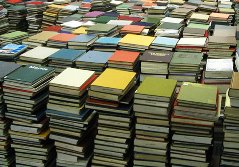 In preparation for my soon-to-come best-of lists, I always like to do a little end of the year accounting. I know some people find this ludicrous but I love looking back on the year and categorizing what I have read. I have been aiming for an average of one book per week, which has been a stretch in the past three years with my class reading requirements, however this fall I no longer had classes. The result was that I was able to finish a few more books. Even though I plan to read several more books this year, lets see how the numbers look so far.
Thursday, December 22, 2011
A monument to hope in the midst of the apocalypse (Books - The Road by Cormac McCarthy)
 It took me two years to work up to reading Cormac McCarthy's The Road after a friend recommended it. I just wasn't craving post-apocalyptic winter. The anticipatory cloud lifted one day and I no longer felt that I would not be able to appreciate the writing or story for the setting. This little personal anecdote befits the book, having now read it, as it is about our worst fears realized. The father and son who are the book's main characters live isolated in a cold, damp scab of a world where there is little sustenance, the other beings are few and impossible to predict, but usually violent, and where the only rule is to survive. But, my gosh, the writing is enveloping to the point of blotting almost all else out, the love between the two characters is deeply moving, and the impression this novel left is indelible.
Tuesday, December 20, 2011
Revolutionary Improvisation in the Theatre of East Central Europe and Vaclav Havel Remembered (Books - The Magic Lantern by Timothy Garton Ash)
 Amidst daily skirmishes between 'the people' and the armed forces in Egypt, a stunning year of uprising by the people throughout the Middle East including an overthrowing of Gaddafi regime in Libya, and weeks of somewhat more amorphous protests in cities in the U.S., a beacon of such revolutions has died - Czech playwright Vaclav Havel, one of the leaders of the mostly peaceful revolution of 1989 that broke the hold of the Soviet Union on Central Europe. He was a shy man, and so an unlikely revolutionary hero. But, as Timothy Garton Ash's The Magic Lantern, a collection of essays written during the 1989 uprisings in Poland, Hungary, Germany, and Czechoslovakia, makes clear, these were civil uprisings lead by intellectuals and so he became one of the key men of these world changing events.
Thursday, December 15, 2011
Ugly Betty meets Serpico in a parody of a mockery of justice (Books - From the Memoirs of a Non-Enemy Combatant by Alex Gilvarry)
 On the last day of American military presence in Iraq, it's appropriate that I should have just finished From the Memoirs of a non-Enemy Combatant an incisive satire, part-political part-social, and the first novel of Alex Gilvarry. Viking sent me a copy in advance of its January release, thanks Viking.
 The first level of this novel I was struck by was the narrative voice Gilvarry lends his lead character Boy Hernandez - it is queeny, misquoting Dostoyevsky one minute and Coco Chanel the next. One could say it is over dramatic, were it not for the overly dramatic circumstances Boy finds himself in. This is a voice ready-made for a one man show in a downtown club.
Monday, December 12, 2011
Seeking freedom on multiple levels (Books - The Free World by David Bezmozgis)
 The Free World, David Bezmozgis's novel about the immigration of a Jewish family from Soviet-governed Latvia to the West in the 1970s, has made a few of this year's top ten lists. Although I found much in it to interest me, it isn't quite making mine. The Krasnansky family consists of Alec, his brother Karl, their parents, wives, and Karl's children. They come to Rome - which serves as the purgatory between their old lives (Soviet, Jewish, a world where they have possessed some power, some property, and some sense of themselves) and their new (Italian, Catholic, a world of poverty and uncertainty). Here they wait to find out which country will grant them a visa - their hope of salvation. This novel is about the aspiration to be free in both a political sense and a personal one. Even as Alec and the other characters aspire to escape Soviet economic oppression and anti-Semitism, they find they cannot be free of themselves. The abstract realm of this paradox is created smartly and on multiple levels however the tension that sustains a drama, the kind one can feel, remained a distant idea.
Thursday, December 8, 2011
A history of volatile Central Europe where the political is the personal (Books - The Ghosts of Europe by Anna Porter)
 Anna Porter's The Ghosts of Europe relates the history of a rapidly changing region - Central Europe - that is Poland, the Czech Republic, Slovakia, and Hungary. She focuses on the twenty years since the 1989 revolution which concluded in the fall of the Soviet empire, but necessarily informs this discussion with a good deal of context, including how these countries and their people were impacted by World War II, as this was so much the making of the region, and sometimes reaching back further to include the influences of the Ottoman or Hapsburg Empires. Though informative, her approach makes no pretense at a broad or objective text bookish approach. Her question is focused and it motivation is personal.
In 2006, I set out to discover whether democracy had taken root behind the Iron Curtain. I chose Central Europe because this part of the world had been the dividing space between East and West, or, as Stalin and Churchill deemed, between spheres of conflicting influence. My second reason is that I am a Central European.
Subscribe to:
Posts (Atom)